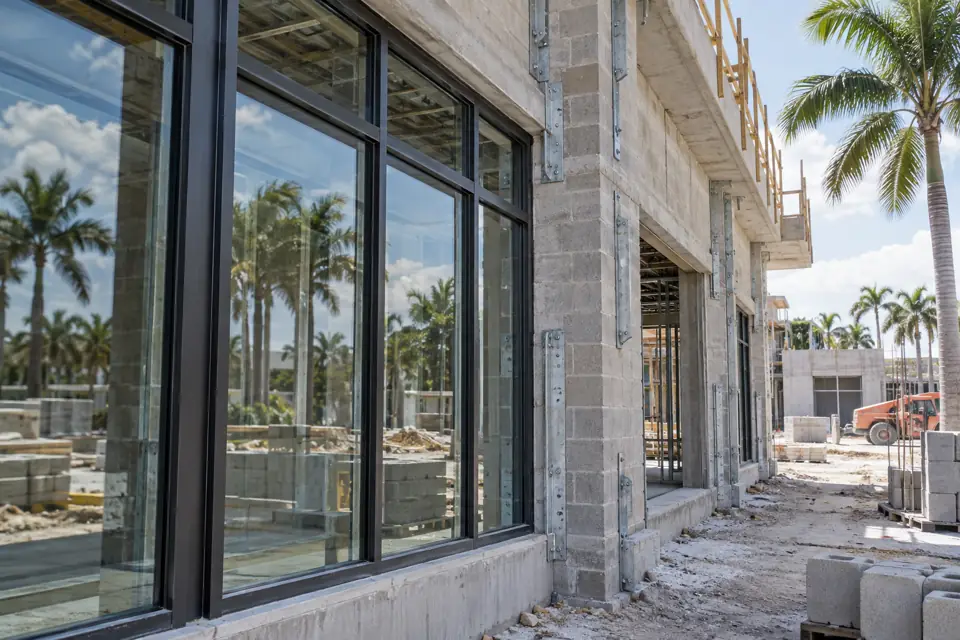
If your commercial project is in Miami-Dade or Broward County, it sits in the high-velocity hurricane zone, the part of Florida where the Florida Building Code applies its strictest wind rules. Those rules affect almost every part of the building envelope, from the roof deck to the storefront glass, and they shape both your budget and your schedule.
What the High-Velocity Hurricane Zone Is
The Florida Building Code defines the High-Velocity Hurricane Zone, usually shortened to HVHZ, as Miami-Dade and Broward counties. Inside the zone, the code adds dedicated provisions for structural design, roofing, masonry, windows, doors and other exterior components. The current edition is the Florida Building Code, 8th Edition (2023), published by the Florida Building Commission.
Product Approval Comes First
In most of the state, building products can be approved through the statewide Florida Product Approval system. In the HVHZ, exterior products generally need approval that is specifically rated for the zone. In practice, that often means a Miami-Dade County Notice of Acceptance, known as an NOA, issued by the county’s Product Control section.
An NOA lists the exact product, its tested design pressures and how it must be installed. Your architect specifies products with the right approvals, your builder buys them, and the inspector checks that what is installed matches the approval document. Swapping a product late in the job usually means a new approval check, and sometimes a redesign.
Impact and Pressure Testing
Windows, doors, storefronts and shutters in the HVHZ are tested to Miami-Dade Testing Application Standards. The best known are TAS 201 for large missile impact, TAS 202 for uniform static air pressure and TAS 203 for cyclic wind pressure loading. Products that pass these tests can be installed as protection on their own; others need separate shutters.
For commercial owners, the practical effect is that impact-rated storefront systems and openings cost more and can take longer to arrive than standard products. Ask your builder about lead times early, especially for large curtain wall or storefront packages.
Roofing in the HVHZ
Roofing is one of the most heavily regulated parts of a building in the zone. The code sets specific requirements for roof systems, underlayment and attachment, and roofing products need approval for HVHZ use. Re-roofing an existing commercial building triggers these rules too, so a roof replacement on an older building can involve more work than owners expect.
Structure, Masonry and Attachments
Structural design in the zone uses higher wind loads, and the code adds requirements for masonry, concrete and how components are tied together. That is why you see so many concrete block walls with reinforced cells and tie beams on South Florida commercial buildings. Rooftop equipment, signs and canopies also need engineered attachment.
What It Means for Your Budget and Schedule
- Budget: the envelope typically carries more cost than the same building elsewhere in Florida, mainly in openings, roofing and structural connections.
- Schedule: approved products can have longer lead times, and plan review checks product approvals closely. Build both into the schedule from the start.
- Builder selection: choose a commercial builder who works in Miami-Dade or Broward regularly. They will know which products have current approvals, which suppliers can deliver, and what local inspectors expect.
Plan With a Builder Who Knows the Zone
The HVHZ rules are demanding but well understood by local builders. The biggest problems come from late product substitutions and from owners who budget using numbers from outside the zone. Involve your builder during design, confirm approvals before ordering, and keep a contingency for envelope surprises on renovation work.
Planning a project in South Florida? Get matched with licensed commercial builders who work in Miami-Dade and Broward every week. Our commercial building permits guide explains what to expect during plan review.