A certificate of occupancy is the local building department’s written permission to use a building: it is issued once the final inspections on your permit pass, and no new building or change of use may open without one.
Key takeaways
- You need a certificate of occupancy (CO) before using a new building or addition, before a tenant first occupies a new shell, and before any change of use, under IBC 2024 Section 111.1, the model code most US states adopt. Philadelphia does not require a new CO when only the owner or tenant changes and the use stays the same (Philadelphia L&I).
- To get one, the permit holder passes every final inspection, clears fire and zoning sign-offs and requests the certificate. In Philadelphia a CO tied to a building permit is issued at completion with no separate application or extra charge.
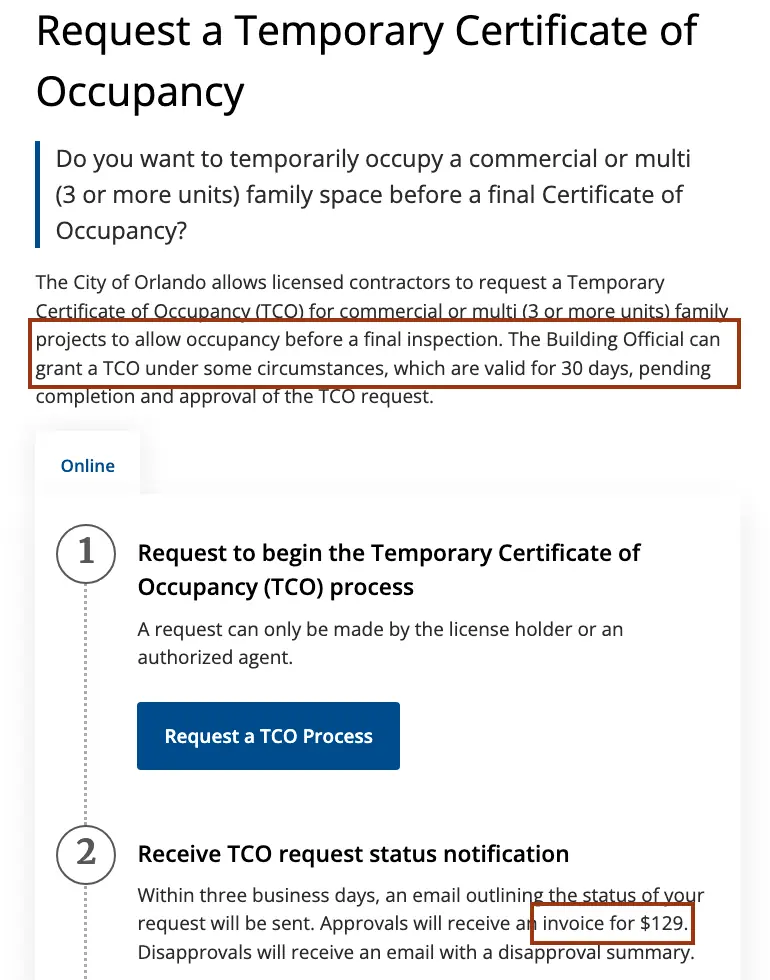
- Where a separate fee applies, published amounts are modest: Philadelphia charges $253 per building or space for a standalone CO plus $7.50 in surcharges, Orlando charges $129 for a temporary CO and Jacksonville $150 for a commercial one (city pages, October 2026).
- Timing follows the last passed inspection: the City of Miami prints online certificates within 3 to 5 days once the permit is final, and Philadelphia processes standalone CO applications within 20 business days.
- Occupying without one can bring citations, revocation and utility shutoff: Orlando warns expired temporary certificates may draw daily Code Enforcement citations, and Miami-Dade’s form authorizes a power disconnection order to FPL.
- A temporary certificate of occupancy (TCO) lets you open with minor items unfinished if the space is safe; the local official sets the term, 30 days in Orlando and 30, 60 or 90 days in Jacksonville.
| Published record | Fee | Time | Source |
|---|---|---|---|
| Philadelphia: CO issued with a building permit | No extra charge | At completion of the permit | Philadelphia L&I |
| Philadelphia: standalone CO (no building permit) | $253 per building or space ($100 of it paid up front as a filing fee), plus $3 city and $4.50 state surcharge | Processed within 20 business days, then inspection | Philadelphia L&I |
| City of Miami: CO or certificate of completion | Not stated on the page | 3 to 5 days online once the permit is final; same day in person | City of Miami |
| Orlando: temporary CO, commercial | $129 | Status email within 3 business days; valid 30 days | City of Orlando |
| Jacksonville: temporary CO | $150 commercial, $100 residential | Inspection the next business day if approved; valid 30, 60 or 90 days | City of Jacksonville |
| Florida private provider jobs: CO request | Set locally | Answer within 10 business days or it is deemed issued | Fla. Stat. 553.791(16) |
What is a certificate of occupancy, and how do you get one?
A certificate of occupancy (CO) is the document a local building official issues after inspecting a finished building or tenant space and finding it meets the building code. It states what the space may be used for, how it was built and how many people it was designed to hold. You get one by passing every final inspection on the permit and then requesting it, usually through the contractor who holds the permit.
- Get zoning approval for the use first if it changes. Philadelphia, for example, requires a zoning permit for a change of use before it will take a CO application.
- Pull the building permit. The architect’s code summary sets the occupancy group (the code’s use category, such as B for offices or A-2 for restaurants) and the occupant load the CO will print.
- Build and pass the inspections during construction, then the final inspections for building, electrical, plumbing, mechanical and gas work. IBC 2024 Section 110.3.12 makes the final inspection after all permitted work is complete.
- Clear the local sign-offs: fire marshal, zoning and, in some places, public works or environmental review. Miami-Dade and Jacksonville list theirs on their forms.
- Request the certificate and pay any fee. In Philadelphia a CO that comes with a building permit costs nothing extra; a standalone CO is $253 per space.
- Read the certificate before you open: check the occupancy group, the occupant load and any stipulations against how you plan to use the space.
| Line on the certificate | Why it matters to an owner or tenant | Code |
|---|---|---|
| Use and occupancy group | The use you may legally open; a different use needs a new permit and CO | IBC 2024 111.2 item 8 |
| Design occupant load | The most people the space was designed for; a 40-person office CO does not cover a 120-seat restaurant | IBC 2024 111.2 item 10 |
| Type of construction | Limits on height, area and future uses; lenders and insurers ask for it | IBC 2024 111.2 item 9 |
| Whether a sprinkler system is required | Tells you if the building relies on sprinklers for its approval | IBC 2024 111.2 item 11 |
| Portion of the structure covered | A CO can cover one suite or floor; check that yours is named | IBC 2024 111.2 item 4 |
| Special stipulations | Conditions you must keep meeting, such as restricted areas | IBC 2024 111.2 item 12 |
IBC 2024 Section 111.2 lists 12 items in all; the Florida Building Code, 8th Edition (2023) adds a 13th, a flood hazard statement. A CO is not a blanket approval: under Section 111.4 the building official may suspend or revoke it in writing if it was issued in error, on incorrect information, or the building is later found in violation.
When is a certificate of occupancy required for a commercial building?
A certificate of occupancy is required before anyone uses a new building or addition, and before a building or tenant space changes occupancy. IBC 2024 Section 111.1 covers use in whole or in part, so the first tenant in a new shell needs one too. The only code exception is work exempt from permits under Section 105.2, which needs no certificate.
Change of occupancy has a defined meaning. The IBC 2024 Chapter 2 definition counts either a change in occupancy classification or a change in the purpose or level of activity in a building, where the code requires a greater degree of safety, accessibility, structural strength, fire protection, means of egress, ventilation or sanitation than exists now.
The code sorts every building into an occupancy group by what happens inside it. IBC Section 302.1 has 10 categories; the ones commercial owners meet most are Business (B, offices), Mercantile (M, retail), Assembly (A, restaurants and venues), Storage (S) and Factory (F).
The line between groups is often a headcount. Restaurants, bars and banquet halls are Group A-2 under Section 303.3, but Section 303.1.1 classifies an assembly building or tenant space with an occupant load of less than 50 persons as Group B. Turning a Group M retail bay into a 60-seat restaurant changes occupancy; a small takeout counter may not. The architect’s code summary calculates the occupant load, so ask for it before you sign.
| Situation | CO needed? | Rule | Source |
|---|---|---|---|
| New building or addition | Yes, before any use | IBC and FBC 111.1 | ICC, IBC 2024 |
| First tenant fit-out in a new shell building | Yes; the shell’s certificate of completion does not allow occupancy | FBC 111.5 | ICC, FBC 8th Ed. |
| Retail (Group M) to restaurant with 50 or more occupants (Group A-2) | Yes, change of occupancy | IBC 303.1.1, 303.3, 111.1 | ICC, IBC 2024 Ch. 3 |
| School to restaurant | Yes (the county’s own example) | Miami-Dade CO page | Miami-Dade County |
| Interior remodel, same occupancy | Varies: Miami-Dade issues a CO for remodeling; the City of Miami issues a certificate of completion | Local practice | City of Miami |
| Work exempt from permits | No | IBC and FBC 111.1 exception (105.2) | ICC, IBC 2024 |
| New owner or tenant, same use | Usually not: Philadelphia says no CO is required when only the owner or tenant changes and the use stays the same; Miami-Dade still requires a new certificate of use for a new business | Local ordinance | Philadelphia L&I; Miami-Dade County |
In Florida, a change of occupancy in an existing building is handled under the Florida Building Code, Existing Building, per FBC Section 101.4.7. Jacksonville calls this a Converting Use permit and, according to its FAQ, requires at minimum a life safety plan and code summary from a Florida-licensed design professional; the review can add sprinklers, a fire alarm, exits or restrooms.
Restaurant conversions are the classic Group A-2 case, and our guide to restaurant build-out contractors covers that work. Office and retail fit-outs are covered by our page on tenant improvement contractors.
How long does a certificate of occupancy take, and what does it cost?
The certificate itself is quick once the last final inspection passes; the wait is the inspections and sign-offs before it. The City of Miami prints online certificates within 3 to 5 days of the permit going final, Philadelphia processes standalone CO applications within 20 business days, and Florida private provider jobs get an answer within 10 business days under Fla. Stat. 553.791(16).
The fee is usually small next to the job. In Philadelphia, a CO that comes with a building permit carries no separate charge. A standalone CO for one space costs $260.50: the $253 permit fee (the $100 filing fee paid at application counts toward it) plus a $3 city and $4.50 state surcharge, per Philadelphia L&I as of October 2026. Temporary certificates run $129 in Orlando and $150 for commercial work in Jacksonville. Your department’s fee schedule is the only binding number, so look it up before budgeting.
Worked example: the Florida private provider clock
Florida is the one state in this guide with a statutory deadline. On jobs inspected by a private provider (a licensed engineer or architect the owner hires instead of city inspectors), the building official has 10 business days to issue the CO or flag missing documents, and silence means it is deemed issued.
| Date (worked example) | Step | Rule |
|---|---|---|
| Mon, Mar 1, 2027 | Request filed with certificate of compliance and fees (plus all other required approvals) | 553.791(16)(a) |
| Mon, Mar 15, 2027 | 10th business day: issue the CO or flag missing documents (request day not counted) | 553.791(16)(a) |
| Tue, Mar 16, 2027 | No notice: CO deemed issued (same date used for the TCO examples) | 553.791(16)(b) |
| Fri, Mar 26, 2027 | Written certificate due, 10 days after the automatic grant | 553.791(16)(b) |
| Thu, Apr 15, 2027 | Orlando TCO issued Mar 16 ends after 30 days | City of Orlando |
| Sat, May 15, 2027 | Jacksonville 60-day TCO option ends | City of Jacksonville |
| Mon, Jun 14, 2027 | 90-day TCO ends (Jacksonville option; Miami-Dade web page) | Jacksonville; Miami-Dade |
| Thu, Mar 16, 2028 | Radio enhancement system installed, 12 months after the TCO | 553.79(22) |
The arithmetic assumes the department is open every weekday in the window; the statute does not list holidays, so confirm closure days. Subsection 553.791(17) also lets the official deny the request if the work does not comply with the codes. Where the CO falls in the larger build schedule is covered in our commercial construction process guide.
What happens if you occupy without a certificate of occupancy?
Occupying without a CO violates Section 111.1 of the building code, and departments enforce it with citations, revocation and utility shutoffs. Orlando warns that expired TCOs may draw daily Code Enforcement citations. Miami-Dade’s TCO form says an expired certificate counts as revoked and can bring a notice of violation, a civil violation or utility disconnection, and the owner signs an affidavit authorizing a power cutoff order to FPL.
- Utilities: Billings, Montana requires the CO before water billing can be transferred to the occupant. In Florida, FBC Section 112.1 bars connecting utilities until the building official releases them, and Miami-Dade faxes the FPL power release only after the TCC or TCO is issued.
- Tickets: starting a business in unincorporated Miami-Dade without a certificate of use may bring a fine and a ticket to both the business owner and the property owner, per the county’s CO and CU page.
- Contractor license: the qualifier’s affidavit on Miami-Dade’s form states that sanctions against the license may be imposed for failure to obtain all finals and the permanent CO.
- Revocation: Section 111.4 lets the building official suspend or revoke a certificate in writing when the building is found in violation.
- Sales and leases: the building code regulates use, not sale, so Section 111 does not itself bar selling a building without a CO. Check whether your purchase contract, lease or loan ties closing, rent start, the final tenant improvement draw or loan conversion to the CO date.
This is general information on 2 model and state codes and 5 local procedures, not legal advice; your attorney and architect confirm what applies to a specific property. The permit steps that come first are in our guide to commercial building permits in Florida.
What is a temporary certificate of occupancy, and how is it different from a CO?
A temporary certificate of occupancy (TCO) lets an owner or tenant use part or all of a building before every item on the permit is finished. IBC 2024 and FBC Section 111.3 allow it only where the portion shall be occupied safely, and leave its length to the building official. A TCO carries an end date; Section 111 sets no term for the permanent CO, though Section 111.4 lets it be suspended or revoked.
| Certificate | What it allows | Where the term is used | Source |
|---|---|---|---|
| Certificate of occupancy (CO) | Use and occupancy for the classified use and occupant load | IBC and FBC 111.2 | ICC |
| Temporary CO (TCO) | Time-limited use with open items; not issued in Jacksonville with an unresolved life safety issue | IBC and FBC 111.3; Orlando; Jacksonville | City of Jacksonville |
| Partial CO (PCO) | A defined area, 100% inspected, opens for its intended use | Jacksonville; Tampa | City of Jacksonville |
| Permission to Stock and Train (PST) | Contractor and owner or tenant staff only; not open for business | Jacksonville | City of Jacksonville |
| Temporary Use Authorization (TUA) | Listed as a request type; terms not printed on the form | Tampa | City of Tampa |
| Certificate of completion (CC) | Proof a structure or system is complete; no occupancy of a shell | FBC 111.5; Miami-Dade; City of Miami | ICC, FBC |
| Certificate of use (CU) | Confirms the business is allowed in its zoning district; needs the CO first | Miami-Dade; Jacksonville | Miami-Dade County |
| AIA G704 certificate of substantial completion | Contract milestone: starts warranties and lets the owner occupy under the contract | Owner and builder contracts | AIA Contract Documents |
Miami-Dade publishes two answers on TCO length. Its certificate of occupancy page says a TCO or TCC is only valid for 90 days, while its TCO/TCC application (revision 9/20) says a TCO under a Florida Building Code permit stays valid as long as the permit is active, and the 90-day term applies to older South Florida Building Code permits. Ask the Permit Section at 786-315-2100 which term will be printed on yours.
Which final inspections and sign-offs come before a certificate of occupancy in Florida?
Every permit tied to the job must pass its final inspection before a CO is issued. Florida Building Code Section 110.3 requires finals for building, electrical, plumbing, mechanical and gas work, and local departments add fire, zoning and environmental sign-offs called completion holds. Miami-Dade’s application lists Public Works, DERM (its Division of Environmental Resources Management) and Zoning holds; Jacksonville’s lists Landscape, Right-of-Way and Fire Marshal sign-offs.
- Trade final inspections: electrical, plumbing, mechanical and gas finals (FBC 110.3).
- Building final inspection: building complete and ready for occupancy (FBC 110.3, Building item 6).
- Fire sign-off: fire marshal final or fire completion hold released.
- Local holds released: zoning, public works, DERM, landscape and right-of-way, varying by city.
- Threshold buildings only: the special inspector files a sealed statement (Fla. Stat. 553.79(9)).
- Pay the fee and request the certificate, online or at the counter; fees are set locally.
- Certificate of occupancy issued, listing the permit, occupancy group, construction type and occupant load (FBC 111.2).
If items are still open but the space can be occupied safely with no open life-safety items, the branch in the diagram applies: request a temporary CO under FBC 111.3 (Orlando 30 days; Jacksonville 30, 60 or 90), then finish the open items, pass all finals and get the permanent CO before the TCO expires.
A threshold building, under Fla. Stat. 553.71, is one greater than 3 stories or 50 feet tall, or an assembly occupancy over 5,000 square feet with more than 500 occupants. The City of Miami also asks the threshold engineer to submit a binder with all final laboratory test results before it issues the certificate.
What is different about a certificate of occupancy in Florida?
Florida uses its own code, the Florida Building Code, 8th Edition (2023), adapted from the IBC. The occupancy ban in Section 111.1 and the temporary occupancy rule in Section 111.3 read almost word for word alike. Florida differs in four places: a 13-item certificate, a certificate of completion section, its own inspection list in Section 110.3, and state statutes that set CO deadlines.
| Topic | IBC 2024 | Florida Building Code 8th Ed. (2023) and statutes | Source |
|---|---|---|---|
| Certificate contents (111.2) | 12 items | 13 items, adds a flood hazard lowest floor statement | ICC code text |
| Temporary occupancy (111.3) | Allowed where portions can be occupied safely; official sets the period | Same text | ICC code text |
| Certificate of completion | No section | 111.5: proof work is complete; does not authorize occupancy of a shell building | ICC code text |
| Final inspection | 110.3.12: after all work required by the permit is completed | 110.3, Building item 6: after the building is completed and ready for occupancy (110.3.11 reserved) | ICC code text |
| CO decision deadline | None in the model code | 553.791(16): 10 business days on private provider jobs, then deemed issued | Florida Legislature |
| TCO and radio systems | None | 553.79(22): TCO not withheld solely for a two-way radio enhancement system; install within 12 months | Florida Legislature |
How do Miami-Dade, Tampa, Orlando and Jacksonville handle certificates of occupancy?
All four apply Florida Building Code Section 111, but each runs its own forms, fees and terms. Orlando and Jacksonville publish TCO lengths and fees, Miami-Dade publishes a 90-day TCO term and a completion-hold checklist, and Tampa’s private provider form lists 5 certificate types. The table compiles each department’s own page or form as of October 2026.
| Jurisdiction | Certificates offered | TCO term | TCO fee | Rule worth knowing | Source |
|---|---|---|---|---|---|
| Miami-Dade County (unincorporated) | CO, CC, TCO, TCC; CU before any business opens | 90 days (web page); FBC permits valid while the permit is active (form rev. 9/20) | Not on the page | Commercial TCO needs the Fire completion hold released; power release goes to FPL at 8:30 a.m. and 2:30 p.m. | Miami-Dade RER |
| City of Miami | CO for new construction or change of use; CC for remodels, renovations and shells | TCO and TCC offered | Not on the page | Online certificates print in 3 to 5 days in iBuild; same day in person at 444 SW 2nd Ave | City of Miami |
| City of Tampa | CO, TCO, CC, TUA, PCO | Not on the form | Not on the form | Private provider qualifier signs a notarized attestation of no known life safety issues; TCOs are filed in Accela | City of Tampa |
| City of Orlando | CO; TCO for commercial or 3+ unit multifamily | 30 days | $129 | Status email within 3 business days; expired TCOs may draw daily Code Enforcement citations | City of Orlando |
| City of Jacksonville | PST, PCO, TCO, CO; certificate of use from Zoning | 30, 60 or 90 days | $150 commercial, $100 residential | No TCO with an unresolved life safety issue; inspection the next business day after approval | City of Jacksonville |
Builders and permit offices by market: Miami commercial builders, Tampa commercial builders, Orlando commercial builders and Jacksonville commercial builders.
Do you need a CO, a TCO or neither?
Work through four questions in order, the same in any IBC state: is the work permit-exempt, does it create a new building or change occupancy, have all finals and holds passed, and are the open items minor with no life-safety issue. The table gives the threshold for each answer, and the flowchart below shows the same logic. Under Section 111.1, permit-exempt work is the only case that needs no certificate.
| If | Then | Rule |
|---|---|---|
| The work is exempt from a permit under Section 105.2 | No CO required; some departments issue one on request | IBC and FBC 111.1 exception |
| New building, addition or first occupancy of a shell | Get a CO before anyone moves in or opens | 111.1; FBC 111.5 |
| An assembly use reaches 50 or more occupants in a space classified B or M | Change of occupancy: new permit, code summary and CO | IBC 303.1.1; 111.1 |
| Only the owner or tenant changes; same use | Usually no new CO (Philadelphia rule); check for a local certificate of use, as in Miami-Dade | Local ordinance |
| Alteration in the same occupancy | Ask the department: Miami-Dade issues a CO, the City of Miami a CC | Local practice |
| All finals and holds approved | Apply for the CO and check the occupancy group and occupant load printed on it | FBC 111.2 |
| Minor items open, no life-safety issue | TCO (Orlando 30 days, $129; Jacksonville 30 to 90 days, $150) or PCO for a finished area | 111.3; city forms |
| A life-safety item is open | No TCO in Jacksonville; a PST allows stocking and training only | Jacksonville form |
| Threshold building (over 3 stories or 50 feet) | Special inspector’s sealed statement before the CO | 553.79(9)(a) |
| Private provider job, no response after 10 business days | CO deemed issued the next business day | 553.791(16)(b) |
Ground-up owners can check the schedule in our guide to new commercial construction and closeout papers on the commercial construction project checklist.
How we compiled this
We read 20 primary documents in October 2026 and re-checked the key fees and deadlines on October 26: IBC 2024 Chapters 1 to 3 and FBC 8th Edition Chapter 1 on ICC’s code site, Florida Statutes 553.71, 553.79 and 553.791, 12 official pages and forms from Philadelphia, Billings, Miami-Dade, Miami, Tampa, Orlando and Jacksonville, and AIA’s G704 summary. We excluded unsourced blog fee and timeline figures and did not contact the departments, so confirm terms on the linked pages.
Frequently asked questions
How long does it take to get a certificate of occupancy?
The certificate follows the last passed final inspection, so the inspections set the pace. The City of Miami prints certificates requested online within 3 to 5 days once the permit is final, Philadelphia processes standalone CO applications within 20 business days, and Orlando answers temporary CO requests within 3 business days. On Florida private provider jobs, Fla. Stat. 553.791(16) gives the official 10 business days.
How much does a certificate of occupancy cost?
Often nothing extra when it comes with a building permit: Philadelphia issues it at completion with no separate charge. A standalone Philadelphia CO costs $253 per building or space plus $7.50 in surcharges, as of October 2026. Temporary certificates cost $129 in Orlando and $150 for commercial work in Jacksonville. Your local fee schedule sets the binding amount.
Who applies for a certificate of occupancy?
Usually the contractor who holds the permit. Philadelphia lets the property owner, an authorized agent or a tenant apply for a standalone CO; Orlando accepts temporary CO requests only from the license holder or an authorized agent; and Miami-Dade’s temporary certificate form needs notarized signatures from both the qualifying contractor and the owner. Whoever files, check the occupancy group and occupant load printed on it.
Does a new tenant need a new certificate of occupancy?
Usually not, if the use and occupancy group stay the same. Philadelphia says no CO is required when only the owner or tenant changes and the use is unchanged, but Miami-Dade requires a new certificate of use when a business opens, relocates or changes. A change such as an office (Group B) becoming a restaurant (Group A-2) needs a permit and a new CO.
Can a certificate of occupancy be revoked?
Yes. Section 111.4 of IBC 2024 and of the Florida Building Code lets the building official suspend or revoke a certificate in writing if it was issued in error, was based on incorrect information, or the building is found in violation of the code or a local ordinance. Miami-Dade treats an expired temporary certificate as revoked.
What is the difference between a certificate of occupancy and a certificate of completion?
A certificate of completion, under Florida Building Code Section 111.5, proves that a structure or system is complete and can allow a utility connection, but it does not authorize occupancy of a shell building. Miami-Dade issues certificates of completion for fences, windows and shell buildings, and a CO for new construction, remodeling or a change of use.
Is a certificate of occupancy the same as substantial completion?
No. Substantial completion is a contract milestone recorded on AIA Document G704, which AIA says establishes the date warranties start and lets the owner occupy or use the work under the contract. A certificate of occupancy is a government approval under Section 111 of the building code, and a project can reach substantial completion and still need its CO.
Sources
- 2024 International Building Code, Chapter 1 Scope and Administration (Sections 110 to 112), International Code Council, accessed October 19, 2026
- 2024 International Building Code, Chapter 2 Definitions (change of occupancy), International Code Council, accessed October 19, 2026
- 2024 International Building Code, Chapter 3 Occupancy Classification and Use, International Code Council, accessed October 19, 2026
- 2023 Florida Building Code, Building, 8th Edition, Chapter 1 Scope and Administration, International Code Council / Florida Building Commission, accessed October 19, 2026
- Florida Statutes 553.791, Alternative plans review and inspection (2026), The Florida Legislature, accessed October 19, 2026
- Florida Statutes 553.79, Permits; applications; issuance; inspections (2026), The Florida Legislature, accessed October 19, 2026
- Florida Statutes 553.71, Definitions (threshold building), The Florida Legislature, accessed October 19, 2026
- Certificate of Occupancy and Certificate of Use, Miami-Dade County, Regulatory and Economic Resources, accessed October 19, 2026
- Application for Temporary Certificates of Completion or Occupancy (form 123_01-141, rev. 9/20), Miami-Dade County, Regulatory and Economic Resources, accessed October 19, 2026
- Get a Certificate of Occupancy (CO) or Completion (CC), City of Miami Building Department, accessed October 19, 2026
- Private Provider Certificate of Compliance, Request for Certificate of Occupancy or Certificate of Completion (2026), City of Tampa, accessed October 19, 2026
- Accela Guide: Apply for a Temporary Certificate of Occupancy (TCO), City of Tampa, accessed October 19, 2026
- Request a Temporary Certificate of Occupancy, City of Orlando Permitting Services, accessed October 19, 2026
- PST / PCO / TCO Application (revised 8/31/2026), City of Jacksonville Building Inspection Division, accessed October 19, 2026
- Building Inspection Division, City of Jacksonville, accessed October 19, 2026
- Building Inspection Division FAQs (Converting Use), City of Jacksonville, accessed October 19, 2026
- Summary: G704-2017, Certificate of Substantial Completion, AIA Contract Documents, accessed October 19, 2026
- Get a Certificate of Occupancy, City of Philadelphia Department of Licenses and Inspections, accessed October 26, 2026
- Certificate of Occupancy, City of Billings, Montana, accessed October 26, 2026