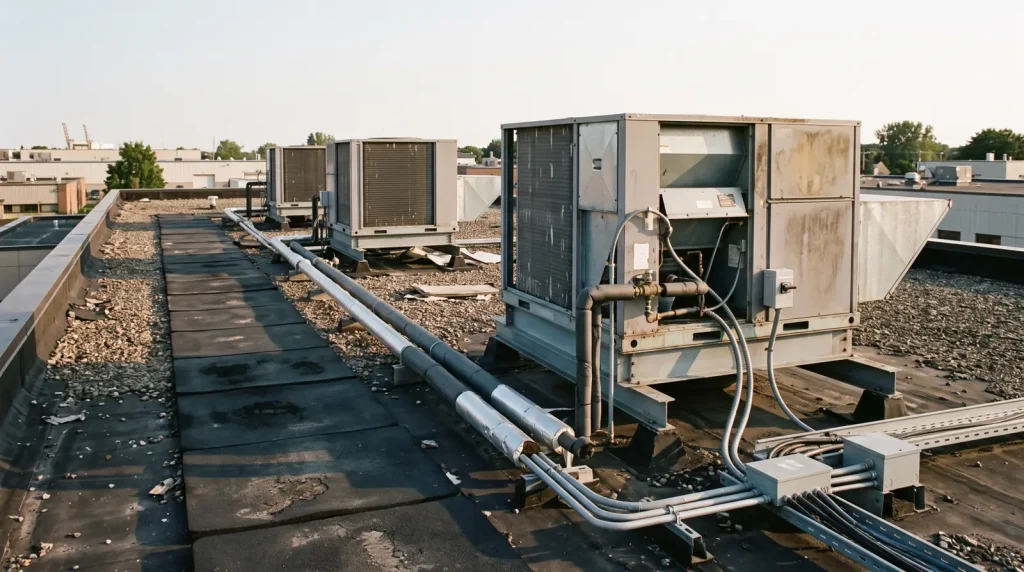
A commercial HVAC system heats, cools and ventilates a business building, most often with packaged rooftop units, which cool 58% of U.S. commercial floorspace (EIA, 2018); replacing one cost a median $4,650 per ton across 13 federal awards.
Key takeaways
- Packaged air-conditioning units served 43% of U.S. commercial buildings and 58% of floorspace in 2018, while central chillers served 3% of buildings but 19% of floorspace, in buildings averaging 88,800 sq ft (EIA CBECS 2018).
- A new air-cooled rooftop air conditioner of 65,000 to 135,000 Btu/h with electric or no heat must reach an IEER of 14.8; from January 1, 2029 the metric becomes IVEC, with a minimum of 14.3 (10 CFR 431.97).
- New self-contained units and comfort chillers made since January 1, 2025 must use refrigerant with a global warming potential (GWP) under 700, but EPA’s rule of May 26, 2026 lets light commercial systems whose components were all made before 2025 still be installed (91 FR 31284).
- One ton of cooling is 12,000 Btu/h (NIST SP 811); size from a load calculation under ANSI/ASHRAE/ACCA Standard 183 or ACCA Manual N, not from square feet per ton.
- Thirteen federal rooftop unit replacements from 2021 to 2026 cost $1,520 to $7,356 per ton, median $4,650; seven chiller replacements cost $3,412 to $7,741 per ton, median $4,645 (USAspending.gov).
- DOE assumes a mean life of 21 years for 65,000 to 135,000 Btu/h rooftop units and 30 years for 240,000 to 760,000 Btu/h units; the manufacturers’ trade group AHRI told DOE 12 to 15 years (89 FR 44052).
What is a commercial HVAC system?
A commercial HVAC system is the heating, ventilation and air-conditioning equipment of a non-residential building, plus the ducts, pipes and controls that deliver its output. Federal rules mark the size: the Department of Energy (DOE) regulates air-cooled commercial package units from 65,000 Btu/h, about 5.4 tons, up to 760,000 Btu/h, and three-phase units under 65,000 Btu/h by separate SEER2 limits (10 CFR 431.97).
Capacity is sold in tons. One ton of refrigeration equals 12,000 Btu/h, or 3.517 kW, so a 10-ton rooftop unit is rated to remove 120,000 Btu/h. A commercial system also conditions the outdoor air the mechanical code requires for ventilation, which a house system rarely handles at the same scale.
| Key number | Value | Source, date |
|---|---|---|
| Share of commercial floorspace cooled by packaged AC units | 58% | EIA CBECS, 2018 |
| Average size of a building cooled by central chillers | 88,800 sq ft | EIA CBECS, 2018 |
| Minimum IEER, 65,000 to 135,000 Btu/h rooftop AC, electric or no heat | 14.8 | 10 CFR 431.97, in force since Jan 1, 2023 |
| GWP limit for refrigerant in new comfort cooling equipment | Under 700 | 40 CFR 84.54, since Jan 1, 2025 |
| Median rooftop unit replacement, 13 federal awards | $4,650 per ton | USAspending.gov, awards 2021 to 2026 |
| Change in HVAC equipment producer prices, Jan 2020 to Sep 2026 | +60.4% | BLS PPI, Sep 2026 preliminary |
| DOE mean life, 65,000 to 135,000 Btu/h rooftop units | 21 years | DOE, May 20, 2024 |
What are the main types of commercial HVAC systems?
Five types cover most U.S. commercial buildings: packaged rooftop units (RTUs), split systems, variable refrigerant flow (VRF), central chiller plants with air handlers, and boilers for hot-water heat. In EIA’s 2018 Commercial Buildings Energy Consumption Survey, packaged air-conditioning units appeared in 43% of buildings and packaged heating units in 37%, which makes the rooftop unit the default for low-rise buildings.
| Type | How it works | Where it shows up (EIA CBECS 2018) | Federal minimum in force, Nov 2026 | Source |
|---|---|---|---|---|
| Packaged rooftop unit (RTU) | Compressor, coils, fans and gas heat or heat pump in one cabinet on the roof, ducted to the floor below | Packaged AC in 43% of buildings, 58% of floorspace; average building 21,900 sq ft | IEER 14.8 (65,000 to 135,000 Btu/h AC) down to 13.2 (240,000 to 760,000 Btu/h AC) | 10 CFR 431.97, Table 1 |
| Split system | Outdoor condensing unit piped to an indoor air handler or furnace | Residential-type central AC in 22% of buildings, 19% of floorspace; average 14,000 sq ft | 13.4 SEER2 for three-phase AC under 65,000 Btu/h; 14.3 SEER2 and 7.5 HSPF2 for split heat pumps | 10 CFR 431.97, Table 19 (from Jan 1, 2025) |
| Variable refrigerant flow (VRF) | One outdoor unit varies refrigerant flow to many indoor fan coils; heat recovery models heat some zones while cooling others | Not reported as a separate category | 15.5 IEER (AC, 65,000 to 135,000 Btu/h); 14.4 IEER and 3.3 COP (heat recovery heat pump) | 10 CFR 431.97, Table 16 (from Jan 1, 2024) |
| Central chiller plant | Chiller makes chilled water that pumps carry to air handlers; water-cooled chillers add a cooling tower | 3% of buildings, 19% of floorspace; average 88,800 sq ft | No DOE equipment standard; chiller minimums come from the energy code your state adopted | EIA CBECS 2018; 40 CFR 84.54 for refrigerant |
| Boiler (heating) | Burner heats water or steam piped to coils, radiators or air handlers | 12% of buildings, 30% of floorspace; average 41,000 sq ft | 80.0% thermal efficiency, gas hot-water boilers 300,000 to 2,500,000 Btu/h | 10 CFR 431.87 |
The building sizes in the survey show the split. Buildings with packaged air-conditioning averaged 21,900 sq ft and those with heat pumps 22,500 sq ft, while chiller buildings averaged 88,800 sq ft and buildings on district chilled water 77,500 sq ft. Individual room air conditioners averaged 18,500 sq ft and swamp coolers 24,500 sq ft (EIA CBECS 2018, page 30).
Which commercial HVAC system fits your building?
Match the system to the load per zone and to where the equipment can sit. Units under 65,000 Btu/h (5.4 tons) fall under DOE’s SEER2 limits; units from 65,000 to 760,000 Btu/h (5.4 to 63 tons) are the rooftop and VRF classes; loads that need many of those, or a building over about 88,800 sq ft like the average chiller building in CBECS 2018, point to a central plant.
| If your building | Consider | Threshold or reason | Source |
|---|---|---|---|
| Is low-rise, has a roof that can carry units, and each zone needs 5.4 to 63 tons | Packaged rooftop units | DOE rooftop class 65,000 to 760,000 Btu/h; average packaged-AC building 21,900 sq ft | 10 CFR 431.97; EIA CBECS 2018 |
| Is split into small suites, each under 65,000 Btu/h | Split systems or small packaged units, one per suite | 13.4 SEER2 minimum since Jan 1, 2025 for three-phase AC | 10 CFR 431.97, Table 19 |
| Has many zones that need heating and cooling at once and little ceiling space for ducts | VRF with heat recovery | 14.4 IEER minimum (65,000 to 135,000 Btu/h); size the outdoor unit on the block load of all zones it serves | 10 CFR 431.97; NYS Clean Heat guidance, July 2025 |
| Is large or tall, with a mechanical room and loads above 760,000 Btu/h (63 tons) in one plant | Chiller plant with air handlers | Average chiller building 88,800 sq ft; new comfort chillers need refrigerant under GWP 700 | EIA CBECS 2018; 40 CFR 84.54(a)(10) |
| Already has hot-water heat in a cold climate | Keep or replace the boiler; add cooling separately | New gas hot-water boilers of 300,000 to 2,500,000 Btu/h must reach 80% thermal efficiency | 10 CFR 431.87 |
| Has an old rooftop unit with a failed compressor | Price a compressor job and a full replacement side by side | A 25-ton RTU compressor cost $14,524 in a 2024 federal award; a 25-ton replacement at the $4,650 median is $116,250 | USAspending 47PE0724F0247 |
Ask each bidder to state the system type, the tonnage per unit, the IEER or SEER2 of the exact model and the refrigerant on the nameplate, so the bids compare on the same basis. Our guide on how to compare construction bids sets out the line items to level before you pick a number.
How do you size a commercial HVAC system?
Size it from a zone-by-zone heat gain and heat loss calculation, never from square feet alone. ANSI/ASHRAE/ACCA Standard 183 sets the minimum method for commercial load calculations and has been adopted into the IECC and ASHRAE Standard 90.1 (HPAC Engineering, June 3, 2026). ACCA’s Manual N, 5th edition is the contractor-side commercial method.
Rules of thumb such as 300 Btu per square foot still appear in top-ranking guides. HPAC Engineering’s June 2026 review notes that such rules have barely changed since 1975 while envelopes and internal heat gains have, and that the result is often oversized equipment that runs less efficiently at part load. For VRF, the New York State Clean Heat program (July 15, 2025 guidance) sizes each outdoor unit on the block load of every zone it serves, which can be smaller than the sum of the zone peaks.
- List every zone with its floor area, glazing, occupancy, lighting and equipment heat, and the design temperatures for your county.
- Add the outdoor air volume the mechanical code requires for each zone, because that air must be cooled or heated too.
- Run the peak load calculation under Standard 183 or Manual N and get both zone peaks and the block load per system.
- Convert to tons by dividing Btu/h by 12,000, then pick equipment from the maker’s performance data at your design conditions, not the nominal tonnage.
- Check the DOE size class of each unit (65,000, 135,000, 240,000 and 760,000 Btu/h breaks) so you know which IEER or SEER2 minimum applies.
- Ask the designer to explain any selected capacity well above the calculated peak in writing.
| Worked example (illustrative load) | Arithmetic | Result |
|---|---|---|
| Calculated block cooling load | From a Standard 183 calculation | 410,000 Btu/h |
| Convert to tons | 410,000 / 12,000 | 34.2 tons |
| Equipment selected | Two 17.5-ton RTUs = 35 tons (210,000 Btu/h each) | 2.4% above load |
| DOE class and minimum | 210,000 Btu/h falls in 135,000 to 240,000 Btu/h | IEER 14.2 (electric heat) or 14.0 (gas heat) |
| Replacement budget at the federal median | 35 x $4,650 | $162,750 |
| Budget at the federal lower and upper quartile | 35 x $3,601 and 35 x $6,375 | $126,035 to $223,125 |
Once installed, a system of this size usually triggers functional testing; our guide to building commissioning requirements explains when the IECC requires it and what it costs.
Which federal efficiency rules apply to commercial HVAC in 2026?
DOE standards apply to equipment by date of manufacture, so any new unit sold in the U.S. already meets them; the owner’s job is to check the rating of the exact model bid. As of November 2026, rooftop units of 65,000 to 760,000 Btu/h are rated by IEER (integrated energy efficiency ratio, which weights efficiency at full and part load) under 10 CFR 431.97, in force since January 1, 2023.
| Equipment (air-cooled) | Size, Btu/h (tons) | Minimum now | Minimum from Jan 1, 2029 | Source |
|---|---|---|---|---|
| Rooftop AC, electric or no heat | 65,000 to 135,000 (5.4 to 11.25) | IEER 14.8 | IVEC 14.3 | 10 CFR 431.97 Tables 1 and 2 |
| Rooftop AC, gas or other heat | 65,000 to 135,000 | IEER 14.6 | IVEC 13.8 | 10 CFR 431.97 |
| Rooftop heat pump, electric or no heat | 65,000 to 135,000 | IEER 14.1, COP 3.4 | IVEC 13.4, IVHE 6.2 | 10 CFR 431.97 |
| Rooftop AC, electric or no heat | 135,000 to 240,000 (11.25 to 20) | IEER 14.2 | IVEC 13.8 | 10 CFR 431.97 |
| Rooftop AC, electric or no heat | 240,000 to 760,000 (20 to 63) | IEER 13.2 | IVEC 12.9 | 10 CFR 431.97 |
| VRF AC | 65,000 to 135,000 | IEER 15.5 | No change scheduled | 10 CFR 431.97 Table 16 |
| Three-phase split AC | Under 65,000 | 13.4 SEER2 | No change scheduled | 10 CFR 431.97 Table 19 |
| Gas hot-water boiler | 300,000 to 2,500,000 | 80.0% thermal efficiency | No change in the current CFR | 10 CFR 431.87 |
Why do the 2029 numbers look lower?
The 2029 numbers use a different test, so they do not compare one to one with IEER. IVEC (integrated ventilation, economizing and cooling) and IVHE (integrated ventilation and heating efficiency) were recommended by a DOE working group in 2023 to fold ventilation and economizer operation into the rating. DOE adopted them in a direct final rule on May 20, 2024, for units made from January 1, 2029 (89 FR 44052).
Your state or city can require more than the federal minimum through its energy code, and 10 states enforced ASHRAE 90.1-2022 or the 2024 IECC in October 2026, per our commercial energy code by state registry. Sixteen U.S. jurisdictions also set whole-building emissions or energy limits, listed in our building performance standards tracker. This is general information, not legal or code advice.
What does the refrigerant transition mean for a new commercial HVAC system?
Under the AIM Act Technology Transitions rule, new self-contained units, including some rooftop units, and chillers for comfort cooling made or imported since January 1, 2025 must use refrigerant with a GWP under 700, such as R-454B (GWP 465) or R-32 (GWP 675) in place of R-410A (GWP 2,088) (40 CFR 84.54; GWPs from 88 FR 73098). Split and VRF systems carry separate installation dates.
| Equipment | Rule | Date | Source |
|---|---|---|---|
| Self-contained light commercial units (some RTUs, PTACs) | No manufacture or import with GWP 700 or more | Jan 1, 2025 | 40 CFR 84.54(a)(1) |
| Same units built before 2025 | Sale and distribution ends | Jan 1, 2028 | 40 CFR 84.54(b) |
| Light commercial split and packaged systems | No installation with GWP 700 or more, except where every specified component was made or imported before Jan 1, 2025 (no end date) | Jan 1, 2025; exception effective Jul 27, 2026 | 40 CFR 84.54(c)(1); 91 FR 31284 |
| VRF systems | No installation with GWP 700 or more; pre-2026 components allowed until Jan 1, 2027, or Jan 1, 2028 with a building permit issued before Oct 5, 2023 | Jan 1, 2026 | 40 CFR 84.54(c)(2) |
| Chillers for comfort cooling | No manufacture, import or installation with GWP 700 or more | Jan 1, 2025 | 40 CFR 84.54(a)(10) and (c)(3) |
State rules can be stricter than the federal one: New York kept its own January 1, 2026 installation deadline for high-GWP equipment, so the May 2026 federal relief does not apply to projects there (ACHR News, May 2026). Check your state environmental agency before ordering R-410A equipment.
R-454B and R-32 are A2L refrigerants: under ASHRAE Standard 34, “A” means lower toxicity and “2L” means lower flammability. EPA’s 2023 rule records that manufacturers planned the switch once building codes allowed A2Ls, so confirm the mechanical code your jurisdiction adopted before design. EPA also found R-454B service cylinders scarce in some regions in 2025 (91 FR 31284), so ask your contractor to confirm refrigerant supply before the install date.
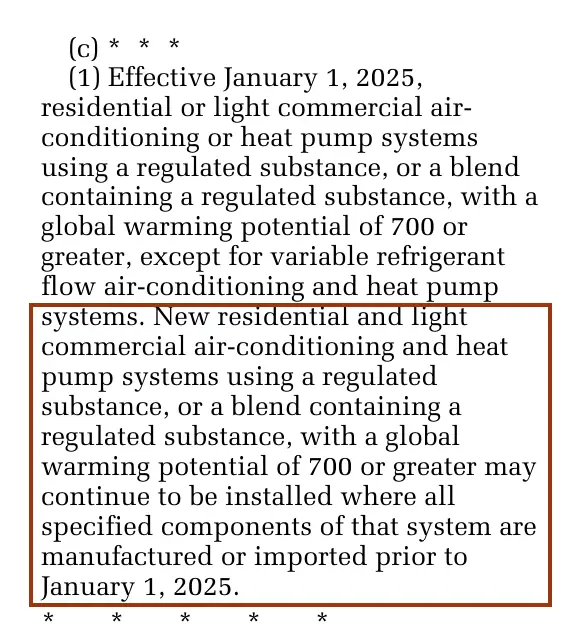
“Specified components” means condensing units, condensers, compressors, evaporator units and evaporators (40 CFR 84.3), so an R-410A installation needs proof that every one of them predates 2025. EPA’s HFC restrictions by sector table, updated August 28, 2026, shows the same dates.
How much does a commercial HVAC system cost per ton?
Thirteen federal rooftop and packaged unit replacements awarded from August 2021 to October 2026 cost $1,520 to $7,356 per ton installed, with a median of $4,650 and a middle half of $3,601 to $6,375. Seven chiller replacements of 90 to 500 tons cost $3,412 to $7,741 per ton, median $4,645. Each figure is the obligated contract amount divided by the tons named in the award (USAspending.gov, accessed November 1, 2026).
| Place (agency) | Award date | Tons | Obligated | Per ton | Source (USAspending) |
|---|---|---|---|---|---|
| Del Rio, TX (GSA) | May 2024 | 12.5 + 20 | $49,387 | $1,520 | 47PH0224F0159 |
| Eagle Pass, TX (GSA) | Sep 2023 | 15 | $38,173 | $2,545 | 47PH0223F0355 |
| Navy, place not stated | Aug 2023 | 12.5 | $39,449 | $3,156 | N3319123F4311 |
| Fort Rucker, AL (Army) | May 2024 | 15 | $60,693 | $4,046 | W9124G24F0035 |
| Fort Rucker, AL (Army) | Feb 2024 | 12 | $51,861 | $4,322 | W9124G24F0009 |
| Cross Lanes, WV (Army) | Oct 2022 | 2 x 10 | $92,724 | $4,636 | W15QKN22F5373 |
| Franklin, NC (Forest Service) | Oct 2026 | 10 | $46,500 | $4,650 | 12441926C0013 |
| Norfolk, VA (Navy) | Aug 2021 | 3 x 6 | $85,128 | $4,729 | N4008521F5955 |
| Quantico, VA (Navy), gas heat | Jun 2025 | 2 x 7.5 | $82,559 | $5,504 | N4008025F0018 |
| Hastings, MN (Army) | Jun 2023 | 5 | $31,147 | $6,229 | W912ES23P0065 |
| Little Neck, NY (FAA), AC to heat pump | Dec 2024 | 7.5 | $48,900 | $6,520 | 697DCK25C00063 |
| Dulles, VA (GSA) | Dec 2023 | 5 | $33,857 | $6,771 | 47PM0524P0002 |
| Eglin AFB, FL (Air Force) | Nov 2023 | 30 | $220,678 | $7,356 | FA282323F0385 |
Size did not bring the price per ton down in this sample: the two 5-ton jobs ran $6,229 and $6,771 per ton and the 30-ton job at Eglin AFB $7,356, while two Texas border-station jobs came in at $1,520 and $2,545. Federal jobs pay Davis-Bacon prevailing wages on contracts over $2,000 (U.S. Department of Labor), which our prevailing wage vs market wage analysis compares with private pay by trade.
What do chiller replacements cost?
Chiller replacements in the federal data ran $3,412 to $7,741 per ton, with the 500-ton design-build job in Philadelphia cheapest per ton and the single 90-ton chiller in Portsmouth, Virginia most expensive. Two awards were left out: a 40-ton air-cooled chiller at $893,136 ($22,328 per ton), whose scope was clearly wider, and a 300-ton job that bundled refrigeration work.
| Place (agency) | Award date | Tons | Obligated | Per ton | Source (USAspending) |
|---|---|---|---|---|---|
| Philadelphia, PA (Navy), design-build | Sep 2021 | 500 | $1,705,933 | $3,412 | N4008521F6413 |
| Manchester, NH (GSA) | May 2026 | 200 | $698,298 | $3,491 | 47PC5226F0328 |
| Eglin AFB, FL (Air Force) | Jun 2026 | 3 x 70 | $915,039 | $4,357 | FA282326F0092 |
| Millington, TN (Army) | Sep 2024 | 2 x 200 | $1,857,946 | $4,645 | W912HP24F1190 |
| Calexico, CA (GSA) | Sep 2026 | 2 x 90 | $962,573 | $5,348 | 47PD5526F0354 |
| Eglin AFB, FL (Air Force) | Aug 2025 | 120 | $689,227 | $5,744 | FA282325F0172 |
| Portsmouth, VA (Navy) | Sep 2025 | 90 | $696,688 | $7,741 | N4008525F0894 |
We found no VRF award that stated its tonnage, so we publish no VRF per-ton figure; VRF award amounts alone, such as a $3,090,630 Army repair in Colorado in 2023, do not convert to a price per ton.
How fast are equipment prices rising?
The Bureau of Labor Statistics producer price index for air-conditioning, refrigeration and forced-air heating equipment rose from 204.2 in January 2020 to 327.608 in September 2026 (preliminary), a 60.4% increase, and 5.7% in the 12 months from September 2025 (BLS series PCU333415333415). An award from 2021 therefore understates today’s equipment cost: the July 2021 index was 223.683, so equipment then cost about 68% of the September 2026 level.
How long does a commercial HVAC system last?
DOE’s 2024 rule assumed a mean life of 21 years for rooftop units of 65,000 to 135,000 Btu/h, 23 years for 135,000 to 240,000 Btu/h and 30 years for 240,000 to 760,000 Btu/h. AHRI, the manufacturers’ association, told DOE that service lives run 12 to 15 years, and AHRI and Carrier both said coastal salt air and long run hours shorten life (89 FR 44052, section IV.F.6).
| Rooftop unit size class | DOE mean life | DOE maximum | AHRI comment | Source |
|---|---|---|---|---|
| Small: 65,000 to 135,000 Btu/h | 21 years | 40 years | 12 to 15 years service life | DOE direct final rule, May 20, 2024 |
| Large: 135,000 to 240,000 Btu/h | 23 years | 40 years | ||
| Very large: 240,000 to 760,000 Btu/h | 30 years | 60 years |
The building usually outlives the equipment: the median U.S. commercial building was 36 years old in 2018, per our commercial building stock age report, older than DOE’s 21-year mean for small rooftop units. DOE also found that about 95% of commercial unitary shipments go to replacements. A property condition assessment rates remaining life unit by unit before you buy or refinance.
What do popular guides get wrong about commercial HVAC?
Four claims in top-ranking guides do not match the primary sources as of November 2026: two R-410A dates, the rooftop unit lifespan and the sizing rule of thumb. Each row below names the claim neutrally and the federal or standards text that replaces it, so you can check a contractor’s statement against the rule itself.
| What several guides say | What the primary source says | Source |
|---|---|---|
| A contractor guide last updated March 2026 calls the January 1, 2026 R-410A installation deadline “technically on the books but effectively on pause” | The rule of May 26, 2026, effective July 27, 2026, lets light commercial systems whose specified components were all made or imported before January 1, 2025 be installed with no end date; VRF keeps its 2027 cutoff | 91 FR 31284; 40 CFR 84.54(c) |
| The same guide lists January 1, 2028 as a later compliance deadline for package units | Manufacture and import of high-GWP self-contained units ended January 1, 2025; January 1, 2028 ends sale and distribution of units built before then | 40 CFR 84.54(b) |
| A manufacturer’s repair-or-replace guide puts packaged rooftop life at about 15 to 20 years | DOE models a 21 to 30-year mean by size; AHRI told DOE 12 to 15 years | 89 FR 44052 |
| An engineering-firm guide sizes cooling at 300 Btu per square foot | Standard 183, adopted into the IECC and ASHRAE 90.1, sets the load calculation method | HPAC Engineering, 2026 |
When you are ready to price a replacement or a new system, request matched bids from vetted commercial builders and send the load calculation with the request.
The HVAC system is designed and sealed by the project’s MEP engineering team, which also lays out power and plumbing.
Before choosing a packaged unit nameplated 208-230/60/3 or 460/60/3, confirm the building has three-phase power and enough spare capacity.
How we compiled this
We read 13 primary documents on November 1, 2026: the eCFR text of 10 CFR 431.97, 431.87 and 40 CFR 84.54; three Federal Register rules; EPA’s sector table; EIA CBECS 2018; the BLS price index; NIST SP 811; and ACCA, NYS Clean Heat and Labor Department pages. We pulled 21 USAspending.gov awards through its public API and excluded awards without a stated tonnage or with mixed scope.
We did not test equipment or survey contractors, and we left out contractor price ranges that name no source.
Frequently asked questions
What is the difference between commercial and residential HVAC?
Commercial systems are larger, often three-phase, and must condition the outdoor air the mechanical code requires for ventilation. Federal rules draw the line by equipment class: DOE rates commercial rooftop units of 65,000 to 760,000 Btu/h by IEER under 10 CFR 431.97, and three-phase units under 65,000 Btu/h by SEER2, with a 13.4 SEER2 minimum for air conditioners made since January 1, 2025.
What is IEER on a rooftop unit?
IEER, the integrated energy efficiency ratio, weights a unit’s efficiency at full load and at part loads, because rooftop units spend most hours below peak. The federal minimum is 14.8 for a 65,000 to 135,000 Btu/h air conditioner with electric or no heat. From January 1, 2029, DOE replaces IEER with IVEC, a metric that folds in ventilation and economizer operation, and the minimum for that class becomes IVEC 14.3.
Is R-410A banned for commercial HVAC?
Not entirely. New self-contained units and comfort chillers made since January 1, 2025 must use refrigerant under GWP 700, and R-410A is 2,088. Since EPA’s rule took effect on July 27, 2026, light commercial split and packaged systems whose specified components were all made or imported before 2025 may still be installed. Sale of pre-2025 self-contained units ends January 1, 2028.
How many square feet does one ton of commercial cooling cover?
There is no reliable fixed number. One ton removes 12,000 Btu/h, but the load per square foot moves with glazing, occupancy, ventilation air, lighting and climate. ANSI/ASHRAE/ACCA Standard 183, adopted into the IECC and ASHRAE 90.1, sets the commercial load calculation method. Ask for the calculation, then divide the block load in Btu/h by 12,000 to get tons.
Is VRF more efficient than a rooftop unit?
By federal minimums, slightly: a 65,000 to 135,000 Btu/h VRF air conditioner must reach IEER 15.5, against 14.8 for a rooftop air conditioner of the same size. VRF with heat recovery can heat some zones while cooling others. Compare the rated IEER of the exact models bid, and note that high-GWP VRF cannot be installed from January 1, 2027.
Should I repair or replace a commercial rooftop unit?
Price both. A 2024 federal award replaced one compressor in a 25-ton rooftop unit for $14,524, while replacing a 25-ton unit at the $4,650 per ton federal median would cost about $116,250. Weigh the repair against the unit’s age: DOE models a 21-year mean life for 65,000 to 135,000 Btu/h units, and AHRI told DOE 12 to 15 years.
Sources
- 10 CFR 431.97, energy efficiency standards for commercial package air conditioning and heating equipment, eCFR, current through October 29, 2026; accessed 2026-11-01.
- 10 CFR 431.87, commercial packaged boiler standards, eCFR; accessed 2026-11-01.
- DOE direct final rule, air-cooled commercial package air conditioners and heat pumps, 89 FR 44052, May 20, 2024; accessed 2026-11-01.
- 40 CFR 84.54, restrictions on the use of hydrofluorocarbons, eCFR, current through October 29, 2026; accessed 2026-11-01.
- EPA final rule, 91 FR 31284, May 26, 2026, effective July 27, 2026 and GovInfo PDF; accessed 2026-11-01.
- EPA Technology Transitions final rule, 88 FR 73098, October 24, 2023; accessed 2026-11-01.
- EPA, Technology Transitions HFC restrictions by sector, updated August 28, 2026; accessed 2026-11-01.
- EIA, CBECS 2018 Building Characteristics flipbook, pages 29 to 30; accessed 2026-11-01.
- NIST SP 811, Appendix B.8 conversion factors; accessed 2026-11-01.
- HPAC Engineering, Are Your Load Calculations Code-Compliant?, June 3, 2026; accessed 2026-11-01.
- ACCA, Manual N commercial load calculation, 5th edition; accessed 2026-11-01.
- NYS Clean Heat load calculation guidance, revised July 15, 2025; accessed 2026-11-01.
- BLS producer price index PCU333415333415, data through September 2026; accessed 2026-11-01.
- U.S. Department of Labor, Davis-Bacon and Related Acts; accessed 2026-11-01.
- USAspending.gov contract awards, 20 awards listed in the tables above plus 47PE0724F0247; accessed 2026-11-01.
- EPA removes R-410A installation deadline, ACHR News, May 2026, accessed November 1, 2026.