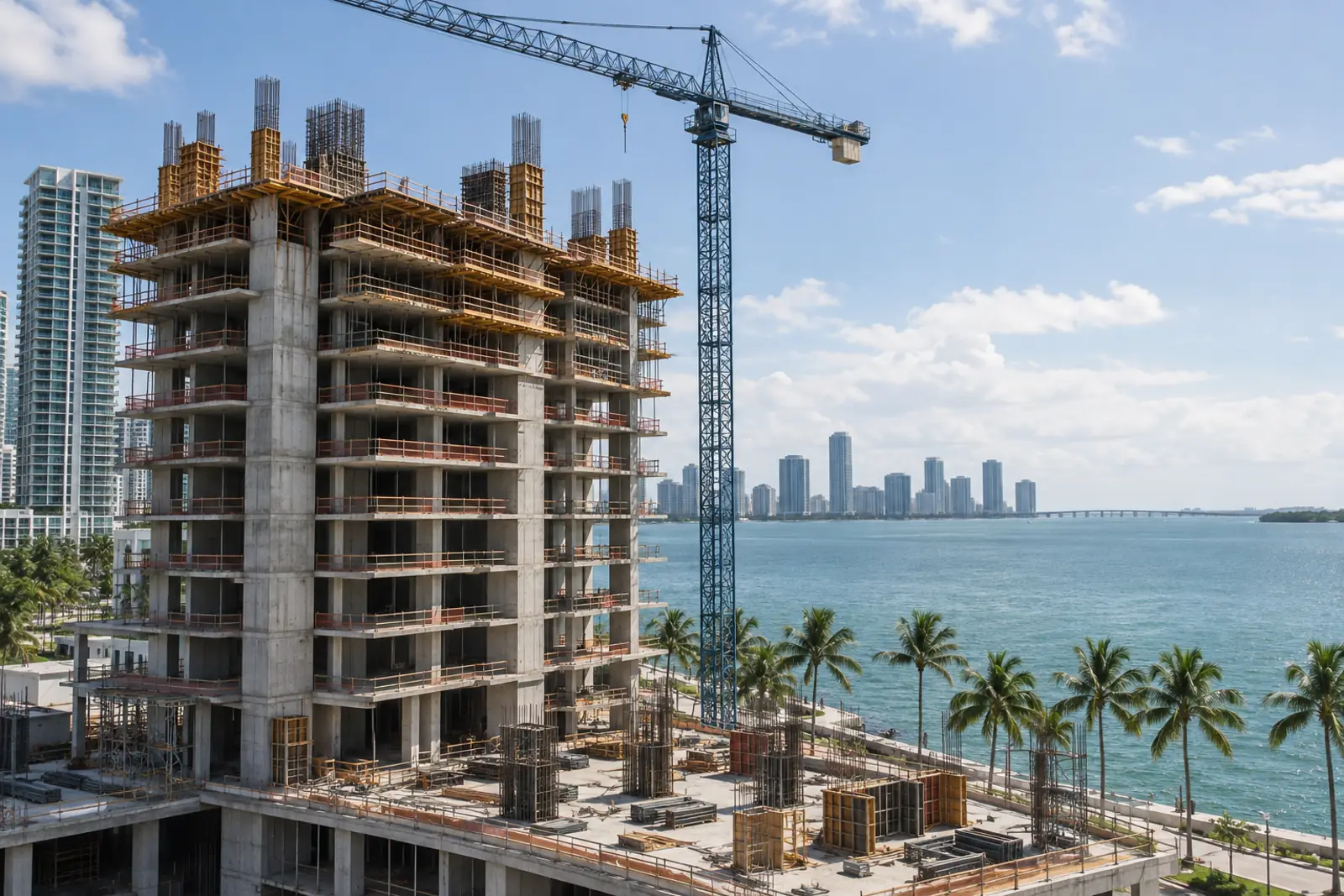
Commercial Builders Miami: HVHZ-Ready Builders, Permits and Local Data
Commercial builders working in Miami must hold an active Florida license, design to High-Velocity Hurricane Zone rules (175 mph for most commercial buildings) and permit through the city's ePlan system. Miami-Dade had 586 commercial building establishments in 2025, per BLS. CB&C introduces licensed builders free to owners.
- 175 mph design windHVHZ wind speed for Risk Category II buildings in Miami-Dade under FBC Section 1620.2.
- 586 builders' officesMiami-Dade commercial building establishments in 2025, up 23.6% from 2020 (BLS QCEW).
- $350 expedited reviewPer discipline for commercial projects over 20,000 square feet, after one full review cycle.
Commercial builders Miami has: many firms, smaller crews
Owners looking for commercial builders Miami can choose from the largest pool of contractor offices in Florida's six biggest markets. Miami-Dade County had 586 private commercial and institutional building establishments in 2025, 23.6% more than the 474 counted in 2020, according to BLS. The City of Miami alone had 489,812 residents on July 1, 2025, in a county of 2,802,029.
Firms multiplied faster than jobs. Employment rose 10.1% to 5,746, so the average establishment now has 9.8 workers on payroll, smaller than in neighboring Broward. For an owner this means plenty of mid-size general contractors for tenant improvements and restaurant build-outs, and a shorter list of firms with the balance sheet for high-rise work. Preliminary data show March 2026 employment at 5,833, up 1.3% from 5,758.
| Measure | 2020 | 2025 | Change |
|---|---|---|---|
| NAICS 236220 establishments | 474 | 586 | 23.6% |
| NAICS 236220 employment | 5,217 | 5,746 | 10.1% |
| Jobs per establishment | 11.0 | 9.8 | n/a |
| NAICS 236220 weekly wage | $1,545 | $1,910 | 23.6% |
| All construction (NAICS 23) employment | 51,301 | 59,626 | 16.2% |
| County population | 2,701,762 | 2,802,029 | 3.7% |
BLS QCEW private ownership annual averages, counted where the establishment reports payroll. Population: April 1, 2020 estimates base and July 1, 2025 estimate (Census Vintage 2025). Changes are CB&C calculations.
Private NAICS 236220 establishments, annual average
Source: U.S. Bureau of Labor Statistics, QCEW annual averages
Building inside the High-Velocity Hurricane Zone
Every Miami site is in the HVHZ, which the 2023 Florida Building Code defines as Broward and Miami-Dade counties. Section 1620.2 sets a single design wind speed per risk category for Miami-Dade, the highest in the state, so structural design does not depend on where in the county the parcel sits. Most offices, shops and warehouses fall in Risk Category II at 175 mph.
| Risk category | Typical examples | Design wind speed |
|---|---|---|
| I | Low-hazard structures such as minor storage | 165 mph |
| II | Most offices, retail and warehouses | 175 mph |
| III | Buildings with large assembly occupancies | 186 mph |
| IV | Essential facilities such as hospitals and emergency centers | 195 mph |
2023 Florida Building Code, Section 1620.2. Examples are general descriptions of the risk categories; the engineer of record assigns the category.
Source: [8]
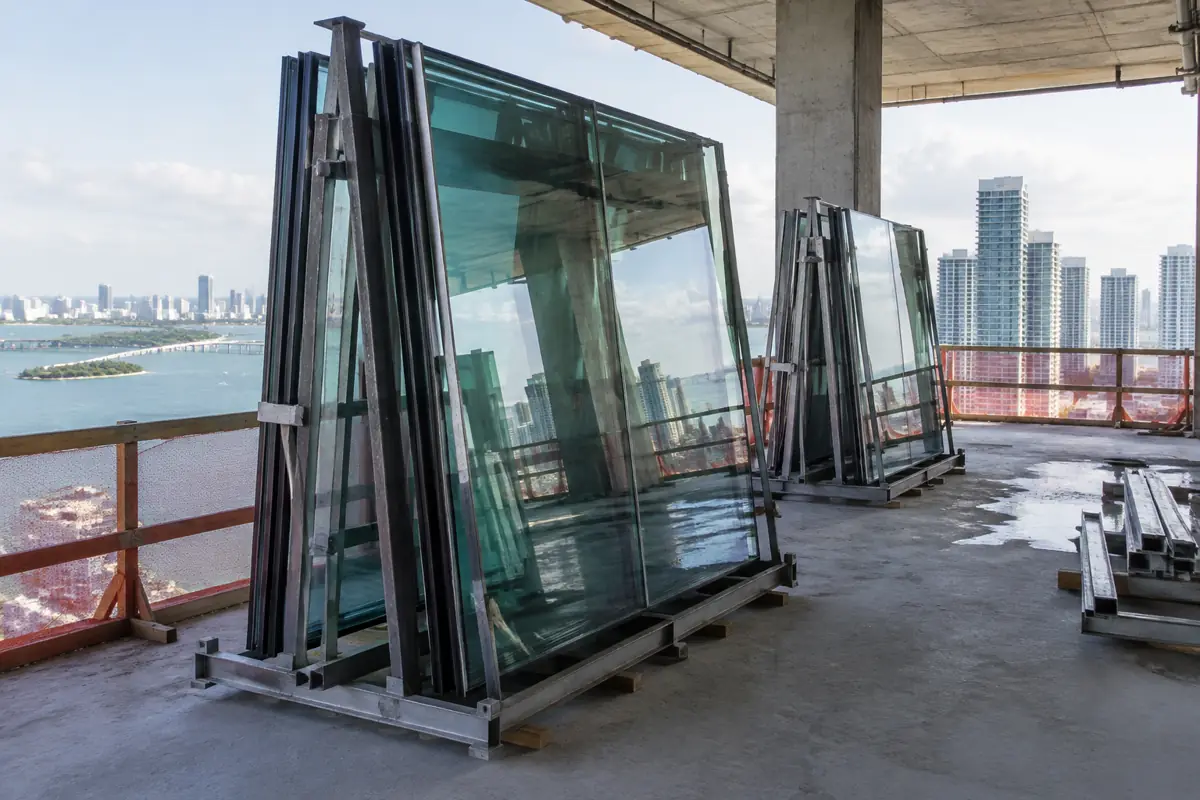
Envelope products face a separate test. The county's Product Control Section approves windows, exterior glazing, wall cladding, roofing, doors, skylights and shutters. It reviews an average of 1,250 applications a year and runs more than 850 quality assurance audits. A first-time approval costs the manufacturer $4,000 and a revision or renewal $1,500, plus a 7.5% surcharge, so check that every specified product already holds a current approval before bids close. HVHZ roofing provisions changed on January 1, 2024 under the 8th edition code.
Permits at the Miami Riverside Center and the county
The City of Miami Building Department works from the Miami Riverside Center at 444 SW 2nd Ave and applies the 8th Edition Florida Building Code, effective December 31, 2023. Its electronic plan review system, ePlan, ties together iBuild for permit applications and ProjectDox for drawings, and Building, Zoning, Planning, Public Works and Fire can review the same set in parallel.
- Expedited review for larger jobsCommercial projects over 20,000 square feet can buy after-hours review at $350 per discipline for up to four hours, but only after one full review cycle; comments usually post in ProjectDox within 48-72 hours.
- Phased permits for high-risesEligible high-rise threshold buildings can start early work while later packages are still in review.
- Concierge ProgramLarge or complex commercial projects that qualify for Special Area Plans can get dedicated coordination.
- Annual Facility PermitOwners with ongoing service work on building systems can hold a 365-day permit instead of one per job.
- Inspections through iBuildRequests can be placed up to five days ahead and usually happen the next day; each subcontractor requests its own.
County review does not stop at the city line. Miami-Dade has 35 municipalities, each with its own building official, and the City of Miami is part of the county's e-municipal system, so a city permit can also need county sign-off for water and sewer, impact fees, environmental resources, fire rescue and the state health department. Unincorporated sites go straight to the county's Department of Regulatory and Economic Resources, where buildings of 10 stories or 100 feet, whichever is less, need an independent structural peer review.
Read our commercial building permits guide for the general sequence and the commercial construction process for where review sits in the schedule.
Storm season, flooding and job site rules
Miami-Dade requires contractors to secure job sites under Section 8-16 of the County Code once a tropical storm or hurricane warning is issued, and a preparedness plan for hoisting equipment must be kept on site. With the Atlantic season running June 1 to November 30, crane-heavy projects should price in shutdown days. The county warns that outages after a storm can last days, weeks or months, which affects anything that depends on temporary power or dewatering.
Flood exposure follows the coast, the Miami River and the canal network. The city keeps elevation certificates for buildings built or substantially improved since December 1992 and supplies FIRM details on request, and its flood guidance applies a 50% substantial damage and improvement rule. The City Commission approved a Citywide Stormwater Master Plan on March 13, 2024 with 25 priority flood prevention projects, and the city's Community Rating System Class 6 gives property owners up to a 20 percent discount on flood insurance.
Miami neighborhoods, corridors and hubs
The city's neighborhood services page groups Miami into these 11 service areas, each with its own mix of commercial work, from Allapattah warehouses to Brickell towers:
- Allapattah
- Coconut Grove
- Coral Way
- Wynwood / Edgewater
- Flagami
- Little Haiti
- Downtown / Brickell
- Little Havana
- Model City
- Overtown
- Upper Eastside
Downtown is the densest market. The Miami Downtown Development Authority reports more than 155,000 jobs and more than 101,000 residents downtown, up nearly 68% from 41,000 in 2012. West of the river, the Miami Freedom Park Special Area Plan pairs a soccer stadium with retail, hotel and office uses and a 58-acre public park.
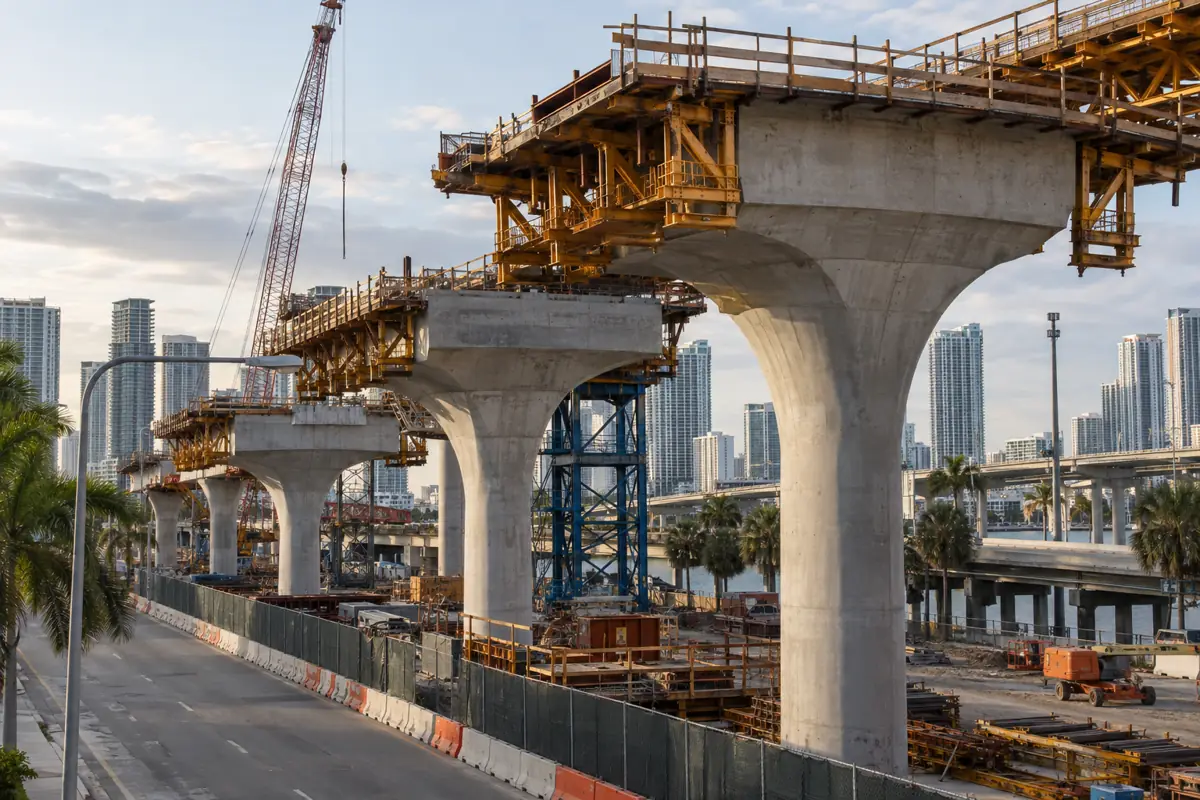
Freight and access projects shape logistics. FDOT and the Greater Miami Expressway Agency are rebuilding I-395 for about 1.4 miles from the Midtown Interchange to the MacArthur Causeway, with a 1,025-foot signature bridge, double-decking S.R. 836 from NW 17 Avenue and upgrading I-95 between NW 8 Street and NW 29 Street. PortMiami handled more than 1,120,913 TEUs in its last fiscal year and supports 340,078 jobs, and Miami International Airport, on 3,230 acres just outside city limits, is the busiest U.S. airport for international freight.
What construction work pays across the Miami metro
Management pays more in South Florida than nationally, while field trades earn less. In May 2025 construction managers in the Miami-Fort Lauderdale-West Palm Beach area averaged $138,950, above the U.S. mean of $124,360; electricians averaged $59,930 against $71,490, and carpenters $54,030 against $65,630.
Annual mean wage, Miami-Fort Lauderdale-West Palm Beach MSA and United States
Source: U.S. Bureau of Labor Statistics, OEWS May 2025
At the industry level, the 2025 NAICS 236220 weekly wage in Miami-Dade was $1,910, 92.7% of the U.S. figure of $2,061, rising to $2,093 in the first quarter of 2026. Our construction pay by metro report shows how far those wages stretch once local prices are counted, and the South Florida commercial construction report compares Miami-Dade with Broward and Palm Beach every quarter.
Getting introductions to Miami builders through CB&C
CB&C is an independent matching service, not a contractor; we perform no construction and sign no construction contracts. Some builders pay us for introductions, and owners pay nothing. For Miami we confirm an active license on the DBPR license portal, ask for completed HVHZ projects and iBuild experience, and only then introduce the builder.
The DBPR extract downloaded on October 3, 2026 listed 5,148 current, active Certified General Contractor licenses and 578 Certified Building Contractor licenses with a Miami-Dade address. Under s. 489.105 a building contractor may put up new commercial buildings of up to three stories, so Brickell and downtown towers need a general contractor. See how we vet builders and how to compare construction bids.
We do not publish Miami price ranges, because no named public source reports them reliably; the cost per square foot guide explains the drivers, from HVHZ envelopes to county impact fees.
Neighboring South Florida markets
Frequently asked questions
What design wind speed applies to a Miami office building?
Under Section 1620.2 of the 2023 Florida Building Code, a Risk Category II building in Miami-Dade is designed for 175 mph (3-second gust). Risk Category IV essential facilities use 195 mph.
Can I speed up City of Miami plan review on a large commercial job?
Projects over 20,000 square feet can request expedited review at $350 per discipline for up to four hours, after one full review cycle. High-rise threshold buildings can also use phased permitting.
Does a City of Miami permit also need Miami-Dade County approval?
Often, yes. The city is in the county's e-municipal system, and permits can need county review for water and sewer, impact fees, environmental resources, fire rescue and the state health department.
What must a contractor do when a hurricane warning is issued for Miami?
Section 8-16 of the Miami-Dade County Code requires the job site to be secured, and a hurricane preparedness plan for hoisting equipment must be on site.
Will the I-395 reconstruction affect deliveries to downtown and Overtown sites?
The I-395/SR 836/I-95 project spans the Midtown Interchange to the MacArthur Causeway and I-95 from NW 8 Street to NW 29 Street. Check the project site for closures before scheduling concrete or crane deliveries.
Are Miami-Dade product approvals accepted elsewhere in Florida?
Florida's product approval statute names Miami-Dade's Product Control as an approved evaluation entity, and Palm Beach County posts an advisory accepting Miami-Dade approvals statewide. Products approved only for non-HVHZ use cannot be used in Miami.
How do I verify a Miami contractor's license?
Search by name or license number on the Florida DBPR license portal and confirm the license is current and active and covers the building's height.
Does CB&C charge Miami owners?
No. Owners pay nothing; CB&C is an independent matching service and some builders pay for introductions.
Sources
- [1] U.S. Bureau of Labor Statistics. QCEW open data, Miami-Dade County (FIPS 12086) area files, 2020 to 2025 annual and Q1 2025, Q1 2026. Accessed 2026-10-07.
- [2] U.S. Bureau of Labor Statistics. QCEW open data, U.S. total (US000) area file, 2025 annual and Q1 2026. Accessed 2026-10-07.
- [3] U.S. Census Bureau. City and Town Population Totals: 2020-2025, Florida (sub-est2025_12.csv). Accessed 2026-10-07.
- [4] U.S. Census Bureau. County Population Totals and Components of Change: 2020-2025 (co-est2025-alldata.csv). Accessed 2026-10-07.
- [5] U.S. Bureau of Labor Statistics. OEWS May 2025 metropolitan area estimates (oesm25ma.zip, MSA_M2025_dl.xlsx). Accessed 2026-10-07.
- [6] U.S. Bureau of Labor Statistics. OEWS May 2025 national estimates (oesm25nat.zip). Accessed 2026-10-07.
- [7] Florida Building Commission (via International Code Council). 2023 Florida Building Code, Building, 8th Edition, Chapter 2 Definitions. Accessed 2026-10-07.
- [8] Florida Building Commission (via International Code Council). 2023 Florida Building Code, Building, 8th Edition, Chapter 16 Structural Design. Accessed 2026-10-07.
- [9] NOAA National Hurricane Center. Tropical Cyclone Climatology. Accessed 2026-10-07.
- [10] Florida Department of Business and Professional Regulation. Licensing Portal: License Search (Verify a Licensee). Accessed 2026-10-07.
- [11] Florida Department of Business and Professional Regulation. Construction Industry Licensing Board licensee extract (CONSTRUCTIONLICENSE_1.csv). Accessed 2026-10-07.
- [12] Florida Legislature. Florida Statutes s. 489.105, Definitions. Accessed 2026-10-07.
- [13] City of Miami. Building Department. Accessed 2026-10-07.
- [14] City of Miami. Understanding ePlan and ProjectDox. Accessed 2026-10-07.
- [15] City of Miami. Get an Expedited Plan Review (Commercial). Accessed 2026-10-07.
- [16] City of Miami. Schedule a Building Inspection. Accessed 2026-10-07.
- [17] Miami-Dade County Department of Regulatory and Economic Resources. Building & Permits. Accessed 2026-10-07.
- [18] Miami-Dade County Department of Regulatory and Economic Resources. County Municipal Approval. Accessed 2026-10-07.
- [19] Miami-Dade County Department of Regulatory and Economic Resources. Plan Review (structural peer review). Accessed 2026-10-07.
- [20] Miami-Dade County Department of Regulatory and Economic Resources, Board and Code Administration Division. Product Approval. Accessed 2026-10-07.
- [21] Miami-Dade County Department of Regulatory and Economic Resources. Natural Disaster Preparedness for Construction Sites. Accessed 2026-10-07.
- [22] Miami-Dade County Department of Regulatory and Economic Resources. HVHZ Code Changes to FL Building Code 8th edition, 2023 (roofing, PDF). Accessed 2026-10-07.
- [23] City of Miami. Homeowners Associations – HOA (neighborhood service areas). Accessed 2026-10-07.
- [24] FDOT and Greater Miami Expressway Agency. The Project: I-395/SR 836/I-95 Design-Build Project. Accessed 2026-10-07.
- [25] Miami Downtown Development Authority. Welcome to Downtown Miami. Accessed 2026-10-07.
- [26] Miami Downtown Development Authority. Downtown Details, Data and Demographics. Accessed 2026-10-07.
- [27] Miami-Dade County. PortMiami. Accessed 2026-10-07.
- [28] Miami-Dade Aviation Department. About Us: Miami International Airport. Accessed 2026-10-07.
- [29] City of Miami. Hurricane Flood Information. Accessed 2026-10-07.
- [30] City of Miami Office of Capital Improvements. Stormwater Master Plan. Accessed 2026-10-07.
- [31] Miami-Dade County. Hurricanes (Weather Ready). Accessed 2026-10-07.
- [32] City of Miami Planning Department. Special Area Plans (SAPs). Accessed 2026-10-07.
- [33] Florida Legislature. Florida Statutes s. 553.842, Product evaluation and approval. Accessed 2026-10-07.
- [34] Florida Building Commission (posted by Palm Beach County). Advisory on Acceptance of Miami-Dade Product Approvals Statewide (PDF). Accessed 2026-10-07.