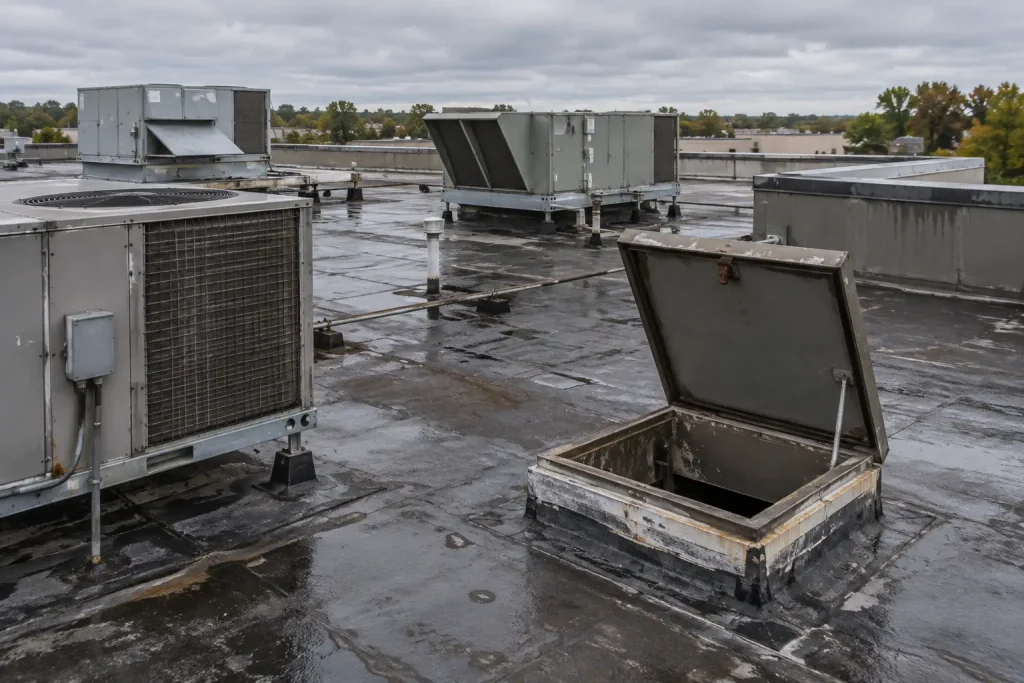
A property condition assessment (PCA) is a visual survey of a commercial building that lists what needs repair and prices it under ASTM E2018-24: fees run from about $2,000 to over $20,000, and the report typically takes 3 weeks.
Key takeaways
- PCA fees run from about $2,000 to well over $20,000 depending on scope, according to the NEEDDA PCA User Guide. For one 4,641 sq ft office building in 2020, a public agency received a $2,675 baseline quote and a $6,700 quote that rose to $16,700 with seismic, envelope and accessibility specialists (Fallbrook Regional Health District).
- Most site visits take 4 to 7 hours, the report follows 5 to 15 working days later, and the whole job typically takes 3 weeks, or 4 to 6 weeks for complex properties (NEEDDA).
- A PCA is visual only: no testing, probing or dismantling, and no environmental review, which needs a separate Phase I environmental site assessment under ASTM E1527-21.
- Repairs below a reporting threshold, typically $3,000 for like items, are left out of the cost tables unless the client asks for them (public E2018-24 report, October 2025).
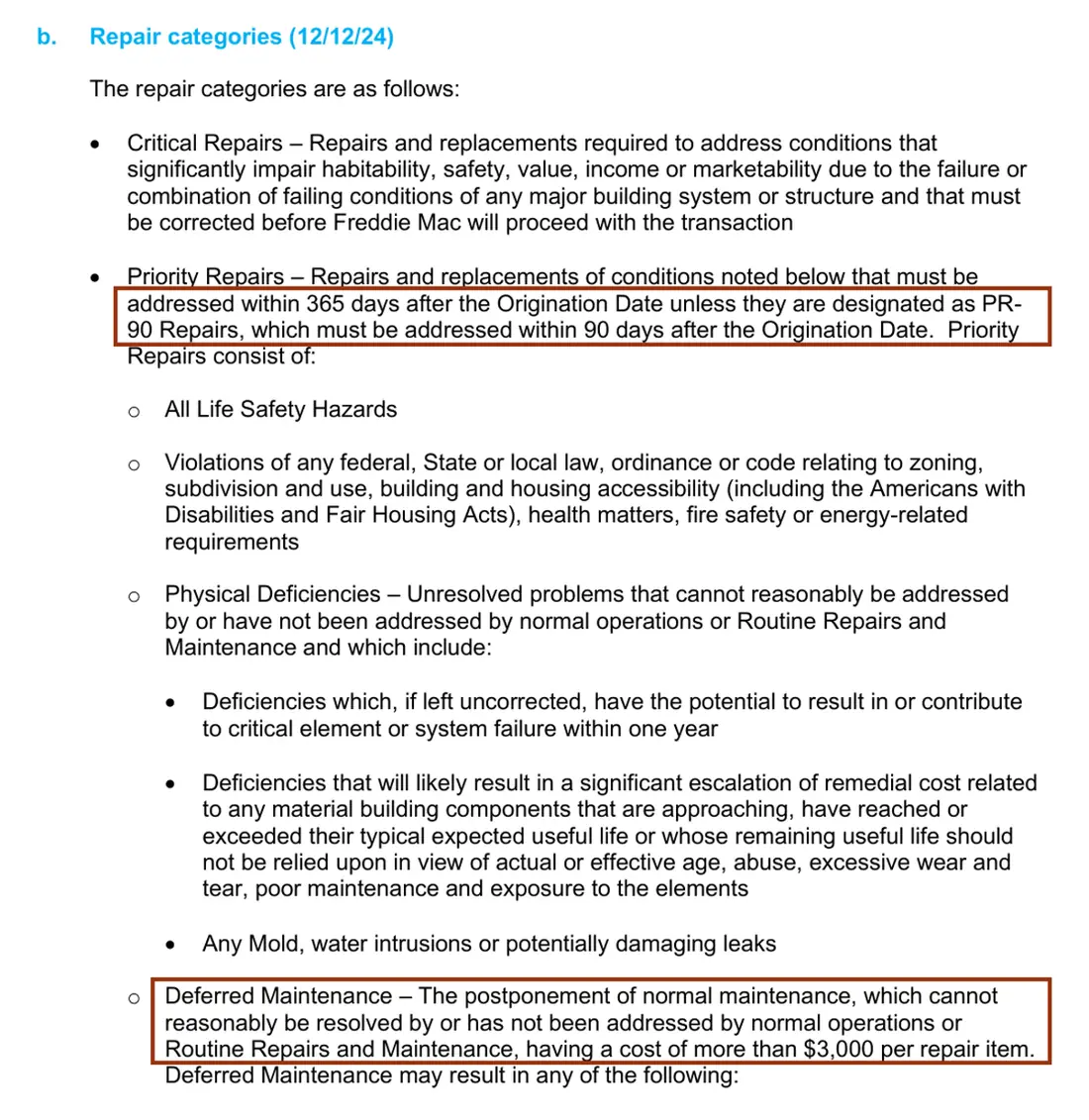
- Freddie Mac requires Priority Repairs within 365 days of origination and PR-90 Repairs within 90 days, and sizes reserves for the loan term plus 2 years, to a maximum of 12 years (Freddie Mac Guide Chapter 62).
- The current edition is ASTM E2018-24, a voluntary guide last updated January 4, 2024; Fannie Mae’s July 2026 Form 4099 still names the 2015 edition.
How much does a property condition assessment cost and how long does it take?
A property condition assessment costs from about $2,000 to well over $20,000, depending on the agreed scope, according to the NEEDDA user guide. Most site visits take 4 to 7 hours, the report follows 5 to 15 working days later, and the whole job typically takes 3 weeks, or 4 to 6 weeks for complex properties.
| Item | Figure | Source |
|---|---|---|
| Consultant fee, published range | About $2,000 to well over $20,000 | NEEDDA PCA User Guide |
| Baseline PCA quote, 4,641 sq ft two-story office, 12-year reserve table (Sept. 2020) | $2,675 ($0.58 per sq ft) | Fallbrook Regional Health District committee packet, October 2020 |
| Second quote, same building, basic services with specialists retained (2020) | $6,700 ($1.44 per sq ft) | Same packet |
| Same quote with seismic ($3,000), envelope ($3,500) and accessibility CASp ($3,500) reports | $16,700 ($3.60 per sq ft) | Same packet |
| Time on site | 4 to 7 hours for most PCAs; more for added scope | NEEDDA PCA User Guide |
| Report delivery | 5 to 15 working days after the site visit | NEEDDA PCA User Guide |
| Total duration | 3 weeks typical; 4 to 6 weeks for complex assessments | NEEDDA PCA User Guide |
| Public example | Site visit October 6, 2025; report October 16, 2025 | E2018-24 report 25-556137.1 |
The two 2020 quotes show what moves the fee: the same small office drew $2,675 for a baseline ASTM scope and $6,700 to $16,700 once specialist reviews were added; the second firm said its base fee would rise by $2,500 if the specialists were not retained. Per-square-foot figures are CB&C arithmetic on the stated 4,641 sq ft and are 2020 prices, so treat them as a floor for 2026 budgets.
Scope moves the fee more than size alone. Specialist add-ons named by NEEDDA include pavement, roof, envelope, elevator, seismic and fire and life safety consultants, and Fannie Mae requires modules for seniors, student, cooperative, modular and mixed-use properties (Form 4099 Section 2.2). Opinions of cost in a PCR are budget figures, not bids; compare them against contractor numbers with the steps in how to compare construction bids.
What is a property condition assessment, and what does ASTM E2018-24 require?
A property condition assessment is a consultant’s walk-through of a commercial building that records visible defects and prices the repairs, done before a purchase or loan. ASTM E2018-24 sets four parts: a walk-through survey, a review of documents and interviews, opinions of cost for the fixes, and a written property condition report (PCR) (Sections 1.1.2 to 1.1.4). It is a voluntary guide, not a code (Section 4.1).
ASTM sells the guide for $104, so most owners never read it; the practical point is that a PCA is a consultant’s opinion on condition and cost, not a pass or fail inspection.
The six steps below follow the guide’s order, with the time, threshold or document each one needs.
- Scope and threshold. The user states the purpose, the evaluation period and the reporting threshold, typically $3,000 per the NEEDDA guide.
- Document review. The consultant sends a pre-survey questionnaire and reviews certificates of occupancy, prior PCAs, maintenance records and recorded building or fire code violations.
- Walk-through survey. A field observer looks at readily accessible areas without testing or dismantling; most site visits take 4 to 7 hours, per NEEDDA.
- Interviews. The observer questions the owner, property manager and maintenance staff about repairs, leaks, complaints and planned work.
- Opinions of cost. Order-of-magnitude costs by line item, sorted into immediate, short-term and, if engaged, long-term tables.
- Report. The PCR with executive summary, cost tables, photographs and limitations, typically 5 to 15 working days after the visit.
What does a baseline PCA leave out?
A baseline PCA leaves out anything that needs testing, calculation or demolition. The public E2018-24 report filed in Utah lists exclusions including probing, dismantling equipment, NFPA hazard classifications, fire ratings of assemblies, STC ratings and capital improvements, and it excludes cost opinions under $3,000 for like items unless the addressee requests them (Partner report, Section 1 exclusions).
The NEEDDA guide adds confined spaces, elevator pits and shafts, code or OSHA compliance except as disclosed by local offices, and environmental issues such as asbestos, mold and potable water quality. Those topics need a separate scope, for example a Phase I environmental site assessment under ASTM E1527-21.
Which edition do PCA guides cite, and which is current?
Several guides still cite older editions. ASTM’s product page lists E2018-24 as the active edition and shows E2018-23, -15, -08, -01 and -99 as prior versions. The table below sets popular claims against the primary documents, each dated, so a reader can check which rule a consultant or lender actually uses as of October 2026.
| Claim you will see | What the primary document says | Source |
|---|---|---|
| “ASTM E2018-15 is the industry standard” (a top-ranking consultant guide, June 2026) | E2018-24 is Active, last updated January 4, 2024; it replaced E2018-15 (August 2015) with 140+ revisions | ASTM; Bureau Veritas |
| Lender guides use the newest edition | Fannie Mae Form 4099 (July 2026) names “ASTM 2018-15” and E2018-08 “as amended or restated”; Freddie Mac asks reports to state deviations from “the most recent version” of E2018 | Form 4099 Sections 1.3, 2.1; Freddie Mac 62.3(c) |
| Short-term means 0 to 1 year (the same guide) | The E2018-24 report wording defines short-term by priority, not months; the lender sets the clock (Freddie Mac 365 days; Fannie Mae typically 12 months) | Partner report; Chapter 62.3(b); Form 4099 Section 4.2.B |
| A PCA tells you whether the building passed | “PCAs do not constitute an inspection per se”; they record conditions at the time of the visit | NEEDDA guide |
| Every PCA includes a reserve study | Reserves are not required by ASTM; the committee could not agree on a method. Freddie Mac and Fannie Mae require one | NEEDDA guide; Chapter 62.6(f) |
How does a PCA compare with a Phase I ESA, an inspection and a reserve study?
A PCA answers what is physically wrong with the building and what it will cost. A Phase I ESA under ASTM E1527-21 answers whether contamination creates CERCLA liability. A commercial inspection under the ComSOP describes conditions without prices. A reserve study plans long-term funding, and in Florida condominiums it is a statutory duty under section 718.112(2)(g).
| Assessment | Question it answers | Governing rule | Performed by | Prices repairs? | Timing rule | Source |
|---|---|---|---|---|---|---|
| Property condition assessment | Physical deficiencies and cost to fix them | ASTM E2018-24 plus lender guide | Consultant and field observer; ASTM does not require a licensed professional, per NEEDDA | Yes, above the threshold | Freddie Mac: report within 6 months of package | ASTM; NEEDDA; Ch. 62 |
| Phase I environmental site assessment | Recognized environmental conditions and CERCLA landowner liability protections | ASTM E1527-21; EPA All Appropriate Inquiries, 40 CFR Part 312 | Environmental professional (degree plus 5 years, license plus 3 years, or 10 years) | No | Within 1 year of acquisition; some parts within 180 days | EPA AAI |
| Commercial property inspection | Observed condition of systems | CCPIA/InterNACHI ComSOP | Commercial inspector | Not required (ComSOP 7.12) | None set | CCPIA ComSOP |
| Florida structural integrity reserve study | Reserve funding for structure, roof, fire protection, plumbing, electrical, waterproofing, windows | Fla. Stat. 718.112(2)(g) | Florida engineer or architect, or certified reserve specialist | Yes, reserve schedule | Every 10 years, buildings of 3+ habitable stories | Florida Statutes |
| Florida milestone inspection | Structural safety of condo and co-op buildings | Fla. Stat. 553.899 | Florida licensed architect or engineer | No; phase two if deterioration found | By December 31 of the year the building turns 30 (25 if the local agency requires), then every 10 years | Florida Statutes |
A Florida buyer can meet several of these at once. A buyer of a mixed-use condo tower can receive a PCA for the lender, a Phase I ESA for liability protection and the association’s milestone report, and our Florida hurricane risk by county data shows where wind exposure adds roof and envelope findings.
What is the difference between immediate, short-term and long-term costs?
Immediate costs fix imminent life-safety issues, deficiencies likely to cause a system failure, and recorded building or fire code violations. Short-term costs cover deficiencies that should be handled on a priority basis but do not need instant action. Long-term costs are the capital replacements expected during the evaluation period, which the client must ask for, according to the wording in a 2025 E2018-24 report.
Agency lenders rename and time-box the same tiers. The table compares the three frameworks line by line.
| Tier | ASTM E2018-24 (report wording) | Freddie Mac Chapter 62 | Fannie Mae Form 4099 |
|---|---|---|---|
| Most urgent | Immediate: imminent life safety, likely system failure, recorded code violations | Critical Repairs: fixed before Freddie Mac proceeds; PR-90 Repairs: within 90 days of origination | Immediate Repair Items (life safety, moisture, pests, energy compliance); Critical Repairs typically within 6 months of the report |
| Next | Short-term: priority basis | Priority Repairs: within 365 days of origination | Deferred Maintenance Items: typically within 12 months of the report |
| Capital plan | Long-term cost opinion, only if engaged | Replacement Reserves: loan term plus 2 years, maximum 12 | Replacement of Capital Items: loan term plus 2 years, 3% annual inflation |
| Below threshold | Under $3,000 for like items excluded unless requested | Routine Repairs and Maintenance: $3,000 or less per repair item | No dollar threshold stated; consultant judgment |
What is the de minimis threshold in a PCA?
The de minimis threshold is the dollar line below which a PCA does not price an item. In the E2018-24 report filed in Utah it is $3,000 for like items, and the report’s good, fair and poor ratings are measured against that threshold. NEEDDA calls it a client-set amount, “typically $3,000”, and Freddie Mac fixes it at $3,000 per repair item.
The word means something else in environmental due diligence. ASTM E1527-21 states that “a de minimis condition is not a recognized environmental condition”, a test of condition, not of dollars (ASTM E1527-21). A buyer reading both reports should not treat the two uses as the same.
What do Fannie Mae and Freddie Mac require in a PCA?
Both agencies require a PCA before they buy a multifamily loan and both add rules ASTM leaves open. Freddie Mac requires the report before it issues a Letter of Commitment, bars the borrower from retaining or directing the consultant, and requires a site visit within 30 days of the report date (Chapter 62, updated 08/25/26). Fannie Mae has the lender select the consultant.
| Requirement | Freddie Mac | Fannie Mae | Source |
|---|---|---|---|
| Who hires the consultant | Seller/Servicer; the borrower may pay but must not retain or direct | Lender selects; consultant must be an independent third party | Ch. 62.2; Form 4099 Section 1.3.A to B |
| Report freshness | Report dated within 6 months before the full underwriting package; site visit within 30 days before the report | Not stated in Form 4099 | Ch. 62.3(c) |
| Units observed | 100% of commercial units; at least 10% of residential units, 50% of vacant and 50% of down units | 5 to 50 units: at least 5 occupied; 51 to 300: 10%; over 300: 5%, not less than 30 | Ch. 62.5(b); Form 4099 Section 3.2.C |
| Reserve horizon | Loan term plus 2 years, maximum 12 | Loan term plus 2 years | Ch. 62.6(f); Form 4099 Section 1.1 |
| Cost basis | Unit, quantity, per-item and total cost for each repair | RS Means or similar no more than 2 years old, inflated 3% per year, with city indices | Ch. 62.6(c); Form 4099 Section 4.2.A |
| Consultant experience | Section 62.8 qualifications | 5 years in architecture, engineering or cost estimating; field observer 3 years and 5 multifamily inspections | Ch. 62.8; Form 4099 Section 1.3.C to D |
| Report form | Form 1105, Sections I to VII | Form 4099 report format, Sections 1 to 7 plus exhibits | Ch. 62.6; Form 4099 Section 3.3 |
The clocks matter for closing schedules. A Freddie Mac PCR dated more than 6 months before the Letter of Commitment may have to be updated, and HUD’s MAP program uses its own Capital Needs Assessment, completed no earlier than 180 days before the Firm Commitment application and filed in HUD’s CNA e-Tool (MAP Guide Section 5.10.3).
What does a property condition report look like in numbers?
A real E2018-24 report shows the scale. Partner Engineering and Science assessed a 13,000 sq ft modular charter school in Alpine, Utah, built in 2011, on October 6, 2025, and issued the report on October 16, 2025. It priced $13,850 of immediate repairs and $265,000 of capital needs over a 12-year evaluation period, or $298,034 at 2.50% inflation (Project 25-556137.1).
The year-6 spike is one event: a $117,000 thermoplastic roof (13,000 sq ft at $9.00), $42,000 for 35 tons of heat pumps at $1,200 per ton, a $15,000 fire alarm panel and $44,000 of carpet, all with a 6-year remaining useful life. The table repeats the report’s arithmetic and reruns it at Fannie Mae’s 3% factor.
| Line | Report figure | Arithmetic |
|---|---|---|
| Immediate repairs (Table 1) | $13,850 | $13,850 / 13,000 sq ft = $1.07 per sq ft |
| Year 1 capital items | $14,500 | Uninflated in year 1 |
| Year 2 | $12,000 uninflated, $12,300 inflated | $12,000 x 1.025 = $12,300 |
| Year 3 | $6,000 uninflated, $6,304 inflated | $6,000 x 1.025^2 = $6,304 |
| Year 6 | $218,000 uninflated, $246,647 inflated | $218,000 x 1.025^5 = $246,647 |
| Year 9 | $4,500 uninflated, $5,483 inflated | $4,500 x 1.025^8 = $5,483 |
| Year 11 | $10,000 uninflated, $12,801 inflated | $10,000 x 1.025^10 = $12,801 |
| 12-year total | $265,000 uninflated, $298,034 inflated | $265,000 / 13,000 / 12 = $1.70; $298,034 / 13,000 / 12 = $1.91 per sq ft per year |
| Same schedule at Fannie Mae’s 3% (CB&C) | $305,086 | Year 6 becomes $218,000 x 1.03^5 = $252,722; total = $1.96 per sq ft per year |
Two lessons carry to other buildings. One event can hold most of the money: year 6 is $218,000 of the $265,000, or 82%. And the inflation rate is a lender input, not a fact about the building, which moved this 12-year total by $7,052.
Why does building age change what a PCA finds?
Building age changes a PCA because the reserve table prices every component whose remaining useful life ends inside the evaluation period (Fannie Mae Form 4099 Section 4.2.C). EIA’s 2018 CBECS put the median U.S. commercial building at 36 years and found 46.3% of the 5,918 thousand buildings were built before 1980 (Table B8). Our commercial building stock age report has the full breakdown.
| Building type | Median age, 2018 (years) | Built before 1980 | Source |
|---|---|---|---|
| Religious worship | 45 | 62.6% | EIA CBECS 2018 B2, B8 |
| Retail (other than mall) | 43 | 53.7% | EIA CBECS 2018 B2, B8 |
| Office | 38 | 47.2% | EIA CBECS 2018 B2, B8 |
| Education | 37 | 48.1% | EIA CBECS 2018 B2, B8 |
| All buildings | 36 | 46.3% | EIA CBECS 2018 B2, B8 |
| Health care | 29 | 32.8% | EIA CBECS 2018 B2, B8 |
| Warehouse and storage | 28 | 33.9% | EIA CBECS 2018 B2, B8 |
| Lodging | 27 | 33.3% | EIA CBECS 2018 B2, B8 |
Renovation history narrows the gap only partly. Of the 831 thousand buildings built in the 1970s, 505 thousand, or 60.8% (CB&C calculation), reported no renovation between 2000 and 2018, and only 14.3% of all buildings reported a roof replacement in that period (EIA CBECS 2018 Table B8). A PCA on an older building that will be upgraded should be read alongside a commercial renovation contractor scope, and in 16 jurisdictions alongside building performance standards deadlines.
Which assessment do you need?
The right assessment depends on who is relying on it and which rule applies. Use the table: each row names a condition, the step it calls for and the rule behind it. Where an alteration or change of use follows the purchase, check permit triggers in our guide to commercial building permits before relying on PCA costs, which exclude capital improvements.
| If | Then | Rule |
|---|---|---|
| You are financing a multifamily loan sold to Freddie Mac | The Seller/Servicer orders the PCA; do not retain or direct the consultant yourself | Freddie Mac Ch. 62.2 |
| Your Freddie Mac PCR will be more than 6 months old at commitment | Budget for an update and a new site visit | Ch. 62.3(c) |
| A repair item costs $3,000 or less | Expect it to be treated as routine maintenance and left out of the cost tables | Ch. 62.3(b); E2018-24 report exclusions |
| You want small items priced anyway | Write a lower threshold into the engagement letter | NEEDDA: threshold set by the client |
| You need CERCLA landowner liability protection | Order a Phase I ESA under ASTM E1527-21 within 1 year of closing, with key parts within 180 days | 40 CFR Part 312 |
| The building is a Florida condo of 3+ habitable stories | Ask the association for its milestone inspection and SIRS, not just a PCA | Fla. Stat. 553.899; 718.112(2)(g) |
| The PCA cannot price an item without more study | Require the recommended scope and cost of that study in the report | Ch. 62.3(a) |
| You want the seller’s existing PCA | Get a reliance letter from the consultant and a fresh site visit | NEEDDA guide; ASTM 4.1 point-in-time limit |
This page describes published standards and lender guides for general information and is not legal, lending or investment advice; your lender’s commitment letter and engagement agreement govern a specific transaction. Construction cost references for budgeting repairs found in a PCR are in our commercial construction cost per square foot guide.
How we compiled this
CB&C compiled this page in October 2026 from 13 primary documents, including a public agency’s 2020 committee packet with two PCA fee quotes for one building, the ASTM product pages, Freddie Mac Chapter 62, Fannie Mae Form 4099, one public E2018-24 report, two Florida statutes and two EIA CBECS tables, plus 2 secondary summaries. We did not buy the full ASTM text, so E2018-24 wording comes from reports that cite it. We did not perform or commission any assessment.
Frequently asked questions
How much does a property condition assessment cost?
The NEEDDA user guide puts PCA fees at about $2,000 to well over $20,000, with scope the main driver. In one public 2020 example, a 4,641 sq ft office drew a $2,675 baseline quote and a $6,700 quote that reached $16,700 with seismic, envelope and accessibility specialists. Lender formats, unit sampling and specialist add-ons push the fee up.
What is the difference between a PCA and a property condition report?
The property condition assessment (PCA) is the process: document review, walk-through survey and interviews. The property condition report (PCR) is the written deliverable. ASTM E2018-24 uses both terms, and Freddie Mac Chapter 62 calls the deliverable a property condition report, also known as an engineering report, submitted with Form 1105 before a Letter of Commitment issues.
Who performs a property condition assessment?
A consultant firm sends a field observer, and a reviewer signs the report. ASTM E2018-24 does not require a licensed architect or engineer, per the NEEDDA user guide. Fannie Mae Form 4099 sets minimums: a consultant with 5 years of architecture, engineering or cost estimating experience, and a field observer with 3 years and 5 multifamily inspections.
How long is a property condition assessment valid?
ASTM E2018-24 treats a report as valid only for the date of the site visit (Section 4). Lenders set their own limits: Freddie Mac wants the report dated within 6 months before the full underwriting package and the site visit within 30 days of the report. HUD accepts a prior Capital Needs Assessment up to 3 years old with approval.
Is a property condition assessment the same as a facility condition assessment?
No. A PCA under ASTM E2018-24 is transaction due diligence for a buyer or lender, priced above a threshold such as $3,000, and Freddie Mac caps its reserve horizon at 12 years. A facility condition assessment is an owner’s capital planning survey across one or many buildings, with a scope and rating scale the owner sets rather than a lender guide.
Does a property condition assessment check code and ADA compliance?
Only partly. A baseline PCA notes recorded building and fire code violations that the city discloses, and the Partner E2018-24 report sent written requests to three local building, fire and zoning offices on September 29, 2025. It does not verify code compliance or perform an accessibility survey; Freddie Mac Chapter 62.4 adds readily observable ADA and Fair Housing Act issues.
Can a buyer rely on the seller's property condition assessment?
Only with the consultant’s written permission. The NEEDDA guide says reports are prepared for a specific client and purpose, consultants are reluctant to extend reliance, and a separate agreement is needed. Freddie Mac requires named reliance language for the lender, rating agencies and securitization parties, so a seller’s report written for another client may lack the reliance language a new lender requires.
Sources
- ASTM International, E2018-24 Standard Guide for Property Condition Assessments: Baseline Property Condition Assessment Process, accessed 2026-10-19.
- Bureau Veritas, Summary of Changes to ASTM E2018-24, accessed 2026-10-19.
- Freddie Mac, Multifamily Seller/Servicer Guide Chapter 62, Property Condition Report Requirements (Guide Bulletin update 08/25/26), accessed 2026-10-19.
- Fannie Mae, Instructions for Performing a Multifamily Property Condition Assessment, Form 4099 (July 2026), accessed 2026-10-19.
- Partner Engineering and Science, Property Condition Report, 195 S Main Street, Alpine, Utah, Project 25-556137.1 (October 16, 2025), Utah Public Notice Website, accessed 2026-10-19.
- National Engineering and Environmental Due Diligence Association, Property Condition Assessment User Guide, accessed 2026-10-19.
- ASTM International, E1527-21 Phase I Environmental Site Assessment Process, accessed 2026-10-19.
- U.S. EPA, Brownfields All Appropriate Inquiries, accessed 2026-10-19.
- U.S. HUD, MAP Guide 4430.G, Section 5.10.3 Capital Needs Assessment (rev. March 2021, mirror), accessed 2026-10-19.
- Florida Legislature, 2026 Florida Statutes s. 718.112 and s. 553.899, accessed 2026-10-19.
- CCPIA, International Standards of Practice for Inspecting Commercial Properties (ComSOP), accessed 2026-10-19.
- U.S. EIA, 2018 CBECS Table B2 and Table B8, accessed 2026-10-05.
- Fallbrook Regional Health District, Facilities Committee packet, October 23, 2020: proposals for property condition assessments, 138 S. Brandon Road, accessed 2026-10-26.