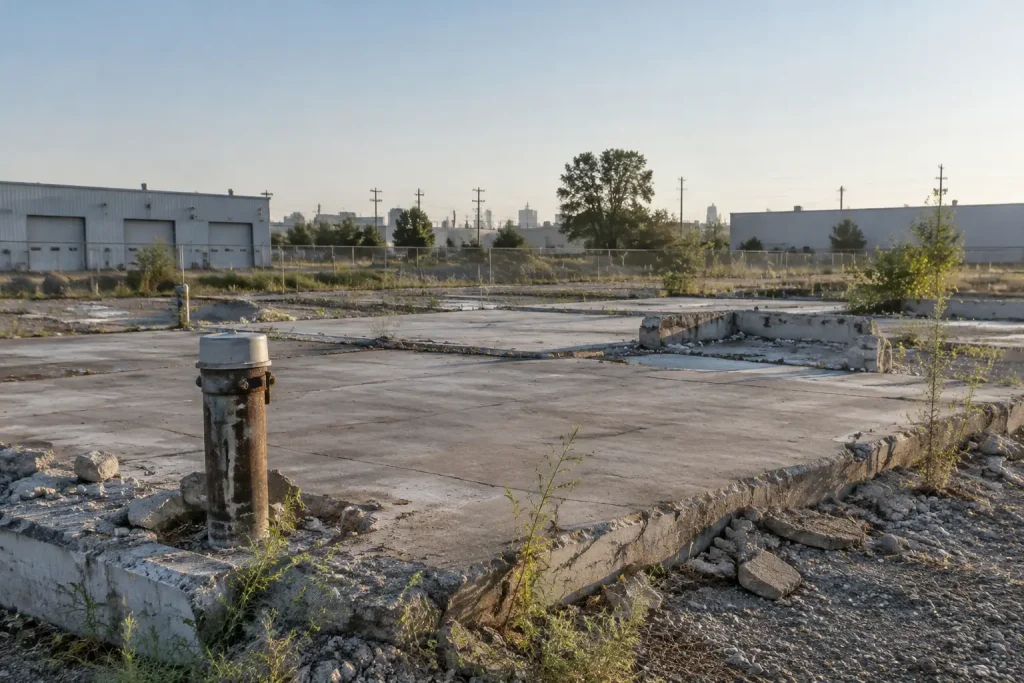
A phase 1 environmental site assessment is a records review, site visit and interviews under ASTM E1527-21 that flags likely contamination before you buy or build: prices run about $2,000 to $3,500, and the work takes 2 to 3 weeks.
Key takeaways
- A standard Phase I averages $2,000 to $3,000 according to the Iowa DNR brownfields program (2025) and $2,000 to $3,500 in a consultant’s 2023 estimate; federal orders for single buildings in 2024 and 2025 ran $4,431 to $7,344 (USAspending).
- Expect 10 to 15 business days of consultant work (Fehr Graham, March 2023) or 4 to 8 weeks in a grant-funded city program; a Phase II, if needed, adds 6 to 12 weeks (City of Cortez, Colorado).
- A Phase I is good for one year before you take title, but five parts (interviews, the lien search, the government records review, the site visit and the signed declaration) must fall within 180 days, counted from each part’s own date, not the report date (40 CFR 312.20; ASTM E1527-21 section 4.6.3).
- A Phase I takes no samples. If it finds a recognized environmental condition (REC), a Phase II samples soil, groundwater or soil vapor; EPA’s federal Phase II orders on single brownfield sites in 2024 ran $53,741 to $224,831 (USAspending).
- Under SBA SOP 50 10 8.1 (effective October 1, 2026), a Phase I is required at any loan size if the property’s current or prior use matches Appendix 6, which lists NAICS 237 heavy and civil engineering construction.
- PFOA and PFOS became CERCLA hazardous substances on July 8, 2024 (89 FR 39124), which puts them inside the E1527-21 scope.
How much does a phase 1 environmental site assessment cost, and how long does it take?
Plan on about $2,000 to $3,500 and 2 to 3 weeks for a standard Phase I on an ordinary commercial site. The Iowa DNR brownfields guide (2025) puts the average at $2,000 to $3,000, a consultant (Fehr Graham, 2023) quotes $2,000 to $3,500 and 10 to 15 business days, and federal orders for single buildings in 2024 and 2025 ran $4,431 to $7,344. None of these covers sampling.
| Item | Published figure | Publisher and date | Type of source |
|---|---|---|---|
| Phase I ESA | $2,000 to $3,000 average | Iowa DNR Brownfield Redevelopment Program, PDF created October 2025 | State agency |
| Phase I ESA | $2,000 to $3,500 unless extra services are requested | Fehr Graham, March 15, 2023 | Consultant estimate |
| Phase I, one hospital (Claremore Indian Hospital, Oklahoma) | $4,431.09 | Indian Health Service order, August 2025 (USAspending) | Federal award record |
| Phase I, one office building (Liberty Loan Building, Washington, DC) | $7,343.62 | GSA order, September 2024 (USAspending) | Federal award record |
| Phase I to ASTM E1527-21, two buildings (Haverhill, Massachusetts) | $15,903.29 for both | GSA order, June 2024 (USAspending) | Federal award record |
| Asbestos inspection (add-on) | $1,000 to $2,500 average | Iowa DNR | State agency |
| Phase I working time | 10 to 15 business days | Fehr Graham, March 15, 2023 | Consultant estimate |
| Phase I, grant-funded program | 4 to 8 weeks; site visit about 2 hours | City of Cortez, Colorado, August 2023 | Municipal program guide |
| Phase II, grant-funded program | 6 to 12 weeks | City of Cortez, Colorado, August 2023 | Municipal program guide |
| Phase II, one brownfield site (former school, Virginia) | $53,740.68 | EPA order, August 2024 (USAspending) | Federal award record |
| Phase II, one brownfield site (former meat plant, Pennsylvania) | $224,830.81 | EPA order, August 2024 (USAspending) | Federal award record |
The federal orders sit above the private estimates and are written under federal contract terms, so treat them as an upper reference for one building, not a quote. They are the full award amounts recorded on USAspending.gov as of October 26, 2026, and the records do not state building size, so no per-square-foot figure is given.
Fehr Graham names what pushes a fee up: extra services such as additional property index numbers for lien searches, ALTA surveys and lead or asbestos surveys, and longer site inspections. A hard-to-reach records history adds time too; under 40 CFR 312.24(b), historical review must reach back to the property’s first developed use, subject to the professional’s judgment, so an old industrial parcel takes longer than a 2010s retail pad.
Build the schedule backward from closing. If the Phase I finds a REC and the Cortez program’s 6 to 12 week Phase II estimate applies, a buyer who orders the Phase I 4 weeks before closing will not have sampling results in time. Our commercial construction process guide shows where due diligence sits in a typical project calendar.
What is a phase 1 environmental site assessment?
A Phase I ESA is the written inquiry an environmental professional prepares to find recognized environmental conditions (RECs): signs that hazardous substances or petroleum were released on the property. It follows ASTM E1527-21, which EPA accepts as meeting its All Appropriate Inquiries (AAI) rule at 40 CFR Part 312. Done before you buy, it is a condition for three defenses against cleanup liability under CERCLA, the federal Superfund law.
Those three defenses (innocent landowner, bona fide prospective purchaser and contiguous property owner, listed in 40 CFR 312.1(b)) are why buyers and lenders order a Phase I. EPA’s lender liability fact sheet adds that a bona fide prospective purchaser must have acquired the property after January 11, 2002 and keep meeting continuing obligations, such as land use restrictions, after closing. No Phase I removes all risk: ASTM E1527-21 section 4.5.1 says no assessment can wholly eliminate uncertainty.
For construction, the Phase I sits in the feasibility stage, next to the survey and geotechnical report, before a buyer commits to a parcel for ground-up work. Owners planning a building on raw or redeveloped land can see where it lands in the sequence on our guide to new commercial construction from bare lot to certificate of occupancy. This page is general information compiled from public rules, not legal or environmental advice for any specific property.
What does a Phase I include under ASTM E1527-21?
A Phase I has ten required parts in 40 CFR 312.21 to 312.31: interviews, historical records, a lien search, government records, a site visit, the buyer’s specialized knowledge, the price check, commonly known information, the degree of obviousness and a signed declaration. Some belong to the environmental professional and some to the buyer, called the user. Five of the ten, including the declaration, carry the 180-day limit.
| Component | Rule section | Done by | Within 180 days of closing? |
|---|---|---|---|
| Interviews with past and present owners, operators and occupants | 312.23 | Environmental professional | Yes |
| Historical sources: aerial photographs, fire insurance maps, building department records, chain of title, land use records | 312.24 | Environmental professional | No (one year) |
| Search for recorded environmental cleanup liens | 312.25 | User, unless the professional is hired for it | Yes |
| Federal, tribal, state and local government records for the site and adjoining properties | 312.26 | Environmental professional | Yes |
| Visual inspection of the property and adjoining properties | 312.27 | Environmental professional | Yes |
| Specialized knowledge or experience of the user | 312.28 | User | No (one year) |
| Purchase price compared with fair market value if uncontaminated | 312.29 | User | No (one year) |
| Commonly known or reasonably ascertainable information | 312.30 | User and professional | No (one year) |
| Degree of obviousness of contamination | 312.31 | Environmental professional | No (one year) |
| Signed declaration by the environmental professional | 312.21(d) | Environmental professional | Yes |
The 2021 edition also requires a site plan and photographs and a Conclusions section that lists every REC, CREC and significant data gap (sections 12.3 and 12.7), per EPA’s comparison of the AAI rule with ASTM E1527-13 and E1527-21.
Some items are not in a standard Phase I. Fehr Graham lists lien searches, ALTA property surveys and lead and asbestos surveys as supplemental services, and the Iowa DNR prices an asbestos inspection separately at $1,000 to $2,500. If a renovation or demolition is planned, ask the consultant to quote those surveys at the same time so the results reach the commercial building permit application.
How long is a Phase I ESA good for?
For CERCLA protection, a Phase I can be relied on for one year before the date you take title, but five components must be done or updated within 180 days before that date (40 CFR 312.20). Those five are the owner and occupant interviews, the lien search, the government records review, the site visit and the environmental professional’s declaration. Miss either window and the inquiry needs an update before closing.
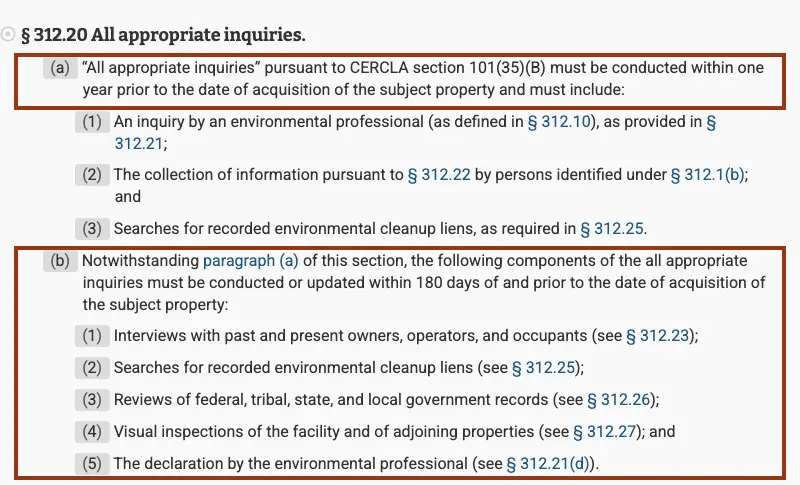
Section 312.20(c) lets a buyer use an earlier inquiry only if its information was collected or updated within one year and the same five components fall inside 180 days. ASTM E1527-21 section 4.6.1 applies the same windows to leases and refinances, counting to the date of the intended transaction instead of the acquisition date.
Does the 180-day clock start on the report date?
No. ASTM E1527-21 section 4.6.3 says the report date generally does not show when the individual components were completed and should not be used to judge the 180-day or one-year limits. Section 4.6.1 requires the report to list the dates of the interviews, records review, site visit and declaration. The earliest of those dates sets your real deadline.
The worked example below assumes a planned closing on March 31, 2027 and a report signed October 9, 2026. Counting 180 days from the earliest component gives March 9, 2027; counting from the report date would wrongly suggest April 7, 2027.
| Date | Event | Effect on the windows |
|---|---|---|
| Mar 31, 2026 | One-year window opens (365 days before the planned closing) | One-year window: all AAI work (312.20(a)) must be dated on or after this day |
| Sep 10, 2026 | Records review (earliest component) | Sep 10, 2026 + 180 days = Mar 9, 2027 |
| Sep 15, 2026 | Site visit and interviews | Good for closings through Mar 14, 2027 |
| Sep 20, 2026 | User’s lien search | Good for closings through Mar 19, 2027 |
| Oct 2, 2026 | 180-day window opens for a Mar 31 close | 180-day window: 5 components (312.20(b)); any component dated earlier needs an update |
| Oct 9, 2026 | Report signed (declaration) | Report date + 180 days = Apr 7, 2027, which is not the test |
| Mar 9, 2027 | Last closing day without updates | Last day all five components sit inside 180 days |
| Mar 31, 2027 | Planned closing | Records review, site visit, interviews and lien search must be redone |
SBA uses a looser rule for its own review. SOP 50 10 8.1, Appendix 4, accepts an otherwise AAI compliant Phase I dated within one year of the date the SBA loan number is issued, “notwithstanding the EPA’s regulations on updating Phase I ESAs after 180 days.” The same paragraph warns that parties may still wish to meet EPA’s timeframes to keep their legal protections, so a borrower who is also buying the land has two clocks to track.
Is ASTM E1527-13 still accepted?
Not for new work. EPA’s final rule at 87 FR 76578, published December 15, 2022, recognized ASTM E1527-21 from February 13, 2023 and removed E1527-13 from 40 CFR 312.11 one year after publication. EPA wrote that a Phase I completed before that date using E1527-13 “will be recognized as compliant,” but its 180-day and one-year windows have long since run out.
| What several guides say | What the primary source says | Source |
|---|---|---|
| ASTM E1527-13 is the current standard (Wikipedia article, read October 2026) | E1527-21 is the active ASTM edition; EPA’s reference to E1527-13 ran until February 13, 2024 | 87 FR 76578; 40 CFR 312.11 |
| Every E1527-13 report is now invalid | A Phase I completed with E1527-13 before February 13, 2024 is recognized as compliant; the time windows still apply | 87 FR 76578 |
| A Phase I is valid for 180 days from the report date | Each of five components must fall within 180 days before acquisition; the report date should not be used | ASTM E1527-21 4.6.3; 40 CFR 312.20(b) |
| A Phase I never covers PFAS | Emerging contaminants are outside scope until designated under CERCLA; PFOA and PFOS were designated effective July 8, 2024 | EPA comparison; 40 CFR 302.4 |
| SBA requires a Phase II for gas stations operating more than 5 years | SOP 50 10 8.1 Appendix 7: a Phase I by an independent professional, tank testing compliance and any further work the professional recommends | SBA SOP 50 10 8.1 |
Forestland and rural property follow a separate standard, ASTM E2247-23, recognized in 89 FR 52386 on June 24, 2024.
What do REC, CREC, HREC and de minimis mean?
A recognized environmental condition (REC) is the presence or likely presence of hazardous substances or petroleum products at the property from a release, or conditions that pose a material threat of a future release (ASTM E1527-21 section 1.1.1). CRECs are a subset of RECs. HRECs and de minimis conditions are not RECs, and that distinction decides whether a lender asks for a Phase II.
| Term | Meaning under ASTM E1527-21 | Illustration (hypothetical) | What it usually means for the deal |
|---|---|---|---|
| REC | Presence of hazardous substances or petroleum from a release; likely presence from a release or likely release; or a material threat of a future release | Stained soil beside a former maintenance bay floor drain | Listed in the report’s Conclusions section; the professional gives an opinion on further investigation |
| CREC | A past release addressed to the regulator’s satisfaction, with substances left in place under controls such as activity and use limitations or engineering controls | A closed fuel spill with a deed restriction barring groundwater wells | Still a REC; the buyer must keep the controls in place to keep CERCLA protection |
| HREC | A past release addressed to the regulator’s satisfaction that meets unrestricted use criteria with no controls | A removed tank with a no further action letter for unrestricted use | Not a REC; the professional must confirm current rules have not changed |
| De minimis condition | A condition that generally would not be the subject of enforcement action if brought to regulators’ attention | Minor drips under a parked forklift | Not a REC; noted, not escalated |
| Significant data gap | A data gap that affects the professional’s ability to identify a REC | No records for 20 years of prior industrial use | Must be listed in Findings and Conclusions; can trigger more work |
The CREC and HREC wording follows a 2023 NEWMOA workshop presentation by Ramboll that quotes the standard. Its key point for buyers: contamination left above unrestricted use levels can never be an HREC, so it stays on the REC list.
When does a Phase I lead to a Phase II?
A Phase II follows when the Phase I lists a REC or a significant data gap and the buyer or lender wants to know whether contamination is actually there. ASTM E1527-21 section 12.8 asks the professional for an opinion on whether additional investigation may be appropriate, not a specific work plan. A Phase II collects soil, groundwater or soil vapor samples, which a Phase I never does.
- A REC or CREC in the Conclusions section (ASTM E1527-21 section 12.7).
- A significant data gap the professional says limits the opinion (section 12.5.1).
- An SBA loan where the Phase I concludes further investigation is warranted: the lender must proceed as the professional recommends or request an exception (SOP 50 10 8.1).
- Any SBA collateral with on-site dry cleaning, current or historical, that used chlorinated or petroleum solvents: Phase I followed by Phase II covering soil, groundwater and soil vapor.
- Gas station collateral where the professional recommends it (SOP 50 10 8.1, Appendix 7).
SBA defines a Phase II by ASTM E1903-19 and requires a Phase II for dry cleaner or gas station collateral to be run by a professional holding a current PE or PG license with 3 years of relevant experience. When a Phase II finds contamination, SOP 50 10 8.1 asks for a remediation cost estimate and names ASTM E2137-22 as one method. For a builder, that estimate belongs in the site work budget before grading bids are compared, as our commercial construction cost per square foot guide explains for other soft and site costs.
Does an SBA loan require a Phase I?
Not always. SBA requires some environmental investigation for all commercial real estate pledged as collateral on 7(a) and 504 loans, and SOP 50 10 8.1 sets the starting point by use and loan size. A Phase I is mandatory at any amount when the property’s current or known prior use matches an Appendix 6 industry. For 7(a) loans, missing these steps “may result in a denial of SBA’s guaranty.”
| Situation | SBA minimum starting point | SOP 50 10 8.1 reference |
|---|---|---|
| Step 1: Compare current and prior uses to the SBA Appendix 6 NAICS list | A match or no match decides the path | Para. E, Investigation Steps |
| Step 2: Loan amount? (only when there is no match) | Up to $250,000 or over $250,000 | Para. E, Investigation Steps |
| Match: current or prior use is on Appendix 6 (for example NAICS 237, 8111 or 8123) | Phase I ESA required at any loan amount | Section A, Ch. 5, Para. E; Appendix 6 |
| Gas station or fuel vendor, NAICS 457 | Phase I plus the gas station rules | Appendix 7 |
| Business sells, supplies or dispenses fuel or heating oil, even off the list | Phase I | Appendix 6 footnote |
| On-site dry cleaning, ever | Phase I plus Phase II on soil, groundwater and soil vapor | Para. E (dry cleaning) |
| No match or 4+ unit building, loan up to $250,000 | Environmental Questionnaire may be enough | Para. E, Investigation Steps |
| No match or 4+ unit building, loan over $250,000 | Questionnaire plus Records Search with Risk Assessment | Para. E, Investigation Steps |
| Questionnaire shows a concern found | Records Search with Risk Assessment at minimum | Para. E |
| Records Search result: low risk | Low risk: keep in loan file | Para. E |
| Records Search result: not low risk | Phase I ESA (ASTM E1527-21) | Para. E |
| Phase I: no further investigation warranted | No further work: keep in loan file | Para. E |
| Phase I: further investigation warranted | Further work: Phase II or exception, requested from the SBA Environmental Committee | Para. E |
Appendix 6 matters for contractors buying their own yards. It lists NAICS 237 (heavy and civil engineering construction) outright, 53241 construction machinery rental when repairs, maintenance or vehicle washing happen on site, and 484 trucking when service bays, truck washing or fuel tanks are present. A Phase I prepared for SBA must also come with SBA’s Reliance Letter from Appendix 5, which cannot be modified.
The lender, not the borrower, runs these steps and keeps the reports in the loan file. For approval volumes and average loan sizes by state, see our research on SBA loans for construction companies.
Who can sign a Phase I, and what must the buyer supply?
Only an environmental professional as defined in 40 CFR 312.10 can sign the declaration. That means a current PE or PG license plus 3 years of relevant experience, a government license or certification plus 3 years, a bachelor’s degree in engineering or science plus 5 years, or 10 years of relevant experience. Others may help under that person’s supervision.
The buyer has its own duties under 40 CFR 312.22: the lien search, any specialized knowledge, whether the price is below fair market value for an uncontaminated property, and commonly known information. ASTM E1527-21 Appendix X3 offers an optional user questionnaire for these items. The steps below put them in order for a commercial site purchase.
- Fix the target closing date and count back 180 days; that is the earliest date the interviews, lien search, records review, site visit and declaration can carry (40 CFR 312.20(b)).
- List the parcel’s current and known prior uses with NAICS codes if an SBA loan is involved, and check them against SOP 50 10 8.1 Appendix 6.
- Hire a professional who meets 40 CFR 312.10; for SBA work confirm $1,000,000 per claim errors and omissions cover, independence from the seller and willingness to sign the Appendix 5 Reliance Letter.
- Order the environmental cleanup lien search through your title company or the consultant (40 CFR 312.25).
- Complete the user questionnaire: specialized knowledge (312.28), purchase price versus fair market value (312.29) and commonly known information (312.30).
- Send the consultant prior reports, tank registrations, permits and the seller’s records; gaps here become data gaps under 312.21(c)(2).
- When the report arrives, check the listed component dates, the Conclusions list of RECs, CRECs and significant data gaps (ASTM 12.7), and the signed 312.21(d) declaration.
- If closing slips past the earliest component date plus 180 days, order an update before you close.
The same sequence fits our commercial construction project checklist, where the Phase I belongs in the feasibility and budget phase. Industrial buyers looking at older distribution sites should read the site work notes in our warehouse construction guide alongside the Phase I.
Which environmental review fits your deal?
The right starting point depends on what you are doing with the property and who is lending. The table below turns the rules above into if-then steps with the threshold and the rule that sets it. Where two rules apply, such as an SBA loan on land you are buying, follow the stricter one: EPA’s 180 days for CERCLA protection, SBA’s one year for the loan file.
| If | Then | Rule |
|---|---|---|
| You are buying commercial land or a building and want CERCLA landowner protection | Phase I to ASTM E1527-21, with the five components inside 180 days of closing | 40 CFR 312.20; 312.11(a) |
| The property is forestland or rural | Phase I to ASTM E2247-23 | 40 CFR 312.11(b) |
| You are leasing commercial space and want bona fide prospective purchaser status | Ask counsel whether the 2018 BUILD Act tenant provision applies; a Phase I may be needed | ASTM E1527-21 Note 1 |
| SBA loan and any Appendix 6 use, current or prior | Phase I at any loan amount | SOP 50 10 8.1 |
| SBA loan, no match, $250,000 or less | Environmental Questionnaire, escalating if a concern appears | SOP 50 10 8.1 |
| SBA loan, no match, over $250,000 | Questionnaire plus Records Search with Risk Assessment | SOP 50 10 8.1 |
| Phase I lists a REC, CREC or significant data gap | Scope a Phase II; allow 6 to 12 weeks in a grant-program schedule | ASTM E1527-21 12.7, 12.8; Cortez guide |
| Any SBA collateral with on-site dry cleaning, ever | Phase I followed by Phase II on soil, groundwater and soil vapor | SOP 50 10 8.1 |
| Closing moves past earliest component date plus 180 days | Update interviews, lien search, records review, site visit and declaration | 40 CFR 312.20(b) |
| Prior Phase I is more than one year old | New inquiry; old findings can inform it but cannot replace it | 40 CFR 312.20(c)(2); ASTM E1527-21 4.7 |
How we compiled this
We read 40 CFR Part 312 and 40 CFR 302.4 on eCFR, three Federal Register rules (87 FR 76578, 89 FR 52386 and 89 FR 39124), the ASTM E1527-21 product page, EPA’s AAI page, lender fact sheet and E1527 comparison document, SBA SOP 50 10 8.1, the Iowa DNR and City of Cortez program guides, one consultant cost page and one NEWMOA workshop deck, plus two keyword searches of federal award records on USAspending.gov (Phase I and Phase II orders, fiscal 2024 to 2026): 13 government or standards-body sources and 2 secondary ones, all accessed in October 2026. From the award records we kept only orders whose description names one or two buildings or one site. We did not review any client Phase I reports or commission any assessments. We left out cost figures from pages that gave no named, dated basis.
Frequently asked questions
How much does a phase 1 environmental site assessment cost?
Published estimates put a standard Phase I at $2,000 to $3,000 (Iowa DNR, 2025) or $2,000 to $3,500 (Fehr Graham, 2023). Federal orders for single buildings recorded on USAspending.gov ran $4,431 to $7,344 in 2024 and 2025. Asbestos surveys, extra lien searches and old industrial histories add cost, and any Phase II sampling is a separate contract.
Does a Phase I ESA include soil or groundwater testing?
No. A Phase I is a records review, site visit and interviews under ASTM E1527-21 and 40 CFR 312.21 to 312.31. Sampling of soil, groundwater or soil vapor happens in a Phase II, which SBA defines by ASTM E1903-19. A Phase I may recommend that sampling when it lists a REC or a significant data gap.
Can I use the seller's Phase I report?
Partly. Under 40 CFR 312.20(d) a buyer may use a report prepared for someone else if it meets the rule, the buyer completes its own user inquiries under 312.28 to 312.30, and the five 180-day components are updated. Information older than one year before your closing cannot carry the inquiry on its own.
Does a Phase I check for asbestos, lead paint or PFAS?
Asbestos and lead paint surveys are add-on services, priced separately by consultants and agencies such as the Iowa DNR at $1,000 to $2,500 for asbestos. PFOA and PFOS became CERCLA hazardous substances on July 8, 2024 (89 FR 39124), so they now sit inside the ASTM E1527-21 scope; other PFAS are not listed in 40 CFR 302.4.
Is a Phase I required to buy commercial property?
No federal law requires one for every sale. A Phase I that meets 40 CFR Part 312 is one of the conditions for CERCLA’s innocent landowner, bona fide prospective purchaser and contiguous owner protections. A 2023 City of Cortez guide notes lenders typically require one, and SBA SOP 50 10 8.1 requires one at any loan size for Appendix 6 uses.
What is the difference between a Phase I and a Phase II?
A Phase I reviews records, interviews people and inspects the site to identify RECs; published estimates put it at $2,000 to $3,500 and 10 to 15 business days (Fehr Graham, 2023). A Phase II takes samples to confirm contamination; a Cortez, Colorado program guide plans 6 to 12 weeks for one.
Does a lender's Phase I protect the buyer?
Not automatically. CERCLA protection under 40 CFR 312.1(b) belongs to the person who conducts all appropriate inquiries, so the buyer must complete its own user duties in 312.22 and make sure the five components fall within 180 days of its own acquisition date. Ask the consultant to name the buyer as a user.
Sources
- 40 CFR Part 312, Innocent Landowners, Standards for Conducting All Appropriate Inquiries, eCFR, National Archives. Accessed October 19, 2026.
- 40 CFR 312.20, All appropriate inquiries, eCFR, National Archives. Accessed October 19, 2026.
- 40 CFR 302.4, Hazardous substances and reportable quantities, eCFR, National Archives. Accessed October 19, 2026.
- Standards and Practices for All Appropriate Inquiries, final rule, 87 FR 76578 (December 15, 2022), U.S. EPA, Federal Register. Accessed October 19, 2026.
- Standards and Practices for All Appropriate Inquiries, final rule, 89 FR 52386 (June 24, 2024), U.S. EPA, Federal Register. Accessed October 19, 2026.
- Designation of PFOA and PFOS as CERCLA Hazardous Substances, 89 FR 39124 (May 8, 2024), U.S. EPA, Federal Register. Accessed October 19, 2026.
- ASTM E1527-21 Standard Practice for Environmental Site Assessments: Phase I Environmental Site Assessment Process, ASTM International. Accessed October 19, 2026.
- Comparison of All Appropriate Inquiries Regulation, the ASTM E1527-13 and ASTM E1527-21 Phase I Process, U.S. EPA (hosted by Wisconsin DNR). Accessed October 19, 2026.
- Brownfields All Appropriate Inquiries, U.S. EPA. Accessed October 19, 2026.
- Lender Liability and Applicability of All Appropriate Inquiries, U.S. EPA. Accessed October 19, 2026.
- SOP 50 10 8.1 Lender and Development Company Loan Programs (effective October 1, 2026), U.S. Small Business Administration. Accessed October 19, 2026.
- ASTM E1527-21 Updates (workshop slides, 2023), NEWMOA, presentation by Ramboll. Accessed October 19, 2026.
- Iowa Brownfield Redevelopment Program: Site Redevelopment Process, Iowa Department of Natural Resources. Accessed October 19, 2026.
- Phase I Environmental Site Assessment Cost (March 15, 2023), Fehr Graham. Accessed October 19, 2026.
- Site Assessment and Cleanup Guide (2023), City of Cortez, Colorado. Accessed October 19, 2026.
- Phase I environmental site assessment, Wikipedia (cited as a secondary example only). Accessed October 19, 2026.
- Award 47PM0924F0055, Phase I ESA, Liberty Loan Building, Washington, DC, USAspending.gov (GSA). Accessed October 26, 2026.
- Award 75H71125F27010, Phase I ESA, Claremore Indian Hospital, USAspending.gov (Indian Health Service). Accessed October 26, 2026.
- Award 47PB0124F0038, Phase I ESA to ASTM E1527-21, Haverhill, MA, USAspending.gov (GSA). Accessed October 26, 2026.
- Award 68HE0324F0063, Phase II ESA, Barnetts School site, USAspending.gov (EPA). Accessed October 26, 2026.
- Award 68HE0324F0067, Phase II ESA, former Arena Dressed Beef site, USAspending.gov (EPA). Accessed October 26, 2026.