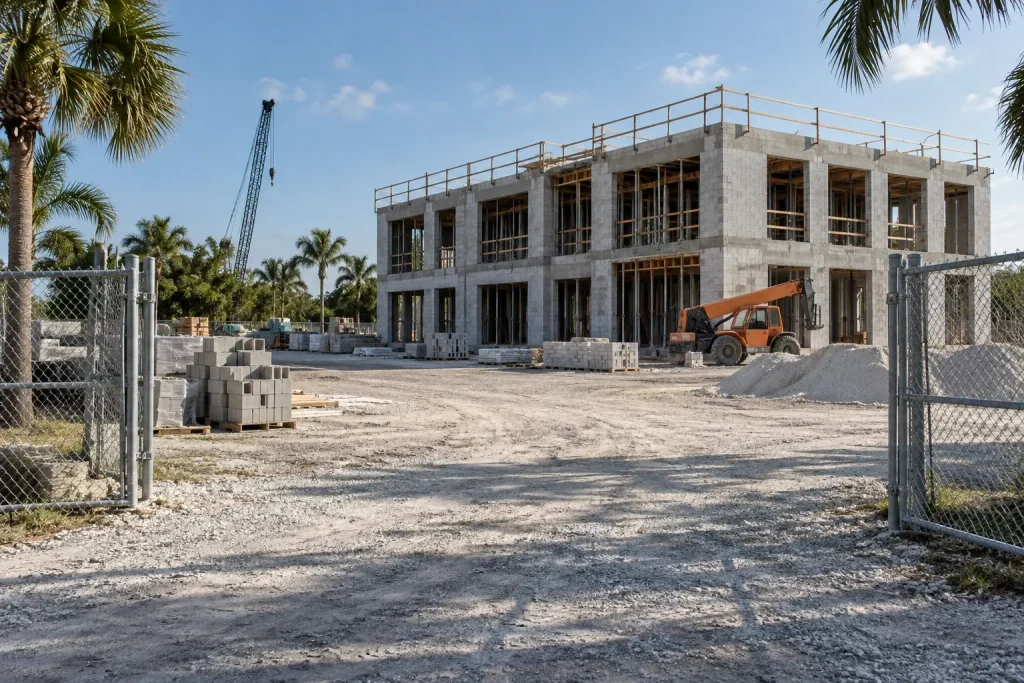
A notice of commencement in Florida is the form an owner records with the county and posts on site before work starts, required for any improvement whose direct contract exceeds $2,500 under Fla. Stat. 713.13 and 713.02(5).
Key takeaways
- The statute requires a notice for any improvement whose direct contract (the owner’s contract with the contractor) is over $2,500: Fla. Stat. 713.13(1)(a) exempts only the jobs covered by Fla. Stat. 713.02(5), which are $2,500 or less.
- The $5,000 figure is a separate rule: under Fla. Stat. 713.135(1)(e) the building department collects a copy before the first inspection only when the direct contract is greater than $5,000, up from $2,500 since ch. 2023-226 took effect on October 1, 2023.
- Several county pages, including the Orange County Comptroller and Miami-Dade’s owner sheet, say a notice is needed only above $5,000. The statute text does not say that; for a $2,500.01 to $5,000 contract, recording a one-page notice with a certified copy costs $13, so ask a Florida construction attorney before skipping it.
- Record after the contract is signed and before any work starts, no more than 90 days ahead (a notice is void if work has not started 90 days after recording, 713.13(2)). Then post, at the front of the site, a certified copy of the recorded notice or a notarized statement that it was filed for recording with a copy attached. It expires 1 year after recording unless it states a later date.
- Only the owner signs (713.13(1)(g)). A tenant that contracts for the work is the owner for this purpose and must state that its interest is a leasehold (713.13(1)(a)3.).
- Recording costs $10 for the first page and $8.50 for each additional page, the sum of three charges in Fla. Stat. 28.24(13); the Miami-Dade, Hillsborough and Orange recording pages add $1 per page plus $2 per certification for the certified copy you post (October 2026).
| Key number | What it means | Source |
|---|---|---|
| $2,500 | At or below this direct contract price, no notice is needed | Fla. Stat. 713.02(5) |
| $5,000 | Above this, the building department needs a copy before the first inspection | Fla. Stat. 713.135(1)(e) |
| $15,000 | HVAC repair or replacement below this is outside the building-department rules | Fla. Stat. 713.135(1) |
| 90 days | Notice is void if work has not started this long after recording | Fla. Stat. 713.13(2) |
| 1 year | Default life of the notice, counted from recording | Fla. Stat. 713.13(1)(d), (6) |
| 45 days | Window for a subcontractor or supplier to serve a notice to owner after first furnishing | Fla. Stat. 713.06(2)(a) |
| $10 and $8.50 | Recording fee, first page and each additional page | Fla. Stat. 28.24(13) |
What is a notice of commencement in Florida?
A notice of commencement is a recorded one or two page statement that names the property, the improvement, the owner, the contractor, any surety and lender, and a person who accepts legal notices for the owner. Florida’s Construction Lien Law treats the recording date as the “commencement of the improvement” (Fla. Stat. 713.01(5)), and liens of contractors, subcontractors and suppliers attach and take priority from that date (Fla. Stat. 713.07(2)).
Recording does not put a lien or cloud on the title. Under 713.13(3) it puts the public on legal notice that claims of lien may follow. Subcontractors and suppliers use the recorded notice to address their notices to owner, the letters that tell an owner they are working on the job and may claim a lien if unpaid; when no notice is recorded, 713.06(2)(e) lets them rely on the building permit application instead.
The owner, or the owner’s authorized agent, records it. When a construction loan funds the job, 713.13(7) requires the lender to record the notice before disbursing construction funds, while posting a copy on site remains the owner’s duty. The statutory definition of owner in 713.01 excludes the state, counties, cities and other public bodies, so the notice belongs to private projects; public jobs rely on payment bonds instead, as our construction surety bonds report explains.
When is a notice of commencement required in Florida?
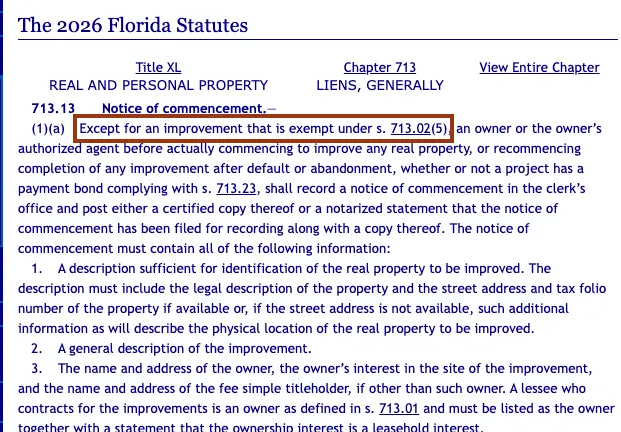
The statute requires one for every improvement to real property unless the direct contract price is $2,500 or less. That is the line in 713.02(5), which 713.13(1)(a) adopts as its only dollar exemption. The $5,000 figure that many county pages quote is a different rule: it decides when the building department must collect a copy of the recorded notice before the first inspection.
Two thresholds, not one
Read the two sections side by side and four bands appear. The direct contract price is the owner’s contract with the contractor, adjusted for change orders under the 713.01 definition of contract price. For a commercial tenant improvement, a $4,200 signage contract and a $1.2 million build-out fall in different rows.
| Direct contract price or job type | Record and post under 713.13? | Copy to building department before first inspection? | Statute |
|---|---|---|---|
| $2,500 or less | No: exempt from Part I except 713.05 | No | 713.02(5) |
| $2,500.01 to $5,000 | Yes | No | 713.13(1)(a); 713.135(1)(e) |
| Over $5,000 | Yes | Yes; without it no later inspection is performed or approved | 713.135(1)(e) and (e)1. |
| Repair or replacement of an existing HVAC system under $15,000 | Statute text still reaches contracts over $2,500 | No: subsection (1) does not apply | 713.135(1), closing sentence |
| Any price, with a payment bond under 713.23 | Yes, with a copy of the bond attached at recording | Per the price bands above | 713.13(1)(e); 713.02(6) |
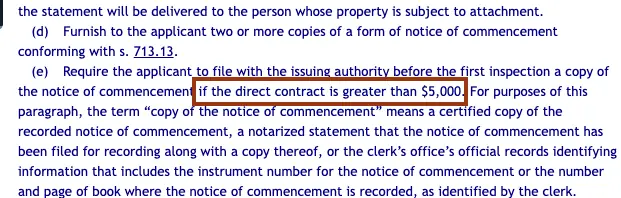
Several official and commercial pages compress these rules into one number. The table sets each statement next to the statute text as published in the 2026 Florida Statutes.
| What the page says | Where it appears | What the statute says |
|---|---|---|
| NOC required for improvements greater than $5,000 | Orange County Comptroller NOC page; Miami-Dade RER owner sheet; City of Pompano Beach | 713.02(5) exempts only $2,500 or less; $5,000 is the 713.135(1)(e) copy trigger |
| Not required for HVAC repair or replacement under $15,000 | City of Pompano Beach; Miami-Dade RER owner sheet | The $15,000 carve-out switches off 713.135(1), the building-department rules, not 713.13 |
| Threshold $2,500 and HVAC $7,500 | Miami-Dade RER brochure dated 9/15 | Superseded: HVAC rose to $15,000 on July 1, 2022 and the copy trigger to $5,000 on October 1, 2023 |
| Must be recorded within 90 days of the start of construction | Florida Construction Legal Updates (updated 2024) | 713.13(2): void if work is not commenced within 90 days after recording |
| Inspection copy rule at 713.135(1)(d) | Levelset Q&A (2019) | The rule moved to 713.135(1)(e) in the 2023 text |
What if your county page says $5,000?
County pages summarize the law; the statute is the law. The Orange County Comptroller, Miami-Dade’s owner information sheet and the City of Pompano Beach all describe $5,000 as the recording threshold, and none of them cites a statute section that sets it.
The only dollar exemption in 713.13(1)(a) is the $2,500 line in 713.02(5). On a contract between $2,500.01 and $5,000, the statute reading says record and post, at a cost of $13 for a one-page notice with a certified copy (28.24(13) plus the clerks’ $1 per page and $2 certification).
This page reports what the statute text and county pages said in October 2026; it is not legal advice. If a clerk or building official tells you a notice is not needed on a job over $2,500, ask a Florida construction attorney whether to record anyway, and collect lien releases with each payment either way.
What changed in 2022 and 2023
Two session laws reshaped the notice. SB 352, chapter 2022-120, took effect July 1, 2022, and CS/CS/HB 331, chapter 2023-226, took effect October 1, 2023. As of October 2026, the history notes for 713.13, 713.132 and 713.135 in the 2026 Florida Statutes end at chapter 2023-226, so no 2024, 2025 or 2026 amendment touches these sections.
| Law | Effective | Change | Section |
|---|---|---|---|
| Ch. 2022-120 (SB 352) | July 1, 2022 | HVAC repair or replacement carve-out raised from $7,500 to $15,000 (2022 text) | 713.135(1) |
| Ch. 2023-226 (HB 331) | October 1, 2023 | Building-department copy trigger raised from $2,500 to $5,000; rule moved from (1)(d) to (1)(e) | 713.135(1)(e) |
| Ch. 2023-226 (HB 331) | October 1, 2023 | Clerk’s instrument number, or book and page, accepted in place of a certified copy | 713.135(1)(e) |
| Ch. 2023-226 (HB 331) | October 1, 2023 | Legal description, street address and folio number changed from “should” to “must” | 713.13(1)(a)1. |
| Ch. 2023-226 (HB 331) | October 1, 2023 | Form gained an online notarization box; permit offices must accept a recorded notice in the statutory form | 713.13(1)(d), (1)(h) |
What goes on the form, and who signs it?
The form in 713.13(1)(d) has nine numbered items plus a warning to owner, the owner’s signature and a notary block. The statute requires the owner to sign and bars anyone else from signing in the owner’s place (713.13(1)(g)); for a company, the signature line names an authorized officer, director, partner or manager. A contractor may handle the recording as the owner’s agent but cannot sign.
| Form item | What to enter | Statute |
|---|---|---|
| 1. Description of property | Legal description, street address and tax folio number if available | 713.13(1)(a)1. |
| 2. General description of improvement | For example, interior build-out of Suite 200, 6,000 sq ft | 713.13(1)(a)2. |
| 3. Owner or lessee information | Name, address, interest in the property; fee simple titleholder if different; a contracting tenant lists itself with a leasehold statement | 713.13(1)(a)3. |
| 4. Contractor | Name, address and phone number | 713.13(1)(a)4. |
| 5. Surety | Name, address, phone and bond amount; attach a copy of the payment bond | 713.13(1)(a)5.; (1)(e) |
| 6. Lender | Name, address and phone of the construction lender | 713.13(1)(a)6. |
| 7. Florida designee for service | Person in Florida who may receive notices for the owner | 713.13(1)(a)7. |
| 8. Extra copy recipient | Optional person who also receives each lienor’s notice | 713.13(1)(b) |
| 9. Expiration date | Blank means 1 year after recording; longer contracts need a later date | 713.13(1)(c), (1)(d) |
| Signature and notary | Owner signs; acknowledgment by physical presence or online notarization | 713.13(1)(d), (1)(g) |
A tenant improvement is the most common commercial twist. Under 713.13(1)(a)3., a lessee that contracts for the work is the owner and signs, and the landlord appears as fee simple titleholder; our tenant improvement allowance guide covers how that interacts with the lease.
How do you record and post a notice of commencement?
Record it with the county’s official records office after the contract is signed and before work starts, post a certified copy (or a notarized statement of filing with a copy) at the front of the site, and, on contracts over $5,000, give the building department a copy before the first inspection. The permit itself can be issued first: 713.135(1)(f) bars building departments from making a recorded notice a condition of issuing the permit.
- Get the form. The building department must furnish 2 or more copies (713.135(1)(d)) and may charge up to $5 per permit for the forms and lien law summary (713.135(4)). It must accept a recorded notice in the statutory form (713.13(1)(h)).
- Pull the property data. Copy the legal description and folio number from the deed or the county property appraiser record; since October 1, 2023 they are mandatory where available (713.13(1)(a)1.).
- Sign before a notary. The owner signs; the acknowledgment can be in person or by online notarization (713.13(1)(d)).
- Attach the bond. If the contractor furnished a 713.23 payment bond, attach a copy now; leaving it off negates the 713.02(6) exemption (713.13(1)(e)).
- Record it before any work starts, and no more than 90 days before. 713.13(1)(a) requires recording “before actually commencing to improve” the property. The notice takes effect on filing in the clerk’s office (713.13(1)(f)) and is void if work has not started 90 days later (713.13(2)), so for a January 15, 2027 start, record between October 17, 2026 and the day before work begins. Hillsborough’s clerk warns that mailed documents can take up to 7 business days, and only walk-in recording guarantees same-day service.
- Post it at the job site. Post either a certified copy of the recorded notice or a notarized statement that the notice was filed for recording, with a copy attached (713.13(1)(a)). “Post” means a conspicuous place at the front of the site, protected from the weather (713.01(26)).
- File the copy with the building department if the contract is over $5,000. A certified copy, a notarized statement with a copy, or the clerk’s instrument number or book and page all count (713.135(1)(e)). Temporary power, land clearing and other preliminary site permits can proceed without it (713.135(1)(e)4.).
Plan review clocks under Fla. Stat. 553.792, inspections and the certificate of occupancy sit on the permit side of the job, which our commercial building permits guide covers. For where the notice falls among the other owner documents, see the permitting phase in our commercial construction process guide.
How long does a notice of commencement last?
A Florida notice of commencement lasts 1 year after recording unless it states a different expiration date in item 9 of the form, and it is void from the start if the improvement does not begin within 90 days after recording. If the construction contract allows more than 1 year to finish, 713.13(1)(c) requires the notice to state 1 year plus the additional period.
| Event | Clock | Example (recorded November 2, 2026) | Statute |
|---|---|---|---|
| Notice takes effect | On filing in the clerk’s office | November 2, 2026 | 713.13(1)(f) |
| Work must start | Within 90 days after recording | By January 31, 2027 | 713.13(2) |
| Copy to building department | Before the first inspection, contracts over $5,000 | Before inspection 1 | 713.135(1)(e) |
| Notice to owner from a subcontractor or supplier | Before or within 45 days after first furnishing | Sub starting December 1, 2026 serves by January 15, 2027 | 713.06(2)(a) |
| Default expiry | 1 year after recording | November 2, 2027 | 713.13(1)(d), (6) |
| Amendment served on lienors | Within 30 days after recording the amendment | Depends on amendment date | 713.13(5)(b) |
| Notice of termination takes effect | No earlier than 30 days after it is recorded | Depends on termination date | 713.132(1)(c), (5) |
| Claim of lien | No later than 90 days after the lienor’s final furnishing | Depends on final furnishing | 713.08(5) |
| Lien enforcement suit | Within 1 year after the claim of lien is recorded | Depends on lien date | 713.22(1) |
Amending or extending it
Within its effective period a notice can be amended to extend it, fix errors or add missing information (713.13(5)(a)). The amendment must cite the official records book and page of the original, and the owner serves it on the contractor and on each lienor who serves notice before or within 30 days after the amendment is recorded (713.13(5)(b)). Changing contractors is different: that needs a new notice of commencement or a notice of recommencement.
Closing it out with a notice of termination
An owner can end the notice early under Fla. Stat. 713.132 once all lienors are paid in full or pro rata. The notice of termination repeats the original’s information and recording reference, states that all lienors have been paid, carries the contractor’s final payment affidavit, and is served on each lienor with a direct contract or a timely notice to owner before recording. Termination takes effect no earlier than 30 days after it is recorded.
How does a notice of commencement protect an owner from paying twice?
Subcontractors and suppliers who have no contract with the owner must serve a notice to owner before, or within 45 days after, they start furnishing (Fla. Stat. 713.06(2)(a)). Once an owner holds that notice, each progress payment has to account for that lienor: under 713.06(3)(c) the owner pays, or causes to be paid, the sums due to every lienor who gave notice, usually by collecting partial releases with each draw.
The notice of commencement decides where those notices go and how long the owner’s payments stay protected. Payments made after it expires are improper payments under 713.13(1)(c), and 713.06(1) caps total liens at the direct contract price except where payments were improper. The hypothetical below shows the arithmetic when an owner pays in full without releases.
| Step | Hypothetical figure | Rule |
|---|---|---|
| Direct contract with the general contractor | $400,000 | 713.01 contract price |
| Electrical subcontractor serves a notice to owner | Day 20 after first furnishing | 713.06(2)(a): within 45 days |
| Owner pays the contractor in full without releases from that subcontractor | $400,000 paid | 713.06(3)(c)1. |
| Contractor leaves the subcontractor unpaid | $38,000 | Claim of lien within 90 days of final furnishing, 713.08(5) |
| Owner’s possible total outlay if the lien is enforced | $438,000, or 109.5% of the contract price | 713.06(1) cap does not protect improper payments |
Two more statutory tools sit at the end of the job. The contractor must hand the owner a final payment affidavit listing any unpaid lienors, at least 5 days before suing to enforce its own lien, and the owner may pay listed lienors directly after giving the contractor 10 days’ written notice (713.06(3)(d)). Subcontractor deadlines in other states differ sharply; our mechanics lien laws by state registry compares all 51 jurisdictions.
This page summarizes statutes and county pages as of October 2026 and is not legal advice. An owner facing a lien or a contract near a threshold should ask a Florida construction attorney two questions: which payments were proper under 713.06(3), and whether the notice of commencement was in effect when each was made.
Where to record a notice of commencement in Miami-Dade, Broward, Hillsborough, Orange and Duval
Each county records the notice in its official records, which the clerk of the circuit court keeps in four of the five counties checked. Broward is the exception: its Records, Taxes and Treasury Division is the statutory repository for the county’s official records. All five publish or follow the same base fee of $10 for the first page and $8.50 for each additional page.
| County | Recording office | Ways to file | Recording fee | Certified copy | Source |
|---|---|---|---|---|---|
| Miami-Dade | Clerk of the Court and Comptroller, Office of County Recorder | In person at the Osvaldo N. Soto Miami-Dade Justice Center; mail to 20 NW 1st Avenue, Suite 5.246, Miami, FL 33128; eRecording Web Service for notices of commencement; approved vendors | $10 first page, $8.50 each additional | $1 per page plus $2 certification | miamidadeclerk.gov |
| Broward | Records, Taxes and Treasury Division | eRecording vendors CSC, E-Docs Solutions, eRecording Partners Network and Simplifile; mail or deliver to 115 S. Andrews Avenue, Room 114, Fort Lauderdale, FL 33301 | $10 and $8.50 under 28.24(13); Broward’s own notice page was offline after a site redesign on October 19, 2026 | Ask the division | City of Pompano Beach; Broward RTT |
| Hillsborough | Clerk of Court and Comptroller | Consumer e-recording portal for notices of commencement only; mail to PO Box 3249, Tampa; walk-in at official records offices, recorded while you wait; mail can take up to 7 business days | $10 first page, $8.50 each additional | $1 per page plus $2 certification | hillsclerk.com |
| Orange | Comptroller | Tyler Tech eFile account, often recorded within 24 hours, plus a $3.50 service fee; eRecording vendors at $4 to $8; in person at 109 E. Church St., Suite 300, Monday to Friday 7:30 AM to 4:00 PM; mail to P.O. Box 38, Orlando, FL 32802 | $10 first page, $8.50 each additional | $1 per page plus $2 certification | occompt.com |
| Duval | Clerk of the Circuit Court | The clerk’s site refused automated access on October 19, 2026; confirm channels on the recording page | $10 and $8.50 under 28.24(13) | $1 per page copy charge under 28.24(6)(a) | duvalclerk.com |
Orange County’s page adds a practical point: buy the certified copy, at $1 per page plus $2, after recording, because the permitting office uses it to schedule the inspection. Market and permit notes for each metro are on our pages for Miami commercial builders, Fort Lauderdale commercial builders, Tampa commercial builders, Orlando commercial builders and Jacksonville commercial builders.
What does it cost to record a notice of commencement?
The base fee is set by statute, not by each county. Fla. Stat. 28.24(13) charges $5 for the first page and $4 for each additional page, then adds $1 and $0.50 for the Public Records Modernization Trust Fund and a $4 per page court technology charge. That is $10 for page one and $8.50 for each page after it, plus $1 for each name beyond four in the index.
| Pages recorded | Recording ($10 + $8.50 per extra page) | Certified copy ($1 per page + $2) | Total | Typical case |
|---|---|---|---|---|
| 1 | $10.00 | $3.00 | $13.00 | One-page county form |
| 2 | $18.50 | $4.00 | $22.50 | Two-page form |
| 3 | $27.00 | $5.00 | $32.00 | Form plus a one-page rider |
| 5 | $44.00 | $7.00 | $51.00 | Two-page form plus a three-page payment bond |
Channel fees sit on top of the statutory amounts. Orange County’s Tyler Tech eFile adds $3.50 and its eRecording vendors add $4 to $8, so a one-page notice filed through eFile with a certified copy costs $16.50 in Orange as of October 2026.
Which situation are you in?
Start with the direct contract price, then check the job type. The table and flowchart below apply the same lines of 713.02(5), 713.13 and 713.135; where a county page and the statute differ, the statute text controls, and the decision is the owner’s to make with counsel.
| If | Then | Statute |
|---|---|---|
| Direct contract is $2,500 or less | No notice of commencement | 713.02(5) |
| Direct contract is over $2,500 and up to $5,000 | Record and post; no copy owed to the building department | 713.13(1)(a); 713.135(1)(e) |
| Direct contract is over $5,000 | Record, post, and file a copy before the first inspection | 713.135(1)(e) |
| Repair or replacement of an existing HVAC system under $15,000 | Building-department rules do not apply; ask counsel whether to record anyway if over $2,500 | 713.135(1) |
| A construction loan funds the work | Lender records before disbursing; owner still posts | 713.13(7) |
| A tenant contracts for the build-out | Tenant signs as owner with a leasehold statement | 713.13(1)(a)3. |
| Contract allows more than 12 months to finish | State 1 year plus the extra period as the expiry | 713.13(1)(c) |
| Owner changes contractors mid-job | Record a new notice or a notice of recommencement | 713.13(5)(a) |
| Work will not start within 90 days | Wait and record closer to the start date | 713.13(2) |
Common mistakes and what they cost
Most problems trace to timing or signatures rather than the form’s content. A notice recorded too early dies at day 90, one left to lapse turns later draws into improper payments, and a missing bond copy or first-inspection copy carries its own statutory cost, listed with the section that imposes it.
| Mistake | Consequence | Statute |
|---|---|---|
| Recording more than 90 days before work starts | Notice is void; record again and pay the fee again | 713.13(2) |
| Letting the notice expire mid-job | Later payments are improper payments, exposing the owner to paying twice | 713.13(1)(c) |
| Contractor or manager signs instead of the owner | Statute says no one else may sign in the owner’s stead | 713.13(1)(g) |
| Payment bond not attached at recording | Owner loses the 713.02(6) bond exemption | 713.13(1)(e) |
| No copy filed by the first inspection on a job over $5,000 | No later inspection is performed or approved until it is filed | 713.135(1)(e)1. |
| Wrong property description that harms a lienor | Payments are treated as improperly paid to that lienor, except clerical errors | 713.06(3)(a) |
How we compiled this
We read 10 sections of the 2026 Florida Statutes on Online Sunshine (713.01, 713.02, 713.06, 713.07, 713.08, 713.13, 713.132, 713.135, 713.22 and 28.24), compared 713.13 and 713.135 year by year on the Florida Senate site from 2021 to 2025, and opened the 2 bill pages behind the changes. County details come from the Miami-Dade, Hillsborough and Orange recording pages, the City of Pompano Beach building page for Broward, Broward RTT and 2 Miami-Dade RER owner handouts, 26 primary documents in total, all opened in October 2026. The Duval clerk site refused automated access, so Duval fees are stated from the statute; forum posts and vendor blogs were checked for phrasing only, never as a source of facts.
Frequently asked questions
Who signs a notice of commencement in Florida?
The owner, and only the owner. Fla. Stat. 713.13(1)(g) says no one else may sign in the owner’s stead, so a contractor or property manager can deliver and record the form but cannot sign it. A company signs through an authorized officer, director, partner or manager, and a tenant that contracts for the work signs as owner with a statement that its interest is a leasehold.
Does a notice of commencement need to be notarized?
Yes. The statutory form in 713.13(1)(d) ends with a notary acknowledgment, and since October 1, 2023 it offers a box for online notarization as well as physical presence. Miami-Dade’s Clerk of the Court and Comptroller also states that documents presented for recording must be signed and notarized, so an unsigned or unacknowledged form is likely to be rejected at the counter.
Do I need a notice of commencement before the building permit is issued?
No. Under 713.135(1)(f) a building department may not require a recorded notice as a condition of issuing a permit. The deadline is the first inspection: on contracts over $5,000 the applicant files a copy before it, and without that copy the department or private provider may not perform or approve later inspections, under 713.135(1)(e)1.
What happens if work does not start within 90 days of recording?
The notice is void and of no further effect under 713.13(2), so the owner records a new one and pays the recording fee again, at least $10 for a one-page form under Fla. Stat. 28.24(13). To avoid that, record no more than 90 days before the planned start, and later if the permit or financing timeline is uncertain.
How do I extend a notice of commencement that is about to expire?
Record an amended notice before the current one expires. Under 713.13(5) the amendment must cite the official records book and page of the original, and the owner serves a copy on the contractor and on each lienor who serves notice before or within 30 days after the amendment is recorded. Payments made after an expired notice are improper payments under 713.13(1)(c).
Is a notice of commencement required for a roof replacement or HVAC job?
A roof replacement is an improvement under 713.01, so the price bands apply: none at $2,500 or less, record and post above that, and a building-department copy above $5,000. For repair or replacement of an existing HVAC system under $15,000, 713.135(1) switches off the building-department rules; the 713.13 text still reaches contracts over $2,500.
Can a contractor record the notice of commencement for the owner?
A contractor can record it as the owner’s authorized agent, because 713.13(1)(a) lets the owner or the owner’s authorized agent record. The contractor cannot sign it, because 713.13(1)(g) reserves the signature for the owner. On a financed job, 713.13(7) puts the recording duty on the construction lender before it disburses funds to the contractor.
What do I post at the job site?
Either a certified copy of the recorded notice of commencement, or a notarized statement that the notice has been filed for recording with a copy attached, under Fla. Stat. 713.13(1)(a). Post it in a conspicuous place at the front of the site, protected from the weather, as 713.01(26) defines posting. A certified copy costs $1 per page plus $2 at the Miami-Dade, Hillsborough and Orange clerks.
Sources
- Fla. Stat. 713.13, Notice of commencement, The Florida Legislature, Online Sunshine, accessed October 19, 2026.
- Fla. Stat. 713.135, Notice of commencement and applicability of lien, The Florida Legislature, Online Sunshine, accessed October 19, 2026.
- Fla. Stat. 713.02, Types of lienors and exemptions, The Florida Legislature, Online Sunshine, accessed October 19, 2026.
- Fla. Stat. 713.01, Definitions, The Florida Legislature, Online Sunshine, accessed October 19, 2026.
- Fla. Stat. 713.06, Liens of persons not in privity; proper payments, The Florida Legislature, Online Sunshine, accessed October 19, 2026.
- Fla. Stat. 713.07, Priority of liens, The Florida Legislature, Online Sunshine, accessed October 19, 2026.
- Fla. Stat. 713.08, Claim of lien, The Florida Legislature, Online Sunshine, accessed October 19, 2026.
- Fla. Stat. 713.132, Notice of termination, The Florida Legislature, Online Sunshine, accessed October 19, 2026.
- Fla. Stat. 713.22, Duration of lien, The Florida Legislature, Online Sunshine, accessed October 19, 2026.
- Fla. Stat. 28.24, Service charges, The Florida Legislature, Online Sunshine, accessed October 19, 2026.
- Fla. Stat. 553.792, Building permit application to local government, The Florida Legislature, Online Sunshine, accessed October 19, 2026.
- Fla. Stat. 713.135 (2022 text), The Florida Senate, accessed October 19, 2026.
- SB 352 (2022), Construction Liens, ch. 2022-120, The Florida Senate, accessed October 19, 2026.
- CS/CS/HB 331 (2023), ch. 2023-226, The Florida Senate, accessed October 19, 2026.
- Official Records: record a document and fees, Miami-Dade Clerk of the Court and Comptroller, accessed October 19, 2026.
- Property records and recording: Notice of Commencement, Hillsborough County Clerk of Court and Comptroller, accessed October 19, 2026.
- File Notice of Commencement (NOC) and Termination of NOC, Orange County Comptroller, accessed October 19, 2026.
- Notice of Commencement, City of Pompano Beach Building Inspections, accessed October 19, 2026.
- Records, Taxes, and Treasury Division, Broward County, accessed October 19, 2026.
- Recording, Duval County Clerk of Courts (automated access refused), accessed October 19, 2026.
- Construction Lien Law for Owners (owner information sheet), Miami-Dade County Department of Regulatory and Economic Resources, accessed October 19, 2026.
- Construction Lien Law for Owners (brochure 123_01-182, 9/15), Miami-Dade County Department of Regulatory and Economic Resources, accessed October 19, 2026.