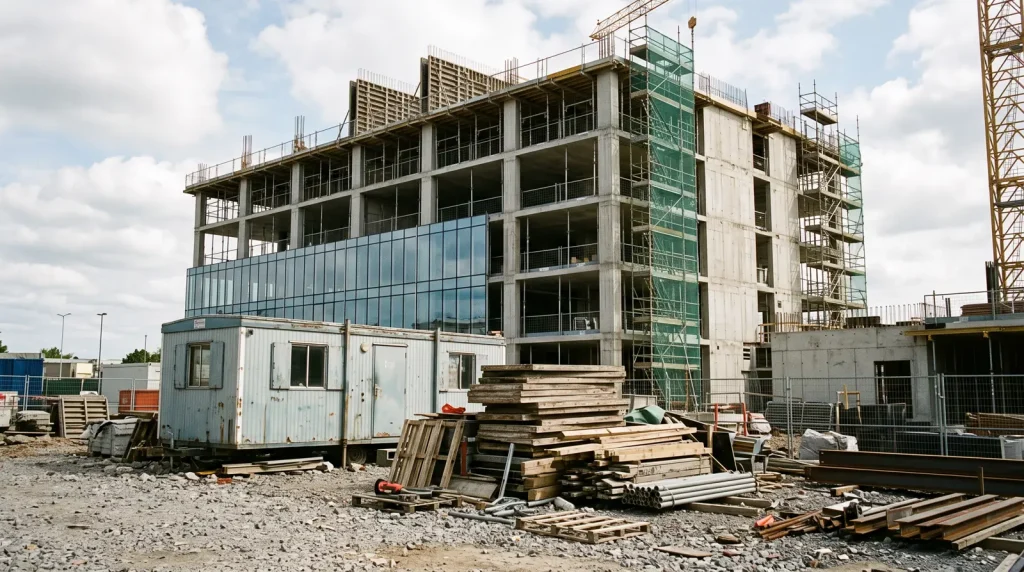
An additional insured is a person or company, such as a project owner, added by endorsement to a contractor’s liability policy for claims caused in whole or in part by the contractor’s work. A certificate alone adds no one.
Key takeaways
- Two forms cover two periods: ISO CG 20 10 04 13 covers the owner while the contractor works, and stops once the work is completed or put to its intended use; CG 20 37 04 13 covers the owner after that.
- The 04 13 editions cap the owner’s cover at what the contract requires: coverage is never “broader than” the contract, and the insurer pays the lesser of the contract amount or the policy limit (CG 20 10 04 13 §C).
- A certificate is not coverage: the ACORD 25 (2016/03) form “confers no rights upon the certificate holder”, and Texas Insurance Code §1811.153 says the same in law since September 1, 2011.
- Texas (Insurance Code §151.104, since January 1, 2012), Kansas (K.S.A. 16-121(c)), Colorado and Montana void additional insured clauses to the extent they cover the owner’s own negligence.
- Public specs name the forms: AIA A101-2017 Exhibit A §A.3.1.3 asks for CG 20 10 07 04 and CG 20 37 07 04, and WSDOT 2027 §1-07.18 asks for completed operations cover for 3 years after Substantial Completion.
This page explains public form and statute text as of November 2026; it is not insurance or legal advice.
What does additional insured status give a project owner, and what does it not?
Additional insured status gives the owner its own right to a defense and payment under the contractor’s commercial general liability (CGL) policy, but only for the claims the endorsement describes. Under ISO form CG 20 10 04 13 that means bodily injury, property damage or personal and advertising injury caused, in whole or in part, by the contractor or those acting for it during its ongoing operations for the owner.
The owner does not become a policyholder. It cannot change the policy, it shares the contractor’s limits because the endorsement “shall not increase the applicable Limits of Insurance” (CG 20 10 04 13 §C), and under Texas Insurance Code §1811.155 it has a right to cancellation notice only if the policy or an endorsement names it and requires notice.
| Question | What the form or law says | Source |
|---|---|---|
| Who is covered | The person or organization in the endorsement’s Schedule; blanket forms add anyone a written contract requires | CG 20 10 04 13 §A; CG 20 38 04 13 |
| Which claims | Bodily injury, property damage, personal and advertising injury caused in whole or in part by the contractor’s acts or omissions | CG 20 10 04 13 §A |
| Owner solely at fault | Not covered: the contractor’s acts or omissions must be at least part of the cause | CG 20 10 04 13 §A |
| After the work is finished | Excluded under CG 20 10; needs CG 20 37 | CG 20 10 04 13 §B |
| How much | Lesser of the contract requirement and the policy limit | CG 20 10 04 13 §C |
| Cancellation notice | Contractor tells the owner within 3 business days under AIA A201 §11.1.4 | AIA A201-2017 |
| Damage to the building under construction | Not this endorsement; that is property insurance under AIA Exhibit A §A.2.3 | AIA A101-2017 Exhibit A |
Physical loss to the structure while it is being built falls under the owner’s property cover, which our builder’s risk insurance guide explains under AIA Exhibit A §A.2.3. A performance bond is a third type of protection: it guarantees the contract, not a liability claim, as our construction surety bonds guide shows.
Which additional insured endorsement covers what: CG 20 10, CG 20 37 or CG 20 26?
Three ISO (Insurance Services Office) forms do most of the work on commercial projects. CG 20 10 covers the owner while the contractor is working, CG 20 37 covers the owner after the work is finished and in use, and CG 20 26 adds a designated person for the contractor’s ongoing operations or premises. Blanket versions, CG 20 38 and CG 20 40, add anyone a written construction contract requires.
| Form | ISO title | What it covers | When it stops or starts | Source |
|---|---|---|---|---|
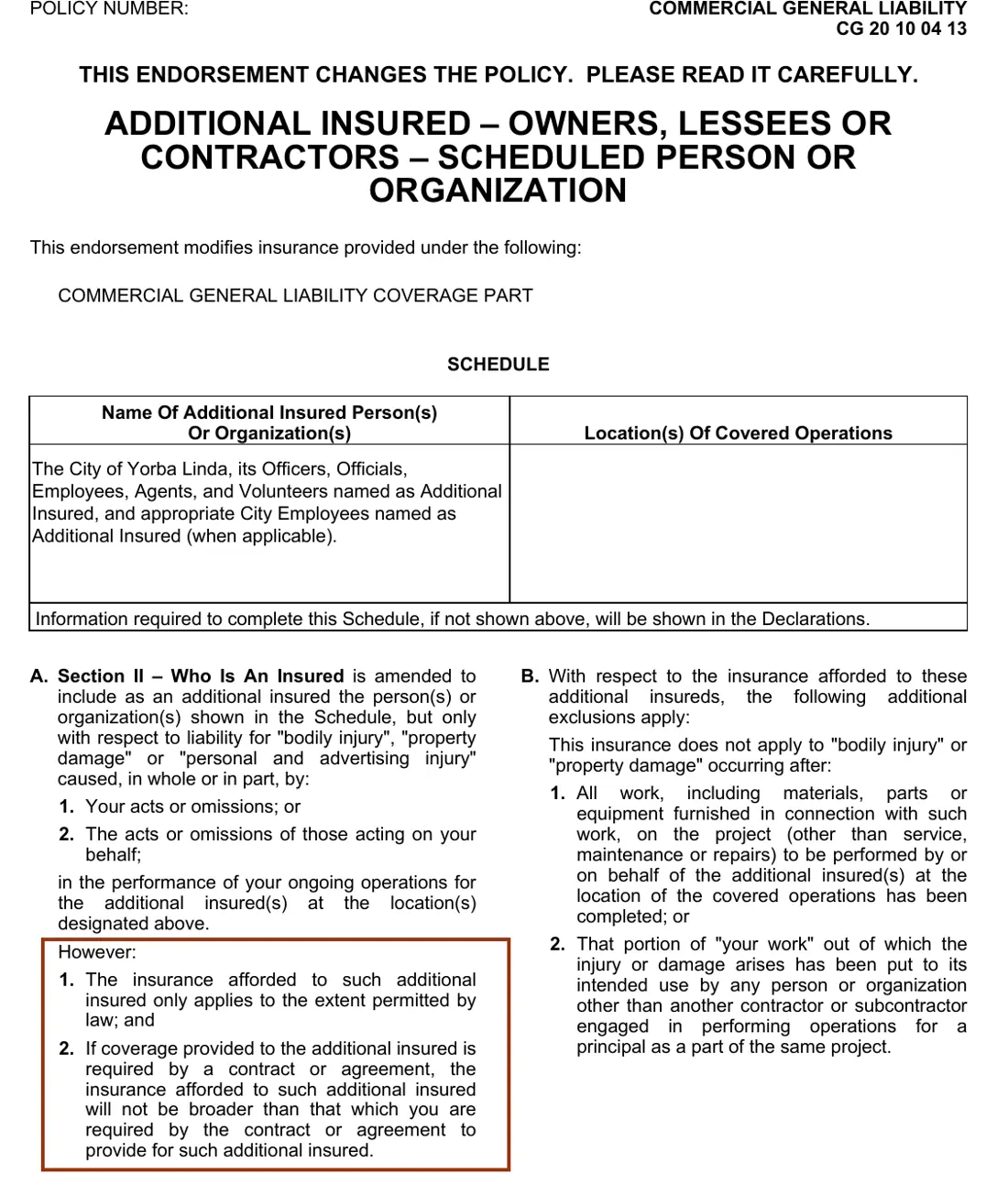
| CG 20 10 | Additional Insured: Owners, Lessees or Contractors, Scheduled Person or Organization | Injury or damage caused in whole or in part by the contractor in its ongoing operations for the additional insured at the listed location | Stops when all project work is completed or that part is put to its intended use | Yorba Linda copy, 04 13 |
| CG 20 37 | Additional Insured: Owners, Lessees or Contractors, Completed Operations | Bodily injury or property damage caused in whole or in part by “your work” at the listed location, in the products-completed operations hazard | Starts where CG 20 10 stops | DASNY packet, 04 13 |
| CG 20 26 | Additional Insured: Designated Person or Organization | Injury or damage caused in whole or in part by the contractor in its ongoing operations or in connection with its premises | No completed operations grant; Sierra Madre still asks for CG 20 37 for contractor work | Sierra Madre packet, 04 13 |
| CG 20 38 | Automatic Status for Other Parties When Required in Written Construction Agreement | Ongoing operations for any party the written contract requires, including parties above the contractor | Same trigger as CG 20 10 | Sierra Madre packet, 04 13 and 12 19 |
| CG 20 39, CG 20 40 | Automatic status, completed operations | Completed operations for parties the written contract requires | Same trigger as CG 20 37 | Sierra Madre packet, 12 19 |
| CG 20 32 | Named in AIA Exhibit A for the Architect and its consultants | Additional insured cover for design professionals | Ongoing operations | AIA Exhibit A §A.3.1.3 |
How did the 2004, 2013 and 2019 editions change additional insured coverage?
The edition date printed after the form number changes what the owner receives. The 11 85 text covered liability “arising out of” the contractor’s operations, the 07 04 text narrowed that to injury “caused, in whole or in part, by” the contractor, and the 04 13 text added two more limits: coverage only “to the extent permitted by law” and never “broader than” what the contract requires.
| Edition | Coverage trigger | Tie to the contract | Limits clause | Source |
|---|---|---|---|---|
| 11 85 (CG 20 26 text shown; WSDOT still names CG 20 10 1985) | Liability “arising out of your operations or premises” | None | None | Sierra Madre packet |
| 07 04 (CG 20 10, CG 20 37) | “Caused, in whole or in part, by” the contractor’s acts or omissions or those acting for it | None | None | Iowa State sample, 2013 |
| 04 13 (CG 20 10, 20 26, 20 37) | Same as 07 04 | Only “to the extent permitted by law”; not “broader than” the contract requires | Lesser of the contract amount and the limits “shown in the Declarations” | Yorba Linda copy |
| 12 19 (CG 20 37 text shown) | Same as 07 04 | Same as 04 13 | Lesser of the contract amount and the “applicable limits of insurance” | Sierra Madre packet |
Some public owners still ask for the older text. Iowa State University’s 2013 sample certificate requires CG 20 10 and CG 20 37 “(7-04) or older edition dates” (Iowa State FP&M), and WSDOT’s 2027 specifications accept “CG-20-10 (1985 edition)” as one option. The City of Sierra Madre’s packet notes that the 11 85 version “provides coverage for all operations”, while later versions need a separate completed operations form.
When does additional insured coverage start and stop?
Ongoing operations cover under CG 20 10 starts with the contractor’s work for the owner and stops when all project work is completed, or when the part that caused the injury is put to its intended use by anyone other than another contractor on the same project. From that point only a completed operations form such as CG 20 37 responds, for as long as the contractor keeps it on its policy.
| Milestone | Rule | Source |
|---|---|---|
| 1. Contract signed | Certificates due before work starts, at each renewal and on request; WSDOT wants full policy copies within 21 days | AIA Exhibit A §A.3.1.1; WSDOT §1-07.18(3) |
| 2. Work starts | CG 20 10 covers injury or damage caused in whole or in part by the contractor’s ongoing operations | CG 20 10 04 13 §A |
| 3. Work completed or put to intended use | CG 20 10 exclusion B applies; only CG 20 37 responds | CG 20 10 04 13 §B |
| 4. Correction period ends | AIA default: keep insurance until the A201 §12.2.2 period ends, 1 year after Substantial Completion, unless Exhibit A states a different duration | AIA Exhibit A §A.3.2.1; A201-2017 §12.2.2 |
| 5. Three years after Substantial Completion | WSDOT requires products and completed operations cover for 3 years | WSDOT §1-07.18(4) item 3 |
WSDOT writes 3 years into §1-07.18(4) and (5), three times the AIA default of 1 year. If your contract names a period, Exhibit A §A.3.2.1 has a blank for it; the date that starts the clock is the one the architect certifies, covered in our guide to substantial completion.
How much coverage does an additional insured actually get?
Under the 04 13 and 12 19 editions, the most the insurer pays for an additional insured is the lesser of the amount the contract requires and the policy limit, and the endorsement adds no new limits. The owner and the contractor draw on the same each-occurrence and aggregate limits, so a low contract number caps the owner’s protection even when the contractor carries more.
| Case | Contract requires (each occurrence) | Policy limit (each occurrence) | Most paid for the owner | Why |
|---|---|---|---|---|
| A. Exhibit A filled like Anderson County, TX (March 20, 2026) | $1,000,000 | $2,000,000 (illustrative) | $1,000,000 | Lesser of $1,000,000 and $2,000,000 (CG 20 10 04 13 §C) |
| B. WSDOT 2027 contract | $3,000,000 | $2,000,000 (illustrative) | $2,000,000 | Lesser of the two; the contractor is short $1,000,000 and in breach of §1-07.18(5) |
| C. Shared aggregate | $1,000,000 | $1,000,000 each occurrence; $2,000,000 aggregate with $1,500,000 already paid (illustrative) | $500,000 | $2,000,000 minus $1,500,000; ACORD 25: “limits shown may have been reduced by paid claims” |
WSDOT closes the gap in case A with one sentence: if the contractor carries limits above the specification, “those additional coverage limits shall also apply” to the agency and the additional insureds (WSDOT §1-07.18(4) item 3). A private owner can copy that sentence into Exhibit A or set its own each-occurrence number.
| Document | Each occurrence | General aggregate | Products-completed operations aggregate | Source |
|---|---|---|---|---|
| Sauk County, WI, A101-2017 Exhibit A bid copy | $1,000,000 | $1,000,000 | $1,000,000 | Exhibit A §A.3.2.2.1 |
| Anderson County, TX, Exhibit A (March 20, 2026) | $1,000,000 | $2,000,000 | Not filled | Exhibit A §A.3.2.2.1 |
| Iowa State University sample certificate, work under $100,000 (2013) | $1,000,000 | $2,000,000 | $2,000,000 | Iowa State FP&M |
| WSDOT Standard Specifications M 41-10 (2027) | $3,000,000 | $6,000,000 | 3 years after Substantial Completion | §1-07.18(5) item 2 |
What do primary and non-contributory and waiver of subrogation add?
Primary and non-contributory wording makes the contractor’s policy pay first for the additional insured without asking the owner’s own insurer to share the loss; ISO CG 20 01 04 13 does this only when the owner is a Named Insured on that other policy and the contract says so in writing. A waiver of subrogation, ISO CG 24 04 05 09, stops the contractor’s insurer from suing the owner to recover what it paid.
| Clause | Text or effect | Condition | Source |
|---|---|---|---|
| Primary and non-contributory (CG 20 01 04 13) | Policy “is primary to and will not seek contribution from any other insurance available to an additional insured” | Owner is a Named Insured on the other policy, and the contract says so in writing | DASNY packet |
| Waiver of subrogation, CGL (CG 24 04 05 09) | Insurer waives recovery against the scheduled party for payments arising from ongoing operations or completed work | Only the person or organization in the Schedule; work under a contract with it | Sierra Madre forms |
| Waiver of subrogation, workers’ compensation (WC 00 03 13) | Endorsement on the contractor’s workers’ compensation policy | Attached to the certificate | Iowa State sample |
| AIA Exhibit A §A.3.1.3 | Additional insured cover “primary and non-contributory to any of the Owner’s general liability insurance policies” | Default AIA text | AIA Exhibit A |
| AIA A201 §11.3.1 | Owner and Contractor waive rights against each other for fire and other losses covered by property insurance | Property losses only | A201-2017 |
| ACORD 25 (2016/03) | “If SUBROGATION IS WAIVED … certain policies may require an endorsement” | Certificate flag only | ACORD 25 sample |
The two conditions in CG 20 01 matter in practice: if the contract is silent on primary status, the endorsement does not apply even when it is attached. Our AIA A201 guide covers the Article 11 waiver that applies to property losses.
Why doesn’t a certificate of insurance make you an additional insured?
A certificate of insurance, usually the ACORD 25 form, is a one-page report that a policy exists on the date it is issued. The form itself says it “confers no rights upon the certificate holder” and that an additional insured needs policy provisions or an endorsement, and Texas and New York put the same rule into statute.
- Contract clause: names the forms and edition dates, limits, primary and non-contributory, and waiver of subrogation (AIA Exhibit A §A.3.1.3 names CG 20 10 07 04 and CG 20 37 07 04).
- Endorsement: the insurer attaches it to the contractor’s CGL policy, with the owner in the Schedule or a blanket form that points to the written contract. This creates the right.
- Certificate: the ACORD 25 reports the policies and marks the “ADDL INSD” column. It is evidence only.
- Claim: the owner is sued over the work and tenders its defense to the contractor’s insurer, citing the endorsement and the contract clause.
| Rule | Text | Source |
|---|---|---|
| ACORD 25 (2016/03) header | “Issued as a matter of information only and confers no rights upon the certificate holder” | City of Tampa sample |
| ACORD 25 important box | “If the certificate holder is an ADDITIONAL INSURED, the policy(ies) must have ADDITIONAL INSURED provisions or be endorsed” | City of Tampa sample |
| Texas Insurance Code §1811.152 | A certificate “is not a policy of insurance and does not amend, extend, or alter the coverage” | Texas Legislature |
| Texas Insurance Code §1811.153 | No “new or additional rights beyond what the referenced policy or any executed endorsement” provides | Texas Legislature |
| New York Insurance Law §502(c) | A certificate shall not “confer to any person any rights beyond those expressly provided by the policy” | New York State Senate |
| AIA Exhibit A §A.3.1.1 | Certificates before work starts, at renewal, on request and with the final Application for Payment | AIA Exhibit A |
Ask for the endorsement pages themselves, with the form number and edition date printed on each page, and match the Schedule to your legal name. WSDOT goes further and requires complete electronic copies of all policies within 21 days of execution (WSDOT §1-07.18(3) item 2). Our builder vetting checks start from the same documents.
Which state laws limit additional insured requirements?
Many states void contract clauses that make a contractor indemnify an owner for the owner’s own negligence, and some extend that rule to additional insured clauses. In Texas, Colorado, Kansas and Montana the statute text reaches insurance or additional insured requirements directly, so the endorsement can cover the owner only for the contractor’s share of fault; the 04 13 forms follow the same rule through “to the extent permitted by law”.
| State | Statute | Effect on an additional insured clause | Scope and dates | Source |
|---|---|---|---|---|
| Texas | Insurance Code §151.104 | Void to the extent it requires or provides coverage that §151.102 bars in an indemnity: the owner’s own negligence or fault | Construction contracts, effective January 1, 2012; excludes single family homes, townhouses, duplexes and municipal public works (§151.105(10)) | Texas Legislature |
| Colorado | C.R.S. §13-21-111.5(6)(d)(I) | Allowed only for liability due to the acts or omissions of the party buying the cover; broader requirements void | Construction agreements; builder’s risk excluded by (6)(d)(II) | Colorado CRS Title 13 |
| Kansas | K.S.A. 16-121(c) | Additional insured cover for the other party’s own negligence or intentional acts is void | Provisions entered into after January 1, 2009 | Kansas Revisor of Statutes |
| Montana | MCA 28-2-2111(1) | A clause to “indemnify, hold harmless, insure, or defend” the other party for its own negligence is void | Construction contracts since 2003; project policies such as builder’s risk allowed by (2)(b) | Montana Legislature |
| California | Civil Code §2782.05 | Voids a subcontractor’s promise to insure or indemnify a general contractor for its active negligence, but (b)(6) keeps endorsements covering the subcontractor’s own acts in ongoing and completed operations | Contracts entered into on or after January 1, 2013; wrap-ups and owner or public agency direct contracts excluded | California Legislative Information |
| New York | General Obligations Law §5-322.1 | Voids indemnity for the owner’s own negligence, but “shall not affect the validity of any insurance contract” from an admitted insurer | Construction contracts | New York State Senate |
In Texas, Colorado, Kansas and Montana, keep your own CGL policy in force: the contractor’s endorsement will not answer for the owner’s share of fault. Ask construction counsel which statute governs your contract and whether its exclusions, such as the Texas municipal public works carve-out in §151.105(10), apply.
What do public construction contracts require?
Public owners write the endorsement numbers into their specifications, which makes them a useful benchmark for a private owner filling in Exhibit A. The AIA A101-2017 Exhibit A default names the 07 04 editions, WSDOT’s 2027 specifications ask for the 1985 edition of CG 20 10 or a CG 20 10 and CG 20 37 pair, and DASNY attaches the 04 13 forms and CG 20 01.
| Document | Additional insured forms | Primary and non-contributory | Waiver of subrogation | Completed operations period | Source |
|---|---|---|---|---|---|
| AIA A101-2017 Exhibit A §A.3.1.3 | CG 20 10 07 04, CG 20 37 07 04; CG 20 32 07 04 for the Architect | Yes | Property losses under A201 §11.3 | To the end of the correction period unless stated (§A.3.2.1) | Sauk County copy |
| WSDOT M 41-10 (2027) §1-07.18 | CG 20 10 (1985), or CG 20 10 + CG 20 37, or CG 20 33 + CG 20 37 | Yes | Yes, all required policies | 3 years after Substantial Completion | WSDOT |
| DASNY insurance requirements (2025) | CG 20 10 04 13, CG 20 37 04 13 | CG 20 01 04 13 | Not in the pages read | Not stated | DASNY |
| Iowa State University sample (2013) | CG 20 10 (7-04) and CG 20 37 (7-04) or older | Not stated | WC 00 03 13 | Not stated | Iowa State FP&M |
| City of Sierra Madre, CA packet (2025) | CG 20 10, 20 26 or 20 38; CG 20 37, 20 39 or 20 40 | At least as broad as CG 20 01 | CG 24 04; WC 00 03 13 | Not stated | Sierra Madre |
The Exhibit A blanks and defaults, including the $1,000,000 fill points that Sauk County and Anderson County used, are walked through in our AIA A101 guide to Exhibit A.
Which endorsements should an owner ask for?
Ask for an ongoing operations form (CG 20 10) and a completed operations form (CG 20 37), primary and non-contributory wording (CG 20 01) and a waiver of subrogation (CG 24 04), each named with its edition date, then hold the endorsement pages rather than a certificate. Adjust for the project: blanket forms when subcontractors must add you, a stated completed operations period, and your own liability policy in states that void broad additional insured clauses.
| If | Then | Why (source) |
|---|---|---|
| The contract says only “name Owner as additional insured” | Name CG 20 10 and CG 20 37 with edition dates, plus CG 20 01 and CG 24 04 | AIA Exhibit A §A.3.1.3; Sierra Madre packet |
| Subcontractors must also add you | Accept CG 20 38 and CG 20 40, which follow the written contract up the chain | Sierra Madre packet; WSDOT §1-07.18(4) item 5 |
| The policy shows CG 20 10 alone | Ask for CG 20 37 before final payment | CG 20 10 04 13 §B ends cover at completion |
| Your contract limit is below the contractor’s policy limit | Raise the number or add the WSDOT “additional coverage limits” sentence | Lesser-of clause, CG 20 10 04 13 §C |
| You want completed operations after handover | State a period: AIA default 1 year; WSDOT 3 years | Exhibit A §A.3.2.1; WSDOT §1-07.18(4) |
| You hold only an ACORD 25 | Request the endorsement pages, or full policies as WSDOT does within 21 days | ACORD 25; Tex. Ins. Code §1811.153 |
| The project is in Texas, Colorado, Kansas or Montana | Keep your own CGL; expect cover only for the contractor’s fault | §151.104; §13-21-111.5(6); 16-121(c); 28-2-2111 |
| A tenant, permit holder or vendor is doing limited work | CG 20 26 can serve for ongoing operations; add CG 20 37 if construction work is involved | Sierra Madre packet |
Put these items next to the license and bond checks in our guide to choosing a commercial contractor, and tick them off before the first certificate is due under Exhibit A §A.3.1.1 with our commercial project checklist.
The base policy the endorsement attaches to is explained in our general liability insurance for contractors guide.
How we compiled this
We read 18 primary documents in November 2026: ISO endorsement texts reproduced in 5 public bid and insurance packets (Yorba Linda, DASNY, Sierra Madre twice, Iowa State), 2 AIA A101-2017 Exhibit A bid copies, an A201-2017 bid copy, WSDOT’s 2027 Standard Specifications, an ACORD 25 (2016/03) sample, and 8 statutes from Texas, Colorado, Kansas, Montana, California and New York. We used no broker or insurer marketing pages as sources and state no premium for adding an additional insured, because we found no primary public price.
Frequently asked questions
Is a certificate holder the same as an additional insured?
No. A certificate holder only receives the ACORD 25 report, which “confers no rights upon the certificate holder”. An additional insured is named in an endorsement to the policy, such as ISO CG 20 10 or CG 20 37, or falls within a blanket form tied to a written contract. Texas Insurance Code §1811.153 bars a certificate from granting rights beyond the policy and its executed endorsements.
What is the difference between CG 20 10 and CG 20 37?
CG 20 10 covers the additional insured for injury or damage caused by the contractor’s ongoing operations, and it stops once all project work is completed or put to its intended use. CG 20 37 covers injury or damage from the contractor’s finished work in the products-completed operations hazard. AIA A101-2017 Exhibit A §A.3.1.3 asks for both, in their 07 04 editions.
What is a blanket additional insured endorsement?
A blanket, or automatic, endorsement adds any party the contractor agreed in a written contract to add, without listing names. On construction policies the ISO forms are CG 20 38 for ongoing operations and CG 20 39 or CG 20 40 for completed operations. The City of Sierra Madre accepts CG 20 38 with CG 20 39 or CG 20 40 as an alternative to scheduled forms.
Does additional insured status cover the owner's own negligence?
Not alone. Since the 07 04 editions, CG 20 10 and CG 20 37 cover injury “caused, in whole or in part,” by the contractor, so the contractor must share the fault. Texas Insurance Code §151.104, Kansas K.S.A. 16-121(c), Colorado C.R.S. §13-21-111.5(6) and Montana MCA 28-2-2111 also void clauses that would cover the owner’s own negligence.
How long should completed operations additional insured coverage last?
The contract sets it. The AIA A101-2017 Exhibit A default keeps the contractor’s insurance until the 1-year correction period in A201 §12.2.2 ends, unless a different duration is written into §A.3.2.1. WSDOT’s 2027 specifications require products and completed operations cover for 3 years after Substantial Completion, a benchmark a private owner can copy.
Does adding an additional insured cost money?
The insurer decides whether to charge for an endorsement, and we found no primary public price list to quote as of November 2026. Blanket forms such as ISO CG 20 38 and CG 20 40 add every party a written contract requires, which avoids a new scheduled endorsement for each owner. Ask the contractor’s broker whether its policy already carries those forms.
Sources
- City of Yorba Linda, CA, ISO CG 20 10 04 13, Additional Insured: Owners, Lessees or Contractors, Scheduled Person or Organization, accessed November 2, 2026.
- DASNY, Insurance Requirements (ACORD 25, CG 20 10 04 13, CG 20 37 04 13, CG 20 01 04 13), 2025, accessed November 2, 2026.
- City of Sierra Madre, CA, Acceptable Additional Insured Endorsements (CG 20 26, CG 20 37 12 19, CG 20 38, CG 20 40), accessed November 2, 2026.
- City of Sierra Madre, CA, Sample insurance forms (CG 20 01 04 13, CG 24 04 05 09, WC 00 03 13), October 24, 2025, accessed November 2, 2026.
- Iowa State University Facilities Planning & Management, Sample Certificate of Insurance 2013 (CG 20 10 07 04, CG 20 37 07 04), accessed November 2, 2026.
- Sauk County, WI, AIA A101-2017 Exhibit A, Insurance and Bonds (bid copy), accessed November 2, 2026.
- Anderson County, TX, AIA A101-2017 Exhibit A, AgriLife Facility bid, March 20, 2026, accessed November 2, 2026.
- City of Rochester, NH, AIA A201-2017 General Conditions (bid package attachment 3), accessed November 2, 2026.
- Washington State Department of Transportation, Standard Specifications for Road, Bridge, and Municipal Construction 2027, M 41-10, §1-07.18, accessed November 2, 2026.
- City of Tampa, FL, ACORD 25 (2016/03) Certificate of Liability Insurance, sample, accessed November 2, 2026.
- Texas Legislature, Texas Insurance Code Chapter 151, §151.102, §151.104, §151.105, accessed November 2, 2026.
- Texas Legislature, Texas Insurance Code Chapter 1811, §1811.152, §1811.153, §1811.155, accessed November 2, 2026.
- New York State Senate, New York Insurance Law §502, accessed November 2, 2026.
- Colorado General Assembly, Colorado Revised Statutes §13-21-111.5(6), CRS 2024 Title 13, accessed November 2, 2026.
- Kansas Office of Revisor of Statutes, K.S.A. 16-121, accessed November 2, 2026.
- Montana Legislature, MCA 28-2-2111, accessed November 2, 2026.
- California Legislative Information, California Civil Code §2782.05, accessed November 2, 2026.
- New York State Senate, New York General Obligations Law §5-322.1, accessed November 2, 2026.