Substantial completion is the contract date when the building is ready for the owner to occupy or use as intended, even with small items left: the architect certifies it, and warranties, retainage release and claim deadlines start (AIA A201-2017 §9.8).
Key takeaways
- Substantial completion means the work is far enough along that the owner can move in or use it as intended; small unfinished items go on a punch list. AIA A201-2017 §9.8.1 words it as complete enough “so that the Owner can occupy or utilize the Work for its intended use.”
- The Certificate of Substantial Completion, AIA G704-2017, fixes the date, the deadline for the punch list and who carries security, maintenance, heat, utilities, damage and insurance (A201 §9.8.4).
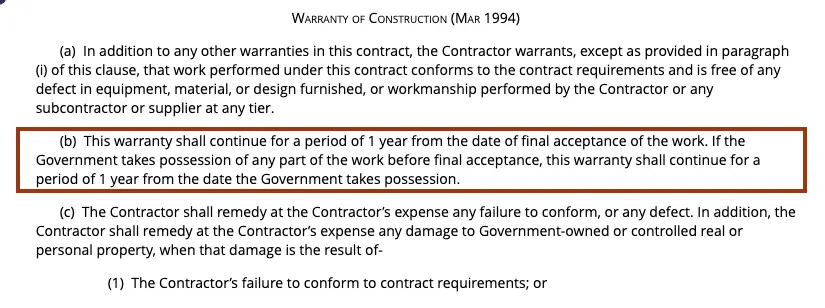
- The one-year period in A201 §12.2.2.1 is a duty to correct work, not the warranty, and §12.2.5 says it sets no time limit on other obligations; federal FAR 52.246-21 runs its warranty 1 year from final acceptance instead.
- Florida public owners must build the punch list within 30 days of substantial completion (up to 45 days at $10 million or more) and pay within 20 business days after, less 150% of the cost to finish (Fla. Stat. 255.077).
- Florida’s construction statute of repose is 7 years and, since chapter 2023-22, runs from the earliest certificate of occupancy, temporary certificate or certificate of completion, not from substantial completion (Fla. Stat. 95.11(3)(b)).
- California’s 10-year latent defect cutoff starts at substantial completion but no later than final inspection, a recorded notice of completion, occupation, or 1 year after work stops (Cal. Code Civ. Proc. 337.15(g)).
What does substantial completion mean?
Under AIA A201-2017 §9.8.1, substantial completion is the stage when the Work, or a designated portion of it, is complete enough under the Contract Documents for the owner to occupy or use it for its intended use. Section 8.1.3 makes the date whatever the architect certifies, and §8.1.1 measures the Contract Time to substantial completion, not to final completion.
The test is use, not perfection. A punch list can remain open, but a building whose required systems do not let the owner operate it as intended fails the §9.8.1 test. Several statutes borrow or replace the AIA wording, so the governing definition depends on the contract and the state. The table compares five definitions we read in the primary text in October 2026.
| Source | Who decides | Test | Part of a project? | Source link |
|---|---|---|---|---|
| AIA A201-2017 §9.8.1, §8.1.3 | Architect certifies the date | Owner can occupy or utilize the Work for its intended use | Yes, a “designated portion” | A201-2017 |
| Mass. G.L. c. 149 §29F(a), (c), (d) | Prime contractor gives notice; owner accepts or rejects within 14 days or it is deemed accepted | Same intended-use test, for contracts of $3,000,000 or more | Phases only if the contract expressly permits | c. 149 §29F |
| Fla. Stat. 255.077(1), 218.735(7) | As defined in the contract | Contract definition, else “beneficial occupancy or use” | Each building, structure or phase gets its own list | 255.077 |
| Cal. Code Civ. Proc. 337.15(g) | Fixed by events, not a certificate | Substantial completion, capped at the earliest of 4 events | Dated separately for each trade | CCP 337.15 |
| FAR 52.236-11 (federal) | Contracting officer | No substantial completion term; the government may take possession with a list of remaining items | Any completed or partially completed part | FAR 52.236-11 |
A201 §9.8.1 leaves the judgment to the architect, so an owner who wants an objective test, such as a temporary certificate of occupancy issued, has to write it into the contract definition.
Closeout terms in plain words
| Term | Plain meaning | Where the rule is |
|---|---|---|
| Substantial completion | The date the owner can move in or use the work as intended, with small items still open | A201 §9.8.1 |
| Final completion | Every item finished and the contract fully performed; final payment follows | A201 §9.10.1 |
| Punch list | The written list of unfinished or faulty items left at substantial completion, with a deadline to finish them | A201 §9.8.2, §9.8.4 |
| Retainage | The share of each progress payment the owner holds back until the end; capped at 5% on Florida public contracts over $200,000 and Massachusetts private contracts of $3,000,000 or more | Fla. Stat. 255.078; c. 149 §29F(b) |
| Certificate of Substantial Completion (AIA G704) | The form the architect prepares and the owner and contractor sign to fix the date and who pays for utilities, security and insurance from then on | A201 §9.8.4 |
| Correction period | One year in which the contractor must come back and fix work found faulty; it is not the warranty | A201 §12.2.2.1, §12.2.5 |
| Liquidated damages | A fixed charge for each day the job finishes late, written into the agreement | A201 §15.1.7 |
| Consent of surety | The bonding company’s written OK before held-back money is released on a bonded job | A201 §9.8.5, §9.10.2 |
| Statute of repose | The outer legal deadline to sue over design or construction defects, even ones nobody has found yet | Fla. Stat. 95.11(3)(b); Cal. CCP 337.15 |
How is substantial completion certified?
Under A201-2017 the contractor starts the process, the architect decides, and the owner and contractor both sign. The contractor lists unfinished items (§9.8.2), the architect inspects and can send the contractor back (§9.8.3), and the architect then prepares the Certificate of Substantial Completion (§9.8.4). Retainage moves only after written acceptance and any consent of surety (§9.8.5).
- Contractor list (§9.8.2). The contractor submits a comprehensive list of items to complete or correct before final payment. An item left off the list is still owed.
- Architect inspects (§9.8.3). The architect checks whether the Work is ready for intended use and adds any items missing from the list.
- Not ready: reinspection (§9.8.3). The contractor completes the items the architect flags, then requests another inspection.
- AIA G704 (§9.8.4). The architect prepares the Certificate of Substantial Completion: it sets the date, assigns security, maintenance, heat, utilities, damage to the Work and insurance, and fixes the time to finish the list.
- Written acceptance (§9.8.5). The owner and contractor accept the responsibilities assigned to them in writing.
- Retainage (§9.8.5). After the surety’s written consent on a bonded job, the owner pays the retainage that applies to the certified work, adjusted for incomplete or nonconforming work.
- Final completion (§9.10). The punch list is finished, the architect makes the final inspection, closeout papers arrive, then final payment and the remaining retainage follow.
What does the AIA G704 record?
AIA G704-2017 is the standard certificate form used with A201. According to the AIA Contract Documents G704 summary and G704 instructions, it records the substantial completion date for the whole Work or a designated portion, the attached list of items, the time to finish them, the owner’s occupancy date and who handles maintenance, heat, utilities and insurance.
- The work or designated portion covered, signed and dated by the architect.
- Warranty start: the substantial completion date, unless the form lists another date.
- The list of items, with completion dates and estimated cost.
- Owner occupancy date and the split of maintenance, heat, utilities and insurance.
- Signatures of the owner, architect and contractor.
Projects with a construction manager as adviser use G734-2019 instead, and AIA publishes no universal Certificate of Final Completion, according to AIA Contract Documents.
What does substantial completion trigger?
Under A201-2017 and a signed G704, several things change on the substantial completion date: warranties begin, the one-year correction period begins, retainage on the certified work becomes payable, site duties shift as the certificate assigns them, and a 10-year contractual claims cap starts. Liquidated damages stop on that date only when the agreement ties them to it.
| Trigger | What changes | Rule | Source |
|---|---|---|---|
| Warranties | Begin on the substantial completion date unless the G704 lists another date | A201 §9.8.4 | AIA A201-2017 |
| Correction of Work | Contractor must correct nonconforming work found within 1 year | A201 §12.2.2.1 | AIA A201-2017 |
| Retainage | Payable after written acceptance and consent of surety, adjusted for incomplete work | A201 §9.8.5 | AIA A201-2017 |
| Security, maintenance, heat, utilities, damage, insurance | Move between owner and contractor as the certificate assigns | A201 §9.8.4 | AIA G704 summary |
| Liquidated damages | Rate and end date come from the agreement; federal clause runs “until the work is completed or accepted” | A201 §15.1.7; FAR 52.211-12(a) | FAR 52.211-12 |
| Contract claims cap | No claims later than 10 years after substantial completion | A201 §15.1.2 | AIA A201-2017 |
| Louisiana lien statement | Due 60 days after substantial completion if no notice of termination is filed | La. R.S. 9:4822(A) | La. R.S. 9:4822 |
Does the warranty start at substantial completion?
Under A201-2017, yes by default: §9.8.4 starts the warranties required by the Contract Documents on the substantial completion date unless the certificate says otherwise. The one-year period many guides call “the warranty” is something else. Section 12.2.2.1 is a duty to correct work found nonconforming within one year, and §12.2.5 says that year has no bearing on the time to enforce other obligations.
Federal contracts differ: FAR 52.246-21(b) runs the construction warranty for 1 year from final acceptance, or from the date the government takes possession of part of the work.
If a manufacturer warranty starts at shipment or startup rather than at your substantial completion date, list it on the G704 with its own start date, which the 2017 form allows. Section 12.2.2.2 also extends the one-year correction period for work first performed after substantial completion.
How much retainage is released at substantial completion?
Retainage is the share of each payment the owner has held back. Under A201 §9.8.5, the retainage on the certified work becomes payable once the owner and contractor accept the certificate in writing and any surety consents, reduced for unfinished or faulty work. Florida public owners may keep 150% of the estimated cost to finish the list, and Massachusetts private owners on contracts of $3,000,000 or more may keep the same 150%.
| Step | Amount | Rule |
|---|---|---|
| Contract sum, Florida state agency project | $4,000,000 | Under $10 million: list due within 30 days (255.077(1)(a)) |
| Retainage held at 5% | $200,000 | Cap of 5% of each progress payment (255.078(1)) |
| Estimated cost to finish the list | $40,000 | Priced on the list (255.077(1)) |
| Holdback at 150% | $60,000 | $40,000 x 1.5 (255.077(4)) |
| Paid within 20 business days after the list | $140,000 | $200,000 minus $60,000 (255.077(4)) |
| Paid after every list item is done | $60,000 | Payment request for remaining retainage (255.077(5)) |
The example assumes everything except retainage is paid. Florida’s local government version, Fla. Stat. 218.735(7)(e), uses the same 20 business days and 150%, and 255.078(6) excludes contracts of $200,000 or less. Our public construction prompt payment and retainage registry compares retainage caps across 50 states and DC.
In Massachusetts, G.L. c. 149 §29F caps private retainage at 5% and lets the owner withhold up to 150% of the cost to finish listed work plus, absent an agreed value, up to 2.5% of the adjusted contract price for missing closeout deliverables. Consent of surety, on AIA G707 at final payment, is covered in our construction surety bond data.
Do liquidated damages stop at substantial completion?
Only when the contract ties them to it. Liquidated damages are a fixed charge for each day the job finishes late. A201-2017 sets no rate; §15.1.7 preserves liquidated damages “in accordance with the requirements of the Contract Documents,” so the rate and end date sit in the agreement. The University of Maine System’s sample A201 adds a §9.11 that charges them for each calendar day of delay until the Work is substantially complete.
Federal clause FAR 52.211-12(a) is worded differently: liquidated damages run for each calendar day of delay “until the work is completed or accepted.” For Florida local government jobs, 218.735(7)(c) sets the final completion date at least 30 days after the list is delivered and extends contract time day for day if the owner delivers it late.
Who carries insurance, utilities and security after substantial completion?
Whoever the G704 names. A201-2017 §9.8.4 requires the certificate to assign security, maintenance, heat, utilities, damage to the Work and insurance between the owner and contractor, and §9.9.1 requires the insurer’s consent and authorization from public authorities before partial occupancy. A blank line on the certificate leaves exactly the gap the form exists to close.
Before signing, ask the owner’s property insurer and the builder’s risk carrier, in writing, which policy covers the occupied area from the certified date. On federal work, FAR 52.236-11(b) relieves the contractor of loss caused by the government’s possession or use.
Which deadlines run from the substantial completion date?
Count from the certified date, then check which statute or clause uses a different trigger. The table lists the day counts we verified in primary text as of October 2026. Day 0 is the date on the G704, or the date a statute treats as substantial completion; each clock below runs from that date unless the table names a different starting point.
| Clock | Time after substantial completion | Who acts | Source |
|---|---|---|---|
| Mass. notice of substantial completion | 14 days | Prime contractor | c. 149 §29F(c) |
| Mass. owner accepts or rejects the notice | 14 days after receipt; silence is acceptance | Owner | c. 149 §29F(d) |
| Mass. owner’s list of incomplete work | 14 days after acceptance | Owner | c. 149 §29F(e) |
| Mass. prime’s list to subcontractors | 21 days after acceptance | Prime contractor | c. 149 §29F(e) |
| Fla. public punch list, under $10 million | 30 days | Public owner and contractor | Fla. Stat. 255.077(1)(a); 218.735(7)(a) |
| Fla. public punch list, $10 million or more | 30 days, up to 45 if the contract extends it | Public owner and contractor | Fla. Stat. 255.077(1)(b); 218.735(7)(a) |
| Fla. payment less 150% holdback | 20 business days after the list | Public owner | Fla. Stat. 255.077(4); 218.735(7)(e) |
| La. lien statement, no notice of termination | 60 days | Lien claimants | La. R.S. 9:4822(A) |
| Mass. retainage application opens | 60 days | Any tier | c. 149 §29F(f) |
| Mass. retainage payment | 30 days after the application, plus 7 per lower tier | Payer at each tier | c. 149 §29F(f) |
| A201 correction period | 1 year | Contractor | A201 §12.2.2.1 |
| A201 claims cap | 10 years | Owner and contractor | A201 §15.1.2 |
| Cal. latent defect repose | 10 years | Claimant | Cal. Code Civ. Proc. 337.15 |
Lien clocks often use a different trigger. Florida’s claim of lien is due 90 days after the lienor’s final furnishing under Fla. Stat. 713.08(5), so a trade still working the punch list starts its clock after the G704 date. State-by-state filing windows are in our mechanics lien deadline registry.
When does the statute of repose start?
A statute of repose is the outer deadline to sue over design or construction defects, even ones not yet found. Its start depends on the state, and in Florida it no longer starts at substantial completion. Since chapter 2023-22, Fla. Stat. 95.11(3)(b) gives 4 years for most construction claims and a hard stop of 7 years, both counted from the earliest temporary or final certificate of occupancy, certificate of completion, or abandonment.
| Jurisdiction or contract | Period | Trigger | Source |
|---|---|---|---|
| Florida, current text | 7 years (4-year limitation inside it) | Earliest of temporary CO, CO, certificate of completion, or abandonment | Fla. Stat. 95.11(3)(b) |
| Florida, 2022 text | 10 years | Latest of owner possession, CO, abandonment, or completion or termination of the contract | Fla. Stat. 95.11(3)(c) (2022) |
| California | 10 years, latent deficiencies | Substantial completion, but no later than the earliest of final inspection, recorded notice of completion, use or occupation, or 1 year after work stops | Cal. Code Civ. Proc. 337.15(a), (g) |
| AIA A201-2017 (contract) | 10 years | Date of substantial completion | A201 §15.1.2 |
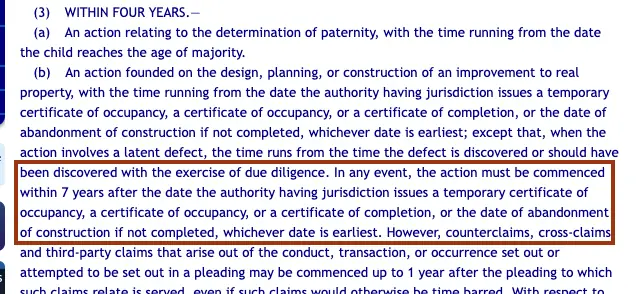
Florida’s SB 360 (chapter 2023-22), approved on April 14, 2023, cut the outer limit from 10 to 7 years and switched from the latest trigger date to the earliest. The current text keeps a latent defect discovery rule inside the 7 years, says repairs under warranty do not extend the period, and treats each building in a multi-building project as its own improvement.
California’s 337.15(g) dates substantial completion separately for each profession or trade, so the architect’s and the roofer’s 10 years can end on different days. Statutes of repose change, as Florida’s did in 2023; this page is general information, not legal advice, and a construction lawyer licensed in the project’s state should confirm the date that applies to your claim.
Substantial completion vs final completion: what changes?
Substantial completion asks whether the owner can use the work; final completion asks whether the contract is fully performed. Under A201-2017 the first is certified on a G704 under §9.8 and releases retainage on the certified work. The second follows the final inspection under §9.10.1 and releases final payment once the six closeout items in §9.10.2 arrive.
| Question | Substantial completion | Final completion | Source |
|---|---|---|---|
| Test | Owner can occupy or use the Work for its intended use | Work acceptable and the Contract fully performed | A201 §9.8.1; §9.10.1 |
| Who certifies | Architect, on the G704 | Architect, by the final Certificate for Payment | A201 §9.8.4; §9.10.1 |
| Work remaining | Punch list with a completion deadline | None, apart from warranty and correction duties | A201 §9.8.4; §12.2 |
| Money released | Retainage on the certified work, adjusted for open items | Final payment and remaining retainage after 6 closeout items, including a payment affidavit, consent of surety and lien waivers if required | A201 §9.8.5; §9.10.2 |
| Claims waived | No waiver clause in §9.8 | Final payment waives owner claims except 4 categories; accepting it waives contractor claims not made in writing | A201 §9.10.4; §9.10.5 |
| Clocks started | Warranties, 1-year correction period, 10-year claims cap | Federal warranty under FAR 52.246-21(b) | A201 §9.8.4, §12.2.2.1, §15.1.2; FAR |
| Standard AIA form | G704-2017 (G734-2019 with a CM adviser) | No universal certificate of final completion | AIA Contract Documents |
Where both milestones sit in the full project sequence, from feasibility to closeout, is covered in our guide to the commercial construction process.
How does the punch list relate to substantial completion?
The punch list is the bridge between the two milestones. A201 §9.8.2 has the contractor draft it, §9.8.3 lets the architect add to it, and §9.8.4 attaches it to the certificate with a deadline. Leaving an item off does not excuse it: A201 §9.8.2, Fla. Stat. 255.077(3) and 218.735(7)(d) all keep the contractor responsible for the full contract work.
Statutes also limit what belongs on the list. Fla. Stat. 255.077(7) says warranty items may not hold up final retainage, and Massachusetts §29F excludes work repaired under a warranty after completion from “incomplete or defective work.” In Massachusetts both the owner’s list and the prime’s lists to subcontractors must be certified as made in good faith.
Is substantial completion the same as a certificate of occupancy?
No. Substantial completion is a contract date between owner and contractor, certified by the architect; a certificate of occupancy is a permit document the building official issues after final inspections. They can fall on the same day, and A201 §9.9.1 requires authorization from public authorities before partial occupancy, but neither document replaces the other.
In Florida the gap now matters for claims: since 2023, 95.11(3)(b) counts from the certificate of occupancy, temporary certificate or certificate of completion, so record both dates in the closeout file. How Florida’s final inspections lead to a certificate of occupancy is set out in our commercial building permits guide.
Tenants should check which date their lease uses: rent commencement tied to substantial completion can fall on a different day than the certificate of occupancy, and the G704 records the owner’s occupancy date as a separate line. The schedule side of a build-out under a lease is covered in our guide to tenant improvement contractors.
Before you sign a G704: what should you check?
Treat the certificate as a contract amendment with dates. The decision table pairs each situation with the clause or statute that controls it and the action to take before signatures. The thresholds come from A201-2017, Florida’s public closeout statutes, Massachusetts §29F and the FAR as of October 2026; they do not cover every state, and the signed contract controls.
| If | Then | Rule |
|---|---|---|
| Required life safety inspections have not passed | Do not certify; the Work is not usable for its intended use, and occupancy needs public authority approval | A201 §9.8.1; §9.9.1 |
| Only a floor, wing or phase is ready | Certify a designated portion and describe it on the G704; in Massachusetts, phases count only if the contract expressly permits | A201 §9.8.4; c. 149 §29F(a) |
| A manufacturer warranty starts at shipment or startup | List it on the G704 with its own start date | A201 §9.8.4; G704 instructions |
| Florida public project | Finish the list within 30 days (45 only if the contract extends it at $10 million or more); expect payment less 150% within 20 business days after | Fla. Stat. 255.077(1), (4) |
| Massachusetts private contract of $3,000,000 or more, owner receives the notice | Accept, or reject in writing with reasons, within 14 days; silence counts as acceptance | c. 149 §29F(d) |
| Federal contract | Expect the warranty from final acceptance or possession and liquidated damages until completion or acceptance; get the remaining-items list before possession | FAR 52.246-21; 52.211-12; 52.236-11 |
| Florida project of any size | Calendar 4 and 7 years from the earliest CO, temporary CO or certificate of completion, not from the G704 | Fla. Stat. 95.11(3)(b) |
Two questions for your construction lawyer before you sign: does the agreement’s liquidated damages clause end at substantial completion or final completion, and do the G704 warranty exceptions match each equipment warranty delivered with the §9.10.2 closeout papers? Our commercial project checklist lists the closeout documents to collect.
A worked $1.2 million example of retainage from the first pay application to final payment is in our guide to retainage in construction.
How we compiled this
We compiled this page in October 2026 from 17 primary documents: the AIA A201-2017 General Conditions as posted by the University of Maine System, 3 AIA Contract Documents pages on G704-2017 and closeout, 7 Florida statute and bill records, California CCP 337.15, Massachusetts c. 149 §29F, Louisiana R.S. 9:4822 and 3 FAR clauses. We excluded unsourced percentages and day counts found on industry blogs.
CB&C is a matching service, not a law firm, contractor or insurer, and nothing on this page is legal advice.
Frequently asked questions
Who determines substantial completion?
Under AIA A201-2017, the architect does. The contractor submits its list under §9.8.2, the architect inspects under §9.8.3 and certifies the date on the G704 under §9.8.4, and §8.1.3 makes that certified date the date of substantial completion. Other contracts can assign the decision differently, and Massachusetts §29F lets a prime’s notice become binding if the owner does not reject it within 14 days.
Can substantial completion apply to only part of a project?
Yes. A201-2017 §9.8.1 covers the Work “or designated portion thereof,” and the G704 describes the portion certified. Partial occupancy before substantial completion falls under §9.9.1 and needs the insurer’s consent and public authority authorization. In Massachusetts, §29F lets phases count only when the contract expressly allows it, and Florida public contracts need a separate list for each building, structure or phase.
What percentage complete is substantial completion?
No AIA percentage exists. A201-2017 §9.8.1 uses an intended-use test, not a number, so a project that is 97% built can still fail it if a required system does not work. Percentages appear elsewhere: 19 jurisdictions cut or allow cutting public retainage at 50% completion, per our retainage registry, and Florida lets public owners hold 150% of the cost to finish the punch list after substantial completion under Fla. Stat. 255.077(4).
Can an owner refuse to sign the certificate of substantial completion?
Under A201-2017 the architect certifies the date, but §9.8.5 releases retainage only after the owner and contractor accept their responsibilities in writing, so a refusal can stall payment and become a claim. Massachusetts §29F sets firm rules for contracts of $3,000,000 or more: the owner must reject in writing within 14 days, state the factual and contractual basis, and certify good faith.
Does final payment happen at substantial completion?
No. Substantial completion releases retainage on the certified work under A201 §9.8.5, adjusted for open items. Final payment follows final completion under §9.10.1 and needs the six closeout items in §9.10.2, including a payment affidavit and consent of surety. On a Florida public job the balance less 150% of the punch list cost is due within 20 business days after the list.
Do warranties start at substantial completion?
Under A201-2017 §9.8.4, warranties required by the Contract Documents start on the substantial completion date unless the G704 lists a different date. The separate one-year correction period in §12.2.2.1 also starts then. Federal contracts differ: FAR 52.246-21(b) starts its 1-year construction warranty at final acceptance, or when the government takes possession of part of the work.
Sources
- AIA Document A201-2017, General Conditions of the Contract for Construction (sample posted by University of Maine System General Services), accessed 2026-10-19.
- Summary: G704-2017, Certificate of Substantial Completion, AIA Contract Documents, accessed 2026-10-19.
- Instructions: G704-2017, Certificate of Substantial Completion, AIA Contract Documents, accessed 2026-10-19.
- Substantial Completion vs. Final Completion: Key Differences, AIA Contract Documents, accessed 2026-10-07.
- Fla. Stat. 95.11 (2026), The Florida Legislature, accessed 2026-10-19.
- Fla. Stat. 95.11 (2022), The Florida Senate, accessed 2026-10-19.
- CS/SB 360 (2023), chapter 2023-22, The Florida Senate, accessed 2026-10-19.
- Fla. Stat. 255.077, project closeout and payment of retainage, accessed 2026-10-19.
- Fla. Stat. 255.078, public construction retainage, accessed 2026-10-19.
- Fla. Stat. 218.735, local government prompt payment, accessed 2026-10-19.
- Fla. Stat. 713.08, claim of lien, accessed 2026-10-19.
- Cal. Code Civ. Proc. 337.15, California Legislative Information, accessed 2026-10-19.
- Mass. G.L. c. 149, §29F, The General Court of Massachusetts, accessed 2026-10-19.
- La. R.S. 9:4822, Louisiana State Legislature, accessed 2026-10-19.
- FAR 52.246-21, Warranty of Construction, Acquisition.gov, accessed 2026-10-19.
- FAR 52.211-12, Liquidated Damages, Construction, Acquisition.gov, accessed 2026-10-19.
- FAR 52.236-11, Use and Possession Prior to Completion, Acquisition.gov, accessed 2026-10-19.