OSHA Violations in Commercial Construction vs Residential and Specialty Trades
- Primary data
- OSHA Frequently Cited OSHA Standards (Federal), by NAICS, archived official result pages
- Data period
- FY2018 to FY2025 (subsector comparison: FY2024, October 2023 to September 2024)
- Latest release used
- 2026-01-03
- Next release
- OSHA updates the tool continuously; FY2026 (October 2025 to September 2026) totals expected after the year closes
- Geography
- United States, Federal OSHA jurisdiction (State Plan states excluded)
- Sources
- 26 (26 Tier 1)
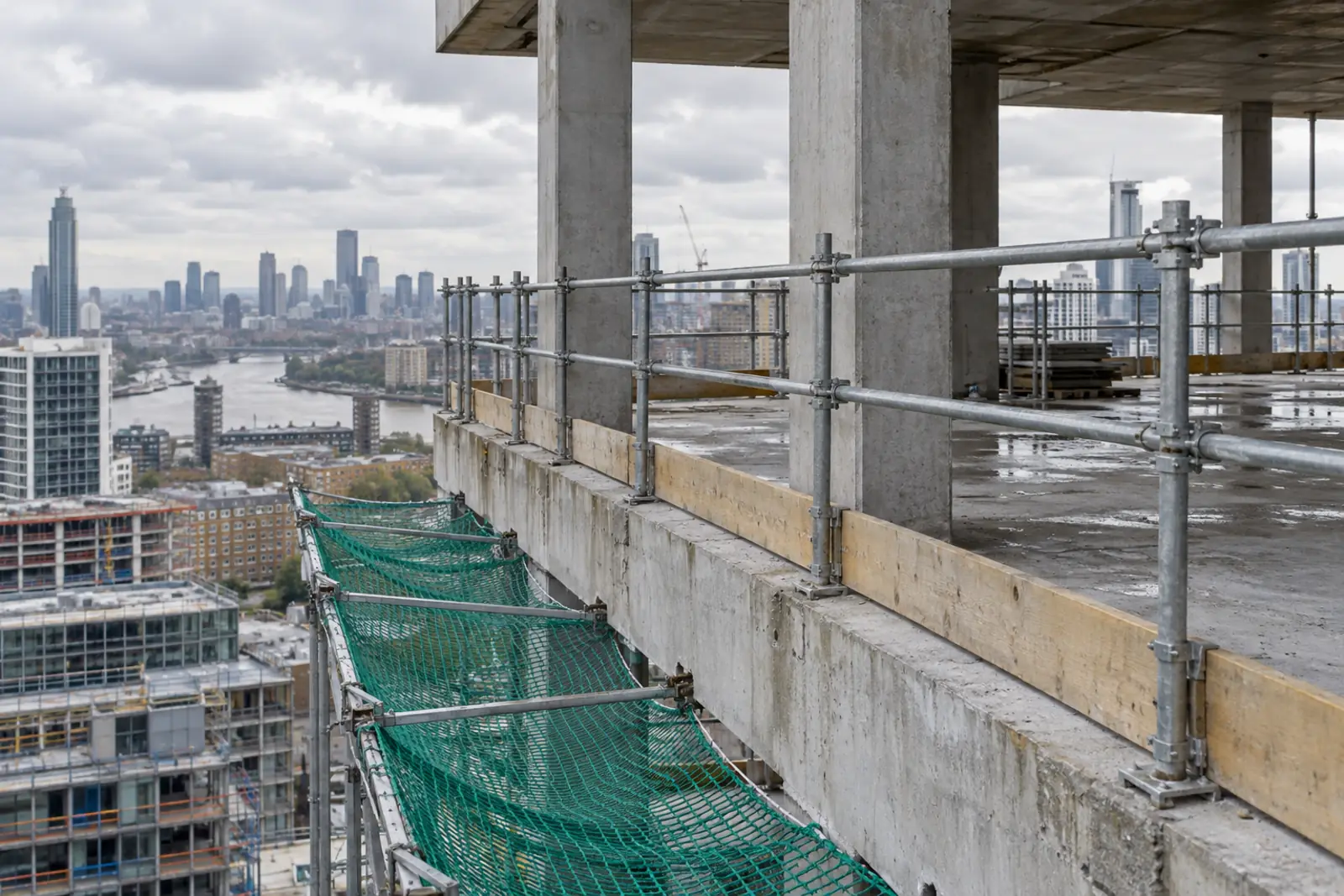
OSHA violations in commercial construction center on fall protection (1926.501) and scaffolds (1926.451). In FY2024 federal OSHA issued 1,145 citations and $5.42 million in current penalties to nonresidential building contractors (NAICS 2362), or $4,730 per citation, against $3,712 for residential builders and $4,401 for specialty trades.
OSHA violations in commercial construction compared side by side
All four groups share the same top standard, 1926.501. The differences are in how concentrated citations are, how much each citation costs and how often contractors are cited relative to their workforce.
| Measure | Nonresidential building (2362) | Residential building (2361) | Specialty trades (238) | All construction (23) |
|---|---|---|---|---|
| Citations (FY2024) | 1,145 | 1,127 | 22,521 | 25,941 |
| Inspections with a citation (FY2024) | 525 | 485 | 8,944 | 10,414 |
| Current penalties (FY2024) | $5,415,395 | $4,183,848 | $99,121,145 | $119,441,611 |
| Citations per inspection | 2.18 | 2.32 | 2.52 | 2.49 |
| Average penalty per citation | $4,730 | $3,712 | $4,401 | $4,604 |
| Fall protection share of citations | 20.9% | 31.9% | 38.3% | 35.6% |
| Most cited standard | 1926.501 Duty to have fall protection | 1926.501 Duty to have fall protection | 1926.501 Duty to have fall protection | 1926.501 Duty to have fall protection |
| Private employees, 2024 (QCEW) | 904,160 | 936,293 | 5,151,234 | 8,135,442 |
| Federal citations per 1,000 employees | 1.27 | 1.20 | 4.37 | 3.19 |
| Injury and illness rate, 2024 (SOII, per 100 FTE) | 1.9 | 2.5 | 2.3 | 2.2 |
FY2024 is October 2023 to September 2024. Federal OSHA only (State Plan states excluded). Penalties are current amounts as of the November 2024 archive capture. NAICS 2362 includes 236220 commercial and institutional building (81.9% of 2362 private employment in 2025) and 236210 industrial building. Employment from BLS QCEW 2024; injury rates from BLS SOII 2024.
Source: [1][2][3][4][22][23] Occupational Safety and Health Administration (U.S. Department of Labor); Occupational Safety and Health Administration (U.S. Department of Labor); Occupational Safety and Health Administration (U.S. Department of Labor); Occupational Safety and Health Administration (U.S. Department of Labor); U.S. Bureau of Labor Statistics; U.S. Bureau of Labor Statistics
Commercial construction in this report: OSHA's tool publishes the 4-digit NAICS group 2362, Nonresidential Building Construction, which combines 236220 Commercial and Institutional Building Construction and 236210 Industrial Building Construction. In 2025, 236220 accounted for 81.9% of 2362 private employment and 89.0% of its establishments (BLS QCEW). Residential building (2361) includes 236118 Residential Remodelers, which held 49.4% of 2361 employment.
Federal OSHA issued 1,145 citations to NAICS 2362 contractors in FY2024 (October 2023 to September 2024), against 1,127 for residential building, 22,521 for specialty trade contractors and 25,941 for all construction (OSHA, NAICS 2362, FY2024; OSHA, NAICS 23, FY2024). Commercial building contractors averaged 2.18 citations per inspection with a citation, the lowest of the four groups; specialty trades averaged 2.52.
Scaled by workforce, federal citations ran at 1.27 per 1,000 private employees in NAICS 2362, 1.20 in residential building, 4.37 in specialty trades and 3.19 in all construction. The numerator covers Federal OSHA only while the employment denominator is national, so the levels are understated; the comparison across columns is the useful part.
The BLS injury data point the same way. Nonresidential building construction reported 1.9 recordable cases per 100 full-time workers in 2024, against 2.5 for residential building, 2.3 for specialty trades and 2.2 for all construction (BLS SOII 2024). For fatality counts, see our separate report on construction worker deaths.
Where commercial, residential and trade citations diverge, standard by standard
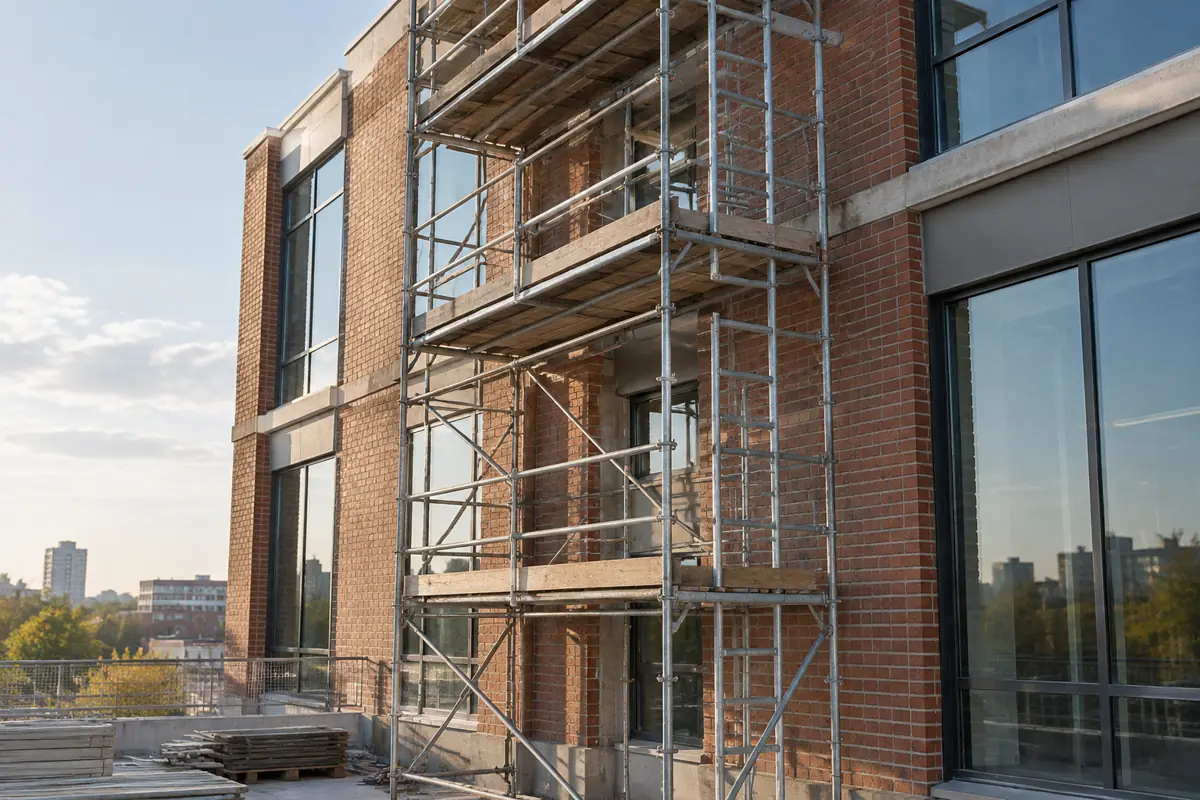
Commercial building contractors are cited less for basic fall protection, ladders and personal protective equipment, and more for scaffolds, aerial lifts, respiratory hazards, silica and electrical work.
Share of federal OSHA citations by standard family, FY2024
Source: OSHA Frequently Cited OSHA Standards, Federal, FY2024 (archived Nov. 2024); CB&C family grouping
| Standard family | 2362 share | 2361 share | 238 share | 23 share | 2362 citations | 2361 citations |
|---|---|---|---|---|---|---|
| Fall protection (Subpart M) | 20.9% | 31.9% | 38.3% | 35.6% | 239 | 359 |
| Scaffolds and aerial lifts (Subpart L) | 16.2% | 13.5% | 10.6% | 10.5% | 185 | 152 |
| Ladders and stairways (Subpart X) | 7.0% | 10.1% | 13.5% | 12.5% | 80 | 114 |
| Head, eye and face protection (Subpart E) | 3.6% | 5.6% | 11.3% | 10.3% | 41 | 63 |
| Respiratory, silica and hazard communication | 13.7% | 6.5% | 6.0% | 6.7% | 157 | 73 |
| General safety provisions and training (Subpart C) | 7.7% | 8.5% | 5.3% | 5.6% | 88 | 96 |
| Excavations (Subpart P) | 5.0% | 2.7% | 2.0% | 4.3% | 57 | 30 |
| Electrical (Subpart K) | 6.9% | 6.7% | 2.0% | 2.4% | 79 | 75 |
| Abatement and recordkeeping (Parts 1903, 1904) | 3.8% | 4.4% | 4.0% | 4.0% | 43 | 50 |
| All other standards | 15.4% | 10.2% | 6.8% | 8.0% | 176 | 115 |
Families grouped by CB&C from 29 CFR subparts: fall protection = 1926.500 to 503; scaffolds = 1926.450 to 454; ladders = 1926.1050 to 1060; head, eye and face = 1926.95 to 102; health = 1910.134, 1910.1200, 1926.1153, 1926.59, 1926.62, 1926.1101 and related; general = 1926.20 to 35; excavations = 1926.650 to 652; electrical = 1926.400 to 449; abatement and recordkeeping = Parts 1903 and 1904.
Source: [1][2][3][4][21] Occupational Safety and Health Administration (U.S. Department of Labor); Occupational Safety and Health Administration (U.S. Department of Labor); Occupational Safety and Health Administration (U.S. Department of Labor); Occupational Safety and Health Administration (U.S. Department of Labor); Office of the Federal Register, eCFR
| Standard | 2362 citations | 2362 share | 2361 share | 238 share | 23 share | Commercial excess ratio (2362 / 23) |
|---|---|---|---|---|---|---|
| 1926.501 Duty to have fall protection | 163 | 14.2% | 23.0% | 27.1% | 25.2% | 0.57 |
| 1926.451 Scaffolds, general requirements | 119 | 10.4% | 9.6% | 7.1% | 7.0% | 1.48 |
| 1926.1053 Ladders | 58 | 5.1% | 7.5% | 11.1% | 10.3% | 0.49 |
| 1910.134 Respiratory protection | 56 | 4.9% | 2.7% | 1.3% | 1.6% | 3.14 |
| 1926.1153 Respirable crystalline silica | 53 | 4.6% | 1.7% | 2.1% | 2.3% | 2.05 |
| 1926.20 General safety and health provisions | 50 | 4.4% | 5.3% | 3.8% | 3.8% | 1.16 |
| 1926.502 Fall protection systems criteria | 48 | 4.2% | 2.7% | 2.1% | 2.2% | 1.93 |
| 1926.453 Aerial lifts | 45 | 3.9% | 2.2% | 2.0% | 2.0% | 1.94 |
| 1926.405 Electrical wiring methods | 37 | 3.2% | 2.6% | 0.5% | 0.7% | 4.56 |
| 1926.651 Specific excavation requirements | 34 | 3.0% | 1.7% | 1.2% | 2.4% | 1.22 |
| 1910.1200 Hazard communication | 29 | 2.5% | 1.4% | 2.0% | 2.0% | 1.29 |
| 1926.503 Fall protection training | 28 | 2.4% | 6.2% | 9.0% | 8.2% | 0.30 |
Commercial excess ratio = a standard's share of NAICS 2362 citations divided by its share of all construction (NAICS 23) citations. Above 1 means the standard is more prominent in commercial building than in construction as a whole.
Source: [1][2][3][4] Occupational Safety and Health Administration (U.S. Department of Labor); Occupational Safety and Health Administration (U.S. Department of Labor); Occupational Safety and Health Administration (U.S. Department of Labor); Occupational Safety and Health Administration (U.S. Department of Labor)
Share of NAICS 2362 citations divided by share of all construction citations (1.0 = same)
Source: CB&C calculation from OSHA Frequently Cited OSHA Standards, Federal, FY2024
Standard meanings follow the current text of 29 CFR Part 1926 on the eCFR: Subpart M covers fall protection, Subpart L scaffolds (including aerial lifts at 1926.453), Subpart X stairways and ladders, Subpart E personal protective equipment, Subpart K electrical, Subpart P excavations and Subpart Z toxic substances, including silica at 1926.1153. Steel erection fall protection (Subpart R) is counted under all other standards.
OSHA penalties compared: commercial, residential and specialty trades
Commercial building contractors pay more per citation than residential builders, mainly because their fall protection and general safety citations carry higher current penalties. Statutory maximums did not change for 2026.
Average current penalty per citation, FY2024
Source: CB&C calculation from OSHA Frequently Cited OSHA Standards, Federal, FY2024 (archived Nov. 2024)
| Standard | 2362 penalty per citation | 2361 penalty per citation | 238 penalty per citation | 23 penalty per citation | 2362 total penalties |
|---|---|---|---|---|---|
| 1926.501 Duty to have fall protection | $8,112 | $5,948 | $7,345 | $7,354 | $1,322,224 |
| 1926.451 Scaffolds, general requirements | $3,642 | $3,417 | $3,635 | $3,627 | $433,342 |
| 1926.1053 Ladders | $3,552 | $3,041 | $3,568 | $3,529 | $206,019 |
| 1926.503 Fall protection training | $2,115 | $1,735 | $2,205 | $2,205 | $59,212 |
| 1926.453 Aerial lifts | $3,847 | $3,122 | $3,904 | $3,840 | $173,129 |
| 1926.502 Fall protection systems criteria | $3,813 | $2,556 | $2,962 | $3,047 | $183,025 |
| 1926.20 General safety and health provisions | $5,431 | $4,117 | $4,111 | $4,249 | $271,545 |
| 1926.1153 Respirable crystalline silica | $2,784 | $2,216 | $1,762 | $2,003 | $147,541 |
| 1910.134 Respiratory protection | $1,998 | $640 | $1,474 | $1,580 | $111,894 |
| 1910.1200 Hazard communication | $1,786 | $1,581 | $1,719 | $1,725 | $51,804 |
| 1926.651 Specific excavation requirements | $4,523 | $3,498 | $5,912 | $7,181 | $153,776 |
| 1926.652 Excavation protective systems | $7,119 | $6,050 | $9,593 | $13,296 | $163,731 |
Current penalty divided by citations for each standard. Small counts in 2362 and 2361 make single-standard averages volatile.
Source: [1][2][3][4] Occupational Safety and Health Administration (U.S. Department of Labor); Occupational Safety and Health Administration (U.S. Department of Labor); Occupational Safety and Health Administration (U.S. Department of Labor); Occupational Safety and Health Administration (U.S. Department of Labor)
The NAICS 2362 average of $4,730 per citation in FY2024 equals 28.6% of the $16,550 maximum for a single serious violation. Averages sit well below the maximum because the figures mix serious, other-than-serious, repeat and willful citations and reflect size, history and good-faith reductions and settlements.
Excavation citations show the opposite pattern: requirements for protective systems (1926.652) averaged $7,119 per citation in NAICS 2362 against $13,296 across construction, where trenching specialists and heavy civil contractors drive the totals.
| Violation type | Minimum per violation (2026) | Maximum (2026) |
|---|---|---|
| Serious | $1,085 | $16,550 per violation |
| Other-than-serious | $0 | $16,550 per violation |
| Repeat | $4,256 | $165,514 per violation |
| Willful | $11,823 | $165,514 per violation |
| Posting requirements | $0 | $16,550 per violation |
| Failure to abate | not applicable | $16,550 per day beyond the abatement date |
2025 amounts carried into 2026 because no inflation adjustment was made. State Plans set their own amounts, at least as effective as federal levels.
Source: [16][15] Occupational Safety and Health Administration (U.S. Department of Labor); Occupational Safety and Health Administration (U.S. Department of Labor)
For 2026, OSHA kept the 2025 amounts: up to $16,550 per serious or other-than-serious violation, $165,514 per willful or repeat violation, and $16,550 per day for failure to abate, generally limited to 30 days (OSHA memo, May 21, 2026; OSHA Penalties). The willful or repeat maximum is 10.0 times the serious maximum. Minimums are $1,085 for a serious violation, $4,256 for a repeat violation and $11,823 for a willful violation.
Current penalties fall as cases settle. The FY2024 penalty total for NAICS 2362 was 10.0% lower in an April 2025 capture than in the November 2024 capture, and the residential total was 8.4% lower. Penalty comparisons in this report therefore use captures taken at the same point after the fiscal year closed.
Trend over fiscal years: are OSHA construction inspections increasing?
Federal construction citations and inspections with citations rose each year from FY2021 to FY2025 and are back near FY2018 levels. Penalties per citation rose faster than citations until FY2024, then eased in FY2025.
Federal OSHA citations and inspections with citations, NAICS 23
Source: OSHA Frequently Cited OSHA Standards, NAICS 23, Federal (archived captures 1 to 3 months after each fiscal year); FY2019 not archived
| Fiscal year | Period | Citations | Inspections | Current penalties | Penalty per citation | Archive capture |
|---|---|---|---|---|---|---|
| FY2018 | October 2017 to September 2018 | 25,881 | 10,536 | $75,393,658 | $2,913 | 2018-11-20 |
| FY2020 | October 2019 to September 2020 | 17,946 | 7,085 | $63,074,054 | $3,515 | 2020-11-07 |
| FY2021 | October 2020 to September 2021 | 19,725 | 7,790 | $69,473,953 | $3,522 | 2021-12-01 |
| FY2022 | October 2021 to September 2022 | 19,670 | 7,999 | $83,305,738 | $4,235 | 2022-11-16 |
| FY2023 | October 2022 to September 2023 | 23,608 | 9,376 | $97,579,276 | $4,133 | 2023-11-29 |
| FY2024 | October 2023 to September 2024 | 25,941 | 10,414 | $119,441,611 | $4,604 | 2024-11-05 |
| FY2025 | October 2024 to September 2025 | 26,428 | 10,691 | $112,165,880 | $4,244 | 2026-01-03 |
Each year uses the first archived capture after the fiscal year closed (1 to 3 months later). FY2019 was not archived in that window and is omitted. Nominal dollars.
Source: [7][8][9][10][11][4][5] Occupational Safety and Health Administration (U.S. Department of Labor); Occupational Safety and Health Administration (U.S. Department of Labor); Occupational Safety and Health Administration (U.S. Department of Labor); Occupational Safety and Health Administration (U.S. Department of Labor); Occupational Safety and Health Administration (U.S. Department of Labor); Occupational Safety and Health Administration (U.S. Department of Labor); Occupational Safety and Health Administration (U.S. Department of Labor)
Federal construction citations were 25,881 in FY2018, fell to 17,946 in FY2020 and climbed to 26,428 in FY2025, a 47.3% rise from the FY2020 low. Inspections with citations grew 50.9% over the same span, from 7,085 to 10,691. FY2025 citations were only 2.1% above FY2018.
Average current penalty per citation, FY2024 to FY2025
Source: CB&C calculation from OSHA Frequently Cited OSHA Standards, Federal (archived Nov. 2024, Dec. 2025, Jan. 2026)
The average current penalty per construction citation rose from $2,913 in FY2018 to $4,604 in FY2024, a nominal increase that tracks annual inflation adjustments to maximum penalties. In FY2025 it fell to $4,244, and specialty trades fell from $4,401 to $4,119. Specialty trade citations were flat, down 0.5%.
Archived captures understate recent years slightly: the FY2018 citation count was 15.0% higher in a capture taken a year later than in the first capture after the year closed. Every year in this table uses a first capture taken 1 to 3 months after year end, so the years are comparable with one another. A matching series for NAICS 2362 was not archived, so the commercial building trend cannot be shown beyond FY2024.
What owners and contractors can check
OSHA's public data can be used to check a contractor's inspection record and to see which hazards inspectors cite most often on comparable jobs. Each check below uses public sources only.
- Inspection history: OSHA's Establishment Search (linked from osha.gov/data) lists inspections, citations and penalties by employer name. Search under every legal entity name the contractor uses, and read case status: penalties can be reduced or vacated after an informal settlement or contest.
- Hazard focus by trade: compare a bidder's planned scope with the standards in the tables above. On commercial building work, scaffold (1926.451), aerial lift (1926.453), respiratory (1910.134) and silica (1926.1153) citations are more common than in construction as a whole.
- Written programs to request: fall protection plans and training records (1926.503), a written respiratory protection program (1910.134), a silica exposure control plan (1926.1153) and a hazard communication program (1910.1200).
- Emphasis programs: OSHA's falls NEP (CPL 03-00-025, effective May 1, 2023) lets compliance officers open inspections when they observe fall hazards, and the heat NEP (CPL 03-00-024, reissued April 10, 2026) prioritizes days with a heat index of 80 degrees Fahrenheit or more.
- Context, not a verdict: one citation is not a measure of a contractor's safety culture. Read a record alongside the firm's size and number of jobs, and see our guide to comparing construction bids and our notes on jobsite culture.
To find general contractors by market, see our commercial builders by state research. This report does not name individual cited companies and is not legal or compliance advice.
Ratios behind the comparison
Share of citations by standard family
Formulafamily citations / total citations x 100, per NAICS group
Inputs: fact sheet total-citation rows for 2362, 2361, 238 and 23 (FY2024); all standard rows in raw/osha_cited_parsed.json; derived ids fam_* (fact sheet rows)
Result: Fall protection: 20.9% (2362), 31.9% (2361), 38.3% (238), 35.6% (23). Respiratory, silica and hazard communication: 13.7%, 6.5%, 6.0%, 6.7%.
Commercial building citations are less concentrated in fall protection and more spread across health, scaffold and electrical hazards.
Limitations: Family grouping is a CB&C convention; Federal OSHA only; one fiscal year.
Average penalty per citation by NAICS and standard
Formulacurrent penalty / citations
Inputs: fact sheet total and standard rows (FY2024); derived ids ppc_* and pps_* (fact sheet rows)
Result: $4,730 (2362), $3,712 (2361), $4,401 (238), $4,604 (23). For 1926.501: $8,112 (2362) versus $7,354 (23).
A commercial building citation costs about 1.27 times a residential one on average.
Limitations: Current penalties shrink as cases settle; averages mix violation types.
Commercial excess ratio
Formula(standard citations in 2362 / total 2362 citations) / (standard citations in 23 / total 23 citations)
Inputs: fact sheet standard rows for 2362 and 23 (FY2024); derived ids cer_* and fer_* (fact sheet rows)
Result: Highest: 1926.405 electrical wiring 4.56, 1910.134 respiratory protection 3.14, 1926.1153 silica 2.05. Lowest: 1926.503 fall protection training 0.30, 1926.1053 ladders 0.49, 1926.501 0.57.
Ratios above 1 mark hazards that are more prominent in commercial building than in construction as a whole.
Limitations: Most 2362 standard counts are under 60, so ratios can move sharply between years. 2362 includes industrial building.
Fiscal-year trend for construction citations and penalties
Formula(later year / earlier year - 1) x 100
Inputs: table t5; derived ids trend_* (fact sheet rows)
Result: Citations up 47.3% from FY2020 to FY2025 and up 1.9% from FY2024 to FY2025; penalties down 6.1% from FY2024 to FY2025.
Enforcement volume in construction has recovered to pre-pandemic levels; FY2025 shows flat citations and lower penalties per citation.
Limitations: The brief asked for a NAICS 236220 trend; OSHA's tool does not publish 6-digit tables in archived form and the 2362 series was archived only for FY2024, so the trend uses NAICS 23.
Citations relative to workforce
Formulafederal citations / QCEW private employment x 1,000
Inputs: fact sheet citation rows (FY2024) and QCEW 2024 employment rows; derived ids cpk_* (fact sheet rows)
Result: 1.27 (2362), 1.20 (2361), 4.37 (238), 3.19 (23).
General contractors in building construction are cited far less often per worker than specialty trades, which perform most of the at-height and hands-on work.
Limitations: Federal-only numerator over a national denominator understates levels; compare across groups only.
Where the numbers diverge
- Federal OSHA issued 1,145 citations to nonresidential building contractors (NAICS 2362) in FY2024, across 525 inspections with citations, carrying $5,415,395 in current penalties.[1]
- Duty to have fall protection (1926.501) was the most cited standard for NAICS 2362 in FY2024 with 163 citations, followed by scaffold general requirements (1926.451) with 119 and ladders (1926.1053) with 58.[1]
- Subpart M fall protection standards made up 20.9% of NAICS 2362 citations in FY2024, compared with 31.9% for residential building, 38.3% for specialty trades and 35.6% for all construction.[1][2][3][4]
- Respiratory protection (1910.134) had a commercial excess ratio of 3.14 in FY2024: 4.9% of NAICS 2362 citations against 1.6% of all construction citations.[1][4]
- Respirable crystalline silica (1926.1153) was 4.6% of NAICS 2362 citations in FY2024, against 1.7% for residential building and 2.3% for all construction.[1][2][4]
- Electrical wiring methods (1926.405) had the highest commercial excess ratio among the top 12 NAICS 2362 standards in FY2024, at 4.56.[1][4]
- Fall protection training (1926.503) was underrepresented in commercial building in FY2024, with a commercial excess ratio of 0.30 (2.4% of NAICS 2362 citations against 8.2% of all construction).[1][4]
- The average current penalty per citation was $4,730 for NAICS 2362 in FY2024, 1.27 times the $3,712 average for residential building (2361).[1][2]
- A 1926.501 citation averaged $8,112 in current penalties for NAICS 2362 in FY2024, compared with $7,354 across all construction.[1][4]
- NAICS 2362 accounted for 4.4% of federal construction citations in FY2024 while employing 11.1% of private construction workers in 2024.[1][4][23]
- In FY2025, 1926.501 alone produced 25.4% of federal construction citations and 40.7% of construction penalties, at $6,812 per citation.[5]
- Federal construction citations rose 47.3% between FY2020 (17,946) and FY2025 (26,428), and inspections with citations rose 50.9%.[8][5]
- Nonresidential building construction had a 2024 injury and illness rate of 1.9 cases per 100 full-time workers, below 2.5 for residential building and 2.2 for all construction.[22]
Summary
- Duty to have fall protection (29 CFR 1926.501) is the most cited standard in every construction subsector, but it accounts for 14.2% of nonresidential building citations in FY2024 against 23.0% for residential building and 27.1% for specialty trades (OSHA, NAICS 2362, FY2024).
- Commercial building citations are spread across more hazards: scaffolds and aerial lifts make up 16.2% of NAICS 2362 citations and respiratory, silica and hazard communication 13.7%, both above the all-construction shares of 10.5% and 6.7%.
- Penalties per citation are higher in commercial building: $4,730 on average in FY2024 for NAICS 2362, compared with $3,712 for residential building (2361), $4,401 for specialty trades (238) and $4,604 for all construction.
- Specialty trade contractors receive most construction citations: 22,521 of 25,941 federal construction citations in FY2024, or 4.37 citations per 1,000 private employees against 1.27 for nonresidential building.
- Construction citations reached 26,428 in FY2025, up 1.9% on FY2024, while current penalties fell 6.1% to $112.2 million (OSHA, NAICS 23, FY2025).
- OSHA made no inflation adjustment for 2026: the maximum penalty stays at $16,550 per serious violation and $165,514 per willful or repeat violation (OSHA memo, May 21, 2026).
- FY2025 figures for NAICS 2362 and 2361 could not be retrieved because OSHA's query tool now sits behind a CAPTCHA; the subsector comparison therefore uses FY2024.
Questions people ask
What is the most common OSHA violation in construction?
Duty to have fall protection, 29 CFR 1926.501. It was the most cited construction standard in FY2025 with 6,705 federal citations, 25.4% of all federal construction citations, and it ranks first on OSHA's FY2025 Top 10 list for all industries. It is also first for commercial, residential and specialty trade contractors.
How much is an OSHA fine in 2026?
Up to $16,550 per serious or other-than-serious violation and up to $165,514 per willful or repeat violation, the same as 2025 because no inflation adjustment was made for 2026. Failure to abate can cost up to $16,550 per day. In practice the average construction citation carried $4,244 in current penalties in FY2025.
What OSHA standards apply to commercial construction?
29 CFR Part 1926 applies to construction work, with some general industry standards in Part 1910 such as respiratory protection (1910.134) and hazard communication (1910.1200). The standards most cited for nonresidential building contractors in FY2024 were 1926.501 fall protection, 1926.451 scaffolds, 1926.1053 ladders, 1910.134 respiratory protection and 1926.1153 silica.
How can I check a contractor's OSHA record?
Use OSHA's Establishment Search, linked from osha.gov/data, and search every legal name the contractor operates under. Each record shows the inspection date, citations, violation types and current penalties. Check whether a case is still open or contested before drawing conclusions.
Are OSHA inspections increasing?
In construction, yes since the pandemic low. Federal construction inspections that produced citations rose from 7,085 in FY2020 to 10,691 in FY2025, a 50.9% increase, and FY2025 was 2.1% above FY2018 on citations. Between FY2024 and FY2025 citations rose 1.9%.
For journalists and researchers
If you cite only a few, cite these
- Nonresidential building contractors (NAICS 2362) received 1,145 federal OSHA citations and $5.42 million in current penalties in FY2024.[1]
- Fall protection was 20.9% of commercial building citations against 31.9% for residential building in FY2024.[1][2]
- 1926.501 produced 40.7% of federal construction penalties in FY2025.[5]
Most quotable statistics
- Fall protection (Subpart M) was 20.9% of federal OSHA citations to nonresidential building contractors in FY2024, against 35.6% across all construction.[1][4]
- Respiratory protection (1910.134) appeared 3.14 times more often, as a share of citations, in nonresidential building than in construction as a whole in FY2024.[1][4]
- A federal OSHA citation to a nonresidential building contractor carried $4,730 in current penalties on average in FY2024, against $3,712 for a residential builder.[1][2]
- Specialty trade contractors received 22,521 of 25,941 federal construction citations in FY2024.[3][4]
- Federal construction citations reached 26,428 in FY2025, up 47.3% from the FY2020 low.[5][8]
- OSHA's 2026 maximum penalties are unchanged from 2025: $16,550 per serious violation and $165,514 per willful or repeat violation.[16]
Press summary
Commercial building contractors face a different OSHA citation mix from home builders and specialty trades, according to a Commercial Builders & Contractors analysis of OSHA's Frequently Cited Standards tables. In FY2024, federal OSHA issued 1,145 citations to nonresidential building contractors (NAICS 2362), with $5.42 million in current penalties. Fall protection was the top standard, but it made up 20.9% of their citations, against 31.9% for residential builders and 38.3% for specialty trades. Commercial building citations were more often about scaffolds, aerial lifts, respiratory protection, silica and electrical wiring; respiratory protection appeared 3.14 times more often than its share in all construction. Each commercial building citation averaged $4,730 in penalties, against $3,712 for residential builders. Across construction, federal citations reached 26,428 in FY2025, up 47.3% from FY2020. OSHA kept its 2026 maximum penalties at 2025 levels: $16,550 per serious and $165,514 per willful or repeat violation.
Suggested headlines
- Fall protection is a smaller share of OSHA citations in commercial building than in home building
- Commercial builders' OSHA citations carry $4,730 in penalties on average, 1.27 times residential
- Respiratory and silica citations run at double the construction average in commercial building
- Federal construction citations hit 26,428 in FY2025, back above pre-pandemic levels
- OSHA freezes 2026 penalty maximums at $16,550 and $165,514
How to cite this report
Commercial Builders & Contractors. (2026). OSHA Violations in Commercial Construction vs Residential and Specialty Trades. Retrieved from https://commercialbuildersandcontractors.com/osha-violations-commercial-construction/
Reuse license
Data and tables are licensed CC BY 4.0. Attribution: “Source: Commercial Builders & Contractors, OSHA Violations in Commercial Construction vs Residential and Specialty Trades” with a link to this page.
Download the data
Every table in this report is available as a CSV under CC BY 4.0. The fact sheet lists each value with its source URL and access date.
- derived_metrics.csv (CSV)
- fact_sheet.csv (CSV)
- Side by side: federal OSHA citations in FY2024 by construction subsector (CSV)
- Share of citations by standard family, FY2024 (CSV)
- Commercial excess ratio for the 12 standards most cited in nonresidential building, FY2024 (CSV)
- Average current penalty per citation by standard and subsector, FY2024 (CSV)
- Federal OSHA citations and penalties in construction (NAICS 23), FY2018 to FY2025 (CSV)
- OSHA civil penalty minimums and maximums for 2026 (CSV)
Frequently asked questions
How many OSHA citations did commercial building contractors receive in FY2024?
Federal OSHA issued 1,145 citations to NAICS 2362 nonresidential building contractors in FY2024 (October 2023 to September 2024), with $5,415,395 in current penalties.
What share of commercial construction citations involve fall protection?
Subpart M fall protection standards were 20.9% of NAICS 2362 citations in FY2024, against 35.6% for all construction.
Which OSHA standards are more common in commercial building than in construction generally?
Electrical wiring methods (1926.405, ratio 4.56), respiratory protection (1910.134, 3.14), silica (1926.1153, 2.05), aerial lifts (1926.453, 1.94) and fall protection systems criteria (1926.502, 1.93), based on FY2024 federal data.
What is the average OSHA penalty per citation in construction?
$4,244 in current penalties per federal construction citation in FY2025, down from $4,604 in FY2024.
Do residential builders get more OSHA citations than commercial builders?
The counts were nearly equal in FY2024: 1,127 for residential building (2361) and 1,145 for nonresidential building (2362). Residential citations carried less in penalties: $3,712 per citation against $4,730.
Why do specialty trade contractors receive most construction citations?
Specialty trades (NAICS 238) employed 5,151,234 private workers in 2024 and do most at-height work; they received 22,521 of 25,941 federal construction citations in FY2024.
Did OSHA penalties go up in 2026?
No. OSHA's May 21, 2026 memo kept 2025 amounts for 2026: $16,550 for a serious violation and $165,514 for a willful or repeat violation.
What is the minimum OSHA penalty for a serious violation in 2026?
$1,085 per serious violation, after the Field Operations Manual changes of July 14, 2025 that raised size and history reductions.
How dangerous is commercial building construction compared with residential?
BLS reports 1.9 recordable injury and illness cases per 100 full-time workers in nonresidential building construction in 2024, against 2.5 in residential building construction.
Does this data include State Plan states such as California or Washington?
No. The Frequently Cited Standards tables in this report cover Federal OSHA inspections only; queries for all jurisdictions returned no rows in the archived pages.
Methodology
Primary data: OSHA's Frequently Cited OSHA Standards tool, which lists, for a NAICS code and jurisdiction, the citations, inspections and current penalties for each standard cited in a fiscal year. On 2026-10-04 the live tool returned an AWS WAF CAPTCHA (HTTP 405) to every automated request, including the Internet Archive's Save Page Now crawler. We therefore used copies of the official result pages archived by the Internet Archive between 2018 and 2026. Each source link points to the archived official page; the raw HTML files are saved with the report.
Groups compared: NAICS 2362 Nonresidential Building Construction (the closest published group to 236220 Commercial and Institutional Building Construction, which held 81.9% of 2362 private employment in 2025), NAICS 2361 Residential Building Construction (which includes 236118 Residential Remodelers), NAICS 238 Specialty Trade Contractors and NAICS 23 Construction. No archived 6-digit 236220 or 236118 tables exist, and the live tool was unreachable, so the brief's 6-digit comparison is reported at the 4-digit level. All figures are Federal OSHA; queries for all jurisdictions (Federal plus State Plans) returned no rows in the archived pages.
Fiscal years and timing: the subsector comparison uses FY2024 (October 2023 to September 2024), the latest year archived for 2362 and 2361. To keep penalties comparable, all FY2024 figures come from captures taken in November 2024. FY2025 figures were available only for NAICS 23 and 238. Current penalties decline as cases settle, and late-entered citations raise counts in later captures, so the trend uses the first capture taken 1 to 3 months after each fiscal year closed.
Derived metrics: standard families group 29 CFR sections by subpart (listed under the family table). The commercial excess ratio divides a standard's share of 2362 citations by its share of all construction citations. Average penalty per citation divides current penalties by citations. Citations per 1,000 employees divide federal citations by BLS QCEW private employment. Every derived value is listed in derived_metrics.csv with its inputs.
Context data: BLS SOII 2024 incidence rates (the latest release; 2025 data are scheduled for late 2026), BLS QCEW 2024 and 2025 annual averages, the 2022 NAICS descriptions, OSHA's FY2025 Top 10 list, the 2026 penalty memo and Federal Register notice, and current OSHA emphasis program directives. Where sources differed (for example, two captures of the same fiscal year), we used the capture that matches the timing rule above and report the difference.
Exclusions and limits: State Plan enforcement, initial (pre-settlement) penalties, violation types (serious, willful, repeat) by NAICS and 6-digit NAICS tables were not available and are not estimated. Fatality counts are covered in a separate report. No individual cited company is named. This report is not legal or compliance advice. Last updated 2026-10-04.
This report presents published data with its limitations. It is not legal, financial or investment advice.
Sources, ranked by quality
Tier 1: primary and official sources (26)
- [1] Occupational Safety and Health Administration (U.S. Department of Labor). Frequently Cited OSHA Standards: NAICS 2362 Nonresidential Building Construction, Federal, FY2024 (archived Nov. 10, 2024). October 2023 to September 2024. Accessed 2026-10-04.
- [2] Occupational Safety and Health Administration (U.S. Department of Labor). Frequently Cited OSHA Standards: NAICS 2361 Residential Building Construction, Federal, FY2024 (archived Nov. 10, 2024). October 2023 to September 2024. Accessed 2026-10-04.
- [3] Occupational Safety and Health Administration (U.S. Department of Labor). Frequently Cited OSHA Standards: NAICS 238 Specialty Trade Contractors, Federal, FY2024 (archived Nov. 11, 2024). October 2023 to September 2024. Accessed 2026-10-04.
- [4] Occupational Safety and Health Administration (U.S. Department of Labor). Frequently Cited OSHA Standards: NAICS 23 Construction, Federal, FY2024 (archived Nov. 5, 2024). October 2023 to September 2024. Accessed 2026-10-04.
- [5] Occupational Safety and Health Administration (U.S. Department of Labor). Frequently Cited OSHA Standards: NAICS 23 Construction, Federal, FY2025 (archived Jan. 3, 2026). October 2024 to September 2025. Accessed 2026-10-04.
- [6] Occupational Safety and Health Administration (U.S. Department of Labor). Frequently Cited OSHA Standards: NAICS 238 Specialty Trade Contractors, Federal, FY2025 (archived Dec. 5, 2025). October 2024 to September 2025. Accessed 2026-10-04.
- [7] Occupational Safety and Health Administration (U.S. Department of Labor). Frequently Cited OSHA Standards: NAICS 23, Federal, FY2018 (archived Nov. 20, 2018). October 2017 to September 2018. Accessed 2026-10-04.
- [8] Occupational Safety and Health Administration (U.S. Department of Labor). Frequently Cited OSHA Standards: NAICS 23, Federal, FY2020 (archived Nov. 7, 2020). October 2019 to September 2020. Accessed 2026-10-04.
- [9] Occupational Safety and Health Administration (U.S. Department of Labor). Frequently Cited OSHA Standards: NAICS 23, Federal, FY2021 (archived Dec. 1, 2021). October 2020 to September 2021. Accessed 2026-10-04.
- [10] Occupational Safety and Health Administration (U.S. Department of Labor). Frequently Cited OSHA Standards: NAICS 23, Federal, FY2022 (archived Nov. 16, 2022). October 2021 to September 2022. Accessed 2026-10-04.
- [11] Occupational Safety and Health Administration (U.S. Department of Labor). Frequently Cited OSHA Standards: NAICS 23, Federal, FY2023 (archived Nov. 29, 2023). October 2022 to September 2023. Accessed 2026-10-04.
- [12] Occupational Safety and Health Administration (U.S. Department of Labor). Frequently Cited OSHA Standards: NAICS 2362 and 2361, Federal, FY2024 (later captures, April 2025). October 2023 to September 2024. Accessed 2026-10-04.
- [13] Occupational Safety and Health Administration (U.S. Department of Labor). Frequently Cited OSHA Standards: NAICS 23, Federal, FY2018 (later capture, Nov. 12, 2019). October 2017 to September 2018. Accessed 2026-10-04.
- [14] Occupational Safety and Health Administration (U.S. Department of Labor). Top 10 Most Frequently Cited Standards, FY2025. October 2024 to September 2025. Accessed 2026-10-04.
- [15] Occupational Safety and Health Administration (U.S. Department of Labor). OSHA Penalties. Penalties assessed after Jan. 15, 2026. Accessed 2026-10-04.
- [16] Occupational Safety and Health Administration (U.S. Department of Labor). 2026 OSHA Civil Penalties Update: No Inflation Adjustment and Updated Minimum Penalties (memo, May 21, 2026). Calendar year 2026. Accessed 2026-10-04.
- [17] Office of the Federal Register (U.S. Department of Labor notice). Department of Labor civil penalty notice, Federal Register, May 27, 2026 (FR Doc. 2026-10456). 2026. Accessed 2026-10-04.
- [18] Occupational Safety and Health Administration (U.S. Department of Labor). OSHA Instruction CPL 03-00-024, National Emphasis Program: Outdoor and Indoor Heat-Related Hazards (April 10, 2026). Effective April 10, 2026. Accessed 2026-10-04.
- [19] Occupational Safety and Health Administration (U.S. Department of Labor). OSHA Instruction CPL 03-00-025, National Emphasis Program: Falls (May 1, 2023). Effective May 1, 2023. Accessed 2026-10-04.
- [20] Occupational Safety and Health Administration (U.S. Department of Labor). OSHA National Emphasis Programs list. Current as of 2026-10-04. Accessed 2026-10-04.
- [21] Office of the Federal Register, eCFR. eCFR Title 29, Part 1926 (Safety and Health Regulations for Construction). Up to date as of 2026-10-01. Accessed 2026-10-04.
- [22] U.S. Bureau of Labor Statistics. Survey of Occupational Injuries and Illnesses, Table 1: Incidence rates by industry and case types, 2024. Calendar year 2024. Accessed 2026-10-04.
- [23] U.S. Bureau of Labor Statistics. Quarterly Census of Employment and Wages, annual averages by industry (open data CSV). 2024 and 2025 annual averages. Accessed 2026-10-04.
- [24] U.S. Census Bureau. 2022 NAICS Descriptions. 2022 NAICS. Accessed 2026-10-04.
- [25] Occupational Safety and Health Administration (U.S. Department of Labor). OSHA Commonly Used Statistics. FY2024. Accessed 2026-10-04.
- [26] Occupational Safety and Health Administration (U.S. Department of Labor). OSHA Data and Statistics (Establishment Search and enforcement data portal). Current. Accessed 2026-10-04.