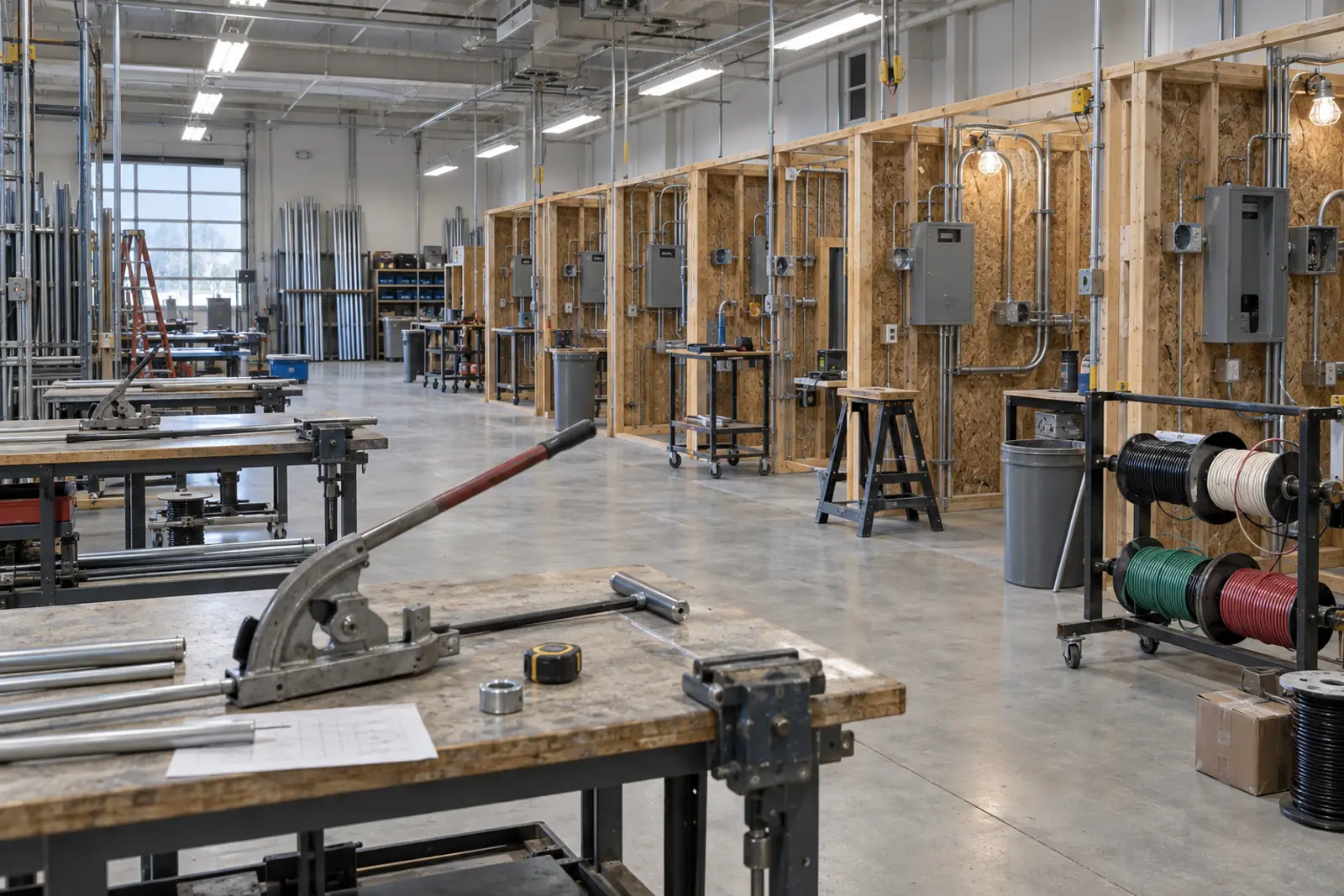
Construction Careers: Paths, Pay and Where the Openings Are
Construction careers start through a paid apprenticeship, a trade or technical school, or a college degree for management. BLS projects about 587,000 openings a year in construction and extraction occupations from 2025 to 2035. Construction managers earned a median $114,990 in May 2025; electricians $63,190; carpenters $60,580.
Construction Careers at a Glance
Construction careers offer something few other fields do: you can start with a high school diploma, get paid while you learn, and work toward a license, a supervisor's role or your own company. BLS projects about 587,000 openings a year in construction and extraction occupations from 2025 to 2035. Most of them, 548,400 a year, come from replacing people who retire or move on, so demand does not depend on the industry growing fast.
Pay starts above the national middle. The median wage for construction and extraction occupations was $59,540 in May 2025, against $50,980 for all occupations. Average hourly earnings of construction employees reached $41.69 in September 2026, up 4.2% in a year, faster than the 3.0% rise for all private employees.
The workforce is also aging at the top end: 702,000 construction workers were aged 65 and over in 2025, up 75.9% from 2015, while the median age was 42.2. Our construction labor shortage tracker follows openings, hiring and quits each month.
Three Ways Into the Trades and Management
| Path | Typical entry | How training works | Where it leads | Source |
|---|---|---|---|---|
| Registered apprenticeship | High school diploma or equivalent | Paid work on site plus classroom instruction; electricians typically train 4 or 5 years with about 2,000 paid hours a year | Licensed electrician, plumber, pipefitter, carpenter, sheet metal worker | BLS OOH; Apprenticeship.gov |
| Trade or technical school | High school diploma or equivalent | Classroom and lab programs; graduates often receive credit toward an apprenticeship | Faster start in an apprenticeship or an entry trade job | BLS OOH, Electricians |
| College degree | Bachelor's degree in construction, business, engineering or a related field | Degree plus on-the-job training, often starting as an assistant manager; some start with an associate degree | Construction manager, project engineer, estimator | BLS OOH, Construction Managers |
| Learn on the job | No formal education typically required | Short-term on-the-job training | Construction laborer or helper, then a trade or supervision | BLS OOH, Laborers and Helpers |
Licensing rules for electricians and plumbers are set by each state.
Registered apprenticeship: A paid job with a structured training plan, combining supervised work on site with classroom instruction. Electrical apprentices typically complete a 4- or 5-year program with about 2,000 hours of paid on-the-job training each year. Unions and contractor associations sponsor many programs. Apprenticeship.gov counted 480,399 apprentices served in construction in 2025, a 28% increase over five years.
Trade or technical school: Programs in electrical, HVAC, welding or building trades teach the basics before you start on a crew. BLS notes that electrical program graduates usually receive credit toward their apprenticeship, which can shorten the path.
College degree: Construction managers typically need a bachelor's degree in construction, business, engineering or a related field, and many start as assistants under an experienced manager. Some begin with an associate degree; others move up from a trade after years in the field.
Our upcoming construction apprenticeship statistics report will add state-level apprentice counts and completion rates.

Where the Openings Are
Openings are largest where employment is largest. Construction laborers lead the BLS projection, followed by electricians and first-line supervisors. Electricians and construction managers are both projected to grow 9% from 2025 to 2035, much faster than average.
Projected openings per year by construction occupation, 2025 to 2035
Source: U.S. Bureau of Labor Statistics, Employment Projections 2025 to 2035, Table 1.10 (released 2026-08-27)
| Occupation | Median pay, May 2025 | Jobs, 2025 | Growth, 2025 to 2035 | Openings per year | Typical training |
|---|---|---|---|---|---|
| Construction managers | $114,990 | 609,100 | 9% | 49,700 | Bachelor's degree, on-the-job training |
| Electricians | $63,190 | 821,000 | 9% | 72,700 | Apprenticeship |
| Plumbers, pipefitters, steamfitters | $63,800 | 510,600 | 7% | 42,000 | Apprenticeship |
| Carpenters | $60,580 | 889,700 | 4% | 62,800 | Apprenticeship |
| Construction laborers and helpers | $46,680 | 1,674,400 | 6% | 137,000 | Short-term on-the-job training |
Median annual wages and projections from the BLS Occupational Outlook Handbook (2025 to 2035 projections).
Roles on a Commercial Construction Project
A commercial job site is a team of specialists, and many of the best-paid construction careers are roles people outside the industry rarely hear about. These are the positions you will see on most mid-size commercial projects.
Superintendent: Runs the site day to day: crews, subcontractors, deliveries, inspections and safety. Most superintendents come up through a trade and a foreman role. First-line supervisors of construction trades averaged $86,450 in May 2025, and BLS projects 67.0 thousand openings a year for them.
Project manager: Owns the budget, schedule, contract and owner relationship. Many hold a construction management or engineering degree; others move up from superintendent or estimator.
Project engineer: A common first job for graduates. Project engineers track submittals and requests for information, keep drawings current and support the project manager while learning the business.
Estimator: Prices work from drawings before a bid goes out. Estimating draws people from both the trades and college programs, and women already hold 20.5% of cost estimator jobs, well above their share of the trades.
Mechanical and specialty trades: HVAC mechanics, sheet metal workers and fire sprinkler fitters install the systems that make commercial buildings work. HVAC mechanics alone are projected to see 40.6 thousand openings a year.
Building inspector: Checks work against code for the building department. Inspectors usually have years of trade or design experience first; BLS projects 14.8 thousand openings a year.
Safety roles are a path of their own. OSHA describes its 10-hour outreach course as an introduction to common job hazards for workers, and the 30-hour course as better suited to supervisors and workers with safety responsibility, so the 30-hour card is a typical step toward a safety coordinator job.
What Construction Careers Pay
The pay ladder in construction is steep. Construction managers earned a mean of $124,360 in May 2025, 2.39 times the $52,030 mean for construction laborers. Skilled trades sit between the two: plumbers averaged $72,170 and electricians $71,490.
U.S. mean annual wage by occupation, May 2025
Source: U.S. Bureau of Labor Statistics, OEWS May 2025 national estimates (released 2026-05-15)
Where you work changes the picture. Our construction pay by metro index adjusts wages for local prices across 56 large metros: San Jose scores 130.6 against a U.S. average of 100, and Miami ranks last at 79.1. Union membership also matters: union members in construction earned a median $1,585 a week in 2025 against $1,132 for nonunion workers, a raw gap of 40.0% that does not adjust for trade, region or experience. See construction union membership for the details.
CB&C real construction pay index, highest and lowest large metros, 2025 (US = 100)
Source: CB&C analysis of BLS OEWS May 2025 and BEA Regional Price Parities 2024
Women and New Entrants in Construction
Women held 11.3% of construction industry jobs in 2025 but 4.3% of trades jobs. Where they do work in the trades, the pay gap is narrower than across the economy: women in construction and extraction occupations earned 88.4% of men's median weekly pay. Women made up about 14% of all active registered apprentices in FY2024, while a Department of Labor analysis found they were 3.5% of construction apprentices over 2010 to 2019.
Women's share of construction industry jobs and of construction trades occupations
Source: U.S. Bureau of Labor Statistics, Current Population Survey annual averages, Tables 11 and 18
Our women in construction report breaks the data down by occupation. Immigrant workers are another large share of the trades workforce; see immigrant construction workers.
The Physical Side of the Job
Construction work is outdoors, physical and riskier than most jobs. The construction fatal injury rate was 9.2 per 100,000 full-time workers in 2024, against 3.3 for all workers, and roofers faced a rate of 48.7. Good employers train for fall protection, heat and equipment hazards from day one. Read construction safety for what a strong safety program looks like, and construction worker deaths for the full data.

From the Field to Running a Company
Many construction careers end in management or ownership. Trades workers become foremen and superintendents; estimators and project engineers become project managers. There were 58,379 commercial building construction establishments in the U.S. in 2025, paying an average weekly wage of $2,061, according to commercial builders by state.
Starting a company is harder than running a crew. Of construction establishments opened in the year to March 2020, 43.5% had closed within five years (construction business failure rate). Owners who survive tend to know their numbers, win the right work and keep their crews; our article on how to win commercial construction bids covers the bidding side, and construction jobsite culture covers the people side.
How to Start a Construction Career
- Pick a direction
Hands-on trade, management, or a mix such as estimating. Use the table above to compare training time and pay.
- Find a registered program
Search Apprenticeship.gov or contact local union training centers and contractor associations in your area.
- Get basic safety training
An OSHA 10-hour construction course shows employers you know the main hazards.
- Check licensing rules
Electricians and plumbers need state licenses in most states; requirements differ by state.
- Keep records
Log hours, projects and certifications. They count toward licenses and promotions later.
More articles for people who work in construction are on the CB&C blog.
Frequently asked questions
Are construction careers in demand?
Yes. BLS projects about 587,000 openings a year in construction and extraction occupations from 2025 to 2035, mostly to replace workers who retire or change careers.
Which construction career pays the most?
Among the main occupations, construction managers earn the most, with a median of $114,990 in May 2025. Supervisors, plumbers and electricians are the highest-paid hands-on roles.
Do I need a degree for a construction career?
Not for the trades. Most electricians, plumbers and carpenters learn through apprenticeships after high school. Construction managers typically need a bachelor's degree, though some move up from the trades.
How long is a construction apprenticeship?
It depends on the trade. BLS says most electricians train in a 4- or 5-year program with about 2,000 hours of paid on-the-job training a year.
Do apprentices get paid?
Yes. Registered apprentices are employees who earn wages while they train, usually with raises as they progress.
Is construction a good career for women?
Women are a minority, at 11.3% of industry jobs and 4.3% of trades jobs in 2025, but the gender pay gap in the trades is narrower than across all occupations.
Where do construction workers earn the most after living costs?
In our 2025 real pay index, San Jose, Chicago and San Francisco rank highest among 56 large metros, and Miami ranks lowest.
Sources
- [1] U.S. Bureau of Labor Statistics. Occupational Outlook Handbook: Construction and Extraction Occupations. Accessed 2026-10-07.
- [2] U.S. Bureau of Labor Statistics. Occupational Outlook Handbook: Construction Managers. Accessed 2026-10-07.
- [3] U.S. Bureau of Labor Statistics. Occupational Outlook Handbook: Electricians. Accessed 2026-10-07.
- [4] U.S. Bureau of Labor Statistics. Occupational Outlook Handbook: Carpenters. Accessed 2026-10-07.
- [5] U.S. Bureau of Labor Statistics. Occupational Outlook Handbook: Plumbers, Pipefitters, and Steamfitters. Accessed 2026-10-07.
- [6] U.S. Bureau of Labor Statistics. Occupational Outlook Handbook: Construction Laborers and Helpers. Accessed 2026-10-07.
- [7] U.S. Bureau of Labor Statistics. Employment Projections Table 1.10: Occupational separations and openings, projected 2025 to 2035. Accessed 2026-10-05.
- [8] U.S. Department of Labor, Apprenticeship.gov. Apprenticeship Industries: Construction. Accessed 2026-10-07.
- [9] U.S. Bureau of Labor Statistics. OEWS May 2025 national estimates (oesm25nat.zip). Accessed 2026-10-03.
- [10] U.S. Bureau of Labor Statistics. OEWS May 2025 metropolitan and nonmetropolitan area estimates (oesm25ma.zip). Accessed 2026-10-03.
- [11] U.S. Bureau of Economic Analysis. Regional Price Parities by MSA, 2008 to 2024 (MARPP.zip). Accessed 2026-10-03.
- [12] U.S. Bureau of Labor Statistics. Employment Situation Table B-3: Average hourly and weekly earnings, private nonfarm payrolls. Accessed 2026-10-05.
- [13] U.S. Bureau of Labor Statistics. CPS Table 18b: Employed people by detailed industry and age, 2025 annual averages. Accessed 2026-10-05.
- [14] U.S. Bureau of Labor Statistics. CPS Table 18b: Employed persons by detailed industry and age, 2015 annual averages. Accessed 2026-10-05.
- [15] U.S. Bureau of Labor Statistics. CPS annual averages 2025, Table 18: Employed people by detailed industry, sex, race and ethnicity. Accessed 2026-10-05.
- [16] U.S. Bureau of Labor Statistics. CPS annual averages 2025, Table 11: Employed people by detailed occupation, sex, race and ethnicity. Accessed 2026-10-05.
- [17] U.S. Bureau of Labor Statistics. CPS annual averages 2025, Table 39: Median weekly earnings by detailed occupation and sex. Accessed 2026-10-05.
- [18] U.S. Department of Labor, Employment and Training Administration. Youth and Women in Registered Apprenticeship (Trendlines, November 2024). Accessed 2026-10-05.
- [19] U.S. Department of Labor, Office of Public Affairs. U.S. Apprenticeship Overview (equity brief). Accessed 2026-10-05.
- [20] U.S. Bureau of Labor Statistics. Union Members 2025, Table 4: Median weekly earnings by union affiliation, occupation and industry. Accessed 2026-10-06.
- [21] U.S. Bureau of Labor Statistics. National hours-based fatal injury rates by industry, occupation and demographics, 2024. Accessed 2026-10-04.
- [22] U.S. Bureau of Labor Statistics. QCEW open data, NAICS 236220, 2025 annual averages. Accessed 2026-10-03.
- [23] U.S. Bureau of Labor Statistics. Business Employment Dynamics, Table 7: Survival of private sector establishments by opening year, Construction. Accessed 2026-10-04.
- [24] U.S. Bureau of Labor Statistics. CPS annual averages archive, 2005 (Tables 11, 17, 18, 39). Accessed 2026-10-05.
- [25] Occupational Safety and Health Administration. Outreach Training Program (10- and 30-hour cards). Accessed 2026-10-07.
- [26] U.S. Bureau of Labor Statistics. CPS annual averages 2025, Table 11 (women's share of cost estimators and other occupations). Accessed 2026-10-05.