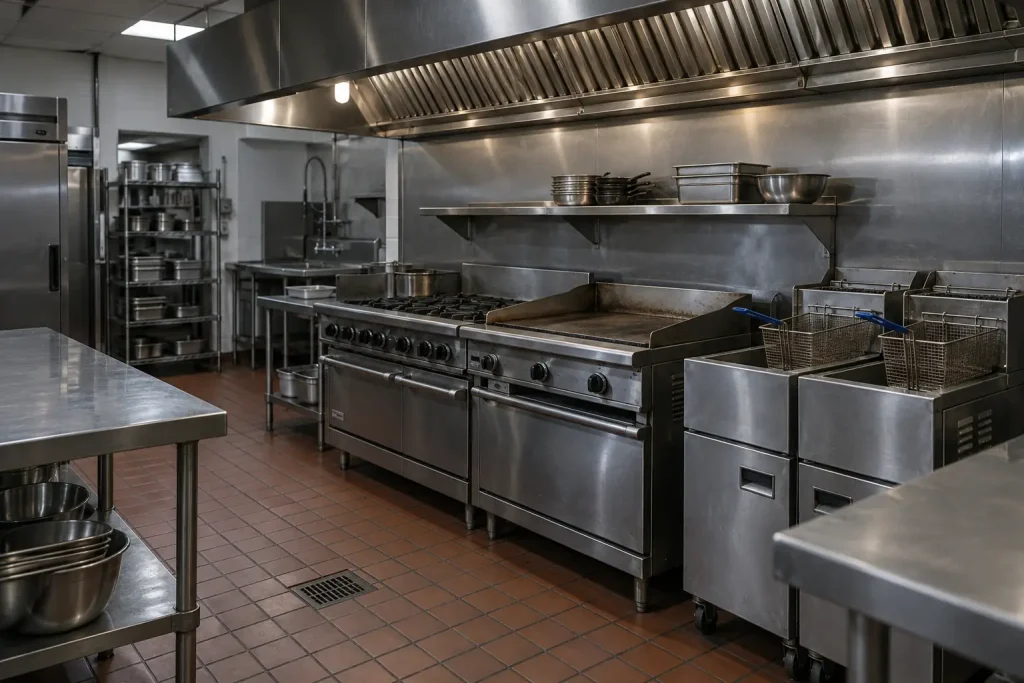
Commercial kitchen hood cleaning is due when a certified inspection finds grease: monthly for wood or charcoal, quarterly for 24-hour, charbroil or wok kitchens, every 6 months for other restaurants and yearly for churches (NFPA 96-2024 Table 12.4).
Key takeaways
- NFPA 96 Table 12.4 sets grease-buildup inspections monthly for solid fuel, quarterly for 24-hour, charbroiling or wok cooking, semiannually for moderate volume and annually for churches, day camps, seasonal businesses and senior centers; this is the 2024 edition text, as quoted in NFPA’s September 2025 committee agenda.
- The International Fire Code repeats the intervals as 1, 3, 6 and 12 months in Table 606.3.3.1 of both the 2021 and 2024 editions, and lets the fire code official approve a different interval (IFC 2024 Section 606.3.3).
- Cleaning is triggered by depth: 0.078 in (2,000 µm) of grease on a duct or hood surface, or 0.125 in (3,175 µm) in a fan housing (NFPA 96 Public Input 10, November 2024).
- After each visit, NFPA 96-2024 requires an adhesive label on the hood with a punched service date and the technician’s and company’s names, plus a written report to the owner within 2 weeks that lists areas not cleaned (NFPA 96 Second Revision No. 2).
- Massachusetts, Utah and New York City license individual hood cleaners, and New York City requires every system to be inspected and cleaned at least every 3 months (FDNY Certificate of Fitness W-64).
- Public price records put one cleaning at $137.90 to $1,129.73 per hood: the Army paid $4,950 to clean 11 hoods at Fort Leavenworth in March 2025, or $450 each (USAspending.gov award W91QF425PA008), and Worcester Public Schools’ April 2025 bids ran $283.65 to $1,129.73 per hood (City of Worcester bid CR-8415-M5).
| Key number | Value | Source |
|---|---|---|
| Inspection interval, kitchens with no solid fuel, charbroiler, wok or 24-hour service | 6 months | NFPA 96-2024 Table 12.4; IFC Table 606.3.3.1 |
| Solid-fuel inspection interval | 1 month | NFPA 96-2024 Table 12.4; IFC Table 606.3.3.1 |
| One cleaning, per hood, public records 2021 to 2025 | $137.90 to $1,129.73 | Cobb County IFB B2115; Army award W91QF425PA008; Worcester CR-8415-M5 |
| Surface grease depth that requires cleaning | 0.078 in (2,000 µm) | NFPA 96-2024, 12.6.1.1 |
| Fan-housing grease depth that requires cleaning | 0.125 in (3,175 µm) | NFPA 96-2024, 12.6.1.1 |
| Written report to the owner | Within 2 weeks | NFPA 96-2024, 12.6.14 and 12.6.15 |
| Fire-extinguishing system maintenance | Every 6 months | NFPA 96-2024 12.2.1; IFC 904.13.5.2 |
| Massachusetts Type 1 experience | 500 hours | FP-026, Rev. 4/26 |
| Utah individual registration | $70 ($30 exam + $40 annual) | Utah State Fire Marshal |
| Record retention | 3 years | Massachusetts DFS; FDNY 3 RCNY 115-02 |
How often does a commercial kitchen hood need cleaning?
A commercial kitchen hood system needs a grease-buildup inspection at a fixed interval set by cooking type, and a cleaning whenever that inspection finds grease. Under NFPA 96 Table 12.4 the intervals are monthly for solid fuel, quarterly for high-volume, semiannually for moderate-volume and annually for low-volume kitchens. The International Fire Code uses the same intervals in months, and a fire code official can set a different one.
| Type of cooking | NFPA 96 Table 12.4 | IFC 2024 Table 606.3.3.1 | New York City (FDNY) | Source |
|---|---|---|---|---|
| Solid fuel: wood, charcoal, briquettes, mesquite | Monthly | 1 month | At least every 3 months; solid-fuel equipment visually inspected monthly | NFPA 96 PC 13; IFC 2024; FDNY pamphlet |
| High volume: 24-hour cooking, charbroiling, wok cooking | Quarterly | 3 months | At least every 3 months | NFPA 96 PC 13; IFC 2024; FDNY W-64 |
| Moderate volume (not defined in the table) | Semiannually | 6 months (“all other cooking operations”) | At least every 3 months | NFPA 96 PC 13; IFC 2024; FDNY W-64 |
| Low volume: churches, day camps, seasonal businesses, senior centers | Annually | 12 months (places of religious worship, seasonal businesses, senior centers; day camps not listed) | At least every 3 months | NFPA 96 PC 13; IFC 2024; FDNY W-64 |
Table 12.4 does not define moderate volume. The IFC avoids the term and puts every kitchen not named in another row at 6 months, so a kitchen with no solid fuel, charbroiler, wok line or 24-hour service, and not on the low-volume list, lands on the 6-month schedule under both documents. The IFC text in Section 606.3.3.1 is the same in the 2021 edition and the 2024 edition.
Which NFPA 96 edition does your fire marshal enforce?
Your fire marshal enforces the edition your state or city adopted, which often trails the edition NFPA lists as current. As of October 2026, the NFPA 96 document page lists the 2027 edition as current. The Massachusetts Certificate of Competency application, revised April 2026, asks applicants to attest to the 2021 version, and Utah’s registration exam covers NFPA 96 and NFPA 17A (2017 edition).
The table number changed between editions. A Massachusetts State Fire Marshal memo dated January 1, 2013 cites “NFPA 96, Table 11.4”, the older Chapter 11 numbering. NFPA committee documents for the 2021 and 2024 editions place inspection, cleaning and records in Chapter 12, so the same schedule now reads Table 12.4.
Every NFPA 96 section number on this page is from the 2024 edition, read in NFPA committee documents because the full text needs an NFPA account. The 2027 edition keeps Table 12.4 but moves the grease depth limits into section 12.4 (First Revision 52). The intervals match IFC 2021 and 2024, so a kitchen gets the same schedule under any of these editions.
Which other services share the hood calendar?
Four other NFPA 96 services run on fixed clocks. The fire-extinguishing system and any listed hood with mechanical, water-spray or ultraviolet devices get maintenance every 6 months, fusible links on fire damper assemblies are replaced at least semiannually, and cooking equipment is inspected and serviced at least annually. Booking them with the hood inspection gives the fire marshal one set of dated records.
| Service | Minimum interval | Rule |
|---|---|---|
| Fire-extinguishing system maintenance | Every 6 months, and after any activation (IFC) | NFPA 96-2024 12.2.1; IFC 2021 904.13.5.2 (certificate forwarded to the fire code official) |
| Listed hoods with mechanical, water-spray or UV devices | Every 6 months or the manufacturer’s frequency | NFPA 96-2024 12.5 |
| Fusible links on fire damper assemblies | At least semiannually | NFPA 96-2024 12.3.3.1 |
| Suppression system fusible links and sprinkler heads | Annually under the IFC; every 6 months under NFPA 96 (2011) 11.2.4, so a swap at each 6-month service meets both | IFC 2021 904.13.5.3; Minnesota Dept. of Health guide |
| Cooking equipment inspection and servicing | At least annually | NFPA 96-2024 12.7.1 |
| Pollution control devices (New York City) | At least every 90 days | FDNY W-64 study material, January 2025 |
What does commercial kitchen hood cleaning cost?
Public records from 2021 to 2025 put one professional cleaning at $137.90 to $1,129.73 per hood. The Army paid $450 a hood at Fort Leavenworth in March 2025, a Georgia school district took bids of $137.90 to $350 for a single-hood system, and Worcester Public Schools received bids of $283.65 to $1,129.73 per hood for the same written scope.
| Public record | Scope | Price | Per hood, one cleaning | Source |
|---|---|---|---|---|
| Army, Fort Leavenworth, KS (awarded March 2025) | One round of exhaust hood cleaning, 11 hoods in 2 facilities | $4,950 | $450 (CB&C: $4,950 / 11) | USAspending.gov W91QF425PA008 |
| Worcester Public Schools, MA (bids April 2025) | One annual cleaning, 21 kitchens, 37 hoods, 22 fans | $10,495 to $41,800 | $283.65 to $1,129.73 (CB&C: total / 37) | Worcester CR-8415-M5 |
| Cobb County School District, GA (tab sheet, file dated April 2021) | Inspection and cleaning, single vent hood system | $137.90 to $350.00 (3 bidders) | $137.90 to $350.00 | Cobb IFB B2115 |
| Cobb County School District, GA | Inspection and cleaning, double vent hood system | $154.85 to $450.00 (3 bidders) | $154.85 to $450.00 per system | Cobb IFB B2115 |
The Worcester bids show how far quotes spread for one scope. Three firms priced one annual inspection and cleaning of the same 21 school kitchens at $10,495, $17,700 and $41,800, a 3.98 times spread.
| Bid (bid closed April 23, 2025) | Total, one year | Per school (/ 21) | Per hood (/ 37) | Multiple of low bid |
|---|---|---|---|---|
| Low bid (awarded) | $10,495 | $499.76 | $283.65 | 1.00 |
| Second bid | $17,700 | $842.86 | $478.38 | 1.69 |
| Third bid | $41,800 | $1,990.48 | $1,129.73 | 3.98 |
The scope came from the Form 30B pricing page: one cleaning a year in the first two weeks of August, each school listed with its hood count, fan count and appliances, and a Massachusetts Type 1 certificate required. CB&C divided each total by 21 schools and 37 hoods; the bids were priced per school, so per-hood figures are our arithmetic.
In the Cobb tab sheet, one bidder also charged $127.50 an hour for routine extra work and $176.50 an hour for emergency calls, so ask every bidder for its hourly and after-hours rates as well as the per-hood price.
Frequency multiplies the bill. As an illustration only, if each quarterly inspection of a high-volume kitchen ends in a cleaning, one hood at Worcester’s low price of $283.65 costs 4 x $283.65 = $1,134.60 a year, and at Fort Leavenworth’s $450 it costs 4 x $450 = $1,800, before extra fans, risers or after-hours work. Tall risers add visits in New York City, where vertical ducts more than 3 stories above the cooking equipment must be cleaned at least every 6 months.
Put every bidder on the same hood count, fan count, Table 12.4 frequency and 12.6.15 report format, then line the numbers up the way our guide on how to compare construction bids sets out.
Is the NFPA 96 schedule for inspection or for cleaning?
The schedule is for inspection. Table 12.4 is titled “Schedule of Inspection for Grease Buildup”, and NFPA 96 section 12.6.1 requires cleaning of the portions an inspection finds contaminated. The cleaner measures grease with a depth gauge comb: 0.078 in (2,000 µm) on a surface, or 0.125 in (3,175 µm) in a fan housing, means those surfaces get cleaned under section 12.6.1.
| Location | Depth that requires cleaning | Source |
|---|---|---|
| Hood, plenum and duct surfaces | 0.078 in (2,000 µm) | NFPA 96-2024, 12.6.1.1 (PI 10); Utah form asks if grease load is under 2,000 microns in horizontal duct, vertical duct and hood |
| Exhaust fan housing | 0.125 in (3,175 µm) | NFPA 96-2024, 12.6.1.1; Utah form asks if fan grease is under 3,175 microns |
| Any hood, duct, fan or grease-removal device (IFC) | “An accumulation of grease”; clean to ANSI/IKECA C10 | IFC 2024 606.3.3.2 |
The rule is moving inside NFPA 96. In the 2027 revision cycle, First Revision 52 moved the depth limits from the cleaning section into section 12.4, the inspection section, with an updated Figure 12.4.1 of the gauge comb. In May 2025, IKECA public comments 8 and 13 asked the committee to require ANSI/IKECA I10 for inspection and ANSI/IKECA C10 for cleaning in the body of the standard; the IFC already names ANSI/IKECA C10 in section 606.3.3.2.
A cleaned system means bare metal. FDNY’s W-64 study material, revised January 2025, says every component must be cleaned to bare metal with no powder or other foreign substance left behind, and that a technician who finds a problem records it on the service report and does not attempt repairs outside the technician’s scope of duties.
What can kitchen staff clean between professional visits?
Staff can clean grease filters; ducts, fans and plenums go to the credentialed cleaner. The FDNY owner pamphlet says a trained employee inspects filters daily and cleans them at least once a month, and that this person does not need a Certificate of Fitness. IFC 2024 section 606.3.1 requires UL 1046 listed grease filters to be in place whenever the equipment under the hood is used.
NFPA 96 section 4.1.5.1 makes inspection, testing, maintenance and cleanliness the equipment owner’s responsibility. In a leased restaurant, write into the lease whether the landlord or the tenant books the Table 12.4 visits and keeps the labels and reports; our guide to tenant improvement contractors covers how kitchen scope is split at lease signing.
Who is allowed to clean a commercial kitchen hood?
NFPA 96 sections 12.4 and 12.6.1 require a “properly trained, qualified, and certified person(s) acceptable to the authority having jurisdiction”, but the standard names no specific certificate. States and cities fill that gap. Massachusetts, Utah and New York City license and examine individual cleaners, and Boston adds its own registration on top of the Massachusetts certificate.
| Jurisdiction | Who must hold what | Entry requirements | Source |
|---|---|---|---|
| NFPA 96 and IFC baseline | Certified person acceptable to the AHJ (NFPA 96 12.4, 12.6.1); qualified individuals (IFC 606.3.3.1) | None specified | NFPA 96 PC 20; IFC 2024 |
| Massachusetts | Certificate of Competency from the State Fire Marshal: Type 1 inspects and cleans for the public; Type 2 cleans only kitchens the holder or employer owns or operates; firm holds a Certificate of Registration | Written exam in Stow or Springfield, in English or Spanish; $25 application; Type 1 needs an affidavit of 500 observed hours | Mass. DFS; FP-026 |
| Boston | Boston Fire Department registration in addition to the state certificate | Registration can be suspended or revoked on 11 listed grounds | BFD policy, 2012 |
| Utah | Licensed kitchen exhaust system concern plus an individual certificate of registration | Criminal background check, liability insurance, open-book exam on NFPA 96, NFPA 17A and R710-7 with 70% on each portion; $30 exam + $40 annual | Utah State Fire Marshal |
| New York City | FDNY company certificate plus a W-64 Certificate of Fitness per technician (P-64 adds precipitators) | Written exam; company certificate requires five years’ experience | FDNY W-64; 3 RCNY 115-02 |
Before the first visit, ask for three numbers that should later appear on the label or report: the technician’s individual certificate number, the company’s licence or registration number, and the insurer on its certificate of insurance. Worcester Public Schools’ 2025 bid required Massachusetts Type 1 compliance and asked each bidder to attach a current certificate. Outside licensing states, IKECA, the developer of the ANSI/IKECA C10 and I10 standards, offers a credential lookup on its website.
The same licence and insurance checks apply to the builder who installs the hood and grease duct under IFC Section 606.1 and the International Mechanical Code, and our checklist on how to choose a commercial contractor lists them.
What must the hood cleaning label show?
Under NFPA 96-2024 section 12.6.13, the cleaner attaches an adhesive label to the hood showing the service date by perforation, the name of the person who did the work and the provider’s name, address and phone number, and the label stays until the next service. IFC 606.3.3.3.1 asks for the same tag fields in a conspicuous location and requires prior tags to be covered or removed.
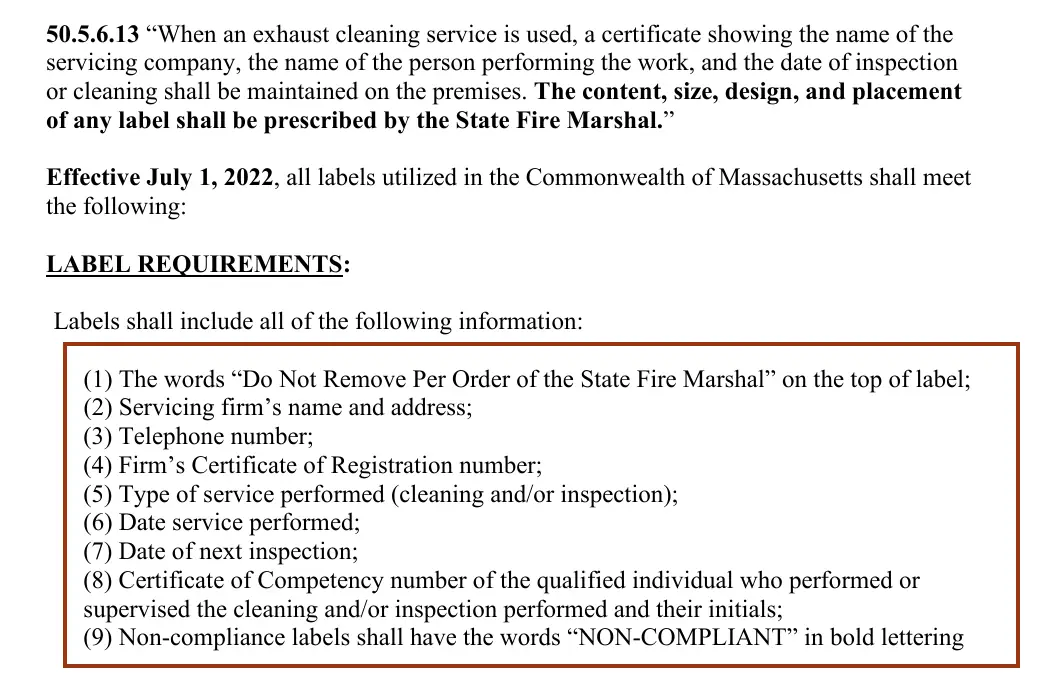
| Field | NFPA 96-2024 label (12.6.13.1) | IFC 2024 tag (606.3.3.3.1) | Massachusetts label (2022 rule) | New York City decal |
|---|---|---|---|---|
| Service date | Punched (perforation) | Date of service | Punched; plus date of next inspection | Date of cleaning |
| Technician | Name of person performing the work | Not required | Certificate of Competency number and initials | Full name and Certificate of Fitness number |
| Company | Name, address, phone | Name, address, phone | Name, address, phone, firm’s Certificate of Registration number | Name, address, phone, FDNY certificate number |
| Type of service | Not specified | Not specified | Cleaning and/or inspection | Not specified |
| Who prints it | Service company | Service company | Company; sequential serial numbers kept in a label log | FDNY-issued, numbered decal |
| Deficiency marking | Written report instead | Not specified | Orange label reading “NON-COMPLIANT”; white when compliant | Hazardous conditions reported to the FDNY Rangehood Unit |
| Size and place | Attached to the hood | Conspicuous location | At least 4.25 by 5.5 in, exterior of each hood | One or more hoods |
| Source | NFPA 96 SR-2 | IFC 2024 | Mass. label rule | FDNY pamphlet; W-64 study material |
New York City stopped accepting company-printed decals after the city’s Department of Investigation found unlicensed businesses placing decals that named licensed companies. Under 3 RCNY 115-02, effective June 1, 2018, only numbered decals bought from the Fire Department count as proof of cleaning, and misuse can bring civil or criminal penalties and loss of the company certificate.
What must the written report include, and when is it due?
NFPA 96-2024 requires two written reports, each due to the owner within 2 weeks: an inspection report under section 12.6.14 and a cleaning report under 12.6.15. Both must list areas that were inaccessible or not covered, duct access panel locations and any visible leaks. Where the authority having jurisdiction requires it, the reports go to the fire code official as well (12.6.16).
| Required item | Inspection report (12.6.14.1) | Cleaning report (12.6.15.1 and 12.6.15.2) |
|---|---|---|
| Date, technician, provider name, address and phone | On the certificate kept on site (12.6.13) | Yes |
| Areas where grease exceeds the 12.6.1 limits | Yes | Not listed |
| Inaccessible areas not inspected or not cleaned | Yes | Yes |
| Accessible areas not inspected or not cleaned | Yes | Yes |
| Location of duct access panels | Yes | Yes |
| Location of visible leakage from ductwork | Yes | Yes |
| Location of leaking access panels | Yes | Yes |
| When | What happens | Who | Rule |
|---|---|---|---|
| At the visit | Label on the hood; certificate kept on the premises; prior tag covered or removed | Cleaner | NFPA 96 12.6.13; IFC 606.3.3.3.1 |
| Within 48 hours | Notice of non-compliance to the local fire department, copy to the owner | Massachusetts certificate holder | Mass. DFS |
| Within 5 days | Deficiency report and red-tag information to the AHJ (the online form says 5 business days) | Utah cleaner | Utah SFM; R710-7 |
| Within 2 weeks | Written inspection or cleaning report to the owner | Cleaner | NFPA 96 12.6.14, 12.6.15 |
| Until the next service | Label stays on the hood | Owner | NFPA 96 12.6.13.2 |
| 3 years | Inspection and cleaning records kept | Owner and certificate holder (Mass.); company (NYC) | Mass. DFS; 3 RCNY 115-02 citing FC107.7 |
Utah turns the report into a checklist. Its Completion and Deficiency Report asks yes or no questions, among them whether grease load is under 2,000 microns in horizontal duct, vertical duct and hood, under 3,175 microns in the fan, whether the on-site exhaust system diagram is accurate and whether the service label was signed, dated and placed; any No answer is a deficiency the cleaner sends on.
How do fire marshals enforce hood cleaning?
Enforcement runs through the fire code official and the agency that licenses cleaners. Massachusetts requires the head of the fire department to issue a cease and desist order to any facility without an inspection in the past 12 months, Utah red-tags non-compliant systems and copies the fire authority within 5 days, and Boston can suspend or revoke a cleaner’s registration when grease buildup or a fire traces back to the cleaning.
- Massachusetts: the cease and desist rule follows Table 50.5.4 of 527 CMR 1.00, and state law allows licensing action and criminal penalties for working with a suspended or revoked certificate or falsely claiming one (Mass. DFS).
- Boston: the 11 grounds include any fire resulting from improper cleaning, excessive grease found by a Boston Fire Department inspector and failure to report customers who are overdue or cancel; at a hearing the cleaner hands over every customer and cleaning date from the past 6 months for re-inspection (BFD policy, December 1, 2012).
- Utah: a non-compliant system gets a RED tag under R710.7.5.9.1, and the authority having jurisdiction may require a follow-up inspection once the deficiency is cleared (Utah State Fire Marshal).
- New York City: Certificate of Fitness holders must notify the FDNY Rangehood Unit of hazardous conditions, and inspecting or cleaning without a valid certificate is unlawful (FDNY W-64 study material).
Paperwork matters most when a kitchen changes hands. Before buying or leasing a second-generation restaurant space, ask for the last label, the last 2 written reports and the latest suppression certificate, and have the existing hood checked against the new menu; our guide to restaurant build-out contractors explains what to inspect before you sign.
A due-diligence report can record the hood as found, but it is not an NFPA 96 inspection. Our article on the property condition assessment explains what the ASTM E2018-24 scope does and does not cover.
What do several hood cleaning guides get wrong?
Most ranking guides get the four tiers right but cite outdated numbering, blur inspection and cleaning, or state thresholds and requirements the primary text does not contain. The table sets 6 claims from top-ranking pages, read in October 2026, against NFPA 96, the IFC and FDNY rules, without naming the publishers.
| What a guide says | What the primary source says | Source |
|---|---|---|
| A top-ranking maintenance guide dated April 2026 cites “NFPA 96 Table 11.4”. | Since the 2021 edition the schedule is Table 12.4, and NFPA lists the 2027 edition as current. | NFPA 96 page; NFPA 96 PC 13 |
| Several guides present the four tiers as a cleaning frequency. | Table 12.4 is a “Schedule of Inspection for Grease Buildup”; cleaning follows when an inspection finds contamination (12.6.1). | NFPA 96 PC 13 and PC 20 |
| One guide says grease over 3 mm anywhere in the duct triggers full system cleaning. | Surfaces: 0.078 in (2,000 µm, which is 2 mm). Fan housings: 0.125 in (3,175 µm). The contaminated portions must be cleaned. | NFPA 96 PI 10, 2024 |
| One guide says a 2025 update made digital documentation mandatory. | The 2024 text requires an adhesive label on the hood and a certificate kept on the premises (12.6.13); we found no 2025 edition and no digital-only rule in the 2027 revision documents we read. | NFPA 96 SR-2; NFPA 96 page |
| One guide places seasonal operations in the semiannual tier. | Table 12.4 puts seasonal businesses in the low-volume tier, inspected annually. | NFPA 96 PC 13 |
| Guides present NFPA 96 as the schedule everywhere. | New York City requires every system to be inspected and cleaned at least every 3 months, whatever the cooking volume. | FDNY W-64 |
Which schedule and paperwork apply to your kitchen?
Start with the cooking style, then layer the local rules. The decision table gives the NFPA 96 interval for each case, the local override where one exists and what to ask the cleaner for. If your jurisdiction is not listed, ask the fire marshal’s office which NFPA 96 or IFC edition it enforces and whether it licenses hood cleaners, because both change the 12.4 answer.
| If | Then | Rule |
|---|---|---|
| Any appliance burns wood, charcoal or other solid fuel | Inspect monthly; in New York City the solid-fuel appliance needs its own exhaust system | NFPA 96 Table 12.4; IFC 1 month; FDNY study material 3.3 |
| You run a charbroiler, a wok line or 24-hour service | Inspect quarterly | NFPA 96 Table 12.4; IFC 3 months |
| The kitchen serves a church, senior center, seasonal business or day camp | Inspect annually; under the IFC a day camp is not listed, so it falls to 6 months unless the fire code official approves otherwise | NFPA 96 Table 12.4; IFC Table 606.3.3.1 |
| None of the above | Inspect semiannually | NFPA 96 Table 12.4; IFC 6 months |
| The gauge reads 0.078 in or more on a surface, or 0.125 in or more in the fan | Clean those portions and get a cleaning report within 2 weeks | NFPA 96 12.6.1, 12.6.15 |
| The kitchen is in New York City | Book at least every 3 months with an FDNY-approved company; check for an FDNY-issued decal | FDNY W-64; 3 RCNY 115-02 |
| The kitchen is in Massachusetts | Hire a Type 1 certificate holder; expect a white label, or orange plus a 48-hour notice if deficient; never let 12 months pass without an inspection | Mass. DFS; label rule |
| The kitchen is in Utah | Hire a licensed concern with registered technicians; a deficient system gets a red tag and an AHJ copy within 5 days | Utah SFM |
| The report lists inaccessible areas | Have access panels added or repaired so the next visit can reach them | NFPA 96 7.4.3 (cited on the Mass. complaint form); 12.6.14.1 |
| You are taking over a used kitchen | Ask for the last label, the last 2 reports and the suppression certificate before signing | NFPA 96 12.6.13 to 12.6.15; IFC 904.13.5.2 |
Adding access panels or rerouting a grease duct is construction governed by the International Mechanical Code (IFC 606.1), not cleaning; our guide to commercial renovation contractors covers how to scope that work. This page explains code text as of October 2026 and is not legal or insurance advice; your fire code official decides which edition and interval apply.
For how the hood itself is sized and listed, see our commercial kitchen hood guide; for the full set of rules that make a kitchen commercial, see our commercial kitchen requirements page.
How we compiled this
We read 23 primary documents in October 2026: NFPA 96 committee reports from the 2024 and 2027 cycles (not the licensed full text), the 2021 and 2024 International Fire Code, Massachusetts, Utah, FDNY and Boston fire rules and forms, a Minnesota Department of Health guide, bid records from 2 school districts and 1 federal award record, rechecked on October 26, 2026. We excluded fire statistics and cost ranges we could not trace to a primary source. Our editorial standards explain how we source and correct pages.
Frequently asked questions
How much does commercial kitchen hood cleaning cost?
Public records from 2021 to 2025 put one cleaning at $137.90 to $1,129.73 per hood. The Army paid $4,950 to clean 11 hoods at Fort Leavenworth in March 2025, or $450 each, and Worcester Public Schools received bids of $283.65 to $1,129.73 per hood in April 2025. Multiply by the visits your Table 12.4 schedule requires, from 1 to 12 a year.
Do you have to be certified to clean restaurant hoods?
NFPA 96 requires a “properly trained, qualified, and certified” person acceptable to the authority having jurisdiction, without naming a certificate. Massachusetts requires a State Fire Marshal Certificate of Competency, Utah requires a company licence and a $70 individual registration, and New York City requires a W-64 or P-64 Certificate of Fitness. Elsewhere, ask the fire marshal which credentials it accepts.
Can restaurant staff clean the hood filters themselves?
Yes. FDNY owner guidance says a trained employee inspects grease filters daily and cleans them at least once a month without a Certificate of Fitness. Ducts, fans and plenums above the filters stay with the credentialed cleaner. IFC 2024 section 606.3.1 requires UL 1046 listed filters to be in place whenever the equipment under the hood is used.
What happens if a restaurant misses a hood inspection?
The consequence is set locally. In Massachusetts the head of the fire department must issue a cease and desist order to a facility with no inspection in the past 12 months. In New York City every system must be inspected and cleaned at least every 3 months, and only FDNY-issued numbered decals count as proof, with records kept for 3 years.
Does a church or school kitchen need hood cleaning every year?
A church, day camp, seasonal business or senior center kitchen sits in the low-volume tier of NFPA 96 Table 12.4 and is inspected annually. IFC 2024 Table 606.3.3.1 lists places of religious worship at 12 months but not day camps. Neither table names schools; Worcester Public Schools buys one cleaning a year, in August, for 21 kitchens.
Is the hood sticker enough proof for the fire marshal?
No. NFPA 96-2024 requires a certificate kept on the premises and a written report to the owner within 2 weeks, in addition to the label on the hood. Massachusetts labels carry a serial number that must appear on the inspection report and in the cleaner’s label log, and New York City accepts only FDNY-issued numbered decals as proof of cleaning.
Which NFPA 96 edition applies to hood cleaning?
The edition your state or city adopted. NFPA lists the 2027 edition as current as of October 2026, while Massachusetts applicants attest to the 2021 version. The section numbers on this page are from the 2024 edition, and the Table 12.4 intervals match IFC Table 606.3.3.1 in the 2021 and 2024 International Fire Code.
Sources
Codes and standards
- National Fire Protection Association, NFPA 96, Standard for Ventilation Control and Fire Protection of Commercial Cooking Operations: document page (current edition 2027), accessed 2026-10-20.
- National Fire Protection Association, NFPA 96 Second Draft meeting agenda, September 8, 2025 (Public Comments 8, 13, 15 and 20 quoting Table 12.4 and sections 4.1.5.1, 12.2.1, 12.3.3, 12.4, 12.5, 12.6.1, 12.7.1), accessed 2026-10-20.
- National Fire Protection Association, NFPA 96 Second Revision No. 2-NFPA 96-2022, sections 12.6.13 to 12.6.16 (label, certificate and reports), accessed 2026-10-20.
- National Fire Protection Association, NFPA 96 First Draft public input responses, November 2024 (Public Input 10, grease depth, resolved by FR-52), accessed 2026-10-20.
- International Code Council, International Fire Code 2024, Chapter 6, Section 606.3 and Table 606.3.3.1, accessed 2026-10-20.
- International Code Council, International Fire Code 2021, Chapter 6, Section 606.3 and Table 606.3.3.1, accessed 2026-10-20.
- International Code Council, International Fire Code 2021, Chapter 9, Section 904.13.5, accessed 2026-10-20.
State and city rules, forms and public bids
- Massachusetts Department of Fire Services, Commercial Cooking Exhaust System Inspections: Hood Cleaning, accessed 2026-10-20.
- Massachusetts State Fire Marshal, Uniform Label Requirements for Commercial Cooking Equipment (effective July 1, 2022), accessed 2026-10-20.
- Massachusetts Department of Fire Services, FP-026 Application for New Certificate of Competency for Cleaning / Inspecting Commercial Cooking Exhaust Systems (Rev. 4/26), accessed 2026-10-20.
- Massachusetts State Fire Marshal, Memorandum: Complaints on Hood Cleaning Work pursuant to 527 CMR 11.8.8 (January 1, 2013), accessed 2026-10-20.
- Utah State Fire Marshal, Kitchen Exhaust Duct Cleaning Systems: licensing and certification, accessed 2026-10-20.
- Utah State Fire Marshal, Completion and Deficiency Report, Commercial Kitchen Exhaust System Service, accessed 2026-10-20.
- New York City Fire Department (FDNY), Certificate of Fitness W-64, Commercial Cooking Exhaust System Cleaning Technician, accessed 2026-10-20.
- New York City Fire Department (FDNY), W-64 Certificate of Fitness study material (revised January 2025), accessed 2026-10-20.
- New York City Fire Department (FDNY), Notice of Adoption, 3 RCNY 115-02, Issuance of Proof of Compliance to Company Certificate Holders (effective June 1, 2018), accessed 2026-10-20.
- New York City Fire Department (FDNY), Fire Safety in Commercial Cooking Locations (owner pamphlet), accessed 2026-10-20.
- City of Boston, Boston Fire Department Policy for Commercial Hood and Exhaust Cleaners (December 1, 2012), accessed 2026-10-20.
- City of Worcester, Purchasing Division, Bid CR-8415-M5, Cleaning and Inspection of Kitchen Exhaust Systems, Worcester Public Schools (bid results), accessed 2026-10-20.
- City of Worcester, Purchasing Division, Bid CR-8415-M5 Form 30B: scope and pricing page (21 schools), accessed 2026-10-20.
- Cobb County School District, IFB B2115, FNS Hood Cleaning Services, tab sheet, accessed 2026-10-20.
- USAspending.gov, Award W91QF425PA008: exhaust hood cleaning, 11 hoods, Fort Leavenworth, KS, accessed 2026-10-26.
- Minnesota Department of Health, Protection of Kitchen Cooking Equipment (rev. June 2024), quoting NFPA 96 (2011) 11.2.4, accessed 2026-10-26.