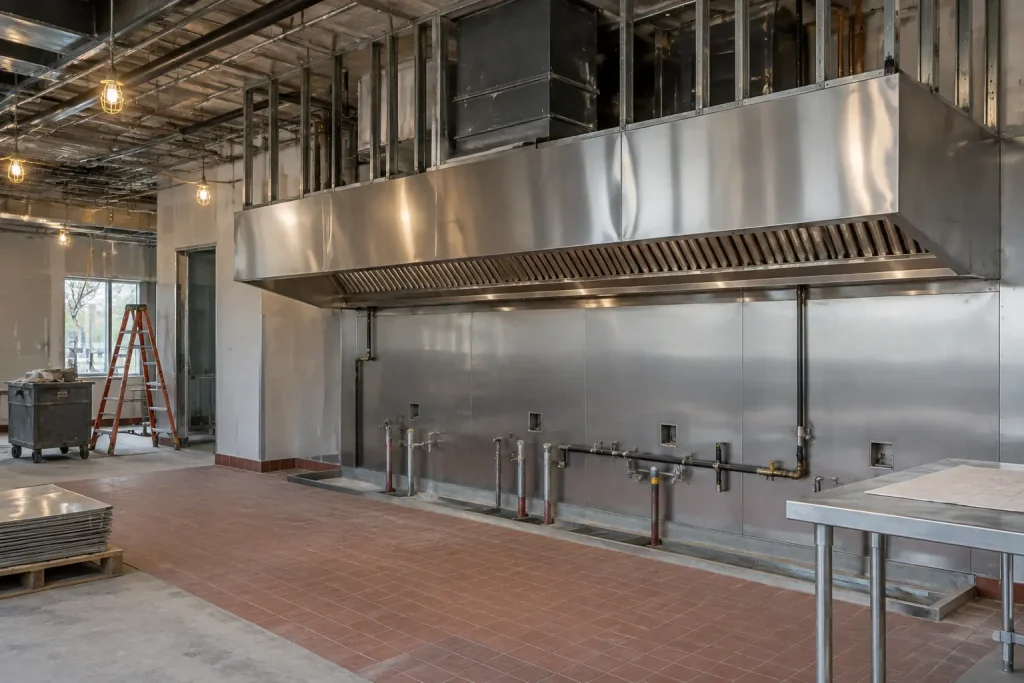
A commercial kitchen hood is the exhaust canopy that captures cooking effluent: a Type I grease hood over medium-, heavy- and extra-heavy-duty appliances, sized at 200 to 700 cfm per linear foot under IMC Section 507.
Key takeaways
- The International Mechanical Code requires a Type I hood wherever appliances produce grease or smoke, and over every medium-, heavy- and extra-heavy-duty appliance (IMC 507, as summarised in Connecticut DAS fire code training, May 2019).
- For an unlisted Type I hood, the 2021 IMC rates printed in Seattle’s commercial kitchen hood worksheet (updated November 2025) run from 200 cfm per linear foot for a light-duty wall canopy to 700 for an extra-heavy-duty single island canopy.
- A 12-foot wall canopy over a heavy-duty line needs 4,800 cfm at the unlisted IMC rate of 400 cfm per foot; Seattle caps a listed hood at 280 cfm per foot, or 3,360 cfm, 30 percent less (CB&C arithmetic from the Seattle SDCI worksheet).
- Grease ducts must move at least 500 fpm, be 16 gauge steel or 18 gauge stainless, and discharge at least 40 inches above the roof (Seattle SMC 506.3.4; Twin Falls 2018 IMC checklist).
- UL 710 Edition 7, published April 29, 2024, covers Type I exhaust hoods; recirculating (ventless) systems are listed under UL 710B instead (UL 710 scope, ANSI Webstore).
- Replacing one kitchen hood and its grease duct cost $27,279.76 at Sheppard Air Force Base in 2025, without makeup air (USAspending.gov award FA302025C0002); six federal hood awards from 2020 to 2025 ran from $16,185.37 for a hood purchase to $1,186,922.19 for a building-wide replacement.
Key numbers
Each figure below is the code value plan reviewers check on a Type I hood permit, with the building-department document that prints it. As of October 2026 these reflect the 2018 and 2021 IMC as adopted locally; confirm the edition your city enforces.
| Number | What it controls | Source |
|---|---|---|
| 200 to 700 cfm per linear foot | Unlisted Type I exhaust rate, by hood style and appliance duty | Seattle SDCI, SMC 507.5 |
| 500 fpm | Minimum air velocity in the grease duct | Seattle SDCI, SMC 506.3.4 |
| 6 in | Minimum canopy overhang beyond the cooking surface | Connecticut DAS, IMC 507.4.1 |
| 18 in | Hood clearance to combustible material | Twin Falls, IMC 507.2.6 |
| 40 in | Exhaust outlet height above the roof | Twin Falls, IMC 506.3.13 |
| 10 F | Largest makeup air temperature difference from the conditioned space | Twin Falls, IMC 508 |
| 2,000 cfm | Seattle trigger for a listed hood and an energy measure | Seattle SEC C403.7.7.1.2 |
| 2027 | Current edition of NFPA 96 listed by NFPA | NFPA 96 document page |
What is a commercial kitchen hood?
A commercial kitchen hood is a canopy or non-canopy hood that captures heat, steam, grease and smoke at the cooking line and sends it through a duct to an exhaust fan. The IMC splits hoods into Type I, for grease and smoke, and Type II, for heat, steam and combustion products. NFPA 96 adds fire safety rules for the Type I system.
A Type I system is more than the stainless canopy. It includes listed grease filters removable without tools, the welded grease duct, the exhaust fan, a makeup air unit interlocked with the fan, and an automatic fire suppression system required by IMC 509.1 (Connecticut DAS). Seattle requires the exhaust fan, duct, hood, any pollution control unit and the makeup air system in one permit application (Seattle SDCI worksheet).
NFPA lists the 2027 edition of NFPA 96 as current as of October 2026, after the 2024 and 2021 editions (NFPA). The fire marshal enforces the edition the state or city adopted, which can be older. How the hood fits into the wider job, from lease walk-through to health inspection, is covered on our page about restaurant build-out contractors.
Type I or Type II: which hood does each appliance need?
Use a Type I hood over any appliance that produces grease or smoke, and over every medium-, heavy- and extra-heavy-duty appliance (IMC 507.2). Use a Type II hood over dishwashers and appliances that give off only heat, steam or combustion products, such as steamers, kettles and pasta cookers (IMC 507.3). Light-duty equipment that makes neither may need no hood when the HVAC design carries its heat.
| Duty class | Example appliances in the code definitions | Hood required | Source |
|---|---|---|---|
| Extra-heavy-duty | Any appliance using open-flame combustion of solid fuel at any time, including solid-fuel pizza ovens | Type I, discharging to its own exhaust system | Connecticut DAS; Twin Falls |
| Heavy-duty | Electric and gas under-fired broilers, chain (conveyor) broilers, gas open-burner ranges, wok ranges, smokers, upright broilers and salamanders | Type I | Connecticut DAS |
| Medium-duty | Electric discrete element ranges, hot-top ranges, griddles, double-sided griddles, fryers including pressure fryers, conveyor pizza ovens, tilting skillets, rotisseries | Type I | Connecticut DAS |
| Light-duty | Gas and electric ovens, pastry and pizza ovens, pasta cookers, steamers | Type I if the process makes grease or smoke; otherwise Type II | Snohomish County; Twin Falls |
| Heat or moisture only | Dishwashing machines, steamers, kettles, pasta cookers | Type II, steel at least 0.0296 in (22 gauge) | Twin Falls, IMC 507.3 |
| No hood | Appliances whose heat and moisture are designed into the HVAC system | None; room exhaust at 0.70 cfm per sq ft, with each appliance counted as at least 100 sq ft | Twin Falls, IMC 507.3 |
Two rules catch mixed cooking lines. Where appliances of different duty share a hood, the highest exhaust rate required by the table applies to the entire hood (Snohomish County worksheet). A Type I hood over extra-heavy-duty, solid-fuel equipment must not also cover other appliances that need fire extinguishing equipment, and it discharges to an independent exhaust system (IMC 507.2.2, per Twin Falls).
Residential equipment does not escape the rule: IMC 507.1.2 requires domestic cooking appliances used for commercial purposes to sit under a Type I or Type II hood. The Type I hood must also be interlocked so the cooking appliances cannot run while the exhaust fan is off (IMC 507.1.1, Connecticut DAS).
How much exhaust does a commercial kitchen hood need?
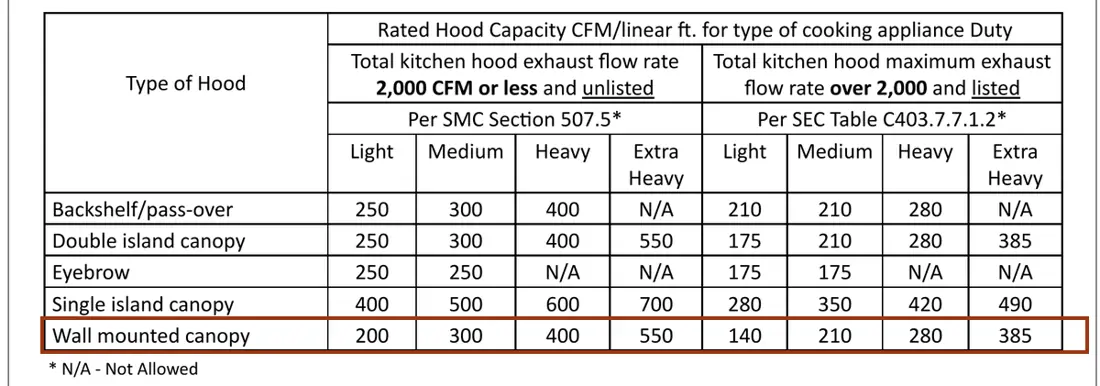
For an unlisted hood, multiply the hood’s length in linear feet by the IMC rate for its style and the highest duty under it. The 2021 IMC rates, as printed in Seattle’s November 2025 worksheet, run from 200 cfm per foot for a light-duty wall canopy to 700 for an extra-heavy-duty single island canopy. A listed hood uses the rate on its label instead.
| Hood style | Light | Medium | Heavy | Extra-heavy | Seattle listed maximum, heavy | Source |
|---|---|---|---|---|---|---|
| Wall-mounted canopy | 200 | 300 | 400 | 550 | 280 | Seattle SDCI, SMC 507.5 and SEC C403.7.7.1.2 |
| Single island canopy | 400 | 500 | 600 | 700 | 420 | Seattle SDCI |
| Double island canopy | 250 | 300 | 400 | 550 | 280 | Seattle SDCI |
| Backshelf or pass-over | 250 | 300 | 400 | Not allowed | 280 | Seattle SDCI |
| Eyebrow | 250 | 250 | Not allowed | Not allowed | Not allowed | Seattle SDCI |
All values are cfm per linear foot of hood. The listed maximums apply in Seattle once total kitchen hood exhaust exceeds 2,000 cfm, and they equal 70 percent of the unlisted IMC rate in every heavy-duty row (280 of 400, 420 of 600).
Hood style moves the number as much as the menu does. A 12-foot single island canopy over heavy-duty appliances needs 7,200 cfm (600 x 12), against 4,800 cfm (400 x 12) for a wall-mounted canopy of the same length, which is 50 percent more air to exhaust and replace. Eyebrow hoods are not allowed over heavy-duty equipment, and backshelf and eyebrow hoods are not allowed over extra-heavy-duty equipment.
Worked example: how do you size a 12-foot hood, its duct and makeup air?
Take a 12-foot wall-mounted canopy over two fryers, a six-burner gas range and a gas under-fired broiler. The range and broiler are heavy-duty, so the whole hood is sized at the heavy rate: 400 cfm per foot under the model IMC, or 4,800 cfm. In Seattle, the same line needs a listed hood capped at 280 cfm per foot, or 3,360 cfm.
| Step | Model IMC, unlisted hood | Seattle 2021 codes, listed hood | Rule used |
|---|---|---|---|
| 1. Exhaust rate, heavy-duty wall canopy | 400 cfm per foot | 280 cfm per foot maximum | IMC 507.5; Seattle SEC Table C403.7.7.1.2 |
| 2. Total exhaust, 12 ft hood | 4,800 cfm | 3,360 cfm | Linear feet x rate |
| 3. Largest duct area at 500 fpm | 9.6 sq ft | 6.72 sq ft | SMC 506.3.4 minimum velocity |
| 4. Example duct and velocity | 18 x 18 in (2.25 sq ft): 2,133 fpm | 16 x 16 in (1.78 sq ft): 1,890 fpm | Seattle recommends 500 to 2,500 fpm |
| 5. Makeup air | About 4,800 cfm (approximately equal to exhaust) | At least 3,024 cfm (90 percent) | IMC 508.1; SMC 508.1 |
| 6. Heater output, 1.08 x cfm x (62 – 24) F | 196,992 Btu/h | 124,105 Btu/h | Seattle worksheet formula and temperatures |
| 7. Energy measure over 2,000 cfm | Set by the adopted energy code | One of: 1,512 cfm transfer air (50 percent), demand control on 75 percent of exhaust, or 40 percent heat recovery | Seattle SEC C403.7.7.1.2 |
The two paths differ by 1,440 cfm of exhaust and 72,887 Btu/h of heater output on the temperatures Seattle’s worksheet prints, partly from the lower listed rate and partly from Seattle’s 90 percent makeup air rule (Seattle SDCI worksheet). That gap flows into fan size, duct size, roof curb and gas service for the makeup air heater.
Two checks keep the example honest. Seattle limits the makeup air temperature difference to 10 F when supply exceeds 2,500 cfm per space, and Twin Falls applies the same 10 F limit under the 2018 IMC (Twin Falls checklist), so makeup air at these volumes normally needs tempering. This is arithmetic for budgeting and review, not a stamped design. Energy code editions by state, which set the trigger for transfer air or demand control, are tracked on our commercial energy code by state page.
Listed or unlisted: what do UL 710, UL 710B and the hood label change?
A listed hood has been tested to UL 710 for the minimum exhaust and maximum supply airflow that give capture and containment, and its label states the minimum exhaust rate in cfm per linear foot. An unlisted hood is built to the IMC construction rules and sized from the code table. Ventless units are a separate product class listed to UL 710B.
| Standard | What it covers | Edition or note | Source |
|---|---|---|---|
| UL 710 | Type I exhaust hoods, with or without fire-actuated exhaust dampers, which close to keep duct gas below 375 F | Edition 7, published April 29, 2024; Intertek effective date April 26, 2026 | ANSI Webstore; Intertek notice |
| UL 710B | Recirculating systems, integral or nonintegral, for commercial electric cooking appliances (formerly called ductless hoods) | Excluded from UL 710 by scope clause 1.10 | ANSI Webstore |
| UL 710C | Ultraviolet radiation systems in kitchen exhaust | UL 710 scope clause 1.8 | ANSI Webstore |
| UL 867 | Electrostatic precipitators in kitchen ventilation | UL 710 scope clause 1.9 | ANSI Webstore |
| UL 1978 | Factory-built grease ducts installed at clearances under 18 in | Exception to field-welded duct rules | Connecticut DAS |
| UL 300 | Fire testing of extinguishing systems over cooking appliances | Required by the Connecticut fire code for hood suppression | Connecticut DAS |
| ASTM F2519 | Grease particle capture efficiency of filters | UL 710 does not rate grease extraction (clause 1.13) | ANSI Webstore |
Listing changes both the number and the paperwork. Snohomish County requires Type I hoods to carry a label with the minimum exhaust flow rate in cfm per linear foot for each duty class (Snohomish County worksheet), and Twin Falls asks for the UL listing of every Type I hood on the plans (Twin Falls checklist). Seattle requires a UL-listed hood once total hood exhaust passes 2,000 cfm, so in that city the listed path covers most full cooking lines.
Intertek’s notice says the 7th edition of UL 710 is harmonized with the 4th edition of ULC 646 and adds requirements for internal wiring, overcurrent protection and ultraviolet systems (Intertek, February 2025). Ask the hood supplier for a listing report updated to the 2024 edition, since Intertek withdraws reports not updated by April 26, 2026.
What clearances, materials and roof terminations does the code require?
Type I hoods need 18 inches to combustible material, steel at least 0.0466 inch thick or stainless at least 0.0335 inch, and a 6-inch overhang beyond the cooking surface. Grease ducts need 16 gauge steel or 18 gauge stainless with liquid-tight welded joints, and the fan outlet must sit at least 40 inches above the roof and 10 feet from property lines.
| Item | Requirement | Section | Source |
|---|---|---|---|
| Hood material | Steel at least 0.0466 in (18 gauge) or stainless at least 0.0335 in (20 gauge) | IMC 507.2.3 | Twin Falls; Seattle |
| Clearance to combustibles | 18 in; none to gypsum board on noncombustible structure faced with noncombustible material extending 18 in past the hood | IMC 507.2.6 | Twin Falls |
| Limited combustibles | 3 in (Connecticut amendment) | IMC 507.2.6 as amended | Connecticut DAS |
| Canopy overhang | At least 6 in beyond the cooking surface | IMC 507.4.1 | Connecticut DAS |
| Hood height | Canopy lip not more than 4 ft above the cooking surface; non-canopy 3 ft, with no more than 1 ft setback | SMC 507.4 | Seattle |
| Grease duct | 16 gauge steel or 18 gauge stainless; continuous external liquid-tight weld or braze | IMC 506.3 | Connecticut DAS |
| Duct velocity | At least 500 fpm | SMC 506.3.4 | Seattle |
| Cleanouts | Doors not more than 20 ft apart | IMC 506.3.7 | Connecticut DAS |
| Duct enclosure | 1 hour through 4 or fewer stories; 2 hours through more than 4 | SBC 713.4, cited by Seattle | Seattle |
| Roof termination | Outlet at least 40 in above the roof; duct at least 18 in above the roof; Type II outlet 30 in | IMC 506.3.13; SMC | Connecticut DAS; Seattle |
| Outlet distances | 10 ft from property line, adjacent building, grade and air intakes; wall outlet not within 3 ft of other openings | IMC 506.3.13.3 | Seattle; Connecticut DAS |
| Fan connection gasket | Rated for continuous duty at 1,500 F | IMC 506.3.2.3 | Connecticut DAS |
The duct route is usually the hardest line on this table to meet in an existing building. Once a grease duct passes through a ceiling, wall or floor, it needs an enclosure serving only that duct from the penetration to the outlet, and Seattle requires at least 6 inches between duct and enclosure (SMC 506.3.11.1, Seattle SDCI). A listed field-applied wrap or a UL 1978 factory-built duct can reduce clearances where a shaft will not fit.
How does a hood get permitted, tested and approved?
Plan reviewers want the hood, duct, fan and makeup air in one submission with calculations, then three tests: a grease duct leak test before concealment (IMC 506.3.2.5), a performance test of exhaust and makeup air rates, and a capture and containment test with every appliance at temperature (IMC 507.6). Twin Falls also asks for a third-party balance report.
- Freeze the appliance schedule. List every appliance with its duty class; the highest duty under each hood sets the rate (Snohomish County).
- Pick the hood style and listing. Record the make, model and label rate in cfm per linear foot, or the IMC table rate for an unlisted hood (Seattle SDCI).
- Size exhaust, duct and makeup air. Show duct area and velocity of at least 500 fpm, makeup air volume and heater output.
- Submit one permit. Hood, duct, fan, makeup air and any pollution control unit go in together, with plan and elevation views.
- Clear the fire review. Twin Falls requires fire marshal plan review of the Type I suppression system and its shutdown devices (Twin Falls).
- Leak-test the grease duct. Test every joint by light, air, water or smoke test before the duct is enclosed (Connecticut DAS).
- Run the performance test. Verify exhaust rate, makeup air, capture and containment with smoke candles or puffers while all appliances and HVAC run.
- Pass final inspection. Seattle wants the performance test certificate handed to the owner before final approval.
City review timelines and fees differ, and our commercial building permits guide covers how to sequence them. The balance report and capture test results belong in the turnover package described in our guide to building commissioning. The hood is one of the last systems signed off before the certificate of occupancy.
What does a commercial kitchen hood cost?
The clearest public price for one hood is $27,279.76: the Air Force paid that in 2025 to replace a kitchen hood and grease duct at Sheppard Air Force Base, with the makeup air option left out. A hood bought as equipment only cost $16,185.37 at Langley Air Force Base, and building-wide hood replacements ran $83,808.42 to $1,186,922.19 on USAspending.gov.
| Scope | Public price | Record |
|---|---|---|
| One hood, equipment purchase only | $16,185.37 (2025) | FA480025P0106, Langley AFB, VA |
| One hood plus grease duct, installed, no makeup air | $27,279.76 (2025) | FA302025C0002, Sheppard AFB, TX |
| Hood system for a building, or several hoods | $83,808.42 to $1,186,922.19 (2020 to 2022) | 4 awards in the table below |
| Upkeep: one hood cleaning | $137.90 to $1,129.73 per hood (2021 to 2025) | W91QF425PA008, Worcester CR-8415-M5 and Cobb County IFB B2115 |
| Upkeep: one semiannual suppression service order | $2,125 to $3,585 (2024 to 2026) | 15B30224P00000475; 15B61926P00000084 |
None of these records states hood length, so no price per linear foot can be derived. The full award list follows.
| Award (USAspending) | Agency and place | Start | Obligated | Description as filed | Type of work |
|---|---|---|---|---|---|
| 36C25722C0015 | Veterans Affairs, Waco, TX | 2022-06-02 | $1,186,922.19 | Replace kitchen hoods, Bldg. 202 | Construction (NAICS 236220) |
| SPE8E322FJ3UE | Defense Logistics Agency, Rockford, IL | 2022-03-10 | $200,613.60 | Replace kitchen exhaust hoods and wet ch[emical] (description truncated in the record) | Supply order (NAICS 339999) |
| W9123620F0071 | Army, Guaynabo, PR | 2020-08-27 | $199,109.00 | Replacement of kitchen exhaust hoods | Construction (NAICS 236220) |
| W911S721F1897 | Army, Fort Leonard Wood, MO | 2021-08-12 | $83,808.42 | Provide kitchen exhaust hood system | Construction (NAICS 236220) |
| FA302025C0002 | Air Force, Sheppard AFB, TX | 2025-02-27 | $27,279.76 | Replace kitchen hood and grease duct at Building 2320, without make-up air option | Mechanical contractor (NAICS 238220) |
| FA480025P0106 | Air Force, Langley AFB, VA | 2025-06-02 | $16,185.37 | Kitchen exhaust hood | Equipment purchase (NAICS 333310) |
Totals are obligations to date and include whatever else each scope carried. The Sheppard AFB record is explicit: $27,279.76 to replace a kitchen hood and grease duct at Building 2320 "without make-up air option", so the makeup air unit was priced and then left out (award FA302025C0002). The Rockford supply order’s truncated description adds wet chemical equipment to the hoods, and the Langley award is an equipment purchase only.
The worked example shows where the money moves: duct length and its rated enclosure, a makeup air unit sized for 3,024 to 4,800 cfm with a heater near 124,105 to 196,992 Btu/h, the suppression system, and roof work for a fan outlet 40 inches up. Federal award totals by state are in our federal construction contracts by state report. When bids arrive, check that each one includes hood, duct, fan, makeup air, suppression, roof curb and tests, using our guide on how to compare construction bids.
Which hood and sizing path fits your kitchen?
Match the hood to the highest-duty appliance under it, then check the local energy code trigger before choosing between a listed and an unlisted hood. The thresholds below come from the IMC text in building-department worksheets and the UL 710 scope; where a city adds a stricter rule, as Seattle does at 2,000 cfm, the local rule controls.
| If | Then | Rule and source |
|---|---|---|
| Any appliance under the hood makes grease or smoke | Type I hood, grease duct, suppression and appliance interlock | IMC 507.2, 507.1.1, 509.1 (Connecticut DAS) |
| Any appliance burns solid fuel at any time | Type I over that equipment with its own exhaust; wall or island canopy only, 550 to 700 cfm per foot | IMC 507.2.2 (Twin Falls); Seattle table |
| Medium and heavy appliances share one hood | Size the whole hood at the heavy rate, 400 cfm per foot on a wall canopy | Snohomish County |
| Only dishwashers, steamers or kettles | Type II hood, steel at least 0.0296 in | IMC 507.3 (Twin Falls) |
| Neither grease nor heat beyond the HVAC design | No hood; room exhaust 0.70 cfm per sq ft, 100 sq ft per appliance | IMC 507.3 (Twin Falls) |
| Island cooking line | Budget 600 instead of 400 cfm per foot at heavy duty, 50 percent more air | Seattle table |
| Total hood exhaust over 2,000 cfm in Seattle | Listed hood plus 50 percent transfer air, demand control on 75 percent of exhaust, or 40 percent heat recovery | SEC C403.7.7.1.2 (Seattle) |
| Electric appliance with a built-in recirculating unit | Specify a system listed to UL 710B, not UL 710 | UL 710 clause 1.10 (ANSI) |
| Reusing a hood in second-generation space | Confirm the label rate covers the new top duty, then rerun the capture and containment test | IMC 507.6 (Connecticut DAS) |
Second-generation restaurant space and shell space are compared on our page about tenant improvement contractors. This is general code information, not engineering or legal advice; the authority having jurisdiction and the hood listing control the final design.
What several guides say vs what the code says
Three claims recur in the pages that rank for this keyword. Each is checked below against the primary document. The guides are described, not named, and the corrections cite the code text as reproduced by Seattle, Twin Falls and Connecticut, plus the federal award records on USAspending.gov accessed in October 2026.
| What a guide says | What the primary source says | Source |
|---|---|---|
| A top-ranking 2026 hood cost guide tells buyers not to use a universal CFM-per-foot shortcut | For an unlisted hood, cfm per linear foot by style and duty is the code requirement, from 200 to 700; a listed hood follows its label rate | Seattle SMC 507.5; Snohomish County |
| Retailer pages say Type I hoods often come complete with fire suppression | Fire suppression is required for commercial cooking systems under IMC 509.1, so it belongs in every Type I scope | Connecticut DAS |
| Search summaries quote $5,000 to $60,000 for installation | Those ranges carry no named source or date; six federal awards from 2020 to 2025 run $16,185.37 to $1,186,922.19 with scope stated | USAspending.gov |
After opening, upkeep of the hood falls under the fire code. NFPA 96-2024 Table 12.4 and IFC 2024 Table 606.3.3.1 set grease inspections every 1, 3, 6 or 12 months by cooking type, as our hood cleaning guide explains, and the fire suppression system guide covers the 6-month service.
How we compiled this
We compiled this from 9 primary sources accessed in October 2026: four building-department hood worksheets and training handouts that reproduce IMC Chapter 5 text (Seattle, Twin Falls, Connecticut and Snohomish County), the NFPA 96 document page, the UL 710 listing at ANSI Webstore, Intertek’s UL 710 update notice, the Florida Building Commission code page and 6 award records from USAspending.gov, with upkeep prices added from 3 more award records, 1 city bid and the 2024 International Fire Code on October 26, 2026.
The ICC’s online IMC text was behind a bot check, so section numbers follow those government copies. We excluded cleaning, inspection, maintenance and overseas contracts from the cost table, and the sizing example is arithmetic, not a design.
To price a hood, grease duct and makeup air package for a specific kitchen, you can request a quote.
Frequently asked questions
Does a commercial kitchen hood need a fire suppression system?
A Type I hood over grease-producing appliances does. IMC 509.1 requires fire suppression for commercial cooking systems, and the Connecticut fire code requires the system to be tested to UL 300, which calls for it to put out a deep fat fryer fire without reignition. Wet chemical systems under NFPA 17A are the usual choice, serviced every 6 months under IFC 904.13.5.2 and NFPA 96-2024 12.2.1.
How often does a commercial kitchen hood system need cleaning?
It is inspected on a fixed clock and cleaned when grease is found: monthly for solid fuel, quarterly for 24-hour, charbroiling or wok cooking, every 6 months for other kitchens and yearly for churches and seasonal businesses (NFPA 96-2024 Table 12.4; IFC Table 606.3.3.1). Public records put one cleaning at $137.90 to $1,129.73 per hood.
Are ventless hoods allowed in commercial kitchens?
They can be, for electric equipment. UL 710 states that recirculating systems for commercial electric cooking appliances, once called ductless hoods, are covered by a separate standard, UL 710B, not by the Type I hood standard. Ask the building and fire officials whether a UL 710B listed unit is accepted for your exact appliance, because the listing covers specific equipment and cooking loads.
How high should a commercial kitchen hood be mounted?
Seattle’s 2021 worksheet allows a canopy hood lip no more than 4 feet above the cooking surface and a non-canopy hood no more than 3 feet, with no more than a 1-foot setback. Canopy hoods must overhang the cooking surface by at least 6 inches (IMC 507.4.1). A listed hood’s installation instructions can set tighter limits, and those control.
Can a residential range hood be used in a commercial kitchen?
IMC 507.1.2 requires domestic cooking appliances used for commercial purposes to sit under a Type I or Type II hood, so the hood must meet commercial rules. For Type I that means steel at least 0.0466 inch or stainless at least 0.0335 inch, liquid-tight welded external joints and 18 inches of clearance to combustibles (IMC 507.2.3, 507.2.5 and 507.2.6).
Which code edition applies to a commercial kitchen hood?
The one your state or city adopted. Seattle reviews hoods under its 2021 Mechanical Code, Twin Falls under the 2018 IMC, and the Florida Building Commission lists the 8th Edition (2023) Florida Building Code with a draft 9th Edition (2026). NFPA lists 2027 as the current NFPA 96 edition. Ask the building department and fire marshal which editions they enforce before design starts.
Sources
- Seattle Department of Construction and Inspections, Commercial Kitchen Hood Worksheet, 2021 Seattle Mechanical Code (updated November 2025). Accessed 2026-10-20.
- City of Twin Falls Building Department, Commercial Kitchen Hoods (Types 1 & 2) design review checklist, 2018 IMC. Accessed 2026-10-20.
- Connecticut DAS Office of Education and Data Management, Commercial Cooking and Grease-Laden Exhaust, Spring 2019 Career Development Series. Accessed 2026-10-20.
- Snohomish County Planning and Development Services, Commercial Kitchen Hood Worksheet/Checklist. Accessed 2026-10-20.
- National Fire Protection Association, NFPA 96, Standard for Ventilation Control and Fire Protection of Commercial Cooking Operations. Accessed 2026-10-20.
- ANSI Webstore (UL Standards & Engagement), UL 710 Ed. 7-2024, Exhaust Hoods for Commercial Cooking Equipment. Accessed 2026-10-20.
- Intertek, Standards Update Notice: UL 710:2024 Ed.7. Accessed 2026-10-20.
- Florida Building Commission, Florida Building Code editions. Accessed 2026-10-20.
- USAspending.gov, Award 36C25722C0015: Replace kitchen hoods, Bldg. 202. Accessed 2026-10-20.
- USAspending.gov, Award SPE8E322FJ3UE: Replace kitchen exhaust hoods and wet ch[emical] (description truncated in the record). Accessed 2026-10-20.
- USAspending.gov, Award W9123620F0071: Replacement of kitchen exhaust hoods. Accessed 2026-10-20.
- USAspending.gov, Award W911S721F1897: Provide kitchen exhaust hood system. Accessed 2026-10-20.
- USAspending.gov, Award FA302025C0002: Replace kitchen hood and grease duct at Building 2320, without make-up air option. Accessed 2026-10-20.
- USAspending.gov, Award FA480025P0106: Kitchen exhaust hood. Accessed 2026-10-20.
- USAspending.gov, Award W91QF425PA008: exhaust hood cleaning, 11 hoods. Accessed 2026-10-26.
- City of Worcester, Bid CR-8415-M5, kitchen exhaust cleaning bids. Accessed 2026-10-26.
- USAspending.gov, Award 15B30224P00000475: semiannual hood suppression service. Accessed 2026-10-26.
- USAspending.gov, Award 15B61926P00000084: semiannual Ansul inspection. Accessed 2026-10-26.
- Cobb County School District, IFB B2115, FNS Hood Cleaning Services, tab sheet. Accessed 2026-10-26.
- International Code Council, International Fire Code 2024, Table 606.3.3.1. Accessed 2026-10-26.