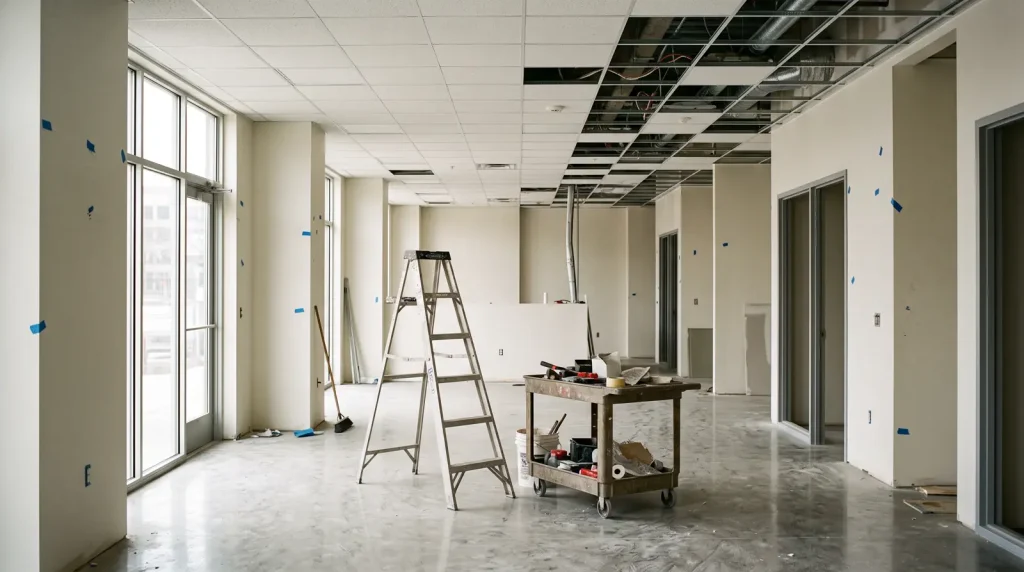
Retainage in construction is the share of each progress payment, usually 5% or 10%, that the owner holds back until the work is finished: 30 of 46 jurisdictions that cap it on public work set 5%.
Key takeaways
- The contract sets the rate: AIA A101-2017 §5.1.7.1 leaves a blank for “the percent retainage, if any,” and adds terms for reducing it in §5.1.7.2 (AIA A101-2017 Instructions).
- Public statutes cap it: of 46 jurisdictions with a percentage limit, 30 set exactly 5%, 9 allow 10% and New Mexico bars retainage (NMSA 57-28-5), per statutes checked on 2026-10-08.
- On a fictional $1,200,000 job at 10%, the owner is holding $117,000 by substantial completion; cutting the rate to 5% at 50% complete halves that to $58,500 (CB&C calculation, rules from AIA A201-2017 §9.3.1).
- Retainage becomes payable once the owner and contractor accept the Certificate of Substantial Completion and any surety consents, “adjusted for Work that is incomplete” (AIA A201-2017 §9.8.5).
- Federal agencies pay in full when progress is satisfactory and may hold up to 10% only when it is not (FAR 52.232-5(e)).
- Washington lets a public contractor post a bond instead of retainage, and the public body must release the bonded amount within 30 days of accepting the bond (RCW 60.28.011(6)).
What is retainage in construction?
Retainage (also called retention) is money the contractor has earned that the paying party keeps back from each progress payment as security that the job gets finished and the subcontractors get paid. Under AIA A201-2017 §9.3.1, each application for payment “shall reflect retainage if provided for in the Contract Documents,” so the rate comes from the signed agreement, within any statutory cap.
Retainage is not a fee or a discount. The money is still owed and is paid at the end, usually at substantial completion, with a smaller sum kept for punch list items. On the AIA G702 pay application it sits on Line 5, split into 5a for completed work and 5b for stored material (AIA G702-1992 Instructions); our AIA G702 guide walks through every line.
| Number | What it means | Source |
|---|---|---|
| 5% | Most common public cap: 30 of 46 jurisdictions with a percentage limit | CB&C state registry (statutes checked 2026-10-08) |
| 10% | Federal maximum, only when progress is unsatisfactory | FAR 52.232-5(e) |
| 0% | New Mexico: retainage barred on public and private contracts (DOT work excluded) | NMSA 57-28-5 |
| 13 | Jurisdictions that cap private retainage by statute (10 at 5%, 3 at 10%) | CB&C lien registry (checked 2026-10-06) |
| 19 | Jurisdictions that cut or stop public retainage at 50% completion (14 required, 5 allowed) | CB&C state registry |
| 7 days | Time for a general contractor to pay subs after the owner pays, with the same percentage retained | AIA A201-2017 §9.6.2 |
| 60 days | California public owners must release retention after completion | Cal. Pub. Cont. Code 7107(c) |
How does retainage work month to month?
Each month the contractor bills the work completed to date, the owner calculates retainage on that cumulative total, and pays the period’s work minus the increase in retainage. Retainage therefore grows with the job: at a flat 10% it equals 10% of everything built so far. It stops growing at substantial completion, when most of it is released, and the rest follows final payment.
The example below is fictional. It assumes a $1,200,000 private office build-out on AIA A101-2017 and A201-2017 terms, six monthly pay applications, 10% retainage on completed work, no stored materials and no change orders. At substantial completion $30,000 of punch list work is open, and the contract lets the owner keep 150% of that cost, the same multiplier Florida public owners use (Fla. Stat. 255.077(4)).
| Pay application | Completed to date | % complete | Billed this period | Retainage held to date (10%) | Paid this period |
|---|---|---|---|---|---|
| 1 | $120,000 | 10.0% | $120,000 | $12,000 | $108,000 |
| 2 | $300,000 | 25.0% | $180,000 | $30,000 | $162,000 |
| 3 | $540,000 | 45.0% | $240,000 | $54,000 | $216,000 |
| 4 | $780,000 | 65.0% | $240,000 | $78,000 | $216,000 |
| 5 | $1,020,000 | 85.0% | $240,000 | $102,000 | $216,000 |
| 6 (substantial completion) | $1,170,000 | 97.5% | $150,000 | $117,000 | $135,000 |
| Retainage release | $1,170,000 | 97.5% | $0 | $45,000 (150% of $30,000 punch list) | $72,000 |
| Final payment | $1,200,000 | 100% | $30,000 | $0 | $75,000 |
| Total | $1,200,000 | $1,200,000 |
The owner pays the full $1,200,000, but $117,000, or 9.75% of the contract, sits with the owner for most of the job. Pay application 6 shows the arithmetic: $150,000 of new work less $15,000 of new retainage ($117,000 minus $102,000) gives $135,000. The same billing lines come from the schedule of values, so a front-loaded schedule also front-loads the cash paid against it.
What changes if retainage drops to 5% at 50% complete?
If the contract cuts retainage to 5% of completed work once the job passes 50%, the owner releases money already held. In the example the cut happens at pay application 4 (65% complete): retainage falls from $54,000 to $39,000, so the contractor receives the period’s $240,000 plus $15,000 of released retainage.
AIA A101-2017 §5.1.7.2 makes a reduction depend on the architect judging progress satisfactory and, on bonded work, on the surety’s consent, usually given on AIA G707A.
| Pay application | Held at flat 10% | Held at 10%, then 5% after 50% | Paid at flat 10% | Paid with the 50% cut |
|---|---|---|---|---|
| 3 (45%) | $54,000 | $54,000 | $216,000 | $216,000 |
| 4 (65%) | $78,000 | $39,000 | $216,000 | $255,000 |
| 5 (85%) | $102,000 | $51,000 | $216,000 | $228,000 |
| 6 (97.5%) | $117,000 | $58,500 | $135,000 | $142,500 |
| Release at substantial completion | $72,000 paid | $13,500 paid | Both keep $45,000 for the punch list | |
What is the typical retainage percentage?
The typical retainage percentage is 5% on public work and 5% or 10% on private work, set in the contract. No federal rule covers private jobs. Among the 46 states and DC with a percentage cap on public contracts, 30 set exactly 5%, 4 set less, 2 sit between 5% and 10%, and 9 allow 10%, per our public construction retainage caps by state registry (statutes checked 2026-10-08).
| Public retainage cap | Jurisdictions | Which |
|---|---|---|
| Barred (0%) | 1 | New Mexico |
| Under 5% | 4 | Iowa (3%), New Jersey local units (2%), Ohio (labor paid at 96% or more), South Carolina (3.5%) |
| 5% | 30 | Includes California, Florida, Georgia, Massachusetts, Minnesota, New York, Virginia, Washington |
| Over 5% and under 10% | 2 | Connecticut state agencies (7.5%), Indiana local boards (up to 6%) |
| 10% | 9 | Arizona, District of Columbia, Illinois, Kentucky, Michigan, Nebraska, North Dakota, Pennsylvania, Texas |
| No percentage cap located | 4 | Alaska, South Dakota, Vermont, West Virginia |
Size thresholds change the answer inside a state. Texas allows 10% on public contracts under $5 million and 5% at $5 million or more (Tex. Gov’t Code 2252.032). North Carolina bars retainage on public projects under $150,000 (N.C. Gen. Stat. 143-134.1), and Florida’s 5% cap does not apply to contracts of $200,000 or less (Fla. Stat. 255.078(6)). New Hampshire was excluded from the counts because no public prompt payment statute was located.
Do private projects have retainage caps?
Private jobs are capped in 13 jurisdictions, 10 at 5% and 3 at 10%, according to our mechanics lien and private retainage registry (checked 2026-10-06). Texas runs the other way: Texas Property Code 53.101 requires the owner to reserve 10% of the contract price during the work and for 30 days after completion, as a fund for lien claimants (Tex. Prop. Code 53.101).
| Private rule | Jurisdictions | Notes |
|---|---|---|
| Cap of 5% | California, Connecticut, Kansas, Massachusetts, Minnesota, Mississippi, Nevada, New York, Tennessee, Utah | California applies to contracts entered on or after 2026-01-01 (Cal. Civ. Code 8811); Massachusetts to projects of $3,000,000 or more; New York to projects of $150,000 or more |
| Cap of 10% | Illinois, Missouri, Nebraska | Illinois and Nebraska drop to 5% once the job is 50% complete |
| Barred | New Mexico | NMSA 57-28-5 covers private contracts too |
| Required reserve of 10% | Texas | Owner keeps 10% until 30 days after completion (Tex. Prop. Code 53.101) |
When must retainage be released?
Most retainage is released at substantial completion, and the rest at final payment. Under AIA A201-2017 §9.8.5 the owner pays the retainage once both parties accept the Certificate of Substantial Completion (AIA G704) and the surety consents, minus the value of incomplete or defective work. Final payment and “any remaining retained percentage” wait for six closeout items listed in §9.10.2, including a bills-paid affidavit and the surety’s consent.
Public statutes add hard deadlines and penalties. In California a public owner that misses the 60-day release window owes a charge of 2% a month on the amount withheld, plus attorney fees in a collection suit (Cal. Pub. Cont. Code 7107(f)). On the example’s $117,000, one late month costs the owner $2,340. The milestones are explained in our guide to substantial completion.
| Rule set | What triggers release | Deadline | Source |
|---|---|---|---|
| AIA A201-2017 (private default) | Accepted G704 certificate plus surety consent | None stated; payment “adjusted for Work that is incomplete” | A201 §9.8.5 |
| Federal fixed-price construction | Work substantially complete | Release all but an amount adequate to protect the Government; rest “promptly” on completion | FAR 52.232-5(e), FAR 32.103 |
| California public | Completion of the work of improvement | 60 days; up to 150% of a disputed amount may be withheld | Pub. Cont. Code 7107(c) |
| Washington public | Completion of all contract work | 60 days | RCW 60.28.011(3)(b) |
| Minnesota public | Substantial completion | 60 days | Minn. Stat. 15.72 |
| Massachusetts public works | Declaration of substantial completion | Estimate within 65 days paying all but 1% of retainage | M.G.L. c. 30 s. 39G |
| Tennessee public and private | Completion or substantial completion, whichever is first | 90 days | Tenn. Code 66-34-103 |
| Texas private | Completion of the original contract | Owner’s 10% reserve runs until 30 days after completion | Tex. Prop. Code 53.101 |
How much can the owner keep for the punch list?
The owner can keep enough to finish the open items, and some statutes fix the multiplier. AIA A201-2017 sets no multiplier, only an adjustment for incomplete work. Florida public owners pay the balance, retainage included, less 150% of the estimated cost to complete the listed items, within 20 business days after the list is made (Fla. Stat. 255.077(4)).
In the example, a $30,000 punch list keeps $45,000 back. Our punch list guide covers who writes the list and when.
How does retainage flow down to subcontractors?
Retainage flows down because the general contractor holds the same percentage from each subcontractor that the owner holds from it. AIA A201-2017 §9.6.2 requires the contractor to pay each subcontractor within 7 days of being paid, “reflecting percentages actually retained” on that subcontractor’s work. When the owner releases retainage, several public statutes set a short clock for passing the subcontractor’s share down.
In the example, the electrical subcontractor bills $60,000 in pay application 4. The owner holds $6,000 of that from the general contractor, the general contractor holds the same $6,000 from the electrician and pays $54,000, and the $6,000 moves down the chain when the owner releases it. Before signing any final lien waiver, a subcontractor should check that its retainage has actually cleared.
| Rule | What it requires | Source |
|---|---|---|
| Same percentage | Sub paid within 7 days of the GC, reflecting the percentage actually retained | AIA A201-2017 §9.6.2 |
| No higher rate for subs | A sub’s retention rate may not exceed the rate in the prime contract; total retention capped at 5% of contract price | Cal. Pub. Cont. Code 7201(b)(1) |
| Pass-through deadline | Sub’s share paid within 7 days after the GC receives retention; late = 2% a month | Cal. Pub. Cont. Code 7107(d), (f) |
| Same-rate reduction | If the agency reduces retainage, the GC must reduce subs’ retainage at the same rate and pay released retainage within 10 days | Minn. Stat. 15.72 |
| 5% ceiling and interest | GC may hold no more than 5% from subs and must pass on interest it earns on reserved funds | RCW 60.28.011(5) |
| Subcontracts covered | The 95% minimum payment rule applies to subcontracts on public projects | Va. Code 2.2-4333(B) |
| Released retainage passed on | When the owner releases retainage attributable to subs, the GC must timely remit it | Fla. Stat. 255.078(2) |
| Federal certification | Each progress payment request certifies it excludes amounts the prime intends to retain from subs | FAR 52.232-5(c) |
Can a bond or escrow account replace retainage?
Yes, where the contract or a statute allows it. Washington is the clearest example: on public improvement contracts the contractor chooses whether retainage stays in a fund, goes into an interest-bearing account with interest paid to the contractor, or is placed in escrow as securities the contractor selects, and the contractor may post a bond for all or part of it instead (RCW 60.28.011(4) and (6)).
| Alternative | How it works | Statute that provides it |
|---|---|---|
| Retainage bond | Surety bond replaces the cash; public body may require an A.M. Best rating no higher than A- and releases the bonded amount within 30 days of accepting the bond | RCW 60.28.011(6) |
| Escrow of securities | Owner issues a joint check to a bank and the contractor; it buys securities the contractor chooses; interest goes to the contractor | RCW 60.28.011(4)(c) |
| Interest-bearing account | Retainage deposited at a bank; interest paid to the contractor | RCW 60.28.011(4)(b) |
| Escrow option in the bid | Local contracts of $200,000 or more for roads, bridges and utility lines must offer escrow; agreement due within 15 calendar days | Va. Code 2.2-4334 |
| Interest on retainage | Owner pays interest on the retainage it holds | Alaska Stat. 36.90.250 |
On private work no statute forces these options, so they have to be negotiated into the agreement before signing. A retainage bond is a surety product; the surety’s underwriting and consent role is explained in our construction surety bond statistics. The federal rule also points the same way: FAR 32.103 lets a contracting officer adjust retainage near completion to recognize “the ability to rely on alternative safeguards.”
How does federal retainage work under FAR 52.232-5?
Federal retainage is the exception, not the default. Under FAR 52.232-5(e), the Payments under Fixed-Price Construction Contracts clause, the contracting officer pays progress payments in full when progress is satisfactory and may retain up to 10% of a payment only while it is not. At substantial completion the agency keeps only an amount adequate to protect the Government and releases the rest.
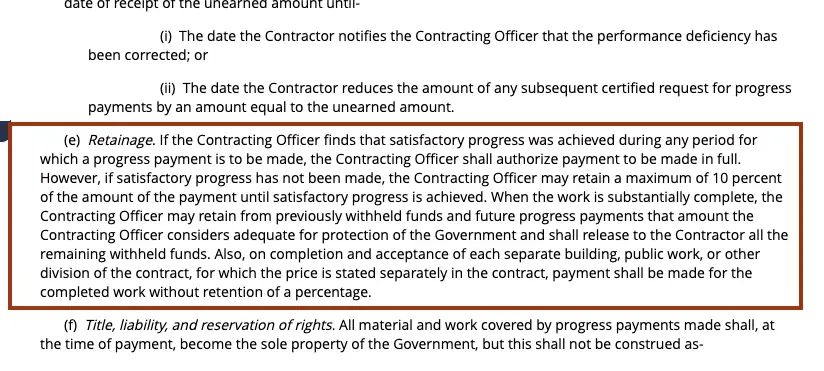
FAR 32.103 adds that retainage “should not be used as a substitute for good contract management,” that decisions are made case by case on past performance, and that “retained amounts shall be paid promptly” once all contract requirements are complete (FAC 2026-01, effective 2026-03-13). Two smaller rules matter on bonded jobs: a separately priced building is paid without retention once completed and accepted, and the portion of a progress payment covering bond premiums is never subject to retainage (FAR 52.232-5(g)).
Which common retainage claims are out of date?
Several top-ranking retainage guides repeat figures that the primary sources no longer support. The table sets 5 of them against the statute or regulation text read for this page on 2026-11-01 or in our 2026-10-08 statute registry. Contract terms can still differ from these defaults, but a cap in a statute overrides a higher rate in a public contract.
| Claim seen in online guides (2025 to 2026) | What the primary source says | Source |
|---|---|---|
| Retainage is typically 10% | 30 of 46 capped jurisdictions set public retainage at 5%; only 9 allow 10% | CB&C state registry |
| The federal standard is 10% retainage | Full payment when progress is satisfactory; up to 10% only when it is not | FAR 52.232-5(e) |
| Federal retainage can drop to 0% at 50% completion | FAR sets no 50% rule; the amount may be adjusted “as the contract approaches completion” | FAR 32.103 |
| Florida public retainage is 10% until 50%, then 5% | Not more than 5% of each progress payment (last amended by ch. 2023-134) | Fla. Stat. 255.078(1) |
| Retainage appears on G702 Line 9 | Line 5 is retainage; Line 9 is the balance to finish, including retainage | AIA G702-1992 Instructions |
What should you do about retainage on your project?
Start from the rule that binds you: a statute on public work, the signed agreement on private work, and FAR on federal contracts. Then check the three numbers that move cash: the rate, the reduction trigger and the release deadline. The table covers the most common situations; it summarizes statutes and form text and is not legal advice for any specific contract.
| If | Then | Rule behind it |
|---|---|---|
| You are drafting a private agreement | Fill in the rate in §5.1.7.1, a reduction trigger in §5.1.7.2 and release terms in §5.1.7.3 | AIA A101-2017 Instructions |
| The public contract states a rate above the state cap | The statutory cap applies; check the registry row for your state | State statute, e.g. Fla. Stat. 255.078(1) |
| A Texas public contract is $5 million or more | Retainage is limited to 5%, not 10% | Tex. Gov’t Code 2252.032 |
| A North Carolina public project is under $150,000 | No retainage may be held | N.C. Gen. Stat. 143-134.1 |
| The job passes 50% complete with satisfactory progress | Ask for the reduction in writing, with surety consent on bonded work | A101 §5.1.7.2; 14 jurisdictions require a cut on public work |
| Substantial completion is certified and a punch list is open | Release all retainage except the value of open items (150% on Florida public work) | A201 §9.8.5; Fla. Stat. 255.077(4) |
| You are a sub and the GC has been paid retainage | Request your share; 7 days in California, 10 days in Minnesota public work | Pub. Cont. Code 7107(d); Minn. Stat. 15.72 |
| A California public owner is past 60 days after completion | The unpaid retention accrues 2% a month | Pub. Cont. Code 7107(f) |
| Retainage ties up cash on a Washington public job | Offer a retainage bond; the bonded amount is due within 30 days of acceptance | RCW 60.28.011(6) |
| You are on a federal job with satisfactory progress | Nothing should be withheld from the progress payment | FAR 52.232-5(e) |
Before relying on a deadline, ask the lawyer who reviews the contract two specific questions: does the state’s public or private retainage statute override the rate written in Article 5 of the agreement, and does the release clock run from substantial completion or final acceptance? The general conditions that carry these terms are covered in our AIA A201 guide.
The retainage rate itself is written into the owner-contractor agreement, as shown in our AIA A101 guide.
Federal and federally assisted jobs can also hold payment for missing wage reports, which our certified payroll guide explains with the 7-day weekly deadline.
How a lender’s holdback mirrors contract retainage on each loan advance is shown in our construction draw schedule example.
How we compiled this
We read 21 primary documents for this page: FAR 52.232-5 and 32.103 on Acquisition.gov, the AIA A101-2017 instructions, an A201-2017 sample, the G702-1992 instructions and 16 state statutes, either live on 2026-11-01 or from copies saved for our 2026-10-08 public statute registry and 2026-10-06 lien registry. State counts come from those registries. The worked example is fictional CB&C arithmetic. We did not use vendor surveys or unsourced bond premium figures.
Frequently asked questions
Is retainage the same as retention?
Yes. Retainage and retention name the same holdback; statutes use both words. Washington’s RCW 60.28.011 calls it a “contract retainage” capped at 5 percent of moneys earned, while California Public Contract Code 7107 speaks of “retention proceeds” and requires public owners to release them within 60 days after completion. In the UK the usual term is retention.
Does retainage earn interest?
Only if the contract or a statute says so. Washington public owners must, at the contractor’s option, deposit retainage in an interest-bearing account or escrow with interest paid to the contractor (RCW 60.28.011(4)). Alaska requires owners to pay interest on retainage (AS 36.90.250). On a private AIA A201-2017 contract, no interest is due on retainage unless the agreement adds it.
Can you file a lien for unpaid retainage?
Generally yes, because retainage is part of the unpaid contract price, but only within the normal lien or bond claim deadline. Washington gives workers and suppliers a lien on retainage reserved on public jobs if notice is given within 45 days of completion (RCW 60.28.011(2)). Private deadlines by state are in our mechanics lien laws by state registry.
Is retainage legal in every state?
No. New Mexico bars retainage on public and private construction contracts, except Department of Transportation work (NMSA 57-28-5). North Carolina bars it on public projects under $150,000 (G.S. 143-134.1). Everywhere else it is allowed, but 46 jurisdictions cap it on public work and 13 cap it on private work, most at 5 percent.
What happens if retainage is not released on time?
The owner may owe a penalty or interest. In California, public owners and prime contractors that hold retention past the deadline owe 2 percent a month on the amount withheld, plus attorney fees to the winner of a collection suit (Pub. Cont. Code 7107(f)). On $117,000 that is $2,340 for each month. Other states apply their prompt payment interest rates.
Who holds retainage on a construction project?
Each payer holds it from the party below: the owner from the general contractor, and the general contractor from each subcontractor, usually at the same percentage. AIA A201-2017 §9.6.2 ties a subcontractor’s payment to the percentage actually retained on its work, and California Public Contract Code 7201 bars a higher rate for subs than the prime contract rate.
Sources
- FAR 52.232-5, Payments under Fixed-Price Construction Contracts, Acquisition.gov (GSA): www.acquisition.gov, accessed 2026-11-01.
- FAR 32.103, Progress payments under construction contracts (FAC 2026-01), Acquisition.gov (GSA): www.acquisition.gov, accessed 2026-11-01.
- Instructions: A101-2017, Standard Form of Agreement Between Owner and Contractor (Stipulated Sum), AIA Contract Documents: help.aiacontracts.com, accessed 2026-11-01.
- AIA Document A201-2017, General Conditions of the Contract for Construction (sample), American Institute of Architects (copy posted by City of Rochester, NH): www.rochesternh.gov, accessed 2026-11-01.
- Instructions: G702-1992, Application and Certificate for Payment, AIA Contract Documents: documentsondemand.aia.org, accessed 2026-10-19.
- RCW 60.28.011, Retained percentage, Washington State Legislature: app.leg.wa.gov, accessed 2026-11-01.
- Fla. Stat. 255.078, Public construction retainage, The Florida Legislature, Online Sunshine: www.leg.state.fl.us, accessed 2026-11-01.
- Fla. Stat. 255.077, Project closeout and payment of retainage, The Florida Legislature, Online Sunshine: www.leg.state.fl.us, accessed 2026-10-19.
- California Public Contract Code 7107, California Legislative Information: leginfo.legislature.ca.gov, accessed 2026-10-08.
- California Public Contract Code 7201, California Legislative Information: leginfo.legislature.ca.gov, accessed 2026-10-08.
- California Civil Code 8811, California Legislative Information: leginfo.legislature.ca.gov, accessed 2026-10-06.
- Minn. Stat. 15.72, Public contracts; retainage, Minnesota Office of the Revisor of Statutes: www.revisor.mn.gov, accessed 2026-10-08.
- Tenn. Code 66-34-103, FindLaw (unofficial copy of Tennessee Code): codes.findlaw.com, accessed 2026-10-08.
- M.G.L. c. 30, s. 39G, The 194th General Court of Massachusetts: malegislature.gov, accessed 2026-10-08.
- Va. Code 2.2-4333, Retainage on construction contracts, Virginia General Assembly, LIS: law.lis.virginia.gov, accessed 2026-10-08.
- Va. Code 2.2-4334, Deposit of certain retained funds, Virginia General Assembly, LIS: law.lis.virginia.gov, accessed 2026-11-01.
- Texas Property Code chapter 53 (53.101, Required retainage), Texas Legislature: statutes.capitol.texas.gov, accessed 2026-10-06.
- Texas Government Code chapter 2252 (2252.032, Retainage), Texas Legislature: statutes.capitol.texas.gov, accessed 2026-10-08.
- NMSA 57-28-5, FindLaw (unofficial copy of New Mexico Statutes): codes.findlaw.com, accessed 2026-10-08.
- N.C. Gen. Stat. 143-134.1, North Carolina General Assembly: www.ncleg.gov, accessed 2026-10-08.
- Alaska Statutes 36.90.200 to 36.90.290, Alaska Legislature: www.akleg.gov, accessed 2026-10-08.
- CB&C, Prompt payment and retainage by state (statutes checked 2026-10-08) and Mechanics lien laws by state (checked 2026-10-06), accessed 2026-11-01.