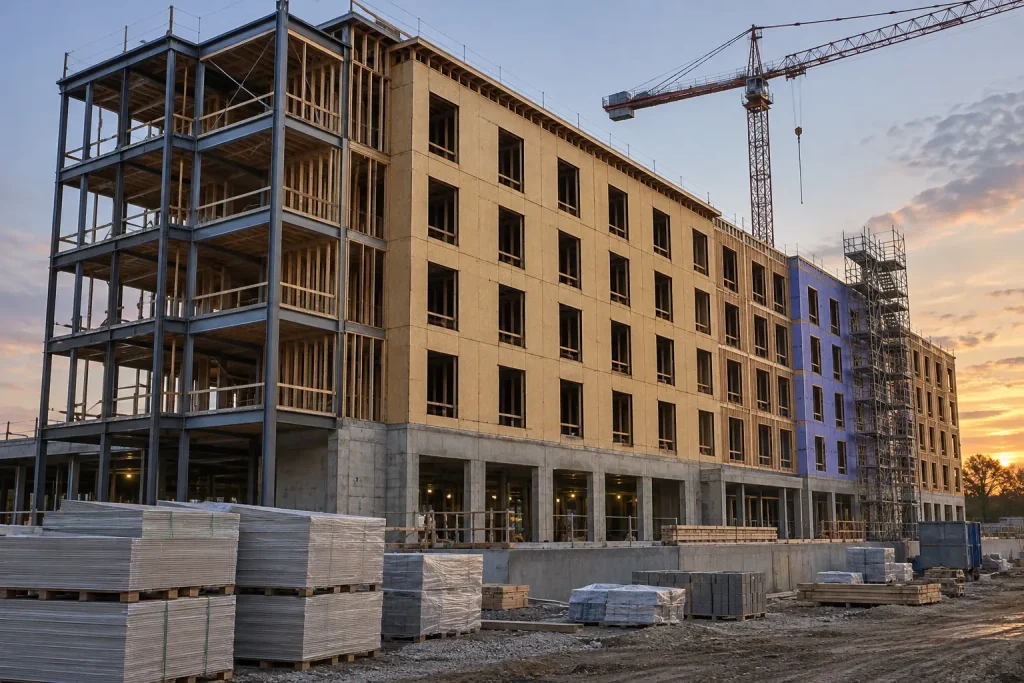
Hotel construction in 2026 costs a median $212,958 per room all-in, from $169,901 for midscale extended-stay to $1,604,356 for luxury (HVS, July 2026), and the 2024 IBC classes a hotel as Group R-1, sprinklered throughout.
Key takeaways
- The HVS U.S. Hotel Development Cost Survey 2026 puts the median development cost at $200,730 per room for select-service hotels and $467,244 per room for full-service hotels, land and pre-opening costs included.
- Rider Levett Bucknall’s Q3 2026 North America cost report lists 3-star hotel hard costs from $235 per square foot (Phoenix, low end) to $700 (San Francisco, high end) across 18 U.S. cities.
- Under IBC 2024 Section 903.3.1.2, a hotel may use the lighter NFPA 13R sprinkler standard only at 4 stories or fewer above grade plane with its highest floor 30 feet or less above fire department access.
- A 150-room hotel needs 7 guest rooms with mobility features, 2 of them with roll-in showers, and 12 rooms with communication features under ADA 2010 Standards Tables 224.2 and 224.4.
- HVS says the typical hotel development process can last 3 to 5 years; on site, 62 new hotels registered in Texas in 2025 and 2026 planned a median of 17.2 months of construction, with the middle half between 13.6 and 21.0 months (TDLR TABS project search, CB&C count).
What does hotel construction involve?
Hotel construction covers three kinds of project: a ground-up new build, a conversion of an existing hotel or other building to a brand, and a brand-mandated renovation under a property improvement plan (PIP). All three are regulated as Group R-1 transient lodging under the 2024 International Building Code, and branded projects add a franchise agreement whose standards sit on top of the code.
The 2024 IBC, Section 310.2, lists hotels, motels, lodging houses with more than five guestrooms, and transient boarding houses with more than 10 occupants as Group R-1. That one classification drives sprinkler, alarm, fire separation, sound and accessibility rules, which is why a 120-room hotel and a 120-unit apartment building of similar size are designed to different code sections.
Project mix matters for budgeting. Lodging Econometrics counted 1,081 U.S. hotel projects with 133,216 rooms under construction at the end of Q2 2026, plus 1,567 conversion projects with 152,044 rooms in the pipeline, a record for a second quarter. Spending is cooling: the Census Bureau put private lodging construction at $23.3 billion (seasonally adjusted annual rate) in August 2026, down 10.1% from a year earlier. The phases of a ground-up project follow the general sequence in our guide to new commercial construction.
How much does hotel construction cost per room?
HVS reports a median of $212,958 per room across all hotel projects proposed or under construction in 2025, published July 13, 2026. Medians range from $169,901 for midscale extended-stay to $1,604,356 for luxury. These are all-in development costs: land, building and site improvements, soft costs, furniture, fixtures and equipment (FF&E), pre-opening costs and developer fee.
| Hotel type | Median total per room | Average total per room | Median building and site per room | Median FF&E per room | Source |
|---|---|---|---|---|---|
| Midscale extended-stay | $169,901 | $167,992 | $110,057 | $16,594 | HVS 2026, Exhibit 6 |
| Limited-service | $196,975 | $204,149 | $141,143 | $16,079 | HVS 2026, Exhibit 6 |
| Select-service | $200,730 | $239,006 | $126,900 | $18,321 | HVS 2026, Exhibit 6 |
| Upscale extended-stay | $264,841 | $250,824 | $190,694 | $25,661 | HVS 2026, Exhibit 6 |
| Full-service | $467,244 | $595,252 | $305,266 | $36,752 | HVS 2026, Exhibit 6 |
| Luxury | $1,604,356 | $1,961,964 | $916,919 | $138,317 | HVS 2026, Exhibit 6 |
HVS states that the survey supports preliminary estimates only and should not be used to price an actual project or for valuation. HVS also warns against reading year-over-year changes into it, because the mix of hotel types and locations shifts each year. Component medians in Exhibit 6 are calculated separately, so they do not add up to the median total.
What do several guides say, and what does the current survey say?
Two of the top-ranking hotel construction guides quote per-room costs that are either undated or two survey editions old. The current HVS figures differ by tens of thousands of dollars per room, and the direction is not always up: the all-property median fell slightly from the 2025 edition, while full-service rose.
| Claim in a top-ranking guide | What the primary source says | Source |
|---|---|---|
| A hotel software guide (2025) cites about $143,000 per room for midscale extended-stay from the HVS 2024 survey | The 2026 survey median for midscale extended-stay is $169,901 per room | HVS 2026, Exhibit 6 |
| A construction software guide (updated December 2025) gives luxury and full-service hotels as “over $400,000” per room, with no source | Full-service median $467,244; luxury median $1,604,356 per room | HVS 2026, Exhibit 6 |
| Several 2026 cost pages quote one national hotel cost per square foot, unsourced | RLB publishes city ranges: 3-star hotels from $235 to $700 per sq ft of gross floor area, hard cost only | RLB Q3 2026 |
What does a hotel cost per square foot in each city?
Rider Levett Bucknall’s Q3 2026 report lists hotel hard construction costs per square foot of gross floor area for 18 U.S. cities. For a 3-star hotel, the midpoint of the published range runs from $297.50 in Phoenix to $575 in San Francisco. Hard cost means the building contract only: no land, design fees, financing, FF&E or pre-opening costs.
| City | 3-star hotel, $ per sq ft | 3-star midpoint | 5-star hotel, $ per sq ft | Source |
|---|---|---|---|---|
| San Francisco | 450 to 700 | 575 | 600 to 1,150 | RLB Q3 2026 |
| Honolulu | 445 to 695 | 570 | 770 to 925 | RLB Q3 2026 |
| Portland | 450 to 650 | 550 | 575 to 750 | RLB Q3 2026 |
| Minneapolis | 405 to 590 | 497.5 | 570 to 780 | RLB Q3 2026 |
| Boston | 360 to 590 | 475 | 510 to 870 | RLB Q3 2026 |
| New York | 395 to 540 | 467.5 | 540 to 815 | RLB Q3 2026 |
| Chicago | 385 to 515 | 450 | 540 to 820 | RLB Q3 2026 |
| Denver | 350 to 525 | 437.5 | 485 to 735 | RLB Q3 2026 |
| Seattle | 360 to 505 | 432.5 | 505 to 765 | RLB Q3 2026 |
| Nashville | 345 to 455 | 400 | 490 to 675 | RLB Q3 2026 |
| Austin | 315 to 465 | 390 | 440 to 605 | RLB Q3 2026 |
| Charlotte | 335 to 445 | 390 | 485 to 665 | RLB Q3 2026 |
| Dallas | 315 to 465 | 390 | 450 to 620 | RLB Q3 2026 |
| Miami | 335 to 440 | 387.5 | 485 to 645 | RLB Q3 2026 |
| Washington, D.C. | 295 to 465 | 380 | 455 to 705 | RLB Q3 2026 |
| Los Angeles | 325 to 430 | 377.5 | 450 to 705 | RLB Q3 2026 |
| Las Vegas | 270 to 465 | 367.5 | 460 to 845 | RLB Q3 2026 |
| Phoenix | 235 to 360 | 297.5 | 445 to 695 | RLB Q3 2026 |
The same report puts the RLB National Construction Cost Index at 292.28 for July 2026, up 4.45% year over year. The method for turning a published per-square-foot range into a budget band for your own building is set out in our guide to commercial construction cost per square foot.
Where does a hotel development budget go?
In the HVS 2026 survey, building and site improvements take 63% to 68% of the total per room in every hotel type. Land takes 8% to 11%, soft costs 10% to 18%, FF&E 4% to 10%, and pre-opening, working capital and developer fee 1% to 3% each. Soft costs include the franchise application fee and construction-period interest.
| Share of total per room | Select-service | Full-service | Luxury | What HVS counts in it |
|---|---|---|---|---|
| Land | 8% | 11% | 11% | Land purchase |
| Building and site improvements | 65% | 63% | 64% | General contractor and subcontractor bids, permits, parking, signage, hard cost contingency |
| Soft costs | 12% | 15% | 18% | Architect and interior design fees, franchise application fee, financing and holding costs, soft cost contingency |
| FF&E | 10% | 7% | 4% | Guestroom furniture, kitchen and laundry equipment, softgoods, technology |
| Pre-opening and working capital | 2% | 2% | 1% | Recruiting, training, linen and supplies, technical services fees |
| Developer fee | 3% | 2% | 2% | Developer fee |
Worked example: a 150-room select-service hotel
Multiplying the HVS 2026 select-service median by 150 rooms gives a $30.1 million all-in starting figure, before local adjustment. Splitting it by the published select-service shares shows how much of that number is the construction contract a builder would bid, and how much sits outside it.
| Line | Input | Arithmetic | Result |
|---|---|---|---|
| All-in budget | 150 rooms at $200,730 median (HVS 2026) | 150 x $200,730 | $30,109,500 |
| Building and site improvements | 65% share (HVS 2026) | $30,109,500 x 0.65 | $19,571,175 |
| Soft costs | 12% share | $30,109,500 x 0.12 | $3,613,140 |
| FF&E | 10% share | $30,109,500 x 0.10 | $3,010,950 |
| Land | 8% share | $30,109,500 x 0.08 | $2,408,760 |
| Developer fee plus pre-opening | 3% plus 2% | $30,109,500 x 0.05 | $1,505,475 |
| Escalated to a start 2 years out | 4.45% a year held flat (RLB index change, assumption) | $30,109,500 x 1.0445 x 1.0445 | $32,848,870 |
The escalation row is CB&C arithmetic, not a forecast: it holds RLB’s 4.45% annual change constant for 2 years, while the HVS 2026 text reports the Turner Building Cost Index at 4.8% for the trailing twelve months and names tariffs on imported metals as the main source of renewed cost pressure. Duty rates by material are tracked in our construction material tariffs report.
How long does it take to build a hotel?
Plan on 3 to 5 years from feasibility study to opening, the span HVS gives for a typical hotel development in its 2026 survey, with about a year and a half of it on site. New hotels registered in Texas from January 2025 to October 2026 planned a median of 17.2 months from construction start to completion, and buildings of 5 stories or more planned 19.0 months.
| Stage | Typical time | Source |
|---|---|---|
| Feasibility to opening, whole development | 3 to 5 years | HVS 2026 survey |
| Franchise Disclosure Document in hand before you sign or pay | At least 14 calendar days | 16 CFR 436.2(a) |
| Construction, new hotel (62 Texas projects, median 70,235 sq ft) | Median 17.2 months; middle half 13.6 to 21.0 months | TDLR TABS project search, CB&C count |
| Construction, 5 stories or more (12 of the 62) | Median 19.0 months | TDLR TABS, CB&C count |
| Signing to opening for your brand | Disclosed in FDD Item 11 | 16 CFR 436.5(k) |
Texas owners register commercial projects with the Texas Department of Licensing and Regulation for accessibility review, and each public record lists estimated cost, size and planned start and finish dates; we pulled every hotel registration from January 2025 to October 2026 on October 26, 2026. The same records give a median estimated cost of $131 per sq ft, well under RLB’s lowest 3-star range ($235 to $360 in Phoenix), so use them for the schedule, not the budget.
How does the brand approval process work for a new hotel?
A branded hotel moves through a franchise process that federal law partly structures. The FTC Franchise Rule requires the brand to deliver its Franchise Disclosure Document (FDD) at least 14 calendar days before you sign or pay, and the FDD must disclose site approval limits, pre-opening duties, approved suppliers and the typical time from signing to opening.
- Feasibility study and budget. Use the HVS 2026 category medians as a first check, and escalate for the 3 to 5 year development timeline HVS describes.
- Receive and review the FDD. Under 16 CFR 436.2(a), the document arrives at least 14 calendar days before you sign a binding agreement or make any payment.
- Franchise application and site approval. FDD Item 11 must state the time limit for the franchisor to approve or disapprove your site.
- Design to brand prototype and local code. The architect reconciles the brand’s design standards with IBC 2024 Section 310.2 (R-1) and ADA Table 224.2 room counts.
- Permits and pre-opening requirements. FDD Item 9 lists your site development and other pre-opening obligations, which the brand checks alongside the building permit.
- Construction with approved suppliers. FDD Item 8 discloses required sources for goods, fixtures and equipment; Item 9 covers brand inspections and audits.
- Certificate of occupancy and opening. The building official issues the certificate; FDD Item 9 sets the brand’s opening obligations and Item 11 discloses the typical time to open.
| FDD item | What it must disclose | Why it matters to the build | Source |
|---|---|---|---|
| Item 7 | Estimated initial investment, in a table | The brand’s own range for construction, FF&E and opening costs | 16 CFR 436.5(g) |
| Item 8 | Obligations to buy goods, fixtures and equipment from required sources | Approved FF&E and system vendors fix part of the bid | 16 CFR 436.5(h) |
| Item 9 | Franchisee obligations, including site development, opening, and maintenance, appearance and remodeling | The contract basis for future PIPs | 16 CFR 436.5(i) |
| Item 11 | Site approval time limit; typical time from signing or first payment to opening | Sets the schedule the builder works inside | 16 CFR 436.5(k) |
The certificate itself, and what a building official checks before issuing it, is covered in our guide to the certificate of occupancy.
What should you ask a hotel construction contractor?
Ask for evidence tied to hotel rules, not general references. A contractor bidding a 4-story R-1 building should be able to name the sprinkler standard, the STC 50 assemblies it has built, and how it will hit Table 224.2 counts. CB&C is a matching service, not a contractor, and this is not legal advice.
- Which sprinkler standard did you price, NFPA 13 or 13R, and does the building meet all three IBC 903.3.1.2 conditions?
- Which tested wall and floor assemblies reach STC 50 and IIC 50 under IBC 1206, and will you field test to NNIC 45?
- How many hotels for this brand have you built or renovated in the past 5 years, and which FDD Item 8 suppliers did you buy from?
- For a PIP, how will you phase rooms so the hotel keeps selling inventory, and how many rooms per floor go offline at once?
- Which line items in your bid fall under HVS building and site improvements, and which are owner FF&E?
A wider vetting checklist sits in our guide on how to choose a commercial contractor. When bids arrive, line them up scope by scope using our method for comparing construction bids.
What is a hotel PIP and what does it cost?
A property improvement plan (PIP) is the brand’s list of required upgrades, commonly issued when a hotel changes owner, converts to the brand or renews its franchise. FDD Item 9 is where a franchise discloses these “maintenance, appearance, and remodeling requirements”. A dated HVS review of two brand programs found PIP costs from about $5,000 to more than $40,000 per room.
| Brand program reviewed by HVS (2017) | Hotel age or condition | Reported PIP cost per room | Source |
|---|---|---|---|
| Hampton by Hilton, Forever Young | Built in the 1980s | Can exceed $40,000 | HVS, Feb 20, 2017 |
| Hampton by Hilton, Forever Young | Built 1990 to 1995 | $20,000 to $30,000 | HVS, 2017 |
| Hampton by Hilton, Forever Young | Built after 1995 | $15,000 to $25,000 | HVS, 2017 |
| Hampton by Hilton, Forever Young | Mansard roofline replaced | Adds $8,000 to $17,000 | HVS, 2017 |
| Holiday Inn Express, Formula Blue | Built before 2001 | $20,000 to $35,000 | HVS, 2017 |
| Holiday Inn Express, Formula Blue | Built after 2001 | $10,000 to $20,000 | HVS, 2017 |
| Holiday Inn Express, Formula Blue | Recently renovated to another scheme | As low as $5,000 | HVS, 2017 |
These figures are 2017 dollars and HVS labelled the article “not a cost guide”, so treat them as a sign of how age moves PIP scope, not as a price. HVS reported that the major items in the Holiday Inn Express program were due within twelve months. Before buying a hotel that will carry a PIP, a property condition assessment prices the items the PIP does not list.
Does a PIP renovation trigger ADA room counts?
Yes, for the rooms you touch. ADA 2010 Standards Section 224.1.1 applies the accessible room requirements to guest rooms being altered or added, until the hotel reaches the number Table 224.2 requires for new construction. A PIP that renovates 60 rooms in a 120-room hotel is scoped on the 60 rooms, with dispersion across room types under Section 224.5.
Occupied-hotel phasing, after-hours work and life safety plans during renovation are covered in our guide to commercial renovation contractors.
Which building codes apply to a hotel?
Under the 2024 IBC, a hotel is Group R-1 (Section 310.2) and must be sprinklered throughout (Section 903.2.8). It needs a manual fire alarm (907.2.8.1), corridor smoke detection (907.2.8.2), smoke alarms in sleeping areas (907.2.11.1), fire partitions between rooms (420.2) and STC 50 sound walls (1206.2). Local amendments can change any of these, so confirm the adopted edition.
| Requirement | Rule | Section | Source |
|---|---|---|---|
| Occupancy | Hotels and motels (transient) and lodging houses with more than five guestrooms are Group R-1 | IBC 2024 310.2 | ICC |
| Sprinklers | Required throughout all buildings with a Group R fire area | IBC 2024 903.2.8 | ICC |
| NFPA 13R option | 4 stories or fewer above grade plane; highest floor 30 ft or less above, lowest floor 30 ft or less below fire department access | IBC 2024 903.3.1.2 | ICC |
| Manual fire alarm | Required in R-1; exception for 2 stories or less where every room exits directly outside and units have 1-hour fire partitions | IBC 2024 907.2.8.1 | ICC |
| Corridor smoke detection | Required in interior corridors serving sleeping units | IBC 2024 907.2.8.2 | ICC |
| Room separations | Walls are fire partitions (Section 708); floors are horizontal assemblies (Section 711) | IBC 2024 420.2, 420.3 | ICC |
| Fire partition rating | 1 hour; 1/2 hour for room separations in Type IIB, IIIB and VB buildings with NFPA 13 sprinklers | IBC 2024 708.3 | ICC |
| Sound between rooms | STC 50 (ASTM E90) for walls and floors; IIC 50 (ASTM E492) for floor-ceilings | IBC 2024 1206.2, 1206.3 | ICC |
| Federal travel and meetings list | Hard-wired smoke detector in each guest room; NFPA 13 or 13R sprinklers unless 3 stories or lower | 15 U.S.C. 2225 | LII |
The federal Hotel and Motel Fire Safety Act guideline sits outside the building code. Under 15 U.S.C. 2225a, federal funds may not pay for a meeting at a property that fails the 15 U.S.C. 2225 guidelines unless an agency head grants a waiver, which matters for hotels that plan to sell government group business.
How many accessible guest rooms does a hotel need?
ADA 2010 Standards Table 224.2 sets the minimum number of guest rooms with mobility features by total room count, and splits them between rooms with and without roll-in showers. A 150-room hotel needs 7 mobility rooms, 2 with roll-in showers. Table 224.4 adds rooms with communication features: 12 for 101 to 150 rooms.
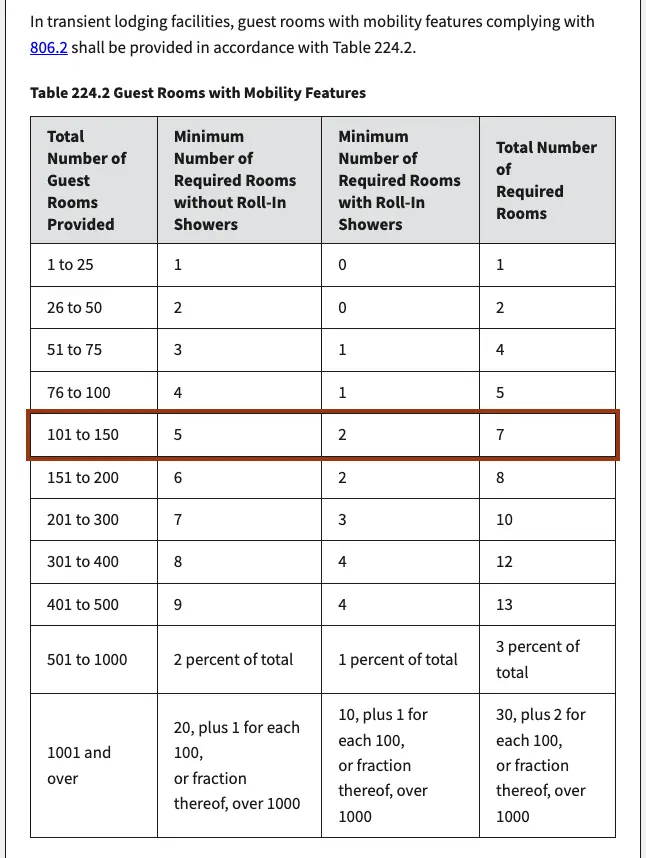
| Guest rooms provided | Mobility rooms without roll-in shower | Mobility rooms with roll-in shower | Total mobility rooms | Communication feature rooms |
|---|---|---|---|---|
| 1 to 25 | 1 | 0 | 1 | 2 (for 2 to 25 rooms) |
| 26 to 50 | 2 | 0 | 2 | 4 |
| 51 to 75 | 3 | 1 | 4 | 7 |
| 76 to 100 | 4 | 1 | 5 | 9 |
| 101 to 150 | 5 | 2 | 7 | 12 |
| 151 to 200 | 6 | 2 | 8 | 14 |
| 201 to 300 | 7 | 3 | 10 | 17 |
| 301 to 400 | 8 | 4 | 12 | 20 |
| 401 to 500 | 9 | 4 | 13 | 22 |
| 501 to 1,000 | 2% of total | 1% of total | 3% of total | 5% of total |
Section 224.5 requires at least one mobility room to also have communication features, and caps at 10% the share of mobility rooms that may count toward the communication total. The 2024 IBC Table 1108.6.1.1 sets parallel counts for Accessible units, and Section 1103.2.11 exempts an owner-occupied R-1 building with five or fewer rooms for rent.
New build, conversion or PIP: which path fits your project?
The choice turns on four checkable thresholds: building height against the NFPA 13R limit, room count against ADA Table 224.2, the age of an existing hotel against the PIP ranges HVS reported, and per-room cost against the HVS 2026 median for the hotel type. The table maps each situation to a next step.
| If | Then | Rule or source |
|---|---|---|
| You are setting an opening date | Allow 3 to 5 years from feasibility, with about 14 to 21 months on site for a new hotel | HVS 2026; TDLR TABS, CB&C count |
| New build is 5 stories or more, or the highest floor is more than 30 ft above fire access | Budget NFPA 13 sprinklers, not 13R | IBC 2024 903.3.1.2 |
| Prototype has 101 to 150 rooms | Plan 7 mobility rooms (2 roll-in showers) and 12 communication rooms, dispersed by room type | ADA Tables 224.2, 224.4; Section 224.5 |
| Buying a branded hotel built before 2001 | Price the PIP before signing, and expect a heavier scope than for newer hotels | HVS, 2017 PIP review |
| A PIP renovates guest rooms | Add accessible rooms in the altered rooms until the facility meets Table 224.2 | ADA Section 224.1.1 |
| Select-service budget is well above $200,730 per room all-in | Ask the cost consultant which component (land, building, soft costs) sits above the HVS share | HVS 2026, Exhibit 6 |
| Hotel plans to host federally funded meetings and has more than 3 stories | Confirm sprinklers to NFPA 13 or 13R and hard-wired room smoke detectors | 15 U.S.C. 2225, 2225a |
How we compiled this
We compiled this page in October 2026 from 11 primary documents: the HVS 2026 and 2025 development cost surveys (cost tables read from HVS Exhibit 6), the RLB Q3 2026 cost report PDF, the Lodging Econometrics Q2 2026 pipeline report, the Census August 2026 construction spending release, the 2024 IBC chapters 3, 4, 7, 9, 11 and 12, the ADA 2010 Standards section 224, 15 U.S.C. 2225 and 2225a, the FTC Franchise Rule and a 2017 HVS PIP review. For construction time we counted 62 new hotel registrations in the Texas TDLR TABS public search (January 2025 to October 2026, pulled October 26, 2026). We excluded unsourced cost claims found in search results. We did not survey owners or price projects.
Frequently asked questions
How long does it take to build a hotel?
HVS says the typical hotel development process can last three to five years, from feasibility study to opening. Construction is the shorter part: 62 new hotels registered in Texas in 2025 and 2026 planned a median of 17.2 months on site, and the 12 with 5 stories or more planned 19 months. Ask the brand for its FDD Item 11 time to opening before you sign.
What is the cheapest type of hotel to build?
In the HVS 2026 survey, midscale extended-stay hotels had the lowest median development cost at $169,901 per room, followed by limited-service at $196,975 and select-service at $200,730. Full-service hotels ran a median $467,244 per room and luxury hotels $1,604,356. HVS says these medians support preliminary estimates only, not the pricing of an actual project.
Is a hotel classified as R-1 or R-2?
A hotel is Group R-1 under Section 310.2 of the 2024 International Building Code because its occupants are primarily transient. Group R-2, in Section 310.3, covers buildings whose occupants are primarily permanent, such as apartment houses. Lodging houses with more than five guestrooms are also R-1, so a small inn can fall under the hotel rules.
Do hotels need sprinklers in every room?
IBC 2024 Section 903.2.8 requires an automatic sprinkler system throughout every building with a Group R fire area, which includes hotels. Section 903.3.1.2 permits the NFPA 13R standard only when the building is 4 stories or fewer above grade plane and its highest floor is 30 feet or less above fire department access; taller hotels use NFPA 13.
What is FF&E in hotel construction?
FF&E means furniture, fixtures and equipment: guestroom furniture, kitchen and laundry equipment, public space furniture, softgoods and technology, as HVS defines the category. In the HVS 2026 survey, median FF&E was $18,321 per room for select-service hotels and $36,752 for full-service hotels, and HVS budgets it separately from building and site improvements.
How many hotels are under construction in the US?
Lodging Econometrics counted 1,081 U.S. hotel projects with 133,216 rooms under construction at the end of Q2 2026, in a total pipeline of 5,975 projects and 703,001 rooms (report dated July 23, 2026). It forecast 661 new hotel openings with 74,820 rooms for 2026 and 738 openings with 78,909 rooms for 2027.
What sound rating do hotel walls need?
IBC 2024 Section 1206.2 requires walls and floor-ceiling assemblies between guest rooms, and between guest rooms and public or service areas, to reach STC 50 when tested to ASTM E90, or NNIC 45 when field tested. Section 1206.3 adds IIC 50 for floor-ceiling assemblies under ASTM E492. Entrance doors are exempt but must fit tightly.
Sources
- HVS, U.S. Hotel Development Cost Survey 2026 (July 13, 2026), accessed October 20, 2026.
- HVS, U.S. Hotel Development Cost Survey 2025 (July 17, 2025), accessed October 20, 2026.
- Rider Levett Bucknall, North America Quarterly Cost Report Q3 2026 (PDF), accessed October 20, 2026.
- Lodging Econometrics, U.S. Hotel Construction Pipeline, Q2 2026 (July 23, 2026), accessed October 20, 2026.
- U.S. Census Bureau, Monthly Construction Spending, August 2026 (release CB26-158), accessed October 3, 2026.
- International Code Council, 2024 International Building Code, chapters 3, 4, 7, 9, 11 and 12, accessed October 20, 2026.
- U.S. Access Board, ADA Accessibility Standards (2010 DOJ Standards), Section 224, accessed October 20, 2026.
- Legal Information Institute, 15 U.S.C. 2225 and 15 U.S.C. 2225a, accessed October 20, 2026.
- Legal Information Institute, FTC Franchise Rule 16 CFR 436.2 and 16 CFR 436.5, accessed October 20, 2026.
- HVS, Industry Insights: Impacts of Major Brand PIPs (February 20, 2017), accessed October 20, 2026.
- Texas Department of Licensing and Regulation, TABS project search, new hotel registrations January 2025 to October 2026, accessed October 26, 2026.