A Knox box is the common trade name for a fire department key box: a small steel safe by the entrance holding keys only firefighters can open, required where the fire code official says so under IFC 506.1.
Key takeaways
- International Fire Code (IFC) Section 506.1 lets the fire code official require a key box where secured openings restrict access, and the box must be listed to UL 1037 (2025 California Fire Code text, summarized by Newberry Springs Fire Department, 2025).
- Many departments turn that permission into a rule for any building with sprinklers or a fire alarm: Santa Clara County Fire Department Spec K-1 adds all schools, and Sioux Falls Fire Rescue (2025) adds high-pile combustible storage.
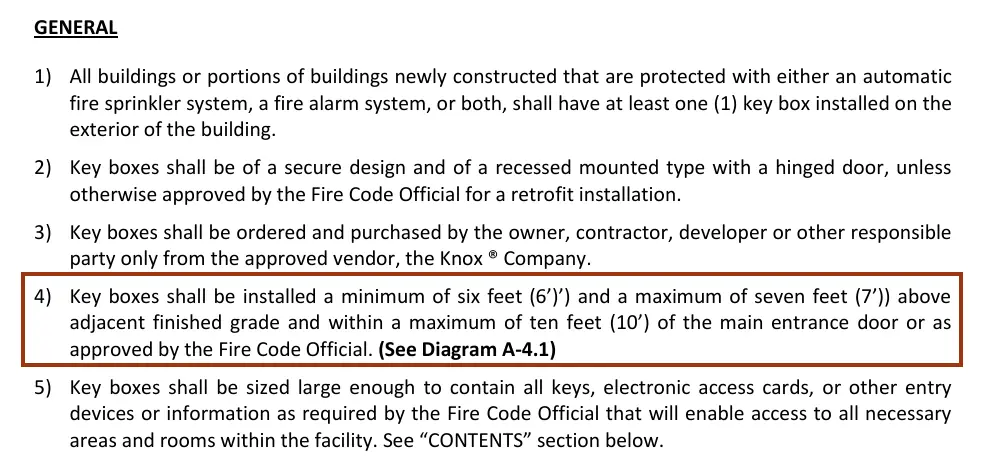
- Mounting heights differ by department, from 42 to 54 inches in Prince William County, Virginia (July 2026) to 6 to 7 feet on new buildings in San Bernardino County Fire Standard A-4 (2021).
- A standard 10-key commercial box listed at $308 to $364 on a Bellevue, Idaho order sheet (posted October 2025) and at $499 to $578 on a Lawrence-Douglas County, Kansas sheet (posted October 2025), before shipping and installation.
- When a lock is changed or rekeyed, IFC 506.2 requires the building operator to notify the fire code official at once and put the new key in the box; Prince William County charges $85 for the first commercial inspection and key lock-in from July 1, 2026.
What is a Knox box, and what does the fire code say?
A key box, also called a rapid entry system, is a small welded steel box mounted outside a building that holds entry and equipment-room keys. Only the local fire department carries the key that opens it. IFC Section 506.1 authorizes the fire code official to require one, says it must be listed to UL 1037 and says it holds whatever keys that official asks for (2025 California Fire Code, Section 506).
The code itself names no brand. A Newberry Springs Fire Department code handout (2025) notes that the code uses the generic term key box, that the common name is a proprietary product name, and that a jurisdiction may specify one system through its local standards. Many do: Prince William County says only one maker’s box is approved there, and San Bernardino County Standard A-4 requires purchase from a single approved vendor. The reason is the master key: each department’s boxes share one key that the department controls, so a box from another system will not open with the key on the engine.
| Item | Number or rule | Source |
|---|---|---|
| Code section that allows the requirement | IFC 506.1 (California Fire Code 506.1) | 2025 CFC Section 506 |
| Listing standard | UL 1037 | 2025 CFC 506.1 |
| Gates and barriers | Approved lock where the fire code official requires it (506.1.1) | 2025 CFC 506.1.1 |
| Elevator key box height | 5 ft 6 in (66 in) above finished floor, right side of the elevator bank | IFC 506.1.2 via Newberry Springs FD, 2025 |
| Elevator banks per box | One box for banks no more than 30 ft apart | 2025 CFC 506.1.2 item 6 |
| Lock changed or rekeyed | Notify the fire code official immediately and provide the new key (506.2) | 2025 CFC 506.2 |
| Standard commercial box capacity | Up to 10 keys; body 4 in high, 5 in wide, 3-7/8 in deep; 8 lb surface mount | Maker spec sheet in Oxnard packet, 2022 |
| Maker’s suggested minimum height | 6 ft above ground | Maker mounting sheet in Oxnard packet, 2022 |
Which buildings need a key box?
Under the model code, a key box is required only where the fire code official requires it, so the real trigger is your local fire department’s written policy. Most published policies require one on any commercial building with sprinklers or a fire alarm, and some add schools, high-pile storage or kitchen hoods. Syracuse, New York weighs occupancy type, building size and department procedures under Section 506.1 of the 2020 Fire Code of New York State.
| Fire department | Buildings that need a key box | Extra rules | Source |
|---|---|---|---|
| Santa Clara County Fire Dept., CA | Buildings with fire alarm or sprinkler systems; all school buildings; strip malls with large anchor stores | Authorization form needed to buy | Spec K-1 (rev. 2009, posted 2024) |
| San Bernardino County Fire Protection District, CA | All new buildings protected by sprinklers, a fire alarm, or both; existing buildings where entry would be hard or forcible entry costly | One box per entrance more than 500 ft apart; 24-hour staffed sites may ask for a waiver | Standard A-4 (July 1, 2021) |
| Sacramento Metropolitan Fire District, CA | All buildings with fire and life safety systems and fixed commercial hood systems | Box on the riser room door’s latch side when that room opens outside | Knox Key Boxes (rev. 03/2023) |
| Sioux Falls Fire Rescue, SD | Buildings with sprinklers or fire alarm systems; buildings used for high-pile combustible storage | Liability release form signed per address | Lock Box System packet (2025) |
| Oxnard Fire Dept., CA | Where access is restricted, per CFC 506.1 | One box at the front for most sites; larger sites may need a second at the rear | Purchasing and Installation Guidelines (2022) |
| City of Syracuse, NY | Decided case by case by occupancy type, size and procedures | Extra boxes where a building fronts more than one fire access road | Emergency Key Box page (accessed Nov 2026) |
New sprinklered buildings meet the trigger in all 4 of the departments above that publish a systems rule, so the key box belongs in the fire protection budget next to the riser, alarm panel and fire department connection covered in our fire sprinkler system cost guide. Restaurants in Sacramento Metro territory also need one because of the hood system, which links the box to the commercial kitchen fire suppression system.
How high and where do you mount a key box?
Mount the key box where your fire department’s standard says, usually beside the main entrance on the addressed side of the building, on the latch side of the door, between about 4 and 7 feet up. Published heights differ: Prince William County asks for 42 to 54 inches, while San Bernardino County requires 6 to 7 feet on new buildings. The maker’s sheet suggests at least 6 feet.
| Jurisdiction | Height | Location rule | Source |
|---|---|---|---|
| Prince William County, VA | 42 to 54 in above ground (most boxes) | Visible and reachable; some at the rear for alarm or sprinkler rooms | Knox Box FAQ (rev. 7/2026) |
| Santa Clara County, CA | 4 to 6 ft above ground; never over 6 ft | Near the main entrance | Spec K-1 |
| Syracuse, NY | 5 ft to 5 ft 6 in above finished floor | Exterior, lock side of an entrance door, addressed side | Emergency Key Box page |
| Napa, CA | 5 ft above finished grade | Next to the main entrance facing the street, in plain view | Key Box Installation Information (2020) |
| York, PA | Maximum 5 ft from grade to the box center | Approved location; through-bolted | Locking Devices Information Sheet (rev. 3/8/2018) |
| Oxnard, CA | Minimum 66 in | Conspicuous spot near the front door | Installation Guidelines (2022) |
| Sacramento Metro, CA | No more than 6 ft above the door’s finished landing | Latch side of the main entrance or exterior riser room door | Knox Key Boxes (2023) |
| Sioux Falls, SD | 6 ft above grade | Within 20 ft of the front entrance | Lock Box System packet (2025) |
| San Bernardino County, CA (new) | 6 to 7 ft above finished grade, recessed type | Within 10 ft of the main entrance door | Standard A-4 |
| San Bernardino County, CA (existing) | 5 to 6 ft, surface mount allowed | Within 10 ft of the main entrance door | Standard A-4 |
| Any IFC jurisdiction: elevator key box | 5 ft 6 in above finished floor | Right side of the elevator bank, lobby at the lowest fire department access level | IFC 506.1.2 (2025 CFC) |
Placement rules beyond height also differ. San Bernardino County bans boxes on columns and architectural pop-outs and, for multi-tenant buildings with no clear front door, wants the box on the address side near the door to the alarm panel and sprinkler riser. Napa warns against spots that landscaping could hide. On new concrete or masonry walls, a recess mounting kit is cast in during construction; the maker’s rough-in size is 6-1/2 in high by 6-1/2 in wide by 5 in deep (maker sheet in the Oxnard packet).
What keys go inside the box?
The box holds the keys firefighters need to get in and reach the building’s fire protection and utility controls: the main entrance, the fire alarm control panel, the sprinkler riser or fire control room, electrical and mechanical rooms, and elevator recall keys. IFC 506.1 leaves the exact list to the fire code official, and Santa Clara County and San Bernardino County publish theirs.
| Key or device | Required by | Source |
|---|---|---|
| Main entrance and all exterior entry doors | Santa Clara County; San Bernardino County; Syracuse (advised) | Spec K-1; A-4 |
| Fire alarm control panel | Santa Clara County; San Bernardino County; Syracuse | Syracuse |
| Sprinkler riser room or fire control room | Santa Clara County; San Bernardino County; Sioux Falls | Sioux Falls packet |
| Electrical and mechanical rooms | Santa Clara County; San Bernardino County; Sioux Falls | A-4 |
| Elevator keys and firefighter recall switches | Santa Clara County; San Bernardino County; Oxnard; Syracuse | Oxnard |
| Roof access doors | Syracuse | Syracuse |
| Suites and offices; master key set | San Bernardino County; Oxnard (one labeled master set) | Oxnard |
| Key fobs or access cards | Oxnard if used; San Bernardino County with approval | A-4 |
| Smoke and heat vent operating keys | Sioux Falls, where vents are installed | Sioux Falls packet |
Label every key so a firefighter can find the right one in the dark. Santa Clara County rejects paper tags and ink and wants a metal ring with a brass disk tag. Sioux Falls prefers one master key and, where several are used, color codes them: red for fire protection, yellow for electrical, green for mechanical and blue for elevators. In buildings over 100,000 sq ft or more than 3 stories, San Bernardino County can ask for several sets of master keys, and a high-rise may keep them in an inside cabinet whose key sits in the outside box.
How do you order and install a key box through the fire department?
Owners buy the box themselves, but through the fire department’s channel: you select your department on the maker’s order page so the box ships keyed to that department’s master key. Some departments approve each order first. After mounting, you call fire prevention, and an inspector checks the box and locks your keys inside; Prince William County charges $85 for that first commercial visit.
- Call the fire prevention office before ordering. Ask whether a box is required, which series, how many, which wall and whether you need a tamper switch. Virginia Beach will not approve a request until a site visit, and Santa Clara County issues an authorization form first.
- Order online under your department. Departments including Deer Park, Texas, Unified Fire Authority in Utah and Oxnard tell owners to select the department on the maker’s site and order the standard 10-key series. In Concord, Massachusetts the order goes to the fire department for approval before it ships, and every box must have a hinged door.
- Have the box shipped to you, not the fire station: Napa says the department does not process paperwork or receive shipments.
- Mount it to your department’s height and distance rule with the maker’s hardware: at least 3/8 in Grade 5 or Grade 8 fasteners into solid wall (maker sheet); York requires through-bolts unless an alternative is approved.
- Cut, tag and test every key in its lock before the visit, as Napa instructs.
- Book the lock-in. Inspectors lock the keys in during the visit (Sioux Falls); Napa combines this with the final occupancy inspection on new buildings and charges an extra fee if it happens later.
On a new project, put the box on the general contractor’s closeout list with its IFC 506.1 requirement noted, so it does not hold up the final fire inspection that precedes the certificate of occupancy. A missing box or untagged keys is the kind of item that lands on a construction punch list in the last week.
How much does a Knox box cost?
A standard commercial key box lists for about $308 to $578 depending on mount type, tamper switch and the department’s price sheet, as of late 2025 order sheets from Bellevue, Idaho and Lawrence-Douglas County, Kansas. A larger vault-style box runs $498 to $977. Shipping, tax, installation and any fire department inspection fee are extra.
| Product (maker’s series) | Bellevue, ID sheet | Lawrence-Douglas Co., KS sheet | Source |
|---|---|---|---|
| Standard box, surface mount, hinged, black (3261) | $308 | $499 | Bellevue; Lawrence |
| Standard box, surface mount, with tamper switch (3262) | $314 | Not listed | Bellevue |
| Standard box, recess mount, black (3270) | $348 | $578 | Bellevue; Lawrence |
| Standard box, recess mount, with tamper switch (3271) | $354 | Not listed | Bellevue |
| Recess mounting kit for standard box (3290) | $89 | $153 | Bellevue; Lawrence |
| Vault box, surface mount, single lock (4401) | $498 | $874 | Bellevue; Lawrence |
| Vault box, recess mount, with tamper alert (4431) | $557 | $977 | Bellevue; Lawrence |
| Power shutdown box, surface mount (4505) | $771 | Not listed | Bellevue |
| Key cabinet, 7 in deep (1302) | $955 | Not listed | Bellevue |
| Elevator key box (1403) | Not listed | $593 | Lawrence |
The two sheets list the same model numbers $191 to $403 apart, and both files were posted in October 2025. Lawrence’s sheet says prices change without notice and exclude shipping, so the price that counts is the one shown at checkout once you select your department. Installed cost is less public. Four federal awards on USAspending.gov show the range for small key box jobs.
| Federal award | Scope in award text | Amount | Year | Source |
|---|---|---|---|---|
| Fort Belvoir, VA (Army) | Install key box, project work orders | $988 | 2023 | W91QV123F0150 |
| Pensacola U.S. Courthouse, FL (GSA) | Key box installation | $4,798.52 | 2023 | 47PE0723F0042 |
| Prince Jonah Kuhio Kalanianaole Federal Building, HI (GSA) | Key box installation | $6,560 | 2026 | 47PD5526C0036 |
| MCAS Cherry Point, NC (Navy) | Install 2 key boxes, barracks building | $7,917 ($3,958.50 per box) | 2022 | N4008522F5097 |
Federal jobs carry security, wiring and paperwork costs a private retail site may not, so treat the $988 to $7,917 range as an upper reference. The arithmetic below shows the owner’s material and fee cost from the published sheets, with labor left as a line for your installer’s quote.
| Line | Retrofit, existing building | New masonry building | Source |
|---|---|---|---|
| Box | Standard surface mount, $308 | Standard recess mount with tamper switch, $354 | Bellevue sheet |
| Recess mounting kit | $0 | $89 | Bellevue sheet |
| Fire department inspection and key lock-in | $85 | $85 | Prince William County fee, 2026 |
| Subtotal before shipping, tax and labor | $393 | $528 | CB&C arithmetic |
| Same lines at Lawrence sheet prices | $499 + $85 = $584 | $578 + $153 + $85 = $816 (recess box without tamper switch) | Lawrence sheet |
| Installer labor and alarm wiring | Quote | Quote; tamper switch wiring goes to the fire alarm contractor | Not published |
How do you maintain and rekey a key box?
The owner keeps the keys current and the box working; the fire department opens it. IFC 506.2 requires the building operator to notify the fire code official immediately when a lock is changed or rekeyed and to provide the new key for the box (2025 CFC 506.2). Owners call fire prevention, and an inspector opens the box and swaps the keys.
| Event | Owner’s action | Source |
|---|---|---|
| Lock changed or rekeyed | Call fire prevention; inspector opens the box and replaces the key | Prince William County; Sioux Falls |
| New access-controlled area or major renovation | Update the keys and cards in the box | Virginia Beach |
| Box broken and cannot be repaired | Owner buys a replacement box from the maker | Prince William County |
| Routine | Fire code official inspects and secures boxes after install and regularly after; owner keeps box operable and keys working | San Bernardino County A-4 |
| Locks rekeyed in a multi-tenant building | Coordinate new key placement with fire prevention | Santa Clara County K-1 |
Rekeying the building without updating the box is the common failure: the box still opens, but the keys inside do not, and crews force entry anyway. IFC 506.2 makes the swap the operator’s duty, so put the key box on the same work order as any lock or access-control change, the same way emergency light tests sit on the monthly list in our guide to emergency lighting requirements.
Is a key box a security risk?
The risk sits in the department’s master key, which opens every box in the jurisdiction, so departments lock those keys up: Nevada, Missouri says its master keys stay in a key vault on the apparatus, and the box itself has a 1/2 in steel door and 1/4 in steel housing (maker sheet). York, Pennsylvania requires a tamper switch that alerts the fire department and central station.
| Option | What it does | Who requires or advises it | Source |
|---|---|---|---|
| Tamper switch | Sends a signal to the alarm system when the box is opened or attacked | Required in York, PA; standard on standard boxes in Unified Fire Authority, UT; Napa, CA advises against it unless security needs are high | York; UFA; Napa |
| Supervised by the fire alarm | Box monitored as a supervisory signal on approved plans | San Bernardino County, with approval | A-4 |
| Electronic lock core | Records each opening by date and time in a cloud log | Shown in the Sioux Falls packet | Sioux Falls packet |
| Liability release | Owner signs before keys go in | Sioux Falls, per address | Sioux Falls packet |
| Limit contents | Common-area and equipment keys only | Sioux Falls | Sioux Falls packet |
Which key box setup fits your building?
Match the box to the building’s size, systems and key count. A standard 10-key box covers most single-tenant buildings; a vault or cabinet suits sites with many tenant keys; and elevator keys go in a separate box at the elevator bank under IFC 506.1.2 unless the exception applies. Confirm every choice with the fire prevention office before ordering.
| If your building… | Then | Rule or source |
|---|---|---|
| Is a school, uses high-pile combustible storage or has a commercial hood system | Expect a key box in Santa Clara County, Sioux Falls and Sacramento Metro territory respectively | Santa Clara K-1; Sioux Falls; Sacramento Metro |
| Has sprinklers or a fire alarm | Plan on at least 1 exterior key box in most jurisdictions | Santa Clara K-1; SB County A-4; Sioux Falls |
| Needs 10 keys or fewer | A standard box holds up to 10 keys; cards reduce the count | Maker sheet |
| Exceeds 100,000 sq ft or 3 stories | Expect several master key sets, possibly an inside cabinet | SB County A-4 |
| Has entrances more than 500 ft apart on fire access roads | Add a box at each entrance | SB County A-4 |
| Has nonstandard fire service elevator keys | Separate labeled box at 5 ft 6 in, right of the bank; one box serves banks within 30 ft | IFC 506.1.2 |
| Is new concrete or masonry | Recessed box with a cast-in recess mounting kit | SB County A-4; Maker sheet |
| Is staffed 24 hours a day | Ask in writing for a waiver | SB County A-4 |
| Has a locked fire lane gate | Approved gate lock or key switch, not a key box on the gate | IFC 506.1.1; SB County A-4 |
Your occupancy group under IBC Chapter 3 sets many of the fire protection systems that trigger a box; see our guide to occupancy classification. This page summarizes published fire department rules and is not legal advice; the fire code official’s written direction for your address controls.
Fire inspectors usually check extinguishers on the same visit, using the rules in our fire extinguisher requirements guide.
How we compiled this
We read the key box section of the 2025 California Fire Code, which carries IFC Section 506, and 17 fire department standards, order sheets and FAQs from 11 states, plus 4 federal award records from USAspending.gov, all accessed in November 2026. Prices come only from department-published order sheets and federal awards; we excluded seller pages. The San Bernardino County screenshot is from the public Standard A-4 PDF.
Frequently asked questions
Is a Knox box required by law?
Only where your fire code official requires one. IFC Section 506.1, adopted in most states, authorizes the official to require a key box where secured openings restrict access. Many departments make it a standing rule for sprinklered or alarmed buildings, such as San Bernardino County for all new protected buildings and Sioux Falls for sprinklered, alarmed or high-pile storage buildings.
Can I buy a key box at a hardware store?
Usually not for a commercial building. The box must be listed to UL 1037 under IFC 506.1 and keyed to your fire department’s master key, so departments such as Prince William County and San Bernardino County accept only one maker’s system, ordered online under the department’s name. A generic lockbox will not open with the key the engine carries.
Who has the key to a Knox box?
Only the local fire department. Each department’s boxes share a master key the department controls, and Syracuse notes each department has its own specific key. Nevada, Missouri keeps its master keys in a locked key vault on the fire apparatus, and Virginia Beach says police and other responders cannot open the boxes.
How many keys does a Knox box hold?
The standard commercial box holds up to 10 keys, per the maker’s spec sheet in the Oxnard Fire Department packet (2022); access cards fit but reduce that count. Larger vault boxes and key cabinets exist for multi-tenant buildings, and the Bellevue sheet lists a cabinet expansion panel holding 78 keys. A residential box holds a maximum of 2 keys (Nevada, Missouri).
Does a key box need a tamper switch?
It depends on the department. York, Pennsylvania requires a tamper switch that alerts the fire department and central station, and Unified Fire Authority in Utah lists it as standard on its required box. Napa, California advises against tamper switch models unless security needs are high. Wiring the switch adds work for the fire alarm contractor.
Can a Knox box be mounted on a gate?
Not without approval. IFC 506.1.1 covers gates separately with an approved lock where the fire code official requires one, and San Bernardino County Standard A-4 bars key boxes on gates or anything other than buildings without specific approval. Gate locks and key switches follow their own department standard, such as San Bernardino County Standard A-3.
Sources
- California Building Standards Commission, via GoCodeBook: 2025 California Fire Code, Section 506 Key Boxes (code text reader) (accessed November 8, 2026)
- International Code Council: International Fire Code 2024, Chapter 5 Fire Service Features (accessed November 8, 2026)
- Newberry Springs Fire Department, CA: Key Boxes (Knox Boxes), 2025 CFC Section 506 handout (accessed November 8, 2026)
- San Bernardino County Fire Protection District: Standard A-4, Fire Protection District Access Key Boxes (July 1, 2021) (accessed November 8, 2026)
- Santa Clara County Fire Department: Spec K-1, Key Box Placement and Required Keys (accessed November 8, 2026)
- Sacramento Metropolitan Fire District: Knox Key Boxes (rev. 03/2023) (accessed November 8, 2026)
- City of Syracuse Fire Prevention Bureau: Emergency Key Box (accessed November 8, 2026)
- City of York, PA, Department of Fire/Rescue Services: Locking Devices Information Sheet (rev. 3/8/2018) (accessed November 8, 2026)
- Prince William County, VA, Fire Marshal’s Office: Key Box (Knox Box) FAQ (rev. 7/2026) (accessed November 8, 2026)
- City of Napa Fire Prevention Division: Key Box Installation Information (accessed November 8, 2026)
- Oxnard Fire Department: Knox Box Purchasing and Installation Guidelines (2022), with maker spec sheet (accessed November 8, 2026)
- Sioux Falls Fire Rescue: Lock Box System packet (2025) (accessed November 8, 2026)
- City of Deer Park, TX, Fire Marshal: Knox Box Requirements (accessed November 8, 2026)
- Concord, MA Fire Department: Knox Box Information (accessed November 8, 2026)
- Virginia Beach Fire Department: Knox Boxes (accessed November 8, 2026)
- Unified Fire Authority, UT: Knox-Box Online Order Information (accessed November 8, 2026)
- Bellevue, ID Fire Department: Knox-Box Online Order Instructions and price list (accessed November 8, 2026)
- Lawrence-Douglas County Fire Medical, KS: Knox Online Order Instructions and price list (accessed November 8, 2026)
- City of Nevada, MO Fire Department: Knox Box Information (accessed November 8, 2026)
- UL Standards & Engagement: UL 1037 Standard for Antitheft Alarms and Devices (accessed November 8, 2026)
- USAspending.gov: Award W91QV123F0150, install key box work orders, Fort Belvoir (accessed November 8, 2026)
- USAspending.gov: Award 47PE0723F0042, key box installation, Pensacola U.S. Courthouse (accessed November 8, 2026)
- USAspending.gov: Award 47PD5526C0036, key box installation, PJKK Federal Building (accessed November 8, 2026)
- USAspending.gov: Award N4008522F5097, install 2 key boxes, MCAS Cherry Point (accessed November 8, 2026)