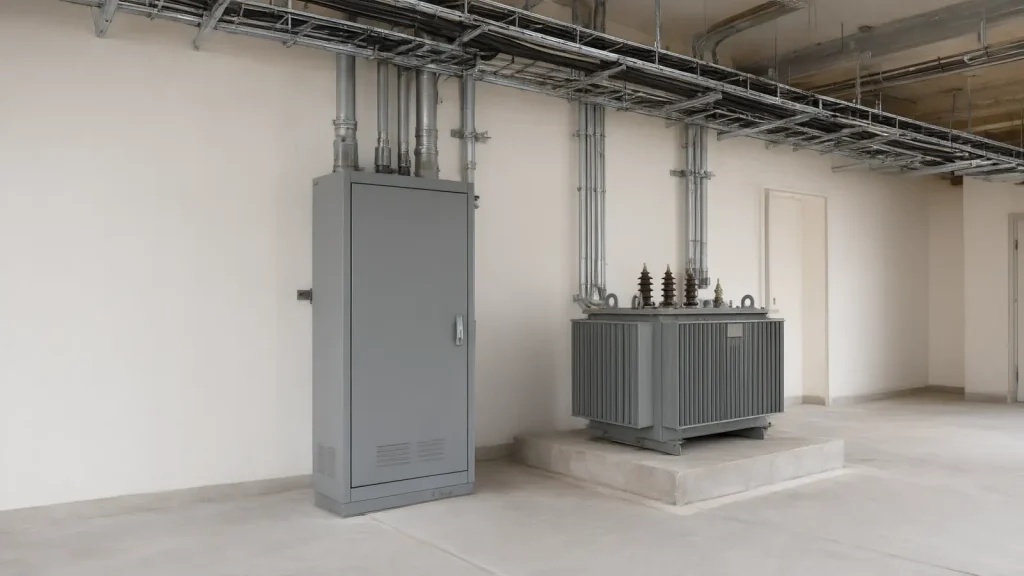
3 phase power is alternating current carried on three wires whose voltages peak 120 degrees apart, so power flow never drops to zero; US commercial buildings receive it as 208Y/120 V or 480Y/277 V service.
Key takeaways
- Three-phase line-to-line voltage is 1.73 times line-to-neutral voltage, which is why a 120 V wye service reads 208 V between phases and a 277 V wye reads 480 V (U.S. DOE motor fact sheet DOE/GO-10097-517).
- Under ANSI C84.1 Range A, a 208Y/120 V service should stay between 197 V and 218 V and a 480Y/277 V service between 456 V and 504 V at the meter (PacifiCorp Engineering Handbook 1C.2.1, November 2024).
- Real power is kW = V x A x 1.732 x PF / 1000: a 50 kW load at 0.9 power factor draws about 154 A at 208 V but about 67 A at 480 V (CB&C arithmetic on the DOE formula).
- Pend Oreille PUD in Washington charges $6,400 to connect a three-phase service up to 800 A versus $3,000 for single-phase 200 to 400 A, and $16.00 per foot of underground three-phase primary versus $3.50 single-phase (fee schedule effective April 1, 2026).
- Service sizing follows NEC Article 220 and service equipment follows Article 230; a 480Y/277 V service disconnect rated 1,000 A or more needs ground-fault protection of equipment under NEC 230.95 (NFPA 70, 2023 edition).
What is three-phase power?
Three-phase power is an AC supply with three hot conductors, each carrying the same voltage shifted one third of a cycle (120 degrees) from the others. Because the three waves peak at evenly spaced moments, the sum of power from all three phases is constant, which gives motors smooth torque and removes the starting windings single-phase motors need (DOE fact sheet DOE/GO-10097-517).
Utilities quote service voltage line to line. In a wye (Y) service the three phase windings meet at a grounded neutral point, so a building gets two voltages from one panel: 120 V or 277 V from any phase to neutral for lights and outlets, and 208 V or 480 V between any two phases for motors and heaters. The DOE fact sheet states that line-to-line readings are 1.73 times line-to-neutral readings, the square root of 3.
| Service | Phase to phase | Phase to neutral | Wires | Typical commercial use | Source |
|---|---|---|---|---|---|
| 120/240 V single-phase | 240 V (two hots) | 120 V | 3 | Small shops, offices with no three-phase equipment (contrast row) | PacifiCorp 1C.2.1 Table 1 |
| 208Y/120 V wye | 208 V | 120 V | 4 | Offices, retail, restaurants, tenant spaces | PacifiCorp 1C.2.1 Table 1 |
| 480Y/277 V wye | 480 V | 277 V | 4 | Large buildings, warehouses, plants; 277 V lighting | PacifiCorp 1C.2.1 Table 1 |
| 240/120 V delta, 4-wire | 240 V | 120 V on two phases, about 208 V on the high leg | 4 | Older shops; high leg marked orange under NEC 110.15 | PacifiCorp 1C.2.1 Table 1; NFPA 70 |
The high-leg figure is arithmetic: 240 V x 0.866 = 207.8 V from the B phase to neutral. NEC 110.15 requires the high leg to be marked orange, and NEC 408.3(E)(1) puts it in the B position of a panelboard, so a 120 V breaker is never landed on it by accident.
Which three-phase voltages do commercial buildings get?
Most US commercial services are 208Y/120 V or 480Y/277 V. The national standard ANSI C84.1 sets how far the delivered voltage may drift: Range A is the normal band a utility designs for, and Range B is a short-term band that calls for correction. PacifiCorp’s engineering handbook (published November 26, 2024) reproduces the C84.1 limits for each nominal service.
| Nominal service | Range B min | Range A min | Range A max | Range B max | Source |
|---|---|---|---|---|---|
| 120/240 V single-phase (contrast) | 110/220 V | 114/228 V | 126/252 V | 127/254 V | PacifiCorp 1C.2.1 Table 1 |
| 208Y/120 V three-phase | 191/110 V | 197/114 V | 218/126 V | 220/127 V | PacifiCorp 1C.2.1 Table 1 |
| 480Y/277 V three-phase | 440/254 V | 456/263 V | 504/291 V | 508/293 V | PacifiCorp 1C.2.1 Table 1 |
| 2.4 to 34.5 kV primary | 95% | 97.5% | 105% | 105.8% | PacifiCorp 1C.2.1 Table 1 |
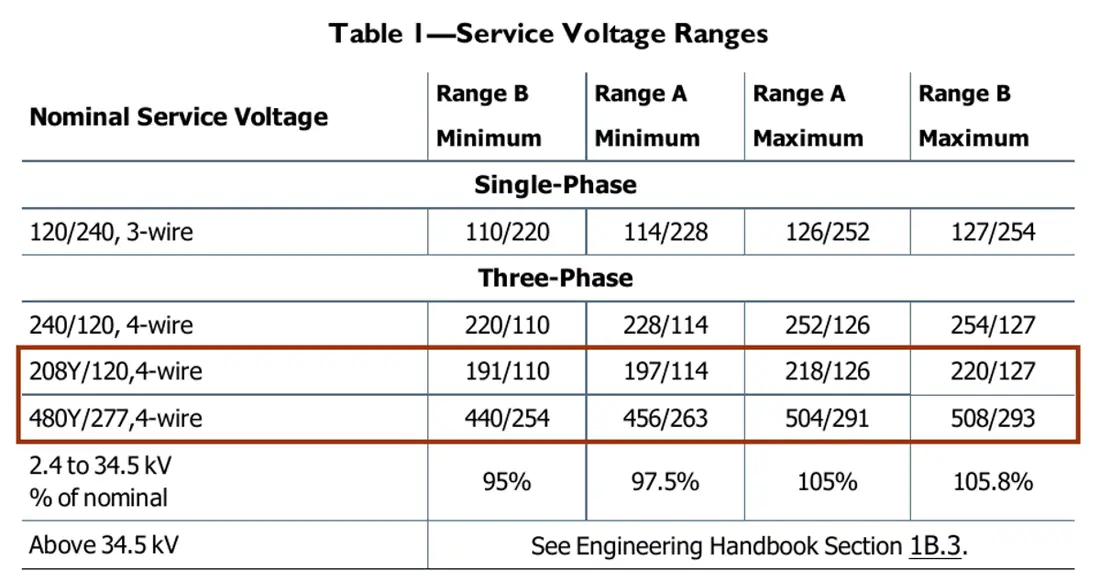
The same handbook lists utilization voltage, measured at the equipment terminals, down to 187 V on a 208Y/120 V system and 432 V on a 480Y/277 V system in Range A. The gap is the voltage drop the building’s own wiring may use, and the handbook points to NEC informational notes suggesting under 3% on feeders, under 3% on branch circuits and under 5% combined.
That gap matters when buying equipment. A motor nameplated 230 V on a 208 V service starts 9.6% below its rating before any drop (208 / 230 = 0.904), so ask the engineer to confirm a 200 V or 208 V rated model where the schedule shows 208Y/120 V service.
How do you calculate three-phase power and amps?
Real three-phase power in kilowatts is volts (line to line) x amps x 1.732 x power factor, divided by 1,000. The U.S. Department of Energy uses this equation in its motor fact sheet: a motor measured at 469.7 V, 37 A and 0.763 power factor draws 22.9 kW as printed by DOE (the unrounded product is 22.97 kW). For apparent power in kVA, drop the power factor.
| Question | Formula | Inputs | Result |
|---|---|---|---|
| kW from a three-phase reading | V x A x 1.732 x PF / 1000 | 208 V, 100 A, PF 0.9 | 32.4 kW |
| Amps for a known three-phase load | kW x 1000 / (V x 1.732 x PF) | 50 kW, 208 V, PF 0.9 | 154.2 A |
| Same load at 480 V | kW x 1000 / (V x 1.732 x PF) | 50 kW, 480 V, PF 0.9 | 66.8 A |
| Same load on single-phase 240 V (contrast) | kW x 1000 / (V x PF) | 50 kW, 240 V, PF 0.9 | 231.5 A |
| kVA of a three-phase nameplate | V x A x 1.732 / 1000 | Hobart AM16VL-BASX, 208 V, 53.48 A | 19.3 kVA |
| Service amps for a transformer size | kVA x 1000 / (V x 1.732) | 225 kVA at 208 V; at 480 V | 624.5 A; 270.6 A |
The table shows why large buildings choose 480 V: the same 50 kW takes 43.3% of the 208 V current (208 / 480), so feeders, breakers and switchgear shrink. The Hobart AM16VL-BASX dish machine shows it on a real nameplate: 53.48 A at 208 to 240 V three-phase versus 23.89 A at 480 V, with a 60 A versus 30 A circuit (Hobart spec sheet F48713, 03/22).
How big a three-phase service does a building need?
The licensed engineer or electrician sizes the service with a load calculation under NEC Article 220, then converts the total volt-amperes to amps at the chosen voltage. The worked example below uses a 10,000 sq ft office on 208Y/120 V with two 10 hp three-phase motors; it is CB&C arithmetic on 2020 and 2023 NEC rules, not a design.
| Load line | NEC rule | Arithmetic | VA |
|---|---|---|---|
| General lighting, office | Table 220.12 (2020): 1.3 VA per sq ft; 125% continuous | 10,000 x 1.3 x 1.25 | 16,250 |
| 100 receptacle outlets | 220.14(I): 180 VA each; 220.44: first 10 kVA at 100%, rest at 50% | 10,000 + 0.5 x 8,000 | 14,000 |
| Two 10 hp motors, 208 V | Table 430.250: 30.8 A each | 2 x 208 x 30.8 x 1.732 | 22,192 |
| Largest motor adder | 430.24: 25% of the largest motor | 0.25 x 11,096 | 2,774 |
| Total | Article 220, Part III | Sum | 55,216 |
| Service amps at 208Y/120 V | VA / (208 x 1.732) | 55,216 / 360.3 | 153 A, so a 200 A service |
| Service amps at 480Y/277 V (contrast) | VA / (480 x 1.732) | 55,216 / 831.4 | 66 A |
For an existing building adding load, NEC 220.87 lets the engineer start from the highest demand measured over the last 12 months, multiplied by 125%, instead of a fresh calculation. Ask the utility for that 12-month demand history before the design starts, because it can show a 400 A service already has room and avoid a new one. Our guide to MEP engineering scope and fees covers who signs that calculation.
When does a business need three-phase power?
A business needs three-phase power when any piece of equipment is nameplated three-phase, which shows as “/3” in the electrical rating (for example 208-240/60/3), or when motor and heating loads are large enough that single-phase current becomes impractical. Rooftop units, walk-in refrigeration, dish machines, combi ovens, air compressors, elevators and machine tools are the usual triggers.
| Motor size | Single-phase 230 V full-load amps | Three-phase 208 V | Three-phase 230 V | Three-phase 460 V | Source |
|---|---|---|---|---|---|
| 5 hp | 28 A | 16.7 A | 15.2 A | 7.6 A | NEC Tables 430.248 and 430.250 |
| 10 hp | 50 A | 30.8 A | 28 A | 14 A | NEC Tables 430.248 and 430.250 |
| 20 hp | Not listed | 59.4 A | 54 A | 27 A | NEC Table 430.250 |
A 10 hp motor draws 50 A on single-phase 230 V but 14 A on three-phase 460 V, and NEC Table 430.248 stops listing single-phase motors at 10 hp, so larger motors are three-phase by default. Use these table values, not the nameplate, to size conductors and short-circuit protection under NEC 430.6(A)(1).
Commercial HVAC is the most common trigger. Federal efficiency rules list three-phase air conditioners under 65,000 Btu/h as their own class in 10 CFR 431.97, so check each packaged unit’s nameplate for “/3” before the service is sized; our guide to commercial HVAC system types and costs lists the classes. Kitchens are the second: the Hobart dish machine above needs a 60 A three-phase circuit at 208 V, and our commercial kitchen equipment guide lists other three-phase items with their spec sheets.
How much does it cost to get three-phase power?
Utilities publish what they charge to bring three-phase service to a site in tariffs or fee schedules, and the charge grows with distance from existing three-phase primary line. In Pend Oreille PUD’s 2026 schedule, three-phase costs more than single-phase at every step, most of all underground: $16.00 per foot of three-phase primary against $3.50 for single-phase.
| Utility (state) | Charge | Three-phase | Single-phase contrast | Effective | Source |
|---|---|---|---|---|---|
| Pend Oreille PUD (WA) | Secondary service connection | $6,400 up to 800 A | $3,000 at 200 or 400 A | April 1, 2026 | PUD fee schedule 2026 |
| Pend Oreille PUD (WA) | 480 V potential transformer adder | $1,000 | n/a | April 1, 2026 | PUD fee schedule 2026 |
| Pend Oreille PUD (WA) | Meter fee | $485 | $175 at 200 A | April 1, 2026 | PUD fee schedule 2026 |
| Pend Oreille PUD (WA) | Underground secondary, 400 A, 76 to 150 ft | $1,800 | $1,200 | April 1, 2026 | PUD fee schedule 2026 |
| Pend Oreille PUD (WA) | Primary service connection, underground | $4,900 | $2,300 | April 1, 2026 | PUD fee schedule 2026 |
| Pend Oreille PUD (WA) | Primary extension | $2,800 per span overhead; $16.00 per ft underground | $2,500 per span; $3.50 per ft | April 1, 2026 | PUD fee schedule 2026 |
| Pend Oreille PUD (WA) | Transformer | Full estimated cost incl. labor | Flat $1,600 to $6,000 up to 400 A | April 1, 2026 | PUD fee schedule 2026 |
| National Grid, Niagara Mohawk (NY) | Line beyond free footage, overhead | $50.58 per ft plus poles | $33.36 per ft | Statement 11, initial June 1, 2019 | P.S.C. No. 220, Statement 11 |
| National Grid, Niagara Mohawk (NY) | Line beyond free footage, underground | $66.91 per ft, plus $16.97 per ft if the utility trenches | $23.39 per ft | Statement 11, initial June 1, 2019 | P.S.C. No. 220, Statement 11 |
| SSVEC (AZ) | Initial design fee, primary service up to 800 A | $500 up to 400 ft, plus $1.00 per ft beyond | Same tier covers 1- or 3-phase | Packets dated January 8, 2026 | SSVEC line extensions |
Fees move. Pend Oreille PUD’s three-phase service connection rose from $5,800 in its March 5, 2024 schedule to $6,400 in April 2026, a 10.3% increase, and its overhead three-phase span went from $2,500 to $2,800. Ask for the tariff sheet in force on the date the utility signs the extension agreement.
| Worked example: 600 ft underground, 400 A service | Three-phase | Single-phase (contrast) |
|---|---|---|
| Primary service connection, underground (over 150 ft from primary) | $4,900 | $2,300 |
| Primary extension, 600 ft | 600 x $16.00 = $9,600 | 600 x $3.50 = $2,100 |
| Meter fee | $485 | $350 (400 A) |
| Subtotal before transformer | $14,985 | $4,750 |
| Transformer | Full cost, quoted by the PUD | $6,000 for a 50 kVA padmount |
| 480 V service | Add $1,000 PT adder | n/a |
The example applies Pend Oreille PUD’s April 1, 2026 rates; it excludes the customer’s own trench, conduit, service equipment, permits and easements, which the schedule says the customer pays in advance; ask whether the $6,400 secondary connection fee also applies to a primary-fed service. On National Grid’s upstate New York system, 500 ft of underground three-phase beyond the free allotment would be $33,455 plus $8,485 of utility trenching, or $41,940, against $20,180 for single-phase. For building-side costs, our guide on estimating construction costs explains how to price the electrical trade.
How do you get three-phase service from the utility?
Getting three-phase service is a six-step sequence: list the loads, calculate the service, apply to the utility, accept its design and estimate, permit and install the service equipment, then pass inspection so the utility sets the meter. Pend Oreille PUD, for example, takes a $250 commercial application fee that is credited against the extension fees.
- Load list. Record volts, phase and amps from every equipment spec sheet; for motors use NEC Table 430.250 full-load current.
- Load calculation. The engineer sizes the service under NEC Article 220 and chooses 208Y/120 V or 480Y/277 V.
- Utility application. Submit the load letter, site plan and fee ($250 commercial at Pend Oreille PUD in 2026; $500 design fee for SSVEC primary service up to 800 A).
- Design and estimate. The utility designs the line extension and transformer; the owner pays line, transformer and connection charges, often in advance.
- Permit and install. The electrical contractor pulls the permit and installs service equipment under NEC Article 230.
- Inspect and energize. After the inspection release, the utility sets the meter ($485 three-phase meter fee at Pend Oreille PUD in 2026).
Put the utility application on the schedule as early as design development, because a transformer and line extension are utility work the general contractor cannot accelerate. Lease build-outs often carry this step, which our page on tenant improvement contractors covers. Kitchen-heavy spaces carry the most three-phase equipment, as our page on restaurant build-out contractors shows.
Phase converter or utility three-phase service: which fits?
A phase converter makes a third phase from a single-phase supply so three-phase equipment can run where the utility offers only single-phase. NEC Article 455 governs it: conductors on the single-phase input must carry at least 125% of the converter’s nameplate input current for variable loads (455.6), the manufactured phase must be marked, and single-phase loads may not be connected to the manufactured phase (455.9).
| Factor | Phase converter | Utility three-phase service | Source |
|---|---|---|---|
| Code article | NEC Article 455 | NEC Article 230 | NFPA 70 |
| Input sizing | 125% of converter nameplate single-phase input amps (variable loads) | Service sized by Article 220 load calculation | NEC 455.6, 230.42 |
| Wiring limits | No single-phase loads on the manufactured phase | Any phase can serve 120 V or 277 V loads | NEC 455.9 |
| Utility charges | None beyond the existing single-phase service | Example: $14,985 plus transformer for 600 ft underground | Pend Oreille PUD 2026 |
| Fits best | One or two machines, single-phase site, no three-phase line nearby | Multiple three-phase loads, growth, tenants with HVAC or kitchens | CB&C reading of the sources above |
Ask the equipment maker in writing whether its warranty covers operation on a phase converter, and ask the utility for a written estimate of three-phase service before buying one, because the two quotes are the real comparison. In National Grid’s upstate New York territory the line charge alone is $66.91 per underground foot, so distance to three-phase primary decides most cases.
Which NEC sections matter for a three-phase service?
Six NEC articles cover nearly every three-phase service question on a commercial job: Article 220 for the load calculation, Article 230 for the service, Article 430 for motors, Article 455 for phase converters, 110.15 for high-leg marking and 110.24 for the fault-current label on service equipment. Section numbers below follow NFPA 70, 2023 edition, unless marked 2020.
| Section | What it requires | Why it matters for three-phase |
|---|---|---|
| 220.12 (2020) / Table 220.12 | General lighting load by occupancy, such as 1.3 VA per sq ft for offices | First line of the service calculation |
| 220.44 | Receptacles: first 10 kVA at 100%, remainder at 50% | Cuts receptacle load in large offices |
| 220.56 | Kitchen equipment demand factors, 65% for 6 or more units | Restaurants and commissaries |
| 220.87 | Existing load: 12 months of peak demand x 125% | Shows whether an existing service can take new three-phase load |
| 230.42 | Service conductor ampacity from the calculated load | Sizes the service entrance |
| 230.71 | No more than six service disconnects | Multi-tenant meter banks |
| 230.95 | Ground-fault protection of equipment on solidly grounded wye services over 150 V to ground, for each service disconnect rated 1,000 A or more | Applies to 480Y/277 V (277 V to ground), not 208Y/120 V |
| 430.250 | Three-phase motor full-load current | Motor branch circuits and feeders |
| 455.6, 455.9 | Phase converter conductor sizing and manufactured-phase limits | Single-phase sites |
States and cities adopt NEC editions on their own schedules, so confirm with the permit office whether the 2020 or 2023 edition applies before the engineer starts; Florida owners can check the code edition in force with our guide to commercial building permits in Florida. The full text of NFPA 70 is free to read online after registration at NFPA.
What should you do next?
Match the situation to the row below. The thresholds come from the NEC sections and the Pend Oreille PUD 2026 schedule cited above; utilities differ, so treat the PUD numbers as an example of the tiers your own utility will use, and read its current line extension rules before committing to a lease or equipment order.
| If | Then | Rule or source |
|---|---|---|
| No equipment is nameplated “/3” and the load calculation fits 400 A single-phase | Stay single-phase | NEC Article 220; PUD 200 to 400 A single-phase tier |
| The building has three-phase and you add load | Pull 12 months of demand, multiply by 125%, compare to the service rating | NEC 220.87 |
| One three-phase machine on a single-phase site, primary far away | Price a phase converter against the utility estimate | NEC 455; tariff per-foot charges |
| Site is more than 150 ft from existing high-voltage line | Expect a primary line extension charge | Pend Oreille PUD 2026, 1.4 and 1.5 |
| Calculated load above 800 A at 208 V (288 kVA) | Ask about 480Y/277 V or a switchboard service | PUD footnote 3; arithmetic 800 x 208 x 1.732 |
| 480Y/277 V service disconnect rated 1,000 A or more | Include ground-fault protection of equipment | NEC 230.95 |
| Demand of 500 kVA or more | Expect a case-by-case utility study | Pend Oreille PUD 2026, 1.6 |
Building a new facility with heavy electrical load? Large distribution and storage buildings are where 480Y/277 V service is most often chosen, as our page on warehouse construction describes. CB&C is a matching service, not an engineer or utility; nothing here is engineering or legal advice, and the service design belongs to a licensed engineer of record.
Service upgrades are often part of a site plan review; our site plan guide lists what the utility sheet must show.
How we compiled this
We read 9 primary documents in November 2026: the PacifiCorp engineering handbook table that reproduces ANSI C84.1, a U.S. DOE motor fact sheet, three utility fee schedules or tariffs (Pend Oreille PUD 2024 and 2026, National Grid Niagara Mohawk Statement 11, SSVEC), the Hobart AM16VL-BASX spec sheet, 10 CFR 431.97 and NFPA 70 section text. All arithmetic is ours and shown in the tables. We excluded per-foot figures that appeared only in blogs and could not be confirmed at the utility.
Frequently asked questions
Is 3 phase power 208 or 240 volts?
It can be either, and 480 V too. A 208Y/120 V wye service gives 208 V between phases and 120 V to neutral; a 240/120 V high-leg delta gives 240 V between phases; a 480Y/277 V wye gives 480 V. ANSI C84.1 Range A keeps 208Y/120 V service between 197 V and 218 V (PacifiCorp handbook 1C.2.1, 2024).
How do I know if my building has three-phase power?
Look at the main panel or switchboard label: three-phase reads 208Y/120 V, 480Y/277 V or 240 V 3-phase 4-wire, with three hot bus bars and three-pole breakers. A meter reading 208 V between any two hots and 120 V to neutral confirms a 208Y/120 V service. The utility bill rate schedule usually names the service too.
Can I run three-phase equipment on single-phase power?
Only through a phase converter or a drive rated for single-phase input, or by buying the single-phase version if the maker offers one. A converter must follow NEC Article 455: input conductors sized at 125% of its nameplate input current for variable loads, and no single-phase loads on the manufactured phase (455.9). Confirm the equipment warranty allows it in writing.
Why is three-phase power more efficient for motors?
The three phases peak at evenly spaced moments, so total power never falls to zero and motors get smooth torque without starting windings (U.S. DOE fact sheet DOE/GO-10097-517). It also moves more power per amp: a 10 hp motor draws 50 A on single-phase 230 V but 28 A on three-phase 230 V under NEC Tables 430.248 and 430.250.
What does 3 phase 4 wire mean?
It means three hot conductors plus a neutral. The neutral lets a wye service supply both line-to-line voltage for motors (208 V or 480 V) and line-to-neutral voltage for lights and outlets (120 V or 277 V). A 3-wire three-phase service has no neutral and serves only line-to-line loads, so 120 V circuits need a separate transformer.
How much does it cost to bring three-phase power to a building?
Distance to existing three-phase line and the utility tariff set the price. Pend Oreille PUD charges $6,400 to connect a three-phase service up to 800 A and $16.00 per foot for underground primary (April 2026). National Grid in upstate New York charges $66.91 per underground foot beyond the free allotment, plus $16.97 per foot if it trenches.
Sources
- PacifiCorp, Engineering Handbook 1C.2.1 Voltage Level and Range (ANSI C84.1 ranges), published November 26, 2024; accessed 2026-11-08.
- U.S. Department of Energy, Determining Electric Motor Load and Efficiency, fact sheet DOE/GO-10097-517; accessed 2026-11-08.
- NFPA 70, National Electrical Code, 2023 edition (Articles 110, 220, 230, 408, 430, 455); accessed 2026-11-08.
- Pend Oreille PUD, Utility Extension Fees, effective April 1, 2026; accessed 2026-11-08.
- Pend Oreille PUD, Utility Extension Fees, effective March 5, 2024; accessed 2026-11-08.
- Niagara Mohawk Power Corp. (National Grid), P.S.C. No. 220, Statement No. 11, Non-URD Line Extension and Service Lateral Costs; accessed 2026-11-08.
- Sulphur Springs Valley Electric Cooperative, New Line Extensions; accessed 2026-11-08.
- Hobart, AM16VL-BASX spec sheet F48713 (03/22); accessed 2026-11-08.
- 10 CFR 431.97, energy efficiency standards for commercial air conditioners (eCFR); accessed 2026-11-08.