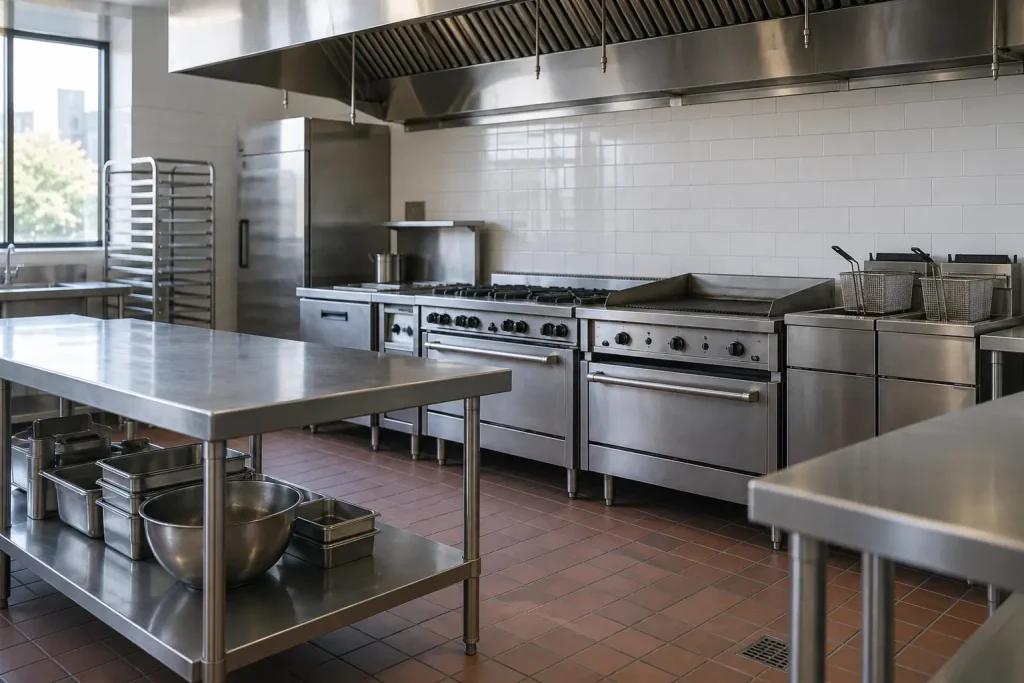
Commercial kitchen equipment falls into six stations: cold storage, prep, cooking, hot holding, warewashing and handwashing. Each item needs an NSF/ANSI sanitation listing, a UL safety listing and gas, power, water or drain set before rough-in, per Food Code 2026.
Key takeaways
- Under the FDA Food Code 2026 §4-205.10, equipment certified for sanitation to an American National Standard by an ANSI-accredited program is “deemed to comply” with the Food Code’s design and construction rules; the local adoption decides whether it is mandatory.
- Federal purchase records from 2024 to 2026 price a 23 cubic foot reach-in refrigerator at $4,168, a Hobart AM16 door-type dish machine at $13,139, a 40-gallon tilt skillet at $26,441 and combi oven/steamers at $29,628 each (USAspending.gov).
- A line of one Vulcan 36S-6BN range (215,000 Btu/h), two Pitco SG14 fryers (110,000 Btu/h each) and one gas convection oven (50,000 Btu/h) totals 485,000 Btu/h, about 468 cubic feet per hour at EIA‘s 1,037 Btu per cubic foot.
- Gas appliances on casters need an ANSI Z21.69 connector no longer than 6 feet, a restraining device and a shutoff valve within 6 feet (Fuel Gas Code §411.1.1, §411.1.3.1, §409.5.1).
- The Hobart AM16VL-BASX door-type dish machine needs a 60 A circuit at 208 to 240 V three-phase and drains at a peak of 18.5 gallons per minute.
- ENERGY STAR’s calculator assumes a conventional steam cooker uses 40 gallons of water per hour; the median certified boilerless model lists 1.5 (data.energystar.gov, pulled October 2026).
What commercial kitchen equipment goes in each station?
A full-service commercial kitchen is planned as six stations, and each station brings its own utilities. Cold storage needs dedicated 115 V circuits and air-gapped drains; the cook line needs gas or 208 V power under a Type I hood; warewashing needs 180°F rinse water, a booster circuit and an indirect drain. The table maps each station to its listings and connections.
| Station | Typical equipment | Sanitation standard | Safety standard | Utilities to rough in |
|---|---|---|---|---|
| Receiving and cold storage | Walk-in cooler and freezer, reach-in refrigerators and freezers, ice machine | NSF/ANSI 7; NSF/ANSI 12 (ice) | UL 471; UL 563 (ice) | 115 V or 208 V circuits; walk-in floor drain and ice machine drain to an air gap |
| Prep | Worktables, prep sinks, mixers, slicers, food processors | NSF/ANSI 2; NSF/ANSI 8 (powered) | UL 763 (motor-operated) | Hand sink, prep sink to an air gap, 115 V receptacles |
| Cook line | Ranges, fryers, griddles, ovens, combi ovens, steam cookers | NSF/ANSI 4 | UL 197 (electric); fuel-burning units UL certified in public specs | Gas manifold or 208/240 V circuits, Type I hood, suppression, water and drain for steamers and combis |
| Hot holding and service | Hot food holding cabinets, steam tables, dispensers | NSF/ANSI 4; NSF/ANSI 18 (dispensing) | UL 197 | Circuits; drains for wells that are plumbed |
| Warewashing | Dish machine, booster heater, 3-compartment sink, prerinse | NSF/ANSI 3; NSF/ANSI 29 (chemical feeders) | UL 921; UL 1453 (booster) | Hot water, 208/480 V three-phase, indirect drain, grease interceptor for pot and prerinse sinks |
| Handwashing and cleaning | Hand sinks, mop or service sink | NSF/ANSI 2 for fabricated sinks | None | Tempered water at least 85°F, at least one service sink |
Standards names come from the NSF certified food equipment listings and the UL Standards & Engagement catalog. The hood and suppression system above the line are covered by UL 710 and UL 300; how a builder handles them on a lease space is covered in our guide to restaurant build-out contractors.
| Key number | What it governs | Source |
|---|---|---|
| 3 compartments | Minimum for a manual warewashing sink | Food Code 2026 §4-301.12(A) |
| 180°F | Minimum final rinse at the manifold, most hot-water dish machines | Food Code 2026 §4-501.112 |
| 5 to 30 psi | Allowed flow pressure of the final rinse | Food Code 2026 §4-501.113 |
| 6 in | Leg clearance for floor equipment not easily movable | Food Code 2026 §4-402.12(A) |
| 1 in | Minimum air gap on a water supply inlet | Food Code 2026 §5-202.13 |
| 6 ft | Maximum gas appliance connector length | Fuel Gas Code §411.1.3.1 |
| R-25 / R-32 | Minimum wall and ceiling insulation, walk-in cooler / freezer | 10 CFR 431.306(a)(3) |
What does commercial kitchen equipment cost?
Federal purchase records give dated, public prices for single items. From 2024 to 2026, agencies paid $4,168 for a 23 cubic foot reach-in refrigerator, $13,139 for a Hobart AM16 door-type dish machine, $13,360 per gas convection oven, $26,441 for a 40-gallon tilt skillet and $29,628 per combi oven/steamer, as recorded on USAspending.gov.
| Item | Quantity | Award total | Per unit | Buyer, date | Source |
|---|---|---|---|---|---|
| Reach-in refrigerator, 1 solid door, 23 cu ft (True T-23-HC) | 1 | $4,167.89 | $4,168 | GSA, New York, Aug 2025 | USAspending 47QSWA25P17ZQ |
| Reach-in refrigerator, 49 cu ft | 1 | $5,489.00 | $5,489 | GSA, New York, Aug 2025 | USAspending 47QSSC25P1SR2 |
| Door-type dish machine (Hobart AM16-BAS-2) | 1 | $13,139.02 | $13,139 | Bureau of Prisons, FCI Fairton, Apr 2024 | USAspending 15B20424F00000052 |
| Gas convection oven | 2 | $26,720.00 | $13,360 | Bureau of Prisons, Pennsylvania, Jul 2024 | USAspending 15B11124P00000083 |
| Tilt skillet (braising pan), 40 gallon | 1 | $26,441.19 | $26,441 | VA Puget Sound, Sep 2024 | USAspending 36C26024F0628 |
| Combi oven/steamer | 4 | $118,513.52 | $29,628 | Air Force Academy, CO, Jun 2025 | USAspending FA700025FG515 |
| Single-tank conveyor dish machine | 2 | $75,020.48 | $37,510 | Coast Guard, Yorktown, VA, Aug 2025 | USAspending 70Z04325PTRAY0003 |
| Walk-in freezer replacement, installed (size not stated) | 1 | $81,844.00 | $81,844 | VA, White River Junction, VT, Jun 2026 | USAspending 36C24126P0498 |
| Cook line set: griddle with stand, refrigerator, combi oven, tilt skillet, steam kettle, 3 fryers | 8 items | $89,327.24 | Not split | Army, Annville, PA, Apr 2023 | USAspending W912KC23F0024 |
Read these as reference prices, not quotes. Most are orders against federal supply schedules, which price delivered equipment; only the walk-in row states installation, and none includes the gas, power, drain and hood work covered below. Brand, size and options move the total: the Hobart AM16-BAS-2 above is a sibling of the AM16VL-BASX in our spec table, and a combi oven price depends on pan capacity and gas or electric heat. Whole-kitchen construction records are in our commercial kitchen guide.
Which listings apply to commercial kitchen equipment?
Commercial kitchen equipment carries two separate listings, for example NSF/ANSI 7 and UL 471 on a reach-in refrigerator. An NSF/ANSI standard covers sanitation: materials, cleanability and food-zone design. A UL standard covers fire and shock hazards, and gas appliances carry a gas certification. Health plan reviewers check the first, building and electrical inspectors the second, so the submittal for each item should show both marks and the standard numbers.
| Equipment | NSF/ANSI standard | UL standard (current edition) | ENERGY STAR category |
|---|---|---|---|
| Worktables, sinks, shelving | 2 Food Equipment | None | None |
| Refrigerators and storage freezers | 7 | UL 471, Ed. 10 | Refrigerators and freezers |
| Ice machines | 12 Automatic Ice Making Equipment | UL 563, Ed. 8 | Ice makers |
| Electric ranges, ovens, fryers, griddles | 4 | UL 197, Ed. 10 | Ovens, fryers, griddles, steam cookers, cooktops |
| Mixers, slicers, processors | 8 Commercial Powered Food Preparation | UL 763, Ed. 5 | None |
| Dish machines | 3 Commercial Warewashing Equipment | UL 921, Ed. 8 | Dishwashers |
| Booster and storage water heaters | 5 Water Heaters | UL 1453, Ed. 6 | None |
| Hot food holding cabinets | 4 | UL 197 | Hot food holding cabinets |
| Exhaust hood | None | UL 710, Ed. 7 (April 29, 2024) | None |
Is NSF certification legally required?
NSF certification is a route to compliance, not a federal mandate. The Food Code is a model that states and counties adopt; its §4-205.10 says equipment certified or classified for sanitation by an ANSI-accredited program is “deemed to comply” with Parts 4-1 and 4-2. Public specifications such as New York OGS MasterSpec 11 40 00 accept either the NSF Certification Mark or the UL Classification Mark.
Uncertified equipment can still pass, but the health reviewer then judges it against each Food Code design rule, which slows plan review. The VA specification 11 40 21 also asks for NSF/ANSI 2 or the UL EPH Classification Mark on utility distribution systems. Ask the reviewer early whether your jurisdiction requires a listed mark on every item.
What do real spec sheets say each item needs?
Manufacturer sheets list the numbers a builder needs: gas input, connection size, voltage, phase, amps, water pressure and drain flow. The five items below are a common mid-size line. Each figure comes from the maker’s sheet or the ENERGY STAR certified-product record as published in October 2026; specifications change, so the approved submittal governs the final rough-in.
| Item | Gas or power | Water and drain | Clearances and notes | Source |
|---|---|---|---|---|
| Vulcan 36S-6BN, 36 in range, 6 burners, standard oven | 215,000 Btu/h natural gas (six 30,000 burners, 35,000 oven); regulator set 5.0 in W.C. | None | Supply line 3/4 in or larger; 6 in rear and 10 in sides to combustibles, 0 in to non-combustible | Vulcan sheet F45327 (2-26) |
| Pitco SG14 gas fryer, 40 to 50 lb oil | 110,000 Btu/h; 120 V, 0.5 A per fryer, 7.0 A with filter system | None | 21 in aisle in front for the filter pan; 18 in from flue to hood intake; Z21.69 connector and restraint on casters | Pitco SG14 page; manual L20-206 |
| Blodgett Zephaire-200-G-ES gas convection oven | 50,000 Btu/h input; 54% cooking efficiency | None | ENERGY STAR certified | ENERGY STAR oven dataset |
| Hobart AM16VL-BASX door-type dish machine | 208-240/60/3, 53.48 A rated, 60 A circuit; 480/60/3, 23.89 A, 30 A circuit; 7.1 kW booster | 3/4 in supply, 55°F minimum, 20 psi flowing; 18.5 gpm peak drain, hose outlet max 40 in above floor | Ventless; if a hood is used, 450 CFM minimum; ASSE 1010 water hammer arrestor by others | Hobart sheet F48713 (03/22) |
| True T-49-2-G-2-HC~FGD01 reach-in, two sections | 115/60/1, 5.4 A, NEMA 5-15P on a 15 A dedicated outlet | None (self-contained) | NSF/ANSI 7; R290 refrigerant; 6 in legs | True product page |
Read the whole sheet, not the retailer summary. Vulcan sheet F45327 describes a “1” rear gas connection” in the product text and, in the installation notes, requires a gas line “3/4″ or larger”; it also asks buyers to specify altitude above 2,000 feet. Feed every figure into the bid documents so trade prices match, the same way you would line up any bid in our guide on how to compare construction bids.
How much gas does a cook line need?
Gas piping is sized for the total connected load. Section 402.2 of the 2023 Florida Building Code, Fuel Gas (2021 IFGC text) says to sum the maximum input of every appliance served and assume all run at once, unless a diversity of load can be established. Divide Btu per hour by the gas heating value to get cubic feet per hour for the meter and pipe tables.
| Line | Appliance | Quantity | Input each (Btu/h) | Subtotal (Btu/h) | Source |
|---|---|---|---|---|---|
| 1 | Vulcan 36S-6BN range | 1 | 215,000 | 215,000 | Vulcan F45327 |
| 2 | Pitco SG14 fryer | 2 | 110,000 | 220,000 | Pitco |
| 3 | Blodgett Zephaire-200-G-ES oven | 1 | 50,000 | 50,000 | ENERGY STAR |
| 4 | Total connected load | 485,000 | Fuel Gas Code §402.2 | ||
| 5 | Heating value of natural gas | 1,037 Btu per cubic foot | EIA, 2025 average | ||
| 6 | Volumetric flow (line 4 / line 5) | about 468 cubic feet per hour | CB&C calculation |
The local gas utility confirms its own heating value and delivery pressure, and both change the result. Sites above 2,000 feet need an altitude adjustment under §402.2, and propane uses a different heating value. Add the water heater, booster and rooftop units to the same schedule before asking the utility for a meter size.
What changes for gas appliances on casters?
Fryers and ranges on casters must connect with an appliance connector listed to ANSI Z21.69 and a restraining device under Fuel Gas Code §411.1.1. The connector may not exceed 6 feet (§411.1.3.1), and the shutoff valve must sit in the same room within 6 feet, upstream of the connector or quick disconnect (§409.5.1). Pitco’s manual L20-206 repeats the restraint rule for the SG series.
The builder’s part is the stub-out: put each gas outlet behind its appliance at a height the 6 foot connector can reach once the unit is pushed back. The NY OGS spec also calls for dual shut-off quick disconnect hoses and restraining cables on all mobile equipment, which sets a fixed anchor point for each cable in the wall.
What electrical service does the equipment need?
Every item lists its voltage, phase, rated amps and minimum circuit ampacity, and the panel schedule is built from those lines under NFPA 70. Refrigeration and countertop prep run on 115 V; dish machines, combi ovens and booster heaters often need 208 V, 240 V or 480 V three-phase. Ordering a three-phase machine for a single-phase space forces a field conversion or a service upgrade.
| Item | Supply | Rated amps | Circuit | Load (arithmetic) | Source |
|---|---|---|---|---|---|
| Hobart AM16VL-BASX, single point | 208-240/60/3 | 53.48 A | 60 A minimum, 60 A maximum protective | 53.48 x 208 V x 1.732 = 19,267 VA, about 19.3 kVA | Hobart F48713 |
| Hobart AM16VL-BASX, single point | 480/60/3 | 23.89 A | 30 A | 23.89 x 480 V x 1.732 = 19,862 VA, about 19.9 kVA | Hobart F48713 |
| True T-49-2-G-2-HC~FGD01 | 115/60/1 | 5.4 A | 15 A dedicated outlet, NEMA 5-15P | 5.4 x 115 V = 621 VA | True |
| Pitco SG14 with filter system | 120 V | 0.5 A per fryer, 7.0 A filter | Receptacle interlocked with hood control (maker advice) | 7.5 x 120 V = 900 VA | Pitco L20-206 |
Two details from the sheets affect rough-in. Pitco manual L20-206 advises plugging the fryer into a receptacle controlled by the ventilation system, so the electrician plans an interlocked receptacle at the line. The NY OGS spec requires a shunt-trip main breaker in a utility distribution system and microswitches that cut power under the hood when suppression discharges. The panel location then goes on the drawings for commercial building permits.
Which water and drain connections must be roughed in?
Most kitchen drains cannot connect straight to the sewer. The 2023 Florida Building Code, Plumbing (2021 IPC text) §802.1.1 sends equipment that stores or prepares food to an indirect waste with an air gap, and §1003.3.1 sends grease-laden fixtures to a grease interceptor. Floor sinks, air gaps and the interceptor are cut into the slab before equipment arrives.
| Fixture or item | Water rule | Drain rule | Source |
|---|---|---|---|
| Hand sink | At least 85°F through a mixing valve; metering faucet runs 15 seconds | Direct connection (not on the §802.1 indirect list) | Food Code §5-202.12; Plumbing §802.1 |
| 3-compartment ware sink | Compartments sized for the largest item; 171°F if hot-water sanitizing | Air gap or air break (§802.1.7); grease interceptor as a pot sink (§1003.3.1) | Plumbing §802.1.7; §1003.3.1 |
| Prep sink, ice machine, food equipment | Supply air gap at least 2 x inlet diameter, 1 in minimum | Indirect through an air gap; each sink compartment drains on its own | Plumbing §802.1.1; Food Code §5-202.13 |
| Dish machine | Final rinse 5 to 30 psi flow pressure | Air gap or air break (§802.1.6); direct to a trapped floor drain within 5 ft only if local law allows | Food Code §4-501.113, §5-402.11(C) |
| Walk-in floor drain | None | Indirect through an air gap; untrapped where subject to freezing | Plumbing §802.1.2 |
| Food waste disposer | None | Never to a grease interceptor | Plumbing §1003.3.2 |
| Mop or service sink | At least one per establishment | Direct; toilets may not be used instead | Food Code §5-203.13 |
Two pipe rules decide floor sink locations. Indirect waste piping longer than 30 inches horizontally or 54 inches in total developed length must be trapped (§802.3), and the air gap must be at least twice the pipe’s effective opening (§802.3.1). Hydromechanical interceptors are sized to ASME A112.14.3, ASME A112.14.4, CSA B481.3 or PDI G101 under §1003.3.5.
What do hand sinks and ware sinks need?
Hand sinks go where employees prepare food, dispense food and wash ware, and in or next to toilet rooms (Food Code 2026 §5-204.11), with tempered water through a mixing valve. Manual warewashing needs a sink of at least 3 compartments (§4-301.12). Bowl sizes, the hand sink temperature by state and drain rules are in our commercial kitchen sink guide.
What temperature and pressure does a dish machine need?
A hot-water-sanitizing dish machine needs a final rinse of at least 180°F at the manifold, or 165°F on a stationary rack single-temperature machine, and no more than 194°F (Food Code 2026 §4-501.112). Rinse flow pressure must stay between 5 and 30 psi (§4-501.113). Chemical-sanitizing machines need wash water of at least 120°F (§4-501.110(B)).
The Hobart AM16VL-BASX meets the rinse temperature with a built-in 7.1 kW booster and asks for building pressure of 20 psi or more while water flows. Its sheet lists 0.67 gallons per rack and 30.15 gallons per hour at 45 racks per hour, and calls for water hardness of 3 grains or less, which may mean a softener on the supply line.
What does a walk-in cooler or freezer need from the builder?
Walk-ins are part building, part appliance, so the builder often supplies the slab, the drain and the power. Federal rules in 10 CFR 431.306 require walk-ins made since January 1, 2009 to have R-25 insulation in walls, ceiling and doors for coolers, R-32 for freezers, and R-28 floor insulation for freezers. Doors need automatic closers and strip or spring-hinged doors.
The floor drain inside a walk-in connects through an air gap under Plumbing §802.1.2, and where the drain sits in an area subject to freezing its line stays untrapped and discharges to a receptor outside that area. Interior lights must reach 40 lumens per watt or shut off on a timer within 15 minutes of the space being empty (§431.306(a)(7)).
Does ENERGY STAR equipment change utility sizing?
ENERGY STAR cuts operating energy and, for steam cookers and dish machines, water and drain flow. As of October 20, 2026, the ENERGY STAR certified product datasets list 4,111 commercial food service models in the nine categories we pulled (coffee brewers excluded). EPA estimates a full certified suite saves about 350 MMBtu, or about $4,000, a year.
The dollar figure moves with local rates: the EPA calculator prices savings at U.S. average rates of $0.1251 per kWh and $1.099 per therm, and its Florida row uses $0.123 per kWh.
| ENERGY STAR category | Certified models (Oct 20, 2026) | Builder-relevant metric | Source |
|---|---|---|---|
| Refrigerators and freezers | 1,942 | Daily kWh by volume and door type | data.energystar.gov |
| Ice machines | 650 | Median potable water 13.0 gal per 100 lb (self-contained), 16.4 (ice-making head), 18.5 (remote) | data.energystar.gov |
| Dishwashers | 417 | Median 0.76 gal per rack, door-type high temp (79 models) | data.energystar.gov |
| Ovens | 380 | Gas input rate listed per model | data.energystar.gov |
| Hot food holding cabinets | 244 | Maximum idle energy rate (watts) | data.energystar.gov |
| Steam cookers | 204 | Median 1.5 gal per hour, boilerless (185 models) | data.energystar.gov |
| Fryers | 182 | 130 gas (median 55.5% efficiency), 52 electric (median 87%) | data.energystar.gov |
| Griddles | 47 | Normalized idle rate | data.energystar.gov |
| Electric cooktops | 45 | Nameplate input (kW) and voltage listed per model | data.energystar.gov |
The steam cooker gap is a plumbing decision. A conventional steamer at the ENERGY STAR calculator‘s 40 gallons per hour over its default 9.25 hour day uses 370 gallons; a boilerless model at 1.5 gallons per hour uses about 14. The calculator’s door-type defaults show the same effect for dish machines: 280 racks a day at 1.29 gallons per rack is 361 gallons, against 188 gallons at the Hobart’s 0.67.
Lower flows can shrink a booster heater or water heater, but Food Code §5-103.11 still requires hot water for peak demand at every fixture. The energy code edition that applies to the building around the kitchen is listed in our table of the commercial energy code by state.
What do equipment guides get wrong?
Two claims in widely read equipment guides do not match the primary documents. The first is about which mark proves sanitation compliance, and the second is a connection size copied from retail listings. Each correction below names the primary source a plan reviewer would use.
| What some guides say | What the primary source says | Source |
|---|---|---|
| Retail buying guides point owners to the NSF mark as the sign of compliance. | Public specs accept the NSF Certification Mark or the UL Classification (EPH) Mark; Food Code §4-205.10 accepts any ANSI-accredited program. | NY OGS 11 40 00; VA 11 40 21 |
| Retail listings give the Vulcan 36S-6B a 3/4 in rear gas connection. | Sheet F45327 (2-26) describes a 1 in rear connection with regulator and requires a supply line of 3/4 in or larger. | Vulcan F45327 |
In what order should equipment rough-in happen?
Rough-in follows the equipment schedule, so the schedule is frozen first. Gas, electrical, water and drain loads are totaled from the sheets (485,000 Btu/h for the sample line), then stubbed up before the slab is poured or walls close. The seven steps below follow that order; a missed floor sink after the pour usually means saw-cutting, which is why the item list belongs on day one of the project.
- Freeze the equipment schedule. Item number, model number, fuel, volts and phase for every piece, with the spec sheet attached (CSI Section 11 40 00).
- Total the gas input. Sum every appliance under Fuel Gas Code §402.2; the sample line is 485,000 Btu/h, about 468 cubic feet per hour.
- Build the electrical load list. Rated amps and minimum circuit per item, such as 60 A at 208-240/60/3 for the Hobart AM16VL-BASX.
- Map water and hot water. Size for peak demand under Food Code §5-103.11 and provide 20 psi flowing at the dish machine.
- Map every drain. Air gaps under Plumbing §802, floor sinks, and a grease interceptor for pot, prerinse and wok fixtures under §1003.3.1.
- Lock the hood line-up. Type I hood length, 18 in from fryer flue to hood intake, and 6 in rear clearance to combustibles for the Vulcan range.
- Rough-in, set, connect, inspect. Stub-ups before the slab and walls close, then equipment set, final connections and the health inspection.
Long-lead equipment such as a three-phase dish machine like the Hobart AM16VL-BASX should be released early, because release dates interact with permit review, as our guide explains for tenant improvement contractors. After setting, startup and functional tests belong in building commissioning. The health and fire sign-offs then feed the certificate of occupancy.
Which rule applies to each equipment decision?
Most rough-in questions on a kitchen job have a numeric answer in a code section or a maker’s sheet. Use the table to check a situation before the trade asks for an RFI. Every threshold below is quoted from the 2026 Food Code, the 2023 Florida plumbing and fuel gas codes (2021 International Code text), 10 CFR 431.306 or the named spec sheet.
| If | Then | Rule |
|---|---|---|
| A gas appliance sits on casters or moves for cleaning | Use an ANSI Z21.69 connector, 6 ft maximum, plus a restraining device | Fuel Gas Code §411.1.1, §411.1.3.1 |
| You place the gas shutoff | Same room, within 6 ft, upstream of the connector | Fuel Gas Code §409.5.1 |
| The site is above 2,000 ft | Adjust gas flow and order appliances for altitude | Fuel Gas Code §402.2; Vulcan F45327 |
| Floor equipment is not easily movable | Seal it to the floor or set it on 6 in legs (4 in if no point is over 6 in from access) | Food Code §4-402.12(A), (B) |
| Countertop equipment is not easily movable | Legs of 4 in (3 in if no part of the table under it is over 20 in from cleaning access) | Food Code §4-402.12(D), (E) |
| The dish machine is within 5 ft of a trapped floor drain | A direct connection is allowed only if local law allows it | Food Code §5-402.11(C) |
| A fixture discharges grease | Route it to a grease interceptor or automatic grease removal device | Plumbing §1003.3.1 |
| An indirect waste run exceeds 30 in horizontal or 54 in total | Trap it | Plumbing §802.3 |
| You build a walk-in freezer | R-32 walls, ceiling and doors; R-28 floor | 10 CFR 431.306(a)(3), (4) |
| A gas fryer goes under the hood | Keep 18 in from flue to hood intake and 21 in of aisle in front | Pitco L20-206 |
Code editions differ by state and city, so the adopted edition at your permit office overrides the section numbers here, which come from the 2026 Food Code and the 2023 Florida codes. This page is general information for planning, not legal or engineering advice; the engineer of record and the plan reviewer make the final call.
Cooking equipment under a Type I hood ties into two more systems, covered in our commercial kitchen hood and kitchen fire suppression system guides.
How we compiled this
We compiled the 22 primary sources listed below in October 2026: two Food Code editions, three Florida code chapters, 10 CFR 431.306, NSF and UL standard records, ENERGY STAR pages, its calculator and nine certified-product datasets, two public specifications, EIA gas data and five manufacturer documents. We also pulled 9 federal purchase records from USAspending.gov in October 2026. We did not test equipment, and dollar figures are EPA estimates or federal purchase prices, not quotes. Build-out budgets are covered in our guide to commercial construction cost per square foot.
Frequently asked questions
Does commercial kitchen equipment have to be NSF certified?
Not by federal law. The FDA Food Code 2026 §4-205.10 says equipment certified for sanitation by an ANSI-accredited program is deemed to comply with its design rules, and most state and county health departments adopt that code. Uncertified items are judged rule by rule at plan review, so ask your reviewer whether a listed NSF or UL EPH mark is required on every item.
What is the difference between NSF and UL on kitchen equipment?
NSF/ANSI standards cover sanitation: materials, cleanability and food-zone design, such as NSF/ANSI 7 for refrigerators and NSF/ANSI 3 for dish machines. UL standards cover fire and shock hazards, such as UL 197 for electric cooking appliances and UL 921 for commercial dishwashers. Health reviewers check the first, electrical and building inspectors the second, so submittals should show both.
How much does commercial kitchen equipment cost?
Federal purchase records give dated prices: $4,168 for a 23 cubic foot reach-in refrigerator (August 2025), $13,139 for a Hobart AM16 door-type dish machine (April 2024), $26,441 for a 40-gallon tilt skillet (September 2024) and $29,628 per combi oven/steamer (June 2025). They cover delivered equipment, not the gas, power, drain and hood work a builder adds.
Does a commercial dishwasher need a booster heater?
A hot-water-sanitizing machine needs a final rinse of at least 180°F at the manifold, or 165°F for a stationary rack single-temperature machine, under Food Code 2026 §4-501.112, which usually means a booster. The Hobart AM16VL-BASX has a 7.1 kW booster built in. Chemical-sanitizing machines need wash water of at least 120°F and no booster.
Does every commercial kitchen need a grease interceptor?
Any kitchen with grease-laden fixtures does under Plumbing Code §1003.3.1: pot sinks, prerinse sinks, soup kettles, wok stations, kettle floor drains, hood wash units and dishwashers without prerinse sinks. A food waste disposer may not discharge into the interceptor (§1003.3.2). Many utilities add their own sizing and pumping rules, so ask the sewer authority before design.
Can a gas fryer on casters use a flexible hose?
Yes, if the connector is listed to ANSI Z21.69, is no longer than 6 feet and is paired with a restraining device, under Fuel Gas Code §411.1.1 and §411.1.3.1. The shutoff valve must be in the same room within 6 feet, upstream of the connector (§409.5.1). Pitco’s SG manual also calls for a quick disconnect device.
Is ENERGY STAR kitchen equipment required?
No federal rule requires ENERGY STAR commercial kitchen equipment, though some utility rebates and owner specs ask for it. As of October 2026 there are 4,111 certified models across nine categories. EPA estimates a full certified suite saves about 350 MMBtu, or about $4,000, a year at U.S. average rates, and certified steam cookers cut water use from 40 to about 1.5 gallons per hour.
Sources
- FDA Food Code 2026 (PDF) and landing page, U.S. Food and Drug Administration, accessed 2026-10-20.
- USAspending.gov award records 47QSWA25P17ZQ, 47QSSC25P1SR2, 15B20424F00000052, 15B11124P00000083, 36C26024F0628, FA700025FG515, 70Z04325PTRAY0003, 36C24126P0498 and W912KC23F0024, U.S. Department of the Treasury, accessed 2026-10-26.
- Search for NSF Certified Food Equipment (standards list), NSF, accessed 2026-10-20.
- UL 197, 471, 563, 710, 763, 921, 1453, 300 standard records, UL Standards & Engagement, accessed 2026-10-20.
- Commercial Food Service Equipment, ENERGY STAR (EPA), accessed 2026-10-20.
- Commercial Steam Cookers, ENERGY STAR (EPA), accessed 2026-10-20.
- Commercial Dishwashers, ENERGY STAR (EPA), accessed 2026-10-20.
- Commercial Fryers, ENERGY STAR (EPA), accessed 2026-10-20.
- CFS Equipment Calculator (xlsx, March 2024), ENERGY STAR (EPA), accessed 2026-10-20.
- Certified commercial food service datasets (fryers, dishwashers, steam cookers, ice machines, ovens, refrigerators and freezers, griddles, hot food holding cabinets, electric cooktops), ENERGY STAR open data, accessed 2026-10-20.
- 2023 Florida Building Code, Plumbing, Chapter 8, Florida Building Commission (via UpCodes), accessed 2026-10-20.
- 2023 Florida Building Code, Plumbing, Chapter 10, Florida Building Commission (via UpCodes), accessed 2026-10-20.
- 2023 Florida Building Code, Fuel Gas, Chapter 4, Florida Building Commission (via UpCodes), accessed 2026-10-20.
- 10 CFR 431.306, walk-in coolers and freezers, eCFR, accessed 2026-10-20.
- How many cubic feet of natural gas are equal to one MMBtu?, U.S. Energy Information Administration, accessed 2026-10-20.
- MasterSpec Section 11 40 00 Foodservice Equipment, New York State Office of General Services, accessed 2026-10-20.
- Section 11 40 21 Food Service Equipment Utility Distribution System, U.S. Department of Veterans Affairs (WBDG), accessed 2026-10-20.
- 36S-6B Endurance range spec sheet F45327 (2-26), Vulcan, accessed 2026-10-20.
- SG14 product page, Pitco, accessed 2026-10-20.
- SG series installation and operation manual L20-206 R6, Pitco, accessed 2026-10-20.
- AM16VL-BASX spec sheet F48713 (03/22), Hobart, accessed 2026-10-20.
- T-49-2-G-2-HC~FGD01 product page, True Manufacturing, accessed 2026-10-20.