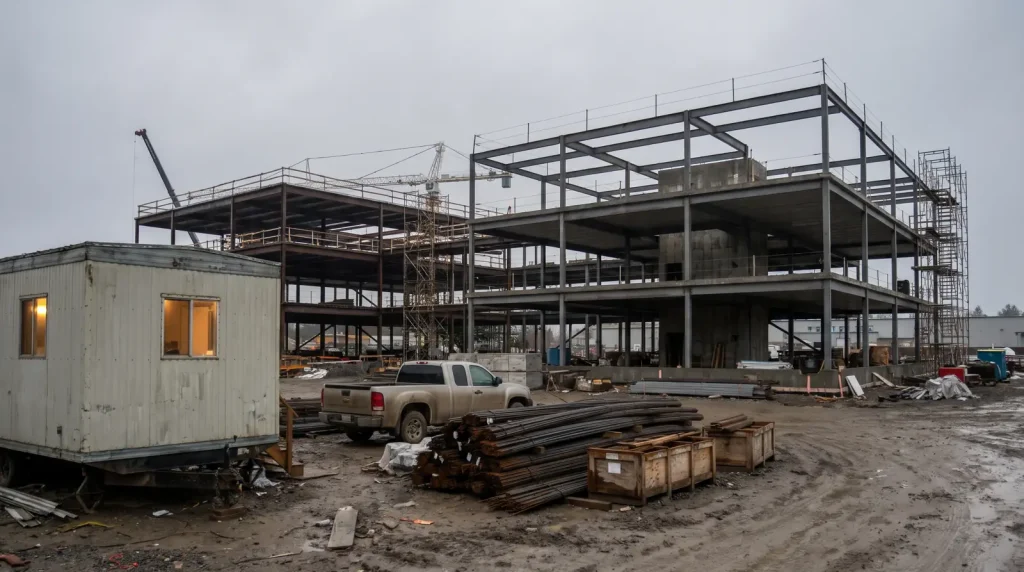
Certified payroll is the weekly wage report each contractor and subcontractor files on federal or federally funded construction over $2,000: one Form WH-347 or equivalent per week, signed under a Statement of Compliance.
Key takeaways
- Any contractor or subcontractor with laborers or mechanics on a Davis-Bacon job over $2,000 must submit a certified payroll for every week covered work is performed (29 CFR 3.3; 40 U.S.C. 3142(a)).
- Each weekly payroll is due within 7 days after the regular pay date, and the prime contractor is responsible for every subcontractor’s submission (29 CFR 3.4(a); 29 CFR 5.5(a)(3)(ii)(A)).
- Form WH-347 is optional, but the data is not. The current form is Rev. January 2025, OMB No. 1235-0008, expiring 01/31/2028, with 16 columns from 1A to 9 (DOL Form WH-347).
- Weekly transmittals carry only an identifying number such as the last 4 digits of the Social Security number; full numbers, addresses, phones and emails stay in your files for 3 years (29 CFR 5.5(a)(3)).
- A firm found to have disregarded its obligations is barred from federal and Davis-Bacon contracts for 3 years, and a false certification can be prosecuted under 18 U.S.C. 1001 and 31 U.S.C. 3729 (29 CFR 5.12).
- States run their own systems: California wants records at least every 30 days, Illinois by the 15th of each month and Washington at least monthly (Cal. Lab. Code 1771.4; RCW 39.12.120).
This page explains the rules as published; it is not legal or payroll advice. Your contract, the wage determination it incorporates and the contracting agency’s instructions control on any specific job.
What is certified payroll and who must file it?
Certified payroll is a payroll record for one project and one workweek that the employer signs as true. The U.S. Department of Labor Wage and Hour Division (WHD) requires it on contracts covered by the Davis-Bacon Act and the Davis-Bacon Related Acts, so an agency can confirm each laborer and mechanic got at least the posted prevailing wage plus fringe benefits for the work actually performed.
The trigger is the contract, not the company. The Davis-Bacon Act reaches every federal construction, alteration or repair contract “in excess of $2,000” (40 U.S.C. 3142(a)), and the Related Acts carry the same clauses into projects that federal agencies assist through grants, loans, loan guarantees and insurance (DOL WHD, Davis-Bacon and Related Acts). The weekly payroll rule in 29 CFR 3.3(c) does not apply to any contract of $2,000 or less.
| Rule | Number | Source |
|---|---|---|
| Contract size that triggers Davis-Bacon | Over $2,000 | 40 U.S.C. 3142(a) |
| How often workers must be paid | At least once a week | 40 U.S.C. 3142(c)(1) |
| How often certified payroll is filed | Every week with covered work | 29 CFR 5.5(a)(3)(ii)(A) |
| Delivery deadline | 7 days after the regular pay date | 29 CFR 3.4(a) |
| Record retention | 3 years after all prime contract work ends | 29 CFR 5.5(a)(3)(i)(A) |
| Overtime clause (CWHSSA) applies | Contracts over $100,000; 1.5 times basic rate over 40 hours | 29 CFR 5.5(b)(1) |
| Debarment period | 3 years | 40 U.S.C. 3144(b)(2) |
| WHD estimate to complete one WH-347 | 55 minutes | WH-347 burden statement |
Who files: the prime contractor and every subcontractor at every tier that employs laborers or mechanics at the site of the work. Each employer certifies its own workers. Owners on federally assisted jobs (a city using a federal grant, a housing developer with an insured loan) usually receive and keep the payrolls for the funding agency. Rate levels come from the wage determination in the contract, posted on SAM.gov; our comparison of Davis-Bacon rates with market wages in 20 metros shows how far those rates sit from local pay.
How often is certified payroll due, and where does it go?
Federal certified payroll is due weekly, for each week in which any covered work is performed, and must be delivered within 7 days after the regular pay date for that payroll period. It goes to the federal agency when the agency signed the contract, or to the applicant, sponsor or owner that keeps the records when the agency only funds the job (29 CFR 3.4(a); 29 CFR 5.5(a)(3)(ii)(A)).
- Pay every laborer and mechanic at least once a week, in full, at no less than the wage determination rate plus fringe for each classification worked (40 U.S.C. 3142(c)(1)).
- Prepare one certified payroll per project per week: WH-347 or any format holding the same data, with an identifying number (for example the last 4 Social Security digits) instead of the full number.
- Sign the Statement of Compliance with an original handwritten signature or a legally valid electronic signature; a scanned or photocopied signature does not meet the rule (DOL WH-347 page).
- Deliver it within 7 days after the regular pay date. Subcontractors deliver to the prime, which collects and forwards all tiers.
- Keep the payroll, the basic records (full SSN, last known address, phone and email) and the subcontract for 3 years after all work on the prime contract is completed.
Electronic portals are allowed. A contracting agency or prime may require one if it takes legally valid e-signatures, keeps the payrolls accessible to the contractor, the agency and DOL for 3 years, and offers another method to a contractor that cannot use it (29 CFR 5.5(a)(3)(ii)(A)). Each payroll carries a certified payroll number, and the WH-347 has a box to mark the final payroll for the job. For weeks with no work, follow the agency’s instruction: Illinois Department of Transportation contracts, for example, require a payroll record marked “No Work”, “Suspended” or “Complete” (IDOT special provision, revised April 1, 2026).
What goes on Form WH-347, column by column?
The January 2025 revision of Form WH-347 has 16 numbered columns on page 1, from 1A Worker Entry No. to 9 Net Pay, plus a page 2 Statement of Compliance with six check boxes. Older guides still describe a 9-column form; the current layout splits names into three fields and adds columns for apprentice status, fringe benefit credit and cash paid in lieu of fringe (WH-347, Rev. January 2025).
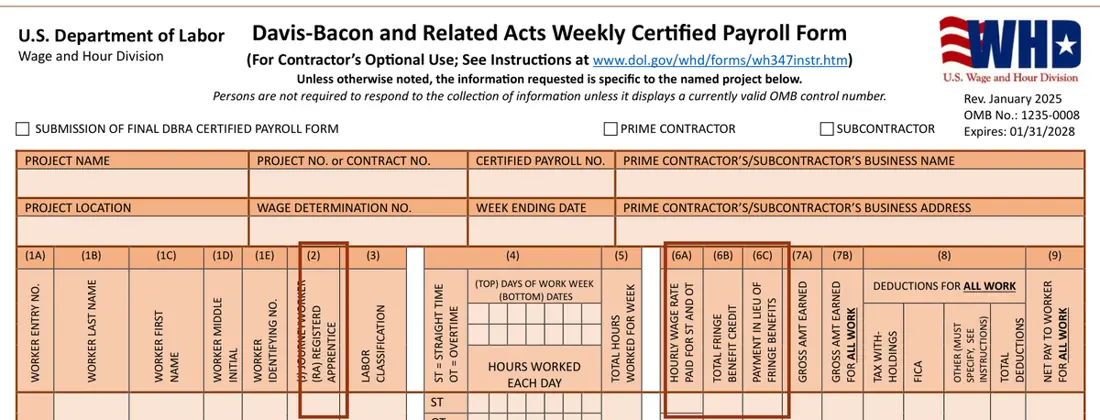
| Column | What you enter | Common error |
|---|---|---|
| 1A to 1D | Entry number, last name, first name, middle initial | Renumbering workers week to week |
| 1E Worker identifying no. | Partial identifier such as last 4 SSN digits; never the full number | Full SSN on a weekly transmittal, barred by 29 CFR 5.5(a)(3)(ii)(B) |
| 2 J or RA | “J” for journeyworker, “RA” for registered apprentice plus level of progression | Apprentice rate paid without RA status |
| 3 Labor classification | Classification from the wage determination for the work actually done | One classification for a worker who did two trades |
| 4 Hours each day | Straight time (ST) and overtime (OT) hours by date | OT not split out on a contract over $100,000 |
| 5 Total hours | Weekly ST and OT totals for this project | Totals that include other jobs |
| 6A Hourly rate paid | Cash hourly rate for ST and OT | Rate below the wage determination base |
| 6B Total fringe benefit credit | Plan contributions or anticipated costs: hours times hourly credit | Credit not annualized across private work |
| 6C Payment in lieu of fringe | Cash paid instead of fringe: hours times hourly cash amount | Cash fringe buried in the base rate |
| 7A Gross, this project | Gross earned on this federal or assisted project | Mixing in private work |
| 7B Gross, all work | Gross for every job that week | Left blank when the worker had other jobs |
| 8 Deductions, all work | Tax withholding, FICA, other (must be specified) | Deductions not allowed under 29 CFR part 3 |
| 9 Net pay, all work | Net pay for the week | Arithmetic that does not tie to 7B minus 8 |
What does the Statement of Compliance certify?
The signer certifies three things under 29 CFR 5.5(a)(3)(ii)(C): the payroll and basic records are correct and complete; every worker, including helpers and apprentices, got full weekly wages with no rebates and only the deductions 29 CFR part 3 permits; and each worker got at least the wage determination rate and fringe for each classification performed.
On the WH-347, boxes 1, 2, 3 and 6 are always checked, box 4 when anyone is paid as an apprentice, and box 5 with the fringe benefit plan table when column 6B carries a credit (DOL WH-347 page).
What does a filled-in certified payroll row look like?
Take the rate DOL itself uses as an example in 29 CFR 5.31(b)(1): Laborer, common or general, at a $21.93 basic hourly rate plus $6.27 an hour in fringe. A fictional laborer works 8 hours Monday to Friday and 4 hours Saturday on a contract over $100,000, so the 4 Saturday hours fall past 40 and need 1.5 times the base rate. The employer pays the whole fringe into plans.
| Line | Arithmetic | Amount |
|---|---|---|
| Straight time (6A ST) | 40 hours x $21.93 | $877.20 |
| Overtime rate | $21.93 x 1.5 = $32.895, paid at $32.90 | $32.90 per hour |
| Overtime (6A OT) | 4 hours x $32.90 | $131.60 |
| Fringe credit (6B) | 44 hours x $6.27 (health $4.50 + pension $1.77) | $275.88 |
| Cash in lieu (6C) | None: all fringe paid to plans | $0.00 |
| Gross, this project (7A) and all work (7B) | $877.20 + $131.60 | $1,008.80 |
| FICA (8) | $1,008.80 x 7.65% | $77.17 |
| Federal tax withholding (8) | Assumed from the worker’s W-4 | $85.00 |
| Net pay (9) | $1,008.80 minus $162.17 | $846.63 |
Two rules drive that row. Overtime is computed on the $21.93 basic rate, not on base plus fringe, because 29 CFR 5.32 excludes fringe from the overtime base while barring a base below the wage determination rate. FICA is 6.2% Social Security plus 1.45% Medicare for 2026 (IRS Publication 15). Fringe paid to plans is not wages to the worker, so it sits in 6B but not in 7A.
A second laborer works 32 hours and the employer has no plans, so it pays the $6.27 as cash. Column 6A shows $21.93, 6C shows 32 x $6.27 = $200.64, and gross is $701.76 + $200.64 = $902.40, because cash in lieu is paid to the worker. If that laborer worked overtime, the premium would still be figured on $21.93, since a cash equivalent of fringe is also excluded from the overtime base under 29 CFR 5.32(c).
How are fringe benefits reported on certified payroll?
A contractor meets the fringe portion of a wage determination in cash, in contributions to bona fide plans, or in a mix, and reports each part separately: plan credit in column 6B and cash in column 6C. Plan credit must be annualized, meaning the yearly cost is divided by all hours worked, private and public, not just the hours on the Davis-Bacon job (29 CFR 5.25(c)(1)).
| Health plan credit for one worker | Annual cost | Hours divided by | Hourly credit |
|---|---|---|---|
| Correct: annualized over all work | $9,360 | 2,080 (1,040 DBRA + 1,040 private) | $4.50 |
| Wrong: divided by Davis-Bacon hours only | $9,360 | 1,040 | $9.00 |
| Shortfall if $9.00 was claimed against a $6.27 fringe rate | $6.27 owed minus $4.50 allowed | $1.77 per hour owed in cash or other plans | |
Figures are a CB&C example using the method in 29 CFR 5.25(c)(1). The 2023 rule codified annualization and exempts defined contribution pension plans that give immediate participation and vesting (DOL comparison chart). Unfunded plans, where the employer pays benefits itself rather than through a trustee, need written approval from the Secretary of Labor before any credit is taken (29 CFR 5.5(a)(1)(v)). List each plan’s name, type, plan number, funded or unfunded status and hourly credit in the page 2 fringe table of the WH-347.
How do apprentices appear on certified payroll?
An apprentice may be paid below the journeyworker rate only while individually registered in a program registered with the DOL Office of Apprenticeship or a recognized State Apprenticeship Agency, and only within the program’s ratio. Anyone listed at an apprentice rate who is not registered, or who exceeds the ratio, must be paid the full wage determination rate for the work performed (29 CFR 5.5(a)(4)(i)).
- Column 2: enter “RA” and the apprentice’s level of progression; check box 4 and list the program name and registering agency (OA or SAA) on page 2.
- Probationary workers certified by OA or an SAA may be paid as apprentices for the first 90 days only.
- Fringe: pay what the apprenticeship program specifies, or the full fringe on the wage determination if the program is silent.
- Out-of-area jobs: since the 2023 rule, the ratio and wage percentages of the project’s locality apply, not those of the program’s home locality (DOL comparison chart).
- Keep written evidence of program registration, each apprentice’s registration and the ratios and rates, under 29 CFR 5.5(a)(3)(i)(D).
For context on apprentice supply by state, see our construction apprenticeship statistics.
What changed in the 2023 Davis-Bacon final rule?
DOL published “Updating the Davis-Bacon and Related Acts Regulations” on August 23, 2023 at 88 FR 57526, effective October 23, 2023. For payroll staff it added phone and email to required records, allowed electronic signatures and set 3-year retention. On June 24, 2024, a federal court in the Northern District of Texas enjoined three provisions; DOL states the rest of the rule remains in effect (DOL rulemaking page).
| Topic | Before the 2023 rule | After October 23, 2023 | Source |
|---|---|---|---|
| Basic records | Name, address, SSN, classification, rates, hours, deductions, wages | Adds worker phone number and email address | 29 CFR 5.5(a)(3)(i)(B) |
| Signature | Not addressed in the regulation text | Handwritten or legally valid electronic signature | 29 CFR 5.5(a)(3)(ii)(E) |
| Retention | 3 years after completion | At least 3 years after all prime contract work is completed; agency or DOL may request payrolls with or without an investigation | DOL comparison chart |
| Prime liability for subs | Joint and several by interpretation | Prime responsible for subcontractor back wages regardless of intent | 29 CFR 5.5(a)(6) |
| Withholding | Silent on other agencies’ contracts | Cross-withholding from any contract held by the same prime | 29 CFR 5.5(a)(2) |
| Debarment, Related Acts | “Willful or aggravated” standard | Disregard of obligations standard; mandatory 3 years | 29 CFR 5.12 |
| Anti-retaliation | No provision | New clause with make-whole relief | 29 CFR 5.18 |
| Rates themselves | 50% majority, else weighted average | 30% rule; stale non-union rates updated by ECI no more than every 3 years | 29 CFR 1.2, 1.6(c) |
| Omitted clauses | Contract amendment needed | Clauses apply by operation of law (enjoined June 24, 2024) | DOL rulemaking page |
The other two enjoined provisions concern material suppliers and pay for truck drivers’ onsite delivery time under 29 CFR 5.2. While the injunction stands, DOL says it will not enforce coverage of offsite delivery drivers’ time on site, but drivers who do non-delivery construction work on site are still covered at the classification rate (DOL rulemaking page).
Who is responsible for subcontractor certified payroll?
The prime contractor answers for every tier. Each subcontract must include the clauses in 29 CFR 5.5(a)(1) to (11) and the wage determination, plus a clause pushing both into lower-tier subcontracts. The prime is responsible for subcontractor compliance and is liable for unpaid wages and interest owed to lower-tier workers (29 CFR 5.5(a)(6)).
A subcontract can let the prime hold payment until a subcontractor’s payrolls for the period are in. That contract term is separate from contract retainage, which our guide to retainage in construction covers, and from the payment timing rules in our 50-state public prompt payment and retainage data. A prime may require a subcontractor to give it full Social Security numbers and contact details for its own files without that data going to the agency (29 CFR 5.5(a)(3)(ii)(B)).
| Subcontract checklist item | Rule |
|---|---|
| Labor standards clauses (a)(1) to (11) and the wage determination attached | 29 CFR 5.5(a)(6) |
| Weekly certified payroll to the prime within 7 days of the pay date | 29 CFR 3.4(a) |
| Right to request full SSN, address, phone and email for prime’s files | 29 CFR 5.5(a)(3)(ii)(B) |
| Payment held for missing payrolls, stated in the subcontract | Contract term |
| Records kept 3 years after prime contract work ends | 29 CFR 5.5(a)(3)(i)(A) |
How do state certified payroll systems differ?
State prevailing wage laws, often called little Davis-Bacon acts, cover state and local public works and usually have their own filing system and calendar. They run in addition to federal rules on federally assisted jobs. California, Illinois and Washington all route filings to a state agency online at least monthly, while the awarding agency may still want weekly copies.
| Jurisdiction | Where it is filed | How often | Source |
|---|---|---|---|
| Federal (Davis-Bacon and Related Acts) | Contracting agency, or owner or sponsor on assisted jobs | Weekly, within 7 days after pay date | 29 CFR 3.4 |
| California | Labor Commissioner through DIR’s online certified payroll reporting (eCPR) system, by web form or XML | At least monthly, meaning once every 30 days, and within 30 days after the final day of work | Cal. Lab. Code 1771.4(a)(3); DIR |
| Illinois | Illinois Department of Labor Certified Transcript of Payroll Portal | By the 15th of each month for the prior month; IDOT state contracts also weekly | IDOT special provision; IDOL |
| Washington | Department of Labor and Industries online system | At least once per month | RCW 39.12.120 |
California adds a penalty that bites fast: after a written request, a contractor has 10 days to produce payroll records, then forfeits $100 for each calendar day, for each worker, until it complies (Cal. Lab. Code 1776(h)). California payroll records must also show straight time and overtime hours each day and week (Cal. Lab. Code 1776(a)). For where federal construction dollars land by state, see our federal construction contracts by state data.
What are the penalties for late or false certified payroll?
Late or missing payrolls first cost cash flow: after written notice, the agency may suspend further payments, advances or loan guarantees until the records arrive. Underpayment adds back wages with interest, CWHSSA liquidated damages of $33 per worker per day of unpaid overtime, and possible 3-year debarment. A false certification can be prosecuted under 18 U.S.C. 1001 and the False Claims Act, 31 U.S.C. 3729 (29 CFR 5.5).
| Problem | Consequence | Source |
|---|---|---|
| Payrolls not submitted or not made available | Suspension of payments after written notice; grounds for debarment; records not produced cannot be used as evidence in a 29 CFR part 6 hearing | 29 CFR 5.5(a)(3)(iv)(B) |
| Underpaid wages or fringe | Back wages plus interest; withholding from this or any other contract of the same prime | 29 CFR 5.5(a)(1)(vi), (a)(2) |
| Unpaid overtime on a contract over $100,000 | Unpaid wages, interest and $33 liquidated damages per worker per calendar day | 29 CFR 5.5(b)(2) |
| Disregard of obligations to workers | 3-year ineligibility for federal and covered contracts, extending to firms the officers have an interest in | 29 CFR 5.12(a)(1); 40 U.S.C. 3144(b) |
| Falsified certification | Civil or criminal prosecution | 18 U.S.C. 1001; 31 U.S.C. 3729 |
| California records not produced 10 days after request | $100 per calendar day per worker | Cal. Lab. Code 1776(h) |
Withholding can reach beyond the job with the problem: since the 2023 rule, an agency may cross-withhold from any contract held by the same prime contractor, even one awarded by a different agency (DOL comparison chart). Payment and performance bonds sit alongside these remedies; our surety bond guide explains what each bond covers.
Does your job need certified payroll?
Start with the money. Federal contract or federal funding over $2,000 with laborers or mechanics on site means weekly federal certified payroll. State or local public work means the state’s prevailing wage law and its filing system, sometimes on top of the federal rule. A purely private job with no public money needs only regular payroll unless the contract or a funding program says otherwise.
| If your job is | Then | Rule |
|---|---|---|
| A federal agency contract over $2,000 with on-site laborers or mechanics | Weekly certified payroll to the agency within 7 days of each pay date | 40 U.S.C. 3142(a); 29 CFR 3.3, 3.4 |
| Funded by a federal grant, loan, guarantee or insurance (Related Acts) | Weekly certified payroll to the owner or sponsor for the agency | 29 CFR 5.5(a)(3)(ii)(A) |
| Over $100,000 under either of the above | Also report overtime at 1.5 times the basic rate over 40 hours | 29 CFR 5.5(b)(1) |
| State or local public works in California | File with the Labor Commissioner at least every 30 days | Cal. Lab. Code 1771.4 |
| State-funded public works in Illinois | File in the IDOL portal by the 15th of each month | 820 ILCS 130 via IDOT provision |
| Public works in Washington | File in the L&I online system at least monthly | RCW 39.12.120 |
| Private work, no public funds | No certified payroll unless the contract requires it | Contract terms |
Bidders new to public work should price the 55 minutes per weekly form, per WHD’s estimate, into general conditions; our guide to winning commercial construction bids covers how public bids are scored.
Payroll reports usually travel with each pay request, so see how lenders and owners review a construction draw schedule and when the clock starts under a notice to proceed.
How we compiled this
We read the Davis-Bacon statute (40 U.S.C. 3142 and 3144), the current eCFR text of 29 CFR 3.3, 3.4, 5.5, 5.12, 5.25, 5.31 and 5.32, the January 2025 Form WH-347 and its DOL instruction page, DOL’s 2023 rule pages and comparison chart, and state sources for California, Illinois and Washington: 22 primary documents in all, accessed in November 2026. The example rows are fictional and use the rate from 29 CFR 5.31; tax withholding is an assumption. We excluded vendor claims we could not confirm at a primary source, including a stated end date for the previous WH-347.
Frequently asked questions
Is Form WH-347 required for certified payroll?
No. Form WH-347 is optional, but the weekly payroll data and the signed Statement of Compliance are mandatory on Davis-Bacon work. You may use any format that holds every item 29 CFR 5.5(a)(3)(ii)(B) lists, as long as the statement uses wording identical to page 2 of the WH-347. Many agencies and primes still require the form or their own portal.
How long do you keep certified payroll records?
Keep certified payrolls, regular payrolls and basic records for at least 3 years after all work on the prime contract is completed, not 3 years after your own subcontract ends, under 29 CFR 5.5(a)(3). The basic records must include full Social Security numbers, last known addresses, phone numbers and email addresses, which stay out of the weekly submissions.
Do you submit certified payroll for weeks with no work?
The federal rule requires a payroll for each week in which covered work is performed, so the agency’s instructions decide how idle weeks are shown. Some agencies want a numbered payroll marked no work so the payroll sequence stays unbroken. Illinois DOT state contracts, for example, require a record marked No Work, Suspended or Complete for any week without activity.
Who signs the certified payroll Statement of Compliance?
The contractor or subcontractor, or its agent who pays or supervises the payment of the workers, signs it under 29 CFR 5.5(a)(3)(ii)(C). The signature must be original handwritten or a legally valid electronic signature; DOL says photocopied or scanned signatures do not count. The signer is personally exposed to prosecution under 18 U.S.C. 1001 if the statement is false.
Does certified payroll apply to private commercial projects?
Usually not. Certified payroll follows public money: federal contracts and federally assisted work over $2,000, plus state and local public works under state prevailing wage laws. A private office or retail job with no public funds needs only regular payroll, unless the construction contract, a public financing program or a project labor agreement writes the requirement in.
Can a general contractor be penalized for a subcontractor's certified payroll?
Yes. Under 29 CFR 5.5(a)(6), the prime contractor is responsible for compliance at every subcontract tier and is liable for unpaid wages and interest owed to lower-tier workers. Since the 2023 rule, that liability applies regardless of the prime’s intent, and agencies may withhold from any contract the prime holds to cover the amount.
Sources
- 40 U.S.C. 3142, Rate of wages for laborers and mechanics, Legal Information Institute, Cornell Law School. https://www.law.cornell.edu/uscode/text/40/3142 (accessed 2026-11-09)
- 40 U.S.C. 3144, Authority to pay wages and list contractors violating contracts, Legal Information Institute, Cornell Law School. https://www.law.cornell.edu/uscode/text/40/3144 (accessed 2026-11-09)
- 29 CFR 3.3, Certified payrolls, eCFR, Office of the Federal Register. https://www.ecfr.gov/current/title-29/subtitle-A/part-3/section-3.3 (accessed 2026-11-09)
- 29 CFR 3.4, Submission of certified payroll and preservation of records, eCFR, Office of the Federal Register. https://www.ecfr.gov/current/title-29/subtitle-A/part-3/section-3.4 (accessed 2026-11-09)
- 29 CFR 5.5, Contract provisions and related matters, eCFR, Office of the Federal Register. https://www.ecfr.gov/current/title-29/subtitle-A/part-5/subpart-A/section-5.5 (accessed 2026-11-09)
- 29 CFR 5.12, Debarment proceedings, eCFR, Office of the Federal Register. https://www.ecfr.gov/current/title-29/subtitle-A/part-5/subpart-A/section-5.12 (accessed 2026-11-09)
- 29 CFR 5.25, Rate of contribution or cost for fringe benefits, eCFR, Office of the Federal Register. https://www.ecfr.gov/current/title-29/subtitle-A/part-5/subpart-B/section-5.25 (accessed 2026-11-09)
- 29 CFR 5.31, Meeting wage determination obligations, eCFR, Office of the Federal Register. https://www.ecfr.gov/current/title-29/subtitle-A/part-5/subpart-B/section-5.31 (accessed 2026-11-09)
- 29 CFR 5.32, Overtime payments, eCFR, Office of the Federal Register. https://www.ecfr.gov/current/title-29/subtitle-A/part-5/subpart-B/section-5.32 (accessed 2026-11-09)
- Form WH-347, Davis-Bacon and Related Acts Weekly Certified Payroll Form (Rev. January 2025), U.S. Department of Labor, Wage and Hour Division. https://www.dol.gov/sites/dolgov/files/WHD/legacy/files/wh347.pdf (accessed 2026-11-09)
- WH-347 form page and instructions, U.S. Department of Labor, Wage and Hour Division. https://www.dol.gov/agencies/whd/forms/wh347 (accessed 2026-11-09)
- Davis-Bacon and Related Acts, U.S. Department of Labor, Wage and Hour Division. https://www.dol.gov/agencies/whd/government-contracts/construction (accessed 2026-11-09)
- Final Rule: Updating the Davis-Bacon and Related Acts Regulations, U.S. Department of Labor, Wage and Hour Division. https://www.dol.gov/agencies/whd/government-contracts/construction/rulemaking-davis-bacon (accessed 2026-11-09)
- Davis-Bacon final rule comparison charts, U.S. Department of Labor, Wage and Hour Division. https://www.dol.gov/agencies/whd/government-contracts/construction/rulemaking-davis-bacon/dba-comparison-charts (accessed 2026-11-09)
- Updating the Davis-Bacon and Related Acts Regulations, 88 FR 57526, Federal Register. https://www.federalregister.gov/documents/2023/08/23/2023-17221/updating-the-davis-bacon-and-related-acts-regulations (accessed 2026-11-09)
- Wage determinations, SAM.gov, U.S. General Services Administration. https://sam.gov/content/wage-determinations (accessed 2026-11-09)
- Certified Payroll Reporting, California Department of Industrial Relations. https://www.dir.ca.gov/public-works/certified-payroll-reporting.html (accessed 2026-11-09)
- California Labor Code 1771.4, California Legislature (via public.law). https://california.public.law/codes/labor_code_section_1771.4 (accessed 2026-11-09)
- California Labor Code 1776, California Legislature (via public.law). https://california.public.law/codes/labor_code_section_1776 (accessed 2026-11-09)
- Special Provision for Submission of Payroll Records, State Contract (revised April 1, 2026), Illinois Department of Transportation. https://public.powerdms.com/IDOT/documents/2279631/Submission%20of%20Payroll%20Records (accessed 2026-11-09)
- Certified Transcript of Payroll, Illinois Department of Labor. https://labor.illinois.gov/laws-rules/conmed/certifiedtranscriptofpayroll.html (accessed 2026-11-09)
- RCW 39.12.120, Certified payroll records, Washington State Legislature. https://app.leg.wa.gov/RCW/default.aspx?cite=39.12.120 (accessed 2026-11-09)
- Publication 15 (2026), Employer’s Tax Guide, Internal Revenue Service. https://www.irs.gov/publications/p15 (accessed 2026-11-09)