A construction draw schedule is the month-by-month plan for paying a construction loan out against work in place: each draw funds inspected work, less a holdback, after lien waivers and a title date-down.
Key takeaways
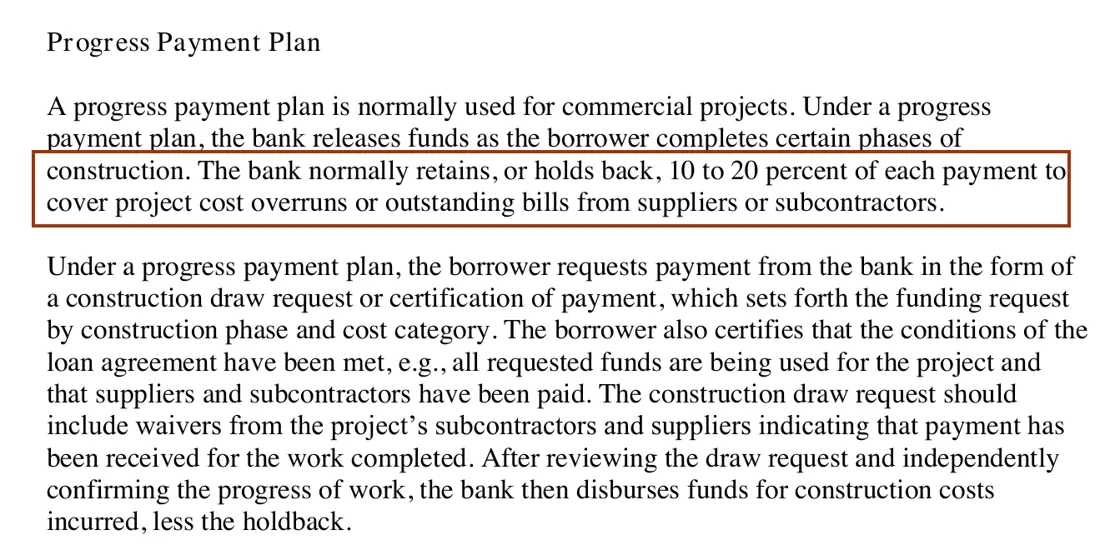
- On commercial loans, banks normally use a progress payment plan and hold back 10 to 20 percent of each payment to cover overruns and unpaid bills, per the OCC Comptroller’s Handbook, Commercial Real Estate Lending (version 2.0, page 49).
- The same handbook says the lender’s title policy should be updated with each draw so the title company confirms no new mechanics liens (page 48).
- Federal lending guidelines say disbursements should not exceed actual construction outlays (12 CFR Part 365, Appendix A), so a draw pays for work in place, not for the calendar.
- Under AIA A201-2017 §9.3.1 the contractor’s pay application goes in at least 10 days before the payment date, the architect has 7 days to certify it (§9.4.1), and subcontractors are paid within 7 days of the contractor being paid (§9.6.2).
- In our worked draw schedule for a $4,000,000 contract, 10 monthly draws pay $3,600,000 and the lender is holding $400,000 of retainage at substantial completion; the HUD MAP Guide step-down would cut that to $100,000.
CB&C is a contractor matching service, not a lender or law firm. This page explains published rules and common practice; it is not legal or financial advice, and your loan agreement and construction contract control.
What is a construction draw schedule?
A construction draw schedule is the lender-approved plan for releasing a construction loan in installments, called draws, as the building goes up. On commercial projects each draw is usually monthly and is sized from the contractor’s pay application, which bills work in place against the schedule of values. The OCC handbook calls this a progress payment plan and says it is “normally used for commercial projects” (page 49).
Two documents drive it. The schedule of values splits the contract sum into line items before the first payment request (AIA A201-2017 §9.2), and the draw schedule projects when each line will be billed. Our guide to the schedule of values shows how to build those lines so a lender’s inspector can test them.
| Number | What it governs | Source |
|---|---|---|
| 10% to 20% | Bank holdback on each commercial progress payment | OCC Comptroller’s Handbook, CRE Lending v2.0, p. 49 |
| 5 equal installments | Most common residential standard payment plan (contrast only) | OCC Comptroller’s Handbook, p. 48 |
| 10 days | Minimum time a pay application goes in before the payment date | AIA A201-2017 §9.3.1 |
| 7 days | Architect’s time to certify, reduce or withhold | AIA A201-2017 §9.4.1 |
| 7 days | GC’s time to pay each subcontractor after being paid | AIA A201-2017 §9.6.2 |
| 10%, then 5%, then 2.5% | HUD-insured multifamily retainage at 0 to 50%, 50 to 75% and 75% to final endorsement | HUD MAP Guide 4430.G §12.15.5 (March 2021) |
| 50% | Cap on outstanding HUD-insured advances for components stored off site, as a share of total construction cost | HUD MAP Guide, Appendix A.12.4 |
| $350,000 | SBA 7(a) construction component above which bonds, inspections and lien waivers are mandatory | SBA SOP 50 10 8.1, Ch. 6 |
How does a commercial construction draw work, step by step?
A commercial draw runs in 7 steps every month: the contractor bills, the architect certifies, the borrower requests funds, lien waivers come in, the lender’s inspector confirms the work, the title company dates down the policy, and the lender funds the costs incurred less the holdback. The OCC handbook (pages 45 to 49) describes each control a bank examiner expects to see.
- Pay application. The general contractor (GC) submits an AIA G702 Application and Certificate for Payment with G703 continuation sheets, itemized by the schedule of values and supported by “releases and waivers of liens from Subcontractors and suppliers,” at least 10 days before the payment date (A201-2017 §9.3.1). Our AIA G702 guide walks through all 9 lines.
- Certification. The architect has 7 days to certify the full amount, certify a lower amount with reasons, or withhold certification (A201-2017 §9.4.1).
- Draw request. The borrower sends the lender a draw request “by construction phase and cost category” and certifies that the loan conditions are met and suppliers and subcontractors have been paid (OCC, page 49). Soft costs such as design fees and loan interest ride on the same request.
- Lien waivers. The request should include waivers showing payment was received for the work completed (OCC, page 49). The AIA G901-2022 conditional waiver is “typically executed as part of the documentation in support of a progress payment.”
- Inspection. Banks “typically require architect or engineering inspection reports with each draw,” and the reports support disbursements “typically based on percentage complete” (OCC, page 45).
- Title date-down. The title company searches for liens recorded since the last draw and brings the lender’s policy forward; the OCC says the policy “should be updated with each draw” (page 48).
- Funding. The bank “disburses funds for construction costs incurred, less the holdback” (OCC, page 49), and the GC pays its subcontractors within 7 days (A201-2017 §9.6.2).
What goes in a construction draw request package?
A complete draw package has 8 parts: the G702 and G703, the borrower’s draw request, invoices for soft costs, conditional lien waivers for this draw, unconditional waivers for the last one, the inspector’s report, the title date-down, and change orders. A missing waiver or an unsigned change order can be enough for the lender to cut that line from the draw.
| Document | Who provides it | What the lender checks | Source |
|---|---|---|---|
| AIA G702 Application and Certificate for Payment | GC, certified by the architect | Line 4 completed and stored to date, Line 5 retainage, Line 8 current payment due | AIA G702-1992 Instructions |
| AIA G703 Continuation Sheet | GC | Each schedule of values line: previous, this period, stored materials (Column F), percent complete | AIA G702-1992 Instructions |
| Borrower’s draw request and certification | Owner or developer | Funding by phase and cost category; loan conditions met; subs and suppliers paid | OCC Comptroller’s Handbook, p. 49 |
| Soft cost invoices | Architect, engineers, testing firms, lender | Matches the soft cost budget line; within the loan budget | 12 CFR 365, App. A (draws not above actual outlays) |
| Lien waivers: conditional for this draw, unconditional for the prior draw | GC, subcontractors, suppliers | Every party paid last month has signed; amounts match the prior G703 | OCC p. 49; AIA G901-2022; state waiver forms |
| Inspection report | Lender’s inspector, architect or engineer | Work in place matches the billed percent; budget still in balance | OCC Comptroller’s Handbook, p. 45 |
| Title date-down endorsement | Title company | No new mechanics liens or other encumbrances since the last draw | OCC Comptroller’s Handbook, p. 48 |
| Approved change orders | Owner, architect, GC; lender and surety consent where required | Contract sum on G702 Line 3 matches signed changes | SBA SOP 50 10 8.1, Ch. 6 (no material changes without lender and surety consent) |
SBA loans add hard rules. When the construction part of a 7(a) loan exceeds $350,000, the lender needs a 100% performance bond and payment bond, builder’s risk and workers’ compensation cover, evidence the borrower’s own money went in before the loan funds, interim and final inspections, and lien waivers or releases from every contractor, subcontractor and supplier (SBA SOP 50 10 8.1, Chapter 6). Our SBA 504 loan guide covers the equity side of SBA projects.
What does a draw schedule look like for a commercial project?
The table below is a worked draw schedule for a fictional $4,000,000 fixed-price contract built over 10 months, with 10% retainage that the lender mirrors as its holdback. Draw 4 bills $160,000 of rooftop HVAC units stored on site, which are installed and billed as work in place in draw 5. Ten draws pay $3,600,000; draws 11 and 12 release the $400,000 held.
| Draw (month) | Installed, % of contract | Completed and stored to date ($) | Billed this period ($) | Retainage held to date ($) | Net draw funded ($) | Funded to date ($) | Balance to finish ($) |
|---|---|---|---|---|---|---|---|
| 1 | 5% | 200,000 | 200,000 | 20,000 | 180,000 | 180,000 | 3,800,000 |
| 2 | 12% | 480,000 | 280,000 | 48,000 | 252,000 | 432,000 | 3,520,000 |
| 3 | 22% | 880,000 | 400,000 | 88,000 | 360,000 | 792,000 | 3,120,000 |
| 4 | 34% (+ $160,000 stored) | 1,520,000 | 640,000 | 152,000 | 576,000 | 1,368,000 | 2,480,000 |
| 5 | 47% | 1,880,000 | 360,000 | 188,000 | 324,000 | 1,692,000 | 2,120,000 |
| 6 | 60% | 2,400,000 | 520,000 | 240,000 | 468,000 | 2,160,000 | 1,600,000 |
| 7 | 72% | 2,880,000 | 480,000 | 288,000 | 432,000 | 2,592,000 | 1,120,000 |
| 8 | 83% | 3,320,000 | 440,000 | 332,000 | 396,000 | 2,988,000 | 680,000 |
| 9 | 93% | 3,720,000 | 400,000 | 372,000 | 360,000 | 3,348,000 | 280,000 |
| 10 (substantial completion) | 100% | 4,000,000 | 280,000 | 400,000 | 252,000 | 3,600,000 | 0 |
| 11 (retainage release) | 100% | 4,000,000 | 0 | 30,000 | 370,000 | 3,970,000 | 0 |
| 12 (final) | 100% | 4,000,000 | 0 | 0 | 30,000 | 4,000,000 | 0 |
The arithmetic is the same each month: net draw equals billed this period minus the increase in retainage. In draw 4, $640,000 billed minus a $64,000 retainage increase ($152,000 less $88,000) gives $576,000. At draw 11 the owner keeps $30,000, which is 150% of an assumed $20,000 punch list, the same 150% multiple HUD applies to items of delayed completion (MAP Guide §12.15.5.D). All figures are CB&C arithmetic on an assumed S-curve, not a real project.
The S-curve shape matters for the loan. Draws 4 to 7 carry $1,800,000 of the $3,600,000 funded before completion, so half the money moves in 4 of the 10 months, and interest on the drawn balance climbs fastest in that stretch. Our commercial construction loan guide shows how the interest reserve is sized for that curve.
How do retainage and the lender’s holdback change each draw?
Retainage is the contractor’s money the owner keeps under the construction contract; the holdback is the share the lender keeps back from each advance under the loan agreement. The OCC puts the bank holdback at 10 to 20 percent (page 49), and because 12 CFR 365 says disbursements should not exceed actual outlays, a holdback at least equal to contract retainage keeps the loan from funding money the owner has not paid out.
The rate need not stay flat. HUD’s MAP Guide §12.15.5 holds 10% until 50% completion, then allows 5% until 75%, then 2.5% until final endorsement, if the contractor has no identity of interest above a 5% equity stake and the surety consents in writing. Applied to the same $4,000,000 schedule, the step-down releases $300,000 earlier.
| Draw | Installed | Flat 10% held ($) | HUD-style step-down held ($) | Rate applied |
|---|---|---|---|---|
| 5 | 47% | 188,000 | 188,000 | 10% |
| 6 | 60% | 240,000 | 120,000 | 5% |
| 7 | 72% | 288,000 | 144,000 | 5% |
| 8 | 83% | 332,000 | 83,000 | 2.5% |
| 9 | 93% | 372,000 | 93,000 | 2.5% |
| 10 | 100% | 400,000 | 100,000 | 2.5% |
Private contracts set their own rate: AIA A101-2017 leaves the percentage blank, and many states cap it on public work. Our guide to retainage in construction lists 30 of 46 capped jurisdictions at 5%. On federal jobs, FAR 52.232-5(e) lets the contracting officer hold up to 10% only when progress is unsatisfactory (federal rule).
How are stored materials paid in a draw?
Stored materials can be drawn before installation, but only with proof the owner holds title and the goods are insured. Under AIA A201-2017 §9.3.2, materials stored on site are payable unless the contract says otherwise; off-site storage needs the owner’s advance approval and a location agreed in writing. Lenders add their own limits.
| Rule set | On-site materials | Off-site materials | Source |
|---|---|---|---|
| AIA A201-2017 (private default) | Payable when delivered and suitably stored | Only if approved in advance by the owner; must establish owner’s title; includes insurance, storage and transport costs | A201-2017 §9.3.2 |
| HUD-insured multifamily (MAP) | Subject to the 10% holdback | Bill of sale and itemized invoice, UCC financing statement, 10% holdback; outstanding off-site advances capped at 50% of total construction cost; $10,000 minimum per advance | MAP Guide Appendix A.12.4 |
| Federal fixed-price construction | Contracting officer may count material delivered on the site | Only if the contract specifically authorizes it and the contractor shows it has acquired title and will use the material on this contract | FAR 52.232-5(b)(2) (federal rule) |
| AIA G702 and G703 | Column F “materials presently stored”; G702 Line 5b retainage on stored material | Same column, with the backup the contract requires | AIA G702-1992 Instructions |
In the worked schedule, the $160,000 of rooftop units in draw 4 sits in G703 Column F with a bill of sale and a delivery ticket; the inspector photographs the crates on site. In draw 5 the units are set, so the $160,000 moves from Column F to Column E and the stored total returns to $0.
How long does a construction draw take?
On AIA terms a draw takes about 15 days from submission to funding, because the pay application goes in at least 10 days before the payment date and the architect needs up to 7 of them to certify. The lender’s inspection and title date-down fit inside that window only if the loan agreement schedules them; no federal rule sets a lender day count.
| Example day | Step | Rule |
|---|---|---|
| Day 0 (25th) | Pay period closes; GC submits G702/G703 | A201-2017 §9.3.1: at least 10 days before the payment date |
| By day 7 (2nd) | Architect certifies, reduces or withholds | A201-2017 §9.4.1: 7 days after receipt |
| Days 7 to 12 | Lender inspection, lien waivers checked, title date-down | Days set by the loan agreement; no federal day count |
| Day 15 (10th) | Lender funds; owner pays the GC, less retainage | Payment date fixed in the owner-contractor agreement |
| By day 22 (17th) | GC pays subcontractors their share | A201-2017 §9.6.2: within 7 days of receiving payment |
Federal jobs run faster on paper: FAR 52.232-27 makes a progress payment due 14 days after the designated billing office receives a proper request (federal rule). HUD-insured jobs bill monthly, with the contractor’s requisition on form HUD-92448 and the lender’s request for an insured advance on form HUD-92403 (MAP Guide glossary and §12.15.5).
How is a commercial draw schedule different from a residential one?
A residential draw schedule usually pays fixed amounts at set stages; a commercial one pays whatever the inspected pay application shows each month. The OCC handbook says a standard payment plan for residential construction “most commonly consists of five equal installments,” with the final payment held until the mechanics lien period expires (pages 48 to 49).
| Feature | Standard payment plan (residential, small commercial) | Progress payment plan (commercial) | Voucher plan |
|---|---|---|---|
| Draw amount | Fixed, often 5 equal installments | Work in place per G702/G703, less 10% to 20% holdback | Each bill paid or reimbursed as presented |
| Trigger | Agreed stage reached, verified by inspection | Monthly pay application, certified and inspected | Invoice or receipt |
| Lender control | Moderate | High; title update each draw | Highest, with more lender workload |
| Source | OCC Handbook p. 48 | OCC Handbook p. 49 | OCC Handbook p. 48 |
What do several guides get wrong about draw schedules?
Three claims recur on top-ranking guides checked on 2026-11-09 and do not match the primary sources: an unsourced 10% retainage figure, fixed stage percentages presented as the commercial norm, and a vague title update. Each correction below cites the document a lender or bank examiner would use.
| What several guides say | What the primary source says | Source |
|---|---|---|
| Retainage is “typically around 10%” (no source) | The contract sets retainage; the lender’s holdback is a separate loan term that banks normally set at 10 to 20 percent; HUD steps 10% down to 5% and 2.5% | OCC p. 49; MAP Guide §12.15.5 |
| A draw schedule is a list of fixed stage percentages | That is the residential standard plan; commercial loans normally use progress payments sized by inspected work in place | OCC pp. 48 to 49 |
| The lender “updates the title” without saying why or when | The title policy should be updated with each draw because mechanics liens can take priority over the bank’s lien in some states | OCC p. 48 |
Which draw setup fits your project?
Pick the draw rules before the loan closes, because the loan agreement, the construction contract and the schedule of values must use the same retainage rate, inspection trigger and stored-material terms. The table below maps common situations to the rule that governs them.
| If your project… | Then plan the draw schedule to… | Why |
|---|---|---|
| Has a 7(a) construction component over $350,000 | Require 100% performance and payment bonds, interim and final inspections and lien waivers from every sub and supplier | SBA SOP 50 10 8.1, Ch. 6 |
| Uses owner equity alongside the loan | Spend the equity first and show it on the first draw | OCC Handbook p. 29; SBA SOP 50 10 8.1 |
| Buys long-lead equipment stored off site | Get the owner’s written approval, bill of sale, insurance and title evidence before billing Column F | A201-2017 §9.3.2; MAP Guide A.12.4 |
| Passes 50% complete with no quality issues | Ask the owner and surety to cut retainage to 5% (written surety consent) | MAP Guide §12.15.5; surety bond terms |
| Reaches substantial completion | Release retainage less 150% of the punch list estimate, after the certificate is accepted | A201-2017 §9.8.5; MAP Guide §12.15.5.D |
| Is a federal contract | Bill under FAR 52.232-5; expect payment 14 days after a proper request and no retainage while progress is satisfactory | FAR 52.232-5, 52.232-27 (federal) |
The final draw closes the loan’s construction phase. Before releasing it, the OCC handbook lists 3 controls: all lien waivers or releases collected, a final inspection showing the building meets specifications, and a certificate of occupancy (page 49). Our substantial completion guide covers the certificate that starts that release, and the punch list guide covers the items the last holdback secures.
The first draw follows the start date set in our notice to proceed guide, and many lenders want the IBC Chapter 17 reports described in our special inspections guide before funding structural work.
How we compiled this
We read 9 primary documents in November 2026: the OCC Comptroller’s Handbook on commercial real estate lending (version 2.0), HUD’s MAP Guide 4430.G (March 2021 revision), SBA SOP 50 10 8.1, 12 CFR Part 365 Appendix A, AIA A201-2017 as posted in a public bid package, the AIA G702 and G901 instructions, and FAR 52.232-5 and 52.232-27. The draw schedule is CB&C arithmetic on an assumed S-curve; we did not use lender quotes, vendor data or any real project’s draws.
Frequently asked questions
What is a typical construction draw schedule?
On a commercial loan, a typical construction draw schedule is one draw a month for the length of the build, each sized from the contractor’s AIA G702 pay application and funded less a holdback. The OCC Comptroller’s Handbook says banks normally hold back 10 to 20 percent. Residential loans more often use about 5 fixed installments tied to stages.
How many draws are in a commercial construction loan?
Usually one per month of construction plus one or two closeout draws. A 10-month build like our $4,000,000 worked example has 10 progress draws, then a retainage release draw after substantial completion and a final draw that pays the last $30,000 held for the punch list. Longer or phased projects add draws in proportion.
Who inspects a construction draw?
The lender’s inspector, often a third-party architect or engineer, visits the site before each draw to confirm work in place and percent complete. The OCC Comptroller’s Handbook says banks typically require architect or engineering inspection reports with each draw. For SBA 7(a) loans with over $350,000 of construction, interim and final inspections are mandatory.
What is a title date-down on a construction draw?
A title date-down is the title company’s search for anything recorded against the property since the last draw, followed by an update to the lender’s title policy. The OCC Comptroller’s Handbook says the policy should be updated with each draw because mechanics liens can take priority over the bank’s lien in some jurisdictions.
What happens if a draw request is rejected?
The lender funds only the lines it can verify, and the rest waits for the next draw. Under AIA A201-2017 Section 9.4.1 the architect can also certify a lower amount within 7 days and must give reasons. Causes include a missing lien waiver, an unsigned change order or work the inspector rates below the billed percent.
Can you draw for materials before they are installed?
Yes, if the contract allows it. AIA A201-2017 Section 9.3.2 pays for materials suitably stored on site and, with the owner’s advance approval, off site, once the owner’s title and insurance are established. HUD-insured loans cap outstanding off-site advances at 50% of total construction cost and require a bill of sale and itemized invoice.
Sources
- Comptroller’s Handbook: Commercial Real Estate Lending, version 2.0, Office of the Comptroller of the Currency, pp. 45 to 49, accessed 2026-11-09.
- Multifamily Accelerated Processing (MAP) Guide, HUD Handbook 4430.G, revision March 19, 2021, U.S. Department of Housing and Urban Development, §12.15.5 and Appendix A.12.4, accessed 2026-11-09.
- SOP 50 10 8.1, Lender and Development Company Loan Programs, U.S. Small Business Administration, Chapter 6 construction provisions, accessed 2026-11-09.
- 12 CFR Part 365, Appendix A, Interagency Guidelines for Real Estate Lending Policies, eCFR, accessed 2026-11-09.
- AIA Document A201-2017, General Conditions (sample in a City of Rochester, NH bid package), §9.2 to §9.10, accessed 2026-11-09.
- AIA G702-1992 Instructions, American Institute of Architects, accessed 2026-11-09.
- AIA G901-2022 Conditional Waiver and Release on Progress Payment, instructions, AIA Contract Documents, accessed 2026-11-09.
- FAR 52.232-5, Payments under Fixed-Price Construction Contracts, Acquisition.gov, accessed 2026-11-09.
- FAR 52.232-27, Prompt Payment for Construction Contracts, Acquisition.gov, accessed 2026-11-09.