
A waiver of subrogation is a pre-loss agreement that stops an insurer, after it pays a claim, from suing the party who caused the loss: in construction, usually the owner, contractor or subcontractors on the same project.
In the standard AIA contract the waiver covers only losses covered by property insurance (AIA A201-2017 §11.3.1). It works only when each policy allows it, which for liability and workers’ compensation means an endorsement such as ISO CG 24 04 05 09 or NCCI WC 00 03 13. It is general information, not legal or insurance advice; have your broker and construction counsel review the actual policies and contract.
Key takeaways
- AIA A201-2017 §11.3.1 has the Owner and Contractor waive rights against each other, the Architect and Separate Contractors for fire and other losses “to the extent those losses are covered by property insurance” (A201-2017).
- AIA A101-2017 Exhibit A §A.2.3.1.4 makes the Owner responsible for losses inside the builder’s risk deductible, so the waiver never moves that amount to the insurer (Exhibit A, Anderson County, TX, March 20, 2026).
- ISO CG 24 04 05 09 waives the CGL insurer’s recovery only against the party in its Schedule, for injury or damage from ongoing operations or completed work done under a contract with that party (City of Sierra Madre sample forms, 2025).
- In New York the workers’ compensation waiver (WC 00 03 13) costs 2% to 10% of manual premium, with a $250 minimum per policy for blanket coverage (NYCIRB R.C. 2183, 2008).
- Kentucky makes it unlawful to require a workers’ compensation waiver as a condition of a contract (KRS 342.700(3)), and Missouri voids prospective waivers where a party is in the construction code group (RSMo 287.150.6).
- An ACORD 25 certificate “confers no rights”; its SUBR WVD box only flags that an endorsement may be required (ACORD 25 2016/03 sample, City of Tampa).
| Key number or rule | Value | Source |
|---|---|---|
| A201 waiver scope | Losses covered by property insurance only | A201-2017 §11.3.1 |
| Who bears the builder’s risk deductible | Owner, unless the parties agree otherwise | Exhibit A §A.2.3.1.4 |
| Notice of property policy cancellation | Within 3 business days | A201-2017 §11.2.3 |
| CGL waiver form | ISO CG 24 04 05 09 (amends Condition 8) | Sierra Madre forms |
| WC waiver form | NCCI WC 00 03 13 (Ed. 4-84); California WC 04 03 06 | Sierra Madre forms |
| WC waiver charge, New York | 2% to 10% of manual premium; $250 minimum, blanket | NYCIRB R.C. 2183 |
| Missouri experience mod credit for subrogation recovery | Within 45 days of collection | RSMo 287.150.6 |
What is a waiver of subrogation, in plain English?
Subrogation is the insurer’s right, after paying its insured, to sue whoever caused the loss. A waiver gives it up in advance. The NCCI workers’ compensation form says it in one line: “We have the right to recover our payments from anyone liable for an injury covered by this policy. We will not enforce our right against the person or organization named in the Schedule” (WC 00 03 13, Ed. 4-84).
Two documents must line up. The contract states who waives against whom, and each insurance policy must permit the waiver or carry an endorsement that grants it. A201-2017 §11.3.1 covers the first half and also requires that the policies “shall not prohibit this waiver of subrogation”. If the contract promises a waiver the policy forbids, the party who signed may be in breach of contract while its insurer still sues; the AIA A201 general conditions assume both halves are in place.
Who pays whom after a loss, with and without the waiver?
With a waiver, the insurer pays its own insured and absorbs the loss; without one, it pays and then tries to recover from the at-fault party. In the CB&C illustration below, a $400,000 fire caused by an electrical subcontractor costs the builder’s risk insurer $375,000 either way, but only the no-waiver case puts the subcontractor in a lawsuit.
| Step (CB&C illustration) | Without a waiver | With A201 §11.3.1 waiver | Rule |
|---|---|---|---|
| Fire damages work in place | $400,000 | $400,000 | Builder’s risk “all-risks” cover, Exhibit A §A.2.3.1.1 |
| Deductible, absorbed by Owner | $25,000 | $25,000 | Exhibit A §A.2.3.1.4 |
| Builder’s risk insurer pays Owner as fiduciary | $375,000 | $375,000 | A201 §11.5.1 |
| Insurer can pursue the electrical subcontractor for | Up to $375,000 | $0 | A201 §11.3.1 |
| Insurer’s net cost after recovery | $0 to $375,000, after a lawsuit | $375,000 | Arithmetic |
The workers’ compensation version runs the same way. Suppose a subcontractor’s employee is hurt by the general contractor’s crane crew and the subcontractor’s insurer pays $90,000 in benefits (illustration). Without a waiver, a statute such as KRS 342.700(1) lets the insurer recover from the at-fault third party up to the benefits “paid and payable”, less a pro rata share of the employee’s legal fees. With WC 00 03 13 naming the general contractor, the insurer will not enforce that right against it.
The endorsement binds only the insurer. The injured employee may still sue the general contractor in tort; a 50-state chart by Matthiesen, Wickert & Lehrer (updated January 13, 2022) makes this point and notes that courts split on whether the waiver also blocks the insurer’s lien on the employee’s recovery (MWL 50-state chart). That is why a waiver does not replace additional insured status or an indemnity clause.
Where does a waiver of subrogation appear in construction contracts?
On AIA projects the waiver sits in A201-2017 Article 11, not in the owner-contractor agreement. AIA A101-2017 Exhibit A sets the property insurance the waiver relies on: §A.2.3.1 requires builder’s risk on an “all-risks” completed value form, at least the initial Contract Sum plus Modifications, naming the Owner, Contractor, Subcontractors and Sub-subcontractors as insureds. Exhibit A itself contains no waiver wording.
| Clause | What it waives | Limit or trigger | Source |
|---|---|---|---|
| A201 §11.3.1 | Owner and Contractor rights against each other, subs, sub-subs, agents, employees, the Architect and consultants, and Separate Contractors | Fire or other causes of loss, only to the extent covered by property insurance; rights to proceeds kept | A201-2017 |
| A201 §11.3.1 flow-down | Owner or Contractor must “require similar written waivers” from the Architect, consultants, Separate Contractors, subs and sub-subs | Applies even if the party owes indemnity, paid no premium, or had no insurable interest | A201-2017 |
| A201 §11.3.2 | Owner rights under separate property policies at or next to the site, and the post-final-payment policy | “To the extent permissible by such policies” | A201-2017 |
| A201 §11.2.2 | Owner rights against Contractor and subs if the Owner fails to buy the required property insurance | To the extent the missing insurance would have covered the loss | A201-2017 |
| A201 §11.2.3 | Same, if the Owner’s property policy lapses | Owner must give notice within 3 business days | A201-2017 |
| A201 §11.4 | Owner rights against Contractor and Architect for loss of use | “Due to fire or other hazards however caused” | A201-2017 |
| A101 Exhibit A §A.2.3.1.4 | Nothing; it allocates the deductible | Owner pays losses within deductibles or self-insured retentions | Exhibit A |
Subcontracts pick up the waiver through the §11.3.1 flow-down duty. If your subcontract form is not an AIA document, check that it repeats the waiver in the same words, names the same parties and limits it to property-insured losses; a mismatch leaves a gap the builder’s risk insurer can use. Our guide to construction contract types covers how general conditions attach to each delivery method, and builder's risk insurance covers who buys the policy.
Which endorsements make a waiver of subrogation work?
Each policy line needs its own permission: ISO CG 24 04 05 09 for general liability, NCCI WC 00 03 13 or a state version for workers’ compensation, and a builder’s risk policy that allows the waiver, as A201 §11.3.1 requires. The City of Sierra Madre’s 2025 contractor packet asks for CG 24 04 “at least as broad” and a WC waiver “similar to a WC 00 03 13” (Sierra Madre forms).
| Policy | Form | What the form says | Who it protects | Source |
|---|---|---|---|---|
| Commercial general liability | ISO CG 24 04 05 09, Waiver of Transfer of Rights of Recovery Against Others to Us | Insurer waives recovery for payments for injury or damage from “your ongoing operations or ‘your work’ done under a contract with that person or organization” | Only the person or organization in the Schedule | CG 24 04 05 09 |
| Workers’ compensation | NCCI WC 00 03 13 (Ed. 4-84) | “We will not enforce our right against the person or organization named in the Schedule”; applies only where a written contract requires it | Scheduled party, or blanket wording | WC 00 03 13 |
| Workers’ compensation, California | WC 04 03 06 | California waiver of recovery form | Scheduled party | Sierra Madre forms |
| Workers’ compensation, Texas | WC 42 03 04 | Specific or blanket waiver; premium shown as a percent | Scheduled party or blanket | MWL chart, 2022 |
| Builder’s risk or property | Policy condition or endorsement | Must “not prohibit this waiver of subrogation” | Parties listed in A201 §11.3.1 | A201 §11.3.1 |
What does a waiver endorsement cost?
Insurers charge a percentage of premium for giving up recoveries. In New York the rating board allows 2% to 10% of manual premium with a $250 minimum per policy for blanket coverage (NYCIRB R.C. 2183). On a job carrying $40,000 of manual premium, that is $800 at 2% and $4,000 at 10%. Workers’ compensation rates by trade are in our contractor workers comp rates by state report.
Blanket or scheduled?
A scheduled waiver names one party; a blanket waiver covers anyone the insured agreed in a written contract to protect. WC 00 03 13 applies “only to the extent that you perform work under a written contract that requires you to obtain this agreement”, so a blanket waiver still depends on the contract wording (WC 00 03 13). Check that it reaches the Architect and consultants if the contract names them.
How is a waiver of subrogation different from additional insured and hold harmless?
A waiver stops your insurer from suing a party; additional insured status lets that party claim under your policy; a hold harmless clause makes you pay for losses you cause. A201-2017 uses all three (§11.1.1, §11.3.1 and §3.18.1), with indemnity “only to the extent caused by the negligent acts or omissions of the Contractor” (A201-2017). The additional insured endorsements CG 20 10 and CG 20 37 have their own page.
| Tool | What it does | Typical source | Who benefits | Source |
|---|---|---|---|---|
| Waiver of subrogation | Insurer gives up recovery against named parties after paying its insured | A201 §11.3.1; CG 24 04 05 09; WC 00 03 13 | The at-fault party that would have been sued | A201 §11.3.1 |
| Additional insured | Another party gets defense and coverage under your CGL for claims arising from your work | A201 §11.1.1; ISO CG 20 10 and CG 20 37 | Owner, Architect and others named | A201 §11.1.1 |
| Hold harmless (indemnity) | You pay the other party’s losses caused by your negligence | A201 §3.18.1 | Owner, Architect, consultants | A201 §3.18.1 |
| Primary and non-contributory | Your policy pays before the additional insured’s own policy | ISO CG 20 01; Exhibit A §A.3.1.3 | Additional insured | Our additional insured guide |
Anti-indemnity statutes target the third tool, not the first. Texas voids a construction indemnity clause “to the extent that it requires an indemnitor to indemnify, hold harmless, or defend a party” against that party’s own negligence (Tex. Ins. Code §151.102). A waiver does not shift liability onto anyone; it removes an insurer’s recovery. Kansas and Oregon wrote waivers into their statutes directly, covered in the next section.
Which states restrict a waiver of subrogation?
At least four states limit construction waivers by statute, and they draw the line differently: Kentucky and Missouri target workers’ compensation, Kansas targets liability and workers’ compensation in private construction, and Oregon targets negligence-based injury and damage but keeps property insurance waivers. The A201 property waiver survives in Kansas and Oregon; workers’ compensation waivers do not survive in Kentucky.
| State | Statute | What is restricted | Exceptions | Effective |
|---|---|---|---|---|
| Kentucky | KRS 342.700(3) | Unlawful for an owner or employer to require another employer to waive its workers’ compensation recovery as a condition of a contract or purchase order; bidders may not be ranked on a voluntary waiver | None stated | July 14, 2018 (current text) |
| Missouri | RSMo 287.150.6 | Contract or subcontract provision waiving workers’ compensation subrogation in anticipation of future injury or death is void where one party is in the construction group of code classifications | Insurer and employer may compromise instead of pursuing a claim | Jan 1, 2014 (current text) |
| Kansas | K.S.A. 16-1803(b)(3) | Private construction: waiver of subrogation for losses “covered or paid by liability or workers compensation insurance” is void | Wrap-up programs, owners and contractors protective, project management protective liability | L. 2005, amended 2009 |
| Oregon | ORS 30.145 | Construction agreement provision void to the extent it requires waiving subrogation, indemnity or contribution for death, bodily injury or property damage caused by another’s negligence | Proceeds of property insurance; ORS 737.602 policies; leases; railroads | 2011 c.518 |
For any other state, ask counsel two questions: does the state’s workers’ compensation act or anti-indemnity statute mention waivers, and does it carve out wrap-up or property insurance as Kansas and Oregon do? Our general liability insurance for contractors guide lists the CGL terms owners usually require alongside the waiver.
What does a certificate of insurance show about a waiver, and what does it not?
A certificate only reports; the endorsement creates the right. ACORD 25 (2016/03) warns that “certain policies may require an endorsement” and that a statement on the certificate “does not confer rights to the certificate holder in lieu of such endorsement(s)” (ACORD 25 sample, City of Tampa). Texas puts the same rule in statute: a certificate “does not amend, extend, or alter the coverage” (Tex. Ins. Code §1811.152).
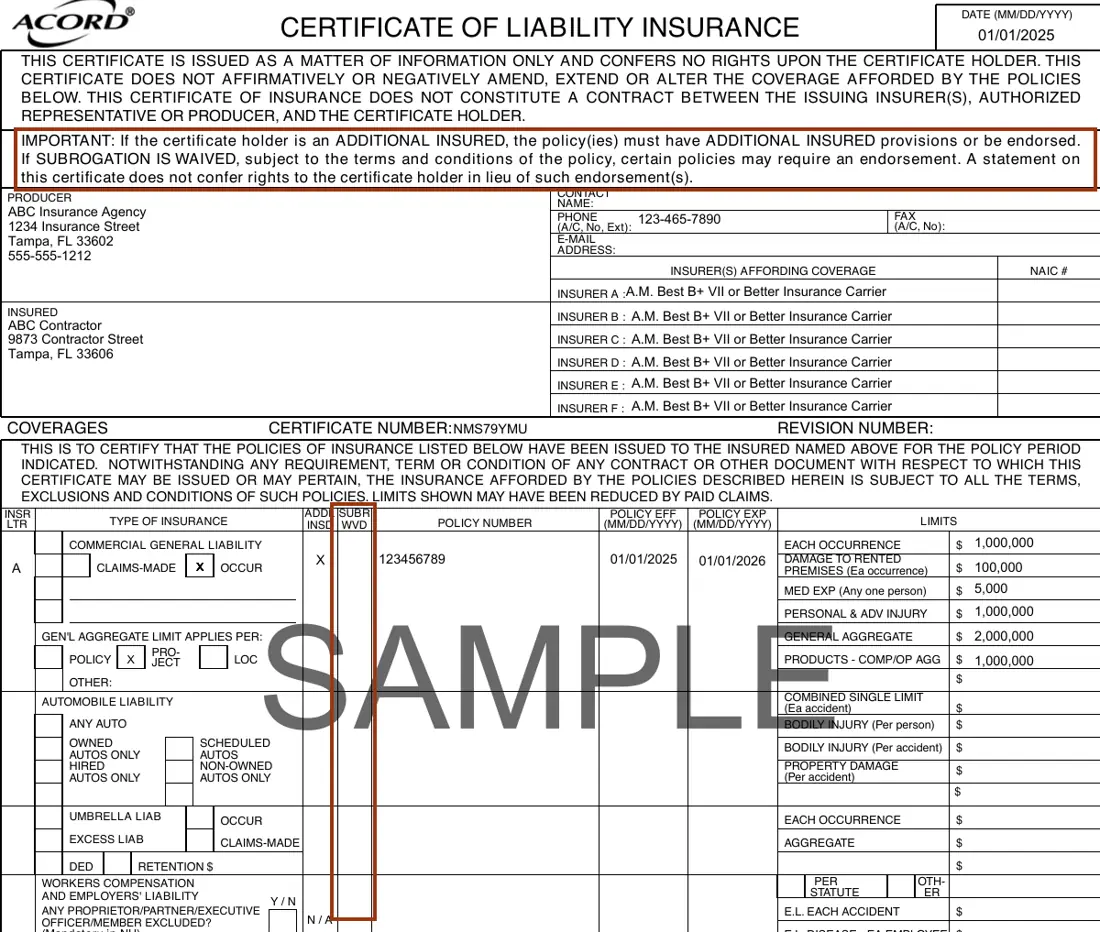
| Item | Certificate (ACORD 25) shows | Endorsement shows |
|---|---|---|
| Waiver exists | An X in the SUBR WVD column next to a policy line | The form number and edition, such as CG 24 04 05 09 |
| Who is protected | Certificate holder name and a free-text description box | The Schedule: named party or blanket written-contract wording |
| Scope | Nothing beyond the checkbox | Ongoing operations and completed work (CG 24 04); written contract condition (WC 00 03 13) |
| Legal effect | “Confers no rights upon the certificate holder” | Changes the policy as of its effective date |
| Which policies | One box per line: CGL, auto, umbrella, WC | One endorsement per policy; the builder’s risk waiver lives in the property policy |
When should you require or accept a waiver of subrogation?
Accept the standard property-insurance waiver on almost every commercial job, because both sides already pay for builder’s risk; scrutinise liability and workers’ compensation waivers, which cost premium and are restricted in some states. The decision table and flowchart hold the same four tests.
| If | Then | Basis |
|---|---|---|
| The project is in Kentucky, Missouri, Kansas or Oregon | Read the statute before signing a workers’ compensation or liability waiver; it may be void or unlawful to require | KRS 342.700(3); RSMo 287.150.6; K.S.A. 16-1803(b)(3); ORS 30.145 |
| The waiver is limited to losses covered by property insurance | Accept it; confirm the builder’s risk policy allows a written pre-loss waiver and who pays the deductible | A201 §11.3.1; Exhibit A §A.2.3.1.4 |
| The contract also asks for CGL or workers’ compensation waivers | Order CG 24 04 05 09 and WC 00 03 13 or the state form; price the charge (2% to 10% of WC manual premium in New York) | Sierra Madre forms; NYCIRB R.C. 2183 |
| You hold only an ACORD 25 with SUBR WVD marked | Ask the agent for the endorsement pages before work starts | ACORD 25 (2016/03); Tex. Ins. Code §1811.152 |
| The waiver runs one way only (sub waives, GC does not) | Ask for a mutual waiver matching A201 §11.3.1, or price the exposure | A201 §11.3.1 is mutual between Owner and Contractor |
What should a waiver of subrogation checklist cover?
Check the contract, the policies and the certificate as a set at signing and again at each renewal. The list below matches the clauses quoted above; the A201 notice duty of 3 business days for a lapsed policy (§11.1.4 for the Contractor, §11.2.3 for the Owner) is the trigger to re-check mid-project. Our AIA contract documents overview shows which documents carry each clause.
| # | Check | Where to look | Pass when |
|---|---|---|---|
| 1 | Waiver clause names all parties | Contract: A201 §11.3.1 or equivalent | Owner, Contractor, Architect, consultants, Separate Contractors, subs and sub-subs listed |
| 2 | Scope matches the insurance | Contract and builder’s risk policy | Limited to property-insured losses, or each extra line has its endorsement |
| 3 | Deductible owner named | A101 Exhibit A §A.2.3.1.4 or §A.3.3.2.1 | Deductible amount disclosed and owner of it stated |
| 4 | Subcontract flow-down | Each subcontract | Same waiver words, same parties |
| 5 | CGL endorsement attached | Contractor’s policy | CG 24 04 05 09 or equivalent naming the party or blanket by written contract |
| 6 | WC endorsement attached | Each employer’s WC policy | WC 00 03 13 or state form; not used where state law voids it |
| 7 | State law checked | Project state statutes | No conflict with KRS 342.700, RSMo 287.150, K.S.A. 16-1803, ORS 30.145 or local law |
| 8 | Certificate matches | ACORD 25 | SUBR WVD marked on each required line and endorsement copies attached |
| 9 | Renewals tracked | Policy dates on the certificate | New endorsements received before each policy expiry |
The waiver works alongside builders risk insurance and the additional insured endorsements on each policy.
How we compiled this
We read 13 primary and public documents in November 2026: the AIA A201-2017 and A101-2017 Exhibit A as published in public bid packages, ISO and NCCI endorsement samples from a city contractor packet, a New York rating board bulletin, an ACORD 25 sample, and the statutes of Kentucky, Missouri, Kansas, Oregon and Texas. One law-firm chart was used only where noted. Dollar examples are CB&C illustrations, not claim data; we excluded case law we could not read in the original.
Frequently asked questions
What does waiver of subrogation mean in simple terms?
It means your insurer agrees in advance not to sue a named party to get back what it paid you. If a subcontractor causes a $400,000 fire and the contract has the AIA A201-2017 §11.3.1 waiver, the builder’s risk insurer pays the owner and cannot pursue that subcontractor for the amount the property insurance covered.
Who benefits from a waiver of subrogation?
The party that would have been sued benefits most: on an AIA job that is the Owner, Contractor, subcontractors, the Architect and consultants, all protected by A201 §11.3.1. The insured gains by keeping the job free of lawsuits, but pays for it: New York allows a workers’ compensation waiver charge of 2% to 10% of manual premium.
Does a waiver of subrogation cost extra?
Usually yes for workers’ compensation and often for general liability. New York’s rating board sets the WC 00 03 13 charge at 2% to 10% of manual premium, with a $250 minimum per policy for blanket coverage (NYCIRB R.C. 2183). On $40,000 of manual premium that is $800 to $4,000. Ask your broker for the exact charge before bidding.
What is a blanket waiver of subrogation?
A blanket waiver covers any person or organization the insured agreed in a written contract to protect, instead of naming one party in the Schedule. The NCCI WC 00 03 13 wording applies only where a written contract requires the waiver, so the blanket form still depends on the contract saying so. Confirm the contract and endorsement name the same parties.
Can an injured worker still sue if there is a waiver of subrogation?
Yes, in most states. WC 00 03 13 binds only the insurer: it will not enforce its recovery right against the scheduled party. The employee’s own tort claim against a negligent general contractor is untouched, and courts split on whether the insurer keeps its lien on the employee’s recovery, per a 2022 50-state law-firm chart.
Is a waiver of subrogation the same as additional insured?
No. Additional insured status, through ISO CG 20 10 or CG 20 37 and A201 §11.1.1, lets the owner claim defense and coverage under the contractor’s policy. A waiver of subrogation, through CG 24 04 05 09 or A201 §11.3.1, only stops an insurer from suing the protected party. Owners usually require both, plus primary and non-contributory wording.
Sources
- AIA A201-2017 General Conditions (sample copy), University of Maine System. Link. Accessed November 15, 2026.
- AIA A101-2017 Exhibit A, Insurance and Bonds, AgriLife Facility, March 20, 2026, Anderson County, TX. Link. Accessed November 15, 2026.
- Sample insurance forms: ISO CG 24 04 05 09, NCCI WC 00 03 13, WC 04 03 06 (Oct 24, 2025), City of Sierra Madre, CA. Link. Accessed November 15, 2026.
- Bulletin R.C. 2183: Waiver of Our Right to Recover from Others Endorsement (WC 00 03 13), Sept 8, 2008, New York Compensation Insurance Rating Board. Link. Accessed November 15, 2026.
- ACORD 25 (2016/03) Certificate of Liability Insurance, sample, City of Tampa, FL. Link. Accessed November 15, 2026.
- KRS 342.700, Kentucky Legislative Research Commission. Link. Accessed November 15, 2026.
- RSMo 287.150, Missouri Revisor of Statutes. Link. Accessed November 15, 2026.
- K.S.A. 16-1803, Kansas Office of Revisor of Statutes. Link. Accessed November 15, 2026.
- ORS 30.145 (chapter 30), Oregon State Legislature. Link. Accessed November 15, 2026.
- Texas Insurance Code chapter 151, §151.102, Texas Legislature. Link. Accessed November 15, 2026.
- Texas Insurance Code chapter 1811, §1811.152, Texas Legislature. Link. Accessed November 15, 2026.
- Workers’ Compensation Subrogation Waiver Endorsements in All 50 States (updated Jan 13, 2022), Matthiesen, Wickert & Lehrer, S.C.. Link. Accessed November 15, 2026.