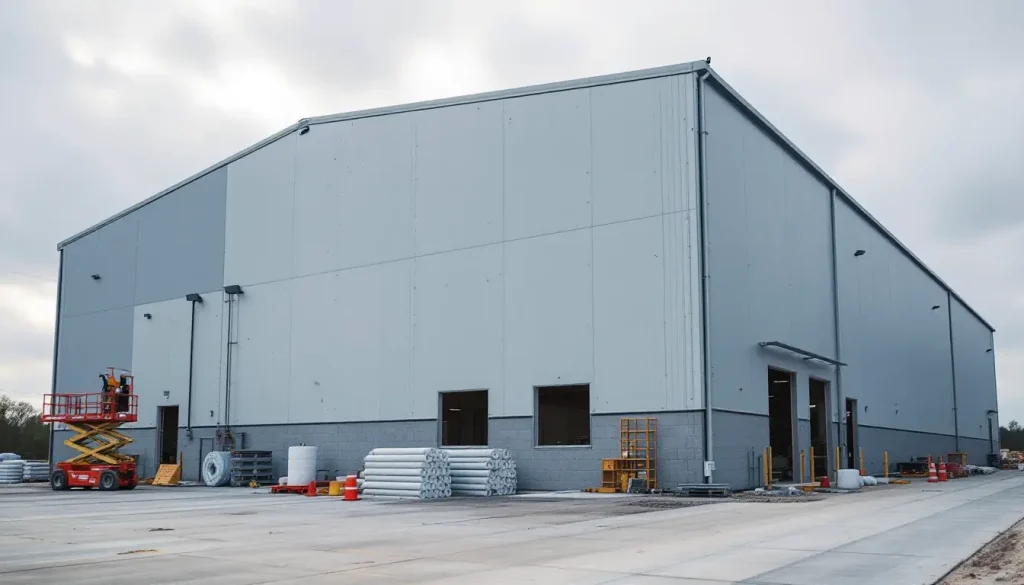
COMcheck is the U.S. Department of Energy’s free software for showing a commercial building meets the IECC or ASHRAE 90.1 energy code; the current COMcheck-Web (October 6, 2025) covers the 2015 to 2024 IECC and 90.1-2013 to 2022.
Key takeaways
- As of November 2026, the U.S. Department of Energy (DOE) lists three COMcheck releases: COMcheck-Web (October 6, 2025), Legacy COMcheck-Web (April 12, 2024) and COMcheck Desktop 4.1.5.5 (March 2, 2022); new codes go into COMcheck-Web only (DOE Building Energy Codes Program, COMcheck page).
- COMcheck produces four compliance certificates: envelope, interior lighting, exterior lighting and mechanical. Envelope and lighting show PASSES or FAILS; mechanical has no single pass or fail (DOE BECP FAQs).
- The 2021 IECC envelope trade-off (Section C402.1.5, Equation 4-2) passes when the sum of proposed minus code-table U x area, F x perimeter and C x area differences is zero or less (2021 IECC Chapter 4).
- In our worked example, a 20,000 sq ft Climate Zone 4A metal building warehouse with an uninsulated slab edge misses by 114.71 Btu/h per degree F; R-15 slab edge insulation turns it into a pass by 11.29.
- Alterations get no trade-off in COMcheck: each altered component must meet the prescriptive value, and the report shows pass or fail with no percentage (DOE BECP FAQs).
What is COMcheck and who makes it?
COMcheck is a free compliance tool from the DOE Building Energy Codes Program (BECP), developed by Pacific Northwest National Laboratory (PNNL). Designers enter the envelope, lighting and HVAC of a new commercial building, addition or alteration, and it reports whether each part meets the IECC, ASHRAE Standard 90.1 or a state-amended code. Plan reviewers and inspectors use the same printout to check the work.
DOE supports the software under its duty to help states carry out model energy codes (42 U.S.C. 6833), and the COMcheck Technical Support Document for version 3.9.1 (PNNL, September 2012) says PNNL built it for DOE to make plan review and site inspection easier. The tool is free, and COMcheck-Web needs only an account with a valid email address.
| Release | Platform | Release date | Codes supported | Source |
|---|---|---|---|---|
| COMcheck-Web (new) | Online | October 6, 2025 | 2015, 2018, 2021, 2024 IECC; 90.1-2013, 2016, 2019, 2022; state-specific codes | DOE BECP |
| Legacy COMcheck-Web | Online | April 12, 2024 | 2015, 2018, 2021 IECC; 90.1-2013, 2016, 2019; state-specific codes | DOE BECP |
| COMcheck Desktop 4.1.5.5 | Windows (104.87 MB) | March 2, 2022 | 2009, 2012, 2015, 2018 IECC; 90.1-2007, 2010, 2013, 2016; state-specific codes | DOE BECP |
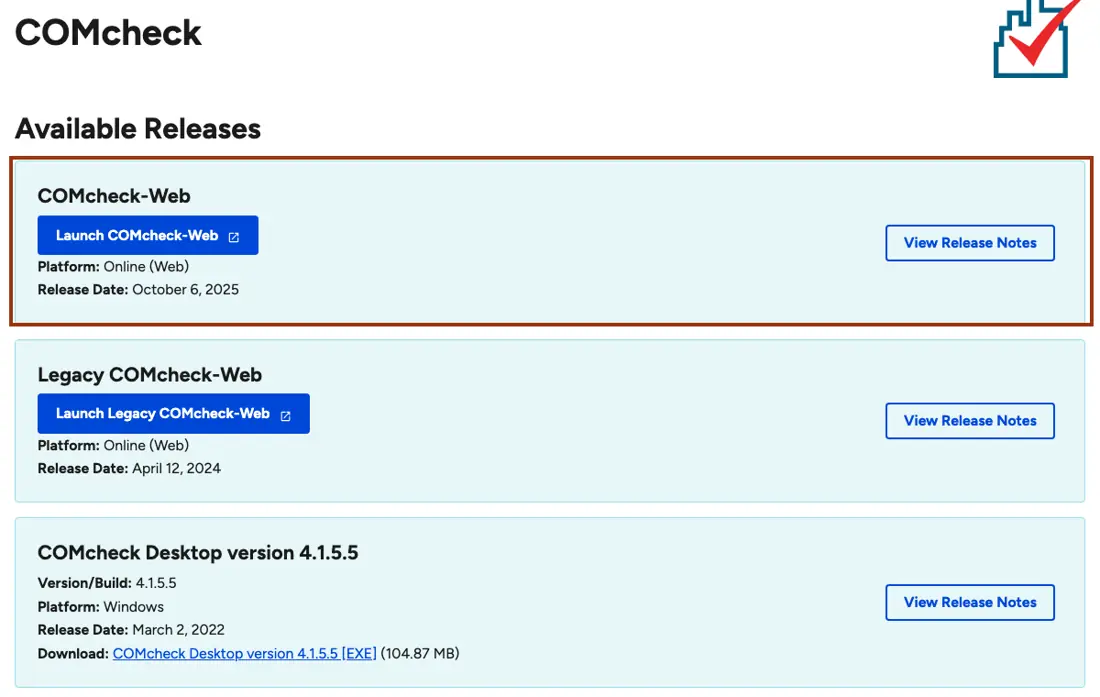
The October 2025 release added the Vermont 2024 standard, the 2024 IECC Appendix CF, an off-site renewable energy module and an energy credit workflow. DOE says the desktop version will eventually lose support, so a project starting in 2026 belongs in COMcheck-Web unless the jurisdiction still enforces a 2009 or 2012 IECC edition.
Which code editions does COMcheck support?
COMcheck-Web supports the 2015, 2018, 2021 and 2024 IECC and ASHRAE 90.1-2013, 2016, 2019 and 2022, plus state-implemented versions. Older editions back to the 2009 IECC and 90.1-2007 run only in Desktop 4.1.5.5. Pick the edition your jurisdiction adopted, not the newest one: a report run on the wrong edition is a common plan review rejection.
The IECC lets a commercial building comply through the IECC itself or through ASHRAE 90.1 (2021 IECC Section C401.2). COMcheck offers both in its code drop-down. A metal building trade association warns that once the 90.1 path is chosen it applies to the whole building: you cannot pair a 90.1 envelope with IECC lighting and mechanical (MBMA COMcheck FAQ, January 2024).
Which states accept COMcheck?
COMcheck works wherever the adopted code edition appears in its drop-down. Checked against DOE data dated September 15, 2026, 25 states enforce a code that COMcheck-Web covers at 90.1-2019 / 2021 IECC or newer, 10 more sit on editions it also covers, 5 need the desktop tool, Oklahoma’s 2006 IECC is not in any current release, and 10 states leave the choice to cities.
| Statewide commercial code in force, October 2026 | States | Current COMcheck release that covers it | Source |
|---|---|---|---|
| ASHRAE 90.1-2022 / 2024 IECC | 10 | COMcheck-Web (new) only | DOE state portal; DOE COMcheck |
| ASHRAE 90.1-2019 / 2021 IECC | 15 | COMcheck-Web or Legacy Web | Same |
| ASHRAE 90.1-2016 / 2018 IECC | 4 | Web, Legacy Web or Desktop 4.1.5.5 | Same |
| ASHRAE 90.1-2013 / 2015 IECC | 6 | Web, Legacy Web or Desktop 4.1.5.5 | Same |
| ASHRAE 90.1-2010 / 2012 IECC | 2 | Desktop 4.1.5.5 only | Same |
| ASHRAE 90.1-2007 / 2009 IECC | 3 | Desktop 4.1.5.5 only | Same |
| ASHRAE 90.1-2004 / 2006 IECC (Oklahoma) | 1 | None of the three current releases lists it | Same |
| No statewide code (home rule) | 10 | Depends on the city or county code | Same |
The state counts come from our registry of the commercial energy code by state, built from the DOE State-Level Commercial Codes Energy Use Index dated September 15, 2026. Texas, for example, has enforced the 2015 IECC for commercial buildings since November 1, 2016, which all three releases cover. Ten home-rule states, including Arizona, Colorado and Missouri, leave the edition to each city, so the city’s adopted code decides which COMcheck code you select.
Supported edition does not mean required tool. COMcheck is an optional way to show compliance; a jurisdiction can accept hand calculations against the code tables, an energy model or its own forms. Philadelphia’s 2023 commercial energy checklist, for example, lets the applicant pick a prescriptive path, COMcheck or performance modeling (Philadelphia L&I checklist P_008_CHK).
What are the four COMcheck reports and who signs them?
A full COMcheck submittal has four compliance certificates (envelope, interior lighting, exterior lighting and mechanical) plus an inspection checklist that the field inspector works from. Plan reviewers expect the certificates signed by the person who completed them. COMcheck can be run by any qualified person, but the jurisdiction may require a registered design professional to sign, under 2021 IECC Section C103.3, so ask the plan reviewer before the first submittal.
| Report | What it checks | Result shown | Code numbers behind it (2021 IECC) | Source |
|---|---|---|---|---|
| Envelope Compliance Certificate | Roof, walls, windows, doors, skylights, floors and slabs: proposed U-factor vs budget U-factor, with trade-offs for new buildings and additions | PASSES or FAILS with a percentage better or worse than code | Table C402.1.4 U-, C- and F-factors; fenestration Table C402.4; 30% vertical glazing cap (C402.4.1) | DOE FAQs; Philadelphia |
| Interior Lighting Compliance Certificate | Installed fixture watts vs the allowance by Building Area Method or Space-by-Space Method | PASSES or FAILS | Table C405.3.2(1): warehouse 0.45 W/sq ft, office 0.64 W/sq ft, retail 0.84 W/sq ft | 2021 IECC |
| Exterior Lighting Compliance Certificate | Connected exterior watts vs base site allowance plus area allowances | PASSES or FAILS | Table C405.5.2(2): base 350, 400, 500 or 900 W for Lighting Zones 1 to 4; parking 0.04 W/sq ft in Zone 2 | 2021 IECC |
| Mechanical Compliance Certificate | HVAC and service water heating systems, required efficiencies and controls | No single pass or fail; a list of requirements the inspector verifies | Tables C403.3.2(1) to (9) equipment efficiencies | DOE FAQs |
DOE recommends one project file for the whole building, with team members working in it through COMcheck-Web’s sharing feature, never at the same time. Lighting-only reports are possible: tick the lighting sections under Reports on the Compliance screen. On a 2021 IECC project, the envelope result may not display until the 10 additional efficiency credits of Section C406.1 are selected, because that edition requires credits for the whole project.
On signatures, Philadelphia’s checklist rejects an envelope certificate that is not “signed by the person completing the report”. Our practical reading: the design professional responsible for each discipline’s drawings signs that discipline’s certificate, so the envelope signer can answer for the wall sections and the mechanical signer for the equipment schedule. This is not legal advice; the building official decides who must seal construction documents.
How does the COMcheck envelope trade-off work?
For new buildings and additions, COMcheck lets a better-than-code component offset a weaker one. The 2021 IECC writes the rule as the component performance alternative, Section C402.1.5: for every assembly, multiply proposed and code-table U-factors by area (F-factors by slab perimeter), subtract, and add the differences. A total of zero or less passes. Window SHGC limits still apply on their own.
Equation 4-2 has five terms. A sums the UA differences for roofs, above-grade walls, windows, doors and floors. B sums the slab-on-grade F x perimeter differences. C sums below-grade wall C x area differences. D adds a penalty when vertical glazing exceeds the 30% cap of Section C402.4.1 (40% in Climate Zones 0 to 6 with daylight responsive controls), and E does the same for skylights over 3% of roof area.
- Pick the climate zone and the “All other” or “Group R” column of 2021 IECC Table C402.1.4.
- Measure each distinct assembly: roof area, net opaque wall area, each window and door type, slab perimeter in feet.
- Find each proposed U-factor in ASHRAE 90.1 Appendix A (footnote a of Table C402.1.4 allows it) or a test to ASTM C1363.
- Compute UA proposed minus UA table for each line, and F x perimeter for the slab.
- Add the lines; a sum of 0 or less passes, then confirm SHGC and mandatory air leakage items separately.
COMcheck itself runs a load-based version of this idea. Its FAQ says the compliance method comes from ASHRAE 90.1 Appendix C, and the 3.9.1 support document says trade-offs are judged on annual heating and cooling loads, so the percentage on the certificate will not equal the plain UA sum below. The direction is the same: weaker walls need stronger roofs, windows or slabs.
Worked example: a metal building warehouse in Climate Zone 4A
Take a 100 ft x 200 ft conditioned metal building warehouse with a 24 ft eave in Climate Zone 4A under the 2021 IECC, “All other” column. The roof is 20,000 sq ft, the gross wall 14,400 sq ft, and after 400 sq ft of windows, 672 sq ft of overhead doors and 84 sq ft of swinging doors, the opaque wall is 13,244 sq ft. The slab perimeter is 600 ft.
| Component | Area or length | Proposed U or F | Table U or F (CZ 4A) | UA proposed | UA table | Difference |
|---|---|---|---|---|---|---|
| Roof, liner system R-25 + R-11 | 20,000 sq ft | U-0.031 | U-0.035 | 620.00 | 700.00 | -80.00 |
| Walls, R-25 in cavity with R-0.375 thermal break strip | 13,244 sq ft | U-0.059 | U-0.052 | 781.40 | 688.69 | +92.71 |
| Fixed windows (assumed NFRC U-0.30) | 400 sq ft | U-0.30 | U-0.36 | 120.00 | 144.00 | -24.00 |
| Overhead doors, 4 at 12 x 14 ft | 672 sq ft | U-0.31 | U-0.31 | 208.32 | 208.32 | 0.00 |
| Swinging doors, 4 at 3 x 7 ft | 84 sq ft | U-0.37 | U-0.37 | 31.08 | 31.08 | 0.00 |
| A, envelope subtotal | -11.29 | |||||
| Design 1: bare slab edge (term B) | 600 ft | F-0.73 | F-0.52 | 438.00 | 312.00 | +126.00 |
| Design 1 total, A + B | +114.71: FAILS | |||||
| Design 2: R-15 slab edge, 24 in. deep (term B) | 600 ft | F-0.52 | F-0.52 | 312.00 | 312.00 | 0.00 |
| Design 2 total, A + B | -11.29: PASSES |
Table values come from 2021 IECC Tables C402.1.4 and C402.4, Climate Zone 4 except Marine. The roof and wall U-factors are ASHRAE 90.1-2022 Appendix A metal building values as reproduced in the Owens Corning code compliance guide, Pub. 10015581-J (September 2026). F-0.73 is the code’s uninsulated slab value (footnote e), and Table C402.1.3 pairs F-0.52 with R-15 for 24 in. below grade. C, D and E are zero: no basement, 2.8% glazing and no skylights.
The roof and window upgrades together buy back 104 units, enough to carry the 92.71-unit wall shortfall but not the 126-unit bare slab. That is why the MBMA FAQ suggests checking slab insulation when a run keeps failing. A single compressed R-19 wall layer (U-0.147) would put the walls 1,258.18 units over, and even the best Appendix A liner roof at U-0.026 recovers only 180, so no roof upgrade saves that wall. Our steel building insulation guide lists the full roof and wall assembly table.
What does a warehouse need before the envelope is checked at all?
A warehouse still needs an envelope check unless it qualifies as low-energy or unconditioned. 2021 IECC Section C402.1.1 exempts buildings with space conditioning below 3.4 Btu/h per sq ft or 1.0 W per sq ft, and greenhouses. ASHRAE 90.1-2019 and 2022 Section 5.1.6.3 make the opposite default: spaces count as conditioned unless the building official approves semiheated or unconditioned.
MBMA adds that any air conditioning makes a space conditioned, even if the heating alone would fit the semiheated limit of 90.1-2019 Table 3.2. The office and the warehouse floor can be classed separately. Settle the classification in writing with the building official before entering the envelope, because a semiheated roof in Climate Zone 4 under 90.1-2022 may be as high as U-0.082 against U-0.037 conditioned.
What gets a COMcheck report rejected at plan review?
Most rejections are data mismatches, not failed results. Philadelphia’s 2023 commercial energy checklist tells reviewers to confirm the code edition and location, the glazing percentage against the elevations, every assembly against the wall sections, the signature and plan page references in the inspection checklist. Missing slabs, default window values and unsupported “Other” U-factors fill most of the remaining failures.
| Rejection reason | What the reviewer checks | Fix before resubmitting | Source |
|---|---|---|---|
| Wrong code edition or city | Energy code field matches the adopted code (2018 IECC or 90.1-2016 in Philadelphia); location matches the site | Select the adopted edition; if the city is not listed, choose the closest city with similar weather and confirm with the official | Philadelphia; DOE FAQs |
| Outdated software version | Heading shows COMcheck 4.1.1 or higher | Rerun in the current release | Philadelphia |
| Glazing percentage looks wrong | Vertical glazing / wall percentage vs elevation drawings | Re-measure window and wall areas per elevation | Philadelphia |
| Missing assemblies | Every unique assembly listed, including cantilevered floors, floors over garages and the slab | Enter all six sides of the envelope; the floor counts | Philadelphia; NIA Insulation Outlook, 2014 |
| Cavity R-value in the continuous column | Cavity and continuous insulation (c.i.) entered in the right fields | Move cavity values; thermal spacer blocks and insulated metal panels do not count as c.i. | Philadelphia; MBMA |
| Unsigned certificate | Signed by the person completing the report | Sign each certificate; ask whether a registered design professional seal is needed (C103.3) | Philadelphia; MBMA |
| Inspection checklist without page references | Envelope, plumbing and mechanical rough-in items point to plan and spec pages | Add sheet numbers to each checklist line | Philadelphia |
| HVAC data does not match the schedule | Number, type and capacity of systems vs the equipment schedule | Enter each unit from the mechanical schedule | Philadelphia |
| “Other” U-factor with no calculation | Calculation for any custom assembly | Attach the U-factor math or ASTM C1363 test data | DOE FAQs |
| Default window and door values | Code default (unlabeled) values are low performing and often cause a fail | Use manufacturer NFRC ratings | MBMA |
| Louvers and penetrations left out | Mechanical louvers entered as their own wall or roof assembly | Add them; 90.1-2019 allows up to 1% of wall area as recessed equipment | DOE FAQs; MBMA |
The checklist then goes to the field: the inspector verifies insulation, windows and equipment against the same items. Treat the COMcheck inputs as part of the construction documents, and log any later product substitution through submittals so the certificate still matches what was built.
How do you run COMcheck step by step?
A COMcheck run takes the drawings, the adopted code and manufacturer data. Gather wall sections, the window schedule with NFRC U-factor and SHGC, the lighting fixture schedule with input watts and the mechanical equipment schedule before opening the software, because default values for windows and doors tend to fail. Then follow the order of the tabs.
- Confirm the adopted code edition with the building department and the climate zone in 2021 IECC Chapter 3 (or the edition in force).
- Open COMcheck-Web, create a project, and select the code, city and project type (new construction, addition or alteration).
- Enter building use by activity type and floor area; these must match the plans.
- Envelope: add each roof, wall, window, door, floor and slab with area, orientation and R-value or U-factor.
- Interior and exterior lighting: enter fixtures by space or building area and the exterior lighting zone.
- Mechanical: add each HVAC and water heating system from the schedule; answer the requirements tab.
- For 2021 IECC projects, select the 10 Section C406.1 efficiency credits.
- Run compliance, fix any FAILS, export the report and sign each certificate.
- Add plan and spec page references to the inspection checklist and submit with the permit set.
COMcheck vs ASHRAE 90.1 Appendix G: which path fits?
COMcheck checks each system against code values, with trade-offs only inside the envelope. A whole-building path, IECC Section C407 or ASHRAE 90.1 Appendix G, simulates annual energy cost and can trade lighting or HVAC gains against a weaker envelope or more glass. It costs more because it needs an energy modeler, but it is the route when glazing or envelope gaps are too big for COMcheck.
| Path | How compliance is judged | Trade-offs allowed | Documentation | Source |
|---|---|---|---|---|
| IECC prescriptive (C402 to C406, C408) | Each component meets table values | None | Plans and schedules; COMcheck optional | 2021 IECC C401.2.1 |
| COMcheck (IECC or 90.1) | Envelope: proposed vs budget; lighting: watts vs allowance; mechanical: requirement list | Within the envelope only, new construction and additions | Four certificates and inspection checklist | PNNL TSD 3.9.1 |
| IECC total building performance (C407) | Annual energy cost of proposed design at or below 80% of the standard reference design | Across envelope, HVAC, water heating and lighting; on-site renewables capped at 5% of cost | Compliance report naming the preparer and software; inputs and outputs on request | 2021 IECC C407.2, C407.3 |
| ASHRAE 90.1-2019 Appendix G | Performance Cost Index (PCI) at or below the target PCIt, built from a fixed 90.1-2004 baseline and a building performance factor (BPF) | Whole building; renewables credited up to 5% of baseline cost | Simulation report and compliance forms | PNNL-29674 PRM manual, 2023 |
The BPF sets how much better than the 2004-level baseline a building must model. For 90.1-2019 in Climate Zone 4A, PNNL lists a BPF of 0.44 for warehouses, 0.51 for offices and 0.51 for retail. Federal agencies use the same Appendix G method for new federal buildings designed on or after April 7, 2023, with savings reported as 100 x (1 minus PCI / PCIt) under 10 CFR 433.101.
Which compliance path should you use?
Use COMcheck when the code edition is in its list and the envelope is near the table values. Use plain prescriptive documentation when every assembly already meets the tables. Move to an energy model when glazing passes 30% of the wall without daylight controls, or when the trade-off sum stays positive after realistic upgrades. The table and flowchart give the same logic.
| If | Then | Rule |
|---|---|---|
| Group R-2, R-3 or R-4 building of 3 stories or less | Use REScheck, not COMcheck | DOE FAQs |
| Mixed-use building with apartments over shops | Run REScheck for the residential part and COMcheck for the commercial part | DOE FAQs |
| Adopted code is the 2009 or 2012 IECC, or 90.1-2007 or 2010 | Use COMcheck Desktop 4.1.5.5 | DOE COMcheck page |
| Alteration of an existing building | Each altered component must meet the prescriptive value; no percentage, no trade-off | DOE FAQs |
| Every assembly meets 2021 IECC Table C402.1.4 or C402.1.3 | Prescriptive path; COMcheck still documents it in one file | 2021 IECC C402.1 |
| One or two assemblies miss and the sum A + B + C + D + E is 0 or less | COMcheck envelope trade-off | 2021 IECC C402.1.5 |
| Vertical glazing over 30% of gross wall (over 40% with daylight controls in Climate Zones 0 to 6) | Trade-off with term D, or a C407 or 90.1 Appendix G energy model | 2021 IECC C402.4.1 |
| Trade-off sum stays positive after upgrades | Whole-building model: cost at or below 80% (C407) or PCI at or below PCIt (Appendix G) | 2021 IECC C407.2; PNNL-29674 |
| Historic building listed or eligible for listing | Possibly exempt; confirm with the state or local official | DOE FAQs |
On a pre-engineered metal building or a tilt-up warehouse, run COMcheck during design, before the building package or panels are ordered: the worked example shows that a slab edge detail can decide the result. When the HVAC is large enough to need commissioning (Philadelphia flags 480,000 Btu/h cooling or 600,000 Btu/h heating plus water heating), plan the building commissioning scope at the same time.
Which code edition you check against depends on the commercial energy code by state, and envelope choices like steel building insulation carry most trade-offs.
How we compiled this
We read the DOE BECP COMcheck page, its technical assistance FAQs, the PNNL COMcheck Technical Support Document 3.9.1, the 2021 IECC Chapter 4 text on the ICC public viewer, Philadelphia’s 2023 plan review checklist, the MBMA COMcheck FAQ, a manufacturer reproduction of 90.1-2022 Appendix A, PNNL-29674, 10 CFR 433.101, 42 U.S.C. 6833, the DOE state portal and a 2014 insulation trade article: 12 documents, accessed in October and November 2026. State counts reuse our October 2026 registry. The worked example is our arithmetic on code table values, not a COMcheck run, so COMcheck’s load-based percentage will differ.
Frequently asked questions
Is COMcheck free?
Yes. COMcheck is free software from the U.S. Department of Energy Building Energy Codes Program. COMcheck-Web runs in a browser after you create an account with a valid email address, and COMcheck Desktop 4.1.5.5 is a free 104.87 MB Windows download. Building departments do not charge for the tool, though they may charge plan review fees for the permit it supports.
What is the difference between COMcheck and REScheck?
REScheck covers residential buildings under the energy code: one- and two-family homes, townhouses and Group R-2, R-3 and R-4 buildings of three stories or less. COMcheck covers everything else, including apartment buildings of four or more stories. A mixed-use building with apartments over shops needs a REScheck file for the residential part and a COMcheck file for the commercial part, according to DOE.
Does COMcheck work for a building alteration?
Yes, but without trade-offs. For an alteration, COMcheck checks only the altered components, each against the prescriptive value of the selected code, and shows pass or fail with no percentage. For an addition, COMcheck treats the new portion like new construction and allows envelope trade-offs. Entering an alteration as new construction to get trade-offs requires modeling the whole building.
What does the percentage on a COMcheck envelope report mean?
It shows how far the proposed envelope beats or misses a budget building that just meets the code tables, calculated with COMcheck’s load-based method drawn from ASHRAE 90.1 Appendix C. Plan reviewers look for the compliance field to read PASSES. When a run fails, MBMA suggests starting with the assemblies whose proposed U-factor most exceeds the budget U-factor, or insulating the slab
Who can prepare and sign a COMcheck report?
Any qualified person can prepare a COMcheck report, according to the Metal Building Manufacturers Association, but the jurisdiction may require a registered design professional under 2021 IECC Section C103.3. Philadelphia’s plan review checklist rejects an envelope certificate not signed by the person who completed it. Ask the plan reviewer which certificates need a seal before submitting.
Can COMcheck trade lighting savings against a weak envelope?
No. In COMcheck the envelope, lighting and mechanical sections must each comply on their own; the PNNL support document states that trade-offs between major systems are not permitted. Trading lighting or HVAC gains against the envelope needs a whole-building energy model under 2021 IECC Section C407, at or below 80% of reference energy cost, or ASHRAE 90.1 Appendix G.
Sources
- U.S. DOE Building Energy Codes Program, COMcheck (releases and supported codes), accessed 2026-11-15.
- U.S. DOE Building Energy Codes Program, Frequently Asked Questions, accessed 2026-11-15.
- PNNL for DOE, Technical Support Documentation for COMcheck through Version 3.9.1, September 2012, accessed 2026-11-15.
- International Code Council, 2021 IECC Chapter 4 CE, Commercial Energy Efficiency, accessed 2026-11-15.
- City of Philadelphia L&I, Commercial Energy Plan Review Checklist P_008_CHK, January 2023, accessed 2026-11-15.
- Metal Building Manufacturers Association, COMcheck FAQ for Metal Building Systems, January 2024, accessed 2026-11-15.
- Owens Corning, Metal Building Insulation Energy Code Compliance Guide, Pub. 10015581-J (reproduces ASHRAE 90.1-2022 Appendix A), September 2026, accessed 2026-10-26.
- PNNL, ANSI/ASHRAE/IES Standard 90.1-2019 Performance Rating Method Reference Manual, PNNL-29674, November 2023, accessed 2026-11-15.
- eCFR, 10 CFR 433.101 Performance level determination, accessed 2026-11-15.
- U.S. DOE, State Portal: Status of State Energy Code Adoption, accessed 2026-11-15.
- Legal Information Institute, 42 U.S.C. 6833, accessed 2026-11-15.
- National Insulation Association, Ensuring Compliance with COMcheck for Metal Buildings, Insulation Outlook, September 2014, accessed 2026-11-15.