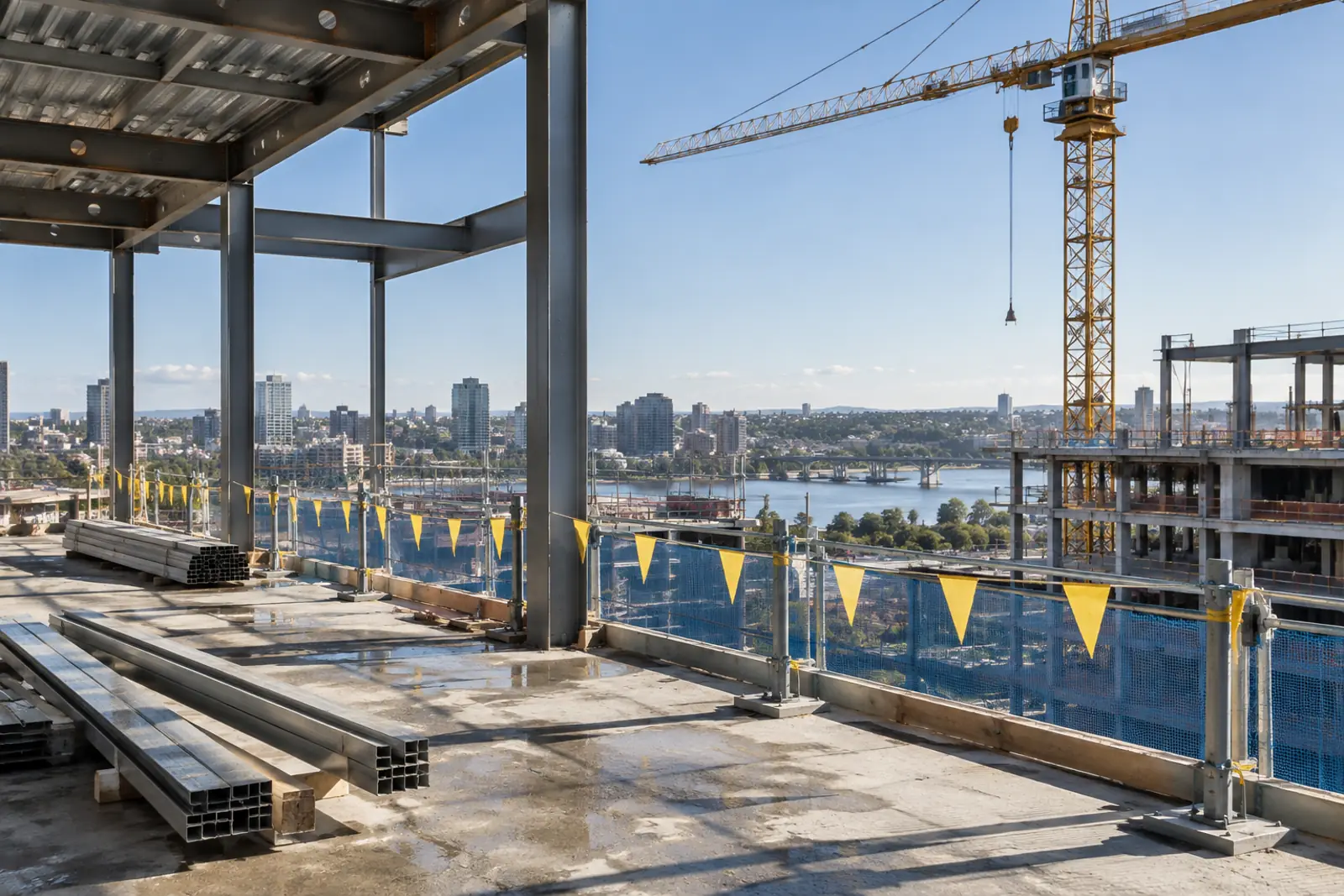
Construction Safety: The Data, the Focus Four and What Works
Construction safety data are stark: 1,034 U.S. construction workers died on the job in 2024, a rate of 9.2 per 100,000 full-time workers against 3.3 for all workers. Falls caused 37.6% of deaths. OSHA's Focus Four hazards are falls, struck-by, caught-in or -between and electrocution, and fall protection is its most cited construction rule.
Construction Safety by the Numbers
Construction safety is measured, in the end, by who goes home. U.S. private construction recorded 1,034 fatal work injuries in 2024, 20.4% of all 5,070 workplace deaths, while accounting for 7.6% of hours worked. The construction fatality rate was 9.2 per 100,000 full-time equivalent workers, against 3.3 for all workers. Deaths fell 3.8% from 1,075 in 2023, and the rate is below the 9.8 recorded in 2014, but progress has been slow for a decade.
Fatal work injuries per 100,000 full-time equivalent workers, 2011 to 2024
Source: U.S. Bureau of Labor Statistics, Census of Fatal Occupational Injuries, hours-based rate tables 2011 to 2024
Commercial building work is not exempt. Deaths in commercial and institutional building construction rose 18.4% to 58 in 2024. Our construction worker deaths report has the full breakdown by state, trade and cause.
What Kills and Injures Construction Workers
Falls dominate. Falls, slips and trips caused 37.6% of construction deaths in 2024, and construction accounted for 46.1% of all fatal falls at work in the U.S. Transportation incidents, harmful exposures and contact with objects and equipment follow. Two newer patterns matter too: 24 construction workers died from environmental heat, half of all heat deaths at work, and 90 died from unintentional overdoses on the job.
Construction fatal work injuries by event or exposure
Source: U.S. Bureau of Labor Statistics, CFOI Table A-1, 2024 (released February 2026)
Risk is concentrated in a few trades. Roofers died at a rate of 48.7 per 100,000 full-time workers, several times the construction average, and helpers and ironworkers are also far above it.
Fatal work injuries per 100,000 FTE workers, 2024
Source: U.S. Bureau of Labor Statistics, CFOI hours-based rates, 2024
OSHA's Focus Four Hazards
OSHA organizes construction hazard training around the Focus Four: falls, struck-by, caught-in or -between, and electrocution. Its Construction Focus Four Training provides lesson plans for each. The table matches each hazard to the closest BLS category for 2024 deaths.
| Focus Four hazard | Closest BLS CFOI category | Construction deaths, 2024 | Typical controls |
|---|---|---|---|
| Falls | Falls, slips, trips (of which fall to lower level: 373) | 389 | Guardrails, safety nets, personal fall arrest, covered openings, ladder and scaffold inspection |
| Struck-by | Struck by object | 79 | Overhead protection, secured loads, traffic plans, high-visibility clothing |
| Caught-in or -between | Caught or struck by running equipment; collapse or engulfment | 35; 37 | Trench protective systems, equipment guarding, lockout, swing-radius barricades |
| Electrocution | Exposure to electricity | 52 | De-energize and lock out, keep clear of overhead lines, ground-fault protection |
BLS event categories do not map exactly to OSHA's hazard names; categories overlap with the totals for contact incidents.
Fall Protection: The Rule Cited Most
Under 29 CFR 1926.501, each construction worker on a walking or working surface with an unprotected side or edge 6 feet or more above a lower level must be protected by guardrails, safety nets or a personal fall arrest system. OSHA's fall protection overview contrasts that with four feet in general industry. Duty to have fall protection is the standard OSHA cites most often in construction, and Subpart M fall protection made up 35.6% of federal construction citations in FY2024.
- Plan fall protection in the bid and schedule, not on the day the deck goes up.
- Cover and label floor holes and skylights as soon as they exist.
- Inspect harnesses, lanyards and anchors before each use, and train workers to use them.
- Treat ladders and scaffolds as fall hazards: inspect scaffolds and set ladders correctly.
- Have a rescue plan for anyone caught by a fall arrest system.
Heat Illness on Construction Sites
OSHA reissued its heat National Emphasis Program on April 10, 2026. It covers construction and treats days with a forecast heat index of 80 degrees Fahrenheit or more as heat priority days, when inspectors may look at heat hazards. Even without a dedicated heat standard, OSHA can cite heat hazards under the General Duty Clause, which requires a workplace free from recognized hazards likely to cause death or serious harm.
- Water, rest, shade
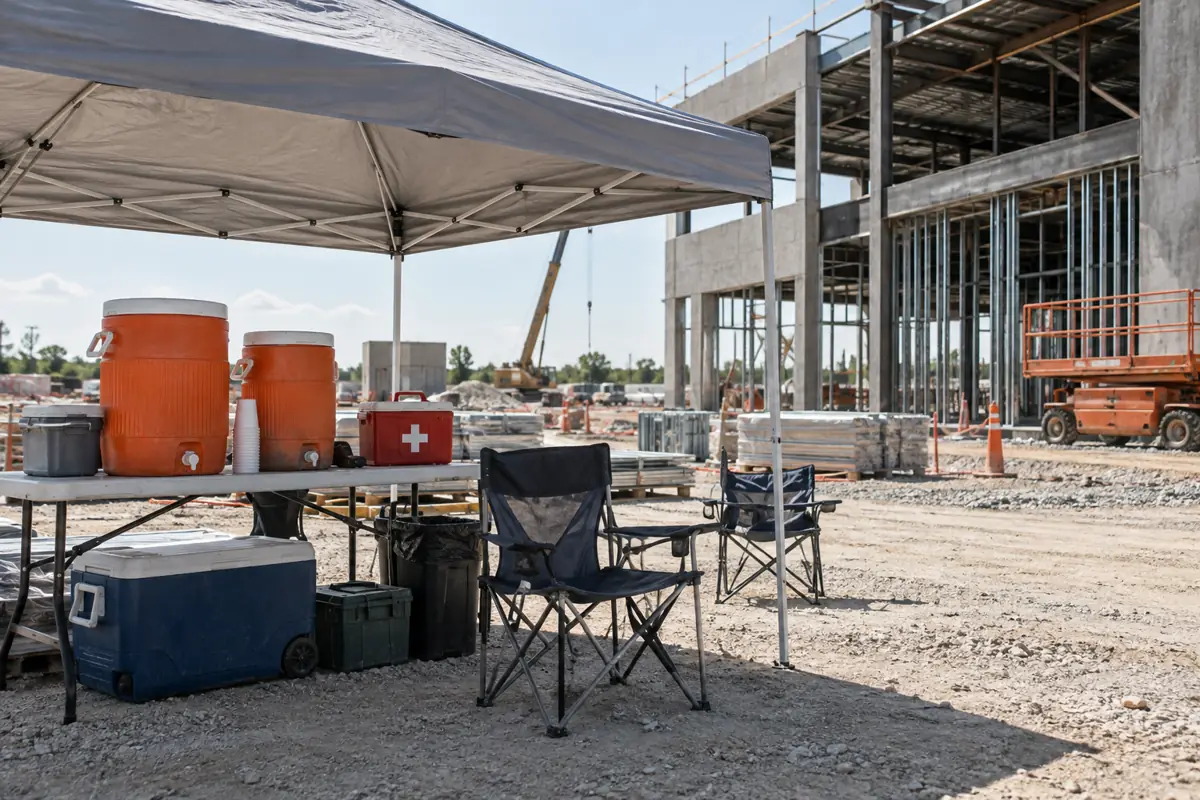
Make cool water and shaded rest available close to the work, and schedule breaks by the heat index.
- Acclimatize new workers
New and returning workers are most at risk in their first days; build up their exposure gradually.
- Watch each other
Train crews to spot heat illness symptoms and to stop work and call for help.
- Shift the hardest work
Move heavy tasks to cooler hours where the schedule allows.
Struck-By, Caught-In and Electrical Hazards
The other three Focus Four hazards kill fewer workers than falls, but they are just as predictable. In 2024, 79 construction workers died after being struck by an object, and transportation incidents, including vehicles and equipment in work zones, killed 244. Trench and excavation collapses killed 13, and construction accounted for 72.2% of all such deaths at work. Exposure to electricity killed 52.
- Struck-by: secure loads before lifting, keep people out from under suspended loads, and separate pedestrians from moving equipment with barriers and spotters.
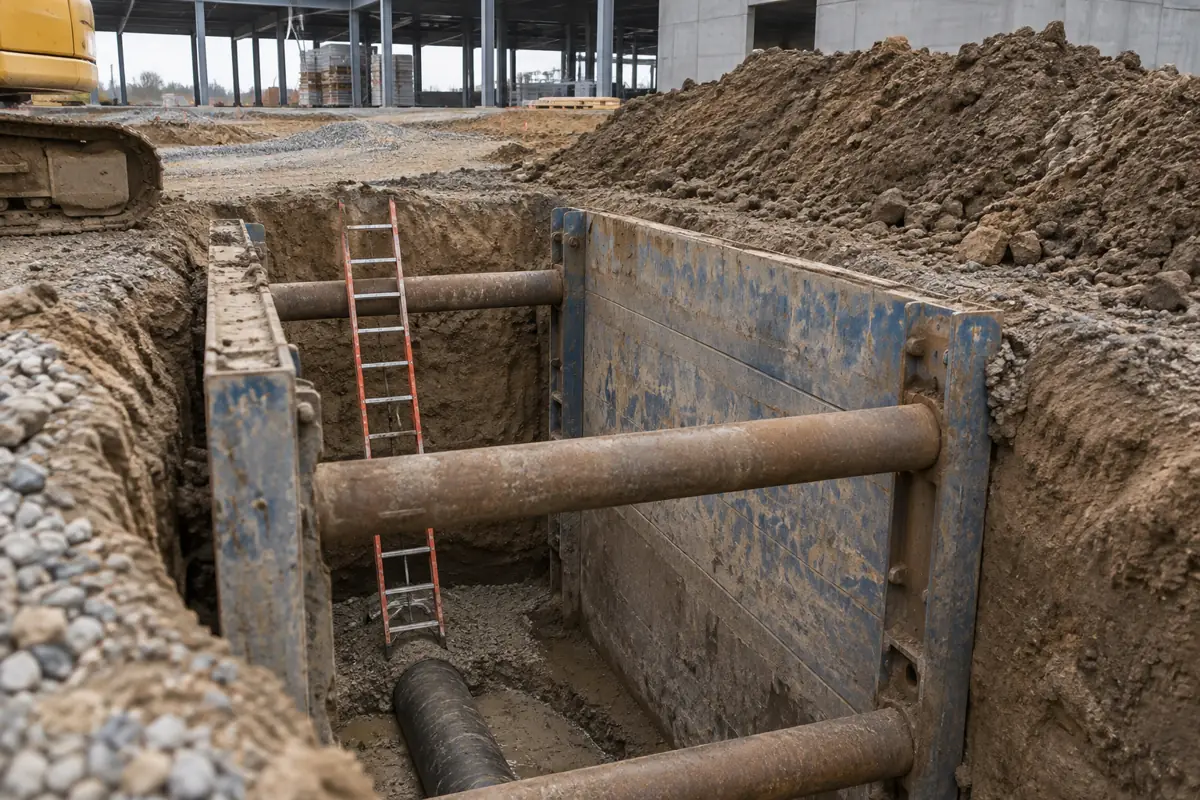
- Caught-in or -between: never enter an unprotected trench; use sloping, shoring or a trench box, keep spoil back from the edge, and barricade the swing radius of excavators and cranes.
- Electrocution: locate and mark overhead and buried lines before work, de-energize and lock out circuits, and use ground-fault protection on temporary power.
- Health hazards: cutting and grinding concrete and masonry create silica dust covered by 1926.1153; use water or vacuum controls and respiratory protection where required.
What OSHA Cites on Commercial Building Sites
Federal OSHA issued 1,145 citations to nonresidential building contractors in FY2024. Fall protection made up 20.9% of them, less than in residential or specialty trade work, while scaffolds, respiratory protection and silica were more common. Penalties can be steep: in 2026 the maximum is $16,550 per serious violation and $165,514 per willful or repeat violation. See OSHA violations in commercial construction for every standard and subsector.
| Standard | Citations (NAICS 2362) | Share of 2362 citations | Average penalty per citation |
|---|---|---|---|
| 1926.501 Duty to have fall protection | 163 | 14.2% | $8,112 |
| 1926.451 Scaffolds, general requirements | 119 | 10.4% | $3,642 |
| 1926.1053 Ladders | 58 | 5.1% | $3,552 |
| 1910.134 Respiratory protection | 56 | 4.9% | $1,998 |
| 1926.1153 Respirable crystalline silica | 53 | 4.6% | $2,784 |
| 1926.20 General safety and health provisions | 50 | 4.4% | $5,431 |
Federal OSHA only; state-plan states are not included. Penalties are current penalties after any reductions.
Source: [7]
The nonfatal injury and illness rate for nonresidential building construction was 1.9 cases per 100 full-time workers in 2024, below 2.2 for all construction.
What a Construction Safety Program Needs
OSHA's Recommended Practices for Safety and Health Programs lay out a step-by-step approach built on seven core elements: management leadership, worker participation, hazard identification and assessment, hazard prevention and control, education and training, program evaluation and improvement, and communication and coordination among host employers, contractors and staffing agencies. That last element matters on multi-employer commercial sites where a general contractor and many subcontractors share the same hazards.
- Written site-specific safety planCovering falls, scaffolds, excavation, electrical, cranes, heat and silica as they apply to the job.
- Training recordsOSHA 10-hour cards for workers and 30-hour cards for supervisors and those with safety duties, plus task-specific training.
- Daily and weekly inspectionsDocumented by the superintendent or safety lead, with hazards fixed and closed out.
- Subcontractor prequalificationReview each subcontractor's safety record and program before award.
- Incident and near-miss reportingInvestigate causes, not blame, and share lessons across crews.
Safety and culture go together. Crews that feel free to stop unsafe work and report near misses prevent the next incident; read construction jobsite culture on how supervisors set that tone. Workers' compensation costs reflect safety records, and our workers comp rates by state report shows how much those costs vary.
Any welding, cutting or torch roofing on site should run under a signed hot work permit with a fire watch.
What Owners Should Ask About Safety
Project owners carry real exposure when a builder runs an unsafe site: delays, investigations and reputational damage. Before you hire, ask for the builder's written safety program, recent incident history and training records, and search the firm in OSHA's public establishment records. Our how we vet builders page explains how we use that search, and how to win commercial construction bids explains why builders with clean records win more prequalified work. For careers in safety and the trades, see construction careers; more articles are on the CB&C blog.
Safety also belongs in the contract. Owners can require a site-specific safety plan before mobilization, regular safety meetings that include subcontractors, prompt reporting of serious incidents to the owner, and a named person on site responsible for safety. These terms cost little to write and make expectations clear before the first crew arrives, when changing them is still easy.
Guardrail heights under the OSHA general industry and construction rules, set against the building code's 42 in guard, are compared in our guide to handrail and guardrail height.
Frequently asked questions
What is the leading cause of death in construction?
Falls. Falls, slips and trips caused 37.6% of U.S. construction deaths in 2024, 389 of 1,034.
What are OSHA's Focus Four hazards?
Falls, struck-by, caught-in or -between, and electrocution. OSHA builds its construction hazard training around them.
At what height is fall protection required in construction?
At 6 feet or more above a lower level for workers on surfaces with unprotected sides or edges, under 29 CFR 1926.501, with guardrails, safety nets or personal fall arrest systems.
Is construction more dangerous than other industries?
Yes. The construction fatality rate was 9.2 per 100,000 full-time workers in 2024 against 3.3 for all workers, and construction recorded more deaths than any other sector.
Which construction trade is most dangerous?
Roofers, with a 2024 fatality rate of 48.7 per 100,000 full-time workers, followed by structural iron and steel workers.
Does OSHA have a heat rule for construction?
OSHA enforces heat hazards through its heat National Emphasis Program and the General Duty Clause. The program treats days with a heat index of 80 degrees Fahrenheit or more as heat priority days.
What is the difference between OSHA 10 and OSHA 30?
The 10-hour class gives workers awareness of common job hazards; the 30-hour class is more appropriate for supervisors or workers with safety responsibility.
Sources
- [1] U.S. Bureau of Labor Statistics. National Census of Fatal Occupational Injuries in 2024 (news release USDL-26-0230). Accessed 2026-10-04.
- [2] U.S. Bureau of Labor Statistics. CFOI Table A-1: Fatal occupational injuries by industry and event or exposure, 2024. Accessed 2026-10-04.
- [3] U.S. Bureau of Labor Statistics. CFOI Table A-9: Fatal occupational injuries by event or exposure and major private industry sector, 2024. Accessed 2026-10-04.
- [4] U.S. Bureau of Labor Statistics. National hours-based fatal injury rates by industry, occupation and demographics, 2024. Accessed 2026-10-04.
- [5] U.S. Bureau of Labor Statistics. CFOI archive: hours-based rate tables, 2011 to 2022. Accessed 2026-10-04.
- [6] U.S. Bureau of Labor Statistics. Hours-based fatal injury rates, 2023. Accessed 2026-10-04.
- [7] Occupational Safety and Health Administration. Frequently Cited OSHA Standards: NAICS 2362 Nonresidential Building Construction, Federal, FY2024 (archived Nov. 10, 2024). Accessed 2026-10-04.
- [8] Occupational Safety and Health Administration. Frequently Cited OSHA Standards: NAICS 23 Construction, Federal, FY2024 (archived Nov. 5, 2024). Accessed 2026-10-04.
- [9] Occupational Safety and Health Administration. Construction Focus Four Training. Accessed 2026-10-07.
- [10] Occupational Safety and Health Administration. 29 CFR 1926.501 Duty to have fall protection. Accessed 2026-10-07.
- [11] Occupational Safety and Health Administration. Fall Protection: Overview. Accessed 2026-10-07.
- [12] Occupational Safety and Health Administration. OSHA Instruction CPL 03-00-024, National Emphasis Program: Outdoor and Indoor Heat-Related Hazards (April 10, 2026). Accessed 2026-10-04.
- [13] Occupational Safety and Health Administration. Heat: Standards (General Duty Clause). Accessed 2026-10-07.
- [14] Occupational Safety and Health Administration. Recommended Practices for Safety and Health Programs. Accessed 2026-10-07.
- [15] Occupational Safety and Health Administration. Outreach Training Program (10- and 30-hour cards). Accessed 2026-10-07.
- [16] Occupational Safety and Health Administration. 2026 OSHA Civil Penalties Update (memo, May 21, 2026). Accessed 2026-10-04.
- [17] U.S. Bureau of Labor Statistics. Survey of Occupational Injuries and Illnesses, Table 1: Incidence rates by industry and case types, 2024. Accessed 2026-10-04.
- [18] U.S. Bureau of Labor Statistics. CFOI Table A-1, 2023. Accessed 2026-10-04.
- [19] Occupational Safety and Health Administration. Top 10 Most Frequently Cited Standards, FY2025. Accessed 2026-10-07.