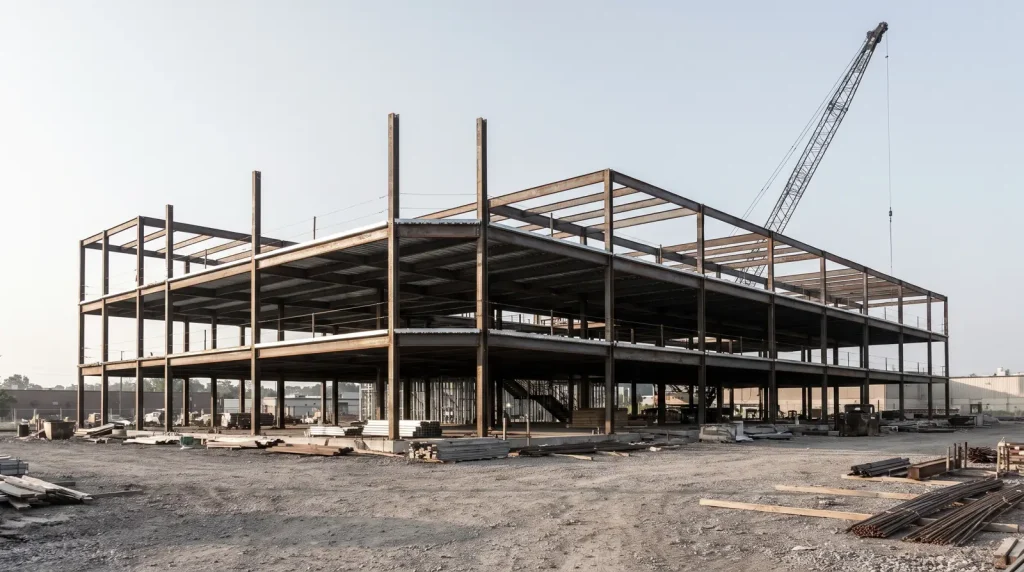
A hot work permit is a signed, one-shift authorization to weld, cut, grind or use a torch outside a designated area: someone checks a 35 ft zone, and a fire watch stays 30 to 60 minutes afterward.
Key takeaways
- OSHA requires the area to be inspected by the person responsible for authorizing cutting and welding before work starts, “preferably in the form of a written permit” (29 CFR 1910.252(a)(2)(iv)).
- A fire watch is required when combustibles sit closer than 35 ft (10.7 m) to the work, when wall or floor openings within 35 ft expose combustibles, or when combustibles are behind a metal wall or deck (29 CFR 1910.252(a)(2)(iii)(A)).
- The fire watch lasts at least 30 minutes after work under OSHA 1910.252 and International Fire Code (IFC) Section 3504.2.1, 2024 edition; the NFPA 51B sample permit (2019 edition) sets a minimum of 1 hour plus up to 3 hours of monitoring if the permit authorizing individual requires it (NFPA 51B permit form).
- IFC 3504.2.6 requires at least one 2-A:20-B:C portable extinguisher with ready access within 30 ft of the hot work.
- The permit and the pre-hot-work check stay on site for at least 48 hours after the work is complete so the fire code official can review them (IFC 3503.3 and 3503.5).
| Rule | Number | Source |
|---|---|---|
| Combustible clearance or shielding radius | 35 ft (10.7 m) | OSHA 1910.252(a)(2)(iii), (v), (vii) |
| Extinguisher | 2-A:20-B:C within 30 ft | IFC 3504.2.6 (2024) |
| Fire watch after work, minimum | 30 min | OSHA 1910.252(a)(2)(iii)(B); IFC 3504.2.1 |
| Fire watch after work, NFPA 51B | 1 hour, plus monitoring up to 3 more hours | NFPA 51B sample permit, 2019 edition |
| Fire watch after work, construction | “Sufficient period”, no fixed minimum | OSHA 1926.352(e) |
| Permit validity on the NFPA form | One day only | NFPA 51B sample permit |
| Area review while permit is open | At least once per day | IFC 3504.3 |
| Records on site | 48 h after work is complete | IFC 3503.3, 3503.5 |
What is a hot work permit?
A hot work permit is the written record that a trained person inspected the work area, listed the precautions and authorized one crew to do work that makes flame, sparks or heat for a set time. The IFC defines hot work as cutting, welding, Thermit welding, brazing, soldering, grinding, thermal spraying, thawing pipe and installing torch-applied roof systems (IFC Chapter 2 definitions).
The form sits on top of three rulebooks. OSHA 29 CFR 1910.252 covers general industry work, OSHA 29 CFR 1926.352 covers construction, and IFC Chapter 35 is the fire code most US cities adopt for buildings. The NFPA 51B standard supplies the permit system and the sample form most companies copy; OSHA 1910.252(a)(1) incorporates its 1962 edition by reference.
A permit is different from a hot work program. Under IFC 105.5.25 a facility can hold one program permit from the fire department, then issue its own job permits through a trained “responsible person”. The IFC calls that person the responsible person; NFPA 51B and most forms call the same role the permit authorizing individual (PAI).
When is a hot work permit required?
A hot work permit is required whenever hot work happens outside an area built or approved for it, such as a welding shop with noncombustible floors and partitions. OSHA 1910.252(a)(2)(iv) requires the authorizer’s inspection before any cutting or welding, and IFC 3501.3 limits hot work to areas “designed or authorized” by the hot work program. On a construction site, IFC 3305.9 makes the site safety director responsible for the permit procedure.
| Situation | Permit needed? | Rule |
|---|---|---|
| Welding steel beam connections in a building under construction | Yes, from the GC or owner’s PAI; site safety director approves the area | IFC 3303.3, 3305.9; OSHA 1926.352 |
| Cutting pipe in an occupied office or store | Yes; often also a fire department operational permit | IFC 3501.3, 105.5.25; OSHA 1910.252(a)(2)(iv) |
| Torch-applied roofing | Yes; fire department operational permit listed | IFC 105.5.25 item 5 |
| Grinding that throws sparks | Yes; grinding is in the IFC hot work definition | IFC Chapter 2 |
| Welding in a fixed welding booth | No job permit; booth needs its own operational permit | IFC 105.5.25, 3504.1.5, 3504.1.6 |
| Hot work on or near a process safety (PSM) covered process | Yes, written permit is mandatory | OSHA 1910.119(k) |
| Sprinklers impaired or explosive atmosphere present | Not allowed without fire code official approval | IFC 3501.3; OSHA 1910.252(a)(2)(vi) |
Steel erection, mechanical piping and torch roofing all involve hot work, and the IFC requires a hot work permit plan inside the site safety plan (IFC 3303.1). The owner designates the site safety director under IFC 3303.2, and the daily site inspection under IFC 3303.3 confirms that every contractor doing hot work that day was briefed on Chapter 35. For the wider safety program on a site, see our construction safety guide.
Does OSHA require the permit to be written?
OSHA 1910.252(a)(2)(iv) says “preferably” written, so general industry rules accept a verbal authorization. Two cases remove the choice: process safety sites under 29 CFR 1910.119(k) must issue a written permit naming the date and the object, and IFC 3503.3 requires the permit to be available to the fire code official for 48 hours after the work. In practice, the IFC makes it a paper or digital record in any city that adopted Chapter 35.
Do you also need a fire department permit?
Sometimes. IFC 105.5.25 lists hot work that needs an operational permit from the fire code official: public exhibitions, portable hot work inside a structure, fixed-site equipment such as welding booths, work in a wildfire risk area and torch-applied roof coverings. In the 2024 IFC text as adopted in the 2025 Fire Code of New York State, portable hot work done under a building permit is exempt (IFC 105.5.25).
That operational permit is not the job permit. Even with a building permit in hand, the contractor still needs its own PAI-signed permit and fire watch under Chapter 35. Fees and lead times are set locally. Ask your fire marshal’s office two questions: whether the building permit covers portable hot work, and whether they issue an annual hot work program permit for a facility. Our commercial building permits guide covers the building side.
What does the 35 ft rule require?
The 35 ft rule means everything combustible within 35 ft (10.7 m) of the point of hot work is moved out, shielded, or watched. OSHA 1910.252(a)(2)(vii) says to relocate combustibles at least 35 ft away where practicable, (a)(2)(v) says to sweep the floor clean for 35 ft, and (a)(2)(iii)(A) requires a fire watch when combustibles or openings remain inside that radius.
| Zone or condition | What to do | Rule |
|---|---|---|
| Inside 35 ft (10.7 m) | Sweep floors, relocate or shield combustibles, cover openings | OSHA 1910.252(a)(2)(v) and (vii); IFC 3504.1.1, 3504.1.2 |
| Inside 30 ft (9.1 m) | 2-A:20-B:C extinguisher with ready access | IFC 3504.2.6 |
| Combustibles within 35 ft stay, or openings within 35 ft expose combustibles in adjacent areas | Fire watch required | OSHA 1910.252(a)(2)(iii)(A) |
| Beyond 35 ft | Fire watch still required if combustibles are easily ignited by sparks | OSHA 1910.252(a)(2)(iii)(A)(2) |
| Combustibles behind a metal wall, ceiling, roof or deck | Move them, or post a fire watch on the opposite side | OSHA 1910.252(a)(2)(x); 1926.352(f) |
| Combustible floor | Wet down, cover with damp sand or fire-resistant shields; protect welders from shock on wet floors | OSHA 1910.252(a)(2)(v) |
| Sprinkler heads near the work | Shield with noncombustible barriers or damp cloth; remove the shields at the end of each workday; never shut the system off | IFC 3504.1.8 |
| Ducts or conveyors that could carry sparks | Shield or shut down | OSHA 1910.252(a)(2)(viii); IFC 3504.1.4 |
On a steel frame, the radius is a sphere in practice: sparks fall through deck holes and unprotected shafts to the floors below. OSHA 1910.252(a)(2)(i) requires protecting combustibles on the floor below where openings cannot be closed, and IFC 3504.2.2 assigns extra fire watch personnel where one person cannot see every exposed area. Fire-resistive assemblies and their penetrations are covered in our fire-rated wall guide.
How long must the fire watch last?
The fire watch lasts for the whole time hot work is under way, including breaks, and then at least 30 minutes after the work ends under OSHA 1910.252 and IFC 3504.2.1. The NFPA 51B sample permit (2019 edition) raises that to a minimum of 1 hour, and the permit authorizing individual can add fire monitoring of up to 3 more hours.
| Rulebook | During work | After work | Source |
|---|---|---|---|
| OSHA general industry | Required when 35 ft triggers apply | At least 30 min | 29 CFR 1910.252(a)(2)(iii)(B) |
| OSHA construction | Required when normal precautions are not enough | “A sufficient period of time”, no fixed minimum | 29 CFR 1926.352(e) |
| International Fire Code, 2024 | Required unless the area has no fire hazards or combustible exposures | Not less than 30 min; the fire code official or program manager can extend | IFC 3504.2.1 |
| NFPA 51B sample permit, 2019 edition | Required, including break activity | Minimum 1 hour, then monitoring if extended by the PAI | NFPA 51B permit form |
| State of Nevada Risk Management permit, January 6, 2024 | Fire watch present during work and breaks | 1 hour, plus monitoring up to 3 more hours as determined by the PAI | Nevada form 5500 |
The worked example below uses the timeline in the figure: a steel crew welds beam connections from 7:00 to 15:00 with a 30 minute lunch, on a deck with stored insulation 20 ft away. The insulation is inside 35 ft, so OSHA 1910.252(a)(2)(iii)(A) requires a fire watch; the stricter end time governs if the contract or the PAI adopts NFPA 51B.
| Step | Arithmetic | Result |
|---|---|---|
| Hot work periods | 7:00 to 11:30 and 12:00 to 15:00 | 7.5 h of hot work |
| Fire watch on site during work and lunch | 7:00 to 15:00 | 8 h |
| OSHA 1910.252 and IFC minimum after work | 15:00 + 30 min | Watch ends 15:30 (8.5 h total) |
| NFPA 51B minimum after work | 15:00 + 1 h | Watch ends 16:00 (9 h total) |
| NFPA 51B monitoring if the PAI sets 3 h | 16:00 + 3 h | Monitoring ends by 19:00 |
| IFC record retention | 15:00 + 48 h | Keep permit on site until 15:00 two days later |
Overtime for the fire watch is part of the hot work price, so a 1 hour watch adds 30 minutes of labor per shift over the 30 minute code minimum. Check which rule the owner’s contract or insurer names before you bid; see OSHA violations in commercial construction for how citations are counted.
How do you fill in a hot work permit?
Fill in the job block, then let the permit authorizing individual walk the area and tick each precaution, then collect the signatures. Every field below comes from the NFPA 51B sample permit (2019 edition), the IFC 3504.3.1 pre-hot-work check, or OSHA 1910.119(k) for process safety sites. A blank box means the precaution was not checked, so the PAI should not sign over one.
| Field | What to write | Rule behind it |
|---|---|---|
| Date and permit expiry time | One date; expiry at end of the shift (the NFPA form says good for one day only) | NFPA 51B form; OSHA 1910.119(k) dates authorized |
| Location, building and floor | Grid line, floor and room, not just the building name | NFPA 51B form; IFC 3504.2.2 area coverage |
| Work to be done and object | Process (weld, cut, grind, braze, torch roof) and the item worked on | OSHA 1910.119(k) object; IFC Chapter 2 |
| Hot work by: employee or contractor | Company name and printed operator name | NFPA 51B form; OSHA 1910.252(a)(2)(xiii)(D) contractor advice |
| Equipment condition | Torch, hoses, regulators, leads checked and in good repair | IFC 3504.3.1 item 1 |
| Sprinklers, hose streams, extinguishers | In service; 2-A:20-B:C within 30 ft | IFC 3504.1.8, 3504.2.6 |
| Within 35 ft: flammables and dust | Flammable liquids, dust, lint and oily deposits removed | NFPA 51B form; IFC 3504.1.1 |
| Within 35 ft: floors | Swept clean; combustible floors wet down or covered | OSHA 1910.252(a)(2)(v) |
| Within 35 ft: other combustibles | Removed, or covered with welding blankets, curtains or metal shields | OSHA 1910.252(a)(2)(vii) |
| Within 35 ft: openings | All wall and floor openings covered; ducts and conveyors protected or shut down | IFC 3504.1.2, 3504.1.4 |
| Walls, ceilings, roofs | Construction noncombustible; combustibles on the other side moved | OSHA 1910.252(a)(2)(x), (xi); 1926.352(f) |
| Enclosed equipment | Cleaned, purged of flammable vapor, isolated and vented | IFC 3504.1.7; OSHA 1926.352(i), (j) |
| Detection systems | Smoke detector heads covered or zone bypassed with the alarm company’s approval | IFC 3504.1.9 |
| Fire watch | Name of the assigned fire watch; areas above and below if exposed | IFC 3504.2.1, 3504.2.2 |
| Time started and time completed | Actual clock times; completed time starts the 30 or 60 minute count | NFPA 51B form; IFC 3504.2.1 |
| Monitoring extension | Yes or no, and hours (up to 3) set by the PAI | NFPA 51B form |
| Signatures | PAI authorization, operator acceptance, fire watch sign-off | OSHA 1910.252(a)(2)(iv); NFPA 51B form |
Post the permit at the work point and put up a sign reading “CAUTION HOT WORK IN PROGRESS STAY CLEAR” wherever people other than the operator can enter the area (IFC 3503.6). In practice:
- Request the permit at least one shift ahead and name the process, location and expected hours.
- PAI walks the 35 ft radius and the floors above and below, then ticks each line (OSHA 1910.252(a)(2)(iv)).
- Shield sprinkler heads near the work and arrange detector bypass; never shut the sprinkler system off (IFC 3504.1.8, 3504.1.9).
- Stage a 2-A:20-B:C extinguisher within 30 ft and confirm the fire watch is trained on it (IFC 3504.2.4, 3504.2.6).
- Sign, post the permit, and start work; close torch valves and remove electrodes if work stops for 1 hour or more (IFC 3505.6, 3506.3).
- Record the completed time, run the fire watch 30 or 60 minutes, then any monitoring the PAI set.
- Fire watch signs off, the PAI closes the permit, and the file stays on site for at least 48 hours (IFC 3503.3).
Who signs a hot work permit?
Three people sign a typical hot work permit: the permit authorizing individual, who inspects the area and authorizes the work; the operator, who accepts the conditions; and the fire watch, who signs off after the post-work watch. OSHA 1910.252(a)(2)(xiii)(B) requires management to designate the authorizing person, and IFC 3503.3 requires that person to be an approved responsible person.
| Role | Who it usually is | Duty | Rule |
|---|---|---|---|
| Permit authorizing individual (PAI) or responsible person | Owner’s facility manager, GC superintendent or safety manager | Inspects area before work and at least daily; signs authorization | OSHA 1910.252(a)(2)(iv), (xiii)(B); IFC 3504.3 |
| Supervisor | Foreman of the welding or mechanical sub | Secures authorization; checks extinguishers and fire watch are on site | OSHA 1910.252(a)(2)(xiv)(D) to (G) |
| Operator | Welder, cutter, roofer | Shows working knowledge of Chapter 35; accepts the permit | IFC 3503.4 |
| Fire watch | Trained worker with no other task | Watches all exposed areas, fights only small fires, sounds the alarm | OSHA 1910.252(a)(2)(iii)(B); IFC 3504.2.3; OSHA 1926.352(e) |
| Site safety director | Person designated by the owner on a construction site | Approves hot work areas; enforces the site safety plan | IFC 3303.2, 3305.9 |
On construction work, OSHA 1926.352(e) says a required fire watch is “additional personnel”, which rules out the welder watching their own sparks. For owners hiring a steel or mechanical sub, ask who the PAI is in the bid and who pays for the watch; the same question belongs on any red iron steel building erection scope.
How long is a permit valid and how long do you keep it?
The NFPA 51B sample permit is good for one day only, and the IFC requires the authorizer to reinspect the area at least once per day while any permit stays open. Records then stay on the premises for at least 48 hours after the work is complete under IFC 3503.3 and 3503.5. Process safety sites keep the permit on file until the hot work is complete under OSHA 1910.119(k).
| Item | Period | Source |
|---|---|---|
| Job permit on the NFPA 51B form | One day | NFPA 51B sample permit, 2019 edition |
| Area reinspection while permit is open | Before work and at least once per day | IFC 3504.3 |
| Permit available to fire code official | During work and 48 h after | IFC 3503.3 |
| Pre-hot-work check report | At the work site during work, then 48 h on premises | IFC 3503.5, 3504.3.1 |
| Process safety (PSM) permit | Until hot work is complete | OSHA 1910.119(k) |
Nothing in the code stops a company from keeping permits longer than 48 hours for its own claims file. Property and builder’s risk insurers can attach their own conditions to hot work, so read the policy wording or ask the broker which form and fire watch duration it expects; the State of Nevada’s risk management form (January 6, 2024) is one public example that adopts the 1 hour NFPA watch. Our builder’s risk insurance guide and contractor general liability guide explain the policies themselves. This page is general information, not legal or insurance advice.
What do common guides get wrong?
Most ranking pages give one fire watch number and one radius with no citation, which hides a real 30 versus 60 minute split and the extinguisher distance. The table below compares typical claims in top-ranking guides, checked on November 9, 2026, with the primary text.
| What several guides say | What the primary source says | Source |
|---|---|---|
| “The fire watch is 30 minutes” (an insurer safety talk) | 30 min is the OSHA 1910.252 and IFC floor; the NFPA 51B sample permit sets 1 hour, and OSHA construction sets no fixed number | OSHA 1910.252(a)(2)(iii)(B); 1926.352(e); NFPA 51B form |
| “OSHA requires a hot work permit” | OSHA general industry says “preferably” written; written is mandatory at PSM sites and in practice under IFC 3503.3 | OSHA 1910.252(a)(2)(iv); 1910.119(k) |
| Extinguisher “nearby” with no distance | 2-A:20-B:C within 30 ft | IFC 3504.2.6 |
| No retention period given | 48 h after work is complete | IFC 3503.3, 3503.5 |
Which rule applies to your job?
Apply every rule that reaches the job and use the strictest number. Construction work falls under OSHA Part 1926, existing-building maintenance often falls under 1910.252, the local fire code adds Chapter 35 on top of both, and a contract or insurer can require NFPA 51B. The decision table and flowchart below show the order to check.
| If | Then | Rule |
|---|---|---|
| The job can use a cold method or a fixed welding area | Do that; fixed areas need noncombustible floors and partitions | IFC 3504.1.5, 3504.1.6 |
| Sprinklers are impaired, or an explosive atmosphere or bulk sulfur, baled paper or cotton is present | Stop; get fire code official approval first | IFC 3501.3; OSHA 1910.252(a)(2)(vi) |
| Combustibles or openings within 35 ft cannot be removed | Shield or cover them and assign a fire watch, both sides of walls and decks | OSHA 1910.252(a)(2)(iii); 1926.352(f) |
| Portable hot work inside a structure is not covered by a building permit | Apply for the fire department operational permit | IFC 105.5.25 |
| The contract, insurer or owner adopts NFPA 51B | Fire watch 1 hour after work, plus PAI-set monitoring | NFPA 51B sample permit |
| None of the above apply | PAI still signs a one-shift permit; watch 30 min unless no fire hazards exist | IFC 3504.2.1 |
Extinguisher rating, travel distance and monthly checks for the rest of the building are in our fire extinguisher requirements guide.
Welding on a steel frame is often checked by a third party too; our guides to special inspections and W beam sizes cover that side of the work.
How we compiled this
We read the current eCFR text of 29 CFR 1910.252, 1926.352 and 1910.119, the 2024 IFC Chapters 1, 2, 33 and 35 as adopted in the 2025 Fire Code of New York State, the NFPA 51B sample permit (2019 edition) and the State of Nevada Risk Management permit, 9 primary documents in all, in November 2026. We could not read the NFPA 51B 2024 edition text without an NFPA account, so 1 hour figures are from the 2019 edition form; check the edition your jurisdiction adopted on the NFPA 51B document page. Local amendments to IFC Chapter 35 can change these numbers.
Frequently asked questions
How long is a hot work permit good for?
The NFPA 51B sample permit is good for one day only, and most company forms copy that limit. While any permit stays open, IFC 3504.3 requires the authorizing person to inspect the area before work and at least once per day. Multi-day jobs therefore get a new permit or a daily re-sign, and sprinkler head shields come off at the end of each workday under IFC 3504.1.8.
Does OSHA require a written hot work permit?
Not always. OSHA 29 CFR 1910.252(a)(2)(iv) requires an inspection by the authorizing person and says the authorization should preferably be a written permit. A written permit is mandatory on or near a process safety covered process under 29 CFR 1910.119(k), and IFC 3503.3 requires permits to be available to the fire code official for 48 hours after work, which makes paper or digital records standard.
Can the welder also be the fire watch?
Not on construction work where a fire watch is required: OSHA 29 CFR 1926.352(e) says additional personnel shall be assigned to guard against fire during the work and afterward. IFC 3504.2.3 adds that the fire watch must have extinguishing equipment at hand and be trained to use it, and IFC 3504.2.2 requires more than one watcher when exposed areas cannot be seen from one spot.
Is grinding considered hot work?
Yes. The International Fire Code definition of hot work lists grinding alongside cutting, welding, Thermit welding, brazing, soldering, thermal spraying, thawing pipe and torch-applied roof systems. A grinder that throws sparks therefore needs the same permit, 35 ft clearance and a 2-A:20-B:C extinguisher within 30 ft under IFC 3504.2.6 as a cutting torch in the same location.
Who can issue a hot work permit?
The person management designates to authorize cutting and welding, under OSHA 29 CFR 1910.252(a)(2)(xiii)(B). The IFC calls this the responsible person: someone trained in hot work fire safety who reviews sites before issuing permits. NFPA 51B calls the same role the permit authorizing individual (PAI). On construction sites, IFC 3305.9 makes the site safety director responsible for the permit procedure.
Do you need a hot work permit for torch-applied roofing?
Yes. Installation of torch-applied roof systems is in the IFC definition of hot work, and IFC 105.5.25 lists application of roof coverings with an open-flame device as work that needs an operational permit from the fire code official. The roofer also needs the job permit, a fire watch for at least 30 minutes after the torch goes off, and an extinguisher within 30 ft.
Sources
- 29 CFR 1910.252, General requirements (welding, cutting and brazing), eCFR, Office of the Federal Register, accessed November 9, 2026.
- 29 CFR 1926.352, Fire prevention (construction), eCFR, Office of the Federal Register, accessed November 9, 2026.
- 29 CFR 1910.119(k), Hot work permit (process safety management), eCFR, Office of the Federal Register, accessed November 9, 2026.
- International Fire Code 2024, Chapter 35 Welding and Other Hot Work, as adopted in the 2025 Fire Code of New York State, International Code Council via UpCodes, accessed November 9, 2026.
- International Fire Code 2024, Section 105.5.25 Hot work operations, International Code Council via UpCodes, accessed November 9, 2026.
- International Fire Code 2024, Chapter 2 Definitions, International Code Council via UpCodes, accessed November 9, 2026.
- International Fire Code 2024, Chapter 33 Fire Safety During Construction and Demolition, International Code Council via UpCodes, accessed November 9, 2026.
- NFPA 51B, Standard for Fire Prevention During Welding, Cutting, and Other Hot Work, National Fire Protection Association, accessed November 9, 2026.
- NFPA 51B Hot Work Permit (sample form, 2019 edition), National Fire Protection Association, hosted by Bonneville Power Administration, accessed November 9, 2026.
- Hot Work Permit, form 5500 (January 6, 2024), State of Nevada Risk Management Division, accessed November 9, 2026.