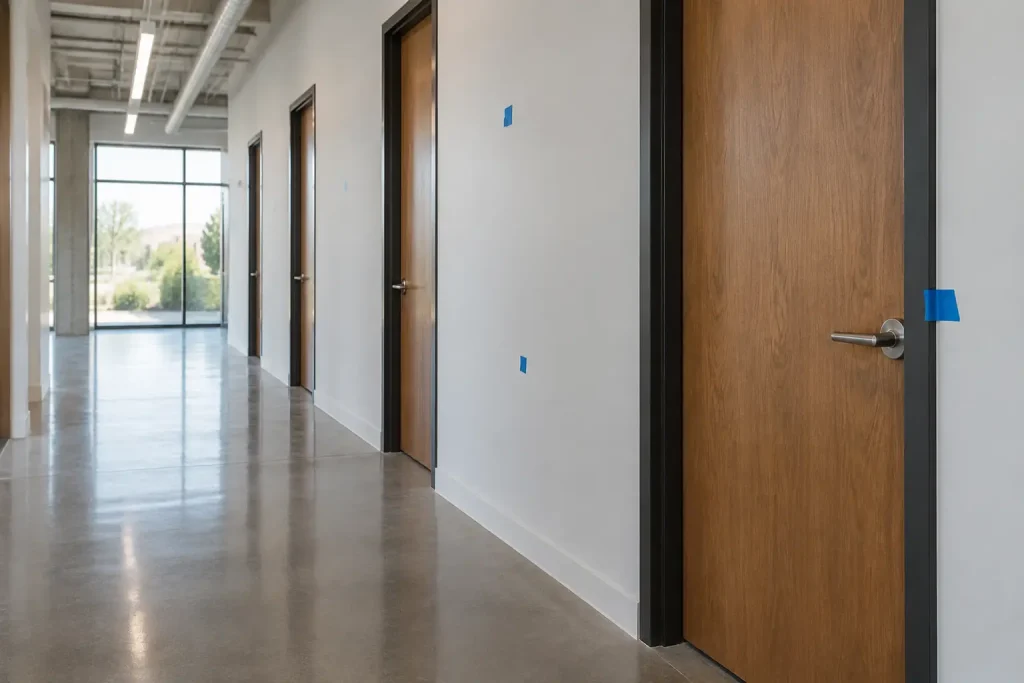
A punch list in construction is the written list of unfinished or faulty work left when a project reaches substantial completion: the contractor must finish every item before final payment, and the owner may hold back money until it does.
Key takeaways
- The general contractor writes the first punch list when it thinks the building is ready to use, and the architect then inspects and adds items (AIA A201-2017 §9.8.2 and §9.8.3).
- The Certificate of Substantial Completion, AIA G704-2017, carries the list and fixes the time to finish it; warranties start on the substantial completion date unless the certificate says otherwise (A201 §9.8.4).
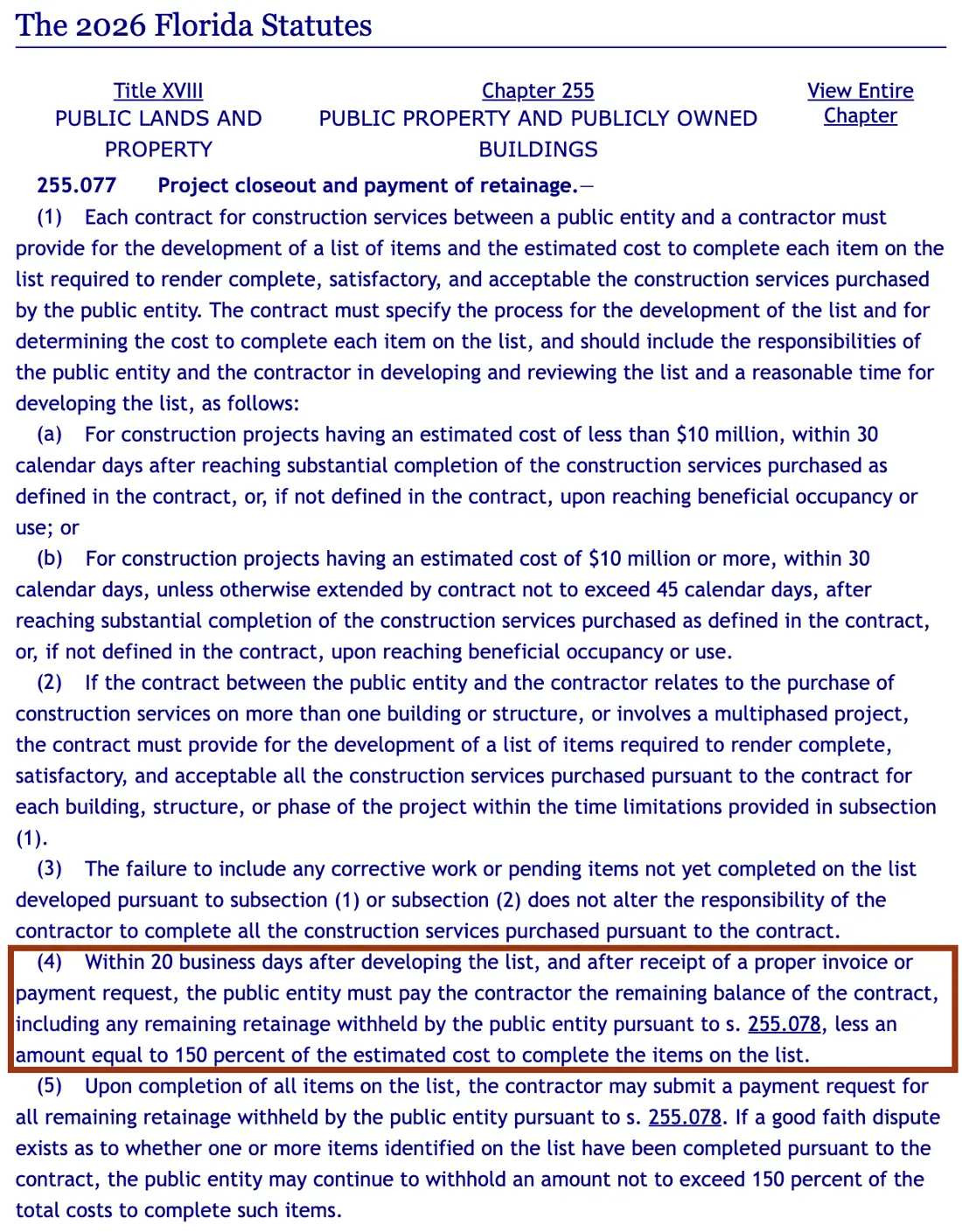
- On Florida state public contracts, Fla. Stat. 255.077 requires the list within 30 calendar days of substantial completion (up to 45 days by contract on $10 million+ projects) and payment of the balance, less 150% of the list estimate, within 20 business days.
- California public owners must release retention within 60 days after completion and may hold no more than 150% of a disputed amount, under Public Contract Code 7107.
- Final payment under A201 §9.10.2 waits for six closeout papers, including a sworn statement that bills are paid, the bonding company’s written consent and, if the owner asks, lien releases.
What is a punch list in construction?
A punch list is the contractor’s written list of work that is unfinished or not built to the drawings and specifications when the project reaches substantial completion, when the owner can use the space. AIA A201-2017 §9.8.2 calls it a “comprehensive list of items to be completed or corrected prior to final payment.” It covers missing and defective work under the existing contract, not new scope, which needs a change order.
Leaving an item off the list does not release the contractor. A201 §9.8.2 says a missing item “does not alter the responsibility of the Contractor,” and Fla. Stat. 255.077(3) repeats the rule for Florida public jobs. Items found after the list is delivered stay the contractor’s obligation under 255.077(6).
A punch list is a contract document between owner, architect and contractor. A certificate of occupancy is a government approval from the building official, explained in our commercial building permits guide. Because A201 §9.8.1 defines substantial completion as the point when the owner can occupy or use the work for its intended use, an open life-safety item usually has to be fixed before the certificate, not carried on the list.
| Rule | Number | Source |
|---|---|---|
| Florida public list deadline after substantial completion, projects under $10 million | 30 calendar days | Fla. Stat. 255.077(1)(a); 218.735(7)(a) |
| Longest Florida list deadline by contract, projects of $10 million or more | 45 calendar days | Fla. Stat. 255.077(1)(b); 218.735(7)(a)2. |
| Holdback for open punch list items on Florida public jobs | 150% of estimated cost | Fla. Stat. 255.077(4); 218.735(7)(e) |
| Payment of the balance after the Florida list | 20 business days | Fla. Stat. 255.077(4); 218.735(7)(e) |
| Florida public retainage cap per progress payment | 5% | Fla. Stat. 255.078(1); 218.735(8)(a) |
| Florida contracts exempt from the retainage rules | $200,000 or less | Fla. Stat. 255.078(6); 218.735(8)(f) |
| California public retention release after completion | 60 days | Cal. Pub. Cont. Code 7107(c) |
| Late retention charge, California public works and Florida local government | 2% per month | Cal. Pub. Cont. Code 7107(f); Fla. Stat. 218.735(9) |
| Correction period for defects after substantial completion | 1 year | AIA A201-2017 §12.2.2.1 |
| Federal retainage when progress is unsatisfactory | 10% maximum | FAR 52.232-5(e) |
When is the punch list made, and who inspects?
Under AIA A201-2017 the punch list is made at the end of construction, when the contractor considers the work, or a portion the owner agrees to accept separately, substantially complete. The contractor self-inspects and submits the list (§9.8.2), the architect inspects and adds items (§9.8.3), and the owner, architect and contractor sign the G704 certificate. Florida public statutes add a 30-day clock.
If the architect’s inspection finds anything that stops the owner from using the space for its intended use, A201 §9.8.3 requires the contractor to fix it before the certificate is issued and to request another inspection. A failed first walk costs a second inspection request under §9.8.3, so the contractor’s own walk before the notice decides the date. AIA’s G704 instructions say the architect “verifies and amends this list” before attaching it.
| Party | Role at the punch walk | Source |
|---|---|---|
| General contractor | Self-inspects, writes the comprehensive list, assigns items to subcontractors, requests reinspection | A201 §9.8.2, §9.8.3 |
| Architect | Inspects, adds items, decides whether the work is substantially complete, prepares the certificate and later the final inspection | A201 §9.8.3, §9.8.4, §9.10.1 |
| Owner | Walks the space, adds items through the architect, accepts the certificate in writing, pays retainage | A201 §9.8.5; G704 signature line |
| Subcontractors | Correct their own items; on California public jobs receive their retention share within 7 days of the prime | Cal. Pub. Cont. Code 7107(d) |
| Surety (the bonding company) | Gives written consent before retainage and final payment are released on bonded jobs | A201 §9.8.5, §9.10.2; AIA G707 |
| Building official | Runs code inspections and issues the certificate of occupancy; not a party to the punch list | Local building code |
A rolling punch list, kept room by room as trades finish, is a scheduling habit rather than an A201 requirement, and the §9.8.2 list still has to be submitted at substantial completion. If the owner moves into part of the building early, A201 §9.9.2 requires owner, contractor and architect to inspect that area jointly immediately before occupancy. Florida’s 255.077(2) requires a separate list for each building or phase on multiphase public contracts.
What goes on a commercial punch list, by trade?
Commercial punch list items are best grouped by trade and by CSI MasterFormat division, the numbering most specifications and subcontracts follow. Typical entries are finish damage in Division 09, door and hardware adjustments in Division 08, fixtures and accessories in Divisions 10 and 22, and devices and labels in Division 26. Where an accessibility rule applies, the 2010 ADA Standards give a measurable pass or fail.
| Division | Typical punch list items | Measurable check | Source |
|---|---|---|---|
| 01 General Requirements | Final cleaning, leftover tools and surplus material, missing operation and maintenance manuals | Waste, tools, equipment and surplus removed at completion | A201 §3.15.1 |
| 08 Openings | Doors that bind or fail to latch, closers that slam, hardware at the wrong height | Closer takes 5 seconds minimum from 90 to 12 degrees; interior hinged door opens with 5 pounds maximum; hardware 34 to 48 inches above the floor | 2010 ADA Standards 404.2.8.1, 404.2.9, 404.2.7 |
| 09 Finishes | Paint touch-ups, dented drywall corners, stained ceiling tiles, scratched flooring, gaps at base | Approved samples and the Division 09 specification sections | Contract documents (A201 §9.8.1) |
| 10 Specialties | Room signs mounted too low or high, loose toilet accessories, grab bars out of range | Tactile characters 48 to 60 inches above the floor; grab bars 33 to 36 inches to the top of the gripping surface | 2010 ADA Standards 703.4.1, 609.4 |
| 22 Plumbing | Leaks, missing escutcheons, fixtures set at the wrong height | Water closet seat 17 to 19 inches; lavatory rim or counter 34 inches maximum | 2010 ADA Standards 604.4, 606.3 |
| 23 HVAC | Open items on the test and balance report, missing filters, unlabeled thermostats | Design airflow in the Division 23 specifications and the balancing report | Contract documents |
| 26 Electrical | Dead receptacles, missing cover plates, incomplete panel directories, failed lamps | Specified devices and panel schedules on the drawings | Contract documents |
| 32 Exterior Improvements | Missing striping, damaged curbs, dead plantings | Site drawings and Division 32 specifications | Contract documents |
Fire alarm, sprinkler and elevator acceptance tests are witnessed by the fire marshal or building official, not scored by the architect, so the punch list only carries the open items those tests leave behind, with the test date in the description. On a tenant fit-out the same divisions (08 to 26) apply to a smaller area, and the lease work letter can decide whether the landlord or the tenant’s builder fixes a base-building item; that split is covered in our guide to tenant improvement contractors.
How do punch list items affect retainage?
Retainage is the share of each progress payment the owner holds back, and the punch list decides how much of it stays held at the end. A201-2017 §9.8.5 pays retainage once the owner and contractor accept the G704 certificate, “adjusted for Work that is incomplete.” Public statutes set hard numbers: Florida caps public retainage at 5% and lets the owner keep 150% of the punch list estimate.
The A201 text sets no multiplier for open items, so private owners and contractors negotiate it or leave it to the architect’s certification. Public owners are bound by statute: our review of state public works law found 30 jurisdictions cap retainage at 5%, as shown in the public construction prompt payment and retainage report.
Statute-by-statute comparison
Five rule sets show how differently the punch list ties to money. AIA A201-2017 leaves the holdback to the parties; Florida sets a 30-day list and a 150% holdback for both state agencies (255.077) and local governments (218.735(7)); California sets a 60-day release; federal contracts under FAR 52.232-5(e) let the contracting officer keep only an amount “adequate for protection of the Government.”
| Rule set | When the list or release is due | Held for open items | Payment clock | Source |
|---|---|---|---|---|
| AIA A201-2017 (private default) | List when the contractor considers the work substantially complete; time to finish fixed in G704 | Retainage “adjusted for Work that is incomplete”; no multiplier | Final payment after final inspection and 6 closeout items | A201 §9.8.2, §9.8.4, §9.8.5, §9.10.2 |
| Florida state public entities | 30 calendar days after substantial completion; up to 45 by contract at $10 million+ | 150% of the estimated cost of listed items | Balance within 20 business days after the list and a proper invoice | Fla. Stat. 255.077(1), (4), (5) |
| Florida local governments | Same 30 and 45 days; list delivered within 5 days after review; final completion date at least 30 days after delivery | 150% of the estimated cost of listed items | Balance within 20 business days after the list; 2% per month interest if late | Fla. Stat. 218.735(7), (9) |
| California public works | Retention released within 60 days after completion | Up to 150% of a disputed amount | 2% per month charge on retention withheld improperly | Cal. Pub. Cont. Code 7107(c), (f) |
| Federal fixed-price construction | At substantial completion, remaining withheld funds released | Amount “adequate for protection of the Government” | Final payment after acceptance, voucher and release of claims | FAR 52.232-5(e), (h) |
Worked example: the 150 percent holdback
The 150 percent rule turns the punch list estimate into dollars. In this illustration a Florida county holds a $2,400,000 building contract under Fla. Stat. 218.735, with 5% retainage and a punch list of 42 items priced at $18,500. The county must pay $111,250 within 20 business days of the list and may hold $27,750 until the items are done.
| Line | Amount | Basis |
|---|---|---|
| Contract sum | $2,400,000 | Illustration |
| Billed through substantial completion | $2,380,000 | Illustration |
| Retainage held at 5% | $119,000 | $2,380,000 x 5%, 218.735(8)(a) |
| Paid to date | $2,261,000 | $2,380,000 less $119,000 |
| Remaining contract balance | $139,000 | $2,400,000 less $2,261,000 |
| Punch list estimated cost, 42 items | $18,500 | Cost per item required by 218.735(7) |
| Holdback at 150% | $27,750 | $18,500 x 1.5, 218.735(7)(e) |
| Due within 20 business days of the list | $111,250 | $139,000 less $27,750 |
| Due after all items are complete | $27,750 | Payment request under 218.735(7)(f) |
The estimate drives the holdback, so a $1,000 overestimate on the list freezes another $1,500. If the county and contractor dispute whether an item is done, 218.735(7)(f) caps the continued holdback at 150% of the cost of the disputed items only, not the whole list.
How does the punch list connect to final payment?
Final payment follows the finished punch list, not the written one. Under A201-2017 §9.10.1 the contractor gives notice that the work is ready for final inspection and submits a final Application for Payment; the architect inspects and issues the final Certificate for Payment. §9.10.2 then holds final payment and any remaining retainage until six closeout items reach the architect.
| A201 §9.10.2 item | Common form | What it protects |
|---|---|---|
| (1) Affidavit that payrolls, material bills and other debts are paid | AIA G706 | Owner’s property against unpaid subcontractor and supplier claims |
| (2) Certificate that required insurance stays in force after final payment | Certificate of insurance | Insurance the contract requires after final payment |
| (3) Statement that the contractor knows of no reason the insurance will not renew | Letter | Coverage for the required period |
| (4) Consent of surety to final payment | AIA G707 | The performance and payment bonds after final payment |
| (5) Special warranties, such as manufacturer warranties | Warranty documents | Roof, equipment and system warranties |
| (6) If the owner requires, receipts, releases and lien waivers | AIA G706A plus subcontractor waivers | Title against liens |
Lien filing deadlines differ by state, as our mechanics lien laws by state report shows, which is why item (1) and item (6) matter before the last check is cut. If a subcontractor refuses to sign a release, A201 §9.10.2 lets the contractor post a bond to indemnify the owner instead. On bonded work the surety’s consent matters because, as AIA’s G707 summary notes, it keeps the bond in place after payment; our construction surety bonds report covers how those bonds work.
Final payment is also a cut-off. Under §9.10.4 the owner waives claims except unsettled liens, nonconforming work, special warranties and permitted audits; under §9.10.5 the contractor waives claims not listed in writing as unsettled at the final Application for Payment. Defects found later fall under the 1-year correction period in §12.2.2.1, which runs from substantial completion. Florida’s 255.077(7) keeps warranty items from delaying the final retainage payment.
What is the step-by-step punch list closeout process?
The punch list closeout process runs in ten steps under AIA A201-2017, from the contractor’s self-inspection to the 1-year correction period. Each step has a contract section, a form or a deadline. On Florida public contracts, steps 1 to 5 also run against the 30-day list deadline and the 20 business day payment clock in Fla. Stat. 255.077 and 218.735(7).
- Self-punch by area and trade. The contractor walks every room with subcontractor foremen and writes each item with location, trade, drawing or spec reference and, on Florida public jobs, an estimated cost (255.077(1)).
- Submit the list with the substantial completion notice. The comprehensive list goes to the architect under A201 §9.8.2.
- Architect inspection. The architect inspects, adds items and decides whether the space is usable for its intended use; if not, the contractor fixes the blocking items and requests another inspection (§9.8.3).
- Certificate of Substantial Completion. The architect issues AIA G704 with the list attached, fixes the time to finish all items and assigns security, utilities, maintenance and insurance (§9.8.4).
- Retainage payment. After written acceptance and any surety consent, the owner pays retainage adjusted for open items (§9.8.5); on Florida public jobs the balance less 150% of the estimate is due within 20 business days.
- Finish and verify items. Each subcontractor closes its items; the contractor and architect initial and date each one before the G704 deadline.
- Request final inspection. The contractor gives notice and submits the final Application for Payment (§9.10.1).
- Deliver closeout documents. Affidavit, insurance certificate and statement, consent of surety, special warranties and any required lien releases (§9.10.2).
- Final payment. The architect issues the final Certificate for Payment; payment triggers the waivers in §9.10.4 and §9.10.5.
- Correction period. Defects found within 1 year of substantial completion go back to the contractor under §12.2.2.1.
Florida local government contracts add three fixed dates to that sequence: the list within 30 calendar days of substantial completion, delivery to the contractor within 5 days after review, and a final completion date at least 30 days after delivery. If the list is late, 218.735(7)(c) extends the contract time day for day.
The same closeout phase is summarized in our commercial construction process guide, which shows the 7 phases before it. Owners who want a one-page tick list for the whole job can use the commercial construction project checklist.
What should a punch list template include?
A punch list template for construction needs enough fields to price, assign and prove each item. Florida public contracts require an estimated cost for every item under 255.077(1) and 218.735(7), so a cost column is mandatory there. The minimum fields are item number, location, trade, description tied to a drawing or spec section, cost, responsible subcontractor, due date, status and a dated sign-off.
| No. | Location | Division and trade | Description and reference | Est. cost | Responsible | Due | Status | Verified |
|---|---|---|---|---|---|---|---|---|
| 001 | Level 1, Room 104 | 08 Doors and hardware | Closer slams; adjust to 5 seconds minimum, ADA 404.2.8.1 | $150 | Door subcontractor | Day 10 | Open | |
| 002 | Level 1, Corridor C | 09 Painting | Scuffs at 3 wall locations; touch up per spec section 09 91 23 | $300 | Painter | Day 7 | Closed | Architect, day 6 |
| 003 | Level 2, Restroom 210 | 10 Specialties | Grab bar at 37 inches; reset to 33 to 36 inches, ADA 609.4 | $250 | Specialties installer | Day 10 | Open | |
| 004 | Roof, RTU-2 | 23 HVAC | Balancing report shows supply below design; rebalance per Division 23 | $1,200 | Mechanical subcontractor | Day 14 | Open | |
| 005 | Site, east lot | 32 Exterior | Two accessible stall stripes missing per site plan | $400 | Paving subcontractor | Day 5 | Closed | Owner, day 5 |
The rows above are an illustration, not data from a real project. Spreadsheets, PDF markups on the drawing set and construction management apps can all hold these 9 fields; what counts is one shared list, one number per defect, a photo reference, and the architect’s initials and date when an item closes, since A201 §9.8.3 makes the architect the party who confirms the work.
What should you do when a punch list stalls or is disputed?
Three questions decide a stalled punch list: whether the space is usable, what an open item is worth, and who missed a deadline. The decision table below pairs each common situation with the contract section or statute that answers it. This is general information, not legal advice; ask your construction attorney whether your signed contract changes these defaults, and see how to choose a commercial contractor for checking closeout terms before you sign.
| If | Then | Rule |
|---|---|---|
| The space cannot yet be used for its intended purpose | It is not substantially complete; the contractor fixes those items before the certificate and asks for a new inspection | A201 §9.8.1, §9.8.3 |
| Private contract on unmodified A201 terms | Retainage paid once the G704 certificate is accepted, adjusted for incomplete work; no fixed multiplier | A201 §9.8.5 |
| Florida public project under $10 million | List with costs within 30 calendar days; balance less 150% within 20 business days | Fla. Stat. 255.077(1)(a), (4) |
| Florida public project, $10 million or more | 30 days, or up to 45 days if the contract extends it | Fla. Stat. 255.077(1)(b) |
| The Florida public owner misses its list deadline | Contractor may request all remaining retainage; state entity pays within 20 days, local government within 20 business days | Fla. Stat. 255.077(9); 218.735(7)(j) |
| Owner and contractor disagree whether an item is done | Hold up to 150% of the cost of the disputed items only | Fla. Stat. 255.077(5); Cal. Pub. Cont. Code 7107(c) |
| A defect appears after the list is delivered | Still the contractor’s obligation | A201 §9.8.2; Fla. Stat. 255.077(6) |
| The item is a warranty claim, not incomplete work | It does not hold up final retainage on Florida public jobs; use the 1-year correction period | Fla. Stat. 255.077(7); A201 §12.2.2.1 |
| Final completion is delayed through no fault of the contractor | Owner pays for the portion fully completed and accepted | A201 §9.10.3 |
| A subcontractor will not sign a lien release | Contractor may furnish a bond to indemnify the owner | A201 §9.10.2 |
How much retainage is held before the punch list, and when each state requires its release, is set out in our guide to retainage in construction.
For every restroom dimension an inspector measures, from the 16 to 18 inch toilet centerline to the 42 inch side grab bar, see our checklist of ADA bathroom requirements.
Measure every riser in each flight before tile or tread covers go down; the 3/8 in rule and a worked failure are in our guide to stair riser height.
How we compiled this
We read 12 primary documents in October 2026: AIA A201-2017 (the AIA sample copy, product page A201 instructions), the AIA G704, G706 and G707 instructions or samples, Fla. Stat. 255.077, 255.078 and 218.735 (2026 Florida Statutes), California Public Contract Code 7107, FAR 52.232-5, the 2010 ADA Standards and CSI MasterFormat. We read 4 top-ranking punch list guides for question phrasing only and took no facts from them. AIA sections describe the unmodified 2017 text; signed contracts often change it.
Frequently asked questions
Who prepares the punch list in construction?
The general contractor prepares the first list. Under AIA A201-2017 §9.8.2 the contractor submits a comprehensive list of items to be completed or corrected when it considers the work substantially complete. The architect then inspects and adds items under §9.8.3, and the owner adds items through the architect. Florida public contracts must also state each party’s duties in building the list, under Fla. Stat. 255.077(1).
Is a punch list the same as a snag list?
Yes. Snag list or snagging list is the British term, used around practical completion under UK contracts, and some public owners say deficiency list. AIA A201-2017 §9.8.2 does not use the word punch at all: it calls the document a comprehensive list of items to be completed or corrected prior to final payment. The function is the same in each case.
How long does a contractor have to finish punch list items?
Under AIA A201-2017 §9.8.4 the architect fixes the time in the Certificate of Substantial Completion, so the deadline is whatever G704 states. On Florida local government contracts, Fla. Stat. 218.735(7)(c) sets the final completion date at least 30 days after the list is delivered, and a late list extends the contract time day for day.
Can an owner hold back retainage for punch list items?
Yes, within limits. AIA A201-2017 §9.8.5 pays retainage adjusted for incomplete work without a fixed multiplier. Florida public owners may keep 150% of the estimated cost of listed items under Fla. Stat. 255.077(4). California public owners may hold up to 150% of a disputed amount under Public Contract Code 7107(c), and federal contracting officers an amount adequate for protection under FAR 52.232-5(e).
What happens if an item is left off the punch list?
The contractor still owes the work. A201-2017 §9.8.2 says a missing item does not alter the contractor’s responsibility, and Fla. Stat. 255.077(3) and (6) say the same for Florida public jobs. After final payment, the owner keeps claims for nonconforming work under §9.10.4, and the 1-year correction period in §12.2.2.1 runs from substantial completion.
Do warranty items belong on the punch list?
Usually not. A punch list covers incomplete or nonconforming work at substantial completion, while warranties start on that date under A201-2017 §9.8.4. On Florida public jobs, Fla. Stat. 255.077(7) and 218.735(7)(h) say warranty items may not affect the final payment of retainage. Defects that appear later go through the 1-year correction period in §12.2.2.1.
What is a rolling punch list?
A rolling punch list is kept area by area while trades are still working, so each room is closed as it finishes rather than all at once. It is a scheduling practice, not an A201 requirement: the contractor must still submit the comprehensive list under §9.8.2 at substantial completion, and §9.9.2 requires a joint inspection before any partial occupancy.
Sources
- American Institute of Architects (copy posted by City of Rochester, NH), AIA Document A201-2017, General Conditions of the Contract for Construction (sample), accessed 2026-10-19.
- AIA Contract Documents, Instructions: A201-2017, General Conditions of the Contract for Construction, accessed 2026-10-19.
- AIA Contract Documents, Instructions: G704-2017, Certificate of Substantial Completion, accessed 2026-10-19.
- AIA Contract Documents, Summary: G707-1994, Consent of Surety to Final Payment, accessed 2026-10-19.
- Idaho Division of Public Works, AIA G706-1994 Contractor’s Affidavit of Payment of Debts and Claims (sample), accessed 2026-10-19.
- The Florida Legislature, Online Sunshine, Fla. Stat. 255.077, Project closeout and payment of retainage (2026), accessed 2026-10-19.
- The Florida Legislature, Online Sunshine, Fla. Stat. 255.078, Public construction retainage (2026), accessed 2026-10-19.
- The Florida Legislature, Online Sunshine, Fla. Stat. 218.735, Timely payment for purchases of construction services (2026), accessed 2026-10-19.
- California Legislative Information, California Public Contract Code section 7107, accessed 2026-10-19.
- Acquisition.gov (GSA), FAR 52.232-5, Payments under Fixed-Price Construction Contracts, accessed 2026-10-19.
- U.S. Access Board, 2010 ADA Standards for Accessible Design, accessed 2026-10-19.
- Construction Specifications Institute, MasterFormat, accessed 2026-10-19.