
An RFI in construction is a request for information: a written question asking the architect or engineer to clarify a gap, conflict or error in the contract documents, answered in writing under AIA A201-2017 §4.2.14.
Key takeaways
- AIA A201-2017 §3.2.2 makes the RFI the contractor’s route for reporting “errors, inconsistencies or omissions,” and §4.2.14 requires a written answer “with reasonable promptness” with no fixed number of days (A201-2017 text, Universities of Wisconsin edition).
- The Navigant Construction Forum study (April 2013) counted 1,083,807 RFIs on 1,362 projects: 796 per average project, with a 9.7-day median reply.
- Smaller jobs generate more RFIs per dollar: 17.2 per $1 million on $5 million to $50 million projects, against 1.1 on $1 billion to $5 billion projects (Navigant, Table 2).
- In an 18-contract WisDOT and UW-Madison benchmark (March 2012), 17% of RFIs became contract modifications and about 12% were unjustified.
- Because A201 sets no day count, the number has to be written into your contract: specifications we read use 5 working days (Yuba Community College District, 2023) to 10 working days (Navigant sample specification, 2013).
- The AIA G716-2004 instructions state that neither the request nor the response authorizes work that adds cost or time, and under the owner-architect agreement AIA B101-2017 §4.2.2.2, answering RFIs whose answer is already in the documents is an Additional Service the owner pays for.
What is an RFI in construction?
An RFI is the formal written question a contractor sends to the design team when the drawings and specifications do not settle something. AIA A201-2017 §3.2.2 tells the contractor to report “errors, inconsistencies or omissions” it finds “as a request for information in such form as the Architect may require,” and §3.2.3 uses the same route for any conflict with codes the contractor discovers.
Under A201-2017 §4.2.4, communications with subcontractors and suppliers go through the contractor, and communications with the architect’s consultants go through the architect. An electrician’s question therefore travels sub to general contractor to architect to electrical engineer, and back. Some owners use a different name for the same document: Yuba Community College District calls it a Request for Interpretation in Specification Section 01 26 13.
On design-build work the designer and builder sit inside one contract, such as AIA A141-2024, so most RFIs become internal coordination. How that changes risk for the owner is covered in our guide to how design-build contractors work. An RFI is unrelated to an RFP or RFQ, which are bid-stage requests to builders.
What should an RFI include?
A usable RFI carries a tracking number, the exact drawing or specification reference, one question, a suggested answer and a date the answer is needed. The AIA G716-2004 form ($59.99 for one-time use on AIA’s store as of October 2026) lays these out as fixed fields, and public owners add their own, such as the priority levels and revision numbering in YCCD Section 01 26 13.
| Field | What to write | Source |
|---|---|---|
| RFI number | Sequential number; revisions carry a suffix such as RFI 001_R1 | YCCD 01 26 13, 1.2.C.3.a |
| To / From | Names, firm names and addresses of sender and receiver | AIA G716-2004 instructions |
| Issue date | The date the RFI is sent | AIA G716-2004 instructions |
| Requested reply date | The date the information is needed under the contract or by reasonable expectation | AIA G716-2004 instructions |
| Priority | Urgent, High, Medium or Low | YCCD 01 26 13, 1.2.C.3.c |
| References and attachments | Drawing sheet, detail, specification section, photos, marked-up sketches | AIA G716-2004; YCCD 01 26 13, 1.2.C.3.b and g |
| Description | The question, stated once and concisely | AIA G716-2004 instructions |
| Sender’s recommendation | Suggested solution plus any known effect on cost or schedule | AIA G716-2004; Navigant 2013 asks for the lowest-cost solution |
| Cost or schedule impact | No, Yes or Potentially | UFGS 01 31 23.13 20, 1.6.3 |
| Receiver’s response | The answer, or the enclosed information requested | AIA G716-2004 instructions |
The requested reply date is the field that most affects speed. The WisDOT report found that Nevada DOT’s I-580 project averaged 13.9 days per answer against 7.1 days on the Wisconsin contracts, and attributed the gap to the missing “request by date” on the NDOT form and the lack of an agreed response goal.
What does AIA A201 say about requests for information?
AIA A201-2017 never sets a number of days for answering an RFI. It makes the contractor report problems through RFIs (§3.2.2 and §3.2.3), sends cost and time disputes into the Claims process (§3.2.4), and requires the architect to answer in writing “within any time limits agreed upon or otherwise with reasonable promptness” (§4.2.11 and §4.2.14). Any day count has to come from the agreement or the specifications, and the owner-architect agreement, AIA B101-2017 §3.6.4.4, uses the same “reasonable promptness” wording.
| Document and section | What it says | Clock | Source |
|---|---|---|---|
| A201-2017 §3.2.2 | Contractor reports errors, inconsistencies or omissions as an RFI; review is as a contractor, not a licensed design professional | “Promptly” | AIA A201-2017 |
| A201-2017 §3.2.4 | Added cost or time from an RFI answer goes to Claims under Article 15; skipping §3.2.2 makes the contractor pay avoidable costs | See §15.1.3.1 | AIA A201-2017 |
| A201-2017 §4.2.11 and §4.2.14 | Architect interprets the contract documents and answers RFIs in writing; may issue supplemental drawings | Agreed limits, or “reasonable promptness” | AIA A201-2017 |
| A201-2017 §3.7.4 | Concealed or unknown site conditions must be reported before they are disturbed | 14 days after first observance | AIA A201-2017 |
| A201-2017 §15.1.3.1 | Claims start by written notice | 21 days after the event or after the condition is recognized | AIA A201-2017 |
| AIA G716-2004 | Request and response do not authorize added cost or time | Sender sets a requested reply date | AIA G716 instructions |
| AIA B101-2017 §3.6.4.4 (owner-architect agreement) | Architect sets the RFI requirements in the contract documents and answers RFIs in writing | Agreed limits, or “reasonable promptness” | AIA B101-2017 |
| AIA B101-2017 §4.2.2.2 | Answering RFIs not prepared per the contract documents, or whose answer is in the documents, is an Additional Service paid by the owner | Architect notifies the owner with reasonable promptness | AIA B101-2017 |
| Federal (DoD) jobs only: UFGS 01 31 23.13 20, 1.6.3 | A “No” cost or schedule answer is not a basis for a contract change | 14 calendar days to dispute in writing | NAVFAC, USACE, AFCEC |
| YCCD 01 26 13, 1.2 | Architect responds to legitimate RFIs; RFIs received after 9:00 AM Friday are logged as received Monday 8:00 AM | At least 5 working days | Yuba Community College District |
We read the A201 text in two owner-published 2017 editions, the Universities of Wisconsin edition and the University of Maine System sample, and §4.2.11 and §4.2.14 read the same in both. Owners edit A201 through supplementary conditions, and the AIA A201-2017 document sells for $179.99 for one-time use as of October 2026. This page summarizes published contract forms and is not legal advice; the signed contract on your project controls.
How long does the architect have to answer an RFI?
Under unedited AIA A201-2017 there is no fixed deadline, only “reasonable promptness.” Published benchmarks cluster around a week: WisDOT averaged 7.1 calendar days against a 7-day goal, the Navigant data set showed a 9.7-day median reply, and the Nevada DOT I-580 project, without a request-by date, averaged 13.9 days. Specifications that do set a number range from 5 to 10 working days.
| Benchmark | Days | Source |
|---|---|---|
| First reply, all projects in the Aconex data set | 6.4 (average) | Navigant Construction Forum, 2013 |
| Median reply, all projects | 9.7 | Navigant Construction Forum, 2013 |
| Average response, 18 WisDOT highway contracts | 7.1 calendar | Tadt, Hanna and Whited, 2012 |
| Average response, Nevada DOT I-580 extension | 13.9 | Tadt, Hanna and Whited, 2012 |
| WisDOT program goal | 7 calendar | Tadt, Hanna and Whited, 2012 |
| YCCD Section 01 26 13 minimum review time | 5 working | Yuba Community College District, 2023 |
| Navigant sample specification and recommended response time | 10 working | Navigant Construction Forum, 2013 |
WisDOT answered only 66% of RFIs within the requested period, so a third ran late even against a 7-day goal. And the Navigant data shows reply time growing with job length: a median of 7 days on projects of 1 year or less, approaching 10 days on projects of 2 years or more. Slow answers are one of the owner-side delays listed in our overview of the commercial construction process.
For a private owner the fix sits in two documents. Write a response period into the owner-architect agreement, since B101-2017 §3.6.4.4 answers to “time limits agreed upon”, and the same number into the Division 01 specification the contractor signs; 7 calendar days matches the WisDOT goal, and 5 or 10 working days match the specifications above. Add a requested reply date field to the RFI form, the change the WisDOT study linked to faster answers.
RFI, submittal or change order: which document do you need?
Use an RFI to ask what the documents mean, a submittal to show how you will meet them, and a Change Order to change them. A201-2017 §3.12.4 says shop drawings, product data and samples “are not Contract Documents,” and §1.1.1 lists Change Orders, Construction Change Directives and minor-change orders as Modifications, but not RFI answers.
| If you need to | Use | Governing clause | Who signs or acts | Changes price or time? |
|---|---|---|---|---|
| Resolve a conflict, gap or error in drawings or specs | RFI | A201 §3.2.2, §4.2.14 | Architect answers in writing | No, by itself (G716) |
| Show how a specified item will be built or supplied | Submittal: shop drawing, product data, sample | A201 §3.12, §4.2.7 | Architect reviews | No; not a Contract Document (§3.12.4) |
| Substitute a different product | Substitution request under the specs | YCCD 01 26 13, 1.3.D.2 | Architect and owner | Possibly, through a Change Order |
| Change scope, price or time with full agreement | Change Order | A201 §7.2.1 | Owner, contractor and architect | Yes |
| Start changed work before price or time is agreed | Construction Change Directive | A201 §7.3 | Owner and architect | Yes, settled later |
| Make a small change with no cost or time effect | Order for a minor change | A201 §7.4 | Architect, in writing | No |
| Report a concealed site condition | Written notice, often with an RFI | A201 §3.7.4 | Architect investigates | Possibly; notice within 14 days |
Questions about means and methods do not belong in an RFI. The 2012 definition Navigant quotes from Hanna, Tadt and Whited calls an RFI unjustifiable if it “questions means or methods, requests a design change that is not considered by the design team, or asks a question whose answer is provided in the contract documents.” RFI volume is a design-bid-build issue first, because designer and builder hold separate contracts; the trade-offs are set out in design-build vs design-bid-build.
When does an RFI turn into a change order?
An RFI becomes a change order when the answer adds work, cost or time and the contractor gives written notice before doing it. In the WisDOT benchmark, about 17% of RFIs, roughly 1 in 6, ended in a contract modification. Under A201-2017 the notice runs through Claims within 21 days (§15.1.3.1); on federal eCMS jobs the window to dispute a “No Cost” answer is 14 calendar days.
- Question found in the drawings or specs.
- Check whether the answer is already in the contract documents. If yes, the RFI is unjustified and may be returned unanswered (YCCD 01 26 13, 1.3.A).
- Submit the RFI with references, one question, a suggested solution and a requested reply date (AIA G716).
- The architect answers in writing (A201 §4.2.14).
- Decide whether the answer changes cost or time. If no, proceed, log the answer and close the RFI.
- If yes or maybe, give written notice before doing the work: a Claim within 21 days under A201 §15.1.3.1, or, on federal jobs using UFGS 01 31 23.13 20, a written dispute within 14 calendar days.
- If owner and contractor agree on price and time, issue a Change Order signed by owner, contractor and architect (A201 §7.2.1).
- If they do not agree, the owner and architect issue a Construction Change Directive (A201 §7.3) and the price is settled later.
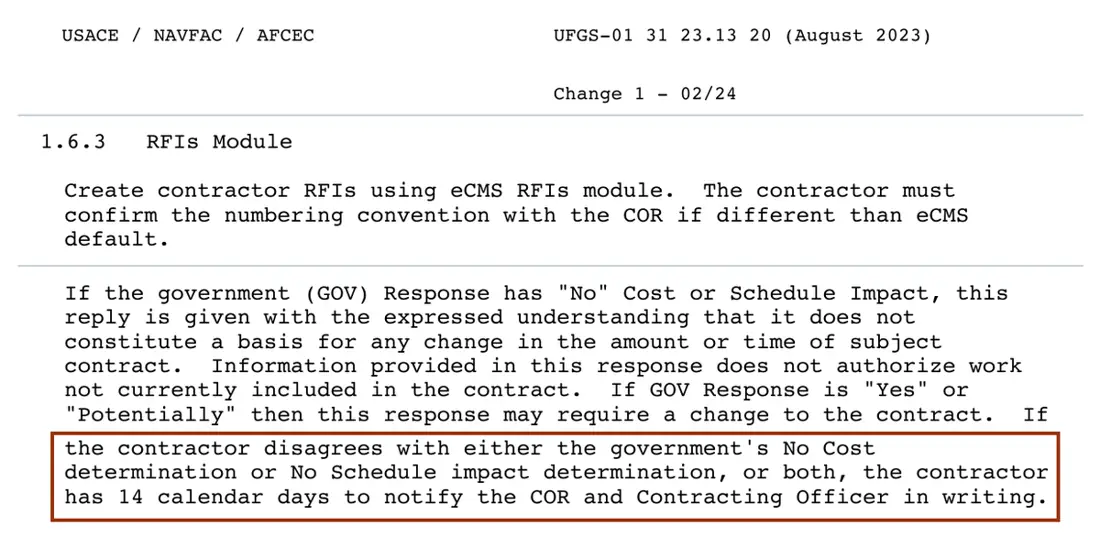
The federal wording is explicit: a “No” cost or schedule answer “does not constitute a basis for any change in the amount or time of subject contract.” YCCD Section 01 26 13, 1.3.E goes further and bars the contractor from proceeding with RFI work it believes will change the price until a change order or other tracking device is approved. Which federal agencies award the most construction dollars, and where, is tracked in our data on federal construction contracts by state.
How many RFIs does a commercial project generate, and what do they cost?
The largest published data set, Navigant’s 2013 analysis of Aconex records, found 796 RFIs on the average project and 9.9 RFIs per $1 million of construction. Per dollar, small jobs generate the most: 17.2 RFIs per $1 million between $5 million and $50 million. Navigant priced a typical RFI at 8 hours and $1,080 to receive, log, review and answer.
| Construction value | RFIs per $1 million | Source |
|---|---|---|
| $5 million to $50 million (333 projects) | 17.2 | Navigant 2013, Table 2 |
| $100 million to $250 million (143 projects) | 5.0 | Navigant 2013, Table 2 |
| $250 million to $500 million (90 projects) | 2.3 | Navigant 2013, Table 2 |
| $1 billion to $5 billion (50 projects) | 1.1 | Navigant 2013, Table 2 |
| All 826 projects from $5 million to $5 billion | 9.9 | Navigant 2013, Table 2 |
Limits apply: about 79% of the 1,362 projects were in Australia and New Zealand, all started between 2001 and 2012, and projects with fewer than 100 RFIs were excluded, which leans the small-job average high: a $5 million job needed at least 20 RFIs per $1 million to be counted. Two size bands are omitted because the published PDF does not render their digits. Cost figures rest on interviews with 3 US design and construction management firms at 2012 to 2013 rates.
The worked example below applies those published rates to a hypothetical $20 million private commercial building, at the small-job rate and the all-project rate. It is arithmetic on published averages, not a forecast for any project.
| Step | Input | Result | Source of the rate |
|---|---|---|---|
| RFIs expected, small-job rate | $20 million x 17.2 per $1 million | 344 RFIs | Navigant 2013, Table 2 |
| RFIs expected, all-project rate | $20 million x 9.9 per $1 million | 198 RFIs, $213,840 at $1,080 each | Navigant 2013, Table 2 |
| Review hours | 344 x 8 hours | 2,752 hours | Navigant 2013, p.13 |
| Review cost | 344 x $1,080 (4 h at $82 plus 4 h at $188) | $371,520 | Navigant 2013, p.14 |
| Unjustified RFIs | 344 x 12% | About 41 RFIs, $44,280 | WisDOT benchmark, 2012 |
| RFIs ending in a modification | 344 x 17% | About 58 RFIs | WisDOT benchmark, 2012 |
The WisDOT rates come from highway contracts, where the same study measured only 2.4 RFIs per $1 million, so the last two rows are an illustration of scale. Navigant’s own figure for an average project was 6,368 review hours and $859,680, at 2012 to 2013 labor rates that we have not updated. Where that effort shows up in industry output data is discussed in our construction productivity tracker.
What does an RFI log look like?
An RFI log is a running register with one row per RFI, showing who asked what, when it was sent, when the answer is due, when it came back and whether it changed cost or time. The 5 rows below are an illustration we built for this page, not records from a real project; day counts are calendar days.
| No. | Subject | Reference | Sent | Reply requested | Answered | Days open | Cost or time | Status |
|---|---|---|---|---|---|---|---|---|
| 001 | Footing depth at grid C-4 | S-201, detail 3 | Mar 2 | Mar 9 | Mar 6 | 4 | No | Closed |
| 002 | Duct conflicts with beam at level 2 | M-102; S-202 | Mar 4 | Mar 11 | Mar 16 | 12 | Potentially | Change order request |
| 003 | Door hardware set missing for 114 | A-601; Section 08 71 00 | Mar 5 | Mar 12 | Mar 10 | 5 | No | Closed |
| 004 | Existing slab thinner than shown | S-100 note 6 | Mar 9 | Mar 12 | Open | (7 at Mar 16) | Yes | Notice sent |
| 005 | Paint color for corridor 120 | A-501 | Mar 10 | Mar 17 | Mar 11 | 1 | No | Closed, unjustified |
Three columns carry the commercial weight: the requested reply date (the WisDOT study tied its absence to answers taking about twice as long), the cost or time flag in the No, Yes or Potentially form UFGS 01 31 23.13 20 uses, and the status that shows whether a notice or change order request went out. An owner reading the log weekly would see RFI 002 run 5 days past its requested date before the change order request arrives, which is why “approve change orders before work” sits in the construction phase of our commercial construction project checklist.
How do you write an RFI that gets a usable answer?
Ask one question, point to the exact sheet and section, propose an answer, state the date you need it and flag any cost or time effect. Those 5 habits map onto the G716 fields, the YCCD 01 26 13 requirements and Navigant’s 2013 best practices, and each one removes a reason for the design team to send the RFI back.
- Search the drawings, specifications and addenda first; an RFI answered by the documents is unjustified (YCCD 01 26 13, 1.3.A).
- Write one question per RFI, with the sheet number, detail and specification section (for example A-601 and Section 08 71 00).
- Attach a marked-up drawing, sketch or photo; YCCD 01 26 13, 1.3.B and C, will not answer coordination RFIs without a scaled suggested solution.
- Propose the lowest-cost solution you would accept, as Navigant recommends.
- Set the requested reply date from the schedule and the contract’s response period, for example 7 calendar days or 5 working days.
- Mark the cost and time effect as No, Yes or Potentially, and if Yes, state the basis of your bid for that item (YCCD 01 26 13, 1.3.E.1).
- Send notice under the contract before doing any added work; on A201-2017 the Claims clock is 21 days (§15.1.3.1).
Questions raised before bid day usually come back as addenda, and A201-2017 §1.1.1 counts addenda issued before signing as Contract Documents. Asking each bidder which addenda it priced is one of the steps in how to compare construction bids.
What several RFI guides get wrong
Three figures circulate widely in RFI guides without matching their primary source: a 7-day A201 deadline, a 22% unanswered rate, and a 10 to 15 RFIs per $1 million rule. We checked each against the A201-2017 text and the April 2013 Navigant report; the table shows the wording each source actually uses.
| Claim in circulation | Where it appears | What the primary source says |
|---|---|---|
| “The AIA A201 sets a 7-calendar-day response standard” | An online RFI guide (accessed October 2026) | A201-2017 §4.2.14: “within any time limits agreed upon or otherwise with reasonable promptness”; no day count |
| RFIs “fail to receive a response 22% of the time”; 21.9% never answered | Two construction software blogs (accessed October 2026) | Navigant gives regional no-reply rates from slightly under 19% (Middle East) to 35% (Asia); no all-project rate appears in the text or Chart 5 |
| “10 to 15 RFIs per $1 million” from unnamed research | A construction software guide (updated October 2025) | Navigant: 9.9 per $1 million across 826 projects, from 17.2 on small jobs to 1.1 on the largest |
| An answered RFI authorizes the work described | Common assumption on site | G716: no authorization for added cost or time; YCCD 01 26 13, 1.3.E.2: answered RFIs are not approval of extra work |
Review periods, rejection reasons and a copyable log for the second row of this table are in our guide to submittals in construction.
Once an RFI answer adds cost or days, the G701 lines, markup schedules and log columns are set out in our change order guide.
How we compiled this
In October 2026 we read 8 primary documents and 6 ranking RFI guides. The documents: two owner-published copies of AIA A201-2017, the AIA B101-2017 owner-architect agreement, AIA’s G716-2004 instructions, UFGS 01 31 23.13 20, YCCD Section 01 26 13, the 2013 Navigant report and the 2012 WisDOT research report (also published in the Journal of Construction Engineering and Management). We ran no survey and hold no project data; the RFI log is an illustration. We excluded a 22% no-reply rate absent from Navigant’s text, paywalled 2020 Aconex study figures, and inconsistent WisDOT row-level values. On October 26, 2026 we re-checked A201 §4.2.14, the Navigant size-band and cost figures and the G716 instructions at source, and removed the names of the guides we corrected.
Frequently asked questions
What does RFI stand for in construction?
RFI stands for request for information. It is a written question, usually from the general contractor to the architect, about a gap, conflict or error in the drawings or specifications. AIA A201-2017 §3.2.2 requires contractors to report errors, inconsistencies or omissions this way. Some owners call it a request for interpretation, as Yuba Community College District does in Section 01 26 13.
Who answers an RFI on a commercial project?
Under AIA A201-2017 §4.2.14 the architect reviews and answers RFIs in writing, routing technical questions to its consultants, such as the structural or electrical engineer. Subcontractors send their questions through the general contractor (§4.2.4). On federal jobs using UFGS 01 31 23.13 20, the government answers inside the eCMS RFI module and marks the cost or schedule impact as No, Yes or Potentially.
Is an RFI a change order?
No. An RFI answer is not one of the Modifications listed in AIA A201-2017 §1.1.1, and the G716-2004 instructions say neither the request nor the response authorizes added cost or time. If an answer changes scope, the contractor gives notice and the parties sign a Change Order under §7.2.1. In a WisDOT benchmark of 18 contracts, about 17% of RFIs ended in a contract modification.
How long should an RFI take to answer?
AIA A201-2017 sets no day count, only reasonable promptness, so the period comes from your agreement or specifications. Published benchmarks: WisDOT averaged 7.1 calendar days against a 7-day goal, and the Navigant 2013 data set showed a 9.7-day median reply. Specifications that set a number often use 5 working days, as YCCD Section 01 26 13 does, or 10 working days, as Navigant’s sample specification does.
What is the difference between an RFI and a submittal?
An RFI asks what the contract documents mean. A submittal, such as a shop drawing, product data sheet or sample, shows how the contractor proposes to meet them. AIA A201-2017 §3.12.4 says submittals are not Contract Documents, and the architect reviews them under §4.2.7. YCCD Section 01 26 13 forbids using an RFI to request approval of a submittal or a substitution.
Can an architect refuse to answer an RFI?
Specifications can allow it. YCCD Section 01 26 13 says RFIs asking for information already in the contract documents may not be answered, and coordination RFIs without a scaled suggested solution will not be answered. Under AIA B101-2017 §4.2.2.2, an architect that does answer such RFIs may bill the owner for it as an Additional Service. The WisDOT benchmark put unjustified RFIs at about 12%.
Sources
- Navigant Construction Forum, Impact and Control of RFIs on Construction Projects, April 2013 (copy hosted by CMAA), accessed 2026-10-19.
- AIA A201-2017 General Conditions, Universities of Wisconsin edition, accessed 2026-10-19.
- AIA A201-2017 sample, University of Maine System, accessed 2026-10-19.
- AIA Contract Documents, A201-2017 product page, accessed 2026-10-19.
- AIA B101-2017 Owner-Architect Agreement (preview), accessed 2026-10-26.
- AIA Contract Documents, Instructions: G716-2004 Request for Information, accessed 2026-10-19.
- AIA Contract Documents, G716 product page, accessed 2026-10-19.
- UFGS 01 31 23.13 20, eCMS, August 2023, Change 1 02/24 (NAVFAC, USACE, AFCEC), accessed 2026-10-19.
- Yuba Community College District, Division 01 Specifications, Section 01 26 13, issued 07/10/2023, accessed 2026-10-19.
- Tadt, Hanna and Whited, Best Practices from WisDOT Mega and ARRA Projects: Request for Information Benchmarks and Metrics, March 2012, accessed 2026-10-19.
- Request for Information: Benchmarks and Metrics for Major Highway Projects, Journal of Construction Engineering and Management 138(12), accessed 2026-10-19.