A bid bond is a surety’s guarantee that a winning bidder will sign the contract and furnish its performance and payment bonds; federal jobs require at least 20% of the bid price, capped at $3 million (FAR 28.101-2).
Key takeaways
- FAR 28.101-2(b) sets the federal bid guarantee at no less than 20% of the bid price and no more than $3 million, so the cap controls on any federal bid above $15 million.
- The Miller Act does not create bid bonds: 40 U.S.C. 3131(b) names only a performance bond and a payment bond. The federal bid bond rule sits in FAR 28.101 and provision 52.228-1.
- Standard Form 24 (Rev. 10/2023) holds a federal bid open 60 days when the bid states no period and gives the winner 10 days after receiving the forms to sign and bond.
- State rules split three ways: a floor (California PCC 10167, at least 10%), a fixed rate (Massachusetts c.149 s.44B, 5%) and a ceiling (Virginia 2.2-4336, no more than 5%); Ohio R.C. 153.54 asks for a bond equal to the full bid.
- The Government Accountability Office (GAO), which decides federal bid protests, upheld rejecting low bids whose surety liability limit sat below the penal sum in 2004 ($44,425 on a $1,750,000 bid) and on September 22, 2026 ($600,000 on a $10,437,758 bid), per B-292864.2 and B-424657.
- Most sureties make no direct charge for a bid bond; the cost comes on the performance and payment bonds after a win, put at 0.5% to 3% of the contract amount by the Surety Information Office (2005), plus a 0.6% fee when the Small Business Administration guarantees them.
What is a bid bond and what does it guarantee?
A bid bond is a three-party promise, signed by the contractor and a surety, that the bidder will not withdraw its bid during the acceptance period and will sign the contract and deliver the required bonds if it wins. The Federal Acquisition Regulation (FAR), the rulebook for federal buying, calls the wider category a bid guarantee in section 28.001 and defines the penal sum as the most the surety must pay.
| Party | Who it is | Where it appears on SF 24 | Role in the bond |
|---|---|---|---|
| Principal | The bidding contractor | Principal (legal name and business address) block | Bound jointly and severally with the surety for the penal sum |
| Surety | The insurer issuing the bond | Surety(ies) block and Liability Limit ($) column | Pays up to its liability limit; on federal bonds it must be on Treasury’s Circular 570 list of approved sureties |
| Obligee | The project owner (the United States on SF 24) | Obligation paragraph | Collects if the bidder defaults after award |
| Attorney-in-fact | The agent who signs for the surety | Signature block, with power of attorney attached | Must include evidence of authority under FAR 28.101-3(a) |
A bid bond stops at the contract. It does not promise that the building gets finished or that subcontractors get paid; those risks move to the performance bond and payment bond, which FAR 28.102-2 sets at 100% of the original contract price on federal construction over $150,000. Bid bonds belong to sealed low-bid procurement, the model compared in our design-build vs design-bid-build guide.
This page summarizes public regulations, statutes and GAO decisions as checked on October 19, 2026. It is not legal, bonding or insurance advice: check the solicitation and the current statute for a specific bid, and ask a surety agent or construction attorney how they apply.
How much does a bid bond cost?
A bid bond usually costs the contractor nothing directly. The Surety Information Office, an industry office backed by the Surety & Fidelity Association of America, wrote in 2005 that “typically, there is no direct charge for a bid bond.” The premium comes after a win, on the performance and payment bonds, which the same brochure put at one-half of one percent to three percent of the contract amount.
| What you pay | When | Rate | On a $4,000,000 contract | Source |
|---|---|---|---|---|
| Bid bond | With the bid | Typically no direct charge | $0 | Surety Information Office, 2005 |
| SBA fee on a bid bond it guarantees | With the bid | No fee | $0 | SBA; 13 CFR 115.32(b) |
| Performance and payment bond premium | When the contract is signed | 0.5% to 3% of the contract amount | $20,000 to $120,000 (our arithmetic) | Surety Information Office, 2005 |
| SBA fee if SBA guarantees those bonds | When the contract is signed | 0.6% of the contract price | $24,000 (our arithmetic) | SBA |
| Certified check instead of a bond (federal 20%) | Held from bid day | 20% of the bid | $800,000 of cash tied up | FAR 52.228-1 |
Read the 0.5% to 3% range as a dated industry figure, not a quote: it dates from 2005, and the rate that binds is the one your surety has filed with the state insurance department. On bonds the Small Business Administration (SBA) guarantees, 13 CFR 115.32(a) bars the surety from charging more than that authorized rate, or any fee beyond premium unless it performs other services, state law allows the fee and you agree to it. Contractors generally carry the bond premium as a line in the bid, per the same brochure.
Three questions for your surety agent: is the bid bond issued at no charge inside your bonding line, what is the filed rate for the final bonds at this contract size, and does any fee other than premium apply?
What bid bond amount does a federal job require?
Federal construction bids that need a performance bond also need a bid guarantee, and FAR 28.101-2(b) sets it at no less than 20% of the bid price and no more than $3 million. Solicitations write the figure into provision 52.228-1 as a percent of the bid price or a dollar amount, whichever is less. The standard instrument is Standard Form 24, Bid Bond.
FAR 28.101-1(a) ties the bid guarantee to the performance bond, and FAR 28.102-1 requires performance and payment bonds on construction contracts exceeding $150,000. In practice the bid bond rule applies above $150,000 unless the chief of the contracting office waives it, with overseas construction, emergency acquisitions and sole-source contracts given as examples in 28.101-1(c). On construction, only a separate bid guarantee for that bid is acceptable (28.101-1(b)).
As of October 2026 some agencies still use the FAR as amended by FAC 2026-01 (effective March 13, 2026) and others use the Revolutionary FAR Overhaul, a rewrite agencies can adopt early; its Part 28 text keeps the same 20% and $3 million wording. Where federal building contract dollars land by state is mapped in our federal construction contracts by state report.
Is the Miller Act the source of the 20% rule?
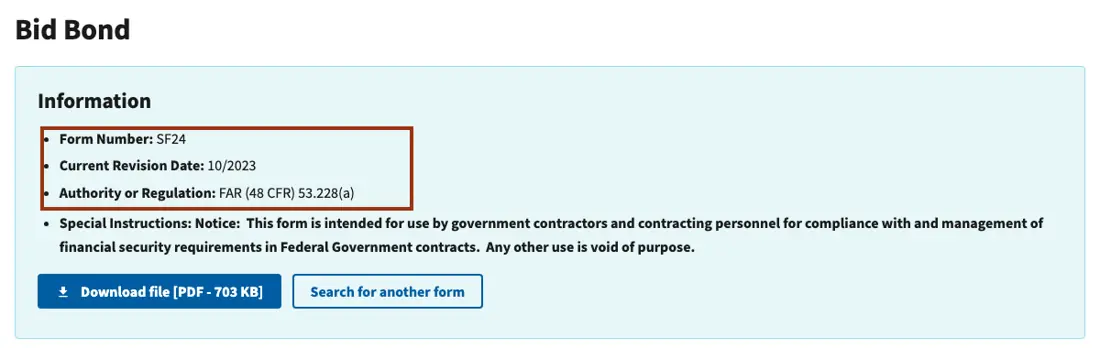
No. Several ranking guides credit the Miller Act, but 40 U.S.C. 3131(b) requires only a performance bond and a payment bond before award of a federal construction contract of more than $100,000, and it never mentions bid security. The bid guarantee rule lives in the regulation: FAR 28.101, provision 52.228-1 and the SF 24 form that GSA lists under FAR 53.228(a), current revision 10/2023.
How long does a federal bid bond stay open?
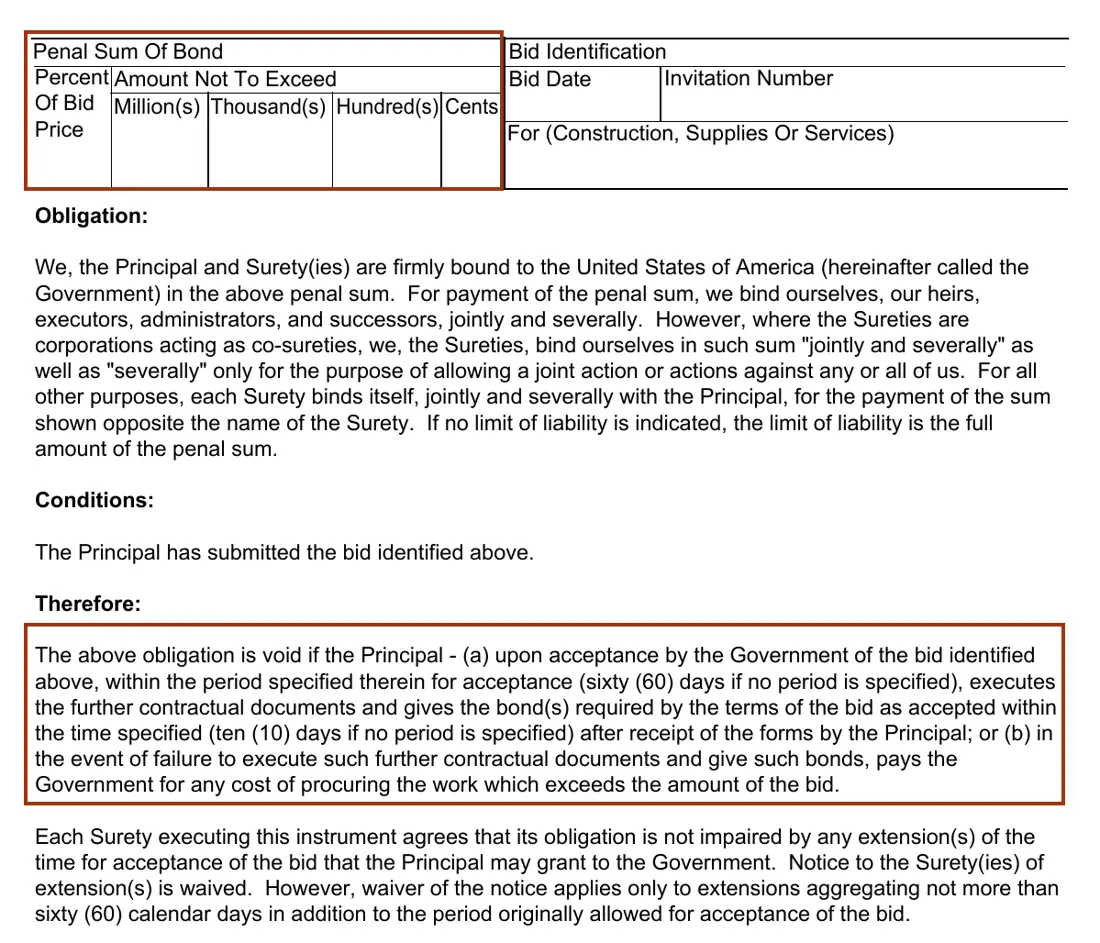
Under the SF 24 conditions, the bond holds for the acceptance period the bid states, or 60 days when it states none. The surety waives notice of extensions that add up to no more than 60 calendar days, and the winner has the time stated, or 10 days, after it receives the award forms to sign the contract and deliver its bonds.
| Clock item | Rule | Source |
|---|---|---|
| Date the bond is executed | Not later than the bid opening date | SF 24, header block |
| Acceptance period | 60 days if the bid specifies no period | SF 24, conditions |
| Extensions the surety accepts without notice | Up to 60 calendar days in total | SF 24, conditions |
| Time to sign and deliver bonds | 10 days after receipt of the forms, unless the solicitation sets another period | FAR 52.228-1(d) |
| Georgia state bids (comparison) | Bid cannot be withdrawn until 60 days after opening | O.C.G.A. 13-10-20(b) |
What do state laws require for bid security?
State statutes do not agree on whether the percentage is a floor, a fixed rate or a ceiling. Of the five states read for this page, California and Georgia set minimums, Massachusetts fixes 5%, Virginia caps the bond at 5%, and Ohio asks for a bond equal to the full bid or a 10% check. Each rule covers only the public owners its statute names.
| Jurisdiction | Statute | Who it covers | Amount | Rule type | Most the owner keeps on default | Source |
|---|---|---|---|---|---|---|
| Federal | FAR 28.101-2; 52.228-1 | Federal contracts that need a performance bond (construction over $150,000) | At least 20% of bid price, not over $3 million | Floor with cap | Excess cost of getting the work over the bid, up to the penal sum | acquisition.gov |
| California | Public Contract Code 10167 | State agencies under the State Contract Act | At least 10% of the amount bid | Floor | Not stated in the section read | leginfo.legislature.ca.gov |
| Georgia | O.C.G.A. 13-10-20 | State public works with estimated bids over $100,000 | Not less than 5% of the total amount payable | Floor | Not stated in the section read | FindLaw copy of the code |
| Massachusetts | M.G.L. c.149 s.44B | General bids and sub-bids under section 44A | 5% of the value of the bid | Fixed | The deposit, but no more than the gap to the next lowest responsible and eligible bidder | malegislature.gov |
| Ohio | R.C. 153.54 | State and local public improvements, excluding the Ohio Department of Transportation | Bond for the full bid, or check or letter of credit for 10% | Full bid or fixed | Lesser of the gap to the next lowest bidder and 10% | codes.ohio.gov |
| Virginia | Va. Code 2.2-4336 | Nontransportation construction over $500,000; state-funded transportation over $350,000 | No more than 5% of the amount bid | Ceiling | Lesser of the gap to the next low bid and the bond’s face amount | law.lis.virginia.gov |
Ohio’s bond-form guaranty is also conditioned to indemnify the owner against failure to perform and to pay subcontractors, material suppliers and laborers (R.C. 153.54(B)(2)), so it doubles as the contract bond. Ohio also lets a bidder on a public improvement under one-half million dollars withdraw if its surety certifies that a second job would exceed its bonding capacity (153.54(G)). The current Ohio text took effect September 30, 2025.
Private owners are not bound by these statutes; the instructions to bidders set the amount, the form and the acceptance period. Owners lining up several bids against those instructions can use our guide to comparing construction bids, and the payment and retainage rules on the same public jobs are in the prompt payment and retainage registry.
How do you calculate the penal sum?
Multiply the bid price by the required percentage, then apply any dollar cap the solicitation states. On federal work the amount is the percent of the bid price or the dollar figure in 52.228-1(c), whichever is less, so a 20% requirement with a $3 million cap stops growing at a $15 million bid. The surety’s liability limit on SF 24 must match that penal sum.
| Bid price | 20% of bid price | Federal guarantee (lesser of 20% or $3 million) | 5% (Massachusetts fixed; Virginia ceiling) | 10% (California floor; Ohio check) |
|---|---|---|---|---|
| $1,000,000 | $200,000 | $200,000 | $50,000 | $100,000 |
| $5,000,000 | $1,000,000 | $1,000,000 | $250,000 | $500,000 |
| $10,437,758 (Advantix bid, 2026) | $2,087,551.60 | $2,087,551.60 | $521,887.90 | $1,043,775.80 |
| $15,000,000 | $3,000,000 | $3,000,000 | $750,000 | $1,500,000 |
| $20,000,000 | $4,000,000 | $3,000,000 | $1,000,000 | $2,000,000 |
| $25,000,000 | $5,000,000 | $3,000,000 | $1,250,000 | $2,500,000 |
On SF 24, the Percent of Bid Price box takes the 20% and the Amount Not To Exceed boxes take the $3 million cap (instruction 3). Instruction 4(a) says the Liability Limit block is the penal sum unless co-sureties split it, and the obligation paragraph adds that if no limit is shown, the limit is the full penal sum. A blank limit is safer than a wrong one, as the 2026 Advantix decision shows.
What happens if the winning bidder backs out?
If the low bidder does not sign or bond in time, the owner can default it and collect the extra cost of getting the work done from the bidder and its surety, up to the penal sum. Under FAR 52.228-1(e) the bidder is liable for any cost of acquiring the work above its bid, and the bid guarantee is available to offset that difference.
- Bid opening: the bid bond goes in with the bid (SF 24 on federal work). A missing or defective bond means rejection unless a FAR 28.101-4(c) waiver fits.
- The owner accepts the low bid within the acceptance period, 60 days if the bid states none.
- If the bidder signs and delivers performance and payment bonds within 10 days of receiving the forms, the bid bond obligation is void and nothing is paid.
- If the bidder fails to sign or bond, the owner may terminate for default under 52.228-1(d).
- The owner awards to the next bidder or rebids and measures the excess cost over the defaulted bid.
- The bidder and surety, bound jointly and severally on SF 24, pay that excess, capped at the penal sum.
The same default costs different amounts under different rules. The table runs one $4,000,000 low bid through three possible gaps to the next bid, assuming the owner awards to that next bidder at its bid price.
| Bid security on a $4,000,000 bid | Next bid $50,000 higher | Next bid $240,000 higher | Next bid $600,000 higher | Rule applied |
|---|---|---|---|---|
| Federal SF 24 at 20% ($800,000 penal sum) | $50,000 | $240,000 | $600,000 | FAR 52.228-1(e); excess cost up to the penal sum |
| Virginia bond at the 5% ceiling ($200,000) | $50,000 | $200,000 | $200,000 | Va. Code 2.2-4336(B); lesser of gap and face amount |
| Massachusetts 5% deposit ($200,000) | $50,000 | $200,000 | $200,000 | M.G.L. c.149 s.44B(3); deposit, no more than the gap |
| Ohio bond for the full bid ($4,000,000) | $50,000 | $240,000 | $400,000 | R.C. 153.54(B)(1); lesser of gap and 10% of the bond |
| Ohio 10% certified check ($400,000) | $50,000 | $240,000 | $400,000 | R.C. 153.54(C)(1); lesser of gap and 10% of the bid |
Two exits exist in the statutes read. Massachusetts returns the deposit in case of death, disability or a bona fide clerical or mechanical error of a substantial nature (s.44B(3)). Ohio caps a rebid claim at 10% of the bid or the cost of reprinting documents, advertising and mailing notices, whichever is less (153.54(B)(1)). None of the three statutes that set a default measure (Ohio, Virginia, Massachusetts) lets the owner keep the full security regardless of the gap.
Why do low bids get rejected over the bid bond?
In federal sealed bidding a missing or defective bid guarantee means rejection under FAR 14.404-2(j) and FAR 28.101-4(a), and the bid cannot be repaired after opening. The defect in both GAO cases below was a surety liability limit lower than the required penal sum, which left the bond unclear about what the surety owed.
| GAO decision | Agency and project | Bid | Required guarantee | Liability limit on SF 24 | Outcome |
|---|---|---|---|---|---|
| Armstrong Elevator Co., B-292864.2, April 13, 2004 | GSA, elevator modernization, federal building in Des Moines | $1,750,000 | $350,000 (20%) | $44,425 | Rejected; a corrected bond filed after opening did not cure it; award went to Mid-American Elevator at $2,053,354 |
| Advantix Engineering, Corp., B-424657, September 22, 2026 | Army National Guard Bureau, maintenance shops at Camp Santiago, Puerto Rico (nine bids) | $10,437,758 | $2,087,551.60 (20%, under the $3 million cap) | $600,000 | Rejected; protest denied; next bid was $17,467,183 |
Our arithmetic on those records: Armstrong’s $44,425 limit was 2.54% of its bid, and the government paid $303,354, or 17.3%, more than the rejected price. Advantix’s $600,000 limit was 5.75% of its bid against a $7,029,425 gap to the next bid, so the 28.101-4(c)(2) waiver, which needs the guarantee to cover that gap, did not apply, as the contracting officer found and the GAO decision records.
FAR 28.101-4(c) lists eight cases where a federal contracting officer must waive the defect, unless acceptance is found in writing to hurt the government’s interest:
- Only one offer is received (the guarantee may be required before award).
- The guarantee is short but at least equals the gap to the next higher acceptable offer.
- The guarantee covers a smaller quantity the bidder is eligible for; award is limited to that quantity.
- The guarantee arrives late and late receipt is waived under FAR 14.304.
- A mistake correction under FAR 14.407 makes it short and the bidder raises it.
- The bid is signed but the bid bond is not signed by the offeror.
- The bid bond is misdated or undated.
- The bond does not name the United States as obligee but correctly identifies the offeror, solicitation number and project.
Power of attorney is the other trap. FAR 28.101-3 treats a missing signed and dated power of attorney at bid opening as a responsiveness defect, and if the surety says the power of attorney was invalid, the bidder may not substitute a new one or a new surety.
Bid bond or certified check: which ties up less cash?
A certified or cashier’s check is money out of the business from bid day until it comes back, while a bid bond is a surety’s promise with no deposit. FAR 52.228-1(b) accepts either on federal work, along with postal money orders, irrevocable letters of credit and certain U.S. bonds or notes. On a $4,000,000 federal bid at 20%, a check means $800,000 held.
| Question | Bid bond | Certified or cashier’s check | Source |
|---|---|---|---|
| Accepted on federal bids? | Yes, SF 24 with a Circular 570 surety | Yes | FAR 52.228-1(b) |
| Cash held on a $4,000,000 federal bid at 20% | No deposit | $800,000 | Our arithmetic |
| Returned to losing federal bidders | Not returned; the bond is listed as an exception to the return rule | As soon as practicable after bid opening | FAR 52.228-1(b) |
| Ohio amount | Bond for 100% of the bid | 10% of the bid | R.C. 153.54(A) |
| Massachusetts return | Same rule as checks | Within five days, excluding weekends and legal holidays, except the three lowest bidders | M.G.L. c.149 s.44B(3) |
| California state forms | Electronic or signed bidder’s bond from an admitted surety insurer | Cash, cashier’s check or certified check, at least 10% | PCC 10167(a), (b) |
| SBA fee if SBA guarantees the bond | No fee for bid bond guarantees | Not applicable | SBA |
Bid bond vs performance bond and payment bond
The three bonds cover consecutive risks on one job: the bid bond covers the step from bid to signed contract, the performance bond covers finishing the work, and the payment bond covers subcontractors and suppliers. On federal construction over $150,000 the last two each equal 100% of the original contract price under FAR 28.102-2, against at least 20% of the bid for the bid bond.
| Item | Bid bond | Performance bond | Payment bond | Source |
|---|---|---|---|---|
| Federal form | SF 24 | SF 25 | SF 25A | FAR 28.106-1 |
| Protects | Owner, against a winner that will not sign or bond | Owner, against failure to perform | People supplying labor and material | 40 U.S.C. 3131(b); FAR 28.001 |
| Federal amount | At least 20% of bid price, not over $3 million | 100% of original contract price | 100% of original contract price | FAR 28.101-2; FAR 28.102-2 |
| Federal trigger | Whenever a performance bond is required | Construction contracts over $150,000 | Over $150,000; two or more payment protections from $35,000 to $150,000 | FAR 28.101-1; FAR 28.102-1 |
| When it is due | With the bid, by bid opening | After award, within the time set (10 days by default) | Same as the performance bond | FAR 52.228-1 |
| SBA guarantee fee | None | 0.6% of contract price (with the payment bond) | 0.6% of contract price (with the performance bond) | SBA |
State performance and payment bond thresholds for 10 states, from no dollar floor to $500,000, are compiled in our construction surety bond statistics.
How do sureties decide whether to write a bid bond?
Public sources say little about underwriting itself, so this section sticks to what is on the record. The SBA tells applicants they must meet the surety’s credit, capacity and character requirements. On federal bids the surety must also appear on Treasury’s Circular 570 and stay inside its listed limit, which 31 CFR 223.10 sets at 10% of paid-up capital and surplus.
- Treasury listing: SF 24 instruction 4(a) requires corporate sureties to be on the Circular 570 list, which held 249 companies with a median single-bond limit of $34.6 million as of August 1, 2026, so a $3 million maximum federal bid guarantee sits well inside the median limit.
- Co-sureties: when two or more sureties share a bond, their allocated liability must total 100% of the penal sum (SF 24 instruction 4(b)).
- Individual sureties: each must attach Standard Form 28, Affidavit of Individual Surety, and the government may ask for more financial detail (instruction 4(c)).
- The follow-on bonds: because SF 24 obliges the bidder to deliver 100% performance and payment bonds within 10 days of award, a bid bond is only useful if a surety is ready to write those bonds at the full contract price.
- Small firms: SBA guarantees bid, performance and payment bonds on contracts up to $9 million, or $14 million on federal contracts, for contractors who meet those surety requirements.
Bonding capacity also decides which jobs are worth chasing, a point covered in how to win commercial construction bids. SBA’s loan programs for contractors are a separate track, tallied by state in our SBA loans for construction companies report.
Which bid bond rule applies to your bid?
Start with who the owner is and the dollar value, because those two facts pick the rule. Federal sealed bids over $150,000 follow FAR 28.101 and SF 24; state and local public bids follow the state statute and the bid documents; private bids follow the instructions to bidders alone. The table pairs each common situation with its threshold and its source.
| If | Then | Rule |
|---|---|---|
| Federal construction bid where a performance bond is required (over $150,000) | Furnish the 52.228-1 amount, at least 20% of the bid price and not over $3 million, usually on SF 24 | FAR 28.101-1, 28.101-2 |
| Federal bid above $15,000,000 with a 20% / $3 million provision | The penal sum is $3,000,000 | FAR 52.228-1(c) |
| SF 24 liability limit is lower than the penal sum | Fix it before bid opening; a corrected bond after opening does not cure the bid | B-292864.2; B-424657 |
| An attorney-in-fact signs for the surety | Attach the signed, dated power of attorney | FAR 28.101-3 |
| Only one federal offer is received | The defect is waived; the guarantee may be required before award | FAR 28.101-4(c)(1) |
| Guarantee is short but at least equals the gap to the next acceptable offer | The defect is waived | FAR 28.101-4(c)(2) |
| Virginia nontransportation job over $500,000 | Bid bond required, no more than 5% of the bid | Va. Code 2.2-4336 |
| Ohio public improvement (not ODOT) | Bond for 100% of the bid, or a 10% check or letter of credit | R.C. 153.54(A) |
| Massachusetts bid under section 44A | 5% deposit by bond, cash or check | M.G.L. c.149 s.44B(2) |
| California state agency bid | At least 10% of the amount bid | PCC 10167(b) |
| Georgia state public works over $100,000 | At least 5%; bid stays firm 60 days after opening | O.C.G.A. 13-10-20 |
| Private project | Follow the instructions to bidders; no statute sets the amount | Bid documents |
| You need cash free or cannot get bonded yet | Use a bond instead of a check; ask about SBA’s guarantee, no fee on bid bonds, contracts up to $9 million | SBA |
How a performance bond claim runs under AIA A312-2010, and what bidders priced the bonds at on public bid tabs, is set out in our performance bond guide.
How we compiled this
We read 25 primary documents, accessed October 19 and 26, 2026 as the source list shows: 11 FAR texts on acquisition.gov, SF 24 and its GSA page, the Miller Act, five state statutes, two GAO decisions, the SBA surety page and its rule (13 CFR 115.32), and two Treasury sources. The only premium range we found outside seller websites is the dated Surety Information Office brochure, labeled with its 2005 date; premium claims from surety sellers were left out. The arithmetic is ours. Our method is on the editorial standards page.
Frequently asked questions
How much does a bid bond cost?
Usually nothing directly: the Surety Information Office, an industry office, wrote in 2005 that there is typically no direct charge for a bid bond. The cost comes after a win: the same source put performance and payment bond premiums at 0.5% to 3% of the contract amount, or $20,000 to $120,000 on a $4,000,000 job, and SBA adds 0.6% on bonds it guarantees.
What percentage is a bid bond?
The owner’s rules set it. Federal construction bids need at least 20% of the bid price, capped at $3 million, under FAR 28.101-2. California state agencies need at least 10%, Georgia state works at least 5%, Massachusetts exactly 5%, Virginia no more than 5%, and Ohio a bond for the full bid. Private bids follow the instructions to bidders.
How long is a bid bond valid?
On federal work the SF 24 bond covers the acceptance period stated in the bid, or 60 days if none is stated, and the surety accepts up to 60 calendar days of extensions without notice. After the winner receives the award forms it has the stated time, or 10 days, to sign and deliver performance and payment bonds.
Do you get a bid bond back if you lose?
A bid bond is not cash, so nothing is handed back; the surety owes something only if your bid is accepted and you then fail to sign or bond. Checks and other deposits are returned: under FAR 52.228-1(b) to losing federal bidders as soon as practicable after bid opening, and in Massachusetts within five business days except for the three lowest general bidders, whose deposits wait for the contract.
What is the difference between bid security and a bid bond?
Bid security, or a bid guarantee in FAR 28.001, is the umbrella term for anything that backs a bid. A bid bond is one form of it, issued by a surety. Others named in FAR 52.228-1(b) include certified checks, cashier’s checks, postal money orders, irrevocable letters of credit and certain U.S. bonds or notes.
What happens if a contractor refuses to sign the contract?
The owner can default the bidder and recover the extra cost of awarding the work elsewhere, up to the penal sum. On a $4,000,000 federal bid with a 20% bond and a next bid $240,000 higher, the claim is $240,000. Under Virginia’s 5% ceiling the same default would cost no more than $200,000.
Can small contractors get bid bonds?
Yes, through the regular surety market or with SBA backing. The SBA Surety Bond Guarantee Program guarantees bid, performance and payment bonds on contracts up to $9 million, or $14 million on federal contracts, for firms that meet the surety’s credit, capacity and character requirements. SBA charges no fee on the bid bond guarantee itself.
Sources
- FAR 28.001 Definitions (FAC 2026-01), Acquisition.gov, GSA. Accessed 2026-10-19.
- FAR 28.101-1 Policy on use, Acquisition.gov, GSA. Accessed 2026-10-19.
- FAR 28.101-2 Solicitation provision or contract clause, Acquisition.gov, GSA. Accessed 2026-10-19.
- FAR 28.101-3 Authority of an attorney-in-fact for a bid bond, Acquisition.gov, GSA. Accessed 2026-10-19.
- FAR 28.101-4 Noncompliance with bid guarantee requirements, Acquisition.gov, GSA. Accessed 2026-10-19.
- FAR 52.228-1 Bid Guarantee (Sept 1996), Acquisition.gov, GSA. Accessed 2026-10-19.
- FAR 14.404-2 Rejection of individual bids, Acquisition.gov, GSA. Accessed 2026-10-19.
- FAR 28.102-1 General (performance and payment bonds), Acquisition.gov, GSA. Accessed 2026-10-19.
- FAR 28.102-2 Amount required, Acquisition.gov, GSA. Accessed 2026-10-19.
- FAR Subpart 28.1, including 28.106-1 Bonds and bond-related forms, Acquisition.gov, GSA. Accessed 2026-10-19.
- FAR Overhaul, Part 28 model deviation text, Acquisition.gov, GSA. Accessed 2026-10-19.
- Bid Bond, Standard Form 24 (form page), U.S. General Services Administration. Accessed 2026-10-19.
- Standard Form 24, Bid Bond (Rev. 10/2023), PDF, U.S. General Services Administration. Accessed 2026-10-19.
- 40 U.S.C. 3131, Bonds of contractors of public buildings or works, Legal Information Institute, Cornell Law School. Accessed 2026-10-19.
- Armstrong Elevator Company, B-292864.2, April 13, 2004, U.S. Government Accountability Office (via GovInfo). Accessed 2026-10-19.
- Advantix Engineering, Corp., B-424657, September 22, 2026, U.S. Government Accountability Office. Accessed 2026-10-19.
- Code of Virginia 2.2-4336, Bid bonds; construction contracts, Virginia Legislative Information System. Accessed 2026-10-19.
- Ohio Revised Code 153.54, Bid guaranty (effective September 30, 2025), Ohio Legislative Service Commission. Accessed 2026-10-19.
- Massachusetts General Laws c.149 s.44B, Plans and specifications; bid deposits, Massachusetts Legislature. Accessed 2026-10-19.
- O.C.G.A. 13-10-20, Bid bonds on state public works, FindLaw copy of the Official Code of Georgia. Accessed 2026-10-19.
- California Public Contract Code 10167, California Legislative Information. Accessed 2026-10-19.
- Surety bonds (program page), U.S. Small Business Administration. Accessed 2026-10-19.
- 10 Things You Should Know About Surety Bonds (2005), Surety Information Office, hosted by Nevada State Risk Management. Accessed 2026-10-26.
- 13 CFR 115.32, Fees and Premiums (SBA Surety Bond Guarantee Program), Legal Information Institute, Cornell Law School. Accessed 2026-10-26.
- List of Certified Companies, Department Circular 570 (effective August 1, 2026), U.S. Treasury, Bureau of the Fiscal Service. Accessed 2026-10-18.
- 31 CFR Part 223, Surety Companies Doing Business with the United States, eCFR, Office of the Federal Register. Accessed 2026-10-18.