A performance bond is a surety’s promise to the project owner that the contractor will finish the contract; if the contractor defaults, the surety completes the work or pays, up to the bond amount, usually 100% of the contract price.
Key takeaways
- Federal construction contracts over $150,000 need a performance bond and a payment bond, each for 100% of the original contract price, under FAR 28.102-1 and FAR 28.102-2; the Miller Act text in 40 U.S.C. 3131 still reads $100,000.
- Under the AIA A312-2010 performance bond, the surety owes nothing until the owner gives notice, declares a default, terminates and commits the unpaid contract balance (Section 3); a lawsuit must follow within 2 years (Section 11).
- A supplier to a subcontractor on a federal job must give the prime contractor written notice within 90 days of its last delivery and sue within 1 year, under 40 U.S.C. 3133(b).
- Public bid tabulations from 2014 to 2018 priced combined performance and payment bonds at 0.10% to 1.77% of the bid (Transbay Joint Powers Authority, City of Longview, Texas); the Congressional Research Service cited 1.5% to 3.0% in July 2025.
- The SBA Surety Bond Guarantee Program backs bonds on contracts up to $9 million, or $14 million on federal work, for a contractor fee of 0.6% of the contract price.
- State floors differ: Virginia requires both bonds above $500,000 (Va. Code 2.2-4337), Florida above $100,000 on state work (Fla. Stat. 255.05), and Texas requires a payment bond above $25,000 (Tex. Gov. Code 2253.021).
What is a performance bond and who are the three parties?
A performance bond is a three-party contract. The contractor (the principal) and the surety bind themselves jointly to the owner (the obligee) for the construction contract, and the bond stays void as long as the contractor performs. Federal jobs use Standard Form 25 (Rev. 10/2023); private and many public jobs use AIA A312-2010. The penal sum, the most the surety can owe, is usually 100% of the contract price.
| Party | Who it is | Name on SF 25 | Name on A312-2010 | What it does |
|---|---|---|---|---|
| Principal | The contractor | Principal | Contractor | Performs the work; signs the bond and, usually, an indemnity agreement with the surety |
| Surety | An insurance company | Surety(ies), each with a Liability Limit ($) | Surety | Completes or pays on default, up to the penal sum; federal sureties must be on Treasury Circular 570 |
| Obligee | The project owner | The United States (the Government) | Owner | Declares the default and claims on the bond; under A312-2010 Section 9 only the owner has a right of action |
A performance bond is credit extended to the contractor, not insurance for it. A 2005 Surety Information Office brochure says the surety prequalifies the contractor and may require personal or corporate indemnity, so a surety that pays an owner then looks to the contractor and its owners to repay it. For federal bonds, corporate sureties must appear on Treasury Circular 570, which listed 249 companies effective August 1, 2026.
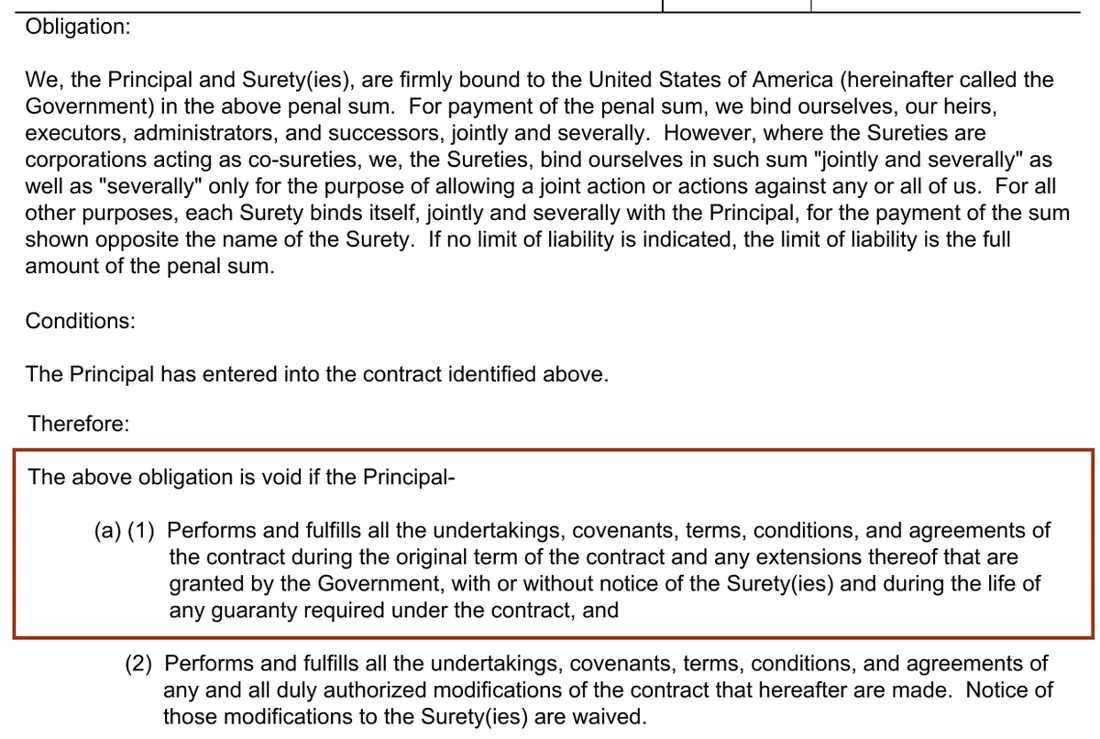
On federal work, the SF 25 conditions make the obligation void if the principal performs every contract term during the original term, any extensions and the life of any guaranty the contract requires, and performs all authorized modifications, with notice of modifications to the surety waived.
This page summarizes statutes, regulations, forms and bid records checked by November 2, 2026. It is not legal, bonding or insurance advice: the bond attached to your contract controls, and a construction attorney or surety agent can apply it to your job. Bid security, including the 20% federal bid guarantee, is covered in our bid bond guide.
How does a performance bond claim work?
Under AIA A312-2010 the owner must take three steps before the surety owes anything: give notice that it is considering a default (Section 3.1), declare the default and terminate the contract (Section 3.2), and agree to pay the unpaid contract balance to the surety or a replacement contractor (Section 3.3). The surety must then promptly choose one of the Section 5 options.
- Notice (Section 3.1): the owner writes to the contractor and the surety, at the addresses on the signature page (Section 12), that it is considering declaring a Contractor Default, and says whether it wants a conference.
- Conference: if the owner does not ask for one, the surety may ask within 5 business days of receiving the notice; unless the owner agrees otherwise, the conference is held within 10 business days of that receipt. The three parties may agree to give the contractor a reasonable time to perform.
- Default and termination (Section 3.2): a Contractor Default is a failure to comply with a material term that has not been remedied or waived (Section 14.3). The owner declares it, terminates the contract and notifies the surety.
- Contract balance (Section 3.3): the owner agrees to pay the Balance of the Contract Price, the total payable less proper payments already made (Section 14.1), to the surety or the completing contractor.
- Surety’s election (Section 5): promptly and at its own expense, the surety takes one of the five actions in the table below.
- Follow-up notice (Section 6): if the surety does not proceed with reasonable promptness, it is deemed in default 7 days after a further written notice from the owner.
- Lawsuit (Section 11): filed where the work is located, within 2 years after the default declaration, after the contractor stopped working, or after the surety refused or failed to perform, whichever comes first.
| Section | What the surety does | What the owner gets | Liability cap (Section 8) |
|---|---|---|---|
| 5.1 | Arranges for the original contractor to finish, with the owner’s consent | The original contractor completes the work | Bond amount |
| 5.2 | Performs and completes the contract itself, through agents or independent contractors | Completed work; the surety’s duties are no greater than the contractor’s (Section 7) | Not listed in Section 8 |
| 5.3 | Obtains bids from qualified contractors acceptable to the owner, arranges a new contract backed by equivalent bonds, and pays damages above the contract balance | A new bonded contract the owner signs, plus the excess cost | Bond amount |
| 5.4.1 | Waives its right to complete, investigates, and pays what it determines it owes | A cash payment; if the owner refuses it, the owner may sue (Section 6) | Bond amount |
| 5.4.2 | Denies liability in whole or in part, citing reasons | The right to sue without further notice (Section 6) | Not applicable |
Section 4 softens only the first step: a late Section 3.1 notice releases the surety only if it shows actual prejudice, and the form gives no such relief for Sections 3.2 and 3.3. Once the surety completes, Section 7 makes it answer for defective work, completion, added legal, design and delay costs, and liquidated damages; Section 8 caps it at the bond amount under 5.1, 5.3 and 5.4, but not 5.2.
Performance bond vs payment bond: what is the difference?
The performance bond protects the owner if the work is not finished; the payment bond protects the subcontractors, laborers and suppliers who are not paid. On federal jobs both are required above $150,000, each equals 100% of the original contract price under FAR 28.102-2, and the payment bond can never be smaller than the performance bond (40 U.S.C. 3131(b)(2)).
| Item | Performance bond | Payment bond | Source |
|---|---|---|---|
| Protects | The owner, against failure to perform | All persons supplying labor and material | 40 U.S.C. 3131(b) |
| Who can claim | The owner only (A312-2010 Section 9) | Anyone with a direct contract with the contractor or a subcontractor (A312-2010 Payment Bond Section 16.2) | AIA A312-2010 |
| Federal amount | 100% of the original contract price, plus 100% of increases | Same; never less than the performance bond | FAR 28.102-2(b) |
| Federal form | SF 25 (Rev. 10/2023) | SF 25A (Rev. 10/2023) | GSA forms pages |
| First formal step | Section 3.1 notice, then a declared default | Claim to the surety; without a direct contract with the contractor, a notice of nonpayment within 90 days first | A312-2010 Payment Bond Section 5 |
| Surety’s response time | Promptly; deemed in default 7 days after a further notice | Written answer within 60 days of the claim, and payment of undisputed amounts | A312-2010 Performance Bond Section 6; Payment Bond Section 7 |
| Deadline to sue | 2 years (Section 11) | 1 year (Section 12; 40 U.S.C. 3133(b)(4)) | 40 U.S.C. 3133 |
The A312-2010 payment bond also protects the owner directly. Once the owner promptly notifies the contractor and surety of a claim, lien or suit by an unpaid supplier and tenders its defense, the surety must defend and indemnify the owner (Sections 3 and 4). If the surety misses the 60-day answer in Section 7.1, Section 7.3 makes it pay the claimant’s reasonable attorney’s fees from then on.
What are the payment bond claim deadlines?
Deadlines run from the claimant’s last day of work or delivery, and they differ by bond and state. On federal jobs a supplier or sub-subcontractor with no contract with the prime has 90 days to give written notice and 1 year to sue; Florida adds a notice within 45 days of starting work. The table lists the federal rule, the A312-2010 form and two state statutes.
| Bond or statute | Notice | Deadline to sue | Source |
|---|---|---|---|
| Federal payment bond (Miller Act) | Claimant with a direct contract with a subcontractor only: written notice to the prime within 90 days of last labor or material. Others may sue once unpaid 90 days after last work | 1 year after last labor or material, in U.S. district court | 40 U.S.C. 3133(b) |
| AIA A312-2010 Payment Bond | No direct contract with the contractor: notice of nonpayment to the contractor within 90 days, then a claim to the surety | 1 year from the claim or from the last work by anyone on the contract, whichever is first | Sections 5.1, 12 |
| Florida public work | Not in privity with the contractor: notice within 45 days of starting; notice of nonpayment no later than 90 days after final furnishing | 1 year after the labor or final delivery | Fla. Stat. 255.05 |
| Florida private job with a lien-exempting bond | Same 45-day and 90-day notices | 1 year | Fla. Stat. 713.23 |
| Virginia public work | Claimant with a direct contract with a subcontractor only: written notice within 90 days by registered or certified mail | 1 year after last labor or material | Va. Code 2.2-4341 |
| AIA A312-2010 Performance Bond (owner) | Section 3.1 notice; conference within 10 business days if requested | 2 years from the earliest Section 11 trigger | Sections 3.1, 11 |
A federal payment bond waiver is void unless written, signed and executed after the claimant furnished the work (40 U.S.C. 3133(c)); Virginia uses the same test (2.2-4341(D)). How waivers travel with progress payments is covered in our lien waiver guide. Without a payment bond, unpaid trades file liens instead, as compared in our mechanics lien laws by state report.
When is a performance bond required?
A performance bond is required by statute on most public construction and by contract on private jobs. Federally, FAR 28.102-1 requires performance and payment bonds on construction contracts exceeding $150,000, and from $35,000 to $150,000 the contracting officer picks two or more payment protections instead. States set their own thresholds in statutes often called Little Miller Acts.
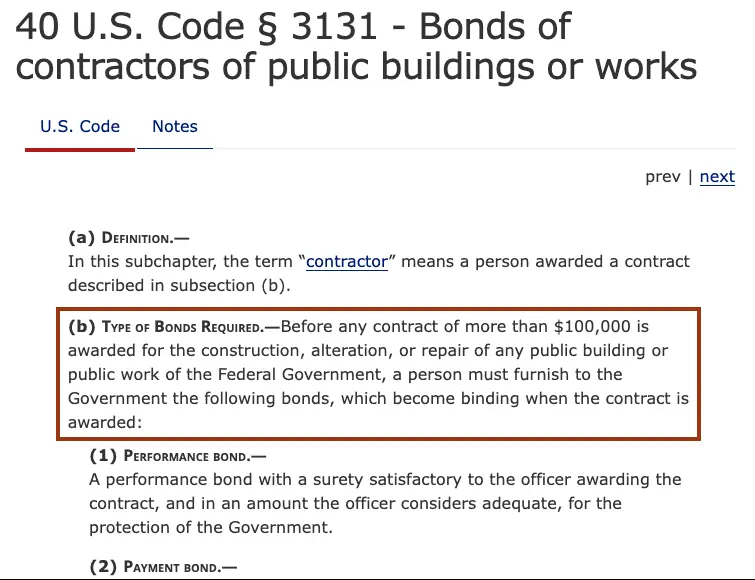
The Miller Act itself, 40 U.S.C. 3131(b), still says bonds are due before award of any federal construction contract of more than $100,000. The $150,000 trigger is the figure the FAR applies as amended through FAC 2026-01, effective March 13, 2026. The statute leaves the performance bond amount to the contracting officer; FAR 28.102-2(b)(1) sets it at 100% of the original contract price unless the officer decides a lesser amount is adequate. Under FAR 52.228-15, the contractor delivers both bonds before starting work.
| Jurisdiction | Performance bond required above | Payment bond required above | Source (accessed) |
|---|---|---|---|
| Federal, statute text | $100,000 | $100,000 | 40 U.S.C. 3131 (2026-11-02) |
| Federal, as applied | $150,000 | $150,000; two or more payment protections from $35,000 to $150,000 | FAR 28.102-1 (2026-11-02) |
| Virginia | $500,000 nontransportation; $350,000 state-funded transportation | Same | Va. Code 2.2-4337 (2026-11-02) |
| Florida | $100,000 on state contracts; local owners may exempt $200,000 or less | Same; one recorded payment and performance bond | Fla. Stat. 255.05 (2026-11-02) |
| Texas | $100,000 | $25,000; $50,000 for municipalities | Gov. Code 2253.021 (2026-11-02) |
| Michigan | $50,000 | $50,000 | MCL 129.201 (2026-10-18) |
| North Carolina | $50,000 per contract on projects over $300,000 | Same | G.S. 44A-26 (2026-10-18) |
| California | Not set by this section | $25,000 | Civil Code 9550 (2026-10-18) |
| Washington | No dollar floor; 10% retainage option at $150,000 or less | Same | RCW 39.08.010 (2026-10-18) |
Bond amounts follow the contract, not just the threshold. Virginia sets each bond at the sum of the contract amount, and on federal jobs FAR 28.102-2 adds 100% of any price increase. The full 10-state threshold table, including New York, Georgia and Ohio, is in our construction surety bond statistics. Where federal construction dollars land by state is mapped in our federal construction contracts by state report.
Do private projects need a performance bond?
On private work no statute read for this page requires a performance bond; the owner’s contract, the lender or the general contractor’s subcontract decides, usually naming the form. Florida gives private owners a reason to require a payment bond: under Fla. Stat. 713.23, a bond of at least the original contract price, attached to the recorded notice of commencement, exempts the owner from liens.
On construction manager at risk jobs the bond can be a priced line inside the guaranteed maximum price (GMP): Henderson County, North Carolina’s 2018 school GMP carried it at 0.80%. How GMP contracts are built is explained in our construction manager at risk guide.
How much does a performance bond cost?
Public records put the combined performance and payment bond premium at 0.10% to 1.77% of the bid on 10 priced bid lines from 2014 to 2018, and at 0.80% on a 2018 school GMP. Published ranges run higher: 0.5% to 3% of the contract amount (Surety Information Office, 2005) and 1.5% to 3.0% (CRS R42037, July 2025). The public records price both bonds as one line.
| Public record | Date | Bid or GMP | Bond line | Rate | Source |
|---|---|---|---|---|---|
| Transbay Joint Powers Authority (TJPA), structural concrete, bidder 1 | Feb 11, 2014 | $48,174,750 | $289,049 | 0.60% | TJPA TG07.2 tab |
| TJPA, structural concrete, bidder 2 | Feb 11, 2014 | $78,741,515 | $787,415 | 1.00% | TJPA TG07.2 tab |
| TJPA, fireproofing, bidder 1 | Sep 18, 2014 | $8,594,839 | $64,461 | 0.75% | TJPA TG16.8 tab |
| TJPA, fireproofing, bidder 2 | Sep 18, 2014 | $8,908,096 | $8,908 | 0.10% | TJPA TG16.8 tab |
| TJPA, fireproofing, bidder 3 | Sep 18, 2014 | $7,253,160 | $87,038 | 1.20% | TJPA TG16.8 tab |
| TJPA, miscellaneous metals | Jan 22, 2015 | $11,528,241 | $115,282 | 1.00% | TJPA TG07.3 tab |
| Henderson County, NC, Edneyville Elementary GMP (CM at risk) | Apr 4, 2018 | $21,852,605 | $174,821 | 0.80% | Board packet |
| City of Longview, TX, street striping, low bid | Jul 25, 2018 | $68,224.72 | $1,008 | 1.48% | Bid 1718-25 tab |
| Longview, second bid | Jul 25, 2018 | $70,846.51 | $705 | 1.00% | Bid 1718-25 tab |
| Longview, third bid | Jul 25, 2018 | $107,936.96 | $1,000 | 0.93% | Bid 1718-25 tab |
| Longview, fourth bid | Jul 25, 2018 | $169,290.48 | $3,000 | 1.77% | Bid 1718-25 tab |
TJPA asked bidders for their bond rate and computed a potential cost; Longview priced the bond as a bid item; Henderson County’s GMP listed 0.80% beside 1.25% ($235,933) for subcontractor bonds. Longview and Henderson rates are our arithmetic.
Two patterns show in these records. Size: the four Longview bids under $170,000 averaged 1.30%, against 0.78% for the six TJPA bids above $7 million (our arithmetic on a small sample). Contractor: on the same TJPA fireproofing package, bidders stated 0.10%, 0.75% and 1.20%, consistent with the Surety Information Office’s note that premiums depend on the size, type and duration of the project and on the contractor.
Rates are regulated, not negotiated freely. Under 13 CFR 115.32(a), a surety on an SBA-guaranteed bond may not charge more than the rate the state insurance department authorizes, and losses are a small share of premium: the Surety & Fidelity Association of America put the 2024 direct loss ratio for all surety lines at 23.5% (preliminary).
What does a bond cost on a $5 million contract?
On a $5,000,000 contract, the public-record rates above imply $30,000 to $50,000 for both bonds, and the top of the published range implies $150,000. If SBA guarantees the bonds, the contractor adds a $30,000 fee, and a $500,000 change order adds $5,000 of premium at 1.00% plus $3,000 of SBA fee. Every line below shows its rate and source.
| Line | Rate | Amount | Source |
|---|---|---|---|
| Premium at the TJPA low bid’s rate | 0.60% | $30,000 | TJPA TG07.2, 2014 |
| Premium at 1.00% | 1.00% | $50,000 | TJPA TG07.3, 2015 |
| Premium at the top of the published range | 3.0% | $150,000 | CRS R42037, 2025; SIO, 2005 |
| SBA contractor fee, if SBA guarantees the bonds | 0.6% of contract price | $30,000 | SBA; 13 CFR 115.32(b) |
| SBA fee the surety pays, at a 1.00% premium | 20% of premium | $10,000 | CRS R42037 |
| $500,000 change order: added bond amount | 100% of the increase | $500,000 | FAR 28.102-2(b) |
| Added premium on the change order | 1.00% | $5,000 | SIO, 2005 (premium adjusts with contract amount) |
| Added SBA contractor fee on the change order | 0.6% | $3,000 | 13 CFR 115.32(d) |
The contractor pays the premium when the bond is executed but prices it into the bid, so the owner pays through the contract sum. On an SBA-guaranteed job, a $500,000 change also hits the 13 CFR 115.32(d) reporting trigger of 25% or $500,000, whichever is less. How bonding capacity limits which jobs a contractor can chase is covered in how to win commercial construction bids.
Which standard forms do owners use?
Federal agencies use Standard Form 25 for the performance bond and Standard Form 25A for the payment bond, both at revision 10/2023 and prescribed by FAR 53.228. Private owners and many public owners use AIA A312-2010, one document holding a Performance Bond and a separate Payment Bond. Florida public bonds must also list the contractor, surety, owner, contract number and bond number on the front page (Fla. Stat. 255.05(1)(a)).
| Form | Publisher and edition | Used on | Terms that matter in a claim |
|---|---|---|---|
| SF 25, Performance Bond | GSA, Rev. 10/2023, FAR 53.228(b) | Federal construction | Void if the principal performs through the term, extensions and guaranty; notice of modifications waived |
| SF 25A, Payment Bond | GSA, Rev. 10/2023, FAR 53.228(c) | Federal construction | Protects persons supplying labor and material; Miller Act notice and suit rules apply |
| A312-2010, Performance Bond | AIA, 2010 edition | Private and many public jobs | Section 3 conditions; Section 5 options; Section 10 waives notice of changes; Section 11 two-year limit |
| A312-2010, Payment Bond | AIA, 2010 edition | Private and many public jobs | Section 5.1 90-day notice; Section 7.1 60-day answer; Section 12 one-year limit |
| Florida statutory bond | Fla. Stat. 255.05 | Florida public buildings and works | Recorded in the county public records; certified copy to the owner before work starts |
The AIA form flags when its author has revised the printed text, so read the copy attached to the contract. When a bond meets a statute, A312-2010 Section 13 deletes conflicting terms and reads in the statutory ones. Where A312 sits among the other AIA forms is explained in our AIA contract documents guide.
What do several guides get wrong about performance bonds?
Four claims in top-ranking pages do not match the primary sources: the Miller Act threshold, two premium ranges and who a payment bond protects. Each is stated neutrally below, with the source that settles it. One more, a widely repeated share of bond claims that are payment bond claims, had no primary source we could find, so it is left out of this page.
| What a ranking page says | What the primary source says | Source |
|---|---|---|
| The Miller Act applies to federal construction contracts over $150,000 (an encyclopedia entry, read November 2026) | The statute still reads more than $100,000; $150,000 is the threshold FAR 28.102-1(a) applies today | 40 U.S.C. 3131(b); FAR 28.102-1 |
| Premiums run 1% to 15% of the bond amount (the same entry, marked citation needed) | Public bid records priced both bonds at 0.10% to 1.77% of the bid (2014 to 2018); the highest published range found is 0.5% to 3% | Cost table above; SIO, 2005 |
| Premiums run 0.5% to 3% (several surety seller pages, no source given) | That range traces to a 2005 industry brochure; the latest government source, CRS R42037 (July 2025), cites 1.5% to 3.0% from a 2007 SBA notice | SIO, 2005; CRS R42037 |
| A payment bond protects the property owner (a payment bond guide updated 2025) | By statute it protects all persons supplying labor and material; the A312-2010 payment bond adds a duty to defend and indemnify the owner against their claims (Sections 3, 4) | 40 U.S.C. 3131(b)(2); AIA A312-2010 |
Which bond rule applies to your project?
Start with who the owner is and the contract value, then the role you hold on the job. The table pairs common situations with the rule and its threshold or deadline. Where no statute applies, the bond clause in the contract and the form it names decide, so read that clause before relying on any row.
| If | Then | Rule |
|---|---|---|
| Federal construction contract over $150,000 | Furnish SF 25 and SF 25A, each 100% of the original contract price, before starting work | FAR 28.102-1; 52.228-15 |
| Federal contract over $35,000 up to $150,000 | Expect two or more payment protections, such as a payment bond or irrevocable letter of credit; furnish one | FAR 28.102-1(b) |
| Virginia nontransportation public contract over $500,000 | Both bonds in the sum of the contract amount | Va. Code 2.2-4337 |
| Florida state public work over $100,000 (local: may be exempt at $200,000 or less) | Record one payment and performance bond before work; give the owner a certified copy | Fla. Stat. 255.05 |
| Texas public work | Performance bond over $100,000; payment bond over $25,000, or $50,000 for a city | Gov. Code 2253.021 |
| Florida private owner who wants lien protection | Require a payment bond of at least the contract price, attached to the notice of commencement | Fla. Stat. 713.23 |
| Owner with a failing contractor on an A312 bond | Send the Section 3.1 notice, hold the conference within 10 business days if asked, declare default and terminate, commit the contract balance | AIA A312-2010 Sections 3, 12 |
| Surety has not acted after the default | Send a further written demand; the surety is in default 7 days after receipt | A312-2010 Section 6 |
| Unpaid sub-subcontractor or supplier on a federal job | Written notice to the prime within 90 days of last work; sue within 1 year | 40 U.S.C. 3133(b) |
| Contract price rises on a federal job | Bond protection rises by 100% of the increase | FAR 28.102-2(b) |
| Small contractor that cannot get bonded on standard terms | Ask a surety about SBA’s guarantee: contracts up to $9 million ($14 million federal), 0.6% fee | SBA |
Bonds protect against a contractor failing to finish; injury and property damage claims fall to the policies covered in our general liability insurance for contractors guide.
How we compiled this
We read 29 primary documents: federal statutes, regulations and forms, the AIA A312-2010 text, SBA rules, a CRS report, nine state statutes, four bid tabulations, a county GMP and two industry documents, most on November 2, 2026 and six on October 18. Seller-site premium figures and an unsourced claim-share statistic were left out. Rates for Longview and Henderson County, averages and the worked example are our arithmetic, under our editorial standards.
Frequently asked questions
Who pays for a performance bond?
The contractor buys the bond and pays the premium, generally when the bond is executed, and builds the cost into its price, per a 2005 Surety Information Office brochure. The owner pays it indirectly: Henderson County, North Carolina’s 2018 school GMP carried a 0.80% payment and performance bond line of $174,821. If SBA guarantees the bond, the contractor also pays SBA 0.6% of the contract price.
How much is a performance bond on a $1 million contract?
At the 0.60% to 1.20% rates most bidders stated on Transbay Joint Powers Authority bid forms in 2014 and 2015, about $6,000 to $12,000 for the performance and payment bonds together. At the 1.5% to 3.0% range the Congressional Research Service cited in July 2025, $15,000 to $30,000. Add $6,000 if SBA guarantees the bonds, at its 0.6% fee.
Is a performance bond the same as insurance?
No. Insurance pays the insured’s own losses; a performance bond is a guarantee to the owner, and the surety expects the contractor to repay what it pays out. The Surety Information Office describes the premium as mainly a fee for prequalifying the contractor and notes that sureties may require personal or corporate indemnity. Federal sureties must be on Treasury Circular 570, which listed 249 companies on August 1, 2026.
How long does a performance bond last?
Standard Form 25 binds the surety through the original contract term, any extensions and the life of any guaranty the contract requires, which can reach into the warranty period. Under AIA A312-2010 Section 11, the owner must sue within 2 years after declaring a default, after the contractor stopped working or after the surety failed to perform, whichever comes first, unless local law sets a different minimum.
Can a subcontractor make a claim on a performance bond?
Generally no. AIA A312-2010 Section 9 gives a right of action on the performance bond only to the owner and its successors. Unpaid subcontractors and suppliers claim on the payment bond instead: on federal jobs, those without a contract with the prime contractor must give written notice within 90 days of their last work and sue within 1 year under 40 U.S.C. 3133.
What happens to the bond when the contract price changes?
On federal jobs the bond grows with the contract: FAR 28.102-2 requires added protection equal to 100% of any price increase. AIA A312-2010 Section 10 has the surety waive notice of changes, including time changes. Premiums adjust to the new contract amount, per the Surety Information Office, and on SBA-guaranteed bonds the surety reports increases of 25% or $500,000, whichever is less.
Can a small contractor get a performance bond?
Yes, through the regular surety market or with SBA backing. The SBA Surety Bond Guarantee Program guarantees bid, performance and payment bonds on contracts up to $9 million, or $14 million on federal work, for firms that meet the surety’s credit, capacity and character standards. SBA covers 90% of a surety’s loss on contracts of $100,000 or less and 80% on most larger ones (CRS R42037, July 2025).
Sources
- 40 U.S.C. 3131, Bonds of contractors of public buildings or works, Legal Information Institute, Cornell Law School. Accessed 2026-11-02.
- 40 U.S.C. 3133, Rights of persons furnishing labor or material, Legal Information Institute, Cornell Law School. Accessed 2026-11-02.
- FAR 28.102-1 General (FAC 2026-01, effective 03/13/2026), Acquisition.gov, GSA. Accessed 2026-11-02.
- FAR 28.102-2 Amount required, Acquisition.gov, GSA. Accessed 2026-11-02.
- FAR 52.228-15 Performance and Payment Bonds, Construction (Jun 2020), Acquisition.gov, GSA. Accessed 2026-11-02.
- Performance Bond, Standard Form 25 (form page, Rev. 10/2023), U.S. General Services Administration. Accessed 2026-11-02.
- Standard Form 25, Performance Bond (Rev. 10/2023), PDF, U.S. General Services Administration. Accessed 2026-11-02.
- Payment Bond, Standard Form 25A (form page, Rev. 10/2023), U.S. General Services Administration. Accessed 2026-11-02.
- AIA Document A312-2010 Performance Bond and Payment Bond (Exhibit K, as posted December 2024), Housing Opportunities Commission of Montgomery County, MD; form by The American Institute of Architects. Accessed 2026-11-02.
- 13 CFR 115.32, Fees and Premiums, Legal Information Institute, Cornell Law School. Accessed 2026-11-02.
- Surety bonds (program page), U.S. Small Business Administration. Accessed 2026-11-02.
- SBA Surety Bond Guarantee Program, R42037 (updated July 18, 2025), Congressional Research Service (via EveryCRSReport). Accessed 2026-11-02.
- 10 Things You Should Know About Surety Bonds (2005), Surety Information Office, hosted by Nevada State Risk Management. Accessed 2026-11-02.
- Tabulation of Bids, TG07.2 Structural Concrete Superstructure (bids February 11, 2014), Transbay Joint Powers Authority. Accessed 2026-11-02.
- Bid Form Comparison Sheet, TG07.3 Miscellaneous Metals (bids January 22, 2015), Transbay Joint Powers Authority. Accessed 2026-11-02.
- Tabulation of Bids, TG16.8 Fireproofing, Rev. 1 (bids September 18, 2014), Transbay Joint Powers Authority. Accessed 2026-11-02.
- Sealed Bid Tabulation, Bid 1718-25 Street Painting Services (July 25, 2018), City of Longview, Texas, Office of Purchasing. Accessed 2026-11-02.
- Request for Board Action, Edneyville Elementary GMP (summary dated April 4, 2018), Henderson County, North Carolina. Accessed 2026-11-02.
- Fla. Stat. 255.05, Bond of contractor constructing public buildings, Florida Legislature. Accessed 2026-11-02.
- Fla. Stat. 713.23, Payment bond, Florida Legislature. Accessed 2026-11-02.
- Code of Virginia 2.2-4337, Performance and payment bonds, Virginia Legislative Information System. Accessed 2026-11-02.
- Code of Virginia 2.2-4341, Actions on payment bonds, Virginia Legislative Information System. Accessed 2026-11-02.
- Texas Government Code 2253.021, Performance and payment bonds required, Texas Legislature (text read via a public copy). Accessed 2026-11-02.
- California Civil Code 9550, California Legislative Information. Accessed 2026-10-18.
- Michigan Compiled Laws 129.201, Michigan Legislature. Accessed 2026-10-18.
- North Carolina G.S. 44A-26, North Carolina General Assembly. Accessed 2026-10-18.
- RCW 39.08.010, Washington State Legislature. Accessed 2026-10-18.
- List of Certified Companies, Department Circular 570 (effective August 1, 2026), U.S. Treasury, Bureau of the Fiscal Service. Accessed 2026-10-18.
- Top 100 Writers of Surety Bonds, Calendar Year 2024 (Preliminary), The Surety & Fidelity Association of America. Accessed 2026-10-18.