A lien waiver is a signed document in which a contractor, subcontractor or supplier gives up mechanic’s lien rights for a stated payment: sign a conditional waiver before the money clears and an unconditional one only after.
Key takeaways
- Which form, when: send a conditional progress waiver with each pay application; sign an unconditional progress waiver for the amount received only after that payment clears; at closeout send a conditional final, then an unconditional final once all money, retainage included, has cleared. That is the four-form set printed in California Civil Code 8132 to 8138.
- A conditional waiver takes effect only when the check is paid by the bank it is drawn on. An unconditional waiver binds on signature: the Arizona form in A.R.S. 33-1008 says it “is enforceable against you if you sign it, even if you have not been paid.”
- 11 states print a statutory waiver form we read in the statute text: Arizona, California, Florida, Georgia, Massachusetts, Michigan, Missouri (residential only), Nevada, Texas, Utah and Wyoming.
- Texas bars anyone from requiring an unconditional waiver before payment in good and sufficient funds (Tex. Prop. Code 53.283), and Nevada and Utah void a waiver when the check fails to clear.
- A Georgia waiver becomes final 90 days after signing unless the claimant files an affidavit of nonpayment first (O.C.G.A. 44-14-366(g)).
- A California final waiver keeps only “disputed claims for extras” listed by dollar amount (Civ. Code 8136 and 8138), so unpaid retainage must be paid or listed before you sign one.
| Key number | What it means | Source |
|---|---|---|
| 4 | Waiver types: conditional or unconditional, progress or final | Cal. Civ. Code 8132 to 8138 |
| 11 | States whose statute prints a lien waiver form (verified October 2026) | State statutes in the table below |
| 90 days | Georgia window to file an affidavit of nonpayment after signing a waiver | O.C.G.A. 44-14-366(g)(2)(C) |
| 5 days, $500 | Missouri residential: time to deliver an unconditional final waiver after a written request, and the statutory penalty | RSMo 429.016.30 |
Which lien waiver should you sign, and when?
Match the form to two facts: whether the money has cleared and whether it is the last payment. Unpaid: sign a conditional waiver. Paid in good funds: sign an unconditional waiver for exactly the amount received. Then use the statutory wording if the job sits in one of the 11 form states listed further down. The table covers the 8 most common situations.
| If | Use | Rule behind it |
|---|---|---|
| You are billing a progress payment that has not been paid | Conditional progress waiver for the net amount of the bill | Cal. Civ. Code 8132; Tex. Prop. Code 53.284(b) |
| A progress payment has cleared in good funds | Unconditional progress waiver for exactly the amount received | Cal. Civ. Code 8134; Tex. Prop. Code 53.283 |
| You are sending the final bill | Conditional final waiver, with disputed extras listed by dollar amount | Cal. Civ. Code 8136 |
| Final payment, including all retainage, has cleared and nothing is disputed | Unconditional final waiver | Cal. Civ. Code 8138; MCL 570.1115(2) |
| Final payment has cleared but change orders are still disputed | Final waiver with the disputed amount in the exceptions, or hold the final until resolved | Cal. Civ. Code 8138 exceptions line |
| You are paid by joint check | Conditional waiver naming the check; treat it as paid only once endorsed and cleared | NRS 108.2457(3); Utah Code 38-1a-802(1)(c) |
| Georgia job, waiver signed, payment late | File an affidavit of nonpayment in the county before day 90 | O.C.G.A. 44-14-366(g)(2)(C) |
| Missouri residential job, paid in full, written request received | Unconditional final waiver within 5 calendar days | RSMo 429.016.30 |
Outside the form states, the contract or the payer’s form controls. AIA sells a generic set: G901-2022 is its conditional waiver on progress payment, and the AIA store lists G902 (unconditional progress), G903 (conditional final) and G904 (unconditional final) beside it, as checked on October 26, 2026. AIA’s G901 instructions warn that its documents may need changes to comply with state or local law, and the G901 application number should match the G702 it supports.
Owners who release tenant improvement money in draws can tie each draw to this pair of forms; our tenant improvement allowance guide covers draw terms. The waiver step sits in phase 5 of our commercial construction project checklist, and a contractor who resists waivers is one of the red flags in our guide on how to choose a commercial contractor.
What is a lien waiver, and what does it give up?
A lien waiver gives up the signer’s right to record a mechanic’s lien for work covered by a stated payment and through a stated date, and most statutory forms waive payment bond rights in the same document. The California forms release “lien, stop payment notice, and payment bond rights” (Civ. Code 8132), and the Texas forms reach any payment bond “that complies with a state or federal statute” (Prop. Code 53.284).
Owners, construction lenders, title insurers and general contractors collect waivers from every tier before they release a draw. Under AIA Document A201-2017, section 9.10.2, final payment and the remaining retainage are not due until the contractor delivers an affidavit that bills are paid and, if the owner asks, “releases and waivers of liens.”
The waiver only matters because the lien right behind it is short-lived: a subcontractor on private commercial work has from 45 days (Hawaii) to 8 months (New York) to record a lien, with a median of 90 days across 51 jurisdictions. Each state’s notice and filing deadline sits in our mechanics lien laws by state registry.
Is a lien waiver the same as a lien release?
No. A waiver gives up lien rights that have not yet been used, usually in exchange for a payment. A release cancels a lien that has already been recorded against the property. Georgia keeps the two apart in its statute: the waiver rules in 44-14-366 do not affect “the validity of a cancellation or release of a recorded claim of lien,” subsection (f)(3).
Can a contract waive lien rights in advance?
In most statutory-form states, no. Florida says a lien right “may not be waived in advance” (713.20(2)), Georgia voids waivers signed before labor or materials are furnished (44-14-366(b)), and Texas voids contract waivers as against public policy (53.286), except in single-family, townhouse and duplex contracts signed before work starts (53.282(a)(3)).
California, Arizona and Nevada void any contract term that waives another claimant’s lien rights (Civ. Code 8122; A.R.S. 33-1008(A); NRS 108.2457(1)). Michigan voids a waiver required by contract except to the extent of payment actually made (MCL 570.1115(1)). Massachusetts voids terms that bar a notice of contract or lien enforcement (M.G.L. c.254, s.32).
What are the four types of lien waivers?
The four types come from two questions: has the money arrived (conditional or unconditional), and is this the last payment (progress or final)? California, Arizona, Nevada, Texas and Michigan print all four as separate statutory forms. Florida and Utah print two, and Georgia prints an interim and a final form that take effect on payment, on a signed acknowledgment, or after 90 days.
| Type | Signed when | Takes effect | What stays open | California form |
|---|---|---|---|---|
| Conditional progress | With the pay application, before payment | When the named check is paid by the bank it is drawn on | Retentions, unpaid extras, unpaid earlier progress payments, contract rights, work after the through date | Civ. Code 8132 |
| Unconditional progress | After the progress payment has cleared | On signature | Retentions, unpaid extras, contract rights, work after the through date | Civ. Code 8134 |
| Conditional final | With the final bill, before final payment | When the final check is paid | Only disputed claims for extras, listed by dollar amount | Civ. Code 8136 |
| Unconditional final | After final payment has cleared | On signature | Only disputed claims for extras, listed by dollar amount | Civ. Code 8138 |
Michigan names the same four forms partial and full rather than progress and final (MCL 570.1115(9)(a) to (d)). It also makes the unconditional form mandatory at the end: a claimant who receives full payment “shall provide” a full unconditional waiver, and a partly paid claimant must give a partial unconditional waiver on request, subsections (2) and (3).
Conditional vs unconditional lien waiver: what is the difference?
A conditional lien waiver works only if the payment named in it actually arrives; an unconditional lien waiver works the moment it is signed, paid or not. California’s unconditional forms must carry a “Notice to Claimant” saying the document “is enforceable against you if you sign it, even if you have not been paid,” printed at least as large as the largest type on the form (Civ. Code 8134, 8138).
| Question | Conditional waiver | Unconditional waiver | Source |
|---|---|---|---|
| When does it take effect? | When the check is endorsed and paid by the bank it is drawn on | When signed | Cal. Civ. Code 8132, 8134; A.R.S. 33-1008(D) |
| What if the check bounces? | It never takes effect | Binding in California and Arizona under the form notice; void in Nevada and Utah by statute | NRS 108.2457(5)(e); Utah Code 38-1a-802(3) |
| Can the payer demand it before paying? | Yes, it is built for that | Not in Texas: no one may require it before payment in good and sufficient funds | Tex. Prop. Code 53.283 |
| Warning text on the form | California: “A PERSON SHOULD NOT RELY ON THIS DOCUMENT UNLESS SATISFIED THAT THE CLAIMANT HAS RECEIVED PAYMENT” | Texas: bold notice at the top, at least 10 point | Cal. Civ. Code 8132; Tex. Prop. Code 53.284(c) |
| Who prefers it | The signer: subcontractor, supplier, contractor | The payer: owner, lender, general contractor | Form notices in Cal. Civ. Code 8132 and 8134 |
| What the recipient checks | Evidence of payment before relying on it | That the named claimant signed it; Michigan residential owners must verify waivers not received from the claimant | A.R.S. 33-1008(A); MCL 570.1115(7) |
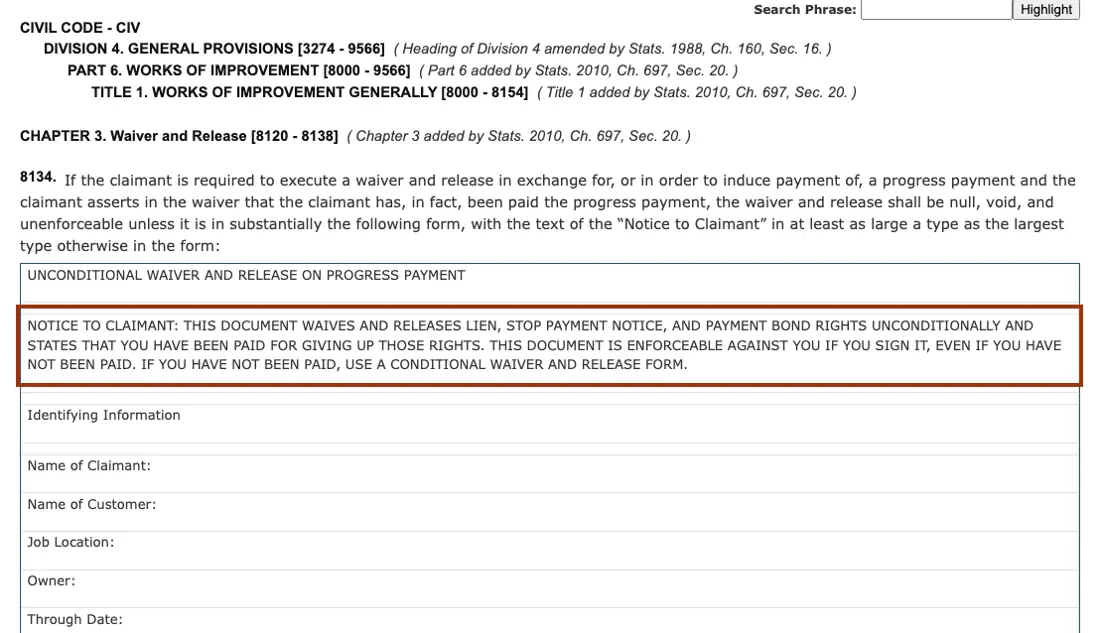
Nevada words its unconditional notice differently from California and Arizona: the document “is enforceable against you if you sign it to the extent of the Payment Amount or the amount received” (NRS 108.2457(5)(b)). Read the notice on the state form in front of you, because the amount it binds you to is not the same in every state.
Which states require statutory lien waiver forms?
We read 11 state statutes that print a lien waiver form: Arizona, California, Florida, Georgia, Massachusetts, Michigan, Missouri, Nevada, Texas, Utah and Wyoming. How binding the form is differs. California, Arizona, Nevada and Texas make a non-conforming waiver unenforceable, Florida lets parties use other wording, and Missouri’s form covers only unconditional final waivers on residential property (RSMo 429.016.27).
| State | Statute | Forms | How strict | Conditional takes effect | Notary in form text | Source |
|---|---|---|---|---|---|---|
| Arizona | A.R.S. 33-1008 | 4 | Unenforceable unless it follows a form “substantially” | Check endorsed and paid by the bank, or written acknowledgment of payment | No | azleg.gov |
| California | Civ. Code 8132 to 8138 | 4 | “Null, void, and unenforceable” unless substantially in the form | Receipt of payment from the bank the check is drawn on | No | leginfo.legislature.ca.gov |
| Florida | Fla. Stat. 713.20(4), (5) | 2 | Form optional (“may”); no one may require a different form, (6); a non-similar waiver is enforceable by its terms, (8) | Lienor may condition the waiver on payment of the check, (7) | No | leg.state.fl.us |
| Georgia | O.C.G.A. 44-14-366(d), (e) | 2 | “Substantially follow” the form, at least 12 point font | Earliest of payment, a signed acknowledgment, or 90 days | No (seal and witness); the affidavit of nonpayment is notarized | FindLaw copy |
| Massachusetts | M.G.L. c.254, s.32(4) | 1 | Partial waiver and subordination “with no material deviation,” only for claimants who filed a notice of contract | Not a conditional form; covers work through the payment period | No | malegislature.gov |
| Michigan | MCL 570.1115(9) | 4 | “Substantially the following format” | On payment of the amount shown, (4) | No | legislature.mi.gov |
| Missouri | RSMo 429.016.27 | 1 | Unconditional final waiver on residential property valid only on the form | No set form for conditional waivers, 429.016.25 | No | revisor.mo.gov |
| Nevada | NRS 108.2457(5) | 4 | Unenforceable unless “in the following forms” | Check endorsed and paid by the bank; void if it fails to clear | No | leg.state.nv.us |
| Texas | Prop. Code 53.284 | 4 | Unenforceable unless it “substantially complies” | Check endorsed and paid by the bank; evidence of payment, 53.281(b)(3) | No | statutes.capitol.texas.gov |
| Utah | Utah Code 38-1a-802(4) | 2, plus a check endorsement | Meets the statute if substantially in the form; enforceable only once payment is received | Check endorsed and paid; void if it fails to clear | No | le.utah.gov |
| Wyoming | Wyo. Stat. 29-10-101(b) | 1 | “Substantially the following form” | Single form; owner may rely even if uncertified funds are dishonored, unless the owner’s own payment is dishonored | Yes, acknowledged before a notary | wyoleg.gov |
Where no statute prints a form, the contract or the payer’s form controls, so the amount, through date and exceptions lines carry all of the risk. Colorado is one example: C.R.S. 38-22-119 prescribes no form but makes a waiver binding only between the parties and requires a statement that the signer’s own suppliers and subs “have been paid or will be timely paid.”
On public projects, lien rights against public property are generally replaced by payment bond claims, and most statutory forms waive those bond rights too: Utah’s forms cover Title 14 bond rights and Utah Code 63G-6a-1103, and Arizona’s cover “any state or federal statutory bond right.” Federal payment bonds apply above $150,000, as our construction surety bond statistics show, and public pay deadlines are in our prompt payment and retainage table.
Where do popular guides and the statutes disagree?
Several lien waiver guides that rank for this search list state rules that the statute text does not support. The differences matter most for owners in Colorado, Florida and Nevada and for anyone told a Georgia waiver must be notarized. Each row describes the guide, its claim and the section we checked on October 19, 2026.
| Guide | What the guide says | What the statute says | Statute |
|---|---|---|---|
| A lien-service guide updated 2025 | Colorado is one of 13 statutory-form states | No form is prescribed; the waiver must state that third-party debts are paid or will be timely paid | C.R.S. 38-22-119 |
| The same guide | Georgia requires notarization | The interim and final waiver forms end with seal and witness lines; only the affidavit of nonpayment has a notary line | O.C.G.A. 44-14-366(d), (e), (g) |
| A lien-software guide updated 2023 | Florida “seems to prohibit” non-statutory forms | No one may require a different form, but a waiver “not substantially similar” is “enforceable in accordance with the terms” | Fla. Stat. 713.20(6), (8) |
| A construction payments guide, undated | Nevada requires notarization | The four forms end with company name, signature and title; no notary block | NRS 108.2457(5) |
All three guides also list Mississippi as a statutory-form state, and two of them list it as a notarization state. We could not open the Mississippi statute text on October 19, 2026, so it is not in our 11-state table; check Miss. Code Title 85, Chapter 7 before you use a Mississippi form.
When do you sign each waiver in the payment cycle?
The standard pattern swaps forms one cycle apart: a conditional progress waiver goes in with each pay application, and an unconditional progress waiver for the previous payment goes in once that money has cleared. Arizona, Nevada and Texas forms tell the recipient to “verify evidence of payment” before relying on a conditional waiver, so the swap gives the payer that proof without asking the signer to waive unpaid money (A.R.S. 33-1008(D), NRS 108.2457(5)(a), Tex. Prop. Code 53.284(b)).
- Bill the period. Submit the pay application (often an AIA G702 with a G703 continuation sheet) for work through a fixed date, for example June 30, 2026.
- Attach a conditional progress waiver for the net amount of this application, naming the maker of the check, the amount and the payee, as Cal. Civ. Code 8132 and Tex. Prop. Code 53.284(b) require.
- Wait for good funds. The conditional waiver takes effect when the check is endorsed and paid by the bank it is drawn on; Utah defines “receives payment” that way, 38-1a-802(1)(c).
- Sign the unconditional progress waiver for exactly the amount received, with the next pay application, never before the funds clear (Tex. Prop. Code 53.283).
- Collect lower tiers. Owners and general contractors collect the same pair from each subcontractor and supplier; Arizona, Nevada, Texas and Utah forms include the signer’s warranty to pay its own laborers and suppliers from the payment.
- Close out. Send a conditional final waiver with the last bill, listing any disputed extras by dollar amount, then an unconditional final after the final payment clears (Cal. Civ. Code 8136, 8138).
The waiver pair sits inside the monthly pay application step, after the architect certifies the amount and before the owner releases funds; our commercial construction process guide shows where that step falls across the 7 phases of a project.
Worked example: what a $54,000 progress payment waives
The figures below are a hypothetical California subcontract of $480,000 with 10% retainage written into the subcontract. Pay application 4 covers work through June 30, 2026. The arithmetic shows which dollars the conditional waiver releases once its check clears and which stay protected under the Civ. Code 8132 exceptions.
| Line | Amount | Waived by the 8132 form? |
|---|---|---|
| Work billed this period | $60,000 | Basis for the payment |
| Less 10% retainage | minus $6,000 | No, “Retentions” are excepted |
| Net check, amount written on the waiver | $54,000 | Yes, once the check is paid by the bank |
| Retainage held to date ($18,000 from applications 1 to 3 plus $6,000) | $24,000 | No |
| Change order 3, approved by email but not signed | $8,500 | No: only change orders “fully executed” before signing are waived; list it under “Extras for which the claimant has not received payment” |
| Lien rights still open after this waiver | $32,500, plus all work after June 30 | $24,000 + $8,500 |
If the same subcontractor signed a California unconditional final waiver at closeout while $24,000 of retainage was still unpaid, the form would keep only “Disputed claims for extras in the amount of: $” (Civ. Code 8138). The retainage would need to be paid first, or the final form held back until it is.
What timing rules decide when a waiver takes effect?
Eight states add timing rules that change when a signed waiver becomes final or what happens when payment fails. Georgia uses a 90-day window, Missouri a 5-day delivery duty, Nevada and Utah void waivers paid by a bounced check, and Michigan protects anyone who pays in reliance on a waiver. None of these rules extends the lien filing deadline itself.
| State | Rule | Trigger or deadline | Source |
|---|---|---|---|
| Georgia | Waiver is conclusively effective at the earliest of receipt of funds, a signed acknowledgment of payment in full, or day 90; an affidavit of nonpayment filed in the county first suspends it | 90 days after signing | O.C.G.A. 44-14-366(g)(2), (g)(5) |
| Missouri (residential) | A paid-in-full claimant must deliver an unconditional final waiver; failure means presumed liability for slander of title plus a penalty | 5 calendar days after a written request; $500 | RSMo 429.016.30 |
| Texas | No person may require an unconditional waiver unless the amount was received in good and sufficient funds | Before payment | Tex. Prop. Code 53.283 |
| Nevada | Waiver “null, void and of no legal effect” if the check fails to clear; joint check counts as payment only of the least of 3 amounts | On dishonor | NRS 108.2457(3), (5)(e) |
| Utah | Waiver void if the check fails to clear; a progress waiver binds only to the extent of payment | On dishonor | Utah Code 38-1a-802(2), (3) |
| Florida | Lienor may condition the waiver on the check; without a payment bond, the owner may withhold the unpaid check amount from the contractor | Until the check is paid | Fla. Stat. 713.20(7) |
| Michigan | A waiver is effective when someone pays relying on it, unless the payer had written notice that the consideration failed | At the time of payment | MCL 570.1115(6) |
| Wyoming | The owner may rely on the waiver even if uncertified funds are later dishonored, unless the owner’s own payment is dishonored | On dishonor | Wyo. Stat. 29-10-101(b) |
A Georgia worked example: a subcontractor signs an interim waiver on March 2, 2026, and the check never arrives. Day 90 falls on May 31, 2026, so the affidavit of nonpayment must be filed in the county where the property sits before then. The statute adds that nothing in the waiver rules “shall shorten the time within which to file a claim of lien,” 44-14-366(g)(4).
What waiver language should stop you before you sign?
Five lines on the form carry the risk: the amount, the through date, the exceptions, the release wording and the signer’s warranty. California’s progress forms keep contract rights, including breach and “work not compensated by the payment,” but a non-statutory form in a state without a form statute may release all of them. Read each line against the payment it covers, starting with exception (4) of Civ. Code 8132.
| Mistake | Consequence | Rule or form |
|---|---|---|
| Signing an unconditional waiver before the funds clear | Lien and bond rights for that amount can be lost even if payment never comes | Cal. Civ. Code 8134 notice; A.R.S. 33-1008(D) |
| A through date later than the work actually billed | Releases rights for work not yet paid for | “Through Date” field, Cal. Civ. Code 8132 |
| Signing a final waiver with retainage still unpaid | California finals keep only disputed extras listed by dollar amount | Cal. Civ. Code 8136, 8138 |
| A blank amount, or “all amounts due,” on a progress waiver | Can be read as releasing more than was paid in states without an extent-of-payment rule | Compare Utah Code 38-1a-802(2)(b)(ii) and NRS 108.2457(2)(b) |
| Extra release language for delay claims or contract rights | May release claims the statutory forms keep | Exception (4), Cal. Civ. Code 8132 |
| Ignoring the warranty to pay lower tiers | The signer promises to pay its own laborers and suppliers from the payment | A.R.S. 33-1008(D); Tex. Prop. Code 53.284(b) |
| Endorsing a joint check without a matching waiver amount | Nevada treats it as payment only of the least of the check, the intended amount or the balance owed | NRS 108.2457(3) |
Owners can head off most of these disputes before the contract is signed. Ask each bidder whether it will deliver conditional and unconditional waivers from every tier with each pay application, not only the final waivers AIA A201-2017 section 9.10.2 lets an owner require at closeout, and score the answers with the rest of the payment terms using our guide to comparing construction bids line by line.
How we compiled this
We read 13 primary documents in October 2026: the waiver sections of 12 state statutes (the 11 form states plus Colorado) and AIA A201-2017 sections 9.3.3 and 9.10.2. Georgia and Colorado came from unofficial copies (FindLaw, current to March 28, 2024, and colorado.public.law) because the official sites were unreachable. We excluded case law, Mississippi and lien filing deadlines. On October 26, 2026 we re-checked the Civ. Code 8134 notice, Tex. Prop. Code 53.283 and O.C.G.A. 44-14-366(g)(2) in public copies of the statutes, and added AIA’s G901 instructions and store listing. This page explains statutes and is not legal advice; our editorial standards cover sourcing and corrections.
Frequently asked questions
Does a lien waiver need to be notarized?
Only one of the 11 statutory forms we read has a notary block: Wyoming’s, under Wyo. Stat. 29-10-101(b). Georgia’s waiver forms use seal and witness lines, and only its affidavit of nonpayment is notarized. The current Texas forms in Prop. Code 53.284 carry no notary jurat. A contract can still require notarization, so check the payment terms.
Does a lien waiver waive retainage?
A progress waiver usually does not. California’s progress forms except “Retentions” (Civ. Code 8132, 8134), Arizona’s progress forms exclude “any retention” and Florida’s progress form excludes retention (713.20(4)). A final waiver usually does: California finals keep only disputed claims for extras listed by dollar amount (8136, 8138), so get retainage paid before signing one.
What happens if I sign an unconditional lien waiver and the check bounces?
In California and Arizona the form notice says the waiver is enforceable even if you have not been paid. Nevada (NRS 108.2457(5)(e)) and Utah (Utah Code 38-1a-802(3)) void the waiver when the check fails to clear. Ask a construction attorney in the project’s state whether a lien is still available before the filing deadline runs.
What is the difference between a lien waiver and a lien release?
A lien waiver gives up lien rights that have not been used yet, usually in exchange for a payment. A lien release cancels a lien already recorded against the property. Georgia’s waiver statute, O.C.G.A. 44-14-366(f)(3), states that its waiver rules do not affect the cancellation or release of a recorded claim of lien, which keeps the two documents separate.
Can a general contractor require an unconditional waiver before paying?
Not in Texas: Prop. Code 53.283 bars anyone from requiring an unconditional waiver unless the amount was received in good and sufficient funds. In Florida no one may require a form different from the statutory ones, 713.20(6). Elsewhere the subcontract controls, so negotiate a conditional waiver with each pay application and an unconditional one after the funds clear.
Do lien waivers apply on public projects?
Liens generally cannot attach to public property, so claims run against the payment bond instead, and the statutory waivers release those bond rights too. California’s forms waive “payment bond rights”, Arizona’s cover “any state or federal statutory bond right” and Utah’s cover Title 14 bonds. Federal payment bonds apply above $150,000, per our surety bond data.
Sources
- California Civil Code 8132, with 8122, 8126, 8134, 8136 and 8138, California Legislative Information, accessed October 19, 2026.
- Texas Property Code Chapter 53, Subchapter L (53.281 to 53.287), Texas Legislature, accessed October 19, 2026.
- Florida Statutes 713.20 (2026), Florida Legislature, accessed October 19, 2026.
- O.C.G.A. 44-14-366, FindLaw copy current as of March 28, 2024, accessed October 19, 2026.
- A.R.S. 33-1008, Arizona Legislature, accessed October 19, 2026.
- MCL 570.1115, Michigan Legislature, accessed October 19, 2026.
- RSMo 429.016, Missouri Revisor of Statutes, accessed October 19, 2026.
- NRS 108.2457, Nevada Legislature, accessed October 19, 2026.
- Utah Code 38-1a-802, Utah Legislature, accessed October 19, 2026.
- Wyoming Statutes Title 29, 29-10-101, Wyoming Legislature, accessed October 19, 2026.
- M.G.L. c.254, s.32, Massachusetts Legislature, accessed October 19, 2026.
- C.R.S. 38-22-119, colorado.public.law copy of the 2024 Colorado Revised Statutes, accessed October 19, 2026.
- AIA Document A201-2017 General Conditions, sample, American Institute of Architects, hosted by the City of Rochester, NH, accessed October 19, 2026.
- Instructions: G901-2022, Conditional Waiver and Release on Progress Payment, AIA Contract Documents, accessed October 26, 2026.
- G702 store page listing G901 to G904 lien waiver forms, AIA Contract Documents, accessed October 26, 2026.