The AIA G702 is the contractor’s monthly Application and Certificate for Payment: nine numbered lines turn G703 continuation sheet totals into the current payment due, and the architect certifies that amount to the owner.
Key takeaways
- The G702-1992 has 9 numbered lines. Line 8, current payment due, is Line 6 minus Line 7, and Line 9, balance to finish, is Line 3 minus Line 6. Line 7 is Line 6 from the prior certificate, the certified figure, not the amount applied for (AIA G702-1992 sample; AIA G702 instructions).
- Under AIA A201-2017 §9.3.1 the contractor submits at least 10 days before the payment date, and under §9.4.1 the architect has 7 days to certify, cut or withhold.
- The worked example below gives a full G703 continuation sheet and the matching G702, with totals that reconcile to the dollar: $1,340,000 completed and stored, $134,000 retained and $279,000 due.
- In the same $2,448,500 example, cutting retainage from 10% to 5% at 54.7% complete raises Line 8 from $279,000 to $346,000, a $67,000 release modelled on Illinois 30 ILCS 550/1.
- Federal jobs run on different rules: FAR 52.232-27 makes a progress payment due 14 days after a proper request, and FAR 52.232-5(e) allows up to 10% retainage only when progress is unsatisfactory.
How do you fill out an AIA G702? A worked example you can copy
Fill in the G703 continuation sheet first, then carry its column totals to the nine G702 lines. The example is pay application 5 on a $2,400,000 contract with $48,500 of net change orders and 10% retainage: the G703 totals $1,340,000 completed and stored, and the G702 shows $279,000 due. All figures are invented CB&C arithmetic, so copy the layout and formulas, not the numbers.
- Fill in the G703 for the period: one row per schedule of values line, plus one row per change order, as AIA’s key-steps guide lists them. Column D is last month’s D + E, Column E is work done this period and Column F is material stored but not installed ($41,600 of storefront glass here).
- Total each column. Column G, $1,012,000 + $286,400 + $41,600 = $1,340,000, becomes Line 4.
- Enter Line 1, the original $2,400,000, and the change order summary: previous months $36,000 added and $6,000 deducted, this month $18,500 added, for a Line 2 of $48,500.
- Apply the retainage rate: 10% x $1,298,400 (Columns D + E) on Line 5a and 10% x $41,600 (Column F) on Line 5b.
- Copy Line 6 from the last certified G702 (application 4, certified at $927,000) into Line 7.
- Do the arithmetic for Lines 6, 8 and 9, then sign before a notary if the contract requires one and leave the architect’s certificate blank.
Step 1: the G703 continuation sheet
Brackets show a credit. Change order 2 deleted $6,000 of site lighting and was credited in full on an earlier application, so its scheduled value and Column D are both negative. Column I, line-by-line retainage, stays blank because one 10% rate applies to every line.
| A Item | B Description of work | C Scheduled value ($) | D From previous application ($) | E This period ($) | F Materials presently stored ($) | G Completed and stored to date, D + E + F ($) | G / C | H Balance to finish, C minus G ($) |
|---|---|---|---|---|---|---|---|---|
| 1 | General conditions and mobilization | 300,000 | 165,000 | 30,000 | 0 | 195,000 | 65.0% | 105,000 |
| 2 | Sitework and concrete | 360,000 | 324,000 | 18,000 | 0 | 342,000 | 95.0% | 18,000 |
| 3 | Structural steel and metals | 420,000 | 378,000 | 42,000 | 0 | 420,000 | 100.0% | 0 |
| 4 | Envelope: roofing, wall panels, storefront (storefront glass stored on site) | 480,000 | 96,000 | 120,000 | 41,600 | 257,600 | 53.7% | 222,400 |
| 5 | Mechanical, plumbing and electrical | 600,000 | 30,000 | 65,400 | 0 | 95,400 | 15.9% | 504,600 |
| 6 | Finishes | 240,000 | 0 | 0 | 0 | 0 | 0.0% | 240,000 |
| CO 1 | Change order 1, added entry canopy (approved in a previous month) | 36,000 | 25,000 | 11,000 | 0 | 36,000 | 100.0% | 0 |
| CO 2 | Change order 2, deleted site lighting (approved in a previous month) | (6,000) | (6,000) | 0 | 0 | (6,000) | 100.0% | 0 |
| CO 3 | Change order 3, added roof hatch and ladder (approved this month) | 18,500 | 0 | 0 | 0 | 0 | 0.0% | 18,500 |
| Grand total | 2,448,500 | 1,012,000 | 286,400 | 41,600 | 1,340,000 | 54.7% | 1,108,500 |
Step 2: the G702 lines
| Line | Calculation | Amount |
|---|---|---|
| 1 Original contract sum | From the agreement | $2,400,000 |
| 2 Net change by change orders | $36,000 minus $6,000 + $18,500 | $48,500 |
| 3 Contract sum to date | $2,400,000 + $48,500 | $2,448,500 |
| 4 Total completed and stored | $1,012,000 + $286,400 + $41,600 | $1,340,000 |
| 5a Retainage, completed work | 10% x $1,298,400 | $129,840 |
| 5b Retainage, stored material | 10% x $41,600 | $4,160 |
| 5 Total retainage | $129,840 + $4,160 | $134,000 |
| 6 Total earned less retainage | $1,340,000 minus $134,000 | $1,206,000 |
| 7 Previous certificates | Line 6 of certificate 4 | $927,000 |
| 8 Current payment due | $1,206,000 minus $927,000 | $279,000 |
| 9 Balance to finish | $2,448,500 minus $1,206,000 | $1,242,500 |
A quick cross-check confirms Line 8. Application 4 carried $18,000 of stored material that has since been installed and moved into Column E, so this period’s gross is $286,400 of work plus a $23,600 net increase in stored material ($41,600 minus $18,000), or $310,000. Ten percent retainage leaves $279,000, the same figure as Line 8.
Run three checks before you sign, because an architect will run them too:
- G703 Column C grand total equals Line 3: $2,448,500.
- G703 Column G grand total equals Line 4: $1,340,000.
- G703 Column H grand total plus Line 5 equals Line 9: $1,108,500 + $134,000 = $1,242,500.
Is there a free G702 template?
Not from AIA: the store listed the G702 at $59.99 for one-time use on October 26, 2026, with the G703 sold as a separate document (AIA store). The two tables above, with the formulas in the line table below, are enough to build a spreadsheet that checks your numbers each month. A spreadsheet that copies AIA’s printed form text is not a licensed AIA document, so when the contract names the G702 and G703, submit on the licensed forms.
What goes on Line 7 if the architect cut the last application?
Line 7 takes the prior certificate’s Line 6, not the prior application’s. If the architect had certified application 4 at $907,000 instead of $927,000, Line 7 becomes $907,000 and Line 8 becomes $299,000, because Line 6 is cumulative. Once the reason for the $20,000 cut is removed, A201-2017 §9.5.3 says the withheld amount is certified, and this arithmetic carries it into the current application.
What is the AIA G702 and when is it used?
The AIA G702, Application and Certificate for Payment, is a one-page form with two jobs: the contractor applies for a progress payment in the left half, and the architect certifies the amount due in the right half. AIA Contract Documents designed G702-1992 for projects where the contractor has a direct agreement with the owner, with procedures set by A201, the general conditions that most AIA owner-contractor agreements adopt (AIA G702 summary).
The form never travels alone. AIA’s instructions say to complete the G703 continuation sheet first, transfer its totals to the G702, sign and notarize the G702, and submit both to the architect, who forwards the certified pair to the owner. The owner then pays the contractor named on the form directly, and the architect’s certificate is not negotiable (G702-1992 instructions and form).
The numbers that matter most on every G702, with the rule each comes from:
| Item | Value | Source |
|---|---|---|
| Numbered lines on G702-1992 | 9 (Line 5 split into 5a and 5b) | AIA sample, 2026 |
| Current edition | G702-1992, paired with G703-1992 | AIA Help Center |
| Price for one use | $59.99 (October 26, 2026) | AIA Contract Documents store |
| Submission lead time | At least 10 days before the payment date | A201-2017 §9.3.1 |
| Architect review window | 7 days after receipt | A201-2017 §9.4.1 |
| Contractor pays subcontractors | Within 7 days after the owner pays | A201-2017 §9.6.2 |
| Stop-work notice after nonpayment | 7 additional days | A201-2017 §9.7 |
| Federal progress payment due | 14 days after a proper request | FAR 52.232-27(a)(1)(i)(A) |
| Federal retainage cap | 10%, only if progress is unsatisfactory | FAR 52.232-5(e) |
| Document | Used for | Pairs with | Source |
|---|---|---|---|
| G702-1992 | Owner to contractor progress billing, architect certifies | G703-1992, A201-2017 | AIA Help Center |
| G703-1992 | Continuation sheet: line items, stored materials, retainage by line | G702-1992 or G732 | AIA sample |
| G702S-2017 | Contractor to subcontractor billing | Subcontract terms | AIA instructions page |
| G702GMP-2021 | Cost of the work projects with a guaranteed maximum price | Cost-plus agreements | AIA instructions page |
| G732 | Construction Manager as Adviser edition of the application | G703-1992 | Named on the G703-1992 sample header |
The G702 assumes an architect certifies for the owner. If your delivery method has no independent architect, the agreement names who signs the certificate, which is one of the practical differences covered in design-build vs design-bid-build contracts.
What does each line on the G702 calculate?
Each G702 line is either a contract figure, a G703 total or simple arithmetic on the lines above it. Lines 1 to 3 set the contract sum to date, Line 4 is the G703 Column G grand total, Line 5 is retainage, and Lines 6 to 9 work out what is earned, what was already certified, what is due now and what is left (G702-1992 sample, viewed October 19, 2026).
| Line | Name on the form | Math | Where the number comes from |
|---|---|---|---|
| 1 | Original contract sum | Fixed contract price | Signed owner-contractor agreement |
| 2 | Net change by change orders | Additions minus deductions | Change order summary, signed change orders only |
| 3 | Contract sum to date | Line 1 plus or minus Line 2 | Arithmetic |
| 4 | Total completed and stored to date | G703 Column G grand total | G703, Columns D + E + F |
| 5a | Retainage on completed work | Rate x (Columns D + E) | Contract retainage rate |
| 5b | Retainage on stored material | Rate x Column F | Contract retainage rate |
| 5 total | Total retainage | 5a + 5b, or G703 Column I total | Fixed rate uses 5a and 5b; variable rate uses Column I |
| 6 | Total earned less retainage | Line 4 minus Line 5 total | Arithmetic |
| 7 | Less previous certificates for payment | Line 6 from the prior certificate | Last certified G702, zero on application 1 |
| 8 | Current payment due | Line 6 minus Line 7 | Arithmetic |
| 9 | Balance to finish, including retainage | Line 3 minus Line 6 | Arithmetic |
How does the change order summary feed Line 2?
The G702 change order summary has two rows, changes approved in previous months by the owner and changes approved this month, each split into additions and deductions. The net of the four cells is Line 2. Work directed by a Construction Change Directive can be billed under A201-2017 §9.3.1.1 before a change order is signed, but it belongs on a G703 line, not in this summary, until the change order exists.
How does the G702 tie to the G703 continuation sheet?
The G703 holds the detail and the G702 holds the totals, so every G702 dollar except the contract figures traces to a G703 column. Column G, total completed and stored to date, becomes Line 4; Columns D and E are the base for Line 5a; Column F is the base for Line 5b; and Column I replaces 5a and 5b when retainage varies by line (G703-1992 sample).
| G703 column | What it holds | Where it lands on the G702 |
|---|---|---|
| C, scheduled value | Value of each line item, change order lines included | Grand total should equal Line 3 |
| D, from previous application | Work billed before this period (prior D + E) | Part of the Line 5a base |
| E, this period | Work completed this period | Part of the Line 5a base |
| F, materials presently stored | Stored materials not yet in D or E | Line 5b base |
| G, total completed and stored | D + E + F | Line 4 |
| H, balance to finish | C minus G | Grand total equals Line 3 minus Line 4 |
| I, retainage (variable rate) | Retainage by line item | Line 5 total when rates differ by line |
Because AIA’s key-steps guide lists each change order as its own G703 line, the Column C grand total should match Line 3 and the Column G grand total must match Line 4 to the cent (AIA key steps for the G702). The line items come from the schedule of values, which A201-2017 §9.2 requires before the first application.
How does retainage reduction change Lines 5 and 8?
A reduction changes only the rate on Lines 5a and 5b, but because Line 5 is cumulative, the cut releases money already held. Illinois local public contracts follow this pattern: up to 10% before 50% completion, then reduced so no more than 5% is held (30 ILCS 550/1). Applied to the worked example at 54.7% complete, Line 8 rises by $67,000.
| G702 line | 10% held | Reduced to 5% at 50% complete | Difference |
|---|---|---|---|
| 5a Completed work | $129,840 | $64,920 | $64,920 released |
| 5b Stored material | $4,160 | $2,080 | $2,080 released |
| 5 Total retainage | $134,000 | $67,000 | $67,000 released |
| 6 Earned less retainage | $1,206,000 | $1,273,000 | +$67,000 |
| 8 Current payment due | $279,000 | $346,000 | +$67,000 |
| 9 Balance to finish | $1,242,500 | $1,175,500 | minus $67,000 |
| Pay app | Percent complete | Line 4 | Retainage at 10% | Retainage, 5% after 50% |
|---|---|---|---|---|
| 1 | 7.4% | $180,000 | $18,000 | $18,000 |
| 2 | 17.2% | $420,000 | $42,000 | $42,000 |
| 3 | 28.2% | $690,000 | $69,000 | $69,000 |
| 4 | 42.1% | $1,030,000 | $103,000 | $103,000 |
| 5 | 54.7% | $1,340,000 | $134,000 | $67,000 |
| 6 | 69.0% | $1,690,000 | $169,000 | $84,500 |
| 7 | 83.7% | $2,050,000 | $205,000 | $102,500 |
| 8 | 95.2% | $2,330,000 | $233,000 | $116,500 |
Where does the retainage rate on Line 5 come from?
The G702 has blanks for the percentages; the rate comes from the agreement and, on many jobs, a statute. A201-2017 §9.3.1 says the application reflects retainage if provided for in the Contract Documents, so the agreement controls on private work unless a state cap applies. Across 46 jurisdictions with a percentage cap on public work, 30 set it at 5%, per the public construction retainage caps by state.
| Contract type | Retainage rule | Reduction or release rule | Source |
|---|---|---|---|
| Federal fixed-price construction | Up to 10%, only if progress is unsatisfactory | Release remaining funds at substantial completion, keeping an adequate amount | FAR 52.232-5(e), FAR 32.103 |
| Florida public, over $200,000 | Up to 5% of each progress payment | Lower rate or a contract schedule of reductions allowed | Fla. Stat. 255.078 |
| Texas public works | 10% under $5 million; 5% at $5 million or more | Partial release allowed; rest at completion | Tex. Gov’t Code 2252.032 |
| Illinois local public works | Up to 10% before 50% complete | At 50%, reduce so no more than 5% is held | 30 ILCS 550/1 |
| California private, signed from Jan. 1, 2026 | 5% of each payment and of the contract price | Cap applies down the subcontract chain | Cal. Civ. Code 8811 |
| AIA private agreement | Rate written in the agreement | As the agreement states | A201-2017 §9.3.1 |
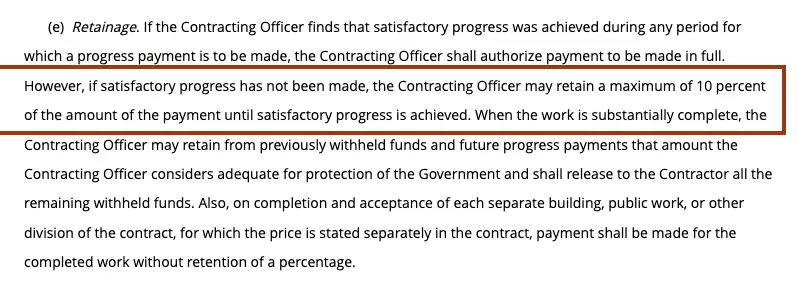
Private work has fewer caps: 13 jurisdictions limit private retainage by statute, 10 of them at 5%, per the mechanics lien and private retainage laws by state.
What does the architect’s certificate mean, and does the G702 need a notary?
By signing the certificate, the architect represents to the owner, under A201-2017 §9.4.2, that the work has progressed to the point indicated, its quality matches the Contract Documents and the contractor is entitled to the amount certified. The certificate does not represent exhaustive inspections, a review of means and methods, or a check of how earlier payments were spent.
A certificate is also not acceptance. A201-2017 §9.6.6 says a Certificate for Payment, a progress payment or owner occupancy does not accept work that fails the Contract Documents, so an owner who pays application 5 can still reject defective work found at substantial completion. If the architect certifies a different amount, AIA’s instructions call for initials on every changed figure on both the G702 and G703 plus a written explanation.
Does the G702 have to be notarized?
Only if the contract requires it. AIA’s G702-1992 instructions tell the contractor to sign and have the form notarized, and the form carries a notary block (state, county, subscribed and sworn, commission expiry), but A201-2017 §9.3.1 says the application shall be notarized, if required. Read the agreement, the supplementary conditions and any lender draw requirements, and follow the strictest one.
The contractor’s signature also certifies that the work is done per the Contract Documents and that earlier payments were passed on to the people owed. Federal jobs use their own wording: FAR 52.232-5(c) requires a signed certification with each request, and payment is not made without it. Unless the contractor provides a payment bond in the full penal sum, A201-2017 §9.6.7 says money paid for subcontracted work is held for those subcontractors, one reason owners look at surety bond coverage on commercial projects.
How long does each step of the G702 pay cycle take under A201?
A201-2017 sets three fixed clocks around the G702: the contractor submits at least 10 days before the payment date (§9.3.1), the architect acts within 7 days of receipt (§9.4.1), and the contractor pays subcontractors within 7 days of being paid (§9.6.2). The payment date itself comes from the owner-contractor agreement, such as the day-of-month blanks in A101-2017 §5.1.3.
| Step | Deadline | A201-2017 section | Example date (illustration) |
|---|---|---|---|
| Contractor submits G702 and G703 | At least 10 days before the payment date | §9.3.1 | Oct 25 |
| Architect certifies, cuts or withholds | Within 7 days after receipt | §9.4.1 | Nov 1 |
| Owner pays the certified amount | Date set in the agreement | §9.6.1 | Nov 15 |
| Contractor pays subcontractors | Within 7 days after receipt of payment | §9.6.2 | Nov 22 |
| Owner still unpaid, contractor may give notice | 7 days after the payment date | §9.7 | Nov 22 |
| Earliest stop-work date | 7 additional days after notice | §9.7 | Nov 29 |
Public owners often run on a statute instead. Federal agencies owe a progress payment 14 days after a proper request and must return an improper invoice within 7 days (FAR 52.232-27), while the median state deadline for a public owner to pay a prime contractor is 30 days across 49 jurisdictions, per the CB&C prompt payment registry checked October 8, 2026. Every monthly cycle sits inside Phase 6 of the commercial construction process from contract to closeout.
Why do G702 pay applications get rejected?
Most rejections trace to a number that does not reconcile or a document that is missing. A201-2017 §9.5.1 lists seven grounds to withhold, from defective work to unpaid subcontractors, and §9.3 sets the paperwork each application needs, so the table below pairs each common problem with the clause a reviewer can point to.
| Problem | What the reviewer sees | Rule behind it | Fix before submitting |
|---|---|---|---|
| Line 4 does not equal G703 Column G | Totals disagree by any amount | G702 instructions: transfer G703 totals | Re-foot Column G and copy the grand total |
| Line 7 copied from the last application | Line 7 above the last certified Line 6 | Form label: Line 6 from prior certificate | Use the certified figure |
| Unsigned change order in Line 2 | Summary total above approved changes | Change order summary lists approved changes | Bill directive work on a G703 line under §9.3.1.1 |
| Stored materials without proof | Column F with no invoices, title or insurance | A201-2017 §9.3.2 | Attach bills of sale, insurance and location; get owner approval for off-site storage |
| Missing lien waivers | No releases from subs paid last month | A201-2017 §9.3.1 | Collect waivers in the form the owner requires |
| Percent complete ahead of the site | Column E above what the architect observed | A201-2017 §9.4.2 | Bill observed progress; walk the job with the architect |
| Billing for work you will not pay a sub for | Sub dispute plus full billing | A201-2017 §9.3.1.2 | Leave disputed sub amounts out |
| Subs not paid from the last payment | Owner evidence request unanswered after 7 days | A201-2017 §9.5.1.3, §9.6.4 | Send proof of payment with the application |
| Wrong retainage rate | Line 5 rate differs from the agreement or statute | A201-2017 §9.3.1; state caps | Check the rate and any 50% reduction trigger |
| No notary where required | Blank notary block | Agreement terms; A201-2017 §9.3.1 | Sign before a notary and state your capacity |
What several guides say vs what the form says
Several widely read G702 guides, checked on October 19, 2026, contain claims that change the math or the paperwork. The table sets each claim against the AIA G702-1992 sample, the G702 instructions, A201-2017 or the FAR, so a reviewer can check the primary source before copying a formula into a billing spreadsheet.
| Claim seen in online G702 guides (October 2026) | What the primary source says | Source |
|---|---|---|
| Line 9 is Line 6 minus Line 3 | Line 9 is Line 3 minus Line 6, a positive balance including retainage | G702-1992 sample |
| Line 7 is Line 6 of the previous application | Line 7 is Line 6 from the prior certificate, the certified figure | G702-1992 sample |
| The form always requires a notary, or no rule requires one | AIA instructions say notarize; A201-2017 §9.3.1 says notarized, if required | G702 instructions, A201-2017 |
| The G702 costs $43.99 | $59.99 for one-time use on October 19, 2026 | AIA store |
| Retainage is typically 10% | 30 of 46 capped jurisdictions set public retainage at 5%; federal is 10% only for unsatisfactory progress | FAR 52.232-5(e) |
What should you do in each pay application situation?
The right move depends on who certifies, what changed since the last certificate and which rule sets retainage. The decision table below covers the eight situations that most often change a G702, each with the clause or statute behind it; the flowchart after it shows the architect’s three options under A201-2017 §9.4.1.
| If | Then | Rule |
|---|---|---|
| The architect certified less than you applied for | Carry the certified Line 6 into Line 7 and resolve the reasons | G702 instructions; A201-2017 §9.5.3 |
| You disagree with the cut | Submit a Claim under Article 15 | A201-2017 §9.5.2 |
| The project passes 50% complete on a reducing contract | Change the 5a and 5b rates on that application | Agreement; e.g. 30 ILCS 550/1 |
| Materials are stored off site | Get the owner’s written approval first, plus title and insurance proof | A201-2017 §9.3.2 |
| Work was directed but no change order is signed | Bill it on a G703 line, not the change order summary | A201-2017 §9.3.1.1 |
| No certificate 7 days after the architect received it | Give 7 days’ notice before stopping work | A201-2017 §9.7 |
| The job is federal | Add the FAR certification; expect payment 14 days after a proper request | FAR 52.232-5(c), 52.232-27 |
| A construction loan funds the job | Match the G702 to the loan’s draw conditions before submitting | Loan agreement |
A201-2017 §9.5.1 lets the architect withhold a certificate, in whole or in part, on seven grounds:
- Defective work not remedied.
- Third-party claims filed or reasonably likely, unless the contractor posts acceptable security.
- Subcontractors or suppliers not paid properly.
- Reasonable evidence the unpaid balance cannot finish the work.
- Damage to the owner or a separate contractor.
- Reasonable evidence of a late finish where the unpaid balance cannot cover the delay damages.
- Repeated failure to carry out the work per the Contract Documents.
A construction loan can add a second reviewer: the lender may set its own draw conditions, such as an inspection or title update, on top of the certified application, so match the G702 to the loan agreement before submitting. Owners vetting builders can ask how each one reconciles its G702 and G703 each month, alongside the steps in how to choose a commercial contractor, and keep each certified application with the lien waivers listed in the commercial project document checklist.
A month-by-month example of how retainage builds up and is released, with state caps and the federal rule, is in our guide to retainage in construction.
When a lender funds the job, each G702 becomes one line of the construction draw schedule the lender inspects and funds.
How we compiled this
We read 13 primary documents in October 2026: the AIA G702-1992 and G703-1992 sample previews, the G702 instructions, summary and key-steps guide from AIA Contract Documents, A201-2017 as posted by the University of Maine System, FAR 52.232-5, 52.232-27 and 32.103 on Acquisition.gov, and four state retainage statutes. The worked example uses invented figures and CB&C arithmetic. We did not reproduce AIA form text, which is copyrighted, and this page is not legal or financial advice. On October 26, 2026 we re-checked A201-2017 sections 9.3.1, 9.4.1, 9.6.2 and 9.7 against the posted text and the G702 price on the AIA store.
Frequently asked questions
Does an AIA G702 need to be notarized?
Only when the contract requires it. AIA’s G702-1992 instructions tell the contractor to sign and notarize the form, and the form includes a notary block, but A201-2017 §9.3.1 says the application is notarized, if required. Check the agreement, the supplementary conditions and any lender draw rules, and follow whichever is strictest.
What is the difference between the G702 and the G703?
The G703 continuation sheet lists every line item with its scheduled value, work this period, stored materials and retainage. The G702 is the one-page summary: it takes the G703 Column G total as Line 4, applies retainage on Lines 5a and 5b, subtracts prior certificates on Line 7 and shows the current payment due on Line 8.
What goes on Line 7 of a G702?
Line 7 is Line 6 from the prior certificate, the amount the architect certified last time, not the amount you applied for. It is zero on application 1. If the architect cut the last application by $20,000, Line 7 drops by $20,000 and the cumulative Line 6 brings that amount back once the reason is resolved.
How is retainage calculated on a G702?
Line 5a is the retainage rate times G703 Columns D plus E, the work completed to date. Line 5b is the rate times Column F, stored materials. The total is 5a plus 5b, or the Column I total when rates vary by line. At 10%, $1,298,400 of completed work gives $129,840 on Line 5a.
How long does the architect have to certify a G702?
Under A201-2017 §9.4.1, the architect has 7 days after receiving the application to certify the full amount, certify a reduced amount with reasons, or withhold the whole certificate with reasons. If no certificate issues within 7 days through no fault of the contractor, §9.7 lets the contractor stop work after 7 more days’ notice.
How much does an AIA G702 cost?
AIA Contract Documents listed the G702 at $59.99 for one-time use on October 26, 2026, and sells the G703 continuation sheet separately at the same price. AIA’s instructions license up to ten copies of a completed G702 for one project. The form text is copyrighted, so free downloads that copy it are not licensed AIA documents.
Is a G702 a lien waiver?
No. The G702 requests and certifies payment; it does not release lien rights. A201-2017 §9.3.1 lets the owner require releases and waivers of liens from subcontractors and suppliers with each application, and AIA sells separate waiver forms, such as the G901 conditional waiver on progress payment, listed with the G702 on its store page in October 2026.
Sources
- G702-1992 Application and Certificate for Payment (store page with sample preview), AIA Contract Documents, accessed 2026-10-26.
- Instructions: G702-1992, Application and Certificate for Payment, American Institute of Architects, accessed 2026-10-19.
- Summary: G702-1992, Application and Certificate for Payment, AIA Contract Documents Help Center, accessed 2026-10-19.
- Get paid on time: how to fill out a payment application (G702-1992 key steps), AIA Contract Documents, accessed 2026-10-19.
- Instructions: G702S-2017, Contractor-Subcontractor Version, AIA Contract Documents Help Center, accessed 2026-10-19.
- Instructions: G702GMP-2021, AIA Contract Documents Help Center, accessed 2026-10-19.
- AIA A201-2017 General Conditions of the Contract for Construction (sample as posted), University of Maine System, accessed 2026-10-19.
- FAR 52.232-5 Payments under Fixed-Price Construction Contracts, U.S. General Services Administration, Acquisition.gov, accessed 2026-10-19.
- FAR 52.232-27 Prompt Payment for Construction Contracts, U.S. General Services Administration, Acquisition.gov, accessed 2026-10-19.
- FAR 32.103 Progress payments under construction contracts, U.S. General Services Administration, Acquisition.gov, accessed 2026-10-19.
- Fla. Stat. 255.078 Public construction retainage, The Florida Legislature, Online Sunshine, accessed 2026-10-19.
- Tex. Gov’t Code 2252.032 Retainage, Texas Legislature, accessed 2026-10-08.
- 30 ILCS 550/1 Public Construction Bond Act, Illinois General Assembly, accessed 2026-10-08.
- Cal. Civ. Code 8811 Retention on private works, California Legislative Information, accessed 2026-10-06.