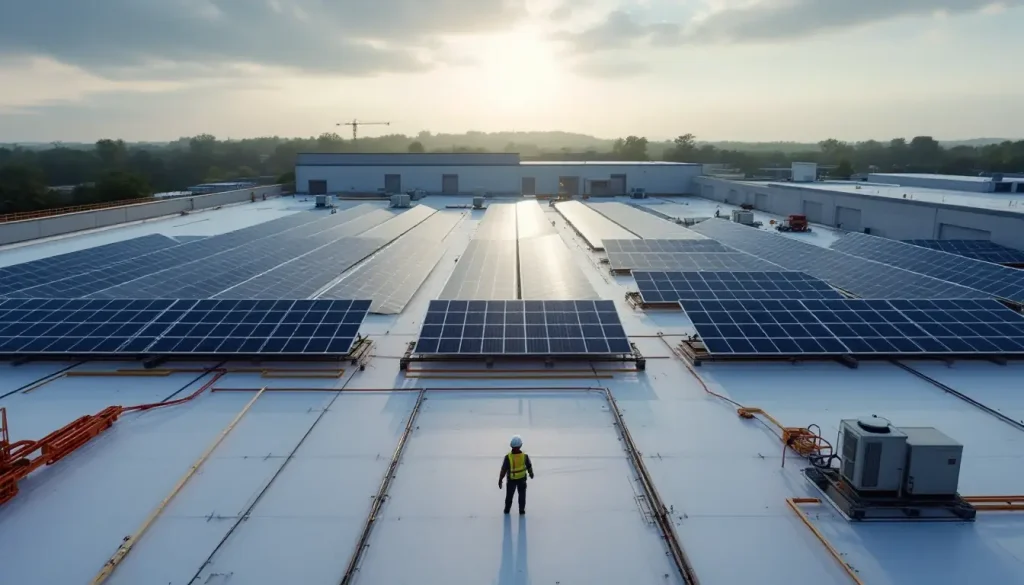
Commercial solar panel cost ran a median $3.1 per watt installed for systems of 100 kW or less and $2.4 per watt above 100 kW in 2025, before incentives, per Berkeley Lab’s August 2026 data.
Key takeaways
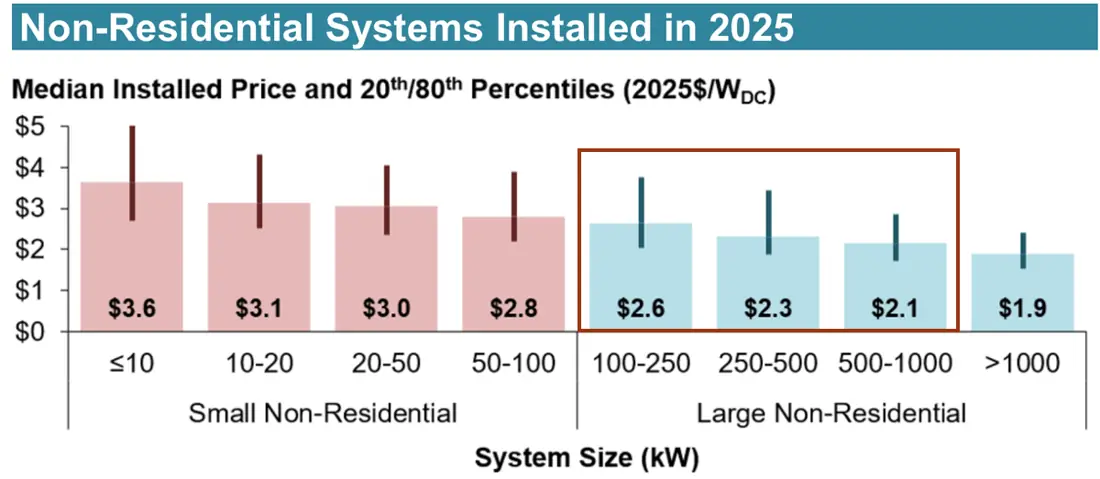
- Median 2025 installed prices for host-owned commercial solar fell from $3.6 per watt (10 kW or less) to $1.9 per watt (over 1,000 kW), a $1.7 per watt spread across sizes (Lawrence Berkeley National Laboratory, U.S. Distributed Solar and Storage 2026 Data Update, August 2026, slide 36).
- A solar project that had not begun construction by July 4, 2026 must be placed in service by December 31, 2027 to earn the clean electricity investment credit (26 USC 48E(e)(4); IRS Notice 2025-42).
- Systems under 1 MW AC get the 30% credit without the prevailing wage and apprenticeship test; larger systems drop to 6% if they fail it (26 USC 48E(a)(2)(A)).
- Solar under 48E is 5-year MACRS property, and 100% bonus depreciation is back for property acquired after January 19, 2025 (26 USC 168(e)(3)(B)(viii) and 168(k)); the depreciable basis drops by half the credit (26 USC 50(c)(3)).
- U.S. commercial customers paid an average 14.04 cents per kWh from January to August 2026, up from 13.29 cents a year earlier (EIA Electric Power Monthly, Table 5.6.B).
- In our worked example, a 200 kW rooftop at the $2.6 per watt median costs $520,000 and pays back in about 7.4 years with the credit and bonus depreciation, or about 14.2 years with no tax benefits.
How much does commercial solar cost per watt?
Commercial solar costs a median $2.4 to $3.1 per watt (DC) installed, before incentives, based on 2025 installs reported in Berkeley Lab’s August 2026 Tracking the Sun data update. Small non-residential systems (100 kW or less) had a $3.1 median, down from $3.2 in 2024. Large non-residential systems (over 100 kW) held at $2.4. These are host-owned systems; third-party-owned systems are excluded.
Watts here are DC watts: the nameplate rating of the panels. Prices are in 2025 dollars and cover the up-front price paid by the owner for the whole installed system, including panels, inverters, racking, electrical work, labor, permits and installer margin. Berkeley Lab puts soft costs and non-module hardware at roughly 80% of the 2025 median installed price, so the panels themselves are a minority of the bill.
| System size (kW DC) | Segment | Median installed price, 2025 ($/W) | Example size | Median total at that size | Source |
|---|---|---|---|---|---|
| 10 or less | Small non-residential | $3.6 | 10 kW | $36,000 | LBNL 2026 update, slide 36 |
| 10 to 20 | Small non-residential | $3.1 | 15 kW | $46,500 | LBNL 2026 update, slide 36 |
| 20 to 50 | Small non-residential | $3.0 | 40 kW | $120,000 | LBNL 2026 update, slide 36 |
| 50 to 100 | Small non-residential | $2.8 | 75 kW | $210,000 | LBNL 2026 update, slide 36 |
| 100 to 250 | Large non-residential | $2.6 | 200 kW | $520,000 | LBNL 2026 update, slide 36 |
| 250 to 500 | Large non-residential | $2.3 | 400 kW | $920,000 | LBNL 2026 update, slide 36 |
| 500 to 1,000 | Large non-residential | $2.1 | 750 kW | $1,575,000 | LBNL 2026 update, slide 36 |
| Over 1,000 | Large non-residential | $1.9 | 1,500 kW | $2,850,000 | LBNL 2026 update, slide 36 |
The total column is CB&C arithmetic: example size times the bin median. A real bid can land well above or below it, because Berkeley Lab’s 20th to 80th percentile bars span roughly $1 to $2 per watt inside most size bins.
What does the average commercial system look like?
The median 2025 non-residential system was 41 kW, while the average was 238 kW because a few large arrays pull the mean up (LBNL 2026 update, slides 4, 32 and 33). Warehouses had a median system size of 85 kW, and schools and industrial sites had medians above 100 kW. About half of non-residential systems were on commercial buildings, 33% on agricultural land, and the rest at tax-exempt sites such as schools, government buildings and houses of worship.
What about solar carports?
Berkeley Lab’s non-residential sample covers rooftop systems of any size and ground mounts up to 7,000 kW DC; it does not report carports separately. A search of federal contract awards on USAspending.gov (November 2026) found no 2023 to 2026 carport award that states both the kW size and the price, so this page does not publish a carport price per watt. Ask each bidder to price the canopy steel, foundations and any lighting as separate lines so you can see what the structure adds over a roof mount.
How much does price vary by state and by project type?
Large commercial systems ranged from a $1.9 per watt median in Maryland to $2.6 in California in 2025, while small systems ranged from $2.4 in Texas and North Carolina to $3.4 in New York (LBNL 2026 update, slide 37). Berkeley Lab shows a state only when it has at least 20 systems in the sample, so many states have no published median.
| State | Large non-res. median, 2025 ($/W) | Commercial power price, Jan to Aug 2026 (cents/kWh) | Years for savings to repay gross cost* | Source |
|---|---|---|---|---|
| Maryland | $1.9 | 17.16 | 8.5 | LBNL slide 37; EIA Table 5.6.B |
| Texas | $2.0 | 8.60 | 17.9 | LBNL slide 37; EIA Table 5.6.B |
| Wisconsin | $2.0 | 13.73 | 11.2 | LBNL slide 37; EIA Table 5.6.B |
| Arizona | $2.3 | 12.28 | 14.4 | LBNL slide 37; EIA Table 5.6.B |
| New Jersey | $2.4 | 17.90 | 10.3 | LBNL slide 37; EIA Table 5.6.B |
| New York | $2.4 | 22.93 | 8.1 | LBNL slide 37; EIA Table 5.6.B |
| Massachusetts | $2.5 | 24.66 | 7.8 | LBNL slide 37; EIA Table 5.6.B |
| California | $2.6 | 26.96 | 7.4 | LBNL slide 37; EIA Table 5.6.B |
*CB&C arithmetic with no incentives: price per watt times 1,000, divided by 1,300 kWh per kW DC per year times the state’s average commercial price. The 1,300 kWh figure is a round planning assumption applied to every state, so sunnier states (Arizona, California) look slower than they are and cloudier states look faster. Use the pattern, not the exact years: an expensive install in a high-rate state can repay faster than a cheap install in a low-rate state such as Texas.
What else moves the price?
| Driver | Effect on price | Source |
|---|---|---|
| System size | $1.7 per watt between the 10 kW or less bin ($3.6) and the over 1,000 kW bin ($1.9) | LBNL 2026 update, slide 36 |
| Adding battery storage | Median +$2.0 per watt of PV for small and +$1.3 for large non-residential systems | LBNL 2026 update, slide 9 |
| State | $1.9 (Maryland) to $2.6 (California) for large systems; $2.4 to $3.4 for small | LBNL 2026 update, slide 37 |
| Soft costs and other hardware | About 80% of the 2025 median installed price | LBNL 2026 update, slide 35 |
| Federal procurement | A 300 kW Defense Logistics Agency install in Goodyear, Arizona obligated $1,417,485.86 (2021), about $4.72 per watt; kW basis (AC or DC) not stated | USAspending.gov, award SP330021C0004 |
The federal row is a contrast, not a benchmark: federal construction carries Davis-Bacon wage rates and contract requirements that private jobs may not. The award is public on USAspending.gov (award SP330021C0004, Defense Logistics Agency).
Is the 30% federal tax credit still available for commercial solar?
Yes, for projects that meet the dates. As of November 15, 2026, a commercial solar project that began construction after July 4, 2026 earns the clean electricity investment credit only if it is placed in service by December 31, 2027 (26 USC 48E(e)(4), added by Pub. L. 119-21 section 70513). A project that began construction on or before July 4, 2026 is outside that cutoff.
Beginning construction now means physical work of a significant nature: IRS Notice 2025-42 made the physical work test the only method for solar facilities that had not begun construction before September 2, 2025 (section 3), except that facilities of 1.5 MW AC or less may still use the 5% cost safe harbor (section 6). A facility counts as continuously built if it is placed in service within 4 calendar years after the year construction began (section 4.04).
| Rule | What it says | Citation |
|---|---|---|
| Base rate | 6% of the qualified investment | 26 USC 48E(a)(2)(A)(i) |
| 30% rate | Under 1 MW AC output, or prevailing wage and apprenticeship met | 48E(a)(2)(A)(ii)(I) and (III) |
| Energy community bonus | +10 points at the 30% rate (+2 at 6%) | 48E(a)(3)(A) |
| Domestic content bonus | +10 points at the 30% rate; manufactured-product threshold 50% if construction begins in 2026, 55% after 2026 | 48E(a)(3)(B); IRS 48E page |
| Low-income allocation | +10 or +20 points for allocated facilities under 5 MW AC | 48E(h) |
| Foreign entity rule | No credit for property with material assistance from a prohibited foreign entity, construction beginning after December 31, 2025 | 48E(b)(6) |
| Solar termination | No credit if placed in service after December 31, 2027, for construction beginning after July 4, 2026 | 48E(e)(4); Pub. L. 119-21 sec. 70513(g)(5) |
| Tax-exempt owners | Schools, governments and nonprofits can elect direct payment of the 48E credit | 26 USC 6417(b)(12), (c) |
One trap: the IRS clean electricity investment credit page (last reviewed January 5, 2026) still describes only the general phase-out that starts after 2032 and does not mention the December 31, 2027 solar cutoff. The statute and Notice 2025-42 control. This page summarizes public statutes and IRS notices and is not tax, legal or financial advice; ask your tax advisor to confirm in writing which begin-construction method your project meets and what records prove it.
How do depreciation and the tax credit change the net cost?
For a taxable owner, depreciation can cut the net cost by roughly another 18% of the price. Solar that qualifies under 48E is 5-year property (26 USC 168(e)(3)(B)(viii)), and 168(k)(1)(A) now allows 100% first-year bonus depreciation for property acquired after January 19, 2025 (Pub. L. 119-21 section 70301). The depreciable basis is the cost minus 50% of the credit (26 USC 50(c)(3)), so a 30% credit leaves 85% of the cost to depreciate.
If the credit is lost because a project misses the 2027 placed-in-service date, the 5-year class and bonus depreciation still apply under 168(e)(3)(B)(viii) and 168(k), but there is no basis reduction. The credit is also subject to recapture if the property stops qualifying in the first years after it is placed in service, under 26 USC 50(a), so selling the building soon after install has a tax cost to model.
What is the payback on a commercial solar system?
A 200 kW rooftop system at the 2025 median price pays back in about 7.4 years for a taxable C corporation that takes the 30% credit and bonus depreciation, valuing every kWh at the 2026 U.S. average commercial price. With no tax benefits at all, the same system takes about 14.2 years. Every input is shown below so you can swap in your own quote and tariff.
| Step | Input or assumption | Arithmetic | Result | Source |
|---|---|---|---|---|
| Installed price | 200 kW DC at the 100 to 250 kW median, $2.6/W | 200,000 W x $2.6 | $520,000 | LBNL 2026 update, slide 36 |
| Federal credit | 30% (under 1 MW AC), in service by Dec 31, 2027 | $520,000 x 0.30 | $156,000 | 26 USC 48E |
| Depreciable basis | Cost minus half the credit | $520,000 – $78,000 | $442,000 | 26 USC 50(c)(3) |
| Bonus depreciation tax saving | 100% bonus, 21% federal corporate rate | $442,000 x 0.21 | $92,820 | 26 USC 168(k); 26 USC 11(b) |
| Net cost | Price minus credit minus tax saving | $520,000 – $156,000 – $92,820 | $271,180 | CB&C arithmetic |
| Annual output | 1,300 kWh per kW DC per year (CB&C planning assumption) | 200 x 1,300 | 260,000 kWh | Assumption; see sensitivity table |
| Annual bill saving | U.S. commercial average, Jan to Aug 2026, 14.04 cents/kWh | 260,000 x $0.1404 | $36,504 | EIA Table 5.6.B |
| Simple payback | Net cost divided by annual saving | $271,180 / $36,504 | 7.4 years | CB&C arithmetic |
The example leaves out state income tax, state incentives, operations and maintenance, panel degradation, inverter replacement and electricity price changes. It also assumes every solar kWh offsets the average commercial price; the EIA average includes demand charges, which a solar array does not reliably reduce, so a tariff with high demand charges will see a smaller saving per kWh than 14.04 cents.
| Scenario (same 200 kW, $520,000) | Net cost | Simple payback at 260,000 kWh and 14.04 cents |
|---|---|---|
| Taxable owner: 30% credit plus 100% bonus at 21% | $271,180 | 7.4 years |
| Tax-exempt owner: 30% credit as elective pay, no depreciation | $364,000 | 10.0 years |
| Taxable owner, credit lost (in service after Dec 31, 2027): bonus at 21% on full cost | $410,800 | 11.3 years |
| No credit and no depreciation benefit | $520,000 | 14.2 years |
How sensitive is payback to sunshine and power price?
For a cross-check on the 1,300 kWh assumption: EIA estimates U.S. small-scale solar produced 93,041 thousand MWh in 2025 (EIA Table 1.1.A) from capacity that grew from 53,228 MW to 59,089 MW during the year (EIA Table 6.1.A), about 1,657 kWh per kW of reported capacity. That fleet figure is weighted toward sunny states, so the table tests lower values too.
| Output (kWh per kW DC per year) | 10 cents/kWh | 14.04 cents/kWh | 20 cents/kWh |
|---|---|---|---|
| 1,100 | 12.3 years | 8.8 years | 6.2 years |
| 1,300 | 10.4 years | 7.4 years | 5.2 years |
| 1,500 | 9.0 years | 6.4 years | 4.5 years |
All cells use the taxable-owner net cost of $271,180 on a 200 kW system. CB&C arithmetic: net cost divided by (200 x output x price).
What should you check before signing a solar contract?
Check the roof, the structure, the electrical service and the permit path before you compare prices, because each can add cost or months. Berkeley Lab found a 2025 median of 13 days from permit application to issue for small non-residential systems and 51 days for large ones, against 6 days for residential (LBNL 2026 update, slide 12). Utility interconnection review is a separate clock.
- Roof age and membrane: a solar array sits on the roof for decades, so re-roof first if the membrane is near the end of its life. Our page on TPO roofing cost per square foot from public bids has current re-roof prices.
- Structural capacity: have an engineer confirm the roof framing can carry the array’s dead load plus ballast and the code wind and snow loads. On a metal building, the MBMA guide specification (Section 1.4) has a blank for a solar-ready load, covered in our pre-engineered metal building guide, and fees for the check are in our structural engineer cost guide.
- Roof area: Berkeley Lab measured a 15% to 47% range of roof coverage for 2025 non-residential systems (slide 28), so obstructions, setbacks and rooftop units decide the real system size.
- Electrical service: confirm the main switchgear and transformer can accept the inverter output; our three-phase power guide covers the service basics.
- Interconnection: file the utility interconnection application early and ask the utility in writing for its study timeline and any upgrade cost assigned to you.
- Tax position: if the system is 1 MW AC or larger, plan for prevailing wage and apprenticeship records; our page on prevailing wage vs market wage shows the pay gap, and certified payroll covers the record-keeping.
- Foreign-entity documentation: for construction that begins after December 31, 2025, ask the installer for supplier certifications that support the material-assistance test in 26 USC 48E(b)(6).
New construction is the cheapest time to plan for solar: specify the solar-ready roof load, conduit paths and switchgear space at design. Our warehouse construction guide covers the shell, roof and electrical service decisions that a later array depends on.
What do common commercial solar cost guides get wrong?
| What a top-ranking guide says | What the primary source says | Source |
|---|---|---|
| Commercial solar costs $1.00 to $2.50 per watt installed in 2026 (an installer blog updated August 2026) | 2025 medians were $3.1 (100 kW or less) and $2.4 (over 100 kW); only the over 1,000 kW bin was below $2.0, at $1.9 | LBNL 2026 update, slides 8 and 36 |
| Safe harbor your project before December 31, 2025 to keep the credit (same blog) | The begin-construction cutoff was July 4, 2026; projects begun later must be in service by December 31, 2027 | 26 USC 48E(e)(4); Notice 2025-42 |
| The bonus depreciation percentage phases down under current law (a supplier guide, October 2025) | 168(k)(1)(A) now reads 100% for property acquired after January 19, 2025 | 26 USC 168(k); Pub. L. 119-21 sec. 70301(c) |
| Businesses reach payback in 6 to 10 years (installer blog, no inputs shown) | Payback swings from about 4.5 to 12.3 years on one 200 kW system as output and power price change, before tax status | CB&C sensitivity table above |
The common thread is unsourced ranges. The Berkeley Lab data come from utility and state incentive program records for systems actually installed in 2025, so they are the closest public stand-in for what owners paid.
Which solar path fits your building?
The right move depends on your tax status, system size and whether construction can start fast enough to hit the December 31, 2027 in-service date. Use the decision table first; the flowchart below holds the same credit logic question by question.
| If | Then | Why |
|---|---|---|
| Not yet started and cannot be in service by Dec 31, 2027 | Price the job without the credit; depreciation still helps a taxable owner | 48E(e)(4) termination |
| Taxable owner, under 1 MW AC, can finish by end of 2027 | Lock the schedule and interconnection now; the 30% credit needs no wage test | 48E(a)(2)(A)(ii)(I) |
| 1 MW AC or larger | Budget prevailing wage and apprenticeship, or the credit drops to 6% | 48E(a)(2)(A)(ii)(III) |
| School, city or nonprofit owner | Use elective pay to receive the credit as a payment, or compare a third-party power purchase agreement | 26 USC 6417 |
| Roof membrane under about 5 years of life left | Re-roof first, then install | Avoids paying to remove and reinstall the array |
| Quote below $1.9/W on a system under 1,000 kW | Ask what is excluded (interconnection, structural work, permits) | Below every 2025 size-bin median, LBNL slide 36 |
Roof condition matters first, so check flat roof replacement cost and TPO roofing cost before mounting panels.
How we compiled this
We used 9 primary documents accessed November 15, 2026: Berkeley Lab’s August 2026 distributed solar data update (price medians read from slides 8, 9, 12, 28, 35, 36 and 37), the text of 26 USC 48E, 50, 168 and 6417 with Pub. L. 119-21 statutory notes, IRS Notice 2025-42, EIA Electric Power Monthly Tables 1.1.A, 5.6.B and 6.1.A, and one USAspending.gov award. We could not retrieve NREL’s Q1 2024 cost benchmark during research, so it is not used. Totals, paybacks and per-watt figures marked CB&C arithmetic are our calculations from those inputs; installer quotes and marketing pages were read only to find gaps and are not used as data.
Frequently asked questions
How much does a 100 kW commercial solar system cost?
At Berkeley Lab’s 2025 medians, a 100 kW system at the 50 to 100 kW bin’s $2.8 per watt comes to $280,000 before incentives; at the next bin’s $2.6 it would be $260,000. The 20th to 80th percentile spread inside most size bins is roughly $1 to $2 per watt wide, so get at least three itemized quotes. Source: LBNL 2026 data update, slide 36.
Does the 30% solar tax credit still apply to businesses in 2026?
Yes, if the dates work. Under 26 USC 48E(e)(4), a solar project that began construction after July 4, 2026 must be placed in service by December 31, 2027. Systems under 1 MW AC get 30% without the wage test; larger systems need prevailing wage and apprenticeship or drop to 6%. This is not tax advice; confirm with your advisor using IRS Notice 2025-42.
How much roof space does a commercial solar system need?
It depends on how much of the roof is usable. Berkeley Lab measured 2025 non-residential systems covering 15% to 47% of roof area across its percentile band, because rooftop units, skylights, fire access paths and setbacks take space. Ask the installer for a layout drawing that shows module count, kW DC and every setback before comparing prices per watt.
Is bonus depreciation available for commercial solar panels?
Yes. 26 USC 168(k)(1)(A) allows 100% first-year bonus depreciation for property acquired after January 19, 2025, and solar under 48E is 5-year MACRS property under 168(e)(3)(B)(viii). If you also take the credit, reduce the depreciable basis by half the credit under 26 USC 50(c)(3), which leaves 85% of cost at a 30% credit.
Can a school or nonprofit get the solar tax credit?
Yes. Under 26 USC 6417, tax-exempt organizations, states and their political subdivisions can elect to receive the 48E credit as a direct payment. In our 200 kW example that is $156,000 on a $520,000 system, with no depreciation benefit, for a simple payback of about 10 years at 14.04 cents per kWh.
How long does a commercial solar permit take?
Berkeley Lab’s 2025 data show a median of 13 days from permit application to issue for non-residential systems of 100 kW or less and 51 days for larger systems, versus 6 days for residential. Utility interconnection review runs separately and can take longer, so apply for both as soon as the design is set. Source: LBNL 2026 data update, slide 12.
Sources
- U.S. Distributed Solar and Storage: 2026 Data Update (Tracking the Sun), Lawrence Berkeley National Laboratory, August 2026. Accessed November 15, 2026.
- 26 USC 48E, Clean electricity investment credit, with statutory notes, Legal Information Institute, Cornell Law School. Accessed November 15, 2026.
- Notice 2025-42, Beginning of construction for wind and solar facilities, Internal Revenue Service, August 2025. Accessed November 15, 2026.
- 26 USC 168, Accelerated cost recovery system, Legal Information Institute, Cornell Law School. Accessed November 15, 2026.
- 26 USC 50, Other special rules for investment credit, Legal Information Institute, Cornell Law School. Accessed November 15, 2026.
- 26 USC 6417, Elective payment of applicable credits, Legal Information Institute, Cornell Law School. Accessed November 15, 2026.
- Clean Electricity Investment Credit, Internal Revenue Service, last reviewed January 5, 2026. Accessed November 15, 2026.
- Electric Power Monthly Table 5.6.B, average price by sector and state, year to date through August 2026, U.S. Energy Information Administration. Accessed November 15, 2026.
- Electric Power Monthly Table 1.1.A, net generation from renewable sources, U.S. Energy Information Administration. Accessed November 15, 2026.
- Electric Power Monthly Table 6.1.A, solar PV capacity, U.S. Energy Information Administration. Accessed November 15, 2026.
- Award SP330021C0004, install new 300 kW solar PV, Goodyear, Arizona, USAspending.gov, Defense Logistics Agency. Accessed November 15, 2026.