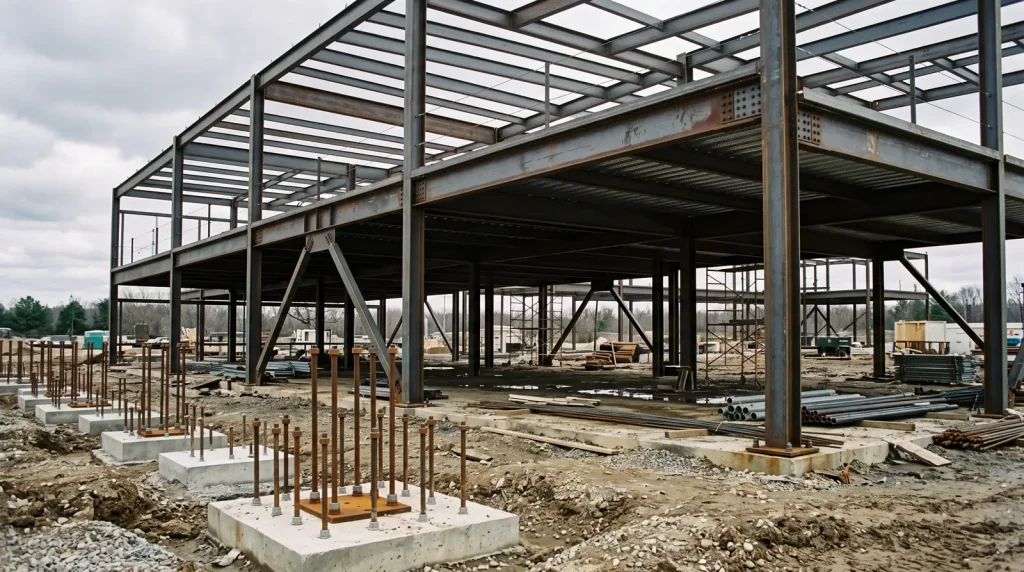
Structural engineer cost on a new $3.5 million commercial building works out to about $26,100 to $36,100 with construction-phase support, or about $18,500 to $25,700 for design alone, from 2025 and 2026 state fee guides and public proposals.
Key takeaways
- Utah’s 2026 guideline caps the whole architect and engineer (A/E) basic fee for a $3 million to $3,999,999 office building at 7.13% of construction, covering design and construction administration, and structural engineering sits inside that fee (Utah DFCM A/E fee guidelines, effective August 1, 2026).
- In three public proposals from 2023 and 2024, structural engineering took 10.5% and 10.8% of fees that cover design work, not construction administration, on two fire station projects and 27.0% on a city hall remodel with a seismic retrofit (Town of Northport, Village of Little Chute, City of Ely).
- Across 83 federal GSA schedule rates for structural engineers, the median ceiling price is $158.90 an hour, with senior and principal titles at a median $190.49 (GSA CALC+ ceiling rates, pulled November 2, 2026).
- Sixteen federal structural assessment contracts signed from January 2024 to September 2026 ranged from $5,438 to $292,136, with a median of $25,946 (USAspending.gov award records).
- Under IBC Chapter 17 the owner, or the design professional acting as the owner’s agent, hires the special inspectors; Utah’s July 2026 state rates run $55 an hour for a concrete or soils technician to $125 for a Professional Engineer (Utah DFCM special inspection rates, July 8, 2026).
How much does a structural engineer cost for a new commercial building?
On a new commercial building, the structural engineer is usually a consultant inside the architect’s fee, so the cost is a share of a share. Utah’s 2026 guideline puts the full A/E basic fee for a $3 million to $3,999,999 office at 7.13% of construction, and public proposals give structural 10.5% to 10.8% of that fee on fire station projects (Utah DFCM, 2026).
State fee guides are ceilings for negotiation, not price lists. Utah calls its schedule the maximum allowable fee for basic services on a typical project, and New Mexico’s architect rate rule, effective June 10, 2025, says its schedule is the highest permissible rate and not the lower limit, average or actual fee (1.5.18 NMAC). Private owners negotiate below these lines on simple buildings.
Key numbers
| Service | Public figure | Date | Source |
|---|---|---|---|
| Whole A/E basic fee, office, $3M to $3,999,999 | 7.13% of construction (Utah Schedule B) | Effective Aug 1, 2026 | Utah DFCM |
| Whole A/E basic fee, office, $3M | 9.72% of construction (Washington Schedule B) | Page updated Jun 1, 2026 | Washington OFM |
| Federal cap on A-E design production fee | 6% of estimated construction cost | FAC 2026-01, Mar 13, 2026 | FAR 15.404-4(c)(4)(i)(B) |
| Structural share of the design fee, fire station projects | 10.5% and 10.8% | Jan 2024 and Mar 2024 | Town of Northport, Village of Little Chute |
| Structural share, remodel with seismic retrofit | 27.0% ($115,000 of $425,900) | Jun 2023 | City of Ely |
| Structural engineer hourly ceiling, median of 83 rates | $158.90 | Nov 2, 2026 | GSA CALC+ |
| Structural assessment, median of 16 federal awards | $25,946 | Jan 2024 to Sep 2026 | USAspending.gov |
| Professional Engineer on a state special inspection contract | $125 an hour | Jul 8, 2026 | Utah DFCM |
The percentage falls as the building gets bigger and rises with complexity. The Utah table below shows three of its five building schedules: Schedule A covers warehouses and parking structures, Schedule B office buildings and tenant improvements, and Schedule E hospitals and research labs (Utah DFCM, pages 3 and 4).
| Construction budget | Schedule A (warehouse) | Schedule B (office) | Schedule E (hospital) | Source |
|---|---|---|---|---|
| $300,000 to $499,999 | 8.22% | 8.81% | 10.69% | Utah DFCM 2026 |
| $500,000 to $749,999 | 7.92% | 8.51% | 10.40% | Utah DFCM 2026 |
| $1,000,000 to $1,499,999 | 7.33% | 7.92% | 9.80% | Utah DFCM 2026 |
| $2,000,000 to $2,999,999 | 6.73% | 7.33% | 9.21% | Utah DFCM 2026 |
| $3,000,000 to $3,999,999 | 6.53% | 7.13% | 9.01% | Utah DFCM 2026 |
| $5,000,000 to $7,999,999 | 6.14% | 6.73% | 8.61% | Utah DFCM 2026 |
| $12,000,000 to $14,999,999 | 5.64% | 6.14% | 7.62% | Utah DFCM 2026 |
| $20,000,000 to $24,999,999 | 5.25% | 5.74% | 7.23% | Utah DFCM 2026 |
| $40,000,000 to $49,999,999 | 4.80% | 5.30% | 6.78% | Utah DFCM 2026 |
What share of the design fee goes to the structural engineer?
Three public design proposals split the fee by discipline. On two fire station projects, structural engineering was 10.5% and 10.8% of the design fee. On the Ely, Nevada city hall, where the scope was a remodel, repairs, a seismic retrofit and an addition under the 2018 International Existing Building Code, structural was 27.0% (Nevada SHPO agenda item 7e, October 2023).
| Project | Date | Structural fee | Total design fee | Structural share | Source |
|---|---|---|---|---|---|
| Town office and fire station, Northport, ME (design development, documents, bidding) | Mar 29, 2024 | $20,010 incl. 15% markup | $191,285 | 10.5% | Town of Northport fee estimate |
| Fire station, Little Chute, WI | Jan 2024 | $44,000 | $408,324 | 10.8% | Village of Little Chute price proposal |
| City hall remodel, seismic retrofit and addition, Ely, NV; $3M to $4M target | Jun 14, 2023 | $115,000 | $425,900 | 27.0% | City of Ely proposal |
Worked example: a new $3.5 million office building
The example below is CB&C arithmetic, not a quote. It applies Utah’s Schedule B rate of 7.13% and Washington’s Schedule B formula, which gives 9.58% at $3.5 million when interpolated between its $3 million row (9.72%) and $4 million row (9.45%) (Washington OFM Appendix A formula), then the public structural shares. Use our commercial construction cost per square foot guide to set your own construction figure.
The inputs sit on different bases. Utah’s 7.13% and Washington’s 9.58% include construction administration and closeout; the Northport share (10.5%) covers design development, construction documents and bidding, Ely’s (27.0%) covers design through construction documents, and the Little Chute price sheet (10.8%) does not split phases (Town of Northport).
| Step | Utah guideline | Washington guideline | Arithmetic |
|---|---|---|---|
| Construction budget (assumed) | $3,500,000 | $3,500,000 | Owner input |
| Whole A/E basic fee | $249,550 | $335,219 | $3.5M x 7.13%; $3.5M x 9.58% |
| Structural at 10.5% (Northport share) | $26,103 | $35,064 | A/E fee x 0.1046 |
| Structural at 10.8% (Little Chute share) | $26,901 | $36,137 | A/E fee x 0.1078 |
| Structural at 27.0% (Ely remodel share) | $67,378 | $90,509 | A/E fee x 0.270 |
| Structural as share of construction, fire station shares | 0.75% to 0.77% | 1.00% to 1.03% | Structural fee / $3.5M |
| Design phases only, fire station shares (71% of the basic fee) | $18,533 to $19,100 | $24,895 to $25,657 | Fire station rows x 0.71 (18% + 20% + 31% + 2%) |
| Design phases only, share of construction | 0.53% to 0.55% | 0.71% to 0.73% | Design-only fee / $3.5M |
Applying a design-only share to a fee that includes construction administration assumes the structural engineer keeps the same share through construction, so the $26,100 to $36,100 rows carry about 29% for construction-phase work (Washington’s 27% construction plus 2% closeout); strip that out and the design-only structural fee falls to about $18,500 to $25,700, or 0.53% to 0.73% of construction (Washington OFM phase split).
Two items sit outside these numbers. The geotechnical report that the structural engineer designs the foundations from is a separate owner contract (Ely added $2,500 of soils work in October 2023), and special inspections during construction are billed by the hour, as shown further down. A federal owner faces a hard ceiling too: FAR 15.404-4(c)(4)(i)(B) caps A-E design production at 6% of estimated construction cost, or $210,000 on a $3.5 million job (FAR, effective March 13, 2026).
How much does a structural engineer charge per hour?
Federal schedule contracts put structural engineers at a median ceiling price of $158.90 an hour across 83 rates on 41 GSA contracts, from $108.61 for junior titles to $190.49 for senior and principal titles (GSA CALC+, November 2, 2026). Those are fully loaded billing prices. The underlying wage for civil engineers, the federal category that includes structural engineers, had a May 2025 median of $48.48 an hour.
The Bureau of Labor Statistics (BLS) does not count structural engineers separately: its 2018 Standard Occupational Classification puts them under 17-2051 Civil Engineers, which “includes architectural, structural, traffic, and geotechnical engineers” (BLS SOC 2018). The 201,620 civil engineers working in architectural and engineering firms earned a median $48.39 an hour in May 2025 (BLS OEWS, May 2025).
| Rate | Hourly figure | What it is | Source |
|---|---|---|---|
| Civil engineer median wage (includes structural) | $48.48 | Wage, May 2025; 25th to 75th percentile $38.43 to $62.34 | BLS OEWS |
| Washington multiplier applied to that wage | $96.96 to $155.14 | 2 to 3.2 times direct base salary, negotiated | Washington OFM 2027-29 |
| GSA junior or level I structural engineer, median | $108.61 | 17 ceiling rates | GSA CALC+ |
| Professional Engineer on Utah special inspection contracts | $125.00 | State rate sheet, July 8, 2026 | Utah DFCM |
| GSA mid or level II structural engineer, median | $145.45 | 14 ceiling rates | GSA CALC+ |
| GSA all structural engineer titles, median | $158.90 | 83 rates, range $48.54 to $297.67 | GSA CALC+ |
| GSA senior, principal or level III, median | $190.49 | 32 ceiling rates | GSA CALC+ |
| Washington cap, firm employees | $250.00 | Hourly maximum on state A/E work | Washington OFM 2027-29 |
| Washington cap, principals | $350.00 | Hourly maximum on state A/E work | Washington OFM 2027-29 |
The gap between wage and billing rate is overhead, benefits and profit. The GSA median of $158.90 is 3.28 times the BLS median wage of $48.48, slightly above Washington’s allowed range of 2 to 3.2 times base salary, which excludes fringe benefits, taxes and retirement contributions (Washington OFM, hourly rates). A quote above $250 an hour for staff time would exceed what Washington pays on public work.
What does a structural assessment of an existing building cost?
A structural assessment of one existing building cost $5,438 to $65,117 in 14 of 16 federal contracts signed from January 2024 to September 2026, with a median of $25,946 across all 16. The two largest, $185,665 and $292,136, covered several structures or a historic building with field investigation (USAspending.gov, Navy Yard award).
| Building or scope | Agency | Place | Signed | Award | Source |
|---|---|---|---|---|---|
| Arbaugh House, historic house | National Park Service | Oldtown, MD | Jul 2024 | $5,438 | USAspending.gov |
| Installed medical equipment | Veterans Affairs | Houston, TX | Sep 2026 | $8,240 | USAspending.gov |
| In-patient pharmacy | Veterans Affairs | San Juan, PR | Jan 2024 | $9,000 | USAspending.gov |
| Parking garage | Veterans Affairs | Clarksburg, WV | Jan 2026 | $12,174 | USAspending.gov |
| Facility with a structural integrity issue | NOAA | North Charleston, SC | Aug 2024 | $12,500 | USAspending.gov |
| Building structural assessment | Veterans Affairs | Kent, WA | Feb 2025 | $16,449 | USAspending.gov |
| Building structural assessment | National Park Service | Kennesaw, GA | Mar 2026 | $20,779 | USAspending.gov |
| Boiler room, Building 2521 | Navy | Crane, IN | Sep 2025 | $23,267 | USAspending.gov |
| Assessment report for an aircraft trainer conversion | Navy | Kaneohe Bay, HI | Aug 2024 | $28,624 | USAspending.gov |
| Road maintenance shop | Bureau of Indian Affairs | Fort Totten (office in CO) | Sep 2025 | $30,880 | USAspending.gov |
| Commissary building | Defense Commissary Agency | Garden City, NY | Sep 2024 | $37,591 | USAspending.gov |
| NAS Fort Worth commissary | Defense Commissary Agency | Fort Worth, TX | May 2024 | $51,265 | USAspending.gov |
| Building 2127 | Air Force | Not listed | Mar 2026 | $53,244 | USAspending.gov |
| Comfort station and district office (2 buildings) | National Park Service | Tupelo, MS | Apr 2024 | $65,117 | USAspending.gov |
| Two buildings and a boundary wall | Navy | Washington, DC | Sep 2024 | $185,665 | USAspending.gov |
| Historic building with field investigation | Army | Selma, AL | Jul 2024 | $292,136 | USAspending.gov |
The low end covers narrow scopes: an in-patient pharmacy in San Juan for $9,000 in January 2024, or installed medical equipment in Houston for $8,240 in September 2026. Awards above $50,000 cover a whole commissary, two or more structures, or a historic building with field investigation. If you are buying a property, a property condition assessment under ASTM E2018-24 usually comes first, and a structural engineer is added when the PCA flags cracking, deflection or corrosion.
Worked example: pricing an assessment by the hour
An owner can test a lump-sum quote against the GSA medians. The hours below are a CB&C assumption for a one-story building with one visible problem (a sagging roof beam), not a public figure. At GSA median rates the job lands at $5,654.48, close to the $5,438 Arbaugh House award (GSA CALC+ medians).
| Task | Hours (assumed) | Rate | Cost |
|---|---|---|---|
| Senior engineer: site visit, review of existing drawings, sealed letter | 16 | $190.49 | $3,047.84 |
| Junior engineer: measurements, photos, calculations, draft report | 24 | $108.61 | $2,606.64 |
| Total | 40 | $5,654.48 |
What do special inspections cost under IBC Chapter 17?
Special inspections are third-party checks of structural work during construction, required by Chapter 17 of the 2024 International Building Code (IBC). The owner, or the registered design professional acting as the owner’s agent, hires the inspection agency, and Utah’s state contract rates in July 2026 ran $55 to $125 an hour for inspectors and engineers, with radiographic weld testing at $160 (ICC Statement of Special Inspections template, May 2026).
The structural engineer of record writes the Statement of Special Inspections, which goes to the building official with the permit application under IBC Section 107.1, and lists each category: steel (Section 1705.2), metal building systems (1705.2.6), concrete (Table 1705.3), masonry (1705.4) and soils (1705.6). Wind-resistance inspections under 1705.12 apply in Exposure B at 150 mph or more, or Exposure C or D at 140 mph or more (IBC 2024 Chapter 17). Plan the cost with your commercial building permit budget.
| Inspector or test | Utah DFCM rate | Source |
|---|---|---|
| ACI level I concrete sampling technician | $55 per hour | Utah DFCM, Jul 8, 2026 |
| Soils in-place density technician | $55 per hour | Utah DFCM |
| ACI level II, ICC concrete special inspector | $65 per hour | Utah DFCM |
| ICC post-installed anchor inspector | $65 per hour | Utah DFCM |
| Masonry ICC special inspector | $72 per hour | Utah DFCM |
| Structural steel and welding, or bolting, special inspector | $85 per hour | Utah DFCM |
| Ultrasonic weld testing (UT) | $125 per hour | Utah DFCM |
| Radiographic weld testing (RT) | $160 per hour plus materials | Utah DFCM |
| Staff engineer | $95 per hour | Utah DFCM |
| Professional Engineer (P.E.) | $125 per hour | Utah DFCM |
| Concrete cylinder compressive strength test | $25 each | Utah DFCM |
| Proctor test (standard or modified) | $140 each | Utah DFCM |
| Overtime, weekends and holidays | 1.5 times the hourly rate | Utah DFCM |
Structural observation is a separate visit by the design engineer, not the inspector. The ICC template lists its triggers under IBC Section 1704.6: Risk Category III or IV buildings, high-rise buildings, Seismic Design Category E with more than 2 stories above grade, or when the engineer or building official requires it. A final report of special inspections must reach the building official before the certificate of occupancy is issued (ICC SSI template).
Worked example: special inspections on a small steel building
The hours are a CB&C assumption for a two-story steel frame on spread footings with a slab on grade; the rates are Utah’s July 2026 schedule. State rates are negotiated for volume, so a private owner should expect quotes above this $7,550 total (Utah DFCM rates).
| Item | Quantity (assumed) | Rate | Cost |
|---|---|---|---|
| Soils density technician, footing subgrade and fill | 16 hours | $55 | $880 |
| Proctor tests | 2 | $140 | $280 |
| Concrete special inspector, footings, slab, deck | 40 hours | $65 | $2,600 |
| Concrete cylinder tests | 30 | $25 | $750 |
| Steel, welding and bolting special inspector | 24 hours | $85 | $2,040 |
| P.E. review and final report | 8 hours | $125 | $1,000 |
| Total | $7,550 |
What moves a structural engineering fee up or down?
Size, building type, existing conditions and delivery method move the fee most, and each has a published effect. In Utah’s 2026 guideline the office-building rate drops from 8.81% at $300,000 to $499,999 of construction to 5.30% at $40 million to $49,999,999, and a renovation adds 0.65 points on the renovated portion (Utah DFCM 2026).
| Driver | Published effect | Source |
|---|---|---|
| Building size | Office rate 8.81% at $300,000 to $499,999; 5.30% at $40M to $49,999,999 | Utah DFCM |
| Building type | $3M to $3,999,999: warehouse 6.53%, office 7.13%, hospital 9.01% | Utah DFCM |
| Renovation | Adds 0.50 to 1.00 points on the renovated portion; Washington allows up to 3 points on remodels | Utah DFCM; Washington OFM 2025 |
| Seismic retrofit of an existing building | Structural share 27.0% in Ely vs 10.5% and 10.8% on two fire station projects | City of Ely; Little Chute |
| Delivery method | Washington office rate at $5M: 9.23% design-bid-build vs 10.69% GC/CM | Washington OFM 2025 |
| Repeat design | Replications of a prototype at 40% of the full fee | Washington OFM 2025 |
| Contractor-designed systems | Roof trusses and pre-engineered metal buildings: fee reduced case by case | Washington OFM 2025 |
| Consultant markup | Up to 10% service charge on sub-consultant work in Washington; Northport carried 15% | Washington OFM 2025; Northport |
| Construction-phase services | 27% of the basic fee in Washington’s phase split; Ely’s structural proposal excluded bidding and construction | Washington OFM 2025; City of Ely |
A pre-engineered metal building is the clearest case of a lower structural fee: the manufacturer’s engineer designs and seals the frame, and Washington’s guide tells agencies to reduce the consultant fee accordingly. The owner still pays the project engineer for the foundations, anchor rods and the special inspection category added in IBC 2024 Section 1705.2.6.
Delivery method changes who holds the engineer’s contract more than the price. In design-build the contractor hires the structural engineer and carries the fee inside the contract sum; in design-bid-build the owner pays it through the architect. Our design-build vs design-bid-build comparison covers the trade-offs, and Washington’s 2025 guide prices GC/CM delivery 1.46 points higher at $5 million.
What does the owner get for the structural engineer’s fee?
The fee buys sealed construction documents and the paperwork the building official needs. Ely’s June 2023 structural proposal promised drawings and specifications at four stages, a structural opinion of probable cost at each, calculations “stamped and signed for permitting” and answers to plan check comments, for $115,000 (City of Ely proposal).
| Phase | Share of basic fee (Washington) | What the design team delivers (structural part) | Source |
|---|---|---|---|
| Schematic design | 18% | Recommended structural materials and systems, conceptual solutions | Washington OFM 2025 |
| Design development | 20% | Structural system and dimensions, design criteria, foundation criteria, preliminary member sizes | Washington OFM 2025 |
| Construction documents | 31% | Final calculations, drawings and specifications, sealed for permit | Washington OFM 2025; Ely |
| Bidding | 2% | Addenda, answers to bidder questions, review of proposed substitutions | Washington OFM 2025 |
| Construction | 27% | Shop drawing and submittal review, site visits, RFI answers; structural observation where IBC 1704.6 applies | Washington OFM 2025; ICC SSI |
| Project closeout | 2% | Final inspection, punch list, review of record documents | Washington OFM 2025 |
Read the exclusions before comparing quotes. Ely’s structural engineer excluded travel beyond the listed visits, geotechnical work, civil site design, anchorage of nonstructural elements, value engineering redesign and all bidding and construction services; in Washington’s split those last two phases carry 29% of the basic fee (Washington OFM 2025). A low quote that leaves out construction support can cost more by occupancy.
What do cost guides get wrong about commercial structural fees?
The top consumer cost guides price residential visits and give commercial work one line. A top-ranking guide updated January 2025 lists a residential hire at $500 to $2,000, hourly billing at $100 to $500 and commercial fees at 0.5% to 1.5% of construction, with no special inspections. The public record below agrees on new buildings and disagrees elsewhere (GSA CALC+).
| Claim in a top-ranking consumer guide (updated Jan 2025) | What the public record shows | Source |
|---|---|---|
| Commercial structural fees run 0.5% to 1.5% of construction | Holds for a new $3.5M office (0.53% to 0.73% for design alone, 0.75% to 1.03% with construction support); a seismic remodel ran 2.9% to 3.8% of its $3M to $4M target | Utah DFCM; City of Ely |
| Structural engineers bill $100 to $500 an hour | 83 GSA rates run $48.54 to $297.67; Washington caps staff at $250 and principals at $350 | GSA CALC+; Washington OFM |
| An inspection costs $100 to $2,000 (residential, for contrast) | Federal commercial assessments ran $5,438 to $292,136, median $25,946 | USAspending.gov, 16 awards |
| No mention of special inspections | IBC Chapter 17 makes the owner hire them; Utah rates $55 to $125 an hour for inspectors and engineers | ICC SSI template; Utah DFCM |
Which structural engineering service does your project need?
Match the service to the trigger. New buildings and additions need a structural engineer of record inside the design team; a crack, sag or new load on an existing building needs an assessment; a purchase starts with a PCA; and every permitted structural project needs special inspections, priced at $55 to $125 an hour for inspectors and engineers on Utah’s 2026 schedule (Utah DFCM).
| If your project is | Then hire | Budget from public records | Source |
|---|---|---|---|
| A new building or addition | Structural engineer of record through the architect, after a soils report | 10.5% to 10.8% of the design fee (27.0% on a seismic remodel) | Northport; Little Chute; Ely |
| An existing building with a crack, sag, damage or new equipment load | Structural assessment with a sealed letter or report | $5,438 to $65,117 for 14 of 16 federal awards | USAspending.gov |
| A building you are buying or refinancing | PCA first; a structural engineer only if the PCA flags it | PCA fee per our PCA guide; assessment as above | CB&C PCA guide |
| Permitted and ready to build | Special inspection agency hired by the owner | $55 to $125 an hour for inspectors and engineers, plus tests | Utah DFCM |
| A pre-engineered metal building | Project engineer for foundations, anchor rods and special inspection | Reduced fee; frame sealed by the maker | Washington OFM 2025 |
| A remodel with seismic or structural changes | Structural engineer under the existing building code | Up to 27.0% of the design fee in Ely | City of Ely |
For a tenant fit-out with no structural change, a structural engineer may not be needed at all; for an office renovation that cuts a slab, adds rooftop units or removes a bearing wall, ask the architect to name the structural engineer, the fee and whether construction-phase visits are included, since those carried 27% of the basic fee in Washington’s split.
Structural fees are one line of the design budget; MEP design fees are compared in our MEP engineering guide.
For who hires the agency, the full list of IBC 1705 categories and a line-by-line fire station contract, see our guide to special inspections under IBC Chapter 17.
The sealed drawings name each member by size, such as W16x26, and our guide to W beam sizes decodes those labels.
How we compiled this
We read 2 state A/E fee guidelines (Utah, effective August 1, 2026, and Washington, 2025 and 2027 editions), 1 state rule (New Mexico), 3 public design proposals with a discipline split, 1 state special inspection rate sheet, the FAR, the ICC special inspection template, 83 GSA ceiling rates, BLS wage data and 16 USAspending.gov award records, all accessed in November 2026. We did not survey firms or collect quotes; worked examples use stated assumptions and show the arithmetic. Federal and state rates are public-sector prices and can run below private market quotes.
Frequently asked questions
How much does a structural engineer charge per hour?
Federal GSA schedule contracts list structural engineers at a median ceiling price of $158.90 an hour across 83 rates, with junior titles at $108.61 and senior or principal titles at $190.49 as of November 2026. Washington caps state A/E work at $250 an hour for staff and $350 for principals. The underlying civil engineer wage had a May 2025 median of $48.48 an hour (GSA CALC+).
How much does a structural engineer cost for a commercial building?
For a new $3.5 million office, the structural fee works out to about $18,500 to $25,700 for design alone and $26,100 to $36,100 with construction-phase support. That applies Utah’s 7.13% and Washington’s 9.58% fee guidelines to the 10.5% and 10.8% structural shares in two 2024 fire station proposals. A remodel with a seismic retrofit took 27.0% of the design fee in Ely, Nevada (City of Ely).
How much does a structural engineering report or letter cost?
Federal structural assessments signed from 2024 to 2026 ran $5,438 to $12,500 at the low end, such as $9,000 for an in-patient pharmacy in San Juan in January 2024, and $16,449 to $65,117 in the middle; the median of all 16 awards was $25,946. Residential letters cost far less, so do not budget commercial work from homeowner price guides (USAspending.gov).
Who pays for special inspections?
The owner pays. Under IBC Chapter 17 the owner, or the registered design professional acting as the owner’s agent, hires an independent inspection agency, as the ICC template for the Statement of Special Inspections spells out. Utah’s July 2026 state rates run $55 an hour for a concrete technician to $125 for a Professional Engineer, plus $25 per concrete cylinder test (Utah DFCM).
Is the structural engineer included in the architect's fee?
Usually yes on new buildings. Utah and Washington both define A/E basic services to include architectural, structural, civil, mechanical and electrical engineering, so the architect carries the structural engineer as a consultant. Washington allows up to a 10% service charge on sub-consultant work added later. Ask whether construction-phase visits are included, since they are 27% of the basic fee in Washington’s split (Washington OFM).
Do I need a structural engineer for a pre-engineered metal building?
Yes, but the fee is smaller. The manufacturer’s engineer seals the frame, and Washington’s 2025 fee guide tells agencies to reduce consultant fees for contractor-designed pre-engineered metal buildings. The owner still needs a project engineer for foundations and anchor rods, and IBC 2024 Section 1705.2.6 adds a special inspection category for metal building systems (ICC SSI template).
Sources
Fee guides, rate sheets, codes and wage data
- A/E Fee Guidelines, effective August 1, 2026, Utah Division of Facilities and Construction Management, accessed November 2, 2026.
- Capital Project Code & Special Inspections Rates, updated July 8, 2026, Utah Division of Facilities and Construction Management, accessed November 2, 2026.
- 2027-29 Capital Budget Instructions, Chapter 8: A/E Fee Guidelines and Fee Schedule, Washington Office of Financial Management, accessed November 2, 2026.
- Chapter 9: Guidelines for Determining A/E Fees for Public Works Building Projects (effective July 1, 2025), Washington Office of Financial Management, accessed November 2, 2026.
- FAR 15.404-4, Profit (A-E fee limit), Acquisition.gov, accessed November 2, 2026.
- 1.5.18 NMAC, Architect Rate Schedule (June 10, 2025), New Mexico State Records Center and Archives, accessed November 2, 2026.
- CCCHP agenda item 7e: City of Ely City Hall Phase 2 proposals (June 2023), Nevada State Historic Preservation Office, accessed November 2, 2026.
- Fire station design price proposal (January 2024), Village of Little Chute, Wisconsin, accessed November 2, 2026.
- Town Office / Fire Station design fee estimate (March 29, 2024), Town of Northport, Maine, accessed November 2, 2026.
- CALC+ labor ceiling rates, structural engineer categories, U.S. General Services Administration, accessed November 2, 2026.
- Occupational Employment and Wages, May 2025: 17-2051 Civil Engineers, U.S. Bureau of Labor Statistics, accessed November 2, 2026.
- 2018 Standard Occupational Classification, major groups, U.S. Bureau of Labor Statistics, accessed November 2, 2026.
- Statement of Special Inspections template (May 2026), International Code Council, accessed November 2, 2026.
- 2024 International Building Code, Chapter 17 Special Inspections and Tests, International Code Council, accessed November 2, 2026.
USAspending.gov award records
- Award record: Arbaugh House, historic house (Oldtown, MD, Jul 2024), USAspending.gov, accessed November 2, 2026.
- Award record: Installed medical equipment (Houston, TX, Sep 2026), USAspending.gov, accessed November 2, 2026.
- Award record: In-patient pharmacy (San Juan, PR, Jan 2024), USAspending.gov, accessed November 2, 2026.
- Award record: Parking garage (Clarksburg, WV, Jan 2026), USAspending.gov, accessed November 2, 2026.
- Award record: Facility with a structural integrity issue (North Charleston, SC, Aug 2024), USAspending.gov, accessed November 2, 2026.
- Award record: Building structural assessment (Kent, WA, Feb 2025), USAspending.gov, accessed November 2, 2026.
- Award record: Building structural assessment (Kennesaw, GA, Mar 2026), USAspending.gov, accessed November 2, 2026.
- Award record: Boiler room, Building 2521 (Crane, IN, Sep 2025), USAspending.gov, accessed November 2, 2026.
- Award record: Assessment report for an aircraft trainer conversion (Kaneohe Bay, HI, Aug 2024), USAspending.gov, accessed November 2, 2026.
- Award record: Road maintenance shop (Fort Totten (office in CO), Sep 2025), USAspending.gov, accessed November 2, 2026.
- Award record: Commissary building (Garden City, NY, Sep 2024), USAspending.gov, accessed November 2, 2026.
- Award record: NAS Fort Worth commissary (Fort Worth, TX, May 2024), USAspending.gov, accessed November 2, 2026.
- Award record: Building 2127 (Not listed, Mar 2026), USAspending.gov, accessed November 2, 2026.
- Award record: Comfort station and district office (2 buildings) (Tupelo, MS, Apr 2024), USAspending.gov, accessed November 2, 2026.
- Award record: Two buildings and a boundary wall (Washington, DC, Sep 2024), USAspending.gov, accessed November 2, 2026.
- Award record: Historic building with field investigation (Selma, AL, Jul 2024), USAspending.gov, accessed November 2, 2026.