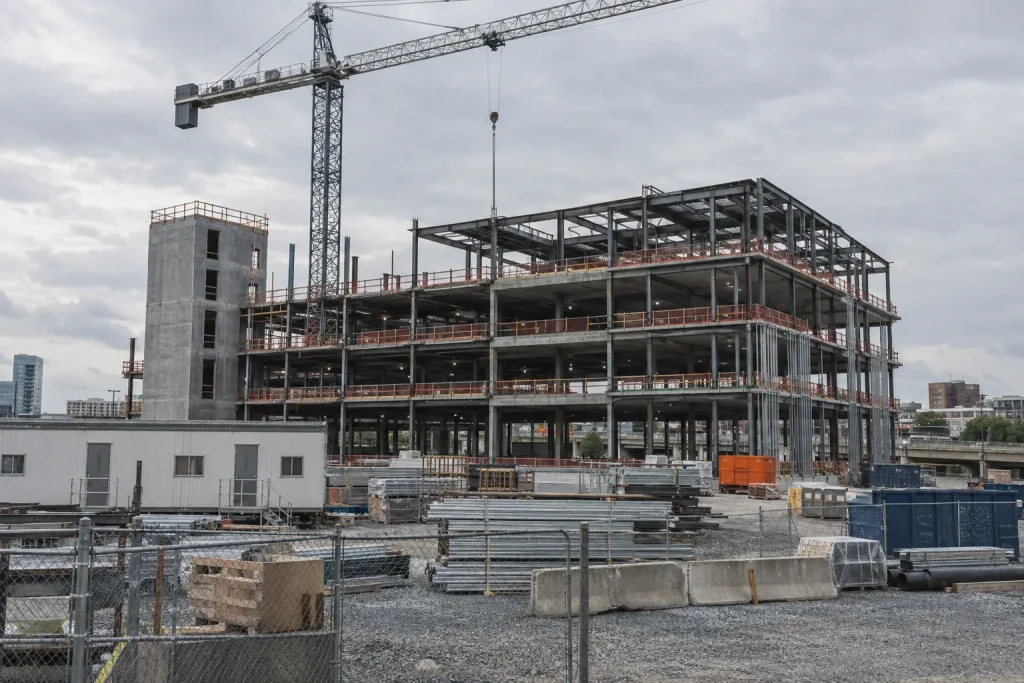
A cost-plus contract pays the builder its actual cost of the work plus a fee, either fixed or a percentage of cost, sometimes capped by a guaranteed maximum price, and gives the owner the right to audit every reimbursed dollar.
Key takeaways
- AIA A102-2017 pays the Cost of the Work plus a fee up to a guaranteed maximum price (GMP); costs above the GMP are “paid by the Contractor without reimbursement by the Owner” under §5.2.1 (AIA A102-2017 text).
- AIA A103-2017 has no ceiling: the contractor submits a Control Estimate within 14 days of signing, and the owner’s acceptance “does not imply” a GMP under §5.2.3 (AIA A103-2017 text).
- Published fees on public cost-plus work run about 3.75% to 6%: Henderson County, North Carolina paid a 3.75% fee on the cost of the work under a 2018 GMP (board packet), and a 2015 California college schedule pays 3.8% to 6% by project size (Mt. SAC §2.1.2).
- Federal contracts only: the percentage-of-cost version is banned (41 U.S.C. 3905(a)), fixed fees are capped at 10% of estimated cost (FAR 15.404-4(c)(4)(i)), and since Executive Order 14402 of 30 April 2026 most civilian agencies need agency-head approval above $10 million (EO 14402, §2(b)).
- Under Article 11 of both AIA forms the owner may audit and copy job-cost records, which the contractor keeps for 3 years after final payment.
- Cost plus is a minority basis at large builders: 4.6% of Tutor Perini’s 2025 revenue was cost plus fee and other, against 18.5% GMP and 69.4% fixed price (Tutor Perini Form 10-K, FY2025).
How does a cost-plus contract work?
Under a cost-plus contract the owner reimburses the costs the contractor necessarily incurs to build the project and pays a separate fee for home office overhead and profit. AIA A102-2017 §5.1 defines the Contract Sum as the Cost of the Work under Article 7 plus the Contractor’s Fee, so the final price is not known until the last invoice has been audited.
That is the reverse of a lump sum. Under a stipulated-sum agreement such as AIA A101-2017, the price is set at signing and the contractor keeps any savings or absorbs any overrun. Federal buyers start from the lump-sum side: FAR 36.207(a) says that, generally, firm-fixed-price contracts “shall be used to acquire construction”.
In return for carrying cost risk, the owner can audit payroll, subcontracts and invoices under Article 11. Comfort Systems USA told investors in its 2025 Form 10-K that its cost-plus margins are “frequently less than fixed-price contract margins because there is less risk of unrecoverable cost overruns”. Where the contract choice sits in a project’s sequence is set out in our commercial construction process guide.
| Number | What it is | Source |
|---|---|---|
| 14 days | Deadline for the contractor’s Control Estimate under a cost-plus contract without a GMP | AIA A103-2017 §5.2.1 |
| 3 years | How long the contractor keeps cost records after final payment | AIA A102/A103 Article 11; FAR 52.215-2(f) |
| 30 days | Owner’s window to audit, or decline to audit, the final accounting | AIA A102-2017 §12.2.2 |
| 3.75% | Fee on the cost of the work in a public cost-plus GMP, Henderson County, North Carolina, 2018 | Henderson County |
| 10% | Maximum fee on a cost-plus-fixed-fee contract (federal contracts only), as a share of estimated cost excluding fee | 41 U.S.C. 3905(b)(1) |
| 15% | Same federal cap for experimental, developmental or research work | 41 U.S.C. 3905(b)(2) |
| $10 million | Federal non-fixed-price contract value above which most civilian agencies need agency-head approval | EO 14402 §2(b)(ii)(D) |
| 10% | Equity interest that makes an entity a related party whose charges need owner approval | AIA A102-2017 §7.8.1 |
What are the types of cost-plus contracts?
Cost-plus contracts differ in how the fee is set and whether the total is capped. Private construction mostly uses three: cost plus a fixed fee, cost plus a percentage fee, and cost plus a fee with a guaranteed maximum price. Federal agencies add incentive-fee and award-fee versions under FAR subparts 16.3 and 16.4, and federal law bans the percentage version on every federal contract.
| Type | How the fee is set | Price ceiling | Owner’s cost risk | Where it is used | Source |
|---|---|---|---|---|---|
| Cost plus fixed fee (CPFF) | Dollar amount fixed at signing; changes only with changes in the work | None | Owner pays every overrun, but the fee does not grow | Private; federal with a 10% fee cap | FAR 16.306(a); AIA §5.1.1 |
| Cost plus a percentage of cost | Agreed percentage times actual Cost of the Work | None | Fee rises with every extra dollar of cost | Private only; banned on federal contracts | AIA §5.1.1; FAR 16.102(c) |
| Cost plus fee with a GMP | Fixed or percentage fee; cost plus fee capped | GMP in A102 §5.2.1 | Contractor pays costs above the GMP, except owner changes | Private and public building work | AIA A102-2017 §5.2.1 |
| Cost plus incentive fee (CPIF) | Negotiated fee adjusted by formula comparing total allowable cost with target cost | None | Shared through the formula | Mainly federal | FAR 16.304 |
| Cost plus award fee (CPAF) | Base amount, which may be zero, plus an award amount set by the government’s evaluation | None | Owner pays cost; fee tracks performance | Mainly federal | FAR 16.305 |
The percentage version is the one to watch. At an illustrative 5% fee, every extra $1,000,000 of cost adds $50,000 of fee, so the contractor earns more when the job costs more. The fixed fee has the opposite weakness: FAR 16.306(a) says it “provides the contractor only a minimum incentive to control costs”, because the fee stays the same whether costs fall or rise.
How does a cost-plus contract with a GMP differ from one without?
AIA publishes two owner-contractor forms for the cost of the work plus a fee. A102-2017 adds a guaranteed maximum price and A103-2017 does not. Both share Article 7 (costs reimbursed), Article 8 (costs not reimbursed) and Article 11 (audit), and both adopt the A201-2017 General Conditions. The difference is who carries cost above the ceiling, and whether one exists.
| Question | AIA A102-2017 (with GMP) | AIA A103-2017 (no GMP) | Source |
|---|---|---|---|
| Intended use | Large projects requiring a GMP | Large projects where the cost “is not fully known at the commencement of construction” | AIA document summaries |
| Price ceiling | GMP stated in §5.2.1, adjusted only by Change Order | None; the Control Estimate is a budget, not a GMP (§5.2.3) | A102 §5.2.1; A103 §5.2.3 |
| Cost above the ceiling | Paid by the contractor (§5.2.1, §8.1.8) | Paid by the owner as Cost of the Work | A102 Articles 5 and 8 |
| Early budget document | Assumptions behind the GMP listed in §5.2.4 | Control Estimate within 14 days, updated with each pay application | A102 §5.2.4; A103 §5.2.1 |
| Competitive bidding | Not addressed in the summary | “Not intended for use in competitive bidding” | AIA A103 summary |
| Fee options | Lump sum, percentage of cost or other formula (§5.1.1) | Same (§5.1.1) | Both forms |
| Savings below the ceiling | Stay with the owner unless §5.1.7 shares them | Not applicable | A102 §5.1.7 |
| Schedule of values | Line items are not separate GMPs (§12.1.5.2) | No GMP to allocate | AIA A102 summary |
A GMP is a cap on a cost-plus contract, not a lump sum. If the final Cost of the Work plus the fee lands below the GMP, the owner pays only the lower actual figure unless the parties wrote a savings split into §5.1.7. Construction management at risk uses the same cap under AIA A133-2019, with the manager pricing the design before the GMP is fixed, as our construction management at risk guide explains.
How much does the fee cost the owner under each structure?
The same project can cost the owner $9,870,000 or $11,130,000 depending on the fee formula and whether a GMP applies. The table runs one CB&C illustration: $10,000,000 estimated Cost of the Work, a 5% percentage fee or a $500,000 fixed fee, and a $10,500,000 GMP, at three actual-cost outcomes. The inputs are illustrative, not market rates; the 5% sits inside the 3.75% to 6% fees in the public contracts cited above.
| Line (CB&C illustration) | Under-run: cost $9,400,000 | On budget: cost $10,000,000 | Overrun: cost $10,600,000 |
|---|---|---|---|
| Cost plus 5% fee: fee earned | $470,000 | $500,000 | $530,000 |
| Cost plus 5% fee: owner pays | $9,870,000 | $10,500,000 | $11,130,000 |
| Cost plus $500,000 fixed fee: owner pays | $9,900,000 | $10,500,000 | $11,100,000 |
| $10,500,000 GMP, fixed fee: savings below GMP | $600,000 | $0 | $0 |
| GMP: contractor’s 50/50 savings share | $300,000 | $0 | $0 |
| GMP: owner pays | $10,200,000 | $10,500,000 | $10,500,000 |
| GMP: overrun absorbed by contractor | $0 | $0 | $600,000 |
Three results stand out. The percentage fee pays the contractor $60,000 more in the overrun case than in the under-run case for the same scope. The GMP shields the owner from the $600,000 overrun, which exceeds the contractor’s whole $500,000 fee. And the 50/50 savings split costs the owner $300,000 more than a plain fixed fee when the job comes in under, which is the price of giving the contractor a reason to save.
Fees also move with changes. Under a 5% fee, a $200,000 owner change adds $10,000 of fee automatically. A fixed fee changes only by the method written into A102 §5.1.2, and if none is written, §6.4 adjusts it “on the same basis that was used to establish the Fee for the original Work”.
A fixed fee is billed in step with cost. A102 §12.1.7.1.4 pays a fixed-sum fee in the same ratio that cost incurred bears to the probable final cost: with $4,000,000 spent of a probable $10,000,000, the contractor has earned 40%, or $200,000, of a $500,000 fee.
What counts as cost of the work, general conditions and fee?
Cost of the Work is only what Article 7 lists. A102 §7.1.1 limits it to costs “necessarily incurred by the Contractor in the proper performance of the Work”, and §8.1.7 excludes “any cost not specifically and expressly described in Article 7”. Site overhead, usually called general conditions, sits inside the Cost of the Work; home office overhead and profit sit in the fee.
The phrase “general conditions” means two things. In AIA usage it is the A201-2017 General Conditions of the Contract for Construction, the rulebook for changes, payment and claims. On a cost report it means site overhead such as the superintendent, site office and temporary utilities, which A102 reimburses under §7.2.2 and §7.5. A102 uses the second sense itself in §12.1.8, naming “general conditions, insurance” as items that may be excluded from retainage.
| Cost item | Bucket | AIA A102-2017 section | What to agree before signing |
|---|---|---|---|
| Field labor wages, payroll taxes and benefits | Cost of the Work | §7.2.1, §7.2.4 | Labor rate schedule; fixed for the job under §7.2.5 |
| Superintendent and site project staff | Cost of the Work (general conditions) | §7.2.2 | Named roles, with owner prior approval |
| Home office staff working part time on the job | Cost of the Work only if listed | §7.2.2.1 | Names, activities and percentage of time |
| Subcontracts | Cost of the Work | §7.3, §10.1 | Bid list; owner may object to proposed subcontractors |
| Materials, waste and spoilage | Cost of the Work | §7.4.1, §7.4.2 | Surplus becomes the owner’s or is sold for credit |
| Contractor-owned equipment | Cost of the Work | §5.1.4, §7.5.2 | Rate cap as a percentage of standard rental; total rent no higher than purchase price |
| Site office, temporary facilities, debris removal | Cost of the Work (general conditions) | §7.5.1, §7.5.3, §7.5.4 | Reimbursed at cost or priced as a lump sum |
| Bond and insurance premiums, permit fees | Cost of the Work | §7.6.1, §7.6.3 | Rates; a captive insurer needs approval (§7.6.1.2) |
| Correcting damaged work not caused by contractor negligence | Cost of the Work | §7.7.3 | Net of insurance and subcontractor recoveries |
| Purchases from related parties | Cost of the Work only after written approval | §7.8 | Disclosure of any entity with a stake above 10% |
| Principal office salaries and expenses | Not reimbursed (fee) | §8.1.1, §8.1.3 | Covered by the fee |
| Overhead, capital and interest | Not reimbursed (fee) | §8.1.4, §8.1.5 | Covered by the fee |
| Bonuses and profit sharing | Not reimbursed without approval | §8.1.2 | Pre-approve or exclude |
| Costs above the GMP | Not reimbursed | §8.1.8 | Only Change Orders raise the GMP |
| Trade discounts, rebates and refunds | Credit to the owner | §9.1, §9.2 | Contractor must arrange to obtain them |
Subcontracts are the line to read hardest because they are usually the largest. U.S. commercial and institutional builders (NAICS 236220) paid 45.4% of their 2022 receipts to subcontractors, according to the 2022 Economic Census. A102 §10.2 bars cost-plus subcontracts without the owner’s written approval and, where approved, requires the same audit rights over the subcontractor.
What audit rights does the owner have under a cost-plus contract?
Audit rights are what make a cost-plus contract workable for the owner. Article 11 of AIA A102 and A103 lets the owner and its auditors “audit and copy” the contractor’s records during business hours on reasonable notice, and the contractor keeps them for 3 years after final payment. Federal cost-type contracts carry a statutory audit right under 41 U.S.C. 3905(d) and the FAR 52.215-2 clause.
Article 11 names the records the owner can see:
- books, job cost reports and complete documentation supporting accounting entries
- subcontracts, subcontractor proposals and subcontractor invoices
- purchase orders, vouchers, receipts and memoranda
- correspondence, instructions and drawings relating to the contract
| Closeout step | Deadline | AIA A102-2017 section |
|---|---|---|
| Contractor submits final accounting and final Application for Payment | Day 0 | §12.2.1 |
| Owner audits, or tells the Architect it will not | Within 30 days of receiving the final accounting | §12.2.2 |
| Owner sends written audit report to the Architect | Within 10 days after the audit ends | §12.2.2.1 |
| Architect issues final Certificate for Payment, or reasons for withholding | Within 7 days of the report or notice | §12.2.2.2 |
| Contractor requests mediation of audit reductions | Within 30 days of receiving the final Certificate | §12.2.2.3 |
| Owner makes final payment | No later than 30 days after the final Certificate, unless the parties set other terms | §12.2.3 |
| Records stay available for audit | 3 years after final payment, or longer if law requires | Article 11 |
The architect does not check the numbers: A102 §12.2.2.2 says the Architect “is not responsible for verifying the accuracy of the Contractor’s final accounting”. If the contractor misses the 30-day mediation window, the amount substantiated by the owner’s auditors becomes binding under §12.2.2.3. On a $10,000,000 job, a hypothetical 1% billing error is $100,000, a figure to set against an auditor’s quote.
How common are cost-plus contracts at large builders?
Less common than GMP or fixed price, judging by the contractors that disclose it. Tutor Perini reported $256.3 million of cost plus fee and other revenue in 2025, 4.6% of $5,543.0 million, in its Form 10-K. AECOM, a design and program management firm, reported 38% cost-reimbursable revenue for the year to September 2025, so the share depends on the kind of firm.
| Company and measure | Period | Cost plus or reimbursable | GMP | Fixed price or lump sum | Source |
|---|---|---|---|---|---|
| Tutor Perini, total revenue | FY2025 | 4.6% ($256.3M) | 18.5% ($1,023.5M) | 69.4% ($3,846.1M) plus 7.5% unit price | Form 10-K |
| Tutor Perini, Building segment revenue | FY2025 | 7.0% ($129.6M) | 52.5% ($973.0M) | 40.5% ($749.7M) | Form 10-K |
| Tutor Perini, Building segment revenue | FY2024 | 10.4% ($167.9M) | 50.1% ($810.7M) | 39.5% ($638.9M) | Form 10-K |
| Tutor Perini, Building segment revenue | FY2023 | 18.2% ($237.1M) | 40.9% ($532.5M) | 40.9% ($533.0M) | Form 10-K |
| Tutor Perini, backlog | 31 Dec 2025 | 6% | 13% | 79% plus 2% unit price | Form 10-K |
| AECOM, revenue | Year to 30 Sep 2025 | 38% | 37% | 25% | Form 10-K |
| Fluor, backlog | 31 Dec 2025 | 81% ($20,713M) | 19% ($4,823M), lump sum and GMP combined | Included in GMP column | Form 10-K |
Inside Tutor Perini’s Building segment, cost plus fee and other revenue fell from $237.1 million in 2023 to $129.6 million in 2025 while GMP revenue rose from $532.5 million to $973.0 million. The company describes cost plus fee contracts as ones that “serve to minimize the Company’s financial risk, but may also limit profits”. Five filings are a small sample, so read this as how large listed firms report, not as a market share. Margins and backlog for 13 listed contractors are compiled in our public contractor financial benchmark.
Should you choose cost plus, lump sum or GMP?
Choose by how complete the design is, whether someone needs a ceiling, and whether you can audit. Lump sum fits bid-ready drawings. Cost plus with a GMP fits a design far enough along to price with stated assumptions. Cost plus without a GMP fits work whose cost “is not fully known at the commencement of construction”, in AIA’s description of A103-2017.
| If | Then | Why (source) |
|---|---|---|
| Drawings are complete and the scope is stable | Lump sum (AIA A101-2017), competitively bid | Price fixed at signing; A103 is “not intended for use in competitive bidding” |
| Design is incomplete and a lender or board needs a ceiling | Cost plus fee with GMP (AIA A102-2017) and a written assumptions list | Costs above the GMP are the contractor’s (§5.2.1); assumptions in §5.2.4 |
| You want the builder pricing the design as it develops | Construction management at risk (AIA A133-2019) | GMP set after preconstruction pricing |
| Scope is unknown: emergency repair, hidden conditions, phased work in occupied space | Cost plus fixed fee without GMP (AIA A103-2017) | Control Estimate within 14 days, updated each pay application (§5.2.1) |
| The fee would be a percentage of cost | Cap the fee, or convert it to a fixed sum once the estimate is accepted | In the illustration, the 5% fee paid $60,000 more on the overrun |
| No one on your side can review job-cost records each month | Avoid cost plus, or hire an owner’s cost consultant first | Article 11 audit rights only help if someone uses them; even federal buyers must show surveillance staff before award (FAR 16.301-3(a)(4)) |
| Federal agencies only: the buyer is a federal agency (private and state or local owners: answer No) | Firm-fixed-price by default; CPFF only under FAR 16.301-2, fee no more than 10% | FAR 36.207(a); FAR 15.404-4(c)(4)(i); EO 14402 approval above $10 million at civilian agencies |
| The contractor wants to buy from an affiliate | Require the written approval process in §7.8 | A related party includes any entity with an equity interest above 10% (§7.8.1) |
Payment basis and delivery method are separate decisions, and our design-build vs design-bid-build comparison covers the delivery side.
What should you negotiate before signing a cost-plus contract?
Most cost-plus disputes start in blank fill-points. The AIA forms leave the fee, the fee adjustment for changes, subcontractor markups, equipment rates, off-site staff and savings sharing for the parties to write in. Settle each before signing and attach the numbers, because A102 §8.1.7 excludes anything not expressly described in Article 7.
- Fee basis (§5.1.1): a fixed sum, or a percentage with a dollar cap.
- Fee on changes (§5.1.2): the percentage or method for added and deleted work.
- Subcontractor overhead and profit on change work (§5.1.3): a stated limit.
- Equipment rental cap (§5.1.4): a percentage of the standard local rental rate, plus the §7.5.2 rule that total rent may not exceed the purchase price.
- Labor rate schedule (§7.2.5): rates that stay fixed unless a Modification changes them.
- Off-site staff (§7.2.2.1): names, activities and percentage of time.
- GMP inputs (A102 §5.2.3, §5.2.4) or Control Estimate contents (A103 §5.2.2): allowances, assumptions and contingencies.
- Savings and bonus (§5.1.7): the split, if any, below the GMP.
- Retainage exclusions (§12.1.8): whether general conditions and insurance are retained.
- Audit plan (Article 11, §12.2.2): who audits, and the 30-day closeout window.
When several builders propose fees and general conditions, line them up the way our guide to comparing construction bids sets out. Confirming that a builder’s accounting system can produce job-cost reports, which FAR 16.301-3(a)(3) treats as a precondition on federal work, belongs in the vetting steps of our guide to choosing a commercial contractor. CB&C is a matching service, not a law firm, and nothing here is legal advice; ask an attorney licensed in the project’s state to review the fill-point language in sections 5.1.1 to 5.1.7.
Why is cost-plus-percentage-of-cost banned on federal contracts?
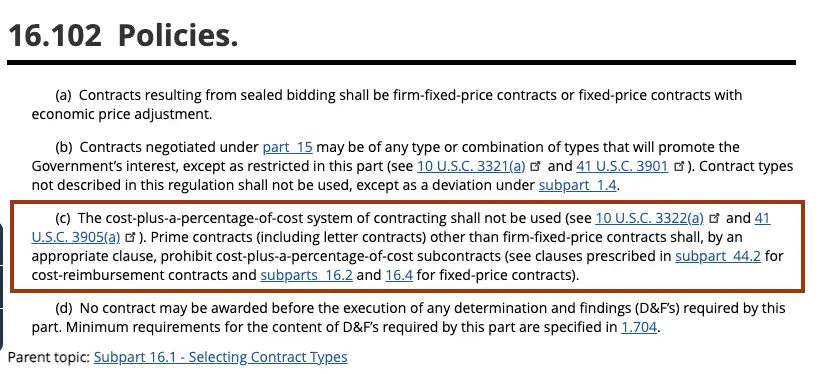
This section applies only to federal contracts; a private owner may still agree a percentage fee, but the federal reasoning is a good argument for capping it. Congress banned it because a fee that rises with cost rewards spending. 41 U.S.C. 3905(a) says the cost-plus-a-percentage-of-cost system “shall not be used”, and 10 U.S.C. 3322(a) says it “may not be used” by defense agencies. FAR 16.102(c) applies the ban and requires prime contracts other than firm-fixed-price to prohibit percentage-of-cost subcontracts by clause.
| Federal rule | What it says | Citation |
|---|---|---|
| Percentage-of-cost ban | The cost-plus-a-percentage-of-cost system may not be used; primes must bar it in subcontracts | 10 U.S.C. 3322(a); 41 U.S.C. 3905(a); FAR 16.102(c); FAR Overhaul 16.101(b) |
| CPFF fee cap, general | 10% of estimated cost, excluding fee | 41 U.S.C. 3905(b)(1); FAR 15.404-4(c)(4)(i)(C) |
| CPFF fee cap, research | 15% of estimated cost, excluding fee | 41 U.S.C. 3905(b)(2); FAR 15.404-4(c)(4)(i)(A) |
| When cost-reimbursement may be used | Requirements cannot be defined well enough, or costs cannot be estimated accurately enough, for fixed price | FAR 16.301-2(a) |
| Construction default | Generally firm-fixed-price; lump sum preferred over unit price | FAR 36.207(a), (b); FAR Overhaul Part 36 |
| Audit | Agency may inspect plans and audit books of primes and subcontractors on cost or CPFF contracts | 41 U.S.C. 3905(d); FAR 52.215-2(b) |
| Executive Order 14402 | Written justification for any non-fixed-price contract; agency-head approval above $100 million (War), $35 million (NASA), $25 million (DHS), $10 million (others) | EO 14402 §2(b); FAR Overhaul 16.104 |
Here is how the caps work on a real figure. On a federal cost-plus-fixed-fee construction contract with an estimated cost of $20,000,000, the fee cannot exceed $2,000,000 (10%). At a civilian agency the same contract is above the $10,000,000 threshold in Executive Order 14402, so it also needs the agency head’s written approval unless an exemption for emergencies or major-system research applies.
As of October 2026 a FAR rewrite (the “FAR Overhaul” deviation text on acquisition.gov) renumbers these rules, moving the ban to 16.101(b), and calls fixed-price types “the default and preferred contract types”; the statutes behind the ban and the caps are unchanged. Where federal construction money lands is tracked in our federal construction contracts by state report.
If the price is fixed instead, the AIA form is A101-2017, and how to fill in AIA A101 walks through each blank.
What general conditions came to on four public GMPs, and how owners cap, extend and audit them, is set out in our guide to general conditions costs in construction.
Unit price and time and materials, the two pricing types not covered here, are compared with cost plus in our guide to the types of construction contracts.
How we compiled this
In October 2026 we read 28 primary documents: five AIA Contract Documents pages and texts for A101, A102 and A103, 10 FAR sections, the FAR Overhaul Part 16 and 36 texts, two statutes, Executive Order 14402, four FY2025 Form 10-K filings, IRS and Census tables, and 2 public fee records (Henderson County, North Carolina and Mt. San Antonio Community College District). The fee arithmetic is a labelled CB&C illustration. We left out vendor-blog fee percentages because none cited a primary source. On October 26, 2026 we re-checked A102 §5.2.1, A103 §5.2.1, the FAR fee caps and Tutor Perini’s revenue table at source, and moved federal-only rules lower on the page.
Frequently asked questions
What is a typical fee on a cost-plus contract?
No standard private fee is published, but public records give a benchmark: Henderson County, North Carolina paid a 3.75% fee on the cost of the work under its 2018 GMP, and a 2015 California college schedule pays 3.8% to 6% by size. For context, building contractors earned net income of 6.04% of receipts in tax year 2022 (IRS Statistics of Income). Federal cost-plus-fixed-fee contracts cap the fee at 10%.
Is a cost-plus contract more expensive than a lump sum?
Not necessarily. A lump-sum bidder prices contingency for the risks it carries, while a cost-plus owner pays actual cost and keeps any under-run unless a GMP savings split says otherwise. In the CB&C illustration, a $500,000 fixed fee on a job that came in at $9,400,000 cost the owner $9,900,000. The owner also pays for the staff or auditor time needed to review costs.
What is the difference between cost plus and time and materials?
Cost plus reimburses actual costs and adds a separate fee. Time and materials pays labor hours at fixed hourly rates that already include wages, overhead, general and administrative expense and profit, plus materials at actual cost, as FAR 16.601(b) describes. Under time and materials the markup sits inside each hourly rate, so the owner checks hours and materials rather than payroll.
Who keeps the savings under a cost-plus contract with a GMP?
The owner, unless the contract shares them. Under AIA A102-2017 the owner pays the actual Cost of the Work plus the fee, so any amount below the guaranteed maximum price is never billed. Section 5.1.7 is the fill-point for a bonus or savings split, such as the 50/50 split in the CB&C illustration, which paid the contractor $300,000.
Can a contractor bill home office costs on a cost-plus contract?
Generally no. AIA A102-2017 §8.1.1 and §8.1.3 exclude principal office salaries and expenses, and §8.1.4 excludes overhead and general expenses unless Article 7 includes them. The exception is §7.2.2.1, where the parties can list named off-site staff and the percentage of time they spend on the job. Everything else is meant to be paid from the fee.
Are cost-plus contracts allowed on public projects?
Federal agencies may use cost-plus-fixed-fee contracts when FAR 16.301-2 conditions are met, but never cost-plus-a-percentage-of-cost (FAR 16.102(c)), and construction generally defaults to firm-fixed-price under FAR 36.207(a). Since Executive Order 14402, civilian agencies need agency-head approval for non-fixed-price contracts above $10 million. State and local rules come from each state’s procurement code, so check the statute that governs the owner.
Can subcontracts on a cost-plus job also be cost plus?
Under AIA A102-2017 §10.2, subcontracts cannot be awarded on a cost-plus-fee basis without the owner’s prior written approval, and an approved one must give the owner the same audit rights over the subcontractor. On federal work, prime contracts other than firm-fixed-price must prohibit cost-plus-a-percentage-of-cost subcontracts by clause under FAR 16.102(c).
Sources
- A102-2017, Owner-Contractor Agreement, Cost of the Work Plus a Fee with a GMP (preview text), AIA Contract Documents. Accessed 19 October 2026.
- Summary: A102-2017, AIA Contract Documents. Accessed 19 October 2026.
- A103-2017, Owner-Contractor Agreement, Cost of the Work Plus a Fee without a GMP (preview text), AIA Contract Documents. Accessed 19 October 2026.
- Summary: A103-2017, AIA Contract Documents. Accessed 19 October 2026.
- A101-2017, Owner-Contractor Agreement, Stipulated Sum, AIA Contract Documents. Accessed 19 October 2026.
- FAR 16.102, Policies, Acquisition.gov (GSA). Accessed 19 October 2026.
- FAR 16.306, Cost-plus-fixed-fee contracts, Acquisition.gov (GSA). Accessed 19 October 2026.
- FAR 16.304, Cost-plus-incentive-fee contracts, Acquisition.gov (GSA). Accessed 19 October 2026.
- FAR 16.305, Cost-plus-award-fee contracts, Acquisition.gov (GSA). Accessed 19 October 2026.
- FAR 15.404-4, Profit, Acquisition.gov (GSA). Accessed 19 October 2026.
- FAR 16.301-2, Application, Acquisition.gov (GSA). Accessed 19 October 2026.
- FAR 16.301-3, Limitations, Acquisition.gov (GSA). Accessed 19 October 2026.
- FAR 36.207, Pricing fixed-price construction contracts, Acquisition.gov (GSA). Accessed 19 October 2026.
- FAR 52.215-2, Audit and Records, Negotiation, Acquisition.gov (GSA). Accessed 19 October 2026.
- FAR 16.601, Time-and-materials contracts, Acquisition.gov (GSA). Accessed 19 October 2026.
- FAR Overhaul, Part 16, Types of Contracts (deviation text), Acquisition.gov (GSA). Accessed 19 October 2026.
- FAR Overhaul, Part 36, Construction and Architect-Engineer Contracts (deviation text), Acquisition.gov (GSA). Accessed 19 October 2026.
- 10 U.S.C. 3322, Cost contracts, Legal Information Institute, Cornell Law School. Accessed 19 October 2026.
- 41 U.S.C. 3905, Cost contracts, Legal Information Institute, Cornell Law School. Accessed 19 October 2026.
- Executive Order 14402 (30 April 2026), The White House. Accessed 19 October 2026.
- Tutor Perini Corporation, Form 10-K for fiscal year 2025, SEC EDGAR. Accessed 19 October 2026.
- AECOM, Form 10-K for fiscal year ended 30 September 2025, SEC EDGAR. Accessed 19 October 2026.
- Fluor Corporation, Form 10-K for fiscal year 2025, SEC EDGAR. Accessed 19 October 2026.
- Comfort Systems USA, Form 10-K for fiscal year 2025, SEC EDGAR. Accessed 19 October 2026.
- Edneyville Elementary GMP (April 2018), Henderson County, NC. Accessed 26 October 2026.
- CM Master Agreement (2015), Mt. San Antonio CCD. Accessed 26 October 2026.
- SOI Tax Stats, Table 5.1, Returns of Active Corporations, tax year 2022, Internal Revenue Service. Accessed 19 October 2026.
- 2022 Economic Census, Construction: Summary Statistics for the U.S., U.S. Census Bureau. Accessed 19 October 2026.