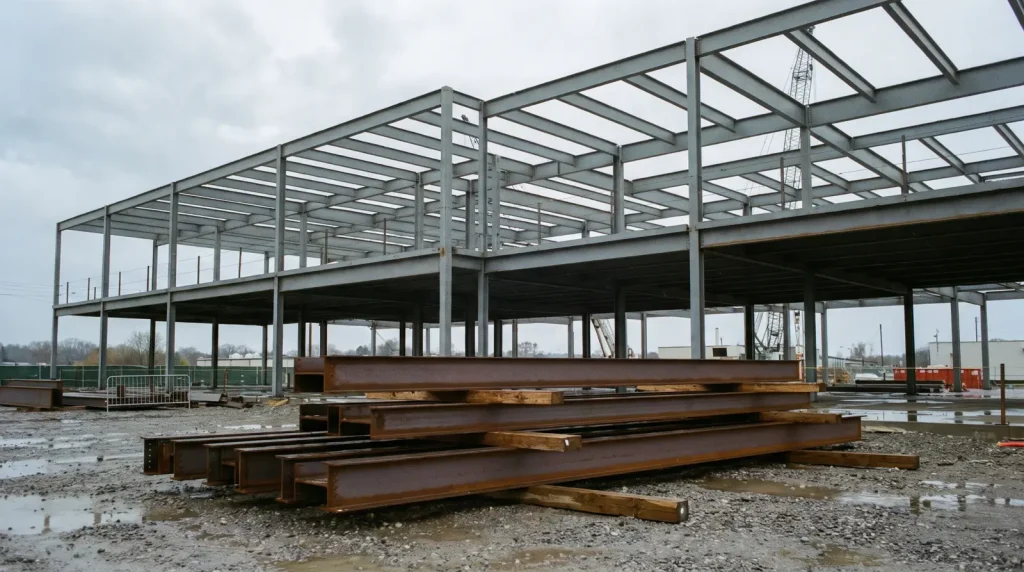
W beam sizes are named by nominal depth and weight: a W12x26 is about 12 in deep (12.2 in actual) and weighs 26 lb per foot, and common commercial sizes run from W6x9 to W24x104.
Key takeaways
- In a designation such as W12x26, the first number is the nominal depth in inches and the second is the weight in pounds per linear foot; actual depth is 12.2 in per the AISC Shapes Database v15.0 (November 2017).
- The AISC Shapes Database v15.0 lists 283 W shapes from W4x13 to W44x335, against 28 S shapes (American Standard I-beams) and 22 HP shapes (bearing piles).
- Weight is not strength: a W12x26 has a moment of inertia (Ix) of 204 in^4 against 110 in^4 for a W8x31, about 85% stiffer with 16% less steel per foot, per the same AISC v15.0 tables.
- Federal guide specification UFGS 05 12 00 calls for ASTM A992 for W shapes and ASTM A36 for S and HP shapes; A992 has a 50 to 65 ksi yield range and a 65 ksi minimum tensile strength.
- Two October 2025 bids to West Virginia DOT priced W12x106 beams at $0.985 and $1.078 per lb delivered, and the BLS index for hot rolled bars, plates and structural shapes rose 15.0% from September 2025 to September 2026.
What do W beam sizes mean, and how do you read W12x26?
A W beam size has three parts. The letter W marks a wide flange shape. The first number (12) is nominal depth in inches, and the second (26) is weight in pounds per linear foot. Actual depth differs from the nominal number: a W12x26 measures 12.2 in, a W12x14 11.9 in and a W12x65 12.1 in in the AISC Shapes Database v15.0.
| Part of W12x26 | Meaning | Value from AISC v15.0 | Symbol |
|---|---|---|---|
| W | Wide flange shape | Shape type W | Type |
| 12 | Nominal depth, inches | 12.2 in actual depth | d |
| 26 | Weight, lb per linear foot | 26 lb/ft; 7.65 sq in of steel | W, A |
| Flange width | Width across each flange | 6.49 in | bf |
| Flange thickness | Thickness of each flange | 0.380 in | tf |
| Web thickness | Thickness of the vertical web | 0.230 in | tw |
| k (design) | Outer flange face to the toe of the web fillet | 0.680 in | kdes |
The weight number is the one buyers and estimators use most. Multiply it by length to get shipping weight: 10 pieces of W12x26 at 30 ft weigh 26 x 30 x 10 = 7,800 lb. The k dimension matters at connections, because bolts and welds have to clear the fillet where the web meets the flange.
What are the common W beam sizes from W6 to W24?
The chart below lists 45 W shapes from W6x9 to W24x104 that show up on commercial framing plans, with depth, flange width, flange and web thickness, design k, area and stiffness. Every value comes from the AISC Shapes Database v15.0 (November 2017), the dataset behind the 15th Edition Steel Construction Manual. AISC has since published v16.0; check a final design against the current release.
W6 to W12 beam sizes
| Size | Depth d (in) | Flange width bf (in) | Flange thickness tf (in) | Web thickness tw (in) | k design (in) | Area (sq in) | Ix (in^4) | Sx (in^3) |
|---|---|---|---|---|---|---|---|---|
| W6x9 | 5.9 | 3.94 | 0.215 | 0.170 | 0.465 | 2.68 | 16.4 | 5.56 |
| W6x12 | 6.03 | 4 | 0.280 | 0.230 | 0.530 | 3.55 | 22.1 | 7.31 |
| W6x15 | 5.99 | 5.99 | 0.260 | 0.230 | 0.510 | 4.43 | 29.1 | 9.72 |
| W6x20 | 6.2 | 6.02 | 0.365 | 0.260 | 0.615 | 5.87 | 41.4 | 13.4 |
| W6x25 | 6.38 | 6.08 | 0.455 | 0.320 | 0.705 | 7.34 | 53.4 | 16.7 |
| W8x10 | 7.89 | 3.94 | 0.205 | 0.170 | 0.505 | 2.96 | 30.8 | 7.81 |
| W8x18 | 8.14 | 5.25 | 0.330 | 0.230 | 0.630 | 5.26 | 61.9 | 15.2 |
| W8x21 | 8.28 | 5.27 | 0.400 | 0.250 | 0.700 | 6.16 | 75.3 | 18.2 |
| W8x24 | 7.93 | 6.5 | 0.400 | 0.245 | 0.794 | 7.08 | 82.7 | 20.9 |
| W8x31 | 8 | 8 | 0.435 | 0.285 | 0.829 | 9.13 | 110 | 27.5 |
| W8x40 | 8.25 | 8.07 | 0.560 | 0.360 | 0.954 | 11.7 | 146 | 35.5 |
| W10x12 | 9.87 | 3.96 | 0.210 | 0.190 | 0.510 | 3.54 | 53.8 | 10.9 |
| W10x19 | 10.2 | 4.02 | 0.395 | 0.250 | 0.695 | 5.62 | 96.3 | 18.8 |
| W10x22 | 10.2 | 5.75 | 0.360 | 0.240 | 0.660 | 6.49 | 118 | 23.2 |
| W10x26 | 10.3 | 5.77 | 0.440 | 0.260 | 0.740 | 7.61 | 144 | 27.9 |
| W10x33 | 9.73 | 7.96 | 0.435 | 0.290 | 0.935 | 9.71 | 171 | 35 |
| W10x49 | 10 | 10 | 0.560 | 0.340 | 1.060 | 14.4 | 272 | 54.6 |
| W12x14 | 11.9 | 3.97 | 0.225 | 0.200 | 0.525 | 4.16 | 88.6 | 14.9 |
| W12x19 | 12.2 | 4.01 | 0.350 | 0.235 | 0.650 | 5.57 | 130 | 21.3 |
| W12x26 | 12.2 | 6.49 | 0.380 | 0.230 | 0.680 | 7.65 | 204 | 33.4 |
| W12x35 | 12.5 | 6.56 | 0.520 | 0.300 | 0.820 | 10.3 | 285 | 45.6 |
| W12x40 | 11.9 | 8.01 | 0.515 | 0.295 | 1.020 | 11.7 | 307 | 51.5 |
| W12x50 | 12.2 | 8.08 | 0.640 | 0.370 | 1.140 | 14.6 | 391 | 64.2 |
| W12x65 | 12.1 | 12 | 0.605 | 0.390 | 1.200 | 19.1 | 533 | 87.9 |
W14 to W24 beam sizes
| Size | Depth d (in) | Flange width bf (in) | Flange thickness tf (in) | Web thickness tw (in) | k design (in) | Area (sq in) | Ix (in^4) | Sx (in^3) |
|---|---|---|---|---|---|---|---|---|
| W14x22 | 13.7 | 5 | 0.335 | 0.230 | 0.735 | 6.49 | 199 | 29 |
| W14x26 | 13.9 | 5.03 | 0.420 | 0.255 | 0.820 | 7.69 | 245 | 35.3 |
| W14x30 | 13.8 | 6.73 | 0.385 | 0.270 | 0.785 | 8.85 | 291 | 42 |
| W14x38 | 14.1 | 6.77 | 0.515 | 0.310 | 0.915 | 11.2 | 385 | 54.6 |
| W14x48 | 13.8 | 8.03 | 0.595 | 0.340 | 1.190 | 14.1 | 484 | 70.2 |
| W14x90 | 14 | 14.5 | 0.710 | 0.440 | 1.310 | 26.5 | 999 | 143 |
| W16x26 | 15.7 | 5.5 | 0.345 | 0.250 | 0.747 | 7.68 | 301 | 38.4 |
| W16x31 | 15.9 | 5.53 | 0.440 | 0.275 | 0.842 | 9.13 | 375 | 47.2 |
| W16x40 | 16 | 7 | 0.505 | 0.305 | 0.907 | 11.8 | 518 | 64.7 |
| W16x57 | 16.4 | 7.12 | 0.715 | 0.430 | 1.120 | 16.8 | 758 | 92.2 |
| W18x35 | 17.7 | 6 | 0.425 | 0.300 | 0.827 | 10.3 | 510 | 57.6 |
| W18x40 | 17.9 | 6.02 | 0.525 | 0.315 | 0.927 | 11.8 | 612 | 68.4 |
| W18x50 | 18 | 7.5 | 0.570 | 0.355 | 0.972 | 14.7 | 800 | 88.9 |
| W18x65 | 18.4 | 7.59 | 0.750 | 0.450 | 1.150 | 19.1 | 1070 | 117 |
| W21x44 | 20.7 | 6.5 | 0.450 | 0.350 | 0.950 | 13 | 843 | 81.6 |
| W21x50 | 20.8 | 6.53 | 0.535 | 0.380 | 1.040 | 14.7 | 984 | 94.5 |
| W21x62 | 21 | 8.24 | 0.615 | 0.400 | 1.120 | 18.3 | 1330 | 127 |
| W24x55 | 23.6 | 7.01 | 0.505 | 0.395 | 1.010 | 16.2 | 1350 | 114 |
| W24x62 | 23.7 | 7.04 | 0.590 | 0.430 | 1.090 | 18.2 | 1550 | 131 |
| W24x76 | 23.9 | 8.99 | 0.680 | 0.440 | 1.180 | 22.4 | 2100 | 176 |
| W24x104 | 24.1 | 12.8 | 0.750 | 0.500 | 1.250 | 30.7 | 3100 | 258 |
Weight per foot is the number after the x in each size. Ix is the moment of inertia about the strong axis (it governs deflection) and Sx is the elastic section modulus (it governs bending stress). Source for every row: AISC Shapes Database v15.0, accessed November 9, 2026.
How many weights does each W depth come in?
Each nominal depth is rolled in several weights. A W12 runs from 14 to 336 lb per ft across 29 sizes in AISC v15.0; a heavier W12 keeps roughly the same depth but gets wider, thicker flanges and a thicker web. The table gives the lightest and heaviest W shape at each depth from W6 to W24.
| Nominal depth | Sizes listed | Lightest | Heaviest | Source |
|---|---|---|---|---|
| W6 | 7 | W6x8.5 | W6x25 | AISC v15.0 |
| W8 | 13 | W8x10 | W8x67 | AISC v15.0 |
| W10 | 18 | W10x12 | W10x112 | AISC v15.0 |
| W12 | 29 | W12x14 | W12x336 | AISC v15.0 |
| W14 | 38 | W14x22 | W14x873 | AISC v15.0 |
| W16 | 11 | W16x26 | W16x100 | AISC v15.0 |
| W18 | 23 | W18x35 | W18x311 | AISC v15.0 |
| W21 | 21 | W21x44 | W21x275 | AISC v15.0 |
| W24 | 21 | W24x55 | W24x370 | AISC v15.0 |
Why can a lighter W beam be stiffer than a heavier one?
Stiffness comes from depth more than from weight. Four W shapes that all weigh 26 lb per ft show it: Ix climbs from 144 in^4 for a W10x26 to 301 in^4 for a W16x26, a 2.09 times gain for the same steel per foot. A W12x26 has 204 in^4 against 110 in^4 for a W8x31, so the lighter section is about 85% stiffer.
| Size | Weight (lb/ft) | Depth (in) | Ix (in^4) | Sx (in^3) | Source |
|---|---|---|---|---|---|
| W8x31 | 31 | 8 | 110 | 27.5 | AISC v15.0 |
| W10x26 | 26 | 10.3 | 144 | 27.9 | AISC v15.0 |
| W12x26 | 26 | 12.2 | 204 | 33.4 | AISC v15.0 |
| W14x26 | 26 | 13.9 | 245 | 35.3 | AISC v15.0 |
| W16x26 | 26 | 15.7 | 301 | 38.4 | AISC v15.0 |
The trade-off is headroom. A W16x26 is 15.7 in deep against 10.3 in for a W10x26, which takes 5.4 in out of ceiling or duct space on every floor. Deeper, lighter W shapes also have narrow flanges (5.5 in on a W16x26), and narrow flanges need closer lateral bracing under ANSI/AISC 360, which is a check for the engineer of record, not the buyer.
W beam vs I-beam: how do W, S and HP shapes differ?
“I-beam” is the everyday name for any I-shaped steel section. In US steel tables it means three families: W (wide flange), S (American Standard beam, the older narrow-flange I-beam) and HP (bearing pile, with flange and web of equal thickness). At the same 35 lb per ft, a W12x35 has 285 in^4 of Ix against 228 in^4 for an S12x35, per AISC v15.0.
| Feature | W (wide flange) | S (American Standard I-beam) | HP (bearing pile) | Source |
|---|---|---|---|---|
| Shapes in AISC v15.0 | 283 | 28 | 22 | AISC v15.0 |
| 12 in example | W12x35: bf 6.56 in, tf 0.520 in, tw 0.300 in | S12x35: bf 5.08 in, tf 0.544 in, tw 0.428 in | HP12x53: bf 12.0 in, tf 0.435 in, tw 0.435 in | AISC v15.0 |
| Stiffness, 12 in example | Ix 285 in^4 at 35 lb/ft | Ix 228 in^4 at 35 lb/ft | Ix 393 in^4 at 53 lb/ft | AISC v15.0 |
| 24 in example | W24x76: Ix 2,100 in^4 | S24x80: Ix 2,100 in^4 | Not rolled at 24 in | AISC v15.0 |
| Steel grade in the federal guide spec | ASTM A992 | ASTM A36 | ASTM A36 | UFGS 05 12 00 |
| Use named in public documents | “Building framing” (UFGS 05 12 00, note to 2.2.1) | Grade note only (A36); not named for new framing | Piling pay items 550.1100 to 550.1140 (WisDOT) | UFGS 05 12 00; WisDOT Average Unit Price List |
The S24x80 and W24x76 pair shows why W shapes took over: the same 2,100 in^4 of stiffness for 4 lb less steel per foot, about 5%. An HP shape looks like a square W column, with the 12 in HP12x53 as wide (12.0 in) as it is deep (11.8 in). Wisconsin DOT buys HP12x53 piling as a priced item, listed below in the cost section.
What steel grade are W beams?
W beams for building framing are rolled to ASTM A992. Federal guide specification UFGS 05 12 00 (USACE, NAVFAC and AFCEC) states that A992 “covers W shapes (rolled wide flange shapes) intended for use in building framing” and calls for A36 for S, M and HP shapes, channels, angles and plates. A992 sets a 50 ksi minimum yield, a 65 ksi maximum yield and a 0.85 cap on the yield-to-tensile ratio.
| Grade | Minimum yield (ksi) | Other limits | Typical shapes | Source |
|---|---|---|---|---|
| ASTM A992 | 50 | Yield 50 to 65 ksi; tensile 65 ksi minimum; yield-to-tensile ratio 0.85 maximum | W shapes for building framing | Bartlett et al., AISC Engineering Journal, Q1 2003; ASTM A992/A992M-22 |
| ASTM A572 Grade 50 | 50 | Listed with A992 at 50 ksi for hot-rolled metal building frames | Shapes and plates | MBMA guide specification, 2026 |
| ASTM A36 | 36 | Specified for S, M and HP shapes, channels, angles and plates | S, HP, angles, plates | UFGS 05 12 00; MBMA guide specification |
Most shapes are now produced to A992, which meets or exceeds A36 and A572 Grade 50, according to a 2003 AISC Engineering Journal study of 207 tensile specimens from 38 heats. Ask the supplier for the mill test report with each heat number; that report is the submittal record that proves grade, as our guide to construction submittals explains.
How much does a W beam cost per pound and per foot?
Delivered, unfabricated W beams sold to public buyers for about $0.99 to $1.08 per lb in October 2025: two bids to West Virginia DOT priced five W12x106 beams, 38 ft 6 in long, at $4,020 and $4,398 each. Escalated with the BLS structural shapes index to September 2026, that is $1.116 to $1.221 per lb, or about $29 to $32 per ft for a W12x26.
| Buyer and date | Item | Price as bid | Per lb | Scope | Source |
|---|---|---|---|---|---|
| West Virginia DOT, Oct 26, 2025 | W12x106, 38 ft 6 in, 5 pieces | $4,020 each ($104.42 per ft) | $0.985 | Material, delivered | WV DOT ARFQ 0803 DOT2600000030, bid response |
| West Virginia DOT, Oct 28, 2025 | W12x106, 38 ft 6 in, 5 pieces | $4,398 each ($114.23 per ft) | $1.078 | Material, delivered | WV DOT ARFQ 0803 DOT2600000030, second bid |
| Steuben County, NY, Mar 29, 2018 | W6x20 black, 20 ft lengths | $11.22 per ft | $0.561 | Material, county supply bid | Steuben County new structural steel bid, 2018 |
| Steuben County, NY, Feb 20, 2025 | W6x20 galvanized, 20 ft lengths, qty 10 | $615.25 to $737.00 per 20 ft length | $1.538 to $1.843 | Galvanized material | Steuben County new structural steel bid, 2025 |
| Wisconsin DOT, FY2025 average | HP12x53 piling | $45.00 per ft | $0.849 | Furnished and driven | WisDOT Average Unit Price List, Oct 21, 2025 |
| Wisconsin DOT, FY2025 average | HP10x42 piling | $39.76 per ft | $0.947 | Furnished and driven | WisDOT Average Unit Price List |
| Wisconsin DOT, FY2025 average | Structural Steel HS (bridge members) | $5.46 per lb | $5.46 | Fabricated and erected bridge steel | WisDOT Average Unit Price List |
Read the Steuben County 2025 line with care: the form’s unit column says linear feet, but the quantity of 10 and prices above $600 only fit whole 20 ft lengths, so we divided by 20 ft and 400 lb per length. The WisDOT bridge steel line is a contrast, not a building price: fabrication, shop coating and erection multiply the delivered-steel price several times over.
What does a common W beam cost per foot in 2026?
Multiply weight per foot by a per-pound price. The table uses the two October 2025 West Virginia DOT bids escalated to September 2026 with BLS series WPU101704 (282.151 in October 2025 to 319.693 in September 2026, preliminary, a factor of 1.133). These are delivered material prices for straight mill lengths, before cutting, drilling, coating or erection.
| Size | Weight (lb/ft) | Low, per ft ($1.116/lb) | High, per ft ($1.221/lb) | One 20 ft length |
|---|---|---|---|---|
| W8x18 | 18 | $20.09 | $21.98 | $402 to $440 |
| W10x26 | 26 | $29.02 | $31.75 | $580 to $635 |
| W12x26 | 26 | $29.02 | $31.75 | $580 to $635 |
| W14x30 | 30 | $33.48 | $36.63 | $670 to $733 |
| W16x40 | 40 | $44.64 | $48.84 | $893 to $977 |
| W18x50 | 50 | $55.80 | $61.05 | $1,116 to $1,221 |
| W21x62 | 62 | $69.19 | $75.70 | $1,384 to $1,514 |
| W24x76 | 76 | $84.82 | $92.80 | $1,696 to $1,856 |
Worked example: pricing ten W12x26 beams
| Step | Input | Result |
|---|---|---|
| 1. Total weight | 26 lb/ft x 30 ft x 10 beams | 7,800 lb |
| 2. Price at Oct 2025 bids | 7,800 lb x $0.985 to $1.078 | $7,683 to $8,408 |
| 3. Escalation factor | WPU101704: 319.693 / 282.151 | 1.133 |
| 4. Price at Sep 2026 index | 7,800 lb x $1.116 to $1.221 | $8,705 to $9,524 |
| 5. What is not included | Fabrication, connections, primer, freight beyond the bid, erection, sales tax | Priced by the fabricator and erector |
The BLS producer price index for hot rolled bars, plates and structural shapes (WPU101704) stood at 319.693 in September 2026 (preliminary), up 15.0% from 277.952 a year earlier and 6.2% below its June 2022 peak of 340.699. The index for fabricated structural metal (WPU107405) rose 5.8% over the same year, to 380.544. Section 232 steel tariffs are one driver, covered in our report on construction material tariffs.
For the building-level view of what steel adds per square foot, our steel building prices guide works from federal awards and the RLB cost report, and how to estimate construction costs shows how a steel line item sits inside a full estimate.
Is there a W beam span table you can use?
We give no span table here, because no free primary source publishes one that fits an owner’s loads. Allowable span for a W beam depends on dead and live load in psf, tributary width, bracing of the compression flange and the deflection limit; floor members are commonly held to L/360 under live load in IBC 2024 Table 1604.3.
The governing references are ANSI/AISC 360 and the beam load tables in Part 3 of the AISC Steel Construction Manual, a paid publication. Five inputs let an engineer size the beam:
- Give the engineer the use (office floor, roof, mezzanine, equipment platform), because IBC Chapter 16 live loads start from occupancy.
- Give the span and beam spacing in feet; tributary width times psf sets the load per foot.
- State any ceiling or duct depth limit in inches, because that caps the nominal depth (for example, a W10 instead of a W16).
- List point loads such as rooftop units, hoists or racking with their weights in lb.
- Ask for the size, the grade (A992 for W shapes) and the connection design on sealed drawings before ordering steel.
A sealed size for one mezzanine beam or header is a narrow scope of work. Federal award records from 2024 to 2026 for design letters, assessments and special inspections are compiled in our structural engineer cost guide.
Which shape fits your project?
Most commercial owners never pick a beam size; they pick a framing system, and the size follows from the engineer’s design. The decision table maps common situations to the shape family and the next step, with the threshold that triggers each choice. Sizes in the right-hand column are examples from the AISC v15.0 chart, not recommendations for a given load.
| If your situation is | Then use | Why, with the number |
|---|---|---|
| Floor or roof beams in a conventional steel building | W shapes, ASTM A992 | UFGS 05 12 00 specifies A992 for W shapes; 50 ksi minimum yield |
| Ceiling space under the beam is tight (under 12 in) | Shallower, heavier W (W8 or W10) | A W10x26 is 10.3 in deep against 15.7 in for a W16x26 at the same weight |
| Headroom is free and you want less steel | Deeper, lighter W (W14 to W24) | W16x26 Ix 301 in^4 against 144 in^4 for W10x26 |
| Matching or repairing existing S-shape members | S shapes, measured on site | Only 28 S shapes remain in AISC v15.0 |
| Driven foundation piles | HP shapes | Equal flange and web thickness; WisDOT HP12x53 at $45.00 per ft driven, FY2025 |
| Clear-span building with no interior columns | Pre-engineered tapered frames | Built-up frames from 50 or 55 ksi plate per the MBMA guide spec |
For the clear-span route, our guide to the pre-engineered metal building explains tapered built-up frames, and the red iron building guide compares hot-rolled I-sections with tube framing.
Steel connections are checked under our special inspections guide, and field welding on the frame needs the permit in our hot work permit guide.
How we compiled this
We read the dimension and property values for 50 shapes from the AISC Shapes Database v15.0 workbook (November 2017) and cross-checked W12x26 and W8x10 against the v16.0 figures cited on our red iron building page. Grades come from UFGS 05 12 00, the MBMA 2026 guide specification and a 2003 AISC Engineering Journal paper. Prices come from 4 public bid or average-price documents and 2 BLS series, all accessed in November 2026; the AISC and ASTM sites blocked automated access, so we could not read the v16.0 workbook directly.
Frequently asked questions
What does W8x10 mean?
W8x10 is a wide flange beam with a nominal depth of 8 in and a weight of 10 lb per linear foot. The AISC Shapes Database v15.0 lists its actual depth as 7.89 in, flange width 3.94 in, flange thickness 0.205 in and web thickness 0.170 in. A 20 ft length weighs 200 lb.
What is the smallest W beam size?
The smallest W shape in the AISC Shapes Database v15.0 is the W4x13, about 4 in deep and 13 lb per foot. The lightest W shape is the W6x8.5 at 8.5 lb per foot. The deepest listed is the W44 series, topping out at W44x335 in that release.
Is a W beam the same as an I-beam?
A W beam is one kind of I-beam. In US steel tables, the older American Standard I-beam is the S shape, with narrower flanges. At 35 lb per foot, a W12x35 has a 6.56 in flange and 285 in^4 of Ix, against 5.08 in and 228 in^4 for an S12x35 (AISC v15.0).
How far can a W12x26 span?
No single answer exists, because span depends on the load in psf, beam spacing, bracing and the deflection limit, such as L/360 for floor live load in IBC 2024 Table 1604.3. Give an engineer the use, span, spacing and point loads, and ask for a sealed beam size under ANSI/AISC 360.
How much does a W beam weigh per foot?
The second number in the size is the weight per foot. A W12x26 weighs 26 lb per foot, so a 30 ft beam weighs 780 lb and ten of them weigh 7,800 lb. The AISC Shapes Database lists the exact weight and cross-section area for each of its 283 W shapes.
What is the difference between a W beam and an HP pile?
An HP shape has a flange and web of equal thickness and is about as wide as it is deep: the HP12x53 is 11.8 in deep, 12.0 in wide and 0.435 in thick in both parts (AISC v15.0). W shapes have thinner webs and serve as beams and columns; HP shapes are driven as foundation piles.
What grade of steel are W beams?
W beams for buildings are rolled to ASTM A992, which UFGS 05 12 00 names for W shapes. A992 requires a yield strength of 50 to 65 ksi, a 65 ksi minimum tensile strength and a yield-to-tensile ratio no higher than 0.85, per a 2003 AISC Engineering Journal summary of the standard.
Sources
- AISC Shapes Database v15.0, American Institute of Steel Construction, November 2017. Accessed November 9, 2026.
- AISC Shapes Database v16.0, American Institute of Steel Construction. Accessed November 9, 2026.
- ANSI/AISC 360, Specification for Structural Steel Buildings, AISC. Accessed November 9, 2026.
- UFGS 05 12 00, Structural Steel, USACE, NAVFAC and AFCEC (August 2018, Change 2). Accessed November 9, 2026.
- Updating Standard Shape Material Properties Database for Design and Reliability, Bartlett, Dexter, Graeser, Jelinek, Schmidt and Galambos, AISC Engineering Journal, First Quarter 2003. Accessed November 9, 2026.
- ASTM A992/A992M-22, Standard Specification for Structural Steel Shapes, ASTM International. Accessed November 9, 2026.
- Metal Building Systems Performance Guide Specification, Metal Building Manufacturers Association, August 2026. Accessed November 9, 2026.
- ARFQ 0803 DOT2600000030, W12x106 steel beams, bid response of October 26, 2025, West Virginia Department of Transportation. Accessed November 9, 2026.
- ARFQ 0803 DOT2600000030, bid response of October 28, 2025, West Virginia Department of Transportation. Accessed November 9, 2026.
- New Structural Steel bid tabulation, March 29, 2018, Steuben County, NY. Accessed November 9, 2026.
- New Structural Steel bid tabulation, February 20, 2025, Steuben County, NY. Accessed November 9, 2026.
- Average Unit Price List, October 21, 2025, Wisconsin Department of Transportation. Accessed November 9, 2026.
- PPI series WPU101704, hot rolled bars, plates and structural shapes, U.S. Bureau of Labor Statistics. Accessed November 9, 2026.
- PPI series WPU107405, fabricated structural metal, U.S. Bureau of Labor Statistics. Accessed November 9, 2026.
- 2024 International Building Code, Chapter 16 Structural Design, International Code Council. Accessed November 9, 2026.