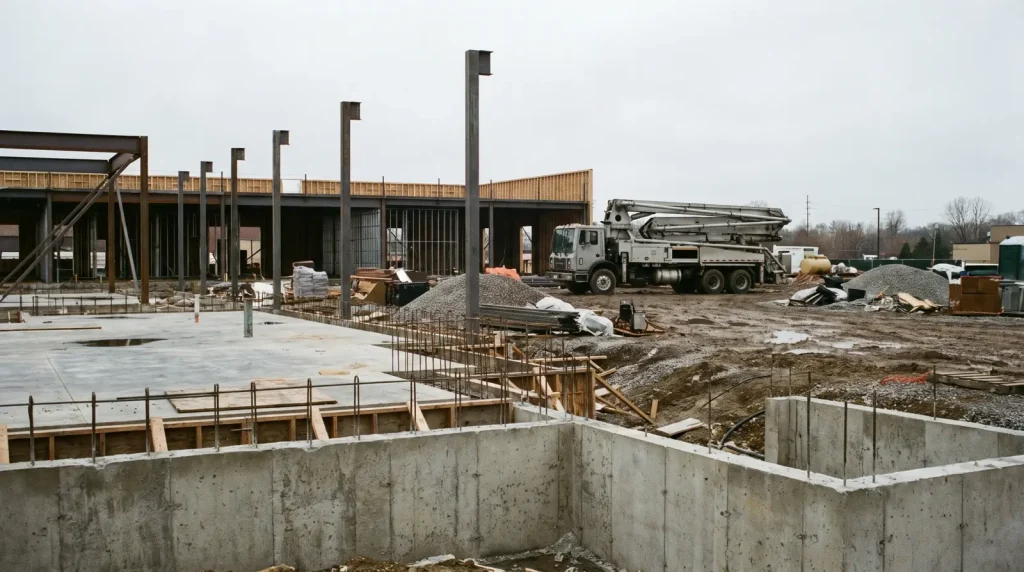
Special inspections are owner-paid, third-party checks of structural and fire-protection work that IBC Chapter 17 requires on top of city inspections; 2026 public rates run $55 to $125 an hour per inspector or engineer.
Key takeaways
- The owner, or the design professional acting as the owner’s agent, must hire the special inspection agency, not the contractor, under IBC Section 1704.2 (ICC Statement of Special Inspections template, May 2026).
- A statement of special inspections goes to the building official with the permit application under IBC Section 107.1, and a final report of special inspections must reach the building official before occupancy (ICC template).
- Utah’s state rate sheet, updated July 8, 2026, pays $55 an hour for a soils or concrete technician, $65 to $85 for ICC special inspectors and $125 for a Professional Engineer (Utah DFCM).
- On two federal laboratory buildings, materials testing and special inspection contracts came to 0.24% and 0.58% of the construction award (USAspending.gov).
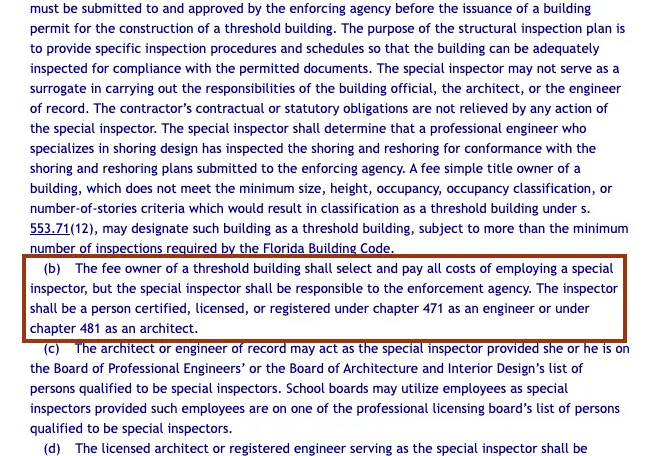
- In Florida, the fee owner of a threshold building (over 3 stories or 50 feet) must select and pay a licensed engineer or architect as special inspector (Fla. Stat. 553.79(5)(b), 2026).
What are special inspections, and how are they different from city inspections?
A special inspection is an inspection of selected materials, fabrication, erection or placement of components and connections, done by an approved agency to confirm the work matches the approved construction documents, as Chapter 17 of the 2024 International Building Code (IBC) requires. The city inspector still makes its own visits. San Diego’s building department states that special inspections are in addition to, and not a substitute for, its own inspections (City of San Diego, accessed November 2026).
The split is about depth. A municipal inspector visits at milestones such as footing, framing and final. A special inspector watches the structural work itself: every concrete placement on many jobs, every complete-joint-penetration weld under AISC 360 Chapter N, every lift of compacted fill. The table compares the two on the points that matter to an owner.
| Point | City (municipal) inspection | Special inspection (IBC Chapter 17) | Source |
|---|---|---|---|
| Who performs it | Building department staff or a private provider the city accepts | Approved agency employing qualified special inspectors | ICC template, 2026 |
| Who hires and pays | Covered by permit and inspection fees | Owner, or the registered design professional in responsible charge acting as owner’s agent (IBC 1704.2) | Boise form 310, 11/2023 |
| Frequency | Milestone visits requested by the contractor | Continuous or periodic, set item by item in the statement of special inspections | Boise Table 2 |
| What it checks | Code compliance of the whole building | Listed structural, soils, fire-resistive and smoke control items (IBC 1705) | IBC 2024 Ch. 17 |
| Paperwork | Inspection result in the permit record | Field reports, test results and a final report to the building official | Seattle SDCI |
| Effect on occupancy | Final building inspection required | Final report required before the certificate of occupancy | ICC template, 2026 |
Who must hire and pay for special inspections?
The owner pays. IBC Section 1704.2 says the owner, or the registered design professional in responsible charge acting as the owner’s agent, shall employ one or more approved agencies to perform the special inspections and tests. Boise’s 2023 permit form spells it out: the owner or design professional, not the contractor, employs the agency, and the owner signs that line (City of Boise form 310, November 2023).
The reason is independence: the inspector checks the contractor’s work, so the contractor should not be the client. Seattle’s building department states that the project owner selects and pays the inspection agency and that the contractor cannot pay, and it bills the owner 1 hour of city staff time at permit issuance for reviewing special inspection reports (Seattle SDCI, accessed November 2026). Virginia’s statewide code amendment reads simply that the owner shall employ one or more special inspectors for the work listed under Section 1705 (13VAC5-63-280).
Which projects are exempt?
The model code lists narrow exceptions in Section 1704.2: work of a minor nature that the building official approves, Group U buildings accessory to a residential occupancy unless the official requires otherwise, and parts of a structure built to the conventional light-frame provisions of IBC Section 2308 or the cold-formed steel light-frame provisions of Section 2211.7 (IBC 2024 Section 1704.2). A commercial building with a concrete foundation, a steel frame or masonry walls almost never fits one. Get any exemption in writing from the plans examiner before bidding.
What does the construction contract say?
Read Section 13.4 of AIA A201-2017 before signing. Its default text has the contractor arrange and pay for required tests unless the contract documents provide otherwise, which sits badly with IBC 1704.2, so owners commonly carve special inspections out as an owner cost in the supplementary conditions. Section 13.4.3 puts the cost of retesting work that failed on the contractor; keep that clause. Our guide to the AIA A201 general conditions covers the rest of Article 13. This is general information, not legal advice; ask your construction attorney whether your amendments assign testing and retesting costs the way your budget assumes.
What is the statement of special inspections?
The statement of special inspections (SSI) is the project’s inspection plan. The registered design professional in responsible charge, usually the structural engineer of record, prepares it, and the permit applicant submits it with the construction documents under IBC Section 107.1, as a condition of permit issuance (ICC SSI template, May 2026). The ICC template groups the checklist into about 40 categories, from structural steel (1705.2) to smoke control testing (1705.19).
Under IBC Section 1704.3 the statement must name the following, item by item:
- The materials, systems, components and work that need special inspection or testing.
- The type and extent of each special inspection.
- The type and extent of each test.
- The extra inspections and tests for wind or seismic resistance, where Sections 1705.12 to 1705.14 apply.
- Whether each inspection is continuous or periodic.
The statement also triggers two other documents. Each contractor building part of the main wind-force-resisting or seismic-force-resisting system must file a written statement of responsibility with the building official and the owner before starting that work (IBC 1704.4). And structural observation by the engineer under IBC 1704.6 is added for Risk Category III or IV buildings, high-rise buildings, and Seismic Design Category E buildings over 2 stories (ICC template, May 2026). Structural observation is a site visit by the designer; it does not replace special inspection.
What is the difference between continuous and periodic special inspection?
Continuous special inspection means the inspector is present the whole time the work is being done. Periodic special inspection means the inspector is present part of the time and checks work that has been or is being done, as defined in IBC Section 202 (IBC 2024 Chapter 2). Continuous items cost the most because the inspector’s hours follow the crew’s hours, including the 1.5x overtime rate on Utah’s 2026 sheet (Utah DFCM).
The code tables set the frequency per task. The examples below come from the concrete table (Table 1705.3) on Boise’s permit form, which follows the 2018 IBC item list (City of Boise form 310). Steel follows AISC 360 Chapter N instead, where the special inspector either observes a task on a random basis (O) or performs it for each welded joint or member (P) (ICC template).
| Task (concrete, IBC Table 1705.3) | Frequency | Source |
|---|---|---|
| Sample fresh concrete, make strength specimens, slump, air and temperature tests | Continuous | Boise Table 2, item 6 |
| Concrete and shotcrete placement | Continuous | Boise Table 2, item 7 |
| Welds on reinforcing bars other than single-pass fillet welds up to 5/16 inch | Continuous | Boise Table 2, item 2c |
| Adhesive anchors in horizontal or upward holes under sustained tension | Continuous | Boise Table 2, item 4a |
| Prestressing force and grouting of bonded tendons | Continuous | Boise Table 2, item 9 |
| Reinforcing steel and tendon placement | Periodic | Boise Table 2, item 1 |
| Anchors cast in concrete | Periodic | Boise Table 2, item 3 |
| Required design mix, curing temperature and formwork | Periodic | Boise Table 2, items 5, 8, 12 |
| Precast member erection; in-place strength before stressing or shore removal | Periodic | Boise Table 2, items 10, 11 |
Strength specimens feed the 28-day cylinder breaks explained in our guide to concrete psi and strength testing.
Which types of work need special inspection, and under which code section?
IBC Section 1705 lists the categories, and the engineer ticks the ones the building contains. Section numbers moved between editions: smoke control testing is 1705.19 in the 2024 IBC but 1705.18 in the 2018 IBC, so check which edition your city adopted before reading a form. The table gives both, from the ICC 2026 template and Boise’s form (ICC template, May 2026; Boise form 310).
| Type of work | 2024 IBC section | 2018 IBC section | What the inspector verifies | Usual frequency | Source |
|---|---|---|---|---|---|
| Structural steel and welding | 1705.2, AISC 360 Ch. N | 1705.2 | Welder records, fit-up, weld size and profile, nondestructive testing per AWS D1.1 | Observe or perform per joint | ICC template |
| High-strength bolting | 1705.2, AISC 360 Ch. N | 1705.2 | Fastener certifications and markings, snug-tight then pretension from the most rigid point outward | Observe or perform per joint | ICC template |
| Steel deck, joists, metal building systems | 1705.2.3, 1705.2.4, 1705.2.6 | 1705.2.2, 1705.2.3 | Deck welds per SDI QA/QC, joist end connections and bridging, metal building system | Periodic | ICC template |
| Concrete and reinforcement | Table 1705.3 | Table 1705.3 | Rebar, anchors, mix, sampling, placement, curing, formwork | Mixed (see table above) | Boise Table 2 |
| Masonry | 1705.4, TMS 402/602 | 1705.4 | Grout space, reinforcement, mortar, prisms; Levels 1, 2 or 3 | Periodic or continuous by level | Boise Tables 3, 4 |
| Soils | 1705.6, Table 1705.6 | 1705.6 | Bearing material, excavation depth, fill materials, lift thickness and density | Periodic; continuous during fill placement | ICC template |
| Driven deep foundations | 1705.7, Table 1705.7 | 1705.7 | Pile materials and lengths, hammer, driving records, capacity of test elements | Continuous | Boise Table 6 |
| Cast-in-place deep foundations | 1705.8, Table 1705.8 | 1705.8 | Drilling records, diameters and depths, bearing strata, concrete volumes | Continuous | Boise Table 7 |
| Helical piles | 1705.9 | 1705.9 | Installation records | Continuous | ICC template |
| Wind resistance (high-wind sites) | 1705.12 | 1705.11 | Required where Exposure B wind speed is 150 mph or more, or Exposure C or D is 140 mph or more | Periodic | ICC template |
| Seismic resistance and testing | 1705.13, 1705.14 | 1705.12, 1705.13 | Seismic force-resisting systems, designated seismic systems, anchorage of components | Per schedule | ICC template |
| Sprayed fire-resistant materials | 1705.15 | 1705.14 | Surface condition, thickness, density and bond strength of spray fireproofing | Periodic | ICC template |
| Intumescent and mastic coatings | 1705.16 | 1705.15 | Thickness of fire-resistive coatings (AWCI Technical Manual 12-B) | Periodic | Philadelphia L&I, 2026 |
| EIFS | 1705.17 | 1705.16 | Exterior insulation and finish system installation | Periodic | ICC template |
| Fire-resistant penetrations and joints | 1705.18 | 1705.17 | Firestop and joint systems in high-rise and Risk Category III or IV buildings | Periodic | ICC template |
| Smoke control | 1705.19 | 1705.18 | Duct leakage before concealment, then pressure differences, airflow and controls before occupancy | Two test phases | IBC 2024 Ch. 17 |
Which categories surprise owners?
Two categories catch owners by surprise. Firestop inspection only applies to high-rise and Risk Category III or IV buildings, which our fire-rated wall guide explains by assembly. Smoke control testing runs twice: once during ductwork erection for leakage, then before occupancy for pressure difference and flow tests, and it overlaps the functional testing in building commissioning, so schedule both on one calendar.
Who is qualified to be a special inspector?
The building official approves each inspector before the work starts, based on written qualifications the design professional submits (ICC template, May 2026). Most cities accept International Code Council (ICC) certifications such as Reinforced Concrete, Structural Steel and Bolting, Structural Masonry, Soils and Spray-applied Fireproofing, or a licensed engineer with relevant experience. Some cities run their own registers with fees and insurance minimums.
| City | What the inspector or agency needs | Fee or rule | Source |
|---|---|---|---|
| Philadelphia | Registration per category; agencies carry $500,000 professional liability insurance; records kept 7 years | Agency $253; inspector $63 per category, maximum $252 per 3-year term | Philadelphia L&I, effective July 1, 2026 |
| New York City | Special Inspection Agency registration in DOB NOW; Class 1 work needs accreditation | $200 new plus $30 per endorsement; renewal $90 | NYC DOB, accessed November 2026 |
| Seattle | Structural inspectors certified by the Washington Association of Building Officials; geotechnical work by the geotechnical engineer of record with 4 years’ experience | Owner nominates the agency before permit issuance | Seattle SDCI |
| San Diego | Registered special inspector (form DS-320) and registered lab or agency (form DS-807) | Final reports on DS-3101 and DS-310 | City of San Diego |
| Florida threshold buildings | Engineer licensed under Chapter 471 or architect under Chapter 481, certified as special inspector | Fee owner selects and pays | Fla. Stat. 553.79(5)(b) |
Can the designer inspect its own work? Philadelphia’s 2026 rules say it is not in itself a conflict of interest for the design professional of record to perform special inspection on a project it designed (Philadelphia L&I), and Florida lets the architect or engineer of record act as threshold inspector if listed by the state board (Fla. Stat. 553.79(5)(c)). Contractors and their affiliates are the party the independence rule keeps out.
How does the special inspection process run from permit to final report?
The sequence below follows the ICC template and the published steps of Seattle’s building department, which lists 6 steps from plan review to acceptance of the final letter (Seattle SDCI; ICC template). The owner’s job is concentrated at steps 3 and 9: sign the agency contract early and chase the final report before the certificate of occupancy request.
- Design: the structural engineer of record writes the statement of special inspections and the schedule, marking each item continuous or periodic (IBC 1704.3).
- Permit application: the statement goes in with the construction documents (IBC 107.1); the plans examiner may add items under IBC 1705.1.1.
- Owner hires the agency: the owner or its design professional signs with an approved agency (IBC 1704.2); Seattle requires a signed nomination form before permit issuance.
- Qualifications approved: inspector credentials go to the building official before the related work starts.
- Contractor statements: contractors on wind or seismic force-resisting systems file statements of responsibility (IBC 1704.4).
- Preconstruction meeting: agency, contractor and engineer agree on notice times, hold points and report routing.
- Inspections and tests: the inspector reports to the building official and the engineer; discrepancies go to the contractor first, then to the official and engineer if not corrected.
- Fabricated items: shop work is inspected at the plant unless the fabricator is approved under IBC 1704.2.5.
- Final report: the agency submits a final report documenting every required inspection and the correction of each discrepancy.
- Certificate of occupancy: the building official accepts the final report and the CO can issue.
A missing final report is a common reason a finished building waits for its certificate. Our guide to the certificate of occupancy for commercial buildings lists the other sign-offs that come due at the same time.
How much do special inspections cost?
Special inspections are billed by the hour plus lab tests. Utah’s July 2026 state schedule pays $55 an hour for soils and concrete technicians, $65 to $85 for ICC special inspectors and $125 for a Professional Engineer, with tests priced per specimen (Utah DFCM, updated July 8, 2026). On two federal laboratory buildings, testing and special inspection came to 0.24% and 0.58% of the construction award.
Hourly and unit rates on a public schedule
| Service (Utah DFCM, July 2026) | Rate | Unit | Source |
|---|---|---|---|
| In-place soil density testing (soils technician) | $55 | per hour | Utah DFCM |
| Proctor test, standard or modified | $140 | each | Utah DFCM |
| ACI Level I concrete sampling technician | $55 | per hour | Utah DFCM |
| ACI Level II, ICC concrete special inspector | $65 | per hour | Utah DFCM |
| Concrete cylinder compressive strength | $25 | each | Utah DFCM |
| Post-installed anchor or prestressed concrete inspector | $65 | per hour | Utah DFCM |
| Masonry ICC special inspector | $72 | per hour | Utah DFCM |
| Fireproofing special inspector | $72 | per hour | Utah DFCM |
| Structural steel and welding, or bolting, special inspector | $85 | per hour | Utah DFCM |
| Ultrasonic testing (UT) | $125 | per hour | Utah DFCM |
| Professional Engineer (P.E.) | $125 | per hour | Utah DFCM |
| Overtime: over 8 hours a day, weekends, holidays | 1.5x | hourly rate | Utah DFCM |
As a share of construction cost
Federal award records let you compare the testing contract with the building contract on the same project. Both are U.S. Geological Survey buildings; the special inspection figures include materials testing, and the construction figures are obligations to date on USAspending.gov, accessed November 2026.
| Project | Construction award | Testing and special inspection award | Share | Source |
|---|---|---|---|---|
| Hydrologic Instrumentation Facility, Tuscaloosa, AL (construction from Dec 2021) | $90,175,120 | $217,478 (May 2022) | 0.24% | construction, testing |
| USGS laboratory building, Moffett Field, CA (construction from Oct 2020) | $76,383,318 | $442,514 (Sep 2021) | 0.58% | construction, testing |
Large buildings spread fixed costs, such as report writing and engineer review, across more construction value. A small building pays the same 2-hour minimums and trip charges on far less work, so its share runs higher. Treat the two ratios as a floor for an 8-figure building, not a rule for a $3 million one.
A line-by-line city contract
The City of Calexico, California, approved a $53,154 testing and special inspection contract for its new fire station headquarters on October 7, 2020, from a unit-rate proposal dated May 27, 2020 (Calexico City Council agenda item 13). Fire stations are essential facilities, which the staff report names as the reason the California Building Code required the work. Escalated with the BLS producer price index for engineering services (PCU541330541330), from 175.1 in May 2020 to 211.065 in September 2026, the same contract is about $64,072 today.
| Line (Calexico, May 2020) | Quantity | Rate | Amount | Source |
|---|---|---|---|---|
| Compaction testing | 100 hours | $98/h | $9,800 | Calexico |
| Concrete testing and retrievals | 120 hours | $98/h | $11,760 | Calexico |
| Welding, bolting, masonry and epoxy inspection | 120 hours | $98/h | $11,760 | Calexico |
| Foundation rebar inspection (engineer) | 8 hours | $150/h | $1,200 | Calexico |
| Asphalt field testing | 8 hours | $98/h | $784 | Calexico |
| Trip charges | 80 trips | $35 | $2,800 | Calexico |
| Concrete compressive strength | 20 sets | $150/set | $3,000 | Calexico |
| Grout and mortar compressive strength | 10 sets | $180/set | $1,800 | Calexico |
| Soil maximum density, base and asphalt lab tests | 6 tests | $200 to $950 | $2,250 | Calexico |
| Engineering oversight and reports | Lump sum | $8,000 | Calexico | |
| Total | $53,154 | Calexico |
Worked example: the same hours at 2026 state rates
The rate moves the price as much as the scope. The table reprices Calexico’s building lines (asphalt, base and trips left out) at Utah’s July 2026 rates. Two inputs are CB&C assumptions, marked: 4 cylinders per concrete set, and 64 engineer hours standing in for the $8,000 oversight line. Calexico’s rates were California prevailing wage with a 2-hour minimum per visit.
| Line | Calexico 2020 cost | Utah 2026 rate | Repriced cost | Source |
|---|---|---|---|---|
| Compaction testing, 100 h | $9,800 | $55/h soils technician | $5,500 | Utah DFCM |
| Concrete testing, 120 h | $11,760 | $55/h ACI Level I | $6,600 | Utah DFCM |
| Welding, bolting, masonry, epoxy, 120 h | $11,760 | $85/h steel special inspector | $10,200 | Utah DFCM |
| Rebar inspection by engineer, 8 h | $1,200 | $125/h P.E. | $1,000 | Utah DFCM |
| Concrete strength, 20 sets (assumed 4 cylinders each) | $3,000 | $25 per cylinder | $2,000 | Utah DFCM |
| Grout strength, 10 tests | $1,800 | $40 each | $400 | Utah DFCM |
| Soil maximum density, 3 tests | $750 | $140 Proctor | $420 | Utah DFCM |
| Engineering oversight (assumed 64 h) | $8,000 | $125/h P.E. | $8,000 | Utah DFCM |
| Total | $48,070 | $34,120 | CB&C arithmetic |
The 29% gap comes from the hourly rate, not the hours. On your own bid, the drivers are: hours of continuous items (concrete placement and fill), the count of pours and lifts, overtime at 1.5x for weekend or night pours, trip charges and 2-hour minimums, travel for shop inspection of out-of-state fabricators, and retests after failures, which A201 Section 13.4.3 assigns to the contractor by default.
What cost guides get wrong
| Claim seen in ranking guides (2022 to 2025) | What the primary record shows | Source |
|---|---|---|
| Special inspections cost 1% to 5% of the construction budget | 0.24% and 0.58% on two federal buildings of $76 million and $90 million | USAspending.gov |
| The contractor arranges the inspector | The owner or its design professional employs the agency; Seattle bars the contractor from paying | Seattle SDCI |
| Special inspections replace city inspections | They add to city inspections, not substitute for them | City of San Diego |
Special inspection is a construction-phase cost separate from the structural design fee; our structural engineer cost guide prices the design side, and the soils items depend on the recommendations in your geotechnical report.
What changes for special inspections in Florida?
Florida adds a state layer for threshold buildings: any building over 3 stories or 50 feet tall, or an assembly occupancy over 5,000 square feet with an occupant content over 500 (Fla. Stat. 553.71(12), 2026). For these, the enforcing agency requires a special inspector working to a structural inspection plan by the engineer or architect of record, approved before the permit issues (Fla. Stat. 553.79(5)(a)).
The fee owner selects and pays the threshold inspector, who answers to the building department rather than to the owner, and must be a Florida-licensed engineer or architect certified as a special inspector. At completion the inspector files a signed and sealed statement before the certificate of occupancy issues (Fla. Stat. 553.79(9)(a)). Florida’s coastal wind speeds also put many projects over the 140 mph Exposure C trigger for wind special inspection; check your county in our Florida hurricane risk by county data.
Which special inspections does your project need?
Use the table to scope the agency contract before the permit drawings are final. Each row names a threshold from the code or statute and the action that follows; the engineer of record makes the final list in the statement of special inspections.
| If your project has | Then | Rule | Source |
|---|---|---|---|
| Any new concrete, steel, masonry or engineered fill | Budget an approved agency hired by the owner before the first footing | IBC 1704.2, 1705 | ICC template |
| Only minor work the building official approves as exempt | Get the exemption in writing from the plans examiner | IBC 1704.2 Exception 1 | IBC 2024 |
| Wind speed of 150 mph or more in Exposure B, or 140 mph or more in Exposure C or D | Add wind special inspection of roof, wall and anchorage components | IBC 1705.12 | ICC template |
| Risk Category III or IV, a high-rise, or SDC E over 2 stories | Add structural observation by the engineer, and firestop inspection for high-rise or RC III/IV | IBC 1704.6, 1705.18 | ICC template |
| A smoke control system | Schedule leakage testing before ducts are concealed and system tests before occupancy | IBC 1705.19 | Philadelphia L&I |
| A Florida building over 3 stories or 50 feet, or large assembly space | Hire a threshold inspector to the engineer’s structural inspection plan | Fla. Stat. 553.79(5) | Florida Statutes |
| A pre-engineered metal building on a 2024 IBC permit | Add the metal building systems category | IBC 1705.2.6 | ICC template |
Pre-engineered frames have their own split of maker and owner duties, covered in our pre-engineered metal building guide.
Two items inspectors check most often have their own guides: the ASTM C143 field test in concrete slump test and the steel shapes in W beam sizes.
How we compiled this
We read the ICC Statement of Special Inspections template (May 2026), 4 city or state code documents (Boise, Philadelphia, Virginia, Florida Statutes 553.71 and 553.79), 4 city program pages, Utah’s July 2026 rate sheet, a 2020 city council contract, 4 USAspending.gov award records and the BLS engineering services price index, all accessed November 2026. The IBC text itself is paywalled to our fetcher, so section wording is taken from the ICC template and the adopted forms; code citations link to the ICC chapter.
Frequently asked questions
Who pays for special inspections, the owner or the contractor?
The owner pays. IBC Section 1704.2 requires the owner, or the registered design professional acting as the owner’s agent, to employ the special inspection agency, and Seattle’s building department states that the contractor cannot pay. Contracts can still shift the cost of retesting failed work to the contractor, as AIA A201-2017 Section 13.4.3 does by default (Seattle SDCI).
Are special inspections the same as city building inspections?
No. City inspectors visit at milestones such as footing, framing and final, while special inspectors check listed structural and fire-protection work continuously or periodically under IBC Chapter 17. San Diego’s building department states that special inspections are in addition to, and not a substitute for, the inspections performed by the city inspector (City of San Diego).
Who prepares the statement of special inspections?
The registered design professional in responsible charge, usually the structural engineer of record, prepares it, and the permit applicant submits it with the construction documents under IBC Section 107.1. It lists each item needing inspection or testing, its extent, and whether it is continuous or periodic, per IBC Section 1704.3 (ICC template, May 2026).
What happens if a special inspector finds a problem?
The inspector reports the discrepancy to the contractor for correction first. If it is not corrected, the inspector reports it to the building official and the design professional of record. Philadelphia’s 2026 rules also require immediate reporting of conditions hazardous to life or safety, and the final report must document each correction (Philadelphia L&I).
Can the engineer of record also be the special inspector?
Often yes. Philadelphia’s July 2026 rules state that it is not in itself a conflict of interest for the design professional of record to inspect its own project, and Florida Statute 553.79(5)(c) lets the architect or engineer of record act as threshold inspector if listed by the state board. The contractor and its affiliates are kept out (Fla. Stat. 553.79).
When is the final report of special inspections due?
Before the certificate of occupancy. The ICC template requires a final report documenting completion of all required special inspections and correction of discrepancies before the occupancy permit issues. Philadelphia also requires notice within 10 days of completing each special inspection, and Florida threshold inspectors file a sealed statement before the CO (ICC template).
How much do special inspections cost for a commercial building?
Utah’s July 2026 state rates run $55 an hour for technicians, $65 to $85 for ICC special inspectors and $125 for a Professional Engineer, plus $25 per concrete cylinder. A 2020 fire station contract in Calexico, California, totaled $53,154, about $64,072 after BLS engineering price escalation to September 2026 (Utah DFCM).
Sources
- Statement of Special Inspections template (B.4_3, May 2026), International Code Council, accessed November 9, 2026.
- 2024 International Building Code, Chapter 17 Special Inspections and Tests, International Code Council, accessed November 9, 2026.
- 2024 International Building Code, Chapter 2 Definitions, International Code Council, accessed November 9, 2026.
- Statement of Special Inspections, form 310 (November 2023), City of Boise, accessed November 9, 2026.
- Special Inspections, Seattle Department of Construction and Inspections, accessed November 9, 2026.
- Special Inspections: Agencies and Inspectors (effective July 1, 2026), City of Philadelphia, Department of Licenses and Inspections, accessed November 9, 2026.
- Special Inspections, New York City Department of Buildings, accessed November 9, 2026.
- Special Inspections, City of San Diego Development Services, accessed November 9, 2026.
- 13VAC5-63-280, Chapter 17 amendments, Virginia Uniform Statewide Building Code, Virginia Administrative Code, accessed November 9, 2026.
- Section 553.79, Florida Statutes (2026), Florida Legislature, accessed November 9, 2026.
- Section 553.71, Florida Statutes (2026), Florida Legislature, accessed November 9, 2026.
- Capital Project Code and Special Inspections Rates (updated July 8, 2026), Utah Division of Facilities and Construction Management, accessed November 9, 2026.
- Agenda Staff Report, Item 13, October 7, 2020 (materials testing and special inspection, Fire Station Headquarters), City of Calexico, accessed November 9, 2026.
- Award 140G0122P0154, materials testing and special inspection, Hydrologic Instrumentation Facility, USAspending.gov, accessed November 9, 2026.
- Award 140G0122C0002, construction of Hydrologic Instrumentation Facility, Tuscaloosa, AL, USAspending.gov, accessed November 9, 2026.
- Award 140G0321P0357, materials testing and special inspections, laboratory building, Moffett Field, CA, USAspending.gov, accessed November 9, 2026.
- Award 140G0321C0002, construction of USGS laboratory building, Moffett Field, CA, USAspending.gov, accessed November 9, 2026.
- Producer Price Index, Engineering services (PCU541330541330), U.S. Bureau of Labor Statistics, accessed November 9, 2026.
- A201-2017 General Conditions of the Contract for Construction, American Institute of Architects, accessed November 9, 2026.