
Tenant improvement allowance accounting turns on who owns the improvements: under ASC 842 a tenant-owned build-out makes the allowance a lease incentive that reduces the right-of-use asset, while tax follows IRC sections 110 and 168.
Key takeaways
- A TI allowance paid or payable at or before commencement reduces the lessee’s right-of-use (ROU) asset under ASC 842-20-30-5(b) and lease payments under ASC 842-10-30-5(a) (codification text reproduced in EY FRD, May 2026).
- Tenant-owned leasehold improvements are amortized over the shorter of their useful life and the remaining lease term under ASC 842-20-35-12; in the 10-year example below that is $30,000 a year on $300,000 of work (EY FRD, May 2026).
- A retail tenant on a lease of 15 years or less can exclude the allowance from income under 26 U.S.C. 110, but only to the extent it is spent on property that reverts to the landlord, within 8 1/2 months after the year it is received (26 CFR 1.110-1(b)(4)(ii)).
- Interior tenant work placed in service after 2017 is generally qualified improvement property: 15-year, straight-line, and eligible for the 100% special allowance restored for property acquired after January 19, 2025 (IRS Publication 946).
- In the worked example the tenant’s annual P&L cost is $160,000 whether the landlord or the tenant owns the build-out; ownership moves the cost between lease expense and amortization and changes both balance sheets (CB&C calculation).
This page explains accounting and tax rules for leases; it is not accounting, tax or legal advice. Take the lease, the work letter and this worked example to your CPA and ask which ownership conclusion and which contingent-incentive policy your auditor will accept.
Who owns the improvements, and why does it decide everything?
Ownership decides whether the allowance is a lease incentive or the landlord buying its own asset. ASC 842 has no explicit ownership test, so practice uses the factors in the EY Financial Reporting Developments guide on lease accounting (May 2026) and the RSM accounting brief of September 2024. If the tenant owns the work, the allowance is an incentive under ASC 842-10-55-30; if the landlord owns it, the payment buys a lessor asset.
ASC 842-10-55-30 says lease incentives include “payments made to or on behalf of the lessee.” RSM notes that a lessor payment that buys “a distinct good or service,” such as a lessor-owned improvement, is not an incentive. EY adds that a lessee should not book a partial asset, so a 60% landlord-funded, 40% tenant-funded improvement is one asset owned by one party.
| Factor | Points to tenant-owned (lease incentive) | Points to landlord-owned (lessor asset) | Source |
|---|---|---|---|
| End of lease | Tenant may remove the work or must restore the space | Work stays and is preserved for the landlord | EY FRD 2.11 |
| Life vs lease term | Lease term covers substantially all of the economic life | Useful life runs well past the term | EY FRD 2.11 |
| Uniqueness | Brand decor, logo, specialized fit-out | General-purpose walls, lighting, restrooms | EY FRD 2.11; RSM 2024 |
| Construction control | Tenant designs and supervises its own contractor | Tenant acts as landlord’s agent under a work letter | EY FRD 2.11 |
| Cost overruns | Tenant bears all overruns | Landlord bears overruns | EY FRD 2.11 |
| Alterations | Tenant can alter or remove without landlord approval or payment | Landlord approval or compensation required | RSM 2024 |
| Legal title | Tenant holds title during the term | Title vests in landlord on installation (rarely decisive alone) | RSM 2024 |
The conclusion also sets the commencement date. If the landlord hands over a shell so the tenant can build its own improvements, commencement is the date the space was made available, per ASC 842-10-55-19 as discussed in EY section 2.11, often months before the tenant opens or receives a certificate of occupancy.
How does a lessee record a TI allowance under ASC 842?
For a tenant-owned build-out, the allowance lowers the right-of-use asset, and the timing of payment decides whether it also lowers the lease liability. Cash already received at or before commencement reduces only the ROU asset under ASC 842-20-30-5(b). A fixed amount payable after commencement is a negative lease payment under ASC 842-10-30-5(a), so it reduces the liability too, per the FASB Accounting Standards Codification Topic 842.
Received at or before commencement
ASC 842-20-30-5 sets the ROU asset as the initial lease liability, plus lease payments made at or before commencement “minus any lease incentives received,” plus initial direct costs. The liability is the present value of payments not yet paid, so cash already in hand does not touch it. The entry is a $200,000 debit to cash and a $200,000 credit to the ROU asset in the example below.
Fixed amount payable after commencement
If the lease fixes the allowance and its due date, for example $200,000 payable 12 months after commencement, ASC 842-10-30-5(a) deducts it from fixed payments. At a 6% discount rate it lowers both the liability and the ROU asset by its present value, $188,679, instead of the full $200,000.
Reimbursed only after the tenant spends
Most work letters pay against invoices, so nothing is payable at commencement. ASC 842 does not address these contingent incentives, and EY describes three acceptable approaches, which RSM calls an accounting policy election. Approach 1 books the maximum allowance at commencement if the tenant is reasonably certain to spend at least that much; Approaches 2 and 3 wait until costs qualify, then reduce the ROU asset prospectively (2) or with a cumulative catch-up (3).
| Timing of the allowance | Lease liability | ROU asset | Codification basis |
|---|---|---|---|
| Received in cash at or before commencement | No change | Reduced by cash received | ASC 842-20-30-5(b) |
| Fixed, payable on a set date after commencement | Reduced by present value | Reduced by present value | ASC 842-10-30-5(a) |
| Contingent, Approach 1 (reasonably certain to spend the cap) | Reduced at commencement | Reduced at commencement | EY FRD 2.4.1.2 |
| Contingent, Approach 2 | Reduced when costs qualify | Reduced, recognized prospectively | EY FRD 2.4.1.2 |
| Contingent, Approach 3 | Reduced when costs qualify | Reduced, with cumulative catch-up to expense | EY FRD 2.4.1.2; RSM 2024 |
Worked example: journal entries for one $200,000 allowance
One lease carries the whole example: 5,000 square feet, 10 years, $150,000 rent a year paid at each year end, a 6% incremental borrowing rate and a $200,000 allowance ($40 per square foot) received in cash at commencement. The tenant spends $300,000 on improvements it owns, with a 15-year useful life. Annual payments in arrears keep every figure checkable, the same simplification EY uses in Illustration 2-10.
| Input | Value | Basis |
|---|---|---|
| Lease term | 10 years, operating lease | Assumed |
| Annual rent, paid in arrears | $150,000 ($30 per sq ft) | Assumed |
| Discount rate | 6% incremental borrowing rate | Assumed |
| TI allowance | $200,000 received at commencement | Assumed ($40 per sq ft x 5,000 sq ft) |
| Tenant build-out cost | $300,000, tenant-owned, 15-year useful life | Assumed |
| Lease liability at commencement | $1,104,013 | PV of 10 x $150,000 at 6% |
| ROU asset at commencement | $904,013 | $1,104,013 minus $200,000, ASC 842-20-30-5(b) |
| Straight-line lease expense | $130,000 a year | ($1,500,000 minus $200,000) / 10 |
| Leasehold improvement amortization | $30,000 a year | $300,000 / 10, shorter of 15-year life and 10-year term |
Lessee journal entries
Five entries cover commencement and year 1: recognize the lease, apply the allowance to the ROU asset, capitalize the build-out, record the first year-end rent payment and amortize the improvements. Years 2 to 10 repeat the last two entries with the figures in the schedule below.
| Date | Account | Debit | Credit |
|---|---|---|---|
| Commencement | Right-of-use asset | $1,104,013 | |
| Lease liability | $1,104,013 | ||
| Commencement | Cash | $200,000 | |
| Right-of-use asset (lease incentive) | $200,000 | ||
| During build-out | Leasehold improvements (ASC 360) | $300,000 | |
| Cash or accounts payable | $300,000 | ||
| End of year 1 | Lease expense | $130,000 | |
| Lease liability | $83,759 | ||
| Cash | $150,000 | ||
| Right-of-use asset | $63,759 | ||
| End of year 1 | Amortization expense | $30,000 | |
| Accumulated amortization, leasehold improvements | $30,000 |
The year 1 lease entry balances at $213,759 on each side. Interest accretion on the liability is $66,241 (6% x $1,104,013), so the liability falls by $83,759 and the ROU asset absorbs the $63,759 difference between straight-line expense and accretion. The schedule below shows that the $200,000 incentive is spread evenly: the ROU asset always equals the liability less the unamortized incentive, $1,020,254 minus $180,000 at the end of year 1.
| Year | Opening liability | Interest at 6% | Liability reduction | Closing liability | ROU amortization | Closing ROU asset |
|---|---|---|---|---|---|---|
| 1 | $1,104,013 | $66,241 | $83,759 | $1,020,254 | $63,759 | $840,254 |
| 2 | $1,020,254 | $61,215 | $88,785 | $931,469 | $68,785 | $771,469 |
| 3 | $931,469 | $55,888 | $94,112 | $837,357 | $74,112 | $697,357 |
| 4 | $837,357 | $50,241 | $99,759 | $737,598 | $79,759 | $617,598 |
| 5 | $737,598 | $44,256 | $105,744 | $631,854 | $85,744 | $531,854 |
| 6 | $631,854 | $37,911 | $112,089 | $519,765 | $92,089 | $439,765 |
| 7 | $519,765 | $31,186 | $118,814 | $400,951 | $98,814 | $340,951 |
| 8 | $400,951 | $24,057 | $125,943 | $275,008 | $105,943 | $235,008 |
| 9 | $275,008 | $16,500 | $133,500 | $141,508 | $113,500 | $121,508 |
| 10 | $141,508 | $8,492 | $141,508 | $0 | $121,508 | $0 |
Year 10 interest is rounded up $2 to close the schedule at zero. Over 10 years the tenant books $1,300,000 of lease expense and $300,000 of amortization, $1,600,000 in total, which equals $1,500,000 of rent plus $300,000 of build-out minus the $200,000 allowance.
What changes if the landlord owns the build-out?
If the same $300,000 of work were lessor-owned and the tenant paid $100,000 of it without reimbursement, EY treats that $100,000 as a noncash lease payment. The ROU asset becomes $1,204,013, straight-line expense becomes $160,000 a year, and the tenant books no leasehold improvement. The total annual P&L charge is still $160,000.
| Structure | ROU asset at commencement | Annual lease expense | Annual LHI amortization | Annual P&L total |
|---|---|---|---|---|
| Tenant-owned, $200,000 allowance received at commencement | $904,013 | $130,000 | $30,000 | $160,000 |
| Tenant-owned, $200,000 fixed and payable at month 12 | $915,334 | $130,000 | $30,000 | $160,000 |
| Landlord-owned, tenant pays $100,000 unreimbursed | $1,204,013 | $160,000 | $0 | $160,000 |
| Tenant-owned, no allowance (tenant pays $300,000) | $1,104,013 | $150,000 | $30,000 | $180,000 |
How does the landlord account for the allowance?
A landlord that pays for tenant-owned improvements records a lease incentive asset and amortizes it straight-line against lease income over the lease term; one that pays for its own improvements capitalizes them as property and depreciates them. Under ASC 842-30-25-11 an operating-lease lessor recognizes lease payments as income straight-line, and EY Illustration 5-7 shows the incentive netted against that income.
| Date | Account (landlord, tenant-owned work) | Debit | Credit |
|---|---|---|---|
| Commencement | Deferred lease incentive (asset) | $200,000 | |
| Cash | $200,000 | ||
| End of each year 1 to 10 | Cash | $150,000 | |
| Lease income | $130,000 | ||
| Deferred lease incentive | $20,000 |
EY section 5.4.2.1 adds that earmarking the money for the tenant’s leasehold improvements does not change this treatment, and the same applies when the tenant submits invoices instead of receiving a lump sum. If the work is lessor-owned, the landlord debits building improvements for the cost it funds, depreciates them over their useful life, and has no incentive to amortize.
Is a tenant improvement allowance taxable?
For tax, a cash allowance is generally ordinary income to a tenant that owns the improvements, according to a 2016 Tax Adviser item published by the AICPA. The main exception is Section 110: a retail tenant on a short-term lease excludes the allowance up to the amount it spends on qualified long-term real property, and that property is treated as the landlord’s nonresidential real property.
All four conditions in Treas. Reg. 1.110-1 must be met. The lease is retail space used to sell goods or services to the general public, which the regulation says includes doctors, lawyers, accountants and hair stylists. The term is 15 years or less, counted with renewal options under section 168(i)(3). The lease or a contemporaneous ancillary agreement signed before payment states the construction purpose. The money is spent in the year received or within 8 1/2 months after it.
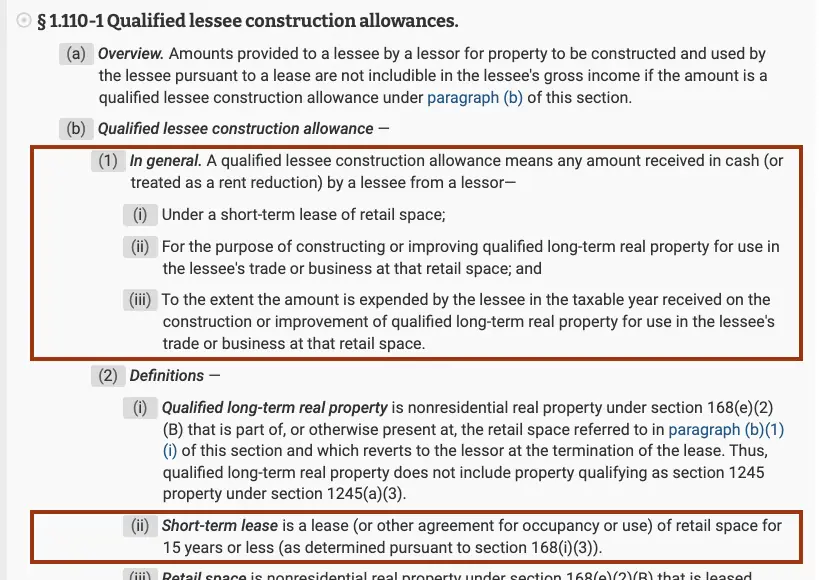
| Section 110 requirement | Rule | Citation |
|---|---|---|
| Lease type | Retail space: selling tangible goods or services to the general public, including support space such as storage and offices | 26 CFR 1.110-1(b)(2)(iii) |
| Lease length | 15 years or less, determined under section 168(i)(3) | 26 U.S.C. 110(c)(2); 1.110-1(b)(2)(ii) |
| Purpose clause | Lease or ancillary agreement, signed before payment, expressly states the allowance is for qualified long-term real property | 1.110-1(b)(3) |
| Property | Nonresidential real property at the retail space that reverts to the landlord; section 1245 property excluded | 1.110-1(b)(2)(i) |
| Spending deadline | Spent in the year received, or within 8 1/2 months after that year ends; tracing not required | 1.110-1(b)(4) |
| Cap | Exclusion limited to the amount actually spent | 26 U.S.C. 110(a) |
| Reporting | Landlord and tenant each attach a statement to the timely filed return; a failure may draw a section 6721 penalty | 1.110-1(c) |
Who depreciates the improvements for tax, and over how many years?
The party that owns the improvements for tax depreciates them, and the class depends on what was built. Interior, non-structural work placed in service after 2017 by the taxpayer who made it is qualified improvement property: 15-year, straight-line under 26 U.S.C. 168(b)(3)(G) and (e)(3)(E)(vii). Property excluded from tenant income under Section 110 is the landlord’s 39-year nonresidential real property.
Treas. Reg. 1.168(b)-1(a)(5) requires that QIP be made by the taxpayer, placed in service after December 31, 2017 and after the building was first placed in service, and it excludes building enlargements, elevators, escalators and the internal structural framework. Section 168(i)(8)(A) says a tenant’s improvements are depreciated under section 168 rules, not over the lease term. Under section 168(i)(8)(B), a landlord that irrevocably abandons its improvements at lease end treats them as disposed of then.
| Who funds and owns (tax) | Who depreciates | Class and method | Source |
|---|---|---|---|
| Tenant owns, cash allowance outside Section 110 | Tenant, on its full cost | QIP: 15-year straight-line; 100% special allowance if acquired after Jan 19, 2025; section 179 election allowed | IRC 168(e)(6); Pub 946 |
| Retail Section 110 allowance | Landlord, on the excluded amount | Nonresidential real property: 39-year straight-line, mid-month | IRC 110(b); 1.110-1(b)(5); Pub 946 |
| Tenant spends above a Section 110 allowance | Tenant, on the excess | QIP if interior and non-structural | 1.110-1(b)(4)(i); IRC 168(e)(6) |
| Landlord builds and owns the work | Landlord | QIP if interior and made by the landlord; otherwise 39-year | IRC 168(e)(6); 1.168(b)-1(a)(5) |
| Landlord pays a cash inducement for tenant-owned work | Landlord amortizes over the lease term | Cost of the lease, per AICPA Tax Adviser (2016) | The Tax Adviser, Aug 2016 |
For tax years beginning in 2026, Publication 946 sets the section 179 limit at $2,560,000, reduced dollar for dollar when section 179 property placed in service exceeds $4,090,000. Publication 946 also notes that a real property trade or business that elects out of the section 163(j) interest limit must use the alternative depreciation system for QIP.
How do the books and the tax return differ in year 1?
GAAP and tax rarely agree on a TI allowance. GAAP never records the allowance as income; tax either excludes it under Section 110 or taxes it as ordinary income and then lets the owner depreciate the work. Using the $200,000 allowance and $300,000 build-out from the worked example, the year 1 differences below would feed the deferred tax calculation under ASC 740.
| Year 1 item | GAAP (ASC 842, tenant-owned) | Tax: retail tenant under Section 110 | Tax: office tenant, no Section 110 |
|---|---|---|---|
| Allowance | Reduces ROU asset; $20,000 of it lowers lease expense | Excluded: $0 income | $200,000 ordinary income |
| Improvements owned for tax | $300,000 leasehold improvements | Tenant owns $100,000; landlord owns $200,000 | Tenant owns $300,000 |
| Tenant cost recovery | $30,000 amortization | $100,000 with 100% special allowance, or $3,333 straight-line with half-year convention | $300,000 with 100% special allowance, or $10,000 straight-line with half-year convention |
| Landlord cost recovery | Deferred incentive amortized $20,000 | $5,128 a full year on $200,000 over 39 years (first year prorated, mid-month) | $20,000 a year if amortized over the 10-year term |
| Rent deduction for tenant | Lease expense $130,000 | Rent paid $150,000 | Rent paid $150,000 |
The 100% special allowance figures assume the property qualifies as acquired after January 19, 2025 and no election out; the straight-line figures use the half-year convention, and the mid-quarter convention applies instead if more than 40% of the year’s depreciable property is placed in service in the last quarter, per Publication 946. Ask your preparer which convention and which election apply before relying on any year 1 number.
Which treatment applies to your lease?
Start with ownership, then timing, then tax status: those three answers fix every entry on this page. The decision table below maps the most common lease and work letter terms to the codification paragraph or tax section that controls them, so a controller, a landlord’s accountant and a tax preparer can each find their line within the same 10-year lease.
| If the lease or work letter says | Then | Rule |
|---|---|---|
| Improvements stay, are general purpose and need landlord approval to alter | Likely lessor asset: landlord capitalizes; tenant books no incentive | EY FRD 2.11; RSM 2024 |
| Tenant designs, controls and can remove brand-specific work | Likely lessee asset: allowance is a lease incentive | ASC 842-10-55-30 |
| Allowance paid in cash at or before commencement | Credit the ROU asset; liability unchanged | ASC 842-20-30-5(b) |
| Fixed allowance due on a set date after commencement | Deduct its present value from lease payments | ASC 842-10-30-5(a) |
| Reimbursement against invoices up to a cap | Pick and disclose a policy: EY Approach 1, 2 or 3 | EY FRD 2.4.1.2 |
| Lessee and lessor are under common control | Amortize improvements over their useful life to the group | ASC 842-20-35-12A |
| Retail use, term 15 years or less with options, purpose clause, spent within 8 1/2 months | Exclude up to the amount spent; both parties file statements | IRC 110; 1.110-1 |
| Office, industrial or lab use, tenant owns the work | Allowance generally taxable; tenant depreciates the full cost, often as 15-year QIP | IRC 168(e)(6); AICPA 2016 |
| Landlord abandons its improvements when the lease ends | Write off remaining basis at that time | IRC 168(i)(8)(B) |
The work letter drives most of these answers, so negotiate it with the accounting in view. The broader guide to how a tenant improvement allowance is negotiated and paid covers amounts, soft-cost caps and turnkey alternatives. Draw requests against an allowance usually follow the same documents as any build: a schedule of values, conditional lien waivers and a certificate of substantial completion.
What do common guides get wrong?
Five claims recur on pages that rank for this query, and each conflicts with the primary text. Most errors come from mixing GAAP with tax lives, or from pre-2018 tax rules that no longer apply. The table states each claim neutrally, without naming the publisher, next to what the codification, the statute or the regulation actually says, as accessed in November 2026.
| What a ranking guide says | What the primary source says | Source |
|---|---|---|
| A 2016 professional journal item: QIP must be placed in service 3 years after the building and occupied solely by the lessee, with 50% bonus | Since 2018, 168(e)(6) has no 3-year or lessee-only test; QIP is 15-year, and 100% special allowance applies to property acquired after Jan 19, 2025 | IRC 168(e)(6); Pub 946 |
| A 2025 vendor guide: improvements amortize over the lease term in one section and useful life in another | Shorter of useful life and remaining lease term, unless ownership transfers or a purchase option is reasonably certain | ASC 842-20-35-12 |
| A landlord-focused vendor guide: depreciate improvements over 27.5, 39 or 7 years under ASC 842 | Those are MACRS tax lives; GAAP uses useful life; interior QIP is 15-year for tax | Pub 946; IRC 168(e)(3)(E)(vii) |
| Several guides: a TI allowance always just reduces the ROU asset | Only if received; a fixed payable amount also reduces the liability; contingent amounts need a policy election | ASC 842-20-30-5; 842-10-30-5; EY FRD |
| A vendor FAQ: a TI allowance is not income | True for GAAP; for tax it is generally ordinary income unless Section 110 applies or the landlord owns the work | IRC 110; AICPA 2016 |
If you are pricing the work itself, our guide to tenant improvement contractors explains how builders quote interior fit-outs, and the retail construction and office renovation guides break down scope for the two lease types that the Section 110 test separates.
What the allowance buys is set by the commercial build-out scope and the shell condition the landlord delivers.
How we compiled this
We read 9 primary or near-primary documents in November 2026: ASC 842 paragraphs as reproduced in the EY FRD (May 2026), the RSM brief (September 2024), 26 U.S.C. 110 and 168, Treas. Regs. 1.110-1 and 1.168(b)-1 on eCFR, IRS Publication 946 (2025) and the AICPA Tax Adviser item (2016). The lease in the worked example is fictional and every figure is our arithmetic. We excluded state tax rules, IFRS 16 and lessor sales-type leases.
Frequently asked questions
How do you account for a tenant improvement allowance under ASC 842?
First decide who owns the improvements. If the tenant owns them, the allowance is a lease incentive: cash received at or before commencement reduces the right-of-use asset under ASC 842-20-30-5(b), and a fixed amount payable later reduces lease payments under ASC 842-10-30-5(a). The tenant capitalizes its own build-out and amortizes it over the shorter of useful life and lease term.
Does a TI allowance reduce the lease liability?
Only when it is still payable at commencement. Cash already received reduces just the ROU asset, because the liability measures payments not yet made. A fixed allowance due later, such as $200,000 at month 12, reduces the liability by its present value, $188,679 at a 6% rate in our example. Contingent reimbursements depend on the policy election EY describes as Approaches 1 to 3.
Is a tenant improvement allowance taxable income to the tenant?
Generally yes when the tenant owns the improvements, according to the AICPA Tax Adviser (2016). The exception is 26 U.S.C. 110: a retail tenant on a lease of 15 years or less excludes the allowance up to the amount spent on property that reverts to the landlord, spent within 8 1/2 months after the year received, with statements filed by both parties.
Over what period are leasehold improvements amortized under ASC 842?
ASC 842-20-35-12 requires the shorter of the improvements’ useful life and the remaining lease term. If the lease transfers ownership or the lessee is reasonably certain to exercise a purchase option, use the full useful life. For leases between entities under common control, ASC 842-20-35-12A uses the useful life to the common control group.
Who depreciates tenant improvements for tax purposes?
The tax owner. A tenant that owns interior work depreciates it as 15-year qualified improvement property under IRC 168(e)(6), possibly with the 100% special allowance for property acquired after January 19, 2025. Improvements funded by a Section 110 allowance belong to the landlord as 39-year nonresidential real property, per Treas. Reg. 1.110-1(b)(5).
How does a landlord record a tenant improvement allowance?
If the tenant owns the work, the landlord records a deferred lease incentive asset and amortizes it straight-line against lease income over the term, so a $200,000 incentive on a 10-year lease reduces income by $20,000 a year (EY Illustration 5-7 method). If the landlord owns the work, it capitalizes and depreciates the improvements instead.
Sources
- Financial Reporting Developments: Lease accounting, Accounting Standards Codification 842 (updated May 2026), EY, accessed 2026-11-21.
- Lessee accounting for tenant improvement allowances (September 2024), RSM US LLP, accessed 2026-11-21.
- Accounting Standards Codification Topic 842, Leases, Financial Accounting Standards Board, accessed 2026-11-21.
- 26 U.S. Code 110, Qualified lessee construction allowances for short-term leases, Legal Information Institute, Cornell Law School, accessed 2026-11-21.
- 26 CFR 1.110-1, Qualified lessee construction allowances, eCFR, National Archives, accessed 2026-11-21.
- 26 U.S. Code 168, Accelerated cost recovery system, Legal Information Institute, Cornell Law School, accessed 2026-11-21.
- 26 CFR 1.168(b)-1, Definitions (qualified improvement property), eCFR, National Archives, accessed 2026-11-21.
- Publication 946 (2025), How To Depreciate Property, Internal Revenue Service, accessed 2026-11-21.
- Lease Payments Are Not Always Rent (Tax Clinic, August 1, 2016), The Tax Adviser, AICPA, accessed 2026-11-21.