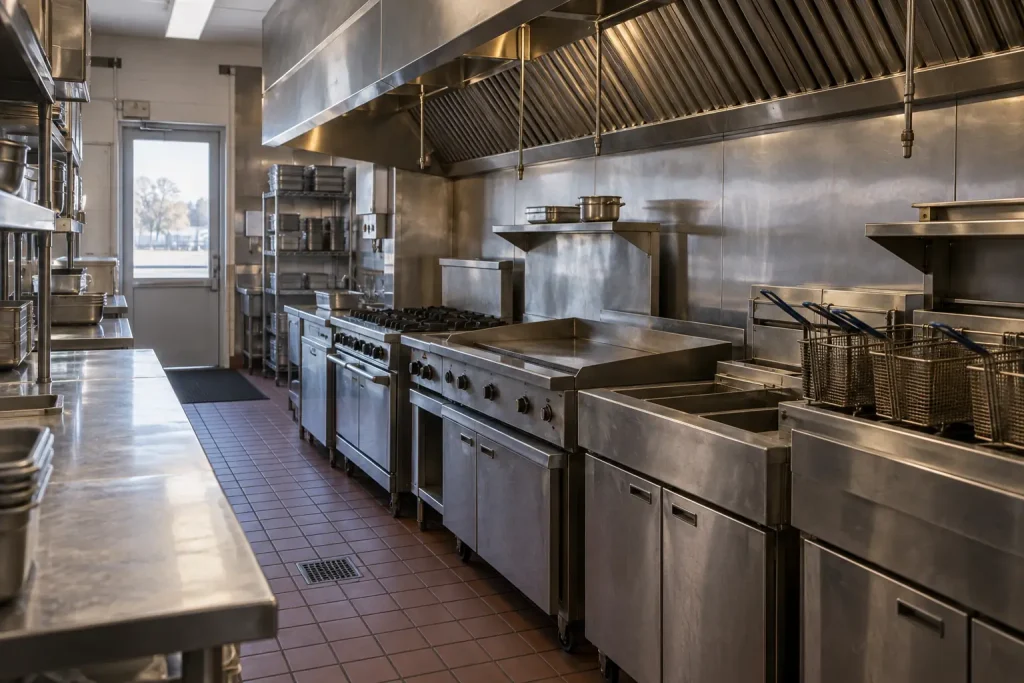
A commercial kitchen fire suppression system is the automatic system built into a Type I hood that puts out a cooking fire and shuts off fuel; IFC 904.13 requires UL 300 listing and service every 6 months.
Key takeaways
- Every hood and duct system that needs a Type I hood must be protected by an approved automatic fire-extinguishing system, and pre-engineered wet- and dry-chemical systems must be tested to UL 300 (IFC 2021 Sections 904.2.2 and 904.13).
- Activation must shut off fuel or electric power to the cooking equipment with a manual reset, and the pull station must sit 10 to 20 feet from the exhaust system and 42 to 48 inches above the floor (IFC 904.13.1 and 904.13.2).
- A line with deep fat fryers needs one 1.5-gallon Class K extinguisher for up to four fryers of 80 pounds of cooking medium each, plus one more for every additional group of four (IFC 906.4.2).
- Fusible links are the one interval the codes disagree on: IFC 2021 904.13.5.3 says replace them annually, while NFPA 96 (2011) 11.2.4 says every 6 months for metal-alloy links (Minnesota Department of Health guide, rev. June 2024). Replacing them at each 6-month service meets both.
- Local fire marshals change the model numbers: Kerrville, Texas allows the pull station up to 30 feet from the exhaust system, and Anna, Texas wants the Class K extinguisher within 20 feet of the hood system.
- In 14 federal award records from 2022 to 2026, one semiannual service order cost $2,125 to $3,585, replacing or installing one system $9,249 to $62,834, and replacing the kitchen systems of a whole federal building $388,442 (USAspending.gov).
What is a commercial kitchen fire suppression system?
A commercial kitchen fire suppression system is a pre-engineered automatic extinguishing system built into a Type I hood. Under IFC 2021 Section 904.13, pre-engineered wet- and dry-chemical systems must be tested to UL 300 and installed under NFPA 96, their listing and the maker’s instructions. It covers the appliances, the hood plenum and the grease duct, and it trips fuel and power when it discharges.
The Kerrville Fire Marshal guideline (Section 4) lists what a plan reviewer expects to see on a 1-hood submittal. Each item is a physical component the installer prices and the inspector checks:
- Detection: fusible links, with their location and temperature rating shown on the plans.
- Agent and piping: the suppression system cabinet, a piping schematic, and nozzle type, number and location over each appliance, the plenum and the duct.
- Manual release: at least 1 pull station per system in the path of egress.
- Shutoffs: the gas shutoff valve and shunt-trip breakers for equipment, lighting and receptacles under the hood.
- Signals: an audible and visual alarm and the connection to the building fire alarm where one exists.
When the system fires, the sequence runs in a fixed order. The six steps below match the activation diagram:
- Heat releases the detection line: a fusible link over the appliances, in the plenum or in the duct separates.
- Agent discharges through the nozzles, which cover the appliances, the hood plenum and the duct (Kerrville guide).
- Fuel and power to the cooking line shut off: the gas valve closes and the electric supply trips, and reset is manual (IFC 904.13.2).
- The building fire alarm receives the signal where a fire alarm system is installed (IFC 904.3.5, NFPA 72).
- The hood exhaust fan keeps running: Kerrville’s acceptance test checks that make-up air shuts off and exhaust stays on.
- Service and recharge happen before cooking resumes, because IFC 904.13.5.2 requires service after every activation.
How often must a commercial kitchen fire suppression system be inspected and serviced?
A qualified technician must service the system at least every 6 months and after every discharge, under IFC 2021 Section 904.13.5.2 and NFPA 96-2024 Section 12.2.1, and send a certificate to the fire code official. Kitchen staff also check it monthly, fusible links are replaced every 6 to 12 months depending on the code, and wet chemical cylinders get a hydrostatic test every 12 years.
| Task | Interval | Rule | Source |
|---|---|---|---|
| Owner inspection: armed, pull station clear, seals intact, tag in place, gauges in range, blow-off caps on | Monthly | NFPA 17A (2009) 7.2.2 | Minnesota Dept. of Health |
| Service by a qualified person, including a test of pull stations, detectors and actuators | At least every 6 months and after activation | IFC 904.13.5.2; NFPA 96-2024 12.2.1; NFPA 96 (2011) 11.2.1 and 11.2.2 | IFC 2021; MDH |
| Fusible links and automatic sprinkler heads (frangible bulbs exempt) | Annually | IFC 904.13.5.3 | IFC 2021 |
| Metal-alloy fusible links | At least every 6 months | NFPA 96 (2011) 11.2.4; NFPA 17 First Revision 14 (2021) adds the same rule for dry chemical systems, citing NFPA 17A | MDH; NFPA 17 first draft |
| Weight and pressure of refillable containers | At least every 6 months; maintenance if net content drops over 5% or pressure over 10% | OSHA 1910.160(b)(7) | eCFR |
| Fixed system inspection by a knowledgeable person | Annually | OSHA 1910.160(b)(6) | eCFR |
| Wet chemical cylinder hydrostatic test | Every 12 years | NFPA 17A (2009) 7.5.1 | MDH |
| Dry chemical cylinders | Examined every 6 years; hydrostatic test every 12 years | NFPA 17 (2009) 11.3.1.2 and 11.5.1 | MDH |
| Hood, filters, fan and duct inspection | 1 month (solid fuel), 3 months (24-hour, charbroiling, wok), 6 months (other), 12 months (low volume) | IFC Table 606.3.3.1 | IFC 2021 Chapter 6 |
Which edition each number comes from matters. The monthly, 12-year and 6-year rules are quoted from NFPA 17A (2009), NFPA 17 (2009) and NFPA 96 (2011), the editions the Minnesota Department of Health applies because the 2012 Life Safety Code, which governs health care kitchens, references them. The 2024 edition of NFPA 96 keeps the 6-month service rule in section 12.2.1 and references NFPA 17A-2024 (NFPA committee documents). Ask your fire marshal which edition it enforces; replacing links at every 6-month visit meets every edition we read.
Hood cleaning and suppression service share a calendar because grease is the fuel. NFPA’s estimate for 2006 to 2010, presented by the Bloomington, Minnesota fire marshal in January 2014, counted 7,640 structure fires a year in eating and drinking establishments, with failure to clean a factor in 21 percent. The Minnesota Department of Health guide also warns that cleaning chemicals must not be sprayed on fusible links, citing NFPA 96 (2011) Section 11.6.7.
Several service-company guides repeat the same shortcuts. The table compares each with the primary text:
| What several guides say | What the primary source says | Source |
|---|---|---|
| Inspect the system every six months (a top-ranking guide, undated) | Service at least every 6 months and after every activation, plus a monthly owner inspection | IFC 904.13.5.2; NFPA 17A (2009) 7.2.2 |
| Fusible link interval not mentioned (two guides, one updated 2022) | IFC: annually. NFPA 96 (2011): metal-alloy links at least every 6 months. A swap at each 6-month service meets both | IFC 904.13.5.3; NFPA 96 (2011) 11.2.4 |
| Class K extinguisher within 30 feet, stated as universal | Anna, Texas requires 20 feet from the hood system | Anna guideline item 13 |
| Activation shuts off the fans | The same Kerrville handout that lists fans in item 9 requires the hood exhaust fan motors to stay on (item 14(m)) and checks that exhaust stayed on at acceptance (item 24) | Kerrville guideline |
What does a commercial kitchen fire suppression system cost?
In 14 federal contract awards on USAspending.gov dated 2022 to 2026, one semiannual service or test order cost $2,125 to $3,585, repairs and modifications $2,157 to $19,450, replacing or installing one system $9,249 to $62,834, and replacing a whole building’s kitchen systems $388,442. No code body publishes a price list, so treat these as public price records, not quotes.
| Type of job | Range in the records | Records | Source |
|---|---|---|---|
| One semiannual inspection, test or service order | $2,125 to $3,585 | 4 orders: Alpharetta, GA 2024; Luke AFB, AZ 2023; Herlong, CA 2025 and 2026 | USAspending.gov |
| Repair, modification or one cylinder | $2,157 to $19,450 | 5 awards, 2022 to 2026 | USAspending.gov |
| Replace or install one system | $9,249 to $62,834 | 3 awards: Atlanta child care kitchen 2026; Rockford, IL 2023; Patuxent River, MD 2022 | USAspending.gov |
| Replace or update several kitchen systems | $63,601 to $388,442 | 2 awards: Durham, NC 2023; Lanham, MD 2026 | USAspending.gov |
The same Bureau of Prisons site in Herlong, California paid $3,415 for its semiannual Ansul inspection in June 2025 and again in December 2025, then $3,585 in July 2026, a 5 percent rise. Number of hoods, emergency timing and federal contract terms explain most of the spread, and every award is listed below.
| Award ID | Agency and place | Start date | Scope in the award record | Obligated |
|---|---|---|---|---|
| 47PC5426F0402 | GSA, Lanham, MD | Aug 4, 2026 | Replace kitchen fire suppression systems at a federal building; 196-day period of performance | $388,442 |
| 36C24623P1930 | VA, Durham, NC | Sep 29, 2023 | Kitchen and canteen hood suppression update | $63,601 |
| N4008022F4924 | Navy, Patuxent River, MD | Sep 21, 2022 | Replace kitchen hood suppression system, one building | $62,834 |
| 36C26226P1461 | VA, Prescott, AZ | Aug 19, 2026 | Kitchen hood fire suppression emergency modification, one room | $19,450 |
| N6247822F4418 | Navy, Pearl Harbor, HI | Aug 26, 2022 | Repair hood suppression system and cylinders, one building | $10,369 |
| 47PE5526F0450 | GSA, Atlanta, GA | Jul 10, 2026 | Replace the child care center suppression system at a federal building | $9,249 |
| 36C26023P1014 | VA, Stafford, VA | Sep 21, 2023 | Kitchen hood suppression system (service and repair code J012) | $5,499 |
| SPE8E323FJ4XW | Defense Logistics Agency, Rockford, IL | Jul 5, 2023 | Install the wet chemical system for a building (supply order; description truncated in the record) | $14,808 |
| N4008524F5525 | Navy, Virginia Beach, VA | Jun 17, 2024 | Replace kitchen hood fire suppression cylinder | $4,315 |
| 15B61926P00000084 | Bureau of Prisons, Herlong, CA | Jul 15, 2026 | Semiannual Ansul inspection | $3,585 |
| 15B61926P00000025 | Bureau of Prisons, Herlong, CA | Dec 17, 2025 | Semiannual inspection of the kitchen system | $3,415 |
| FA488724P0008 | Air Force, Luke AFB, AZ | Nov 15, 2023 | Kitchen fire suppression testing | $2,900 |
| 47PF0022F0476 | GSA, Cleveland, OH | Apr 13, 2022 | Cafeteria suppression system modification | $2,157 |
| 15B30224P00000475 | Bureau of Prisons, Alpharetta, GA | Jul 25, 2024 | Semiannual fire suppression hood service | $2,125 |
In these records, scope explains most of the spread. The $388,442 Lanham award replaces several kitchen systems over a 196-day period, while a single cylinder swap in Virginia Beach cost $4,315 and an emergency modification of one room’s system in Prescott cost $19,450. The awards do not itemize hood length, nozzle count or fire alarm work, so they cannot be converted to a price per linear foot.
Recurring cost comes from service visits. The 12-year count below uses the code intervals for one system and the two Bureau of Prisons service orders as illustrative prices; those orders may cover more than one hood, and recharges, link sets and repairs are extra:
| Item (one system, 12 years) | Rule | Per year | 12 years |
|---|---|---|---|
| Owner inspections | NFPA 17A (2009) 7.2.2, monthly | 12 | 144 |
| Service visits | IFC 904.13.5.2, every 6 months | 2 | 24 |
| Fusible link sets, IFC rule | IFC 904.13.5.3, annually | 1 | 12 |
| Fusible link sets, NFPA 96 (2011) rule | NFPA 96 (2011) 11.2.4, every 6 months | 2 | 24 |
| Cylinder hydrostatic tests | NFPA 17A (2009) 7.5.1, every 12 years | n/a | 1 |
| Service cost at $2,125 per visit | Bureau of Prisons order, July 2024 | $4,250 | $51,000 |
| Service cost at $3,415 per visit | Bureau of Prisons order, December 2025 | $6,830 | $81,960 |
On a new line, ask each bidder to price the suppression system, the gas valve, the shunt trip, the fire alarm connection and the 1st semiannual service as separate lines. Our guide on how to compare construction bids shows how to line up those exclusions side by side.
Which kitchens need one, and which code section requires it?
Any cooking appliance that needs a Type I hood needs an automatic fire suppression system. IMC 2021 Section 507.2 requires a Type I hood where appliances produce grease or smoke, including every medium-, heavy- and extra-heavy-duty appliance. IMC Section 509.1 and IFC Section 904.2.2 then require the suppression system. One exception covers electric appliances tested to UL 710B at 5 mg/m3 of grease or less.
The Kerrville guideline names the usual triggers: deep fat fryers, griddles, upright broilers, char broilers, range tops, grills, open face ovens, salamanders, cheese melters, woks, open face pizza ovens and barbecue smokers. Under IMC 507.1, if 1 appliance under a single hood requires a Type I hood, the whole hood is a Type I hood, and IFC 904.3.2 requires 1 system to protect all hazards that could burn together. The hood, the duct and the suppression system are usually priced together in a restaurant fit-out, as our guide to restaurant build-out contractors explains.
| Standard or code | What it governs here | Edition status, October 2026 | Source |
|---|---|---|---|
| NFPA 96 | Ventilation control and fire protection of commercial cooking operations: hood, duct, fan, extinguishing system | 2027 edition, issued April 24, 2026, effective May 14, 2026 | NFPA document page |
| NFPA 17A | Wet chemical extinguishing systems: design, installation, inspection and maintenance | 2027 edition, issued April 16, 2026, effective May 6, 2026 | NFPA document page |
| NFPA 10 | Portable extinguishers, including Class K selection and placement | 2026 edition | NFPA document page |
| UL 300 | Fire test for extinguishing systems that protect commercial cooking equipment | Edition 4, published June 10, 2019; last revised April 22, 2024 | UL Standards & Engagement |
| IFC 904.13 and 906.4 | Kitchen system rules, service intervals, Class K extinguishers | 2021 text quoted here; Anna, Texas still cites the 2015 IFC | ICC Digital Codes |
| IMC 507 and 509.1 | When a Type I hood is required, hood size, fan interlock | 2021 text quoted here | ICC Digital Codes |
The fire marshal enforces the edition its state or city adopted, which can trail the newest one by a decade: the Anna handout requires compliance with the 2015 IFC and 2015 IMC alongside current NFPA 17A and NFPA 96. Ask for the adopted editions in writing before the hood is ordered.
What does UL 300 mean, and which system types qualify?
UL 300 is the fire test standard for systems that protect commercial cooking equipment, and UL Standards & Engagement lists Edition 4, published June 10, 2019, as current. IFC 904.13 makes UL 300 testing mandatory for pre-engineered wet- and dry-chemical kitchen systems. Sprinkler, water mist, carbon dioxide and foam-water systems qualify through their own NFPA installation standards instead.
| System type | Installation standard named in IFC 904.13 | Extra rule in the code | Source |
|---|---|---|---|
| Pre-engineered wet chemical | NFPA 17A | Tested to UL 300, listed and labeled for the application | IFC 904.13, item 6 |
| Pre-engineered dry chemical | NFPA 17 | Tested to UL 300, listed and labeled for the application | IFC 904.13, item 5 |
| Automatic sprinklers | NFPA 13 | Separate, identified indicating control valve (904.13.4); fryer sprinklers tested to UL 199E (904.13.4.1); no manual pull required (904.13.1 exception) | IFC 904.13.4 |
| Automatic water mist | NFPA 750 | Listed and labeled for commercial cooking protection | IFC 904.13, item 3 |
| Carbon dioxide | NFPA 12 | Nozzle at the top of the duct; added nozzles in vertical ducts over 20 ft and horizontal ducts over 50 ft; ventilation shuts off on activation | IFC 904.13.3, 904.13.3.1 |
| Foam-water sprinkler or spray | NFPA 16 | Listed and labeled for commercial cooking protection | IFC 904.13, item 4 |
| Factory-built recirculating system | UL 710B listing | Exception to 904.13 when listed, labeled and installed under IMC 304.1 | IFC 904.13 exception |
An older system that is not listed to UL 300 does not get a permanent pass. IFC 904.13.5.1 says that when the cooking media, the position of cooking equipment or the equipment itself changes, the existing system must comply with Sections 904.13 through 904.13.4. In practice, a menu change that swaps a range for a fryer is the moment an old system has to be brought up to the UL 300 rule.
How does the system tie into the hood, the gas valve and the fire alarm?
The suppression system is wired and piped into three other systems. IFC 904.13.2 requires activation to shut off fuel or electric power to the cooking equipment, with a manual reset. IFC 904.3.5 requires monitoring by the building fire alarm under NFPA 72 where one exists. The hood exhaust fan normally keeps running: Kerrville’s acceptance test checks that make-up air shuts off and exhaust stays on.
| Interlock or device | Requirement | Section | Source |
|---|---|---|---|
| Gas supply | Shuts off automatically on activation; reset is manual | IFC 904.13.2 | IFC 2021 |
| Electric power to appliances | Shuts off on activation; Kerrville wants shunt-trip breakers for equipment, lighting and receptacles under the hood | IFC 904.13.2; Kerrville item 14(m) | Kerrville guideline |
| Manual pull station | At or near a means of egress, 10 to 20 ft from the exhaust system, 42 to 48 in above the floor, at most 40 lb of force and 14 in of travel | IFC 904.13.1 | IFC 2021 |
| Building fire alarm | Monitors the system under NFPA 72 where a fire alarm system is installed | IFC 904.3.5 | IFC 2021 |
| Hood exhaust fan | Starts automatically with Type I appliances, within 15 minutes when sensor-started; the appliance interlock may not depend on any fire-extinguishing system component | IMC 507.1.1 | IMC 2021 |
| Exhaust and make-up air at discharge | Acceptance test: make-up air shuts off, exhaust stays on | Kerrville item 24 | Kerrville guideline |
| Appliance position | Appliances at least 6 in inside the hood unless listed otherwise; caster channels return them to the design position after cleaning | Anna items 1 and 2 | Anna guideline |
The hood geometry sets the nozzle layout. IMC 507.4.1 requires a canopy hood to overhang the appliance by at least 6 inches on all open sides, with no more than 4 feet from the hood’s front lower lip to the cooking surface, and Anna adds that the gas shutoff valve must sit below the ceiling and be readily accessible. Nozzles are aimed at a design position, so an appliance rolled 1 position down the line after cleaning may sit outside its coverage; that is the reason for Anna’s caster-channel rule.
How do local fire marshals change the numbers?
Model codes set the baseline, and the authority having jurisdiction can amend it. Three city handouts show the spread: Kerrville, Texas allows the pull station 10 to 30 feet from the exhaust system, while IFC 904.13.1, Duluth, Minnesota and Anna, Texas say 10 to 20 feet. Anna wants the Class K extinguisher within 20 feet of the hood system; the IFC says 30 feet of travel.
| Requirement | IFC 2021 model | Duluth, MN | Kerrville, TX | Anna, TX |
|---|---|---|---|---|
| Pull station distance from exhaust system | 10 to 20 ft | 10 to 20 ft | 10 to 30 ft | 10 to 20 ft |
| Pull station height | 42 to 48 in | 42 to 48 in | 42 to 48 in | 42 to 48 in |
| Class K extinguisher distance | 30 ft of travel (906.1, item 2) | Within 30 ft, plus a 40-B bicarbonate dry chemical unit | Within 30 ft | Within 20 ft of the hood system |
| Fire alarm | Monitored where installed (904.3.5) | Alarm sounds throughout the building | Connected where available | Connected where provided; reported with Contact ID |
| Fusible links | Replaced annually (904.13.5.3) | Not stated | Dated links changed every year | Not stated |
| Installer credential | Qualified individuals | Certified by the manufacturer | Texas ECR license; designer type PL, A or K | Texas ECR license; designer type PL, A or K |
| Code edition cited | 2021 | Minnesota State Fire Code | IFC as adopted by the city | 2015 IFC and 2015 IMC |
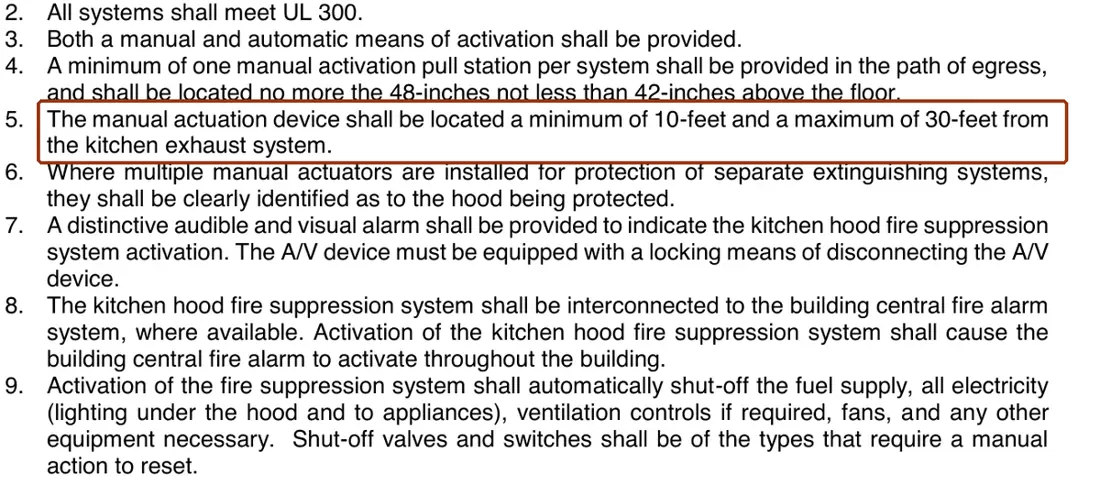
Ask the fire marshal’s plan reviewer three questions before ordering the hood: which IFC and NFPA 96 editions apply, the permitted pull-station distance, and whether the acceptance test must be witnessed, as Anna requires. Duluth and Kerrville each issue a separate fire suppression permit with its own plan set, and our guide to commercial building permits covers the building permit that runs beside it.
Which Class K extinguishers does the code require?
Cooking equipment that uses vegetable or animal oils and fats, or solid fuel, needs a Class K portable extinguisher within 30 feet of travel under IFC 2021 Sections 906.1 and 906.4, and IFC 906.2 sends selection and maintenance to NFPA 10. The count follows the fryers: one 1.5-gallon unit covers up to four fryers holding 80 pounds of cooking medium each.
The worked example below applies the IFC 906.4 rules to a fictional line with 8 fryers, 1 wood-fired oven and 1 oversized fryer. Every input is shown so you can swap in your own equipment schedule:
| Equipment (fictional example) | Input | Rule | Class K result |
|---|---|---|---|
| 8 fryers | 50 lb of oil each, at or under the 80 lb limit | IFC 906.4.2, items 1 and 2: one unit per group of 4 | 2 units of 1.5 gal |
| 1 wood-fired oven | Firebox 4 cu ft, at or under the 5 cu ft limit | IFC 906.4.1 | 1 unit of 2.5 gal (or 2 of 1.5 gal) |
| 1 large fryer | 7 sq ft of surface, over the 6 sq ft limit | IFC 906.4.2, item 3 | Per the extinguisher maker’s recommendation |
| Minimum before the maker’s rule | 2 x 1.5 gal + 1 x 2.5 gal | Sum | 3 units, 5.5 gal |
Every Class K unit needs a placard: Kerrville requires a sign near the extinguisher stating that the fire protection system shall be activated before the extinguisher is used. IFC 906.4 also requires the extinguisher to be compatible with the system’s agent. For staff training, OSHA 29 CFR 1910.157 requires a monthly visual inspection under paragraph (e)(2) and an annual maintenance check under (e)(3).
Do you need a new system, a re-evaluation or only service?
The answer turns on four checks: whether the appliances need a Type I hood under IMC 507.2, whether the existing system is listed to UL 300, whether cooking media or appliance positions are changing under IFC 904.13.5.1, and whether service is current under IFC 904.13.5.2. The table and flowchart apply the same thresholds. This is general code information, not legal or insurance advice; the fire code official’s reading governs.
| If | Then | Rule |
|---|---|---|
| Appliances produce grease or smoke and no system exists | Install a UL 300 listed system with the Type I hood | IMC 507.2 and 509.1; IFC 904.13 |
| Electric appliance tested to UL 710B at 5 mg/m3 of grease or less at 500 cfm | A Type I hood, and so hood suppression, may not be required | IMC 507.2 exception |
| Existing system is not listed to UL 300 | Plan a replacement; it is required once cooking media, positions or appliances change | IFC 904.13 and 904.13.5.1 |
| Swapping or moving appliances under the hood | Installer re-checks nozzle coverage; Kerrville requires resubmittal for any deviation from approved plans | IFC 904.13.5.1; Kerrville item 18 |
| Adding fryers beyond 4 at up to 80 lb each | Add one 1.5-gal Class K for each additional group of 4 | IFC 906.4.2 |
| Solid fuel appliance with a firebox of 5 cu ft or less | One 2.5-gal or two 1.5-gal Class K; inspect the hood monthly | IFC 906.4.1; Table 606.3.3.1 |
| 24-hour, charbroiling or wok cooking | Inspect the hood and duct every 3 months | IFC Table 606.3.3.1 |
| The system discharged | Service and recharge before cooking; reset fuel and power by hand | IFC 904.13.5.2 and 904.13.2 |
| The building has a fire alarm system | Connect and monitor the kitchen system under NFPA 72 | IFC 904.3.5 |
On a build-out, the suppression system is tested twice: the contractor’s pre-test, then the fire marshal’s acceptance test, which Kerrville books at least 1 business day after the pre-test. That sign-off is one of the inspections behind a certificate of occupancy.
Second-generation spaces need the same 4 checks before lease signing, because a reused hood with an old system becomes a replacement the day the menu changes. Our guides to tenant improvement contractors and commercial renovation contractors cover how that scope is priced. The fire marshal’s acceptance test belongs in the building commissioning plan on larger projects.
The system protects the hood and duct described in our commercial kitchen hood guide, and the grease buildup it guards against is removed on the schedule in our hood cleaning guide.
The rest of the building follows IFC Table 906.3(1), with travel, rating and mounting rules covered in our guide to commercial fire extinguisher requirements.
How we compiled this
We read the 2021 International Fire Code and International Mechanical Code on ICC Digital Codes, the NFPA and UL Standards & Engagement document pages for current editions, OSHA’s 29 CFR 1910.157 and 1910.160, a Minnesota Department of Health guide that quotes NFPA 96, 17 and 17A section numbers, a Bloomington fire marshal presentation and handouts from 3 city fire marshals. Prices come from 14 award records pulled from the public USAspending.gov API, for 15 primary documents plus 14 award records, accessed October 20 and rechecked October 26, 2026. We did not test any system, and NFPA 96 and 17A section text is quoted through the Minnesota guide (2011 and 2009 editions) because the current editions require an NFPA account; where NFPA committee documents quote the 2024 text, we cite that edition instead.
Frequently asked questions
How much does a kitchen hood fire suppression system cost?
In federal award records from 2022 to 2026, one semiannual service order cost $2,125 to $3,585, replacing or installing one system $9,249 to $62,834, and replacing every kitchen system in a large federal building $388,442. The records do not list hood length or nozzle count, so ask bidders to price the system, gas valve, shunt trip and alarm tie-in separately.
What triggers a commercial kitchen fire suppression system?
Heat triggers it automatically when a fusible link in the detection line over the appliances, plenum or duct separates, and a person can trigger it with the manual pull station. IFC 2021 Section 904.13.1 places that pull station 10 to 20 feet from the exhaust system, 42 to 48 inches above the floor, near an exit, with no more than 40 pounds of pull force.
Does the hood suppression system shut off the gas?
Yes. IFC 2021 Section 904.13.2 requires activation to shut off the fuel or electric power supply to the cooking equipment automatically, and the reset must be manual. Kerrville, Texas also requires shunt-trip breakers for equipment, lighting and receptacles under the hood, while the hood exhaust fan motors stay on and make-up air shuts off during the acceptance test.
Do you need a Class K extinguisher if you have a hood suppression system?
Yes. IFC 2021 Section 906.4 requires a Class K portable extinguisher for cooking with vegetable or animal oils and fats, placed within 30 feet of travel under Section 906.1. One 1.5-gallon unit covers up to four fryers of 80 pounds each. A placard must say the fixed system is activated before the extinguisher is used, as the Kerrville guideline requires.
How often do fusible links need to be replaced?
IFC 2021 Section 904.13.5.3 requires fusible links and automatic sprinkler heads to be replaced annually, with frangible bulbs exempt. NFPA 96 (2011) Section 11.2.4, as quoted by the Minnesota Department of Health, requires metal-alloy links every 6 months. Replacing links at each 6-month service meets both rules; keep the dated links, as Kerrville requires.
Is a dry chemical kitchen system still allowed?
A pre-engineered dry chemical system is allowed if it is tested to UL 300, listed and installed under NFPA 17, per IFC 2021 Section 904.13. Older systems that are not listed to UL 300 must be brought into compliance when cooking media, appliance positions or appliances change, under Section 904.13.5.1. NFPA 17 (2009) also requires dry chemical cylinders to be examined every 6 years.
Who can install or service a kitchen suppression system?
IFC 2021 Section 904.13.5.2 requires service by qualified individuals, with a certificate sent to the fire code official. Local rules go further: Duluth, Minnesota requires installers certified by the manufacturer, and Kerrville and Anna, Texas require a state fire extinguisher ECR license for the installing company plus a PL, A or K license for the designer.
Sources
- International Code Council: International Fire Code 2021, Chapter 9 (Sections 904.2.2, 904.3.5, 904.13, 906), accessed 2026-10-20.
- International Code Council: International Fire Code 2021, Chapter 6 (Section 606, Table 606.3.3.1), accessed 2026-10-20.
- International Code Council: International Mechanical Code 2021, Chapter 5 (Sections 507, 509.1), accessed 2026-10-20.
- National Fire Protection Association: NFPA 96 document page (2027 edition), accessed 2026-10-20.
- National Fire Protection Association: NFPA 17A document page (2027 edition), accessed 2026-10-20.
- National Fire Protection Association: NFPA 10 document page (2026 edition), accessed 2026-10-20.
- UL Standards & Engagement: UL 300, Edition 4, accessed 2026-10-20.
- Minnesota Department of Health: Protection of Kitchen Cooking Equipment (rev. June 2024), accessed 2026-10-20.
- City of Kerrville Fire Marshal: Section 4: Commercial Kitchen Fire Suppression Systems, accessed 2026-10-20.
- City of Duluth: HVAC Commercial Hood Suppression Systems (Doc 32), accessed 2026-10-20.
- City of Anna Fire Marshal’s Office: Kitchen Hood System (Commercial), accessed 2026-10-20.
- eCFR: 29 CFR 1910.160, Fixed extinguishing systems, general, accessed 2026-10-20.
- eCFR: 29 CFR 1910.157, Portable fire extinguishers, accessed 2026-10-20.
- City of Bloomington, MN: Fires at Food Establishments (January 21, 2014), accessed 2026-10-20.
- USAspending.gov: Contract award 47PC5426F0402, accessed 2026-10-20.
- USAspending.gov: Contract award 36C24623P1930, accessed 2026-10-20.
- USAspending.gov: Contract award N4008022F4924, accessed 2026-10-20.
- USAspending.gov: Contract award 36C26226P1461, accessed 2026-10-20.
- USAspending.gov: Contract award N6247822F4418, accessed 2026-10-20.
- USAspending.gov: Contract award 47PE5526F0450, accessed 2026-10-20.
- USAspending.gov: Contract award 36C26023P1014, accessed 2026-10-20.
- USAspending.gov: Contract award N4008524F5525, accessed 2026-10-20.
- USAspending.gov: Contract award 15B61926P00000025, accessed 2026-10-20.
- USAspending.gov: Contract award 47PF0022F0476, accessed 2026-10-20.
- USAspending.gov: Contract award 15B30224P00000475, accessed 2026-10-20.
- USAspending.gov: Contract award 15B61926P00000084, accessed 2026-10-26.
- USAspending.gov: Contract award FA488724P0008, accessed 2026-10-26.
- USAspending.gov: Contract award SPE8E323FJ4XW, accessed 2026-10-26.
- National Fire Protection Association: NFPA 96 Second Draft meeting agenda, September 2025 (quotes NFPA 96-2024 sections 12.2.1 and 12.3.3), accessed 2026-10-26.
- National Fire Protection Association: NFPA 17 First Draft First Revision statements, 2021 (FR-14, fusible link replacement), accessed 2026-10-26.