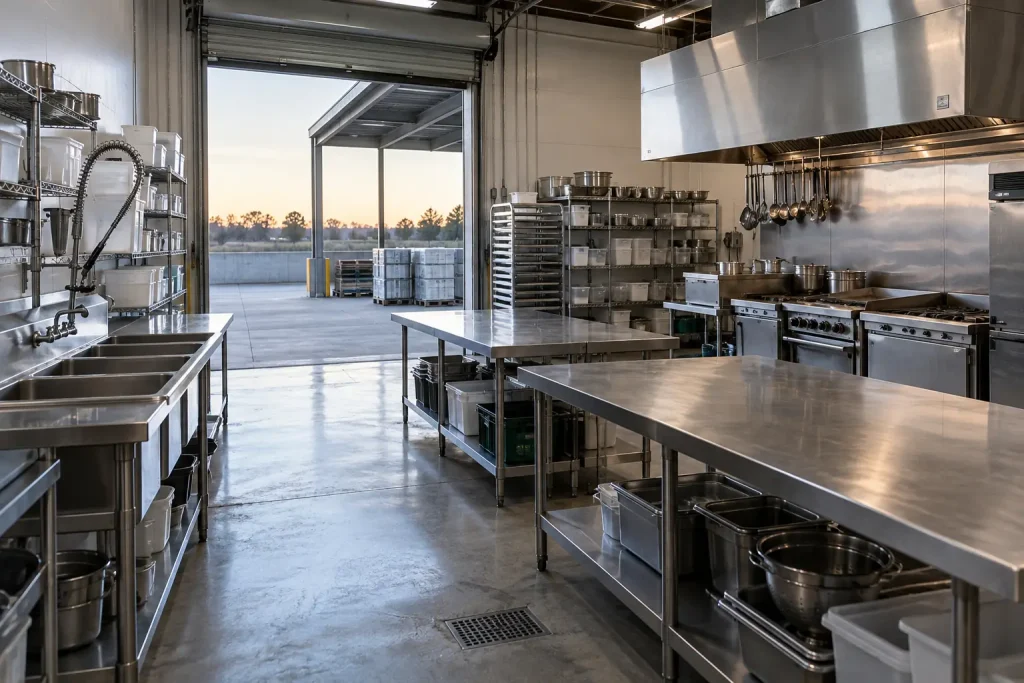
A commissary kitchen is a permitted commercial kitchen that food trucks and caterers use as a base for prep, storage, cleaning, water and waste: Texas, Florida and New York City make mobile units report to one daily.
Key takeaways
- The FDA Food Code 2022, the model code states adopt, calls a truck’s home base a “servicing area” for cleaning, dumping waste, refilling water and ice and loading food, and lets the local health department decide from the menu whether a truck needs one (FDA Food Code 2022, §1-201.10(B) and Annex 7).
- Daily return is the rule in Texas (25 TAC §228.221(b)(1)), Florida (Rule 61C-4.0161(2)(c)), New York City (Health Code §89.19(l)) and Indiana (410 IAC 7-24 §113, quoted by the St. Joseph County Department of Health).
- Florida exempts self-sufficient trucks from its commissary rule under 61C-4.0161(2)(h), and North Carolina lets a truck that meets every commissary sanitation rule serve as its own base (G.S. 130A-248(c1)).
- In The Food Corridor’s 2023 operator survey, 68 of 161 kitchens (42%) averaged $20 to $29 an hour and 81.4% averaged under $30 (2023 Shared Kitchen Operator Survey).
- Nineteen Texas commissary build-outs filed with the state from 2022 to 2026 had a median estimated cost of $85.71 per square foot; the middle half ran $45.00 to $209.35 (TDLR TABS filings, CB&C calculation).
- A 1,750 sq ft build at the median, $150,000, spread over 10 years equals $1,250 a month, the cost of 50 rented hours at $25 an hour (CB&C calculation).
What is a commissary kitchen?
A commissary kitchen is a licensed, inspected commercial kitchen that serves as the home base for mobile food businesses and off-site caterers. New York City’s Health Code §89.03(f) lists the five services one provides: storing the unit, cleaning and sanitizing it, washing its equipment and utensils, disposing of liquid and solid waste, and supplying potable water, food and supplies (NYC Health Code Article 89).
The FDA’s model code uses a narrower term. The FDA Food Code 2022 defines a servicing area in §1-201.10(B) as “an operating base location to which a mobile food establishment or transportation vehicle returns regularly for such things as vehicle and equipment cleaning, discharging liquid or solid wastes, refilling water tanks and ice bins, and boarding food.” A commissary kitchen pairs that servicing area with prep, cooking and storage space, the combination New York City’s five-service definition describes.
The rules we read recognize three set-ups: a shared kitchen rented by the hour or month, a private kitchen one business leases or owns, and a permitted restaurant that signs a commissary agreement with a truck. In The Food Corridor’s 2023 survey, 111 of 185 shared-kitchen operators (60%) described their facility as a commissary or commercial kitchen and 48 (26%) as an incubator.
| Number | What it means | Source |
|---|---|---|
| Daily | Return frequency for mobile units in Texas, Florida, New York City and Indiana | 25 TAC §228.221; Fla. 61C-4.0161; NYC §89.19(l) |
| 5 services | Storage, unit cleaning, utensil washing, waste disposal, water and supply loading | NYC Health Code §89.03(f) |
| $20 to $29/hr | Average hourly rate at 42% of 161 surveyed shared kitchens, fall 2023 | The Food Corridor, 2023 survey |
| 1,000 to 3,000 sq ft | Most common shared-kitchen size: 74 of 184 kitchens (40%) | The Food Corridor, 2023 survey |
| $85.71/sq ft | Median estimated build-out cost, 19 Texas commissary filings, 2022 to 2026 | TDLR TABS, CB&C calculation |
| $50,000 | Texas project cost at which plans go to TDLR for accessibility review | Tex. Gov’t Code §469.101 |
| 1 year | Term of a New York City mobile food commissary permit | NYC Health Code §89.09(c) |
Who has to use a commissary kitchen?
Food trucks, trailers and pushcarts that prepare or hold temperature-controlled food are the main group, because the state and city rules below tie them to a base for water, waste and storage. Caterers are the second group: the FDA Food Code 2022 lists a “catering operation” as a food establishment in §1-201.10(B), and §6-202.111 bars running a food establishment from a private home. Meal-prep and delivery-only brands use commissaries for the same reason.
Food trucks, trailers and carts
Mobile units need a commissary when the menu needs one. Annex 7, Chart 4-D of the FDA Food Code 2022 says the decision to require “a commissary or servicing area should be based on the menu, type of operation, and availability of on-board or on-site equipment.” A truck selling only prepackaged food that needs no temperature control falls outside the Food Code’s definition of a food establishment, under paragraph (3)(a).
North Carolina writes the cart and truck split into statute. Under G.S. 130A-248(c1), a pushcart must use a permitted restaurant or commissary as its base, while a mobile food unit may skip the base if it meets all sanitation requirements of a permitted commissary. Raw meat, poultry and fish must still be prepared in a permitted commissary or restaurant in pre-portioned or ready-to-cook form.
Caterers, meal prep and delivery-only kitchens
Caterers who cook temperature-controlled food need a permitted kitchen because the Food Code’s private home exception in §1-201.10(B)(3)(d) covers only food that is not time and temperature controlled, such as bake-sale items. Florida goes further for mobile units: Rule 61C-4.0161(2)(g) bars preparing food, storing equipment or washing wares in a private residence, and bars taking water from or dumping wastewater at one (Fla. Admin. Code 61C-4.0161).
Meal-prep services, packaged-food startups and delivery-only restaurant brands rent the same kitchens. In the 2023 survey, 161 of 167 responding operators (96%) named renting shared space for food production as a top-three revenue source, and 120 (72%) named cold or dry storage, so production renters, not just trucks, fill most booking calendars.
Which state and city rules require a commissary kitchen?
The FDA Food Code is a model, so commissary rules come from the state and city codes that adopt it. The table compares eight rule sets we read in full on primary sites in October 2026. Texas, Florida, New York City and Indiana require a daily return. California ties every mobile food facility to a commissary. North Carolina and Florida carve out trucks that carry their own facilities.
| Jurisdiction | Rule | What it requires | Exemption or limit | Source |
|---|---|---|---|---|
| FDA model code | Food Code 2022, §1-201.10(B); Annex 7 Chart 4-D | Servicing area for cleaning, waste, water, ice and loading food | Local regulator decides by menu; prepackaged non-TCS sellers are not food establishments | FDA |
| California | Health and Safety Code §114295 | Mobile food facilities operate in conjunction with a commissary and are stored at one or another approved location | (b)(1): fixed-position units at community events with water and liquid waste disposal | California Legislative Information |
| Texas | 25 TAC §228.221(b) | Operate from a central preparation facility or fixed food establishment; report daily for supplies, cleaning and servicing | (c)(1)(C): no servicing area where only packaged food is placed on the unit | Texas Administrative Code |
| Florida | Fla. Admin. Code 61C-4.0161(2)(c) and (e) | Approved commissary with potable water and waste disposal; report at least daily; file DBPR HR-7022 before use | (2)(h): self-sufficient vehicles exempt; (5) utility hookup for 1 day’s operation | Florida Administrative Code |
| North Carolina | G.S. 130A-248(c1) | Pushcarts based at a permitted restaurant or commissary | Mobile food unit meeting all commissary sanitation rules may be its own base | N.C. General Statutes |
| New York City | Health Code §89.05(a)(2), §89.19(l), §89.27 | Proof of a permitted commissary; units cleaned and serviced at least daily there | No cleaning on streets or sidewalks, §89.27(d) | NYC DOHMH |
| Indiana (St. Joseph County) | 410 IAC 7-24 §113, county guide | Return to a commissary or servicing area at least once daily; written agreement renewed annually | Owner’s own permitted restaurant may serve as commissary | St. Joseph County Department of Health |
| Utah | Utah Code 11-56-104 | Annual permit from the local health department; permits valid statewide | No commissary subsection in the text in force since 5/3/2023 | Utah Legislature |
Summaries of these rules drift from the text. The table below sets three common claims against the primary source as we checked it on October 20, 2026. None of the corrections means a business can skip the local health department; they mean the question to ask is narrower.
| What summaries say | What the primary source says | Source |
|---|---|---|
| Utah bars local health departments from requiring a commissary for tier-one trucks | That was H.B. 476 (2023), which would have added subsection (5) with five conditions; the 11-56-104 text published as in force since 5/3/2023 has no commissary provision | H.B. 476 (2023) |
| Self-contained trucks are exempt from commissary rules | True in Florida for self-sufficient vehicles under 61C-4.0161(2)(h); Texas 25 TAC §228.221(b)(1) still requires a daily report to a fixed base | Fla. 61C-4.0161; 25 TAC §228.221 |
| A ranking explainer says rent runs $15 to $50 an hour | 131 of 161 surveyed kitchens (81.4%) averaged under $30; 3 (about 2%) averaged $50 or more | The Food Corridor, 2023 survey |
What must a commissary kitchen have to pass inspection?
A commissary is built to the same physical-facility rules as a restaurant kitchen, plus a servicing area where trucks fill water and dump waste. Texas 25 TAC §228.221(b)(2) says the base must comply with Food Code Chapter 6, Physical Facilities. The FDA Food Code 2022 sets the measurable minimums: a 3-compartment sink, 85°F water at handsinks and 50 foot-candles at prep surfaces; states still on the 2017 edition apply 100°F at handsinks, as our commercial kitchen sink guide explains.
| Requirement | Minimum | Rule | Source |
|---|---|---|---|
| Warewashing sink | At least 3 compartments, large enough to immerse the largest equipment | Food Code §4-301.12(A), (B) | FDA Food Code 2022 |
| Handwashing sink | Water at 85°F (29.4°C) or more; metered faucets run 15 seconds | Food Code §5-202.12(A), (C) | FDA Food Code 2022 |
| Lighting at prep surfaces | 540 lux (50 foot-candles) | Food Code §6-303.11(C) | FDA Food Code 2022 |
| Lighting in walk-ins and dry storage | 108 lux (10 foot-candles) at 30 inches above the floor | Food Code §6-303.11(A) | FDA Food Code 2022 |
| Servicing area cover | Overhead protection, except areas used only for closed-hose water loading or waste discharge | Food Code §6-202.18; 25 TAC §228.221(c)(1)(A) | FDA; Texas |
| Servicing area surface | Smooth, nonabsorbent (concrete or machine-laid asphalt), graded to drain | Fla. 61C-4.0161(2)(d); 25 TAC §228.221(c)(1)(D) | Florida; Texas |
| Truck cleaning area (NYC) | Large enough for the largest unit served; physically separated from food operations | NYC Health Code §89.27(c) | NYC DOHMH |
| Waste from trucks | Removed at an approved waste servicing area or by a sewage transport vehicle | Food Code §5-402.14 | FDA Food Code 2022 |
Local checklists add items the model code leaves to plumbing and fire officials. The St. Joseph County, Indiana planning guide lists 17 commissary items, including a dump station when trucks carry water and wastewater tanks, a grease trap if required, a properly located mop sink, and ventilation with make-up air where high heat, steam or grease is produced. Hood types and exhaust rates for the cooking line are in our commercial kitchen hood guide, and grease interceptor sizing is covered in our guide to restaurant build-out contractors.
How much does it cost to rent a commissary kitchen?
Most shared commissaries charge by the hour and bill monthly. In The Food Corridor’s survey of operators, collected October to November 2023, 79% of 159 kitchens booked by the hour and 91% of 158 billed monthly. The most common average rate band was $20 to $29 an hour, reported by 68 of 161 kitchens (42%); 54 more (34%) averaged $10 to $19 (The Food Corridor).
| Average hourly rate | Kitchens | Share of 161 | Source |
|---|---|---|---|
| Under $10 | 9 | 6% | The Food Corridor, 2023 |
| $10 to $19 | 54 | 34% | The Food Corridor, 2023 |
| $20 to $29 | 68 | 42% | The Food Corridor, 2023 |
| $30 to $39 | 21 | 13% | The Food Corridor, 2023 |
| $40 to $49 | 6 | 4% | The Food Corridor, 2023 |
| $50 to $59 | 2 | 1% | The Food Corridor, 2023 |
| $60 or more | 1 | 0.5% | The Food Corridor, 2023 |
Hourly rates leave out the fees that decide the monthly bill. Four live listings on The Kitchen Door marketplace, read October 20, 2026, show the spread: a food-truck spot without kitchen time, monthly packages with included hours, and an unlimited plan. Check what each price includes before comparing, because storage shelves, water loads and application fees are often billed separately.
| Location | Plan | Price | Included or extra | Source |
|---|---|---|---|---|
| Groveland, FL | Truck or cart base, no kitchen time | $75/month or $799/year plus tax | $105 application fee; water load and disposal from $15/month | Listing, 2026-10-20 |
| Groveland, FL | 100 hours/month | $1,250 plus tax | Extra hours $13; one-year lease, 90-day notice | Listing, 2026-10-20 |
| Beech Grove, IN | Food trucks, trailers, carts | $240/month | Kitchen hours $15 to $30; caterer plan $275 with 14 hours | Listing, 2026-10-20 |
| Anaheim, CA | 30 hours/month | $1,125 | Storage and utilities included; extra hours $25; truck spot $1,300/month | Listing, 2026-10-20 |
| Fort Collins, CO | Unlimited access | $700/month | One dry rack included; walk-in cooler shelves $100/month | Listing, 2026-10-20 |
How much does it cost to build out a commissary kitchen?
Texas publishes real numbers. Under Texas Government Code §469.101, plans for projects estimated at $50,000 or more go to the Texas Department of Licensing and Regulation, which posts each filing’s estimated cost and square footage. The 19 commissary filings we kept, registered 2022 to 2026, had a median of $85.71 per square foot and a median project cost of $500,000.
| TABS project | County | Registered | Scope (as filed) | Est. cost | Sq ft | $/sq ft |
|---|---|---|---|---|---|---|
| TABS2025020139 | Harris | 2025 | Hoods added to an existing commissary | $250,000 | 20,221 | $12.36 |
| TABS2024008379 | Harris | 2023 | Interior remodel, existing building | $650,000 | 51,641 | $12.59 |
| TABS2026023722 | Harris | 2026 | New kitchen and prep area, interior | $85,000 | 2,989 | $28.44 |
| TABS2026021390 | Fort Bend | 2026 | Commissary fit-out inside a warehouse | $1,500,000 | 34,977 | $42.89 |
| TABS2025015263 | Dallas | 2025 | Existing building remodeled as commissary | $585,000 | 13,000 | $45.00 |
| TABS2026002156 | Travis | 2025 | Renovation of an existing commissary | $500,000 | 9,240 | $54.11 |
| TABS2022024327 | Travis | 2022 | Tenant finish-out, existing space | $200,000 | 3,497 | $57.19 |
| TABS2022024196 | Bexar | 2022 | Interior renovation, 1-story masonry | $250,000 | 3,452 | $72.42 |
| TABS2026017488 | Dallas | 2026 | Cold-kitchen remodel, phase II | $218,000 | 2,735 | $79.71 |
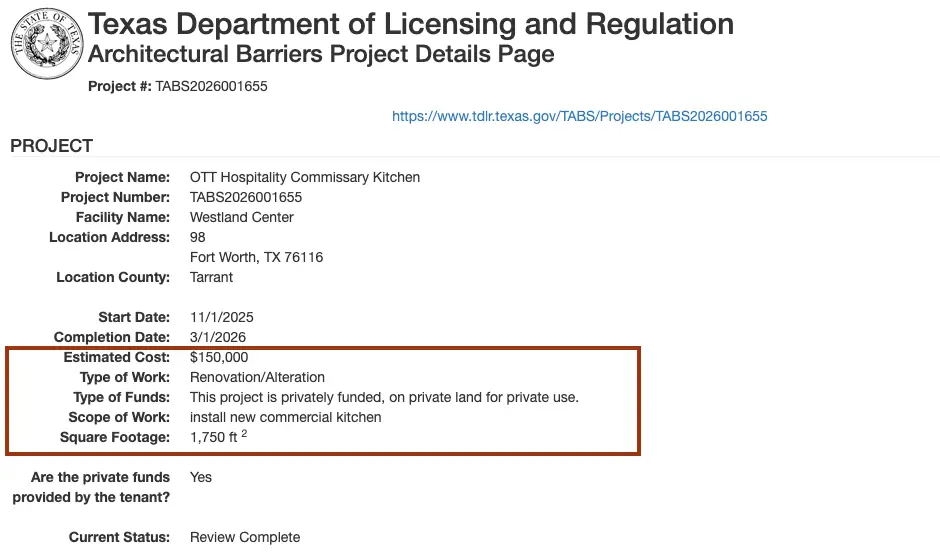
| TABS2026001655 | Tarrant | 2025 | New commercial kitchen installed | $150,000 | 1,750 | $85.71 |
| TABS2025017440 | Dallas | 2025 | Shell finish-out with offices | $750,000 | 8,638 | $86.83 |
| TABS2024025164 | Dallas | 2024 | Shell finish-out, baking facility | $750,000 | 8,380 | $89.50 |
| TABS2022008877 | Travis | 2022 | Change of use to food-prep kitchen | $600,000 | 5,563 | $107.86 |
| TABS2026017059 | Dallas | 2026 | Office side converted to tamale prep | $325,000 | 1,619 | $200.74 |
| TABS2022027438 | Harris | 2022 | Cafe plus commissary renovation | $300,000 | 1,433 | $209.35 |
| TABS2025021866 | Travis | 2025 | Existing building converted | $455,296 | 2,100 | $216.81 |
| TABS2023000278 | Dallas | 2022 | Metal shell building converted | $1,800,000 | 7,011 | $256.74 |
| TABS2024011323 | Tarrant | 2024 | Kitchen and break room renovation | $1,900,000 | 4,616 | $411.61 |
| TABS2024003214 | Winkler | 2023 | New building, kitchen and volunteer room | $1,000,000 | 1,400 | $714.29 |
The spread, $12.36 to $714.29 per square foot, comes from scope, not region. The cheapest filing added hoods to a 20,221 sq ft kitchen that already existed. The most expensive was new construction: a 1,400 sq ft kitchen and volunteer building in Winkler County. Filings under 5,000 sq ft had a median of $143.22 per square foot; filings of 5,000 sq ft or more had $54.11, likely because fixed items such as hoods and grease interceptors spread over less floor.
| Scope type in the filing | Example (TABS) | $/sq ft | What drives it |
|---|---|---|---|
| Add equipment to an existing commissary | TABS2025020139 | $12.36 | Hoods only; walls, plumbing and floors already in place |
| Fit-out inside a warehouse or shell | TABS2026021390 | $42.89 | 34,977 sq ft spreads hoods, sinks and drains over a large floor |
| Small conversion of a non-kitchen building | TABS2025021866 | $216.81 | 2,100 sq ft; new plumbing, ventilation and finishes for a change of use |
| Metal shell converted to a kitchen | TABS2023000278 | $256.74 | 7,011 sq ft pre-engineered metal building brought up to food code |
| New construction | TABS2024003214 | $714.29 | 1,400 sq ft; site, structure and every system built new |
Treat these as filer estimates, not bids. TABS records the cost the owner’s representative estimated when registering for accessibility review, and the square footage is the area filed, which can include offices and storage. The filings do not say whether cooking equipment is in the estimate. For a pre-engineered metal shell like TABS2023000278, our page on metal building contractors explains what the shell price covers, and our commercial construction cost per square foot guide shows how to escalate an older estimate.
Is it cheaper to rent or build a commissary kitchen?
Renting wins at low hours and building wins only at steady, high use. The median Texas filing, TABS2026001655, estimated $150,000 for a 1,750 sq ft kitchen. Spread over 120 months with no interest, that is $1,250 a month before rent on the space, equipment, utilities or permits. At a $25 hourly rate, the same $1,250 buys 50 hours of shared kitchen time every month.
| Line | Input | Arithmetic | Result |
|---|---|---|---|
| Build cost, median filing | 1,750 sq ft at $85.71/sq ft | 1,750 × $85.71 | $150,000 |
| Build cost per month | 10-year horizon, no financing | $150,000 ÷ 120 | $1,250 |
| Rent hours that equal it | $25/hour (Fort Collins and Anaheim listings) | $1,250 ÷ $25 | 50 hours/month |
| Build at the upper quartile | 1,750 sq ft at $209.35/sq ft | 1,750 × $209.35 ÷ 120 | $3,053.02/month |
| Rent hours that equal it | $25/hour | $3,053.02 ÷ $25 | 122 hours/month |
| Rent 60 hours, survey band low | $20/hour | 60 × $20 | $1,200/month |
| Rent 60 hours, survey band high | $29/hour | 60 × $29 | $1,740/month |
| Rent 60 hours, Anaheim package | $1,125 for 30 hours + $25/hour | $1,125 + 30 × $25 | $1,875/month |
| Rent 60 hours, Groveland 100-hour plan | $1,250 for 100 hours | Flat package | $1,250/month |
The arithmetic leaves out the costs that usually tip the decision toward renting: the lease on the building, financing, equipment the filings may exclude, and the plan review and permit fees in the next section, such as North Carolina’s $120 permit fee under G.S. 130A-248(d). It also leaves out what tips it the other way: exclusive access, no booking conflicts, and storage you control. If your projected hours sit near the break-even line, get two bids built on the same scope; our checklist on how to compare construction bids covers what to line up.
How do you get a commissary approved or signed up?
Renting takes paperwork; building takes plan review. A truck owner using someone else’s kitchen files proof of the arrangement: Florida requires form DBPR HR-7022, Commissary Services Notification, before the truck uses the commissary, and St. Joseph County, Indiana requires a written commissary agreement renewed every year. Building your own starts with plans the health department must approve before construction, under Food Code §8-201.11.
- Ask what your menu needs. Food Code Annex 7, Chart 4-D ties the commissary decision to the menu and on-board equipment; bring your menu and truck specs to the permitting health department.
- Submit plans: menu, volume, layout. Food Code §8-201.11 requires plans before construction, conversion or remodeling, and §8-201.12 lists the intended menu, anticipated volume, layout, mechanical schematics and materials. North Carolina caps local plan review fees at $250 under G.S. 130A-248(f); St. Joseph County charges $100 under 3,000 sq ft.
- Building permit; Texas TDLR filing at $50,000+. The building department issues the construction permit, explained in our guide to commercial building permits. In Texas, projects of $50,000 or more also go to TDLR for accessibility review under Gov’t Code §469.101.
- Build: 3-compartment sink, 85°F handsinks, 50 fc. Food Code §4-301.12, §5-202.12 and §6-303.11 set those minimums; add the covered servicing area and dump station if trucks will service there.
- Preoperational inspection and permit. Food Code §8-203.10 provides for an inspection before opening; in St. Joseph County, building and fire approval come before the health department’s opening inspection. The building side closes with a certificate of occupancy.
- Register the truck-to-kitchen link. File Florida HR-7022 for each commissary used, keep New York City’s commissary permit current (valid 1 year under §89.09(c)), and renew county agreements on schedule.
Eighteen of the 19 Texas filings were renovations or additions, so the job is usually a tenant improvement rather than new construction. Our page on tenant improvement contractors covers shell versus second-generation space. A large warehouse fit-out like TABS2026021390 (34,977 sq ft) follows the same slab, dock and sprinkler checks as our guide to warehouse construction.
Do you need a commissary, and should you rent or build?
Work down the table in order: exemptions first, then the daily-return rules, then the money. The thresholds come from the rule sections and cost data above. Each “then” is a starting point for the conversation with your health department or builder, not a ruling; local codes can add requirements, and this page is not legal advice.
| If | Then | Rule or data |
|---|---|---|
| Only prepackaged food that needs no temperature control | Not a food establishment under Food Code §1-201.10(B); ask your health department | FDA Food Code 2022 |
| Florida truck that is self-sufficient | Exempt from the commissary rule: Fla. Rule 61C-4.0161(2)(h) | Fla. Admin. Code |
| North Carolina truck that meets every commissary sanitation rule | Truck can be its own base: G.S. 130A-248(c1); raw meat still prepped in a permitted kitchen | N.C.G.S. |
| Truck in Texas, Florida (not self-sufficient), New York City or Indiana | Use a permitted commissary; return daily in TX, FL, NYC and Indiana | TX; FL; NYC; IN |
| California mobile food facility | Operate with a commissary and store the unit there unless (b)(1) applies | HSC §114295 |
| Caterer cooking temperature-controlled food | Use a permitted kitchen; no private home under Food Code §6-202.111 | FDA Food Code 2022 |
| Need more than about 50 hours a month for 10 years | Price a build-out (median $85.71 per sq ft, TABS); 50 hours is the floor, because rent on the space, equipment and financing push the break-even higher | CB&C calculation from TDLR TABS |
| Need fewer hours or no 10-year horizon | Rent (42% of kitchens averaged $20 to $29 an hour) | The Food Corridor, 2023 |
| Texas build-out estimated at $50,000 or more | File with TDLR for accessibility review | Gov’t Code §469.101 |
Building a commissary means meeting the full set of rules on our commercial kitchen page, starting with the station list in our commercial kitchen equipment guide.
How we compiled this
We read 12 primary documents, including the FDA Food Code 2022, rules for California, Texas, Florida, North Carolina and Utah, New York City Health Code Article 89, a county health guide, The Food Corridor’s 2023 survey and Texas Government Code chapter 469. On October 20, 2026 we pulled all 36 TDLR TABS filings named “commissary”, kept 19 from 2022 onward and dropped three non-kitchen scopes; on October 26, 2026 we rechecked the median filing, the survey rate table, the Texas daily-return rule and the status of Utah H.B. 476 at the primary sources. We did not survey kitchens, visit sites or receive bids.
Frequently asked questions
Can a restaurant serve as a commissary for a food truck?
Often, yes. North Carolina’s G.S. 130A-248(c1) names a permitted restaurant or commissary as the base, Texas 25 TAC §228.221 allows any fixed food establishment, and St. Joseph County, Indiana lets an owner use its own permitted restaurant or sign a commissary agreement with one. The restaurant must have room to service the truck: water filling, waste disposal and storage.
Can I use my home kitchen as a commissary?
Not for a food truck or catering business in most places. FDA Food Code 2022 §6-202.111 bars running a food establishment from a private home or living quarters, and Florida Rule 61C-4.0161(2)(g) bars trucks from preparing food, storing equipment or dumping wastewater at a private residence. The Food Code’s home-kitchen exception covers only non-temperature-controlled food, such as bake-sale items.
How often does a food truck have to go to the commissary?
Daily in several jurisdictions. Texas 25 TAC §228.221(b)(1) requires a daily report for supplies, cleaning and servicing; Florida Rule 61C-4.0161(2)(c) requires at least daily when operating; New York City Health Code §89.19(l) requires cleaning and servicing at least daily; Indiana’s 410 IAC 7-24 §113 requires at least once daily. California requires operating in conjunction with, and storage at, a commissary.
What is a commissary agreement?
It is a signed document from a permitted kitchen’s owner or manager allowing a mobile unit to use the kitchen as its base. St. Joseph County, Indiana requires one renewed annually and charges $75 a year for the commissary. Florida uses a state form instead, DBPR HR-7022, Commissary Services Notification, filed before the truck uses each commissary.
Do food trucks in North Carolina need a commissary?
A pushcart does. A mobile food unit has a choice under G.S. 130A-248(c1): meet every sanitation requirement of a permitted commissary on the truck, or use a permitted restaurant or commissary as its base. Either way, raw meat, poultry and fish must be prepared in a permitted commissary or restaurant in pre-portioned or ready-to-cook form.
Is a commissary kitchen the same as a shared kitchen or incubator?
They overlap. In The Food Corridor’s 2023 survey of 185 shared-kitchen operators, 60% called their facility a commissary or commercial kitchen and 26% an incubator, which adds business training. Ownership varied: 59% were for-profit, 32% nonprofit and 4% government. A commissary can also be private, used by one restaurant group or caterer.
Sources
- U.S. Food and Drug Administration: Food Code 2022 (§1-201.10, §4-301.12, §5-202.12, §5-402.14, §6-202.18, §6-202.111, §6-303.11, §8-201.11, §8-201.12, §8-203.10, Annex 7) (accessed October 20, 2026)
- California Legislative Information: Health and Safety Code §114295 (accessed October 20, 2026)
- Texas Administrative Code (via Cornell LII): 25 Tex. Admin. Code §228.221, Mobile Food Units (accessed October 20, 2026)
- Florida Administrative Code: Rule 61C-4.0161, Mobile Food Dispensing Vehicles, Temporary Commercial Kitchens and Theme Park Food Carts (accessed October 20, 2026)
- North Carolina General Assembly: G.S. 130A-248, Regulation of food and lodging establishments (accessed October 20, 2026)
- NYC Department of Health and Mental Hygiene: Health Code Article 89, Mobile Food Vending (accessed October 20, 2026)
- St. Joseph County (Indiana) Department of Health: Planning Guide for Mobile Food Trucks (accessed October 20, 2026)
- Utah Legislature: Utah Code 11-56-104 (accessed October 20, 2026)
- Utah Legislature: H.B. 476 Food Truck Regulations (2023 General Session) (accessed October 20, 2026)
- The Food Corridor: Survey Data Summary: 2023 Shared Kitchen Operator Survey (accessed October 20, 2026)
- Texas Department of Licensing and Regulation: Texas Architectural Barriers project search (TABS), 36 commissary filings (accessed October 20, 2026)
- Texas Legislature: Government Code Chapter 469, Elimination of Architectural Barriers (accessed October 20, 2026)
- The Kitchen Door: Commissary listing, Groveland, FL (accessed October 20, 2026)
- The Kitchen Door: Commissary listing, Beech Grove, IN (accessed October 20, 2026)
- The Kitchen Door: Commissary listing, Anaheim, CA (accessed October 20, 2026)
- The Kitchen Door: Commissary listing, Fort Collins, CO (accessed October 20, 2026)