Construction management companies sell one of three services: an adviser paid a fee, an at-risk builder guaranteeing a maximum price, or a general contractor bidding a lump sum. Public contracts from 2015 to 2018 show fees of 3.75% to 6%.
Key takeaways
- Mt. San Antonio Community College District’s 2015 construction management agreement pays a construction-phase fee of 6% on projects of $1 million or less, falling to 3.8% above $20 million, plus a 0.75% to 1% preconstruction fee (Mt. SAC agreement §2.1).
- Henderson County, North Carolina’s April 2018 CM-at-risk GMP for Edneyville Elementary totaled $21,852,605, with a 3.75% fee ($730,978) and $1,169,965 of general conditions, together 8.70% of the GMP (Henderson County board packet).
- On a private job no statute sets the fee or the firm’s duties: the AIA agreements leave the fee as a blank to fill in (AIA C132-2019 §11.1; A133-2019 §6.1.2), so the public figures above are benchmarks, not rules.
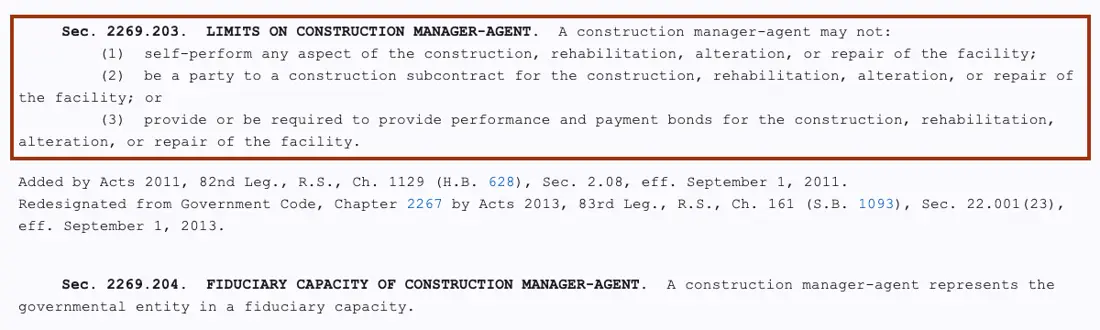
- Public work in Texas only: an agency construction manager may not self-perform work, hold subcontracts or post performance and payment bonds, and acts as the owner’s fiduciary (Texas Gov. Code 2269.203 and 2269.204).
- The Certified Construction Manager credential requires at least 48 months of responsible-in-charge experience, a 175-question exam and 25 renewal points every 3 years (CCM Application Handbook v4.8, March 2026).
What do construction management companies do?
A construction management company runs the cost, schedule, bidding and quality side of a building project for the owner. As an adviser it consults during design and construction and manages the owner’s separate trade contracts, the role set out in AIA C132-2019 and, for Texas public owners, Government Code 2269.201. At-risk firms do the same work and then build the project under a guaranteed maximum price, so one label covers 3 business models.
Private owners can borrow a public scope as a checklist, because no statute fixes the scope on a private job. The scope in a real public contract is specific. Exhibit A of the Mt. San Antonio Community College District agreement (September 10, 2015) has the construction manager set up project accounting and budget systems (§2.1.7), split the work into prime bid packages (§2.1.9), keep a prequalified contractor list (§2.1.10) and run bidder outreach and pre-bid conferences (§2.2). Under §1.3 that work must be performed by or under a licensed architect, registered engineer or licensed contractor.
How many construction management companies are there?
Federal data do not count construction management firms on their own. They sit inside NAICS 236220, commercial and institutional building construction, which the Census Bureau NAICS definition says includes general contractors, design-build firms and project construction management firms. That industry had 58,379 private establishments and 761,316 jobs in 2025, according to the BLS Quarterly Census of Employment and Wages.
| Number | What it measures | Source |
|---|---|---|
| 58,379 | Private NAICS 236220 establishments in the US, 2025 annual average | BLS QCEW |
| 3.8% to 6% | Agency CM construction-phase fee by cost tier, Mt. SAC, 2015 | Mt. SAC §2.1.2 |
| 0.75% to 1% | Mt. SAC preconstruction fee, fixed after the last bid | Mt. SAC §2.1.1 |
| 3.75% | CM-at-risk fee on the cost of work, Henderson County GMP, 2018 | Henderson County |
| $1 million | Minimum professional liability per occurrence for a construction manager-agent (Texas public work only) | Tex. Gov. Code 2269.208 |
| 5% | Cap on each yearly personnel rate increase in Ohio’s K-12 CM-at-risk form | Ohio OFCC form |
| 48 months | Minimum responsible-in-charge experience for the CCM | CCM Handbook v4.8 |
| 6.00% | General conditions as a share of the cost of work, Henderson County GMP, 2018 | Henderson County |
Our state-by-state count of NAICS 236220 establishments, jobs and pay is in commercial construction companies by state.
How do agency CM, CM at risk and general contractors differ?
The three models differ on who signs the trade contracts, who posts the bonds and who absorbs an overrun. An agency CM signs nothing with the trades and works as the owner’s fiduciary. A CM at risk holds the subcontracts and guarantees a maximum price. A general contractor holds the subcontracts under a lump sum fixed after design. AIA publishes a separate contract family for each of the 3.
| Question | Agency CM (adviser) | CM at risk | General contractor | Source |
|---|---|---|---|---|
| Who signs the trade contracts? | The owner signs each prime contractor | The CM signs subcontracts | The GC signs subcontracts | Tex. Gov. Code 2269.203, 2269.206; AIA A133 |
| Who posts performance and payment bonds? | Each prime contractor, if the contract requires bonds; a Texas public agent may not post them | The CM, on the GMP | The GC, on the contract sum | 2269.203(3); Fla. Stat. 255.103 |
| How is the firm paid? | Stipulated sum, multiple or percentage | Cost of the work plus a fee, up to the GMP | Stipulated sum (lump sum) | AIA C132 §11.1; A133 §6.1; A101 |
| Who pays an overrun within scope? | The owner | The CM, above the GMP | The GC, within the lump sum | AIA A133 |
| Duty to the owner | Fiduciary on Texas public work; on private work, only what the contract says | Contractual | Contractual | 2269.204 |
| Selected on | Public: qualifications, like an architect. Private: owner’s choice | Public: qualifications, then fee and general conditions. Private: owner’s choice | Low bid, typically | 2269.207, 2269.253 |
| AIA forms | C132, A132, A232, B132 (2019) | A133-2019 with A201-2017 | A101-2017 with A201-2017 | AIA C132 cover |
The adviser’s limits are written into the contract. AIA C132-2019 §3.3.15 says the construction manager has no control over means, methods or safety and is not responsible for a contractor’s failure to perform, while its contractors sign A132-2019. Federal law treats much of the same adviser work as architect-engineer services: 40 U.S.C. 1102(2)(C) lists program management and construction phase services.
The mechanics of a guaranteed maximum price under AIA A133-2019, from early release packages to final reconciliation, are covered in our guide to construction management at risk. Owners weighing a single design and build contract instead can compare design-build vs design-bid-build.
How are construction management companies paid?
Public contracts split a construction manager’s pay into 3 buckets: a preconstruction fee, a construction-phase fee, and general conditions or staff costs. The fee is a percentage of construction cost or of the cost of the work in every public form we read, but the base and the buckets differ, so 4% in one contract is not the same money as 4% in another.
Private owners meet the same 3 buckets in AIA C132-2019 and A133-2019, which leave every rate blank. No private fee schedule is published, so the public documents below, dated 2015 to 2022, are the closest written benchmark; percentages travel across years better than dollar amounts, but ask each firm for a current proposal on the same 3 buckets.
| Owner or form | Model | Preconstruction | Fee | General conditions and staff | Source |
|---|---|---|---|---|---|
| Mt. San Antonio CCD, California, 2015 | Agency CM, multiple prime | 1% of anticipated construction cost up to $1,000,000, 0.75% above | 6%, 5.5%, 4.6%, 4% or 3.8% of construction cost by tier, billed monthly by percent complete | Separate budget submitted for approval during construction documents, built from hourly rates of $55.50 to $155.00 | Mt. SAC §2.1, Exhibit B |
| Henderson County, North Carolina, 2018 | CM at risk | Not shown in the GMP summary | 3.75% of the cost of work: $730,978 | $1,169,965 inside the GMP | GMP summary, April 4, 2018 |
| Ohio Facilities Construction Commission, K-12 form | CM at risk | Fixed fee plus capped hourly personnel and capped reimbursables | Capped percentage of cost of work plus CM contingency, by phase (§3.5) | Capped dollar amounts proposed with the GMP | OFCC Document 00 52 23 |
| Florida State University, Attachment B | CM at risk | Stipulated sum | A percentage of the cost of work, reset when the GMP is accepted | Lump sum general conditions plus estimated general requirements | FSU CM Fee Summary |
| Colorado Office of the State Architect, 2022 | CM/GC | Preconstruction services fee | Construction services fee for overhead and GMP responsibility | General conditions fees, including insurance, bonds and personnel | CMGC/GMP 101 |
| AIA C132-2019 | Agency CM | Stipulated sum, multiple or percentage (§11.1.1) | Same options (§11.1.2) | Reimbursables plus a stated markup (§11.6.2) | AIA C132 |
| AIA A133-2019 | CM at risk | Set in §5.1.1 | Lump sum, percentage of cost of work or other (§6.1.2) | Part of the cost of the work | AIA A133 |
Ohio’s form shows how a careful owner caps each bucket. The CM’s personnel rates may rise no sooner than 1 year after signing, no more than once a year and by no more than 5% each time, and a shared-savings change order returns 100% of unused CM contingency with a matching fee cut (OFCC form §3.4.1 and General Provisions).
How the preconstruction bucket is scoped, priced under A133 §5.1.1 and released by design stage is covered in our guide to preconstruction services. Fee structures without a price ceiling are compared in our cost-plus contract guide.
Where does a general contractor’s fee sit?
A general contractor on a lump sum does not disclose its fee: overhead and profit are inside the bid. IRS Statistics of Income data put building contractors’ net income at 6.04% of receipts in tax year 2022, and the 2022 Economic Census shows commercial and institutional builders passed 45.4% of receipts to subcontractors. Neither figure is a markup you can negotiate line by line.
The 2013 to 2022 trend behind those ratios is in our analysis of construction company profit margins.
What does a construction management fee cost on a real project?
On Henderson County’s Edneyville Elementary GMP, dated April 4, 2018, the construction manager’s 3.75% fee came to $730,978 and general conditions to $1,169,965. Together they were $1,900,943, or 8.70% of the $21,852,605 GMP, for an 89,635 square foot school at $243.80 per square foot. The fee alone was 3.35% of the GMP because the 3.75% applied to the cost of work only.
Scaled to a private job with a $6,000,000 cost of work, the same rates give a $225,000 fee (3.75%) and $360,000 of general conditions (6.00%), $585,000 in all (CB&C arithmetic on the Henderson ratios). General conditions are mostly site staff and site costs billed by the month, which the Colorado Office of the State Architect lists as personnel, insurance and bonds, so a smaller or slower job can carry a higher ratio.
| GMP line | Amount | Share of GMP | Basis |
|---|---|---|---|
| Trade packages, including 1.25% subcontractor bonds | $19,110,546 | 87.45% | Bid trade packages |
| Construction contingency, 2% | $382,211 | 1.75% | 2% of trade subtotal |
| Cost of work subtotal | $19,492,757 | 89.20% | Base for the fee |
| Insurance and builder’s risk, 1.30% | $284,084 | 1.30% | Percentage line |
| Payment and performance bond, 0.80% | $174,821 | 0.80% | Percentage line |
| General conditions | $1,169,965 | 5.35% | 6.00% of the cost of work |
| CM fee, 3.75% | $730,978 | 3.35% | 3.75% × $19,492,757 |
| Total GMP | $21,852,605 | 100% | Sent to the board for acceptance, April 18, 2018 |
How do fee tiers change the bill?
Tiered schedules like Mt. SAC’s charge one rate on the whole construction cost, so crossing a tier line can cut the fee in dollars. A $5,000,000 project pays $312,500 in preconstruction and CM fees, while a $5,000,001 project pays $267,500, because the CM rate drops from 5.5% to 4.6% (Mt. SAC §2.1.2). Ask whether a tiered fee is flat or marginal before you sign.
| Construction cost | Preconstruction fee | CM fee | Total fees | Share of cost |
|---|---|---|---|---|
| $1,000,000 | $10,000 (1%) | $60,000 (6%) | $70,000 | 7.00% |
| $1,000,001 | $7,500 (0.75%) | $55,000 (5.5%) | $62,500 | 6.25% |
| $5,000,000 | $37,500 | $275,000 (5.5%) | $312,500 | 6.25% |
| $5,000,001 | $37,500 | $230,000 (4.6%) | $267,500 | 5.35% |
| $8,000,000 | $60,000 | $368,000 (4.6%) | $428,000 | 5.35% |
| $20,000,000 | $150,000 | $800,000 (4%) | $950,000 | 4.75% |
| $20,000,001 | $150,000 | $760,000 (3.8%) | $910,000 | 4.55% |
As a cross-check, Henderson’s $19,492,757 cost of work run through the Mt. SAC agency schedule gives $925,906 in fees (4.75%), against the $730,978 at-risk fee, before Mt. SAC’s hourly general conditions. The gap is not a price comparison: the agency firm carries no GMP and posts no bond, and the at-risk firm does. Compare proposals only with the base, the buckets and the risk named.
What do common fee guides get wrong?
Most top-ranking fee guides quote one percentage range with no contract behind it. The public documents we read split the fee from general conditions, tie the rate to project size and treat agency and at-risk firms as different services. Four corrections matter when you compare construction management proposals in 2026.
| What a guide says | What the primary source says | Source |
|---|---|---|
| A contractor directory’s cost guide, written mainly for home projects, says construction project management runs 10% to 15% of total project cost. | Mt. SAC’s fees top out at 7.00% of cost on a $1,000,000 job, including preconstruction; Henderson’s fee plus general conditions was 8.70% of the GMP. A figure above 10% would have to include costs outside the fee in both documents. | Mt. SAC; Henderson County |
| The same directory guide says a construction project manager is not financially responsible for subcontractors’ work. | True only for the agency model. A CM at risk holds the subcontracts and pays overruns above the GMP within its scope. | AIA C132 §3.3.15; AIA A133 |
| A fee guide updated in January 2026 puts owner’s representative fees at 1% to 5% of construction cost, with no source. | We found no public owner document that publishes an owner’s representative percentage. The nearest public schedule, Mt. SAC’s agency CM, is 3.8% to 6% plus 0.75% to 1% for preconstruction. | Mt. SAC §2.1 |
| Several top-ranking explainers treat licenses and credentials as optional extras. | California limits construction project management on state work to licensed architects, registered engineers and licensed general contractors; Texas requires a license where CM-agent work is architecture or engineering. | Cal. Gov. Code 4525(e); Tex. Gov. Code 2269.205(c) |
Which type of construction management company should you hire?
Pick the model by when you need a price and who will hold the trade contracts: those 2 questions split the 3 models. If you need a ceiling before drawings are done, hire a CM at risk. If you will sign each trade yourself, hire an agency CM. If drawings are complete and you want a bid price, hire a general contractor and add an adviser only if your staff cannot run the job.
| If | Then | Threshold or rule | Source |
|---|---|---|---|
| You need a price ceiling before construction documents are finished | Hire a CM at risk and sign a GMP amendment | Benchmark: 3.75% fee on the cost of work plus general conditions of 6.00% of the cost of work (2018) | AIA A133-2019; Henderson County |
| You will sign separate contracts with each trade | Hire an agency CM | Benchmark: 3.8% to 6% of construction cost by size, plus 0.75% to 1% preconstruction (2015); require bonds from each trade in its own contract | AIA C132-2019; Mt. SAC §2.1 |
| Drawings are complete and your staff can review pay applications, RFIs and change orders | Bid a lump sum to general contractors | Fee is inside the bid; compare on scope and general conditions | AIA A101-2017 |
| Drawings are complete but nobody on your side can run the job | Lump-sum GC plus an adviser paid hourly | Benchmark hourly rates: $104.50 project manager, $126.00 superintendent (2015 to 2017 schedule) | Mt. SAC Exhibit B |
| Your project is about $1,000,000 | Price a lump-sum GC with hourly oversight before accepting a percentage CM fee | Mt. SAC fees reach 7.00% of cost at $1,000,000 | Mt. SAC §2.1 |
| Public owners only: you are a Texas agency hiring an agent or running a two-step CM-at-risk selection | Select the agent on qualifications; ask no fees in step one | $1 million professional liability for agents; 5 or fewer finalists; rank within 45 days; architect may serve as agent only through a separate selection | Tex. Gov. Code 2269.205, 2269.207, 2269.208, 2269.253 |
| Public owners only: Florida continuing CM contract, or a federal construction contract | Follow the statute’s limits and bond rules | Florida continuing contracts capped at $7.5 million per project, adjusted each July 1; federal performance and payment bonds above $150,000 | Fla. Stat. 255.103; FAR 28.102-1 |
How do you vet a construction management company?
Vet the firm and the named people. Check the license against your state’s rule, the insurance and bonds for the model you picked, the CCM status of the project lead, and the contract terms that lock key staff and rates. Each of the 8 checks below has a public threshold or a lookup you can run before the interview.
- License. Ask for the license number of the firm or of the supervising architect, engineer or general contractor, and check it with your state board; on California state work only those 3 may provide construction project management (Cal. Gov. Code 4525(e)).
- Professional liability. Ask for an errors and omissions certificate; $1 million per occurrence, the floor Texas sets for public construction manager-agents, is a reasonable minimum to request on a private job (2269.208).
- Bonds. For at-risk work, decide whether your contract will require a performance and payment bond on the GMP and get a surety letter for that amount; on private work the bond is a contract choice, while Florida lets public owners require one under s. 255.05 (Fla. Stat. 255.103). An agency CM posts none.
- CCM status. Get the project lead’s name and confirm it in the CMAA certification directory; the credential needs 48 months of responsible-in-charge experience.
- Experience areas. Ask for projects showing design review, mobilization and supervision, bid evaluation, scheduling, cost-benefit analysis and claims review, the 6 areas California lists for state work (Cal. Gov. Code 4529.5).
- Key personnel. Name the project manager and scheduler in the contract, with no removal without written consent (Ohio OFCC form).
- Rate schedule. Attach hourly rates by role and cap increases, for example 5% a year after year 1 (Ohio OFCC form).
- Savings clause. Write how unused contingency returns; Ohio returns 100% of the CM contingency with a fee reduction (§3.4.1).
License classes by state are listed in our commercial contractor license requirements registry, and bond thresholds, such as the $150,000 federal floor, in our construction surety bond statistics. For safety records and reference calls, use the owner checklist on how to choose a commercial contractor.
The AIA families for each of the 3 models are mapped in our guide to AIA contract documents. This page summarizes 17 public documents and is not legal advice; ask counsel to check the fee base, the general conditions cap and the contingency return clause before you sign a CM agreement.
How we compiled this
We read 17 primary documents in October 2026: 4 public owner contract forms or fee schedules (Mt. San Antonio Community College District, Ohio Facilities Construction Commission, Florida State University, Colorado Office of the State Architect), 1 GMP sent for board acceptance (Henderson County, North Carolina), 3 AIA document previews, statutes from Texas, California, Florida and the U.S. Code, FAR 28.102-1, the CCM handbook and BLS QCEW data. Fee figures come only from these documents; we excluded fee ranges published without a contract or dataset behind them. We did not survey firms. On October 26, 2026 we re-read the Mt. SAC fee tiers, the Henderson County GMP lines and the CCM handbook at their source files, and reordered the page so rules that bind only public or federal owners are labelled as such.
Frequently asked questions
What is the difference between a construction manager and a general contractor?
A general contractor usually joins after design and holds the trade contracts under a lump-sum bid. A construction manager joins during design. As an agency adviser it holds no trade contracts and posts no bonds under Texas Government Code 2269.203; as a CM at risk it takes the subcontracts and guarantees a maximum price under contracts such as AIA A133-2019.
Is an owner's representative the same as a construction management company?
Often in practice, though not by law. An owner’s representative usually works like an agency CM: paid a fee or hourly rates, advising the owner and holding no trade contracts. Texas defines the public version as a construction manager-agent with fiduciary duties under Government Code 2269.204. If the firm signs subcontracts or guarantees a price, it is acting at risk.
Can the project architect also act as the construction manager?
On a private job nothing bars it, but the roles pull in different directions, so most owners keep them separate. AIA publishes separate 2019 agreements for each role, B132 for the architect and C132 for the adviser. On Texas public work, Government Code 2269.205(b) bars the owner’s architect or engineer from serving as construction manager-agent unless hired through a separate or concurrent selection.
Do construction management companies carry performance and payment bonds?
At-risk firms and general contractors usually do; agency advisers do not. On a private job a bond is required only if your contract requires it. Public rules differ: Texas Government Code 2269.203(3) bars a public construction manager-agent from providing bonds, Florida Statutes 255.103 lets public owners require one on a GMP, and federal construction contracts above $150,000 need them under FAR 28.102-1.
How do public owners select construction management companies?
Mostly on qualifications, under state law; private owners may select any way they like. Texas selects public construction manager-agents the way it selects architects, on demonstrated competence and qualifications under Government Code 2269.207, and for CM at risk bars fee requests in step one of a two-step process (2269.253). On federal work, 40 U.S.C. 1102 lists construction phase services among architect-engineer services.
Does a construction manager need to be a Certified Construction Manager?
No statute we read requires the CCM, but it is a checkable signal. The CCM Application Handbook, version 4.8 of March 2026, requires at least 48 months of responsible-in-charge experience, a 175-question exam in 240 minutes, and 25 renewal points every 3 years. Ask for the project lead’s name and confirm it in the CMAA certification directory.
Sources
- Mt. San Antonio Community College District, Master Agreement for Construction Management (CM) Services, dated September 10, 2015, accessed October 20, 2026.
- Henderson County Board of Commissioners, Request for Board Action: Guaranteed Maximum Price, Edneyville Elementary School (April 18, 2018), accessed October 20, 2026.
- Ohio Facilities Construction Commission, Document 00 52 23, Agreement Form (K-12 School CM at Risk Project), accessed October 20, 2026.
- Florida State University Facilities, Attachment B, CM Fee and Services Summary, accessed October 20, 2026.
- Colorado Office of the State Architect, CMGC/GMP 101 (October 2022), accessed October 20, 2026.
- AIA Contract Documents, C132-2019, Owner and Construction Manager as Adviser (preview), accessed October 20, 2026.
- AIA Contract Documents, A132-2019, Owner and Contractor, Construction Manager as Adviser Edition (preview), accessed October 20, 2026.
- AIA Contract Documents, A133-2019, Owner and Construction Manager as Constructor, Cost of the Work Plus a Fee with a GMP (preview), accessed October 20, 2026.
- AIA Contract Documents, A101-2017, Owner and Contractor, Stipulated Sum, accessed October 20, 2026.
- Texas Legislature, Texas Government Code Chapter 2269, Subchapters E and F, accessed October 20, 2026.
- California Legislative Information, California Government Code 4525, accessed October 20, 2026.
- California Legislative Information, California Government Code 4529.5, accessed October 20, 2026.
- Legal Information Institute, Cornell Law School, 40 U.S.C. 1102, Definitions (Brooks Act), accessed October 20, 2026.
- The Florida Senate, Florida Statutes 255.103, Construction management or program management entities, accessed October 20, 2026.
- Acquisition.gov, FAR 28.102-1, General (bonds for construction contracts), accessed October 20, 2026.
- Construction Manager Certification Institute, CMAA, CCM Application Handbook, version 4.8 (March 24, 2026), accessed October 20, 2026.
- Construction Management Association of America, CCM Certification Directory, accessed October 20, 2026.
- U.S. Bureau of Labor Statistics, QCEW open data, NAICS 236220, 2025 annual averages, accessed October 20, 2026.
- U.S. Census Bureau, 2022 NAICS descriptions (code 236220), accessed October 20, 2026.
- Internal Revenue Service, SOI Table 5.1, Returns of Active Corporations, tax year 2022, accessed October 20, 2026.
- U.S. Census Bureau, 2022 Economic Census, Construction: Summary Statistics for the U.S., accessed October 20, 2026.