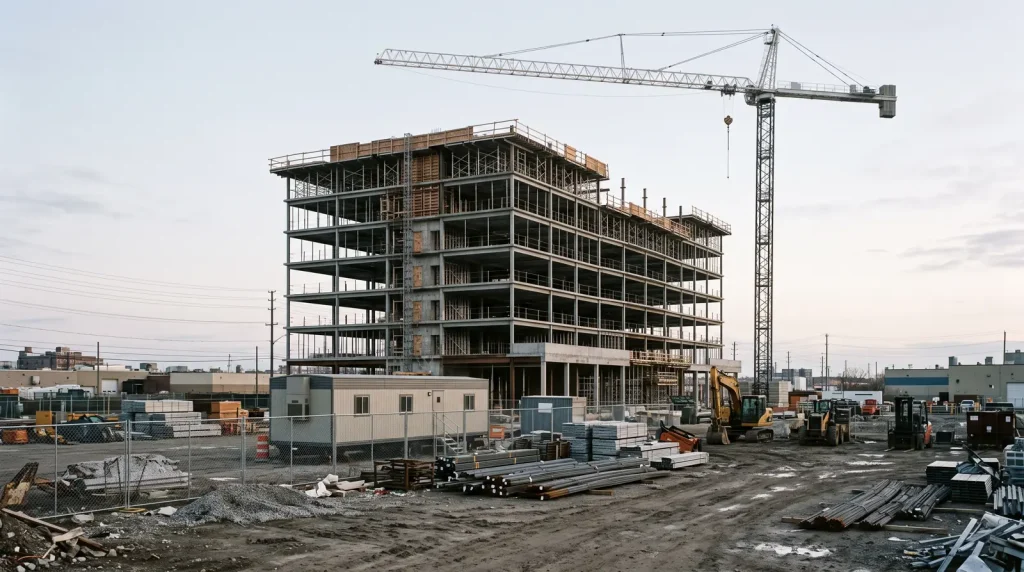
The main types of construction contracts are five pricing methods: lump sum, unit price, cost plus fee, guaranteed maximum price and time and materials. Each sits inside a delivery method such as design-bid-build, design-build or CM at risk.
Key takeaways
- Pricing type decides who pays an overrun. Under a guaranteed maximum price, costs above the cap “shall be paid by the Contractor without reimbursement by the Owner” (AIA A102-2017 §5.2.1); under AIA A103-2017 there is no cap and the owner pays every overrun.
- Federal construction is almost all fixed price: 93.08% of $51.12 billion in fiscal year 2025 federal construction contract obligations was firm fixed price, and time and materials was 0.06% (USAspending API, FY2025).
- Unit price shifts quantity risk to the owner. On City of Tampa contract 26-C-00023 (bids opened August 18, 2026), 4-inch concrete sidewalk was bid at $72.00 to $85.00 per square yard, paid on measured quantity (Tampa bid tabulation).
- A real GMP fee: Henderson County, North Carolina accepted a $21,852,605 CM-at-risk GMP in April 2018 with a 3.75% fee ($730,978) on a $19,492,757 cost of the work (Henderson County board packet).
- Neither AIA’s current document list nor the ConsensusDocs comparison matrix includes an owner agreement for time and materials; the federal model requires a ceiling price “that the contractor exceeds at its own risk” (FAR 16.601(d)(2)).
What are the main types of construction contracts?
Construction contracts are sorted two ways. Pricing type sets how the builder is paid: a fixed lump sum, a rate per unit, actual cost plus a fee with or without a guaranteed maximum price (GMP), or hourly rates plus materials. Delivery method sets who designs and when the builder joins. The table covers the 5 pricing types, the cost risk each carries, and the 2026 standard forms.
| Pricing type | How the builder is paid | Who pays a cost overrun | AIA form | ConsensusDocs form | Fits when | Source |
|---|---|---|---|---|---|---|
| Lump sum (stipulated sum) | One price for the defined scope, changed only by change order | Contractor, within the scope | A101-2017; A104-2017 abbreviated | 200; 205 short form | Drawings are complete and bid-ready | A101 §4.1; ConsensusDocs matrix |
| Unit price | Rate per unit times measured quantity | Owner for quantity growth; contractor for its unit rate | Unit price table in A101-2017 §4.4 | 210 (public works, optional unit price) | Quantities are known in kind but not in amount | A101 §4.4; FAR 36.207(b) |
| Cost plus fee, no GMP | Actual cost of the work plus a fixed or percentage fee | Owner | A103-2017; A134-2019 (CM) | 235; 510 (CM) | Scope is still moving and the owner can audit | A103-2017; ConsensusDocs 235 |
| Cost plus fee with GMP | Actual cost plus fee, capped at the GMP | Contractor above the GMP; owner below it | A102-2017; A133-2019 (CM) | 230; 500 (CM); 410 (design-build) | Owner wants a ceiling before design is finished | A102 §5.2.1; ConsensusDocs 230 |
| Time and materials | Fixed hourly rates (including overhead and profit) plus materials at cost | Owner, up to any ceiling | No owner agreement in AIA’s list | None in the matrix | Nobody can estimate the extent or duration of the work | FAR 16.601; AIA list |
AIA sells a one-time license for an agreement such as A101-2017 at $179.99 (AIA Contract Documents store, November 2026). Which general conditions, exhibits and payment forms travel with each agreement is set out in our guide to AIA contract documents.
| Key number | What it measures | Source |
|---|---|---|
| 93.08% | Firm-fixed-price share of FY2025 federal construction contract obligations (NAICS 23, $51.12 billion) | USAspending |
| 15% | Quantity swing on a unit-priced item, above or below the estimate, that lets either side demand a price adjustment (federal contracts only) | FAR 52.211-18 |
| 14 days | Latest notice of concealed site conditions after first observance under the A201-2017 general conditions | A201-2017 §3.7.4 |
| 3.75% | CM fee on the cost of the work in Henderson County’s 2018 CM-at-risk GMP | Henderson County |
| 10% | Fee cap on a cost-plus-fixed-fee contract, as a share of estimated cost (federal contracts only) | FAR 15.404-4(c)(4)(i) |
| 69.4% | Fixed-price share of Tutor Perini’s $5.54 billion 2025 revenue | Form 10-K, FY2025 |
How does a lump sum (stipulated sum) contract work?
A lump sum contract fixes one price for a defined scope at signing. AIA calls it a stipulated sum: under AIA A101-2017 §4.1 the owner pays the Contract Sum, adjusted only by change orders, so the contractor keeps savings and absorbs overruns inside the scope. The owner still carries its own changes, design gaps and concealed site conditions.
The price is less fixed than it looks. A101-2017 has three places that move it: alternates in §4.2, allowances in §4.3 and unit prices in §4.4. The A201-2017 general conditions add a fourth: if the builder finds concealed conditions that “differ materially” from the drawings, it must give notice no later than 14 days after first seeing them, and the architect recommends an equitable adjustment (§3.7.4). How the A201 handles changes and claims is covered in our guide to the AIA A201 general conditions.
| Clause | What can change the lump sum | Source |
|---|---|---|
| Change order | Owner, contractor and architect agree a new price and time | A201-2017 Article 7 |
| Construction change directive | Price set by lump sum, unit prices, or cost plus a fixed or percentage fee | A201-2017 §7.3.3 |
| Concealed or unknown conditions | Equitable adjustment if notice is given within 14 days | A201-2017 §3.7.4 |
| Allowances | Placeholder sums trued up to actual cost | A101-2017 §4.3 |
| Alternates | Priced options the owner may accept after signing | A101-2017 §4.2 |
| Unit prices | Rates applied to measured quantities | A101-2017 §4.4 |
ConsensusDocs 200 puts the agreement and general conditions in one document, where AIA splits them into A101 and A201 (ConsensusDocs comparison matrix). Federal agencies start here: FAR 36.207(a) says “Generally, firm-fixed-price contracts shall be used to acquire construction” (FAR 36.207). Because allowances are the softest number in a lump sum bid, check them first when you read how to compare construction bids.
When does a unit price contract make sense?
A unit price contract fixes a rate per unit of work, such as dollars per square yard of sidewalk, and pays for the quantity actually installed. The contractor carries the risk that its rate is too low; the owner carries the risk that quantities grow. Federal rules prefer it only where quantities such as excavation “cannot be estimated with sufficient confidence” (FAR 36.207(b)).
The City of Tampa’s sidewalk maintenance contract 26-C-00023 shows the format. Four bidders priced the same 23 line items at the same estimated quantities, and the city stated its intent to award to the lowest total (Tampa itemized bid tabulation, opened August 18, 2026). The spread is wide: the highest total, $501,341.00, was 64.8% above the lowest, $304,280.00.
| Item (unit) | Estimated quantity | Low bidder’s unit price | Range across 4 bids | Source |
|---|---|---|---|---|
| Concrete sidewalk and driveways, 4″ thick (SY) | 1,400 | $72.00 | $72.00 to $85.00 | Tampa 26-C-00023 |
| Concrete sidewalk and driveways, 6″ thick (SY) | 400 | $76.00 | $76.00 to $113.95 | Tampa 26-C-00023 |
| Removal of existing concrete flatwork (SY) | 2,000 | $30.00 | $20.00 to $42.03 | Tampa 26-C-00023 |
| Concrete curb and gutter, Type E (LF) | 300 | $32.00 | $32.00 to $50.92 | Tampa 26-C-00023 |
| Detectable warnings (SF) | 350 | $25.00 | $25.00 to $46.00 | Tampa 26-C-00023 |
| Contingency allowance (lump sum) | 1 | $10,000.00 | $10,000.00 (set by the city) | Tampa 26-C-00023 |
| Total bid | $304,280.00 | $304,280.00 to $501,341.00 | Tampa 26-C-00023 |
The bid total is an estimate, not a price. The worked example applies the low bidder’s $72.00 rate for 4-inch sidewalk to three field quantities; the rate stays fixed while the line total follows the measured square yards.
| Scenario | Square yards installed | Unit price | Line total | Change from bid line |
|---|---|---|---|---|
| As bid | 1,400 | $72.00 | $100,800 | None |
| Quantity overrun | 1,700 | $72.00 | $122,400 | $21,600 more (21.4%) |
| Quantity underrun | 1,150 | $72.00 | $82,800 | $18,000 less (17.9%) |
Both swings exceed 15%. On a federal job, FAR 52.211-18 lets either side demand an equitable adjustment when a unit-priced quantity varies more than 15% above or below the estimate (FAR 52.211-18); a city contract follows its own terms. In standard forms, unit prices sit in the A101-2017 §4.4 table or in ConsensusDocs 210, the public works agreement with an optional unit price. Tutor Perini bills unit price work monthly “based on actual quantity of work performed” and reported $417.2 million of it in 2025, none in its Building segment (Form 10-K, FY2025).
How do cost-plus and guaranteed maximum price contracts differ?
Both pay the contractor its actual cost of the work plus a fee. A guaranteed maximum price adds a ceiling: under AIA A102-2017 §5.2.1, costs that would exceed the GMP are “paid by the Contractor without reimbursement by the Owner.” Without a GMP, as in AIA A103-2017, the owner pays every overrun and relies on its right to audit the job-cost records.
The fee can be “a lump sum, percentage of Cost of the Work, or other provision” (A102-2017 §5.1.1). ConsensusDocs splits the same choice into ConsensusDocs 230, cost of the work plus a fee with a GMP, and ConsensusDocs 235, which “does not include a guaranteed maximum price.” Henderson County’s 2018 GMP for Edneyville Elementary shows how the cap is built from its parts.
| GMP line | Amount | Rate shown in the summary | Source |
|---|---|---|---|
| Trade packages and site work | $19,110,546 | Henderson County, Apr 4, 2018 | |
| Construction contingency | $382,211 | 2.00% | Henderson County |
| Cost of work subtotal | $19,492,757 | Henderson County | |
| Insurances and builder’s risk | $284,084 | 1.30% | Henderson County |
| Payment and performance bond | $174,821 | 0.80% | Henderson County |
| General conditions | $1,169,965 | 5.35% of GMP (CB&C arithmetic) | Henderson County |
| CM fee | $730,978 | 3.75% of the cost of work subtotal | Henderson County |
| Guaranteed maximum price | $21,852,605 | $243.80 per sq ft on 89,635 sq ft | Henderson County |
The county set this GMP from a 100% design development estimate, before construction documents were finished, which is the reason owners choose a GMP over a lump sum. Fee and general conditions together were $1,900,943, or 8.70% of the GMP. Fee structures, cost-of-the-work rules and audit deadlines under A102 and A103 are compared in our guide to the cost-plus contract.
Federal contracts only: the cost-plus-a-percentage-of-cost system “shall not be used” (FAR 16.102(c)), and a cost-plus-fixed-fee contract’s fee is capped at 10% of estimated cost (FAR 15.404-4(c)(4)(i)). Private owners may use a percentage fee, but at 5% every extra $1,000,000 of cost adds $50,000 of fee.
What is a time and materials contract, and why does it need a ceiling?
A time and materials contract pays fixed hourly labor rates, which already include overhead and profit, plus materials at cost. It suits work nobody can scope yet, such as emergency repairs. Neither AIA nor ConsensusDocs lists a standard owner agreement for it, so owners borrow the federal model: a ceiling price the contractor exceeds at its own risk (FAR 16.601(d)(2)).
| Federal rule | What it says | Write into a private T&M agreement | Source |
|---|---|---|---|
| Hourly rates | Fixed rates that “include wages, overhead, general and administrative expenses, and profit” | A rate schedule by trade, so markup is not added twice | FAR 16.601(b)(1) |
| When allowed | Only when the extent or duration of the work cannot be estimated | A defined trigger, such as unknown damage behind finishes | FAR 16.601(c) |
| Justification | Contracting officer finds that no other contract type is suitable | A date to convert to a lump sum or GMP once scope is known | FAR 16.601(d)(1) |
| Ceiling | Ceiling price the contractor exceeds at its own risk | A not-to-exceed sum and written notice before it is reached | FAR 16.601(d)(2) |
| Term | Head of contracting activity approval if base plus options exceed 3 years | An end date | FAR 16.601(d)(1) |
Federal use is rare and usually small. In fiscal year 2025, time and materials made up $28.5 million, or 0.06%, of federal construction obligations. One example is a U.S. Army time and materials order for renovations at Picatinny Arsenal, New Jersey: $6,306,918.66 obligated, one offer, not competed, running from February 17, 2025 to March 20, 2028 (USAspending award W15QKN25CA006). Inside an AIA contract, time and materials shows up only as a change pricing method: A201-2017 §7.3.4 prices a disputed change on labor, materials, equipment rental, bonds and permit costs plus overhead and profit, with an itemized accounting (A201-2017).
How do delivery methods change the contract?
A delivery method decides who designs, who builds and when the builder joins; the pricing type decides how the builder is paid. The two combine. Design-build under AIA A141-2024 can carry a stipulated sum or the cost of the work with or without a GMP, set in its Exhibit B Design-Build Amendment (AIA A141-2024 summary).
| Delivery method | Owner signs with | Builder joins | Usual pricing | AIA forms | ConsensusDocs | Source |
|---|---|---|---|---|---|---|
| Design-bid-build | Architect, then builder | After design is complete | Lump sum; unit price for civil work | B101 with A101 and A201 | 200, 210 | AIA list; matrix |
| CM at risk | Architect and construction manager | During design | Cost plus fee with GMP, or without | A133-2019 (GMP), A134-2019 (no GMP) | 500, 510 | AIA list; matrix |
| Design-build | One design-builder | At the start | Lump sum, or cost plus fee with or without GMP | A141-2024 | 410 (GMP), 415 (lump sum) | A141-2024; matrix |
| CM as adviser (agency) | Architect, CM adviser and each trade contractor | During design, as adviser | Adviser paid a fee; trades priced separately | C132-2019 adviser, A132-2019 trades | 830 | AIA list; ConsensusDocs 830 |
| Integrated project delivery | Multi-party agreement | At the start | Set in the multi-party agreement | A195-2008 with A295-2008; C191-2009 | 300 | AIA list; matrix |
The best published comparison of the three main methods is a 2018 study of 212 U.S. building projects, 53 design-bid-build, 78 CM at risk and 81 design-build, by Keith Molenaar and Bryan Franz for the Charles Pankow Foundation (Revisiting Project Delivery Performance). Holding project traits constant, design-build was delivered 102% faster than design-bid-build at about the same unit cost.
| Measure (regression-predicted) | Design-build vs design-bid-build | CM at risk vs design-bid-build | Source |
|---|---|---|---|
| Unit cost | 0.3% less | 1.6% more | Pankow 2018, Table 3 |
| Cost growth | 3.8% less | 1.4% less | Table 3 |
| Construction speed | 36% faster | 20% faster | Table 4 |
| Delivery speed | 102% faster | 25% faster | Table 4 |
A federal design-build job shows pricing and delivery combined: the Army’s 2023 design-build award for the Veterans Affairs health care center in El Paso, Texas is a firm-fixed-price contract with $620,602,660 obligated after full and open competition with 2 offers (USAspending award W9126G24C0004). How the two methods split design risk is covered in design-build vs design-bid-build, and the GMP process from preconstruction to buyout in construction management at risk. Adviser, at-risk and general contractor firms and the fees public owners pay them are compared in our guide to construction management companies.
How common is each type of construction contract?
No public dataset counts private construction contracts by type. Two filed sources come close. Federal procurement records code every award by pricing type, and in fiscal year 2025 firm fixed price covered 93.08% of $51.12 billion in construction obligations. One listed builder’s 10-K shows a private-heavy mix: 69.4% fixed price and 18.5% GMP in 2025.
| Pricing type (federal code) | All construction, NAICS 23 | Share | Commercial and institutional building, NAICS 236220 | Share | Source |
|---|---|---|---|---|---|
| Firm fixed price (J) | $47,584.0M | 93.08% | $30,481.2M | 99.48% | USAspending |
| Cost plus incentive fee (V) | $1,057.2M | 2.07% | $0.0M | 0.00% | USAspending |
| Fixed price with economic price adjustment (K) | $350.3M | 0.69% | $0.9M | 0.00% | USAspending |
| Cost plus award fee (R) | $272.7M | 0.53% | $0.1M | 0.00% | USAspending |
| Cost plus fixed fee (U) | $111.8M | 0.22% | $18.0M | 0.06% | USAspending |
| Fixed price incentive (L) | $83.7M | 0.16% | $79.6M | 0.26% | USAspending |
| Time and materials (Y) | $28.5M | 0.06% | $11.8M | 0.04% | USAspending |
| No pricing code recorded | $1,520.8M | 2.97% | $49.2M | 0.16% | USAspending |
| Total obligations, FY2025 | $51,123.2M | 100% | $30,641.0M | 100% | USAspending |
Commercial building is even more fixed price than construction as a whole: 99.48% of FY2025 federal obligations under NAICS 236220. Cost-type federal work sits mostly in civil and specialty projects. Federal construction spending by state is mapped in our federal construction contracts by state report.
| Contract type | Tutor Perini total revenue, 2025 | Share | Building segment, 2025 | Backlog share, Dec 31, 2025 | Source |
|---|---|---|---|---|---|
| Fixed price | $3,846.1M | 69.4% | $749.7M | 79% | Form 10-K, FY2025 |
| Guaranteed maximum price | $1,023.5M | 18.5% | $973.0M | 13% | Form 10-K |
| Unit price | $417.2M | 7.5% | $0 | 2% | Form 10-K |
| Cost plus fee and other | $256.3M | 4.6% | $129.6M | 6% | Form 10-K |
In the Building segment, GMP was the largest type at $973.0 million of $1,852.2 million, ahead of fixed price at $749.7 million. The company says its cost plus fee contracts “serve to minimize the Company’s financial risk, but may also limit profits.”
Which type of construction contract should you choose?
Choose by how much of the scope is known and who should carry an overrun. Complete drawings point to a lump sum; measured quantities that may swing more than 15% point to unit prices; an unfinished design with a need for a ceiling points to a GMP; and work nobody can estimate points to time and materials with a written cap. Federal agencies default to fixed price (FAR 36.207(a)).
| If | Use | Standard form | Threshold or reason | Source |
|---|---|---|---|---|
| Nobody can estimate the extent or duration of the work | Time and materials with a ceiling | Custom agreement; rate schedule | Ceiling the contractor exceeds at its own risk | FAR 16.601 |
| Work is measured units whose totals may swing | Unit price | A101 §4.4; ConsensusDocs 210 | Quantity may move more than 15% from the estimate | FAR 52.211-18; 36.207(b) |
| Drawings are complete and you want competitive bids | Lump sum, design-bid-build | A101 with A201; ConsensusDocs 200 | Price fixed at bid; concealed conditions notice within 14 days | A201 §3.7.4 |
| Design is unfinished and you need a ceiling | Cost plus fee with GMP (CM at risk) | A133-2019 or A102-2017; ConsensusDocs 500 or 230 | Henderson County set its GMP at 100% design development | Henderson County |
| You want one firm for design and price, schedule first | Design-build | A141-2024; ConsensusDocs 410 or 415 | 102% faster delivery than design-bid-build in 212 projects | Pankow 2018 |
| Scope keeps moving and you can audit monthly | Cost plus fee without GMP | A103-2017 or A134-2019; ConsensusDocs 235 or 510 | Owner pays every overrun | A103-2017 |
| The buyer is a federal agency | Firm fixed price | Agency forms under the FAR | 93.08% of FY2025 construction obligations | USAspending |
This page describes standard forms and public records; it is not legal advice. Before signing, ask a construction attorney two things: which A201-2017 clauses your state’s lien and prompt payment statutes override, and whether the fee applies to change orders under §5.1.2 of A102-2017 or the matching clause of your form.
The fixed-price owner agreement most private jobs use is explained blank by blank in our AIA A101 guide, and the site overhead inside a cost-plus price in our guide to general conditions.
How we compiled this
We read 4 top-ranking guides to find what they leave out, then compiled 24 primary documents: AIA and ConsensusDocs form texts and catalog pages, 5 FAR sections, USAspending fiscal year 2025 obligations by pricing type, a 2026 City of Tampa bid tabulation, a 2018 Henderson County GMP, Tutor Perini’s FY2025 10-K and the 2018 Pankow study, accessed in November 2026. We did not survey contractors or review private contracts, and federal rules are labelled federal.
Frequently asked questions
What are the 4 main types of construction contracts?
Lists of four usually name lump sum, unit price, cost plus fee and time and materials, and treat a guaranteed maximum price as a cost-plus contract with a ceiling, which is how AIA titles A102-2017. Lists of five split the GMP out. Design-build and CM at risk are delivery methods, not pricing types, and each can carry more than one pricing type.
Which type of construction contract is riskiest for the contractor?
A lump sum carries the most cost risk for the contractor, because it absorbs any overrun inside the agreed scope. A GMP comes close: under AIA A102-2017 §5.2.1, costs above the ceiling are paid by the contractor. Owner changes, and concealed conditions reported within 14 days under A201-2017 §3.7.4, can still raise either price.
Which construction contract type is best for the owner?
No type wins on every project; the trade is price certainty against flexibility. A lump sum gives the firmest price but needs complete drawings. A GMP gives a ceiling earlier, as Henderson County did at 100% design development in 2018. Cost plus without a GMP and time and materials leave the owner paying every overrun, so they need audit rights and a ceiling.
Is a not-to-exceed price the same as a GMP?
Not always. A GMP is a defined term in AIA A102-2017 and A133-2019: the cost of the work plus the fee, guaranteed not to exceed a stated sum, with costs above it paid by the contractor. Not-to-exceed is a looser label often put on a time and materials order; FAR 16.601(d)(2) calls it a ceiling price the contractor exceeds at its own risk.
Can one construction contract mix pricing types?
Yes. AIA A101-2017 is a lump sum agreement with a table for unit prices in §4.4 and allowances in §4.3, and FAR 36.207(a)(3) allows a combination of lump-sum and unit pricing on federal work. City of Tampa contract 26-C-00023 mixed 22 unit-priced items with a $10,000 lump sum contingency allowance in its August 2026 bid.
What type of contract does the federal government use for construction?
Federal agencies default to firm fixed price: FAR 36.207(a) says such contracts “shall be used to acquire construction”, priced as lump sum, unit price or both. In fiscal year 2025, 93.08% of $51.12 billion in federal construction contract obligations was firm fixed price and 0.06% was time and materials, according to USAspending records.
Sources
- AIA Contract Documents, A101-2017, Owner-Contractor Agreement, Stipulated Sum (preview text), accessed November 1, 2026.
- AIA Contract Documents, A102-2017, Cost of the Work Plus a Fee with a GMP (preview text), accessed November 1, 2026.
- AIA Contract Documents, A103-2017, Cost of the Work Plus a Fee without a GMP (preview text), accessed November 1, 2026.
- City of Rochester, NH / AIA, A201-2017 General Conditions (sample posted with a City of Rochester, NH bid), accessed November 1, 2026.
- AIA Contract Documents, List of All Current AIA Contract Documents, accessed November 1, 2026.
- AIA Contract Documents, Summary: A141-2024, Agreement Between Owner and Design-Builder, accessed November 1, 2026.
- AIA Contract Documents, A101-2017 store page (one-time license price), accessed November 1, 2026.
- ConsensusDocs, ConsensusDocs and AIA comparison matrix, accessed November 1, 2026.
- ConsensusDocs, ConsensusDocs 230, Cost of Work Plus a Fee with GMP, accessed November 1, 2026.
- ConsensusDocs, ConsensusDocs 235, Cost of Work Short Form, accessed November 1, 2026.
- ConsensusDocs, ConsensusDocs 210, Owner and Constructor Agreement for Public Works, accessed November 1, 2026.
- ConsensusDocs, ConsensusDocs 830, Owner and Construction Manager as Agent, accessed November 1, 2026.
- Acquisition.gov, FAR 36.207, Pricing fixed-price construction contracts, accessed November 1, 2026.
- Acquisition.gov, FAR 52.211-18, Variation in Estimated Quantity, accessed November 1, 2026.
- Acquisition.gov, FAR 16.601, Time-and-materials contracts, accessed November 1, 2026.
- Acquisition.gov, FAR 16.102, Policies (cost-plus-percentage-of-cost ban), accessed November 1, 2026.
- Acquisition.gov, FAR 15.404-4, Profit (fee limits), accessed November 1, 2026.
- U.S. Department of the Treasury, USAspending API, spending_over_time by contract pricing type, FY2025, NAICS 23 and 236220, accessed November 1, 2026.
- USAspending.gov, Award W9126G24C0004, design-build VA health care center, El Paso, TX, accessed November 1, 2026.
- USAspending.gov, Award W15QKN25CA006, renovations, Picatinny Arsenal, NJ (time and materials), accessed November 1, 2026.
- City of Tampa, Itemized bid tabulation, contract 26-C-00023, Citywide Sidewalk Maintenance, accessed November 1, 2026.
- Henderson County, NC, Request for Board Action, GMP for Edneyville Elementary School (April 18, 2018), accessed November 1, 2026.
- SEC EDGAR, Tutor Perini Corporation Form 10-K for fiscal year 2025, accessed November 1, 2026.
- Charles Pankow Foundation, Revisiting Project Delivery Performance, Final Report (Molenaar and Franz, December 31, 2018), accessed November 1, 2026.