Fire extinguisher requirements for most commercial buildings come down to three numbers: a unit rated at least 2-A within 75 feet of walking distance, its top no higher than 5 feet, and a check every 30 days.
Key takeaways
- The International Fire Code (IFC) Section 906.1 requires portable extinguishers in all Group A, B, E, F, H, I, M, R-1, R-2, R-4 and S occupancies, within 30 feet of travel from commercial cooking equipment, and where flammable liquids are stored, used or dispensed (2024 IFC text as adopted in the 2025 Fire Code of New York State).
- For ordinary combustibles (Class A), IFC Table 906.3(1) allows 3,000 sq ft per unit of A rating in light hazard spaces, 1,500 in ordinary and 1,000 in extra hazard, capped at 11,250 sq ft per extinguisher and 75 feet of travel.
- Extinguishers of 40 lb or less mount with the top no higher than 5 ft; heavier hand-held units no higher than 3.5 ft; every hand-held unit sits at least 4 in off the floor (IFC 906.9.1 to 906.9.3).
- Employers covered by OSHA 29 CFR 1910.157 must have a monthly visual check, an annual maintenance check, a 6-year emptying of stored-pressure dry chemical units and a hydrostatic test every 5 or 12 years by type.
- Public contracts price a new 5 lb ABC unit at $39.50 and an annual inspection at $0.70 to $7.50 per unit (Cleveland Metroparks contract, 2023 to 2025; San Antonio bid tabulation, July 2, 2025).
| Rule | Number | Code section |
|---|---|---|
| Class A travel distance | 75 ft max | IFC Table 906.3(1); OSHA 1910.157(d)(2) |
| Class B travel distance | 30 or 50 ft by rating | IFC Table 906.3(2); OSHA 1910.157(d)(4): 50 ft |
| Class K from commercial cooking | 30 ft of travel max | IFC 906.1 item 2, 906.4 |
| Minimum single unit, light or ordinary hazard | 2-A | IFC Table 906.3(1) |
| Max floor area per extinguisher | 11,250 sq ft | IFC Table 906.3(1) |
| Top of unit, 40 lb or less | 5 ft max | IFC 906.9.1 |
| Top of unit, over 40 lb | 3.5 ft max | IFC 906.9.2 |
| Floor to bottom of unit | 4 in min | IFC 906.9.3 |
| Inspection | About every 30 days | IFC 906.2 via NFPA 10; OSHA 1910.157(e)(2) |
| Maintenance | Every 12 months | OSHA 1910.157(e)(3) |
Where are fire extinguishers required?
The IFC, the model fire code most US states and cities adopt, requires portable fire extinguishers in nearly every commercial occupancy group under Section 906.1, plus five location triggers that apply whatever the occupancy. The International Code Council (ICC) publishes the 2024 IFC, and Section 906.2 sends selection, installation and maintenance to NFPA 10, the Standard for Portable Fire Extinguishers.
| IFC 906.1 item | Where extinguishers are required | Notes |
|---|---|---|
| 1 | All Group A, B, E, F, H, I, M, R-1, R-2, R-4 and S occupancies, new and existing | R-2: a 1-A:10-B:C unit in each dwelling unit can replace common-area units; Group E: a 2-A:20-B:C unit in each classroom can do the same |
| 2 | Within 30 ft of travel from commercial cooking equipment | Also domestic cooking in Group I-1, I-2 Condition 1 and R-2 college dormitories |
| 3 | Where flammable or combustible liquids are stored, used or dispensed | Sized by IFC Table 906.3(2) |
| 4 | Each floor of a structure under construction | Except Group R-3 |
| 5 | Where IFC Table 906.1 lists an operation | Examples: repair garages, spray finishing, hot work, tents, high-piled storage |
| 6 | Special-hazard areas the fire code official names | Laboratories, computer rooms, generator rooms |
Group B (offices), M (retail), S (storage) and F (factory) cover most buildings our readers build or own, and our guide to occupancy classification explains how a space gets its letter. The rule reaches existing buildings too: the New York Department of State ruled in Technical Bulletin TB-3004-FCNYS that Section 906.1 is an operational provision, so owners of existing Group B or M buildings cannot claim a grandfather exemption.
Group U buildings that are normally unmanned are exempt where visiting personnel carry a suitable extinguisher on their vehicle, and a Group S warehouse can swap fixed units for a 10-lb, 40-A:80-B:C extinguisher on each forklift if the fire code official approves and two spares stay on site (2024 IFC 906.1 exceptions).
How many fire extinguishers do you need?
The count comes from two tests in IFC Table 906.3(1), and the larger result wins. First divide the floor area by the coverage of one unit: 3,000 sq ft per unit of A rating in light hazard, 1,500 in ordinary and 1,000 in extra, never more than 11,250 sq ft per extinguisher. Then check that no point is more than 75 feet of walking from a unit.
| Hazard class | Typical spaces | Minimum unit | Sq ft per unit of A | Max sq ft per unit | Max travel |
|---|---|---|---|---|---|
| Light (low) | Offices, classrooms, churches, assembly halls | 2-A | 3,000 | 11,250 | 75 ft |
| Ordinary (moderate) | Shops and allied storage, light manufacturing, research, auto showrooms, parking garages, Class I and II commodity warehouses | 2-A | 1,500 | 11,250 | 75 ft |
| Extra (high) | Woodworking, vehicle repair, aircraft and boat servicing, painting, dipping and coating, flammable liquid handling | 4-A | 1,000 | 11,250 | 75 ft |
The hazard examples come from the California State Fire Marshal regulation, 19 CCR 565.1, which follows NFPA 10 wording. A 2-A unit in a light hazard office covers 2 x 3,000 = 6,000 sq ft; the same unit in an ordinary hazard shop covers 3,000 sq ft. Two 2.5-gallon water units count as one 4-A unit under the table’s footnote.
Spaces with flammable liquids 0.25 inch deep or less get a second, Class B layer from IFC Table 906.3(2). The fire code official picks the hazard level; a smaller rating forces a shorter walk.
| Hazard level | Option 1: rating and max travel | Option 2: rating and max travel |
|---|---|---|
| Light (low) | 5-B within 30 ft | 10-B within 50 ft |
| Ordinary (moderate) | 10-B within 30 ft | 20-B within 50 ft |
| Extra (high) | 40-B within 30 ft | 80-B within 50 ft |
How do you place extinguishers on a floor plate?
On an open floor plate the 75-foot travel rule usually sets the count, not the rating. Split the plate into bays no wider than the walk allows, put one unit in each bay on a path people already use, then confirm the count also meets the area test. The worked example below uses a 200 by 150 foot light hazard office floor.
| Step | Input | Arithmetic | Result |
|---|---|---|---|
| 1. Floor area | 200 ft x 150 ft | 200 x 150 | 30,000 sq ft |
| 2. Coverage per 2-A unit (light hazard) | 3,000 sq ft per unit of A | 2 x 3,000 | 6,000 sq ft |
| 3. Units by area | 30,000 / 6,000 | 5.0 | 5 units |
| 4. Bay size for 75 ft travel | 3 bays across, 2 bays deep | 200 / 3 and 150 / 2 | 66.7 x 75 ft bays |
| 5. Worst walk, unit at bay center | Right-angle path along aisles | 33.3 + 37.5 | 70.8 ft, under 75 ft |
| 6. Units by travel | 1 per bay | 3 x 2 | 6 units |
| 7. Install the larger count | Area 5, travel 6 | max(5, 6) | 6 units |
| 8. Upsize check: 4-A units | 4 x 3,000 = 12,000, capped at 11,250 | 30,000 / 11,250 = 2.67 | 3 by area, still 6 by travel |
The arithmetic is CB&C’s, built from IFC Table 906.3(1); it assumes walking along right-angle aisles, so partitions, racks and doors can lengthen the real path and add a unit. NFPA 10 measures travel as the actual walking distance, so mark each unit on the floor plan and walk the worst corner before the fire inspection.
Place units by exits and along corridors, under IFC 906.5, so a person moves toward the way out to grab one. The Town of Brighton, NY Fire Marshal guideline (May 2020) gives the same advice, and it keeps the extinguisher plan aligned with the exit signs in our guide to emergency lighting requirements.
Which extinguisher class and rating do you need?
Match the letter to the fuel and the number to the size of fire. In a rating such as 2-A:10-B:C, the 2 means about 2.5 gallons of water equivalent against wood and paper, the 10 means roughly 10 sq ft of flammable liquid fire, and C means the agent does not conduct electricity, per the Brighton guideline. Ratings come from the UL listing on the label.
| Class | Fuel | Common unit | Placement rule |
|---|---|---|---|
| A | Wood, paper, cloth, many plastics | 5 lb ABC dry chemical (2-A:10-B:C) | 75 ft travel (IFC Table 906.3(1)) |
| B | Flammable liquids, grease, solvents, flammable gases | ABC or BC dry chemical, CO2 | 30 or 50 ft by rating (IFC Table 906.3(2)) |
| C | Energized electrical equipment | ABC dry chemical, CO2, clean agent | Placed on the Class A or B pattern (IFC 906.3.3) |
| D | Combustible metals: powders, flakes, shavings | Listed Class D agent | 75 ft travel (OSHA 1910.157(d)(6)); NFPA 10 (IFC 906.3.4) |
| K | Cooking oils and fats | Wet chemical, 1.5 or 2.5 gal (6 or 9 L) | 30 ft of travel from cooking equipment (IFC 906.1 item 2) |
Kitchens need a Class K unit even when a hood suppression system is installed. IFC 906.4.2 calls for one 1.5-gallon Class K unit for up to four fryers holding 80 lb of oil each, one more for each additional group of four, and the maker’s rule for any single fryer over 6 sq ft of surface. Solid-fuel appliances with fireboxes of 5 cu ft or less need one 2.5-gallon or two 1.5-gallon units (IFC 906.4.1).
The Class K unit must be compatible with the hood system agent, and our guide to commercial kitchen fire suppression systems covers the pull station, fusible links and the 6-month service that sit beside it.
How high do you mount a fire extinguisher?
Measure to the top of the unit, not the bracket. IFC 906.9.1 caps the top at 5 feet above the floor for extinguishers with a gross weight of 40 lb or less, and 906.9.2 caps it at 3.5 feet for heavier hand-held units. Section 906.9.3 keeps the bottom at least 4 inches off the floor.
| Dimension | Requirement | Source |
|---|---|---|
| Top of unit, gross weight 40 lb or less | 60 in (5 ft) max above floor | IFC 906.9.1 |
| Top of unit, gross weight over 40 lb | 42 in (3.5 ft) max above floor | IFC 906.9.2 |
| Bottom of hand-held unit | 4 in min above floor | IFC 906.9.3 |
| Projection into a corridor, leading edge 27 to 80 in high | 4 in max from wall | 2010 ADA Standards 307.2 |
| Mounting | Maker’s hanger or bracket, anchored per maker instructions | IFC 906.7 |
| Cabinet | Not locked, unless vandalism risk and a means of ready access | IFC 906.8 |
| Visibility | Not obstructed; signs where view cannot be kept clear | IFC 906.6 |
The fire code is not the only dimension. The 2010 ADA Standards for Accessible Design, Section 307.2, limit anything with a leading edge between 27 and 80 inches above the floor to 4 inches of projection into a circulation path. Measure wall face to the front of the cylinder: if a bracket-hung unit sticks out more than 4 inches in a corridor, specify a recessed or semi-recessed cabinet on the drawings before the walls close.
How often must extinguishers be inspected and serviced?
Four clocks run on every unit. Staff check it about every 30 days, a certified technician services it every 12 months, stored-pressure dry chemical units are emptied every 6 years, and each shell gets a hydrostatic pressure test every 5 or 12 years by type, under OSHA 1910.157(e) and (f) and NFPA 10 as adopted by IFC 906.2.
| Task | Interval | Who | Record | Source |
|---|---|---|---|---|
| Inspection: in place, charged, pin and seal intact, not blocked | About every 30 days | Facility staff | Date and initials | Kansas State Fire Marshal Fire Fact 067; OSHA 1910.157(e)(2) |
| Annual maintenance: mechanical parts, agent, expelling means | Not more than 12 months apart | Certified service technician (IFC 906.2.1) | Tag with month, year and technician | OSHA 1910.157(e)(3) |
| 6-year maintenance: empty and service | Every 6 years | Certified technician | Restarts after recharge or hydro test | OSHA 1910.157(e)(4) |
| Hydrostatic test: stored-pressure dry chemical, mild steel, brazed brass or aluminum shell | 12 years | Trained tester with test equipment | Date, tester signature, serial number | OSHA Table L-1, 1910.157(f)(16) |
| Hydrostatic test: CO2, stored-pressure water, wetting agent, AFFF | 5 years | Trained tester | Same | OSHA Table L-1 |
| Employee training on extinguisher use | At hire and every year | Employer | Training record advised | OSHA 1910.157(g) |
The Kansas State Fire Marshal Fire Fact 067 lets facility staff do the monthly inspection without a state certificate but limits annual and 6-year work to certified firms. One exception saves labor on big sites: IFC 906.2 exception 2 drops the 30-day inspection and allows maintenance every 3 years for dry chemical units supervised by a listed electronic monitoring device that reports position, charge and obstruction.
What does OSHA 1910.157 add for employers?
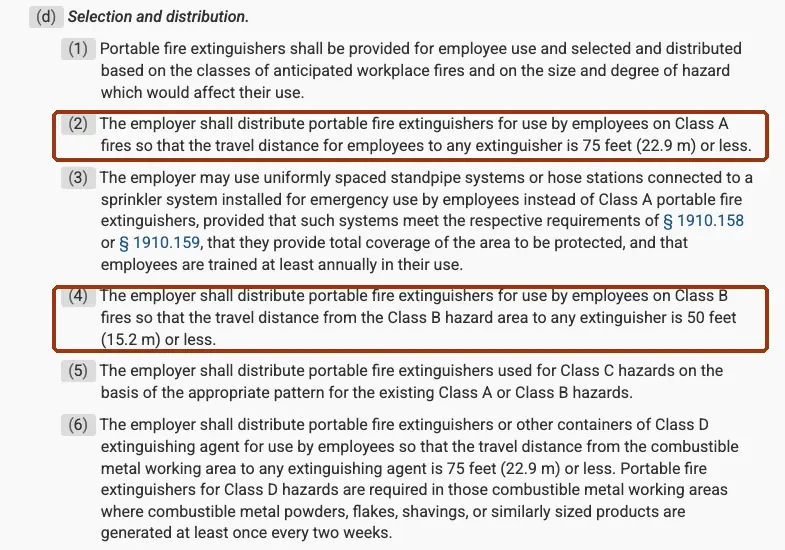
OSHA 29 CFR 1910.157 is a federal workplace rule that sits on top of the fire code. It repeats the 75-foot Class A travel limit, sets a 50-foot Class B limit, and adds annual employee training and record keeping. An employer with a written total-evacuation policy and no extinguishers on site is exempt from it, though the adopted fire code may still require units.
| Topic | IFC 906 with NFPA 10 (building) | OSHA 1910.157 (general industry, federal) | OSHA 1926.150 (construction, federal) |
|---|---|---|---|
| Who enforces | Local fire code official | OSHA, for employers | OSHA, on construction sites |
| Class A placement | Rated by hazard; 75 ft travel; 11,250 sq ft max | 75 ft travel | 2A per 3,000 sq ft; 100 ft travel |
| Class B placement | 30 or 50 ft by rating | 50 ft travel | 10B within 50 ft of more than 5 gal of flammable liquid |
| Per floor rule | Each floor under construction | None stated | At least one 2A per floor; one next to a stairway |
| Inspection | About every 30 days (NFPA 10) | Monthly visual | Not stated in 1926.150(c)(1) |
| Training | Not stated in 906 | At hire and yearly | Not stated in 1926.150(c)(1) |
| Source | 2024 IFC 906 | eCFR 1910.157 | eCFR 1926.150 |
On an active job site, OSHA 29 CFR 1926.150(c)(1) governs: one 2A unit per 3,000 sq ft of protected building area, no point more than 100 feet away, and at least one per floor. Our guide to construction office trailers applies the same rule to the site trailer, and our construction safety guide covers the site plan around it.
What do extinguishers and service cost?
Public contracts put a new 5 lb ABC unit at $39.50 and a 6-liter Class K unit at $168.00 under the Cleveland Metroparks contract 20230029 (May 1, 2023 to April 30, 2025). Per-unit service ran $0.70 to $7.50 for an annual inspection and $1.75 to $45.00 for 6-year maintenance across that contract and a 2025 San Antonio bid.
| Item | Price | Scope | Source and date |
|---|---|---|---|
| New 2.5 lb ABC | $29.50 | Unit only | Cleveland Metroparks, 2023 to 2025 |
| New 5 lb ABC | $39.50 | Unit only | Cleveland Metroparks, 2023 to 2025 |
| New 10 lb ABC | $61.00 | Unit only | Cleveland Metroparks, 2023 to 2025 |
| New 20 lb ABC | $114.00 | Unit only | Cleveland Metroparks, 2023 to 2025 |
| New 10 lb CO2 | $152.00 | Unit only | Cleveland Metroparks, 2023 to 2025 |
| New 6 L Class K wet chemical | $168.00 | Unit only | Cleveland Metroparks, 2023 to 2025 |
| New 5 lb clean agent | $211.00 | Unit only | Cleveland Metroparks, 2023 to 2025 |
| Annual inspection, per unit | $0.70 (plus $20.00 minimum service charge) | Tag and seal included | Cleveland Metroparks, 2023 to 2025 |
| ABC inspection, per unit | $7.50 | On-site | San Antonio IFB 5894, opened July 2, 2025 |
| ABC recharge | $8.95 (10 lb) to $40.00 | Per unit | Cleveland Metroparks; San Antonio 2025 |
| 6-year maintenance | $1.75 to $45.00 | Per unit | Cleveland Metroparks; San Antonio 2025 |
| ABC hydrostatic test | $5.00 to $65.00 | Per unit | Cleveland Metroparks; San Antonio 2025 |
| Monthly plus annual inspection, about 1,281 units | $216.54 per unit over 4.8 years (about $45 per unit-year) | Federal medical center, outsourced | USAspending, VA Seattle, 2017 to 2022 |
| Monthly inspection, about 300 units | $111.97 per unit-year | Federal medical center, outsourced | USAspending, VA Roseburg, 2017 to 2018 |
For the 30,000 sq ft worked example, six 5 lb ABC units (2-A:10-B:C) cost 6 x $39.50 = $237.00 at the Cleveland Metroparks price, before brackets, cabinets or install labor. A first-year inspection runs 6 x $7.50 = $45.00 at the San Antonio rate, or the $20.00 minimum service charge at Cleveland’s $0.70 per unit. Outsourcing the 30-day checks costs far more: the two federal awards above work out to $45 to $112 per unit per year.
Prices in both contracts are public-agency unit rates for volume buyers (San Antonio estimated 175 ABC inspections a year across three line items), so a single building owner can expect higher per-visit charges; ask each bidder for a per-unit inspection price, a minimum trip charge and a recharge price by size in writing. Extinguishers are a small line next to sprinklers, which our fire sprinkler system cost guide prices per square foot.
What do common guides get wrong?
Three claims repeat across top-ranking guides and do not match the primary text of IFC Section 906 or OSHA 29 CFR 1910.157. Each one changes either the unit count or the service plan, so check the code section before you buy or schedule anything for a building.
| What several guides say | What the primary source says | Effect |
|---|---|---|
| A top-ranking retail guide, updated 2025: one extinguisher per 3,000 sq ft | IFC Table 906.3(1): 3,000 sq ft per unit of A in light hazard, so a 2-A covers 6,000 sq ft; the flat 3,000 sq ft rule is OSHA 1926.150 for construction sites | Overbuying by up to half in offices; underbuying in ordinary hazard shops, where a 2-A covers 3,000 sq ft |
| A service-company OSHA guide: NFPA 10 is incorporated into OSHA compliance by reference | 29 CFR 1910.157 sets its own intervals and does not cite NFPA 10; NFPA 10 applies through the fire code (IFC 906.2) | Two separate enforcers: plan for both the fire inspector and OSHA |
| A 2020 municipal fire marshal guideline: the bottom of the unit must be between 4 and 48 in off the floor | IFC 906.9.1 measures to the TOP: 5 ft max for 40 lb or less, 3.5 ft max over 40 lb; 4 in min at the bottom (906.9.3) | A 20 in tall unit with its bottom at 48 in puts the top at 68 in, 8 in over the 60 in limit |
Which rule applies to your building?
Start with the IFC 906.1 occupancy group and the hazards inside it, then apply the tightest rule that touches the space. Most commercial owners answer to the adopted fire code first, OSHA second when they have employees, and the ADA wherever a unit hangs in a corridor. The table below lists the common triggers with the action and the section behind it.
| If | Then | Rule |
|---|---|---|
| Building is Group A, B, E, F, H, I, M, R-1, R-2, R-4 or S | Install 2-A minimum units within 75 ft of travel | IFC 906.1 item 1, Table 906.3(1) |
| Space is a woodshop, repair bay or coating area (extra hazard) | Use 4-A minimum, 1,000 sq ft per unit of A | IFC Table 906.3(1) |
| Commercial cooking with oils or fats | Class K within 30 ft of travel; 1.5 gal per 4 fryers of 80 lb | IFC 906.1 item 2, 906.4.2 |
| Flammable liquids 0.25 in deep or less (ordinary hazard) | 10-B within 30 ft or 20-B within 50 ft | IFC Table 906.3(2) |
| Unit weighs over 40 lb | Top no higher than 3.5 ft | IFC 906.9.2 |
| Bracket-hung unit projects over 4 in into a corridor | Recessed or semi-recessed cabinet | ADA 307.2 |
| Cabinet in an area with vandalism | Lock allowed only with a means of ready access, such as a break-glass panel | IFC 906.8 exception 1 |
| Dry chemical units on listed electronic monitoring | No 30-day inspection; maintenance every 3 years | IFC 906.2 exception 2 |
| Employer has a written total-evacuation plan and no extinguishers | Exempt from OSHA 1910.157; fire code may still require units | OSHA 1910.157(b)(1) |
| Building under construction | 2A per 3,000 sq ft, 100 ft travel, one per floor | OSHA 1926.150(c)(1); IFC 906.1 item 4 |
Extinguisher placement is checked at the final fire inspection that clears the certificate of occupancy, so mark every unit, cabinet and 75-foot travel check on the fire protection sheet of the drawings. Kitchen tenants should also read our guide to restaurant build-out contractors, since Class K units and hood systems are usually in that scope. This page summarizes model code text and is not legal advice; your fire code official’s adopted edition and amendments control.
Fire department access is the other half of the inspection; our Knox box guide explains when a key box is required.
Welding and cutting add their own rule, a 2-A:20-B:C extinguisher within 30 ft of the work under IFC 3504.2.6, covered in our guide to the hot work permit.
How we compiled this
We read 13 primary documents in November 2026: OSHA 29 CFR 1910.157 and 1926.150 from eCFR, the 2024 IFC Section 906 as adopted in the 2025 Fire Code of New York State, state fire marshal and code guidance from Kansas, New York and California, the 2010 ADA Standards, two public price contracts and two USAspending federal awards. The NFPA 10 text itself needs a login, so its numbers are quoted only where an adopted code or state agency reprints them. The placement and cost arithmetic is CB&C’s own and is shown in full.
Frequently asked questions
How many fire extinguishers are required in a commercial building?
Run two tests and keep the larger count. Under IFC Table 906.3(1), divide floor area by 3,000 sq ft per unit of A rating in light hazard (6,000 sq ft for a 2-A unit) or 1,500 in ordinary hazard, capped at 11,250 sq ft per unit. Then make sure no point is more than 75 feet of walking from a unit. On open floor plates the 75-foot test usually wins.
How high should a fire extinguisher be mounted?
For a unit with a gross weight of 40 lb or less, the top must be no more than 5 feet above the floor (IFC 906.9.1). For a hand-held unit over 40 lb, the top must be no more than 3.5 feet (IFC 906.9.2). The bottom must be at least 4 inches off the floor, and a corridor unit should project no more than 4 inches (ADA 307.2).
How often do commercial fire extinguishers need to be inspected?
Staff inspect each unit about every 30 days and record the date and initials. A certified technician performs maintenance at least every 12 months, empties stored-pressure dry chemical units every 6 years, and hydrostatically tests shells every 12 years for dry chemical or every 5 years for CO2 and water units, under OSHA 1910.157(e) and (f).
What is the maximum travel distance to a fire extinguisher?
For ordinary combustibles (Class A) the limit is 75 feet of actual walking distance under IFC Table 906.3(1) and OSHA 1910.157(d)(2). For flammable liquids (Class B) it is 30 or 50 feet depending on the rating, and for commercial cooking a Class K unit must be within 30 feet of travel. Construction sites under OSHA 1926.150 allow 100 feet.
Does OSHA require fire extinguishers in every workplace?
Not always. OSHA 1910.157(b)(1) exempts an employer with a written policy for immediate total evacuation, an emergency action plan and a fire prevention plan, and no extinguishers on site. The local fire code is separate: IFC 906.1 still requires extinguishers in most commercial occupancy groups, so the building may need units even when OSHA does not.
What fire extinguisher do I need for a commercial kitchen?
A Class K wet chemical unit within 30 feet of travel from the cooking equipment, under IFC 906.1 item 2 and 906.4. One 1.5-gallon unit covers up to four fryers holding 80 lb of oil each, and solid-fuel appliances with fireboxes of 5 cu ft or less need one 2.5-gallon or two 1.5-gallon units. A public contract priced a 6-liter Class K unit at $168.00.
Sources
- 29 CFR 1910.157, Portable fire extinguishers, eCFR, Office of the Federal Register, accessed November 8, 2026.
- 29 CFR 1926.150, Fire protection (construction), eCFR, Office of the Federal Register, accessed November 8, 2026.
- 2025 Fire Code of New York State (2024 IFC), Chapter 9, Section 906, New York State via UpCodes, accessed November 8, 2026.
- 2024 International Fire Code, Chapter 9, International Code Council, accessed November 8, 2026.
- NFPA 10, Standard for Portable Fire Extinguishers, National Fire Protection Association, accessed November 8, 2026.
- TB-3004-FCNYS: Required fire extinguisher locations in existing buildings, New York Department of State, accessed November 8, 2026.
- Fire Fact 067: Fire Extinguisher (July 2020), Kansas Office of the State Fire Marshal, accessed November 8, 2026.
- Fire extinguisher spacing and installation requirements (May 2020), Town of Brighton, NY Office of the Fire Marshal, accessed November 8, 2026.
- Cal. Code Regs. tit. 19, 565.1, Classification of hazards, California State Fire Marshal via Cornell LII, accessed November 8, 2026.
- 2010 ADA Standards for Accessible Design, 307 Protruding objects, US Access Board, accessed November 8, 2026.
- IFB 5894 draft bid tabulation, fire extinguisher service (opened July 2, 2025), City of San Antonio, accessed November 8, 2026.
- Fire extinguisher contract 20230029 price sheet, 2023 to 2025, Cleveland Metroparks, accessed November 8, 2026.
- Award VA26017P1525, monthly and annual fire extinguisher inspection, Seattle, USAspending.gov, accessed November 8, 2026.
- Award VA26017P1598, monthly fire extinguisher inspection, Roseburg, USAspending.gov, accessed November 8, 2026.