A change order is a written agreement, signed by the owner, contractor and architect, that changes the work, the contract sum or the contract time; under AIA A201-2017 §7.2 it is issued on form G701.
Key takeaways
- AIA A201-2017 Article 7 gives three ways to change the work: a Change Order signed by three parties (§7.2), a Construction Change Directive signed by owner and architect (§7.3) and a minor change by the architect alone (§7.4), per the A201-2017 standard form.
- A201 sets no markup percentage: §7.3.4 allows overhead and profit as set in the Agreement or a reasonable amount, and the A102 and A103 forms leave the fee-on-changes line blank (§5.1.2), per the A102-2017 preview.
- Named public schedules cap markup: the Department of Veterans Affairs allows at most 10% overhead and 10% profit on the first $20,000 of a change, falling to 5% and 5% above $50,000, under VAAR 852.243-70 (September 2019).
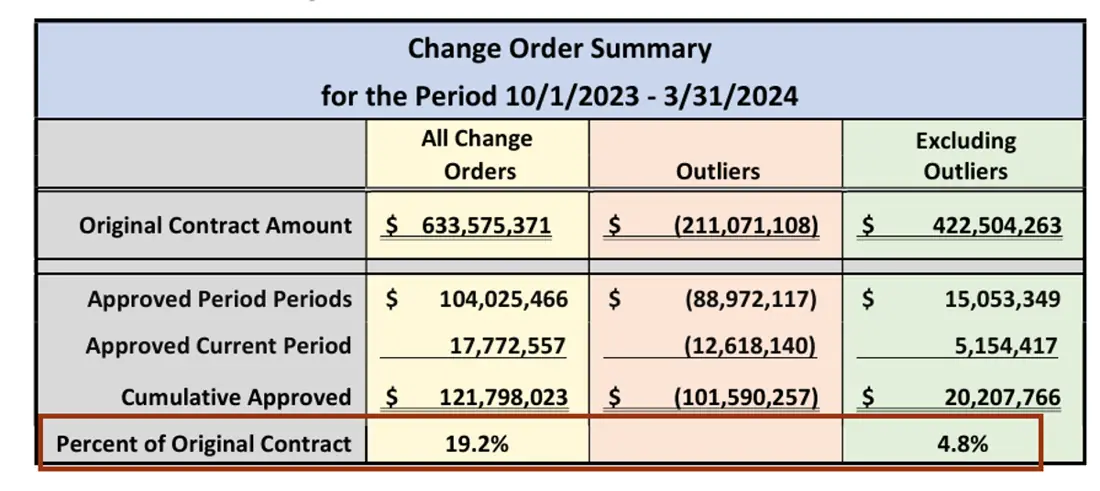
- The South Florida Water Management District reported approved change orders of 19.2% of original contract value for October 2023 to March 2024, or 4.8% without two outlier contracts, in its Inspector General review.
- Time grows faster than money: nine Fort Worth contracts sampled in a March 4, 2022 city audit went from 3,160 to 4,795 contract days, a 52% increase.
What is a change order in construction?
A change order is the signed record of an agreed change to scope, price or schedule after the contract is signed. A201-2017 §7.2.1 says it must state three things: the change in the work, the adjustment to the Contract Sum and the adjustment to the Contract Time. The architect prepares it (§4.2.8) and the owner, contractor and architect all sign it, per the A201-2017 form.
Two other instruments sit beside it in Article 7. A Construction Change Directive (CCD) orders the work before price or time is agreed, and an order for a minor change lets the architect adjust details that cost nothing and add no days. An RFI (request for information) only asks what the documents mean; it changes nothing until one of these three instruments is issued.
| Instrument | A201-2017 section | AIA form | Who signs | Price and time | Source |
|---|---|---|---|---|---|
| Change Order | §7.2 | G701-2017 | Owner, contractor, architect | Agreed before signing | A201 §7.1.2, §7.2.1 |
| Construction Change Directive | §7.3 | G714-2017 | Owner and architect (contractor optional) | Set later by a §7.3.3 method or the architect (§7.3.4) | A201 §7.3.1 to §7.3.10 |
| Order for a minor change | §7.4 | G710-2017 Architect’s Supplemental Instructions | Architect alone | No change allowed | AIA document list |
| Request for information (RFI) | §3.2.2, §4.2.14 | G716-2004 | Contractor asks, architect answers | None by itself | AIA document list |
What does AIA A201 Article 7 require?
Article 7 of A201-2017 lets the owner change the work without voiding the contract, as long as the change stays within the general scope (§7.1.1, §7.3.1). The contractor must proceed promptly with any change unless the instrument says otherwise (§7.1.3). Our guide to every A201-2017 article and deadline places Article 7 in the full form.
§7.2 Change orders: agreement on all three terms
A Change Order needs agreement on the change, the price and the time, all in one signed document (§7.2.1). If the parties agree on the work but not the money, the form cannot be signed, and A201 §7.3.2 sends the change to a Construction Change Directive instead. The G701 form adds that it is not valid until all three parties sign, per the AIA G701-2017 sample.
§7.3 Construction change directives: work first, price later
A CCD lets the owner keep the job moving when price talks stall. On receipt the contractor proceeds (§7.3.6) and states whether it agrees with the pricing method. §7.3.3 lists four methods: an itemized lump sum, unit prices, cost plus an agreed fixed or percentage fee, or the architect’s determination under §7.3.4. Disputed time goes to a claim under Article 15 (§7.3.5).
If the contractor does not respond or disagrees, the architect sets the price from reasonable expenditures and savings, and §7.3.4 limits recoverable cost to five categories unless the contract says otherwise. Work done under a CCD can be billed on the next pay application at the architect’s interim figure (§7.3.9, §9.3.1.1), and once both sides agree the CCD is recorded as a Change Order (§7.3.7, §7.3.10).
| §7.3.4 cost item | What it includes | What it excludes or limits |
|---|---|---|
| .1 Labor | Wages plus payroll taxes, required fringe benefits, workers’ compensation and other employee costs the architect approves | Home office staff (covered by markup) |
| .2 Materials, supplies, equipment | Cost including transportation, whether built in or consumed | Items not attributable to the change |
| .3 Machinery and equipment rental | Rental from the contractor or others | Hand tools |
| .4 Bonds, insurance, permits, taxes | Premiums, permit fees and sales or use taxes directly related to the change | General policy premiums not tied to the change |
| .5 Supervision | Supervision and field office personnel directly attributable to the change | Supervision the job would carry anyway |
§7.4 Minor changes: the waiver trap
The architect may order a minor change in writing if it fits the design intent and changes neither price nor time (§7.4). If the contractor thinks the order does affect price or time, it must tell the architect and not start; a contractor that does the work without that notice waives any adjustment. AIA issues minor changes on form G710-2017, Architect’s Supplemental Instructions.
What goes on a G701 change order form?
The G701-2017 form carries the project and contract names, the change order number and date, a written description of the change with any exhibits, and seven price and time lines. AIA sells it for $59.99 per single use as of November 2026 on its G701-2017 store page. The arithmetic lines let anyone audit the running contract total in one glance.
- The original Contract Sum or Guaranteed Maximum Price.
- The net change from change orders already signed.
- The Contract Sum before this change order (line 1 plus line 2).
- The increase, decrease or no change from this change order.
- The new Contract Sum including this change order.
- The change in Contract Time, in days.
- The new date of Substantial Completion.
The form notes that amounts authorized by a CCD stay off these lines until owner and contractor agree on cost and time; at that point a Change Order supersedes the directive. The lines below use the worked example later on this page, with an assumed $1,240,000 contract and three earlier change orders worth $38,600.
How are change orders priced, and what markup is allowed?
Change orders are priced as direct cost (labor, materials, equipment, subcontracts, bonds) plus a markup for overhead and profit. A201-2017 §7.3.4 uses the markup written in the Agreement, or a reasonable amount if none is written. A102-2017 and A103-2017 leave three blanks for this: fee adjustment for changes (§5.1.2), subcontractor overhead and profit limits (§5.1.3) and owned-equipment rental rates (§5.1.4), per the A103-2017 preview.
Public owners fill those blanks with fixed schedules. The table compares four dated, named schedules on a commercial owner’s terms: who performs the work and what percentage applies.
| Owner document (date) | Self-performed work | Markup on subcontracted work | Other limits | Source |
|---|---|---|---|---|
| AIA A201-2017 §7.3.4 (default) | Amount set in the Agreement, else “reasonable” | Same rule | Five cost categories only | A201-2017 |
| AIA A102-2017 / A103-2017 | Blank §5.1.2, owner fills it | Blank §5.1.3 | Equipment rental cap % blank §5.1.4 | A102 preview |
| Dept. of Veterans Affairs, VAAR 852.243-70 (Sept 2019) | Up to 10% overhead and 10% profit on first $20,000; 7.5% and 7.5% on next $30,000; 5% and 5% above $50,000 | Same declining scale, up to three tiers | Changes over $500,000 priced under FAR 15.403-5; credits deducted before markup | eCFR |
| Washington State DOT M 41-10, 2027 edition, §1-09.6 | Labor +29%; materials +21%; equipment +21% | 12% to $50,000; 10% from $50,000 to $200,000; 7% at $200,000 and up | Markup covers overhead, profit, bonding, insurance and B&O tax | WSDOT |
| Case Western Reserve University, Section 00410 (rev. May 21, 2014) | One markup, not over 10%, at any tier | Supervising contractor up to 5% of lower-tier net change | Owned equipment at 75% of AED Green Book monthly rate / 176; no contingency in change pricing | CWRU Facilities |
Credits follow a separate rule. Under A201 §7.3.8 a pure deduction is credited at actual net cost, and when a change mixes additions and credits, overhead and profit apply only to the net increase. An AIA counsel article dated August 17, 2022 explains that on a pure deduction the contractor keeps the markup it priced on the deleted work, per AIA Contract Documents. The VA clause reaches the opposite result for credit-only changes, allowing a reasonable overhead and profit allowance in the downward adjustment.
On cost-plus and GMP jobs the fee on changes is the §5.1.2 blank, so the owner should fill it before signing. Our cost-plus contract guide covers fixed and percentage fee structures, and our comparison of construction contract types shows how lump sum, unit price and T&M jobs reprice.
What does a priced change order look like, line by line?
The example below prices one owner-requested change, a 400 sq ft secure storage room added to an office tenant build-out after framing, under two schedules. The inputs are assumed for illustration: 64 carpentry hours at a $68 burdened rate, $2,860 of materials, a $5,400 electrical subcontract and a 1% bond and insurance premium. The schedules are the Case Western caps and the VA declining scale.
| Line | Owner schedule (10% self, 5% on subs) | VA schedule (VAAR 852.243-70, 10% + 10%) |
|---|---|---|
| GC labor: 64 h x $68 | $4,352.00 | $4,352.00 |
| GC materials | $2,860.00 | $2,860.00 |
| GC direct cost | $7,212.00 | $7,212.00 |
| GC overhead and profit on own work | $721.20 (10%) | $721.20 overhead + $793.32 profit |
| Electrical sub direct cost | $5,400.00 | $5,400.00 |
| Sub’s own markup | $540.00 (10%) | $540.00 overhead + $594.00 profit |
| GC markup on sub price | $297.00 (5% of $5,940) | $653.40 overhead + $718.74 profit |
| Subtotal | $14,170.20 | $16,632.66 |
| Bond and insurance, 1% (assumed) | $141.70 | $166.33 |
| Change order amount | $14,311.90 | $16,798.99 |
| Markup as % of $12,612 direct cost | 13.5% | 33.2% |
The same work costs $2,487.09 more under the VA schedule because it allows separate overhead and profit at each tier, with profit computed on cost plus overhead. Under the owner schedule the change adds 3 days and $14,311.90, taking the contract from $1,278,600.00 to $1,292,911.90 and Substantial Completion from March 15 to March 18, 2027 (assumed dates); change orders to date reach $52,911.90, or 4.27% of the $1,240,000 original. Owners can pay for that from the budget line described in our guide to construction contingency and how it is drawn down.
How often do change orders happen on public projects?
Public audits put change orders at about 3% to 5.4% of original contract value on routine programs, with single projects far higher. The South Florida Water Management District’s Inspector General counted 58 change orders on 21 contracts from October 1, 2023 to March 31, 2024: $121,798,023 approved against $633,575,371 original, or 19.2%, falling to 4.8% without two outliers, per its Project 24-16 review.
| Owner and period | Scope | Change orders as % of original | Source |
|---|---|---|---|
| SFWMD, Oct 2023 to Mar 2024 | 21 contracts, $633,575,371 original | 19.2% (4.8% without 2 outliers) | SFWMD OIG, 2024 |
| SFWMD, 2015 to 2020 | District construction contracts | 4% average | SFWMD OIG, 2024 |
| Missouri DOT, 2002 audit | Highway program | 3% | Missouri State Auditor 2002-96 |
| Kansas, Iowa, Illinois DOTs (cited 2002) | Highway programs | 2% to 5%; 5.4%; 4% to 7% | Missouri State Auditor 2002-96 |
| One state DOT with FHWA, 2001 | 28 projects, $91,675,260 original | 3.5%; some projects over 21% | FHWA process review |
| University of Illinois, English Building slate roof | $3,818,000 original | 63.36% | UI Board report, July 2019 |
| University of Illinois, Turner Hall classrooms | $4,439,000 original | 17.65% | UI Board report, July 2019 |
Some public owners cap the total. Fort Worth’s audit notes that Texas Local Government Code §252.048 limits increases to 25% of the original contract price, and the University of Illinois reports any construction change over 5% to its Board of Trustees. Private owners face no statutory cap, so the Texas cap is a useful benchmark rather than a rule for them. The University of Illinois list shows only contracts above its 5% trigger, so it overstates a typical rate.
How do change orders add time to the schedule?
A change order adds time only if the G701 says so, so the day count belongs on the form, not in a later letter. A201-2017 §8.3.1 extends Contract Time for delays caused by the owner or architect, by changes ordered in the work, by weather documented under §15.1.6.2 and by other causes beyond the contractor’s control. Days are calendar days unless the contract says otherwise (§8.1.4), per the A201-2017 form.
A time claim needs notice within 21 days of the event (§15.1.3.1), an estimate of cost and the probable effect on progress (§15.1.6.1), and for weather, data showing conditions were abnormal for the period and could not have been anticipated (§15.1.6.2). A contractor that wants more money must give notice before doing the work, except in an emergency (§15.1.5).
Federal jobs run on FAR 52.243-4 (June 2007): the contractor asserts its right to an adjustment within 30 days of a written change order, costs incurred more than 20 days before notice of a constructive change are not recovered, and nothing is allowed after final payment, per acquisition.gov. These federal rules apply only to federal contracts.
Fort Worth’s internal auditors sampled contracts with change orders approved from October 1, 2019 to June 30, 2020 and found contract days rose 52%. One time-only change order added 444 days and was approved two months after the city’s final acceptance letter, per the 2022 audit. The table lists the nine contracts with day counts.
| Sample contract | Original days | Days added by change order | Days added by allowance request | Increase |
|---|---|---|---|---|
| 1 | 270 | 564 | 0 | 208.9% |
| 2 | 300 | 360 | 60 | 140.0% |
| 4 | 365 | 25 | 39 | 17.5% |
| 5 | 270 | 45 | 0 | 16.7% |
| 6 | 480 | 140 | 0 | 29.2% |
| 7 | 180 | 151 | 26 | 98.3% |
| 8 | 540 | 45 | 0 | 8.3% |
| 9 | 425 | 30 | 0 | 7.1% |
| 10 | 330 | 150 | 0 | 45.5% |
| Total | 3,160 | 1,510 | 125 | 52% |
The 125 days added through allowance requests broke the city’s own rule, General Conditions §12.02, that contract time changes only by change order. Track each change’s days against the critical path in your commercial construction schedule and its float.
What should a change-order log track?
A change-order log lists every potential change from the day it is raised until it is signed, rejected or folded into another change, with money and days in separate columns. It should show the running total as a percentage of the original contract, because that is the number public owners report and caps such as Texas’s 25% are measured against, per the Fort Worth audit.
- Open a row when a change is raised: owner request, RFI answer or concealed condition, with notice inside 14 days under A201 §3.7.4.
- Issue a Proposal Request (AIA G709-2018) describing the change.
- Record the contractor’s priced proposal: itemized cost, markup at the contract rate and days requested.
- Record the reviewed amount and days after the architect and owner check quantities and rates.
- Execute a G701 if all three agree, or a G714 directive if not, and log the instrument number.
- Bill approved amounts on the next G702/G703 pay application, submitted at least 10 days before payment (§9.3.1), and update the cumulative percentage.
The template below uses the worked example and three earlier changes on the same assumed $1,240,000 contract. Copy the columns into a spreadsheet and add a row per potential change order (PCO).
| PCO | Raised | Origin | Description | Instrument | Requested | Approved | Days asked / approved | Status | Cumulative % of original |
|---|---|---|---|---|---|---|---|---|---|
| 001 | 2027-01-08 | RFI 004 | Add blocking for owner AV mounts | CO 001 (G701) | $9,850.00 | $9,400.00 | 0 / 0 | Signed | 0.76% |
| 002 | 2027-01-15 | Concealed condition, §3.7.4 | Remove abandoned slab conduit | CCD 001 (G714), then CO 002 | $24,300.00 | $22,100.00 | 4 / 2 | Signed | 2.54% |
| 003 | 2027-01-29 | Owner request | Upgrade lobby door hardware | CO 003 (G701) | $7,600.00 | $7,100.00 | 0 / 0 | Signed | 3.11% |
| 004 | 2027-02-12 | Owner request | Secure storage room, 400 sq ft | CO 004 (G701) | $14,311.90 | $14,311.90 | 3 / 3 | Signed | 4.27% |
Rows 001 to 003 total $38,600, the line 2 figure on the G701 shown earlier. Our RFI guide shows when an RFI answer becomes a change order, and our G702 pay application guide shows where approved changes are billed.
Which change instrument fits your situation?
Pick the instrument from two questions: does the change move price or time, and do all three parties agree on both? The table adds the thresholds that public owners and the federal clause attach to each choice. This page explains standard contract forms and public records; it is not legal advice, and your signed contract and any state statute control.
| If | Then | Rule |
|---|---|---|
| The change costs nothing and adds no days, and fits the design intent | Architect issues a minor change (G710) | A201 §7.4 |
| Contractor believes a minor change does affect price or time | Notify the architect and do not start | A201 §7.4 (waiver if it proceeds) |
| Owner, contractor and architect agree on scope, price and days | Sign a G701 Change Order | A201 §7.2.1 |
| Work must start before price or days are agreed | Owner and architect issue a G714 directive; contractor proceeds | A201 §7.3.2, §7.3.6 |
| Contractor wants more money for a change | Give claim notice before doing the work | A201 §15.1.5 |
| Concealed condition found on site | Notify before disturbing it, no later than 14 days | A201 §3.7.4 |
| Cumulative changes would pass 25% on a Texas local government contract | The statute does not allow increases above 25% of the original price | Texas LGC §252.048 |
| Federal VA change over $500,000 | Submit the proposal under FAR 15.403-5 | VAAR 852.243-70(a) |
| Your contract is cost plus a fee or GMP | Fill A102/A103 §5.1.2 and §5.1.3 before signing | A102-2017, A103-2017 |
Our map of AIA contract documents shows which change forms go with each contract family, including G731 for construction manager as adviser jobs and G741 for design-build.
How we compiled this
We read the AIA A201-2017 standard form, the A102-2017, A103-2017 and G701-2017 samples, AIA’s current document list and one AIA counsel article, two federal clauses (FAR 52.243-4, VAAR 852.243-70), one state DOT specification and one university pricing standard: 17 primary documents, accessed November 2026. Change-order rates come from five public audits and board reports dated 2001 to 2024. The worked example uses assumed inputs, labelled as such, and our own arithmetic; we did not survey contractors or owners.
Frequently asked questions
Who signs a change order?
Under AIA A201-2017 §7.2.1 a change order is signed by the owner, the contractor and the architect, and the G701 form states it is not valid until all three sign. A Construction Change Directive needs only the owner and architect (§7.3.1), and a minor change under §7.4 is signed by the architect alone.
Can a contractor refuse a change order?
A contractor can refuse to sign a G701 if it disagrees on price or time, but under A201-2017 it cannot refuse the work. The owner and architect then issue a Construction Change Directive, the contractor proceeds promptly under §7.3.6, and the price is set later by agreement, by the architect under §7.3.4, or through an Article 15 claim.
What is a reasonable markup on a change order?
A201-2017 sets no percentage; §7.3.4 uses the amount in the Agreement or a reasonable amount. Written schedules range from 10% on self-performed work and 5% on subcontracted work at Case Western Reserve University to 29% on labor and 21% on materials at Washington State DOT, and the VA allows up to 10% overhead plus 10% profit on the first $20,000.
What is the difference between a change order and a construction change directive?
A change order (A201 §7.2, form G701) records full agreement on the change, the price and the time. A construction change directive (A201 §7.3, form G714) orders the work before price or time is agreed, so the job keeps moving. Once owner and contractor agree, the directive is recorded as a change order under §7.3.7 or §7.3.10.
Is there a limit on how much change orders can add to a contract?
Private contracts under A201-2017 have no percentage cap, but changes must stay within the general scope of the contract (§7.3.1). Some public owners cap totals: Texas Local Government Code §252.048 limits increases to 25% of the original price on local government contracts, and the University of Illinois reports changes over 5% to its Board of Trustees.
Does a change order have to be signed before the work starts?
Not always. A201-2017 §15.1.5 requires notice before the contractor proceeds with work it wants paid as extra, and §7.4 makes a contractor that performs a minor change without notice waive any adjustment. Work can start before a signed price only under a Construction Change Directive, which owner and architect sign first.
Sources
- AIA Document A201-2017, General Conditions of the Contract for Construction (standard form sample), American Institute of Architects, via City of Rochester, NH (accessed 2026-11-08)
- AIA Document A102-2017 preview, AIA Contract Documents (accessed 2026-11-08)
- AIA Document A103-2017 preview, AIA Contract Documents (accessed 2026-11-08)
- AIA Document G701-2017 Change Order, free sample, AIA Contract Documents (accessed 2026-11-08)
- G701-2017 store page, AIA Contract Documents (accessed 2026-11-08)
- List of All Current AIA Contract Documents, AIA Contract Documents (accessed 2026-11-08)
- Contractor’s Overhead and Profit on Deductive and Net Increase Change Orders (Aug 17, 2022), AIA Contract Documents (accessed 2026-11-08)
- 48 CFR 852.243-70, Construction Contract Changes, Supplement (SEP 2019), eCFR (accessed 2026-11-08)
- FAR 52.243-4, Changes (JUN 2007), Acquisition.gov (accessed 2026-11-08)
- Standard Specifications for Road, Bridge, and Municipal Construction M 41-10, 2027, §1-09.6, Washington State DOT (accessed 2026-11-08)
- Section 00410, Pricing of Construction Contract Change Orders (rev. May 21, 2014), Case Western Reserve University (accessed 2026-11-08)
- Monitoring Review of Construction Change Orders as of March 31, 2024, Project 24-16, South Florida Water Management District OIG (accessed 2026-11-08)
- Performance Audit, MoDOT Contract Change Orders, Report 2002-96, Missouri State Auditor (accessed 2026-11-08)
- Process Review on Change Orders (March 2001), Federal Highway Administration (accessed 2026-11-08)
- Construction Change Orders Audit (March 4, 2022), City of Fort Worth Internal Audit (accessed 2026-11-08)
- Change Orders Report to the Board of Trustees (July 24-25, 2019), University of Illinois (accessed 2026-11-08)
- Local Government Code Chapter 252, Texas Legislature (accessed 2026-11-08)