Construction contingency is money budgeted for costs that are expected but not yet assigned: federal GSA policy carries 7% for new buildings and 10% for renovations during construction, plus a design contingency that falls from 10% to 0%.
Key takeaways
- The U.S. General Services Administration (GSA) sets construction contingency at 7% of the escalated award estimate for new capital construction and 10% for modernization and repair and alteration work (GSA P120, Table 3-1).
- Design contingency is a separate line that shrinks as drawings mature: GSA carries 10% at planning, 5% to 7.5% at design development for new buildings and 0% at final construction documents (GSA P120).
- Colorado state projects carry 5% of total project cost for new construction and 10% for renovation, and unspent contingency reverts to the capital construction fund (Colorado Office of the State Architect, Rev 8/2023).
- Under AIA A133-2019 the construction manager’s contingency sits inside the guaranteed maximum price (GMP) “for the Construction Manager’s exclusive use” (§3.2.4), and any savings split is a blank the parties fill in at §6.1.7 (AIA A133-2019 text).
- Ohio’s standard public CM-at-risk form returns 100% of unused CM contingency to the owner by default, plus a matching fee cut, no more than 30 days before final payment (Ohio OFCC Document 00 52 23, §3.4.1).
- Escalation is a separate line in GSA’s method, priced to the midpoint of construction; BLS prices for new nonresidential buildings rose 5.4% in the 12 months to September 2026 (BLS PPI series WPU801).
What is construction contingency, and what is it not?
Construction contingency is a budgeted sum for unintended, not directly controllable events on a defined scope, such as unforeseen site conditions or design coordination gaps. GSA’s P120 cost and schedule policy (PBS 1000.6B, November 7, 2022) follows ASTM E2168 and separates it from allowances, which price planned items not yet defined, and reserves, which management holds for changed requirements. Owner-added scope is funded separately.
The split decides who may spend the money and what paperwork each draw needs. P120 also bars estimators from hiding a contingency inside unit prices or quantity takeoffs, so each of the 7 buckets below should appear as its own line in the estimate and, once a contract is signed, in the payment breakdown described in our guide to the schedule of values.
| Bucket | Who holds it | What it covers | Size in public guides | Source |
|---|---|---|---|---|
| Design contingency | Owner’s estimator, inside the construction estimate | Elements expected but not yet drawn | 10% at planning down to 0% at final CDs, % of direct cost | GSA P120 Table 3-1 |
| Escalation allowance | Owner’s estimate | Price rises from the estimate date to the construction midpoint | Rate from a market study; BLS PPI +5.4% for the 12 months to September 2026 | BLS WPU801 |
| Construction contingency | Owner, outside the contract sum | Changes during construction: unforeseen site conditions, design coordination | 7% new, 10% renovation, % of ECCA | GSA P120 Table 3-1 |
| CM contingency (inside the GMP) | Construction manager, for its exclusive use | Costs inside the GMP not yet assigned to a line or change order | 2% of the trade subtotal, $382,211, in a 2018 North Carolina school GMP | AIA A133 §3.2.4; Henderson County |
| Allowance | Contract sum; owner selects the item | Planned items not yet specified; the difference is settled by change order | Set item by item | AIA A201 §3.8 |
| Owner contingency | Owner, at project level | Whole project: soft costs (design fees, permits, FF&E, financing) and construction | Colorado: 5% new, 10% renovation of total project cost | Colorado OSA |
| Management reserve | Owner’s program or portfolio | Unforeseen changes in requirements; not part of the construction estimate | Not set as a percentage | GSA P120 |
GSA’s estimate terms make the stacking order explicit: ECCA = direct cost + design contingency + escalation, and ECC = ECCA + construction contingency. Because the 7% or 10% construction contingency is applied after escalation, it grows with the escalation rate. AIA A201-2017 §3.8 puts allowances inside the contract sum, with unloading, labor, overhead and profit priced outside the allowance figure; our AIA A201 guide covers that clause.
How much contingency do public owners carry?
Public owner manuals set construction-phase contingency at 5% to 10% for new buildings and 10% to 15% for renovations, but each applies the percentage to a different base. GSA uses the escalated award estimate, Colorado uses total project cost, and the University of Alaska Anchorage uses construction cost. Quote the base with the percentage, because 5% of total project cost and 5% of construction cost are different dollar amounts.
| Owner and document | Date | New construction | Renovation | Base | Source |
|---|---|---|---|---|---|
| GSA, P120 Table 3-1 | Nov 7, 2022 | 7% | 10% | Estimated cost of construction at award (ECCA) | GSA P120 |
| GSA, cost estimating Q&A (Q8) | Jan 18, 2024 | 7% | 10% | “Determined by the level of Risk in a Project” | GSA Q&A |
| DoD, UFS 3-701-01 Facilities Pricing Guide | 6 June 2026 | 5% (factor 1.05) | Not set separately | Plant replacement value formula | DoD UFS 3-701-01 |
| Colorado Office of the State Architect | Rev 8/2023 | 5% | 10% | Total project cost, excluding land or building purchase | Colorado OSA |
| University of Arkansas, Policy 705.1 | First issued Dec 4, 2003 | 10% through bidding, no less than 5% at award | Same rule | Construction cost | U of A 705.1 |
| University of Alaska Anchorage, Appendix 7.4b | 2017 | About 10% | 12% to 15% | Construction cost | UAA guidelines |
| Cornell University, Capital Project Financial Guidelines | Nov 2025 | 3.5% on planned maintenance under $2M | Same, with a $200,000 pooled fund behind it | Not stated | Cornell guidelines |
| Washington Department of Enterprise Services | Nov 14, 2025 | Not set | “Often exceeds 10%” on remodels | Not stated | WA DES |
The DoD figure works differently from the rest. The DoD Facilities Pricing Guide supplement of 6 June 2026 multiplies replacement value by 1.05 for construction contingencies, 1.057 for supervision, inspection and overhead in the continental U.S., and 1.09 for planning and design (1.13 for medical). It is a portfolio planning factor, not a project rule, and it matches Colorado’s 5% for new construction.
How does design contingency fall as drawings progress?
Design contingency covers expected but undrawn elements, so it shrinks as documents fill in. GSA’s Table 3-1 sets 10% at planning and development for both new and repair and alteration work, 7.5% to 10% at concept design for new buildings against 10% to 15% for renovation, and 0% once construction documents are final. These percentages apply to direct cost, before markups and escalation.
| Design stage | New construction | Repair and alteration (R&A) | Source |
|---|---|---|---|
| Planning and development | 10% | 10% | GSA P120 Table 3-1 |
| Concept design | 7.5% to 10% | 10% to 15% | GSA P120 Table 3-1 |
| Design development | 5% to 7.5% | 7.5% to 10% | GSA P120 Table 3-1 |
| 75% construction documents | 2% to 5% | 3.5% to 7.5% | GSA P120 Table 3-1 |
| 90% construction documents | 1% to 3% | 1.5% to 3.5% | GSA P120 Table 3-1 |
| Final construction documents | 0% | 0% | GSA P120 Table 3-1 |
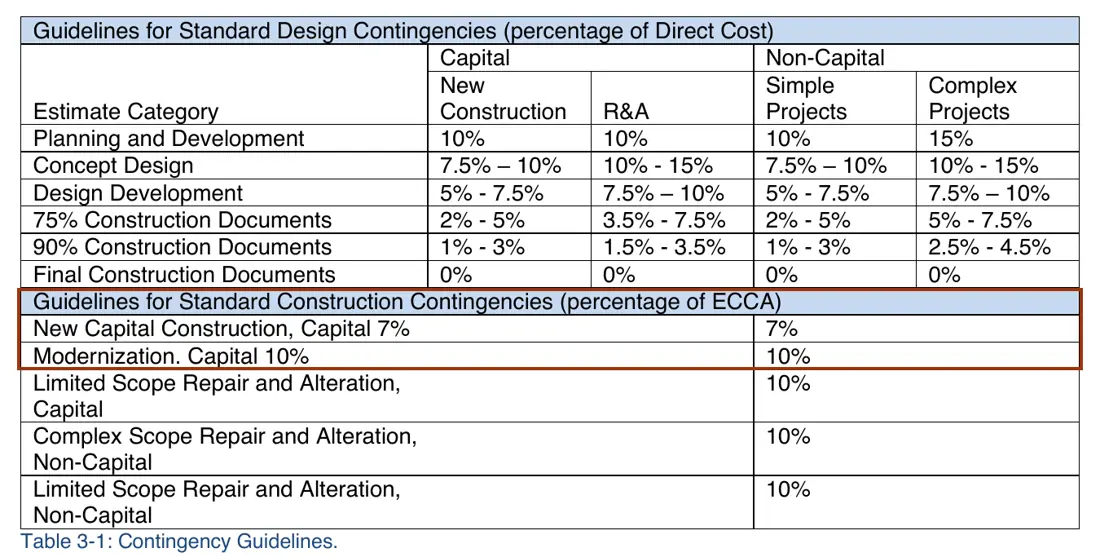
Washington State writes the same idea into its budget forms. Its 2025-27 capital budget instructions (June 2024) count the design contingency inside the maximum allowable construction cost (MACC) and keep project contingency outside it, so the design allowance is spent by the time the contractor’s price is set.
Why do renovations carry more contingency than new buildings?
Renovations carry more because existing buildings hide conditions that drawings cannot show. GSA adds 3 points at the construction stage (10% against 7%) and up to 5 points at concept design (15% against 10%). The University of Alaska Anchorage lifts renovations to 12% to 15%, and Washington DES notes remodel contingency often exceeds 10% because of unforeseen conditions and aging systems.
Colorado’s cost management guidelines list 5 kinds of change that its 10% renovation contingency is meant to absorb, and each one is more likely in an existing building:
- Differing site conditions: found on site or in the structure and not detected in the initial investigations.
- Bid alternates: additive or deductive alternates taken after the base bid result.
- Added value: work needed to deliver the original scope that the bid documents omitted.
- Upgrades: voluntary material or system upgrades within the original scope, justified on durability, energy or appearance.
- Unknown items: disruptions, shutdowns and relocations caused by working around existing operations.
Washington DES also asks for a written narrative once changes pass 15% of the original contract cost, a useful tripwire for any owner. How occupied buildings are phased and priced is covered in our guide to commercial renovation contractors.
Is escalation part of construction contingency?
Treat escalation as its own line. GSA’s P120 calls escalation a contingency for future market and code-driven price increases, but prices it separately: the estimator escalates the current estimate to the midpoint of construction, assuming half the work is bought before that point, with a project market study as the primary data source. Construction contingency is then added to the escalated figure.
| Index | Period | Change | Source |
|---|---|---|---|
| BLS PPI, new nonresidential building construction (WPU801) | Sep 2025 to Sep 2026 (preliminary) | +5.4% (176.749 to 186.243) | BLS |
| RLB National Construction Cost Index | 12 months to July 2026 | +4.45% (to 292.28) | RLB Q3 2026 |
| Mortenson Construction Cost Index | 12 months to Q3 2026 | +5.60% | Mortenson Q3 2026 |
On a $4,620,000 estimate at concept design, 12 months to the construction midpoint at the BLS rate adds $248,161. Washington’s 2025-27 instructions require structured escalation research for projects over $25,000,000 and a formal report on cost and escalation drivers above $50,000,000. Monthly updates of these series are on our commercial construction price index.
Who controls contingency in a GMP contract, and who keeps the savings?
In a guaranteed maximum price contract two pots sit side by side. The construction manager’s contingency sits inside the GMP for its exclusive use under AIA A133-2019 §3.2.4, covering costs in the GMP not yet assigned to a line. The owner’s contingency sits outside the GMP and pays for owner changes by change order. Who keeps unspent CM contingency is whatever §6.1.7 or the owner’s form says.
| Question | AIA A133-2019 | Ohio OFCC K-12 CM at risk form | Colorado state projects |
|---|---|---|---|
| How the CM contingency is set | Stated in the GMP proposal with the cost of the work and fee (§3.2.1, §3.2.3.3) | Proposed with the GMP Amendment, capped at a stated % of the Cost of the Work | Project contingency of 5% or 10% of total project cost |
| Who may draw it | The CM, for costs in the GMP not assigned elsewhere (§3.2.4) | The CM, within the cap | The agency, by category, never to add scope beyond the appropriation |
| Paper trail | Its own schedule of values line (§11.1.5); supporting documents to the Architect for each transfer (§11.1.5.3) | Not covered in the clause read | Contingency Summary Form at closeout |
| Cost above the GMP | Paid by the CM without reimbursement (§6.2) | Not covered in the clause read | Not applicable |
| Unspent at closeout | Owner pays only the Cost of the Work plus the Fee (§6.1.1); a split needs §6.1.7 | 100% returned by Shared-Savings Change Order, plus a fee cut (§3.4.1) | Reverts to the capital construction fund |
The arithmetic below uses the 3.75% fee and $382,211 CM contingency (2% of $19,110,546 in trade packages) from Henderson County, North Carolina’s 2018 Edneyville Elementary GMP (board packet, April 18, 2018), and assumes $120,000 is unspent at closeout. The unspent figure is an illustration, not a reported result.
| Savings clause | Owner saves | CM keeps | Arithmetic |
|---|---|---|---|
| Ohio §3.4.1 default | $124,500 | $0 | $120,000 returned + 3.75% fee cut on $120,000 ($4,500) |
| A133, §6.1.7 blank, fee 3.75% of cost | $124,500 | $0 | Unspent $120,000 is never billed; fee falls by $4,500 |
| A133, §6.1.7 blank, lump-sum fee | $120,000 | $0 | Fee does not change |
| A133 with a 50/50 split written into §6.1.7 | $60,000 | $60,000 | 50% x $120,000, before any fee effect |
A shared-savings clause gives the manager a reason to finish under the GMP, and the owner pays for that incentive: in the 50/50 row it costs $60,000. How the GMP itself is assembled, step by step, is set out in our guide to construction management at risk. Audit rights over the cost of the work are compared across AIA forms in our cost-plus contract guide.
How is contingency drawn down and released?
Contingency is spent through documented transfers and released in steps. Public manuals hold it high through bidding, cut it at award, track it against progress and return what is left at closeout. The University of Arkansas guideline (Policy 705.1) holds 10% through design and bidding and allows no less than 5% at award, and Colorado reverts unspent contingency to its capital construction fund.
- Set at budget. Carry design + construction contingency by stage: GSA starts at 10% design contingency plus 7% or 10% construction contingency. Colorado splits the pot into professional services, construction, FF&E and miscellaneous.
- Lock in the GMP. Show the CM contingency as its own line, capped: A133 §3.2.3.3 lists it in the GMP proposal and §11.1.5 gives it a schedule of values line; Ohio caps it at a stated % of the Cost of the Work.
- Bid and award. Arkansas keeps 10% through bidding, no less than 5% at award. Colorado bars using construction contingency to cover a bid overage without first consulting the Office of the State Architect.
- Document draws. Under A133 §11.1.5.3 the CM sends support to the Architect for each transfer from contingency to another line; owner contingency moves only by change order.
- Report monthly. Compare remaining contingency vs percent complete on each payment application, which A133 §11.1.6 requires to show percentage of completion by portion of the work.
- Partial release. Cornell allows one release request after substantial completion for contingency no longer needed (Cornell, November 2025).
- Return at closeout. Ohio executes a shared-savings change order no more than 30 days before final payment; Colorado reverts any balance to the capital construction fund.
Step 6 ties to the substantial completion milestone, when punch list and closeout costs are the main exposure left; our guide to substantial completion lists what that certificate triggers.
What does contingency add to a new build versus a renovation?
On the same 20,000 square feet at concept design, a renovation can carry more contingency dollars than a new building that costs more. Using GSA’s upper-end percentages and the BLS escalation rate, contingency and escalation add 24.0% to a $4,200,000 new office and 33.3% to a $3,240,000 office renovation. This is CB&C arithmetic on published figures, not a quote.
| Line | New build: 20,000 sq ft office, Miami | Renovation: 20,000 sq ft office fit-out | Basis |
|---|---|---|---|
| Base hard cost | $4,200,000 | $3,240,000 | RLB Q3 2026 Miami secondary office midpoint, $210/sq ft; Cushman & Wakefield 2026 U.S. fit-out average, $162/sq ft |
| Design contingency at concept design | $420,000 (10%) | $486,000 (15%) | GSA P120 Table 3-1, upper end |
| Subtotal | $4,620,000 | $3,726,000 | |
| Escalation, 12 months to midpoint | $248,161 | $200,141 | BLS WPU801, x 1.0537 |
| Estimated cost at award (ECCA) | $4,868,161 | $3,926,141 | |
| Construction contingency | $340,771 (7%) | $392,614 (10%) | GSA P120 Table 3-1 |
| Construction budget (ECC) | $5,208,932 | $4,318,755 | |
| Per square foot | $260.45 | $215.94 | Divided by 20,000 sq ft |
| Contingency plus escalation | $1,008,932 (24.0% of base) | $1,078,755 (33.3% of base) | |
| Contingency only | $760,771 (18.1% of base) | $878,614 (27.1% of base) |
Soft costs, land and financing are excluded; Colorado’s method would add a further 5% or 10% of total project cost on top of those lines. The new-build rows use the same RLB range and GSA percentages as the budget example in our commercial construction cost per square foot guide.
What do common rules of thumb get wrong?
Several top-ranking guides, read in November 2026, quote 5% to 10% without naming a source or a base. The primary documents agree on direction, more for renovation and less as drawings mature, but differ on the base and on who keeps leftovers. 4 claims recur, and each needs a qualifier from the public record.
| What several guides say | What the primary source says | Source |
|---|---|---|
| “5% to 10% of the total budget is typical” | The base changes the dollars: GSA applies 7% to the escalated award estimate, Colorado applies 5% to total project cost, and a design contingency of up to 10% sits on top early in design | GSA P120; Colorado OSA |
| “Contractor contingency covers escalation” | GSA prices escalation separately, to the construction midpoint, before construction contingency is added | GSA P120 |
| “Unused contractor contingency is commonly split 60/40 or 75/25” | AIA A133-2019 leaves the split blank at §6.1.7; Ohio returns 100% to the owner; Colorado reverts all unspent contingency | AIA A133; Ohio OFCC |
| “Contingency pays for owner-requested changes” | GSA funds scope changes by revising the project budget, not from construction contingency; A133 §3.2.2 sends changes in scope, systems or quality through a change order | GSA P120; AIA A133 |
Which contingency level fits your project?
Pick the percentage from the design stage and the type of work, then adjust for size and contract. The 9 thresholds below come from GSA, Washington State, Colorado, Cornell and the AIA forms. When bids land above budget, compare them line by line before touching contingency, using our checklist on how to compare construction bids.
| If | Then | Source |
|---|---|---|
| New building at planning or concept design | Carry 10% design contingency plus 7% construction contingency on the escalated estimate | GSA P120 |
| Renovation or alteration at concept design | Carry 10% to 15% design contingency plus 10% construction contingency | GSA P120 |
| Older or occupied building with unknown structure or systems | Budget at the top of the range: UAA allows 12% to 15%; Washington DES sees remodels exceed 10% | UAA; WA DES |
| Construction midpoint more than 12 months away | Add a separate escalation line; 12 months at 5.4% adds about $54 per $1,000 | BLS WPU801 |
| Project over $50,000,000 | Use a quantitative risk register and risk-based contingency | WA OFM 2025-27 |
| Project from $10,000,000 to $50,000,000 | Use a formal qualitative risk register | WA OFM 2025-27 |
| Signing a GMP | Show CM contingency as its own line, cap it as a % of the Cost of the Work and fill in §6.1.7 | AIA A133; Ohio OFCC |
| Bids come in over budget | Do not spend construction contingency on the overage; take deductive alternates or redesign first | Colorado OSA |
| Maintenance project under $2,000,000 | 3.5% contingency backed by a pooled reserve, as Cornell does | Cornell |
This page summarizes 14 public owner documents and is not legal or financial advice; ask your attorney to check how contingency, allowances and the §6.1.7 savings clause are defined before you sign a GMP amendment.
Which party holds the contingency depends on the pricing method described in our guide to types of construction contracts.
Each draw on owner contingency is recorded on a signed G701, priced as shown in our change order guide with a worked example.
How we compiled this
We read 14 primary documents in October and November 2026: GSA’s P120 policy and its January 2024 Q&A, the DoD Facilities Pricing Guide supplement of 6 June 2026, capital budget guidance from Colorado, Washington State (OFM and DES), the University of Arkansas, the University of Alaska Anchorage and Cornell, the AIA A133-2019 and A201-2017 preview texts, Ohio’s CM-at-risk agreement form, a 2018 Henderson County GMP and the BLS producer price index. Hard costs come from 2 published cost reports (RLB Q3 2026 and Cushman & Wakefield 2026) and escalation from a third (Mortenson Q3 2026). Percentages in vendor blogs were excluded unless a primary document confirmed them, and the worked budget is labelled arithmetic, not market data.
Frequently asked questions
What is a typical construction contingency percentage?
Public owner guides set 5% to 10% for new construction and 10% to 15% for renovation, on different bases. GSA uses 7% for new capital construction and 10% for repair and alteration, applied to the escalated award estimate, plus a design contingency of up to 10% early in design. Colorado uses 5% and 10% of total project cost.
What is the difference between owner contingency and contractor contingency?
Owner contingency sits outside the construction contract and pays for owner changes and unknowns through change orders. Contractor or CM contingency sits inside the contract price or GMP: AIA A133-2019 §3.2.4 reserves it for the construction manager’s exclusive use, for costs that are in the GMP but not yet assigned to a line. Track the two separately.
What is the difference between a contingency and an allowance?
An allowance is a stated sum for a planned item not yet specified, such as door hardware, and AIA A201-2017 §3.8 adjusts the contract sum by change order when the actual cost differs. A contingency covers unplanned events. GSA’s P120, following ASTM E2168, requires the two to be shown separately and never hidden in unit prices.
What happens to unused construction contingency?
The contract decides. Under AIA A133-2019 the owner pays only the cost of the work plus the fee, so unspent CM contingency stays with the owner unless §6.1.7 sets a split. Ohio’s public form returns 100% plus a fee cut no more than 30 days before final payment, and Colorado reverts unspent contingency to its capital construction fund.
Is 10% contingency enough for a renovation?
Often, but not always. GSA uses 10% construction contingency for renovation once design is complete, plus up to 15% design contingency at concept design. The University of Alaska Anchorage allows 12% to 15% for renovations, and Washington’s Department of Enterprise Services notes that remodel contingency often exceeds 10% because of unforeseen conditions and aging systems.
Does contingency cover change orders?
It pays for change orders caused by unknowns, such as differing site conditions or coordination gaps, but not for added scope. GSA’s P120 says scope changes must be funded by revised project funding, not construction contingency, and AIA A133-2019 §3.2.2 sends changes in scope, systems or quality through a change order that adjusts the GMP.
Sources
- U.S. General Services Administration, P120, PBS Cost and Schedule Management Policy Requirements (PBS 1000.6B, November 7, 2022), accessed November 1, 2026.
- U.S. General Services Administration, Q&A: Cost Estimating and Cost Management Principles (January 18, 2024), accessed November 1, 2026.
- U.S. Department of Defense, UFS 3-701-01, DoD Facilities Pricing Guide (6 June 2026), accessed November 1, 2026.
- Colorado Office of the State Architect, SBP Project Monitoring and Cost Management Guidelines (Rev 8/2023), accessed November 1, 2026.
- Washington Office of Financial Management, 2025-27 Capital Budget Instructions, Part 2 (June 2024), accessed November 1, 2026.
- Washington Department of Enterprise Services, Project Budgets presentation (November 14, 2025), accessed November 1, 2026.
- University of Arkansas, Fayetteville Policies and Procedures 705.1, Construction-Project Cost Estimating Guideline, accessed November 1, 2026.
- University of Alaska Anchorage, Appendix 7.4b, General rules for the preparation of a Project Budget, accessed November 1, 2026.
- Cornell University, Capital Project Financial Guidelines (November 2025), accessed November 1, 2026.
- AIA Contract Documents, A133-2019, Owner and Construction Manager as Constructor, Cost of the Work Plus a Fee with a GMP (preview), accessed November 1, 2026.
- AIA Contract Documents, A201-2017, General Conditions of the Contract for Construction (preview), accessed November 1, 2026.
- Ohio Facilities Construction Commission, Document 00 52 23, Agreement Form (K-12 School CM at Risk Project), accessed November 1, 2026.
- Henderson County Board of Commissioners, Request for Board Action: Guaranteed Maximum Price, Edneyville Elementary School (April 18, 2018), accessed November 1, 2026.
- U.S. Bureau of Labor Statistics, PPI series WPU801, new nonresidential building construction, accessed November 1, 2026.
- Rider Levett Bucknall, Construction Cost Report, North America, Q3 2026, accessed November 1, 2026.
- Mortenson, Construction Cost Index, 3rd Quarter 2026, accessed November 1, 2026.
- Cushman & Wakefield, Office fit-out costs across the Americas rise 5.5% (2026 Fit Out Cost Guide release), accessed November 1, 2026.