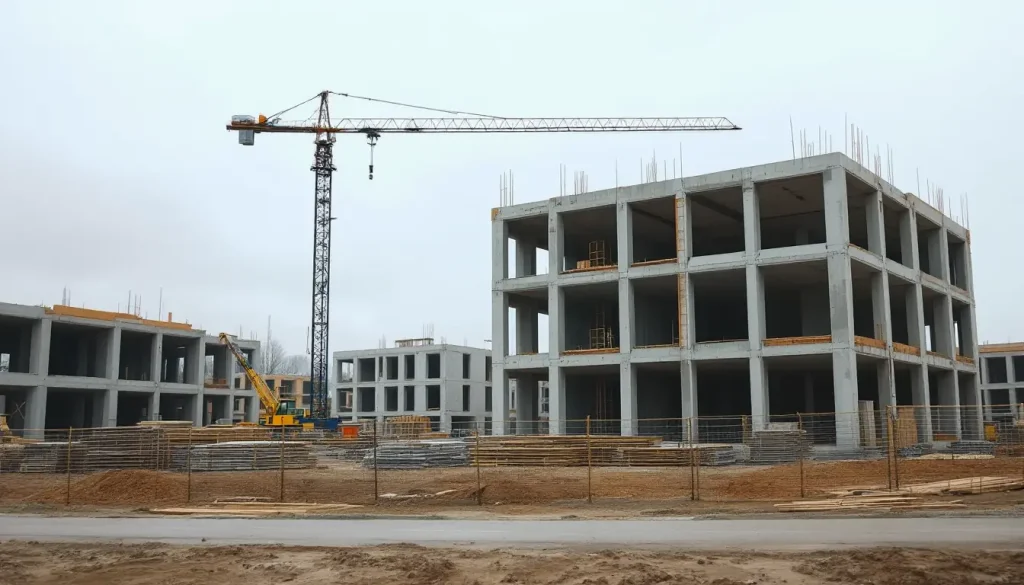
Fall protection requirements on a construction site start at 6 feet: OSHA rule 29 CFR 1926.501 requires a guardrail, safety net or personal fall arrest system at any edge 6 ft or more above a lower level.
Key takeaways
- Construction work triggers fall protection at 6 ft (1926.501(b)(1)), general industry work at 4 ft (29 CFR 1910.28(b)(1)), scaffolds above 10 ft (1926.451(g)(1)) and steel erection above 15 ft (1926.760(a)(1)).
- A construction guardrail top edge sits at 42 in plus or minus 3 in and must hold 200 lb within 2 in of the top without dropping below 39 in (29 CFR 1926.502(b)).
- A personal fall arrest system must stop a worker within 6 ft of free fall and 3.5 ft of deceleration, cap arresting force at 1,800 lb with a harness, and tie to an anchorage good for 5,000 lb per worker (1926.502(d)).
- On low-slope roofs (4 in 12 or flatter), a warning line goes at least 6 ft from the edge, or 10 ft from edges perpendicular to roofing equipment travel (1926.502(f)(1)).
- Duty to have fall protection (1926.501) drew 6,705 federal construction citations in FY2025, 25.4% of the total, at $6,812 per citation (OSHA Frequently Cited Standards, NAICS 23, FY2025).
- OSHA kept 2025 penalty maximums for 2026: $16,550 per serious violation and $165,514 per willful or repeat violation (OSHA memo, May 21, 2026).
At what height is fall protection required in construction?
Fall protection is required in construction at 6 ft above a lower level for unprotected sides and edges, leading edges, holes, wall openings, formwork, ramps and roofs under OSHA 29 CFR 1926.501. Three activities have their own heights: scaffolds above 10 ft, steel erection above 15 ft and steel connectors above two stories or 30 ft. Repair on a finished building counts as construction; routine maintenance falls under the 4 ft general industry rule.
The split between construction and general industry matters on commercial sites. OSHA defines construction work as “construction, alteration, and/or repair, including painting and decorating” (29 CFR 1910.12(b)), so a tenant improvement crew works to the 6 ft rule, while a building engineer cleaning gutters on the same roof next month works to 4 ft under 1910.28.
| Situation | Trigger height | What OSHA accepts | Rule |
|---|---|---|---|
| Unprotected side or edge (floors, decks, mezzanines) | 6 ft or more | Guardrail, safety net or personal fall arrest system (PFAS) | 1926.501(b)(1) |
| Constructing a leading edge | 6 ft or more | Guardrail, net or PFAS; written plan only if infeasible | 1926.501(b)(2) |
| Holes, including skylights | More than 6 ft | PFAS, covers or guardrail on all sides | 1926.501(b)(4) |
| Wall openings (inside sill under 39 in) | Outside drop 6 ft or more | Guardrail, net or PFAS | 1926.501(b)(14) |
| Low-slope roof (4 in 12 or flatter) | Edge 6 ft or more | Conventional systems or warning line combinations | 1926.501(b)(10) |
| Steep roof (over 4 in 12) | Edge 6 ft or more | Guardrail with toeboards, net or PFAS | 1926.501(b)(11) |
| Scaffold platform | More than 10 ft | Guardrail or PFAS, by scaffold type | 1926.451(g)(1) |
| Steel erection, general | More than 15 ft | Guardrail, net, PFAS, positioning or restraint | 1926.760(a)(1) |
| Steel connectors and controlled decking zones | More than 2 stories or 30 ft, whichever is less | Same systems; between 15 and 30 ft, gear worn and ready to tie off | 1926.760(b), (c) |
| General industry (maintenance, operations) | 4 ft or more | Guardrail, net, PFAS or travel restraint | 1910.28(b)(1) |
The 6 ft line is the reason falls lead construction enforcement. Falls, slips and trips killed 389 construction workers in 2024, 37.6% of the industry’s 1,034 deaths (BLS Census of Fatal Occupational Injuries, 2024). The year-by-year count and the trades most affected are in our report on construction worker deaths.
Which work areas have their own fall protection rules?
Holes, wall openings, hoist areas, excavations, formwork and dangerous equipment each have a specific paragraph in 1926.501(b), and the accepted systems differ by area. A hole is any gap 2 in or more in its least dimension (1926.500(b)), so a floor penetration for a 4 in pipe already counts, and its cover must carry twice the load placed on it.
| Area | Requirement | Rule |
|---|---|---|
| Hole covers in walkways | Support twice the weight of workers, equipment and materials; secured; color coded or marked HOLE or COVER | 1926.502(i)(2) to (4) |
| Hole covers in roadways | Support twice the maximum axle load of the largest expected vehicle | 1926.502(i)(1) |
| Hoist areas | Guardrail or PFAS at 6 ft; PFAS when a worker leans through a removed rail | 1926.501(b)(3) |
| Formwork and rebar faces | PFAS, net or positioning device at 6 ft | 1926.501(b)(5) |
| Ramps, runways, walkways | Guardrail at 6 ft | 1926.501(b)(6) |
| Wells, pits, shafts | Guardrail, fence, barricade or cover at 6 ft deep | 1926.501(b)(7)(ii) |
| Dangerous equipment below | Under 6 ft: guardrail or equipment guard; 6 ft or more: guardrail, PFAS or net | 1926.501(b)(8) |
| Overhand bricklaying | Guardrail, net, PFAS or controlled access zone 10 to 15 ft from the working edge | 1926.501(b)(9), 1926.502(g)(3) |
| Precast concrete erection | Guardrail, net or PFAS; written plan only if infeasible | 1926.501(b)(12) |
On a leading edge, a controlled access zone line goes 6 to 25 ft back from the edge, or up to 60 ft (or half the member length, whichever is less) during precast erection (1926.502(g)(1)). The line hangs 39 to 45 in high, is flagged at least every 6 ft and has a 200 lb minimum breaking strength.
What are the fall protection requirements for low-slope and steep roofs?
A roof with a slope of 4 in 12 or less is low-slope; anything steeper is a steep roof (1926.500(b)). Roofing crews on a low-slope roof with an edge 6 ft or more above the ground may use a warning line plus a guardrail, net, PFAS or safety monitor, and on roofs 50 ft wide or less a safety monitor alone. Steep roofs require a guardrail with toeboards, a net or PFAS.
| Roof condition | Accepted protection | Rule |
|---|---|---|
| Low-slope, any width | Guardrail, net or PFAS; or a warning line combined with guardrail, net, PFAS or safety monitoring system | 1926.501(b)(10) |
| Low-slope, 50 ft wide or less | Safety monitoring system alone also permitted | 1926.501(b)(10) |
| Steep (over 4 in 12) | Guardrail with toeboards, net or PFAS; no warning lines, no monitor-only | 1926.501(b)(11) |
| Materials near the edge | Not stored within 6 ft of a roof edge unless guardrails are up | 1926.502(j)(7)(i) |
The warning line itself is specified in 1926.502(f): rope, wire or chain flagged every 6 ft or less, 34 to 39 in above the roof including sag, a 500 lb minimum tensile strength, and stanchions that resist a 16 lb horizontal push at 30 in without tipping. The safety monitor must be a competent person on the same roof, within sight and speaking distance, with no other duties, and no mechanical equipment may be used or stored where monitoring alone protects the crew (1926.502(h)).
Worked example: warning line layout on a 120 ft by 80 ft roof
A single-ply reroof on a 120 ft by 80 ft low-slope roof cannot use a monitor alone because the roof is wider than 50 ft. With the warning line option and a membrane cart travelling the long way, the set-backs below fix the work area. Every input is from 1926.502(f)(1).
| Step | Input | Result |
|---|---|---|
| Roof area | 120 ft x 80 ft | 9,600 sq ft |
| No equipment: 6 ft from all four edges | (120 – 12) x (80 – 12) | 108 x 68 = 7,344 sq ft (76.5%) |
| Equipment travelling along the 120 ft side: 10 ft from the two 80 ft ends | 120 – 20 = 100 ft | 100 ft long |
| 6 ft from the two 120 ft sides | 80 – 12 = 68 ft | 68 ft wide |
| Work area with equipment | 100 x 68 | 6,800 sq ft (70.8%) |
| Strip outside the line | 9,600 – 6,800 | 2,800 sq ft needs guardrail, net, PFAS or a monitor |
The 2,800 sq ft perimeter strip is where crews flash the edge, so the bid should carry either temporary guardrail for about 400 lineal ft of perimeter or PFAS anchors plus a monitor. Membrane pricing for the same roof is in our TPO roofing cost guide.
What does an OSHA-compliant guardrail look like?
An OSHA construction guardrail has a top edge 42 in plus or minus 3 in above the walking surface, a midrail or equivalent halfway down, and holds a 200 lb outward or downward force within 2 in of the top without the rail dropping below 39 in (29 CFR 1926.502(b)). Scaffold guardrails follow a separate rule, 38 to 45 in for supported scaffolds placed in service after January 1, 2000 (1926.451(g)(4)(ii)).
| Component | Requirement | Rule |
|---|---|---|
| Top edge height | 42 in plus or minus 3 in (39 to 45 in); may exceed 45 in if all other criteria are met | 1926.502(b)(1) |
| Top rail strength | 200 lb within 2 in of the top edge, outward or downward | 1926.502(b)(3) |
| Deflection under 200 lb | Top edge stays at 39 in or higher | 1926.502(b)(4) |
| Midrail | Midway between top edge and surface; not needed behind a wall or parapet 21 in or higher | 1926.502(b)(2) |
| Midrail strength | 150 lb in any downward or outward direction | 1926.502(b)(5) |
| Openings | Intermediate members 19 in apart or less; no opening wider than 19 in | 1926.502(b)(2)(iii), (iv) |
| Rail size | At least 0.25 in thick; wire rope flagged every 6 ft or less | 1926.502(b)(9) |
| Toeboard | 3.5 in high minimum, 0.25 in gap maximum, 50 lb strength | 1926.502(j) |
| Scaffold top rail | 38 to 45 in (36 to 45 in for older supported scaffolds); 200 lb, 100 lb on two-point suspension | 1926.451(g)(4) |
Temporary OSHA guardrail and the permanent building-code guard are different targets. The finished building needs a 42 in minimum guard under the International Building Code, while OSHA accepts 39 in during construction, so a temporary rail set at 39 in will not pass final inspection if it is left in place. The permanent numbers are in our guide to handrail and guard height.
What are the limits for personal fall arrest systems and safety nets?
A personal fall arrest system must keep free fall to 6 ft or less, stop the worker within 3.5 ft of deceleration, limit arresting force to 1,800 lb with a full-body harness, and connect to an anchorage rated at 5,000 lb per worker or designed by a qualified person with a safety factor of two (1926.502(d)). Safety nets hang no more than 30 ft below the work.
| Component | Requirement | Rule |
|---|---|---|
| Free fall | 6 ft maximum, and no contact with any lower level | 1926.502(d)(16)(iii) |
| Deceleration distance | 3.5 ft maximum | 1926.502(d)(16)(iv) |
| Arresting force | 1,800 lb with a body harness (900 lb with a body belt) | 1926.502(d)(16)(i), (ii) |
| Anchorage | 5,000 lb per worker, or qualified-person design at safety factor 2 | 1926.502(d)(15) |
| Lanyards, vertical lifelines, D-rings, snaphooks | 5,000 lb minimum; D-rings and snaphooks proof-tested to 3,600 lb | 1926.502(d)(3), (4), (9) |
| Self-retracting lifeline | 3,000 lb if it limits free fall to 2 ft or less; 5,000 lb otherwise | 1926.502(d)(12), (13) |
| Positioning device | Free fall 2 ft maximum; anchorage 3,000 lb or twice the impact load | 1926.502(e)(1), (2) |
| Appendix C test weight | Compliance presumed for a worker plus tools under 310 lb | 1926.502(d)(16) |
The free fall and deceleration limits add up to a clearance check. The rule allows 6 ft of free fall plus 3.5 ft of deceleration, 9.5 ft of travel before the worker stops, and the worker’s body hangs below the harness attachment point on top of that. Where the lower level is closer, the fix is a shorter lanyard, a self-retracting lifeline that limits free fall to 2 ft, or a higher anchor; the device maker’s instructions give the full clearance figure.
| Vertical drop from work level to net | Minimum net extension beyond the edge | Rule |
|---|---|---|
| Up to 5 ft | 8 ft | 1926.502(c)(2) |
| More than 5 ft up to 10 ft | 10 ft | 1926.502(c)(2) |
| More than 10 ft (30 ft maximum drop) | 13 ft | 1926.502(c)(1), (2) |
Nets are drop-tested on site with a 400 lb sandbag, 30 in plus or minus 2 in across, after installation, after relocation or major repair, and every 6 months in one place (1926.502(c)(4)). Mesh openings may not exceed 36 sq in or 6 in on a side, and the border rope needs 5,000 lb breaking strength.
When can a written fall protection plan replace guardrails, nets or harnesses?
A written fall protection plan is allowed only for leading edge work, precast concrete erection and residential construction, and only when the employer can show that guardrails, nets and PFAS are infeasible or create a greater hazard (1926.502(k)). It is not an option for general commercial framing, roofing or deck work, where one of the three conventional systems is required.
When the plan is allowed, 1926.502(k) requires each of these elements:
- Prepared by a qualified person, specific to the site, and kept up to date (k)(1).
- Every change approved by a qualified person (k)(2).
- A current copy kept at the job site (k)(3).
- Carried out under the supervision of a competent person (k)(4).
- Written reasons why guardrails, PFAS and nets are infeasible or more hazardous (k)(5).
- Other measures considered, such as scaffolds, ladders or vehicle-mounted platforms (k)(6).
- Each location without conventional protection named and run as a controlled access zone (k)(7).
- A safety monitoring system where no other measure is used (k)(8).
- The name of each worker allowed into the controlled access zones (k)(9).
- An investigation after any fall or near miss, with plan changes made (k)(10).
What fall protection training does OSHA require?
Every worker who might be exposed to a fall hazard must be trained by a competent person to recognize fall hazards and to erect, inspect and use the systems on that job (29 CFR 1926.503). The employer documents it in a written certification with the worker’s name, the training date and the trainer’s or employer’s signature. The rule sets no fixed hours or renewal interval; retraining is triggered by change.
| Training item | What the rule requires | Rule |
|---|---|---|
| Who must be trained | Each employee who might be exposed to fall hazards | 1926.503(a)(1) |
| Trainer | A competent person qualified in the listed topics | 1926.503(a)(2) |
| Topics | Hazards in the work area; erecting, maintaining, inspecting systems; guardrails, PFAS, nets, warning lines, monitors, controlled access zones; worker role in monitoring and plans; material handling | 1926.503(a)(2)(i) to (vii) |
| Record | Written certification: name, date(s), signature of trainer or employer; latest one kept | 1926.503(b) |
| Retraining | When the workplace changes, the system changes, or a worker shows gaps in knowledge or use | 1926.503(c)(1) to (3) |
Training citations are cheap per item but frequent: 1926.503 drew 28 federal citations in nonresidential building in FY2024 at an average current penalty of $2,115 each (OSHA Frequently Cited Standards, NAICS 2362, FY2024).
How much are OSHA fall protection penalties in 2026?
As of November 2026, a serious fall protection violation carries up to $16,550 and a willful or repeat violation up to $165,514, the same maximums as 2025 because OSHA made no inflation adjustment for 2026 (OSHA memo, May 21, 2026; OSHA Penalties). Actual assessed penalties run lower: nonresidential building contractors averaged $8,112 per 1926.501 citation in FY2024.
| Violation type | Minimum (2026) | Maximum (2026) | Source |
|---|---|---|---|
| Serious | $1,085 | $16,550 per violation | OSHA memo, May 21, 2026 |
| Other-than-serious | $0 | $16,550 per violation | OSHA Penalties page |
| Willful | $11,823 | $165,514 per violation | OSHA memo, May 21, 2026 |
| Repeat | $4,256 | $165,514 per violation | OSHA memo, May 21, 2026 |
| Failure to abate | None listed | $16,550 per day, generally up to 30 days | OSHA Penalties page |
The citation record shows where commercial crews get caught. In FY2024, federal OSHA cited nonresidential building contractors (NAICS 2362) 163 times under 1926.501, 48 times under 1926.502 and 28 times under 1926.503, against 119 scaffold citations under 1926.451. The full standard-by-standard comparison is in our OSHA violations in commercial construction report.
| Standard (NAICS 2362, FY2024) | Citations | Average penalty per citation | Total current penalties |
|---|---|---|---|
| 1926.501 Duty to have fall protection | 163 | $8,112 | $1,322,224 |
| 1926.451 Scaffolds, general | 119 | $3,642 | $433,342 |
| 1926.1053 Ladders | 58 | $3,552 | $206,019 |
| 1926.502 Fall protection systems criteria | 48 | $3,813 | $183,025 |
| 1926.503 Fall protection training | 28 | $2,115 | $59,212 |
Worked example: one inspection, three fall citations
An inspector finds an unguarded slab edge, a guardrail that sags below 39 in and no training certificates. The table prices that outcome three ways: at the FY2024 nonresidential building averages, at the 2026 serious maximum of $16,550 each, and with the 1926.501 item cited as a repeat violation.
| Scenario | 1926.501 | 1926.502 | 1926.503 | Total |
|---|---|---|---|---|
| FY2024 average current penalty, NAICS 2362 | $8,112 | $3,813 | $2,115 | $14,040 |
| All three serious, at the 2026 maximum | $16,550 | $16,550 | $16,550 | $49,650 |
| 1926.501 repeat, others serious, at the maximum | $165,514 | $16,550 | $16,550 | $198,614 |
On a site with several contractors, OSHA’s multi-employer citation policy (CPL 02-00-124) can cite the creating, exposing, correcting and controlling employer for the same open edge, so a general contractor can be cited for a subcontractor’s missing rail. Insurance carriers price that record too; see our guides to general liability insurance for contractors and contractor workers comp rates by state. None of this is legal advice; ask counsel about contest deadlines and settlement terms before signing an informal settlement agreement.
Which fall protection requirement applies to your crew?
Pick the rule by activity first and height second: scaffold and steel erection rules override the 6 ft default, roofing choices depend on slope and roof width, and only three activities can use a written plan. The decision table and flowchart hold the same logic; every threshold is from 29 CFR Part 1926 Subparts L, M and R or 1910.28.
| If | Then | Rule |
|---|---|---|
| The work is routine maintenance on a finished building | Use general industry rules: protect at 4 ft | 1910.28(b)(1) |
| A worker stands on a scaffold platform more than 10 ft up | Guardrail or PFAS per scaffold type; competent person decides erector protection | 1926.451(g)(1), (2) |
| Steel erection more than 15 ft up | Guardrail, net, PFAS, positioning or restraint | 1926.760(a)(1) |
| Connector or decking zone more than 2 stories or 30 ft up | Full protection; at 15 to 30 ft, gear worn and ready to tie off | 1926.760(b), (c) |
| Roofing on 4 in 12 or flatter, roof 50 ft wide or less | Safety monitor alone allowed, or any warning line combination | 1926.501(b)(10) |
| Roofing on 4 in 12 or flatter, roof wider than 50 ft | Warning line plus guardrail, net, PFAS or monitor; or conventional systems | 1926.501(b)(10) |
| Roofing steeper than 4 in 12 | Guardrail with toeboards, net or PFAS | 1926.501(b)(11) |
| Leading edge or precast erection where systems are infeasible | Written site plan by a qualified person, controlled access zones | 1926.502(k) |
| Any other edge, hole or opening 6 ft or more above a lower level | Guardrail, net or PFAS | 1926.501(b)(1), (4), (14), (15) |
Federal OSHA rules are a floor. State Plan states run their own OSHA programs and may adopt stricter fall rules, so check the OSHA State Plans list for the project state before writing the site safety plan. When comparing bidders, ask each for its 1926.503 certification records and its last 3 years of OSHA citations; our checklist for choosing a commercial contractor covers the rest of that screen.
Where do popular fall protection guides get the rules wrong?
One contractor guide on page 1, updated in August 2026, mixes construction and general industry rules in two places and drops the guardrail tolerance. The corrections below set each claim against the regulation text in 29 CFR Parts 1910 and 1926 as of November 2026.
| What several guides say | What the primary source says | Source |
|---|---|---|
| A contractor guide updated in 2026 says excavations need fall protection at 4 ft when a ladder is within 25 ft | Fall protection at excavation edges starts at 6 ft deep; the 4 ft and 25 ft numbers are the trench egress rule, a ladder or ramp within 25 ft of travel | 1926.501(b)(7); 1926.651(c)(2) |
| The same guide says low-slope roof crews may use warning lines from 6 to 15 ft and a monitor alone beyond 15 ft | Those 6 ft and 15 ft bands are the general industry roof rule; in construction a warning line is set at least 6 ft back and a monitor alone is allowed only on roofs 50 ft wide or less | 1910.28(b)(13); 1926.501(b)(10) |
| The same guide gives 42 in as the guardrail height | 42 in is the target; 39 to 45 in complies, and the rail must stay at 39 in or higher under a 200 lb load | 1926.502(b)(1), (4) |
Fall hazards change with the trade, so pair this with our construction safety guide and the hot work permit rules.
How we compiled this
We read the regulation text of 29 CFR 1926.500 to 1926.503, 1926.451, 1926.651, 1926.760, 1910.12 and 1910.28 on November 15, 2026, and took citation and penalty figures from 2 archived OSHA Frequently Cited Standards tables and the OSHA penalty memo of May 21, 2026, which our research team compiled in October 2026. Fatality counts come from the BLS Census of Fatal Occupational Injuries for 2024. We did not inspect sites or test equipment.
Frequently asked questions
At what height is fall protection required by OSHA?
In construction, OSHA requires fall protection at 6 ft above a lower level under 29 CFR 1926.501(b)(1). General industry work, such as building maintenance, triggers at 4 ft under 1910.28. Scaffolds trigger above 10 ft (1926.451(g)), steel erection above 15 ft (1926.760), and steel connectors above two stories or 30 ft, whichever is less.
Is fall protection required at 4 feet or 6 feet?
Both, depending on the work. Construction, alteration and repair use the 6 ft trigger in 29 CFR 1926.501. Routine maintenance and operations in a finished building use 4 ft under 29 CFR 1910.28(b)(1). Trench egress at 4 ft deep (1926.651(c)(2)) is a ladder or ramp rule, not a fall protection trigger.
What are the three acceptable fall protection systems in construction?
Guardrail systems, safety net systems and personal fall arrest systems are the three conventional systems in 29 CFR 1926.501. Guardrails need a 42 in plus or minus 3 in top edge; nets hang no more than 30 ft below the work; PFAS limits free fall to 6 ft. Warning lines, safety monitors and controlled access zones are allowed only in listed situations.
How far from the edge does a roof warning line have to be?
At least 6 ft from the roof edge when no mechanical equipment is used. With equipment, the line stays 6 ft from edges parallel to the direction of travel and 10 ft from edges perpendicular to it, under 29 CFR 1926.502(f)(1). The line must sit 34 to 39 in high and be flagged every 6 ft or less.
How often is fall protection training required?
29 CFR 1926.503 sets no fixed renewal interval or hour count. Each exposed worker is trained by a competent person before exposure, the employer keeps a signed written certification, and retraining is required when the workplace or equipment changes or a worker shows gaps in knowledge or use of the systems.
What is the OSHA fine for no fall protection in 2026?
Up to $16,550 per serious violation and $165,514 per willful or repeat violation in 2026, unchanged from 2025 under OSHA’s May 21, 2026 memo. Assessed penalties are lower after reductions and settlements: nonresidential building contractors averaged $8,112 per 1926.501 citation in FY2024, according to OSHA’s Frequently Cited Standards data.
Sources
- 29 CFR 1926.500, Scope, application and definitions, OSHA / eCFR, accessed November 15, 2026.
- 29 CFR 1926.501, Duty to have fall protection, OSHA, accessed November 15, 2026.
- 29 CFR 1926.502, Fall protection systems criteria and practices, OSHA / eCFR, accessed November 15, 2026.
- 29 CFR 1926.503, Training requirements, OSHA / eCFR, accessed November 15, 2026.
- 29 CFR 1926.451, Scaffolds, general requirements, OSHA / eCFR, accessed November 15, 2026.
- 29 CFR 1926.651, Specific excavation requirements, OSHA / eCFR, accessed November 15, 2026.
- 29 CFR 1926.760, Steel erection fall protection, OSHA / eCFR, accessed November 15, 2026.
- 29 CFR 1926.1053, Ladders, OSHA / eCFR, accessed November 15, 2026.
- 29 CFR 1910.28, Duty to have fall protection and falling object protection, OSHA / eCFR, accessed November 15, 2026.
- 29 CFR 1910.12, Construction work, Legal Information Institute (eCFR text), accessed November 15, 2026.
- 2026 OSHA Civil Penalties Update (memo, May 21, 2026), OSHA, accessed November 15, 2026.
- OSHA Penalties, OSHA, accessed November 15, 2026.
- Frequently Cited OSHA Standards, NAICS 2362, Federal, FY2024 (archived), OSHA, accessed November 15, 2026.
- Frequently Cited OSHA Standards, NAICS 23, Federal, FY2025 (archived), OSHA, accessed November 15, 2026.
- National Census of Fatal Occupational Injuries in 2024, U.S. Bureau of Labor Statistics, accessed November 15, 2026.
- CFOI Table A-1, 2024, U.S. Bureau of Labor Statistics, accessed November 15, 2026.
- CPL 02-00-124, Multi-Employer Citation Policy, OSHA, accessed November 15, 2026.
- State Plans, OSHA, accessed November 15, 2026.