
A commercial kitchen inspection is not one visit but 9 sign-offs in a fixed order: health plan review, building rough-in and final, fire marshal hood and suppression tests, grease interceptor approval, then the health pre-opening inspection.
Key takeaways
- The FDA Food Code requires approved plans before a food establishment is built, converted or remodeled (Section 8-201.11) and one or more preoperational inspections before it opens (Section 8-203.10) (FDA Food Code 2022).
- The permit application is due at least 30 calendar days before the planned opening date under Food Code Section 8-302.11, so the paperwork clock starts before the build is finished (FDA Food Code 2022).
- Los Angeles County reviews first plan submittals within 20 business days (10 expedited) and wants a preliminary inspection when the project is 80% complete (LA County Plan Check, 2026).
- The grease duct needs a light test with a lamp of at least 100 watts before any part is concealed, and the hood needs a performance test before final approval (IMC 2018 Sections 506.3.2.5 and 507.6, quoted in an ICC 2019 handout).
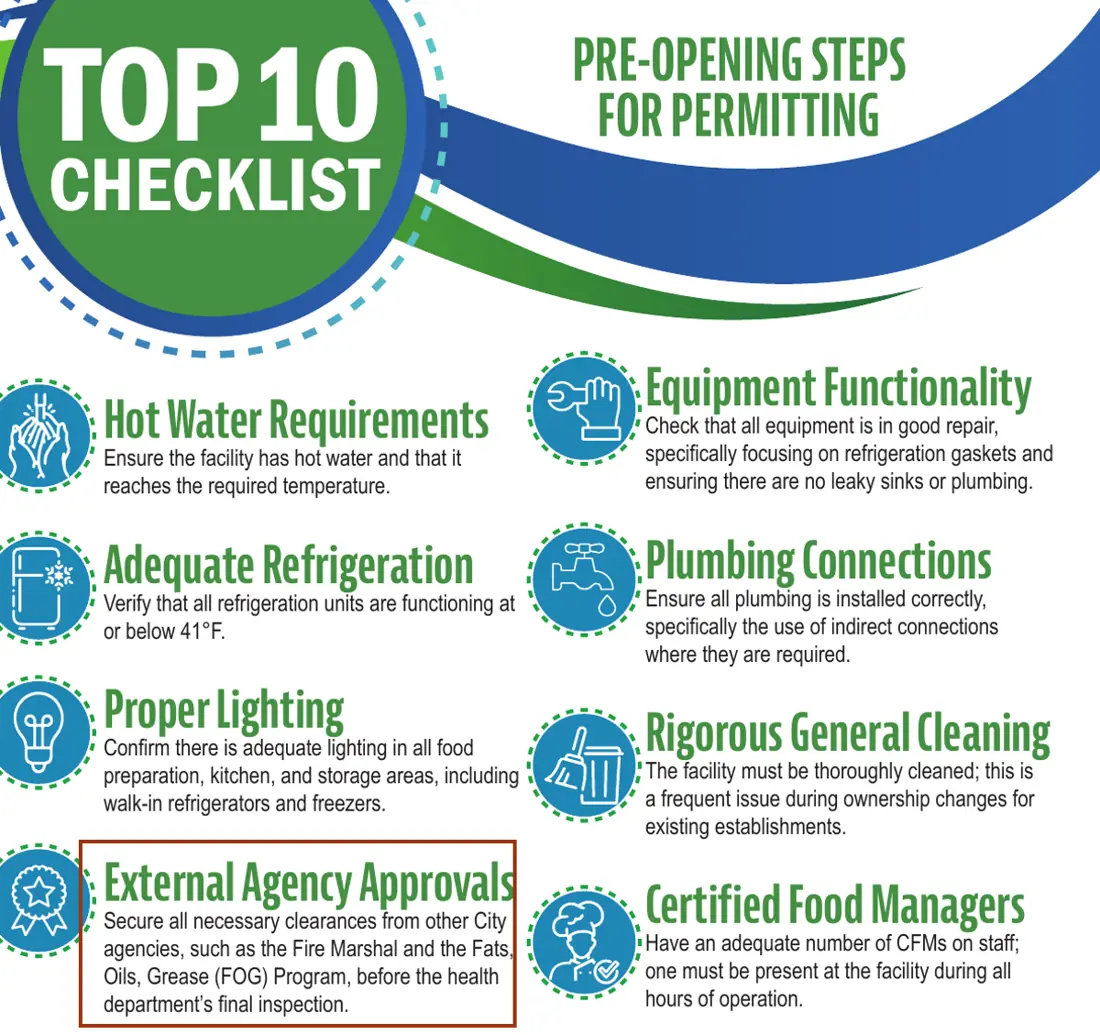
- Norfolk’s health department tells applicants to clear the fire marshal and the Fats, Oils and Grease (FOG) program before booking the health final (Norfolk Department of Public Health, 2026).
- After opening, cold holding at 41°F or below was out of compliance in 79.8% of full-service restaurants FDA observed in 2017 to 2018, the most common miss of 10 risk items (FDA risk factor report, June 2023).
| Key number | Value | Source |
|---|---|---|
| Permit application before opening | At least 30 calendar days | Food Code 2022, 8-302.11 |
| Health plan review, first submittal | 20 business days standard, 10 expedited | LA County Plan Check |
| Health preliminary inspection | At 80% construction complete | LA County Plan Check |
| Health pre-opening inspection booking | 2 weeks before opening (Anne Arundel, MD); at least 5 business days’ notice (Hampton, VA) | County checklists |
| Fire suppression acceptance test booking | At least 1 business day after the contractor’s pre-test | Kerrville Fire Marshal, item 21 |
| Grease duct light test lamp | Not less than 100 watts | IMC 2018, 506.3.2.5 |
| Routine health inspection interval | At least once every 6 months | Food Code 2022, 8-401.10 |
| Correcting a priority violation | On the spot, or within 72 hours if the inspector agrees | Food Code 2022, 8-405.11 |
Which inspections does a new commercial kitchen need, and in what order?
A new or gutted commercial kitchen passes 9 checkpoints run by 4 agencies: the health department reviews plans first, the building department inspects rough-in work before walls close, the fire marshal witnesses the hood suppression test, the sewer utility or FOG program signs off the grease interceptor, and the health department’s pre-opening inspection comes last, usually after the certificate of occupancy (CO).
The order matters because each agency checks the one before it. At step 8 of its process, Los Angeles County will not give final health approval without proof of a CO or a signed building inspection card (LA County Environmental Health), and Norfolk, Virginia asks for fire marshal and FOG clearance before its final. Our broader guide to the commercial kitchen covers the build requirements behind each of these checks.
| Step | Inspection | Agency | Who books it | Rule or local source |
|---|---|---|---|---|
| 1 | Health plan review | Health department | Permit applicant (owner or operator) | Food Code 8-201.11 |
| 2 | Grease interceptor size approval | FOG or pretreatment program | Owner’s engineer | Raleigh: before building plans; Austin: before purchase |
| 3 | Rough-in: under-slab plumbing, gas piping, rough electrical, HVAC | Building department | General contractor (GC) | Phoenix: each stage before concealment |
| 4 | Grease duct light test | Building (mechanical) | Permit holder performs it | IMC 2018, 506.3.2.5 |
| 5 | Health preliminary inspection | Health department | Operator | LA County: at 80% complete |
| 6 | Suppression acceptance test and hood performance test | Fire marshal; building official | Suppression installer; permit holder | IFC 904.4; IMC 507.6 |
| 7 | Building finals, interceptor sign-off, CO | Building; utilities | GC | Norfolk: fire and FOG first |
| 8 | Health pre-opening inspection, then permit | Health department | Operator | Food Code 8-203.10, 8-301.11 |
| 9 | Routine inspections | Health department | Unannounced | Food Code 8-401.10 |
What happens at health department plan review?
Health plan review is a paper inspection before construction: the reviewer checks the menu, food volume, layout, finish schedule and every piece of equipment by maker and model number against the Food Code. Food Code Section 8-201.12 lists the required contents, and Los Angeles County’s fee covers 2 plan reviews and 2 inspections, with extra fees for corrections caused by scope changes.
Plans are required before construction, conversion of an existing building, or a remodel the health department decides needs review (Food Code 8-201.11). The Conference for Food Protection’s 2025 plan review guidance adds the triggers most tenants hit: moving equipment or cabinetry, a menu change that adds equipment, and any equipment connected to gas, electricity or plumbing. Layout and clearance rules are covered in our guide to commercial kitchen design.
| Item in the submittal | Food Code 2022 reference | Common reason it delays review |
|---|---|---|
| Intended menu | 8-201.12(A) | Missing menu (LA County list of delay causes) |
| Anticipated volume of food | 8-201.12(B) | Walk-in and hot water sized without a meal count |
| Layout, mechanical schematics, finish schedule | 8-201.12(C) | Water heater location not shown (LA County) |
| Equipment types, makers, model numbers, dimensions | 8-201.12(D) | No equipment schedule or spec sheets (LA County) |
| Standard operating procedures | 8-201.12(E) | SOPs not written; checked again at 8-203.10 |
Which building inspections come before the kitchen is closed up?
Building inspections run at every stage before work is covered: under-slab plumbing, gas piping, rough electrical, HVAC and a kitchen exhaust inspection, then a final for each trade. Phoenix schedules any request made before 9 p.m. for the next business day, and Salt Lake City’s cutoff is 3:00 p.m. the workday before. Missing one inspection can mean opening a finished wall.
Phoenix lists kitchen exhaust as its own inspection type (code 254) alongside plumbing, mechanical and electrical finals, and says all required inspections must pass before permanent occupancy (City of Phoenix PDD). Salt Lake City names low-voltage and fire alarm wiring as the biggest offenders at penetration inspections, and warns that stamped approved plans must be on site (Salt Lake City Building Services). The permit side of a build-out is covered in our guide to commercial building permits.
| Building inspection | When to call it | What a kitchen adds | Source |
|---|---|---|---|
| Under-slab plumbing | Before the slab is poured or patched | Floor sinks, trench drains, interceptor lines | Phoenix inspection list |
| Gas piping | Before concealment | Range, fryer and oven drops | Phoenix inspection list |
| Rough electrical and HVAC | Before insulation and drywall | Hood fan circuits, shunt trip, make-up air unit | Phoenix; Salt Lake City |
| Grease duct light test | Before any duct is concealed | 100-watt lamp through every joint, including hood-to-duct | IMC 2018, 506.3.2.5 |
| Kitchen exhaust (Phoenix code 254) | Hood and duct installed | Clearances, cleanouts, termination | Phoenix inspection list |
| Trade finals and building final | All work complete; other agencies signed | Fire and interceptor sign-offs first | Phoenix; Norfolk |
How does the fire marshal test the hood and suppression system?
The fire marshal witnesses an acceptance test of the hood’s wet chemical suppression system after the installer has pre-tested it: piping is blown through with nitrogen or dry air, the fusible links and pull station must trip the system, and gas, make-up air and power must shut off (NFPA 17A Section 6.4.8). Separately, the hood gets a performance test of airflow and smoke capture before final approval.
The rules come from 3 documents. IFC 2018 Section 904.4.1 lists 6 items inspected before acceptance tests, from the hazard specification to operating instructions. NFPA 17A (2017) Section 6.4.8 sets the operational tests and 6.4.10.3 makes the installer sign an acceptance report. IMC 2018 Section 507.6 sets the hood test, which North Carolina’s Office of the State Fire Marshal says the code official or a professional engineer must witness. System details sit in our guide to the commercial kitchen fire suppression system.
| Test | What passes | Rule | Who runs it |
|---|---|---|---|
| Pre-acceptance inspection | Hazard matches design; detectors, pull stations, nozzles, alarms and labels in place | IFC 2018, 904.4.1 | Fire code official |
| Piping integrity | Nitrogen or dry air discharges from every nozzle; no hydrostatic test of piping | NFPA 17A (2017), 6.4.4 | Installing contractor |
| System operational test | Automatic detection, manual release, gas shutoff, make-up air shutoff, power shutoff all work | NFPA 17A (2017), 6.4.8 | Installer, witnessed |
| Acceptance report | Signed by the installing contractor | NFPA 17A (2017), 6.4.10.3 | Installing contractor |
| Hood performance test | Exhaust airflow per 507.5 and make-up air per 508 verified | IMC 2018, 507.6 | Permit holder supplies equipment |
| Capture and containment | Smoke candles or puffers show capture with all appliances hot; smoke bombs not allowed | IMC 2018, 507.6.1 | Code official or engineer witnesses |
Local fire marshals add steps. Kerrville, Texas requires a contractor pre-test before anyone calls, books the witnessed test at least 1 business day later, observes an air blow-out of the nozzles, requires dated fusible links changed every year, and wants a Class K extinguisher within 30 feet (Kerrville Fire Marshal, Section 4). The hood itself is covered in our guide to the commercial kitchen hood.
Who signs off on the grease interceptor?
The grease interceptor is approved at 2 points: its size is approved by the sewer utility’s FOG or pretreatment program during design, and the installed unit is inspected before the kitchen opens. Raleigh requires pretreatment approval before commercial building plans are submitted, Austin says not to buy a unit before plan approval, and Anne Arundel County, Maryland inspects the interceptor before opening.
The inspecting office depends on where the unit sits. Salt Lake City sends Public Utilities to inspect exterior grease interceptors and Building Services to inspect hydromechanical units inside the building (Salt Lake City). Austin rejects units holding under 100 gallons and requires at least 500 gallons for kitchens with a dishwasher (Austin Water). Anne Arundel requires exterior placement, outside food preparation and storage areas (Anne Arundel County Department of Health). Sizing methods are in our grease trap guide.
What fails a health department pre-opening inspection most often?
Health departments single out the same pre-opening problems: hot water that is not up to temperature, refrigerators not holding 41°F, missing light, sinks plumbed without air gaps, no sanitizer test strips, no certified food manager and missing agency sign-offs. Norfolk’s health department puts these items on its 2026 top-10 list, and the 4 other county checklists reviewed repeat most of them.
The table maps each item to its Food Code 2022 section and to the 5 published local checklists. Local rules can be stricter than the Food Code: Hampton, Teller, Craven and Anne Arundel checklists all state 100°F at hand sinks, the figure in the 2017 Food Code, while the 2022 edition requires at least 85°F. Build to the local number.
| Item the inspector checks | Food Code 2022 section | Local checklist that names it | Do this before you book |
|---|---|---|---|
| Hot water at hand sinks: 85°F minimum through a mixing valve (local: often 100°F; 110°F at the 3-compartment sink in Hampton) | 5-202.12(A) | Norfolk top 10; Hampton; Teller; Craven | Fire the water heater a day ahead and measure at the farthest sink |
| Cold holding at 41°F or below, thermometer in the warmest spot | 3-501.16(A)(2); 4-204.112 | Norfolk; Hampton; Anne Arundel | Run every unit 24 hours with a cup of water inside (Hampton) |
| Light: 50 fc at prep surfaces, 20 fc at hand sinks and reach-ins, 10 fc in walk-ins and dry storage | 6-303.11 | Norfolk; Craven; Hampton | All fixtures working and shielded |
| Indirect drains on prep sinks, 3-compartment sink, ice machine, dish machine; air gap at least 1 inch and twice the inlet diameter | 5-402.11; 5-202.13 | Norfolk; Teller | Plumber confirms air gaps before the floor sinks are trimmed |
| Hand sinks stocked with soap, towels and a handwashing sign, never blocked | 6-301.11; 6-301.12; 6-301.14; 5-205.11 | Hampton; Teller; Craven; Anne Arundel | Mount dispensers and signs at every hand sink |
| Sanitizer and a matching test kit | 4-302.14 | Norfolk; Hampton; Teller | Stock strips for the sanitizer you will use |
| Certified food protection manager | 2-102.12 | Norfolk; Teller; Hampton ($15 registration) | Register the manager before the inspection; Teller allows course completion within 90 days of the opening inspection |
| Thin-probe food thermometer | 4-302.12(B) | Hampton (0°F to 220°F); Anne Arundel | Have one on site |
| Equipment certified to an ANSI standard and installed as approved | 4-205.10; 8-203.10 | Anne Arundel; Craven; Teller | Get health approval before substituting any unit |
| Self-closing, tight-fitting exterior doors | 6-202.15 | Teller; Craven; Anne Arundel | Install closers and door sweeps |
| Construction dust and debris gone | 6-501.12 | Craven; Anne Arundel; Norfolk | Final clean and sanitize food contact surfaces |
| Fire marshal and FOG sign-offs in hand | 8-203.10 (compliance with LAW) | Norfolk; Anne Arundel | Bring the signed reports and the CO |
Teller County, Colorado puts it plainly: if an applicant cannot check every box on its list, the facility is not ready for its opening inspection (Teller County checklist). Craven County, North Carolina asks that all refrigeration and the water heater be powered up and all construction material removed before the visit (Craven County, 2024). The Hampton Health Department will not honor same-day requests.
How long does each inspection take to schedule?
Lead times are set locally, but published rules give real anchors: 20 business days for a first health plan review in Los Angeles County, next business day for most building inspections, at least 1 business day after a pre-test for a Kerrville suppression test, and 2 weeks’ notice for an Anne Arundel pre-opening inspection. The Food Code adds a 30-day permit application rule.
| Step | Published lead time | Jurisdiction | Source |
|---|---|---|---|
| Health plan review, first submittal | 20 business days standard; 10 expedited | Los Angeles County, CA | LA County Plan Check |
| Health plan review, corrected plans | 10 business days | Los Angeles County, CA | LA County Plan Check |
| Building inspection request | Before 9 p.m. for the next business day | Phoenix, AZ | City of Phoenix |
| Building inspection request | By 3:00 p.m. the workday before | Salt Lake City, UT | Salt Lake City |
| Suppression acceptance test | At least 1 business day after the pre-test | Kerrville, TX | Kerrville Fire Marshal |
| Health permit application | At least 30 calendar days before opening | Food Code model | Food Code 2022, 8-302.11 |
| Health pre-opening inspection | Schedule 2 weeks before opening | Anne Arundel County, MD | Anne Arundel checklist |
| Health pre-opening inspection | At least 5 business days’ notice; no same-day | Hampton, VA | Hampton checklist |
Worked backward from a target opening date, those rules stack up. With a first review of 20 business days and one correction round of 10, health plan approval alone takes 30 business days, about 6 weeks, before building permits are pulled in Los Angeles County. The permit application goes in at least 30 calendar days before opening, and the pre-opening visit is booked 2 weeks out in Anne Arundel. A GC who tracks these dates on the punch list avoids a finished kitchen waiting on paperwork.
What do routine health inspections check after opening?
Once open, the health department inspects at least once every 6 months under Food Code Section 8-401.10, unless it runs a written risk-based schedule. The items that fail most often are operational, not built: FDA’s 2017 to 2018 study of 430 full-service restaurants found cold holding out of compliance in 79.8%, handwashing in 74.4% and cooling in 68.9%.
| FDA data item (2017 to 2018) | Full-service % out | Fast food % out | Food Code 2022 section |
|---|---|---|---|
| Cold holding at proper temperature | 79.8 | 62.2 | 3-501.16(A)(2) |
| Proper handwashing | 74.4 | 58.7 | 2-301.12; 2-301.14 |
| Proper cooling | 68.9 | 58.8 | 3-501.14 |
| Date marking of ready-to-eat food | 64.1 | 34.6 | 3-501.17; 3-501.18 |
| Protection from cross contamination | 57.4 | 30.2 | 3-302.11 |
| Food contact surfaces cleaned and sanitized | 57.4 | 39.4 | 4-602.11; 4-702.11 |
| Reheating for hot holding | 35.6 | 26.2 | 3-403.11 |
| Hot holding | 31.3 | 24.7 | 3-501.16(A)(1) |
| No bare-hand contact with ready-to-eat food | 24.4 | 8.3 | 3-301.11 |
| Cooking raw animal foods | 21.3 | 4.7 | 3-401.11 |
A violation’s class sets the deadline. Priority items must be fixed during the inspection, or within 72 hours if the inspector agrees; priority foundation items within 10 calendar days; core items within 90 calendar days (Food Code 2022, Sections 8-405.11 and 8-406.11). The FDA’s June 2023 report counted a restaurant out of compliance if a practice failed even once during the visit.
Where do common inspection checklists disagree with the Food Code?
Several popular checklists state rules that differ from the FDA Food Code or leave out the construction phase. The 2022 Food Code requires hand sink water of at least 85°F, not 100°F, and an inspection at least every 6 months, not once a year. Local law can be stricter, so the corrections below say which rule controls.
| What a guide says | What the primary source says | Source |
|---|---|---|
| A trade magazine article (2017): inspectors make an unannounced visit at least once a year | At least once every 6 months, unless a written risk-based schedule or HACCP plan allows longer | Food Code 2022, 8-401.10 |
| Several county checklists: hand sinks must reach 100°F | Food Code 2022 sets 85°F minimum; 100°F was the 2017 figure and still applies where a state enforces it | Food Code 2022 and 2017, 5-202.12(A) |
| Top-ranking checklists (2025 and 2026): inspection prep is cleaning, storage and staff hygiene | New kitchens also need plan approval, preoperational inspections and a permit applied for 30 days ahead | Food Code 2022, 8-201.11, 8-203.10, 8-302.11 |
| A property inspector’s hood checklist: no test procedure named | Grease duct light test before concealment and a witnessed hood performance test before final approval | IMC 2018, 506.3.2.5 and 507.6 |
Which inspections does your kitchen project trigger?
New construction, a converted building or a space never used for food triggers the full 9-step sequence. A remodel that moves equipment, adds a hood or touches gas, water or power triggers plan review plus the affected trade and fire tests. A change of ownership often triggers a health pre-opening inspection. Like-for-like finish swaps usually trigger none.
| If your project is | Then plan for | Source |
|---|---|---|
| New building, conversion or first food use of a space | All 9 steps, starting with health plan review | Food Code 8-201.11(A), (B) |
| Installing or replacing an exhaust hood | Health plan review, mechanical permit, light test, hood test, suppression acceptance test | LA County triggers; IMC 506.3.2.5, 507.6 |
| Moving equipment or cabinetry, or adding equipment on gas, electricity or plumbing | Health plan review and trade inspections | CFP plan review guidance, 2025 |
| Adding a fixture that drains grease (sink, dish machine) | Ask the FOG program whether the interceptor size must be re-approved | Raleigh; Austin |
| Change of ownership, no construction | Health pre-opening inspection; deep clean | Anne Arundel; Norfolk |
| Like-for-like refrigerator in the same footprint, or FRP replaced with FRP, tile or stainless | Usually no plan review; confirm in writing | CFP plan review guidance, 2025 |
These requirements are drawn from model codes and 11 local documents, and your state may enforce an older Food Code edition or amended building codes; this is general information, not legal advice. Contractors who handle these sign-offs are listed in our guide to restaurant build-out contractors.
Plan the build so it passes: see kitchen lighting requirements and which wall panels pass in each zone.
How we compiled this
We read the FDA Food Code 2022 (January 18, 2023 version) and confirmed the same section numbers in the 2026 edition, then compiled 11 local documents: 6 health department checklists and process guides, 2 building department pages, 1 fire marshal guideline and 2 FOG program pages, plus an ICC handout quoting IMC and IFC 2018 text and NFPA 17A (2017). Failure rates come from the FDA’s June 2023 risk factor report. All were accessed November 2026; we did no inspections or surveys ourselves.
Frequently asked questions
What is a commercial kitchen inspection?
A commercial kitchen inspection is any check by the health, building or fire authority that a food establishment meets code. Before opening, that means health plan review, building rough-in and final inspections, a fire marshal suppression test, grease interceptor sign-off and a health preoperational inspection under FDA Food Code Section 8-203.10. After opening, health inspections recur at least every 6 months.
Who schedules the health department pre-opening inspection?
The operator applying for the food permit schedules it, once construction, the certificate of occupancy and the fire and grease sign-offs are done. Anne Arundel County, Maryland asks for scheduling 2 weeks before the expected opening date, and Hampton, Virginia asks for at least 5 business days’ notice and refuses same-day requests. The permit application is due 30 days before opening under Food Code 8-302.11.
Does the fire marshal have to test the hood suppression system before opening?
Yes, in most jurisdictions. IFC 2018 Section 904.4 requires automatic fire-extinguishing systems to be inspected and tested before acceptance, and NFPA 17A (2017) Section 6.4.8 lists the operational tests: detection, manual release, gas shutoff, make-up air shutoff and power shutoff. Kerrville, Texas requires a contractor pre-test first, then books the witnessed test at least 1 business day later.
What is a grease duct light test?
It is a leak test of the Type I hood’s grease duct required by IMC 2018 Section 506.3.2.5 before any part of the duct is concealed. A lamp of at least 100 watts is passed through the entire duct, including the hood-to-duct connection, to show that all welded and brazed joints are liquid tight. The permit holder supplies the equipment and performs it while the inspector watches.
How often is a restaurant kitchen inspected after it opens?
FDA Food Code Section 8-401.10 sets at least once every 6 months. A health department may stretch the interval if it uses a written risk-based schedule applied across the jurisdiction and contacts the establishment every 6 months, if the operation runs a validated HACCP plan, or if it serves only coffee and non-perishable packaged foods. Many states enforce older Food Code editions with the same rule.
What happens if a kitchen fails a health inspection?
It depends on the violation class. Under Food Code 2022 Section 8-405.11, priority and priority foundation violations must be corrected during the inspection, or within 72 hours for priority items and 10 calendar days for priority foundation items if the inspector agrees. Core items get up to 90 calendar days under Section 8-406.11. An imminent health hazard requires the operation to stop.
Sources
- FDA Food Code 2022, January 18, 2023 version, U.S. Food and Drug Administration, accessed 2026-11-21
- FDA Food Code 2026, U.S. Food and Drug Administration, accessed 2026-11-21
- FDA Food Code 2017, U.S. Food and Drug Administration, accessed 2026-11-21
- FDA Report on the Occurrence of Foodborne Illness Risk Factors in Fast Food and Full-Service Restaurants, 2017 to 2018 (June 2023), accessed 2026-11-21
- Retail Food Facility Plan Check, Los Angeles County Department of Public Health, accessed 2026-11-21
- Top 10 Checklist: Pre-opening Steps for Permitting, Norfolk Department of Public Health (Virginia Department of Health), file dated May 2026, accessed 2026-11-21
- Food Permit Pre-opening Inspection Checklist (rev. 2023), Hampton Health Department, accessed 2026-11-21
- Food Service Facility Pre-Opening Checklist, Anne Arundel County Department of Health, accessed 2026-11-21
- Summary Checklist to Prepare for Preoperational Inspection, Teller County, Colorado, accessed 2026-11-21
- Food Service Establishment Pre-Opening Permitting Checklist (2024), Craven County Health Department, accessed 2026-11-21
- Type I Hoods: Commercial Cooking Operations (2019 Annual Conference handout), International Code Council, accessed 2026-11-21
- Performance Test Requirements for Type I Hoods (May 2, 2019), North Carolina Office of the State Fire Marshal, accessed 2026-11-21
- Section 4: Kitchen Cooking Hood Fire Suppression System, City of Kerrville Fire Marshal, accessed 2026-11-21
- Commercial Inspections, City of Phoenix Planning and Development, accessed 2026-11-21
- Inspection Success Checklist, Salt Lake City Building Services, accessed 2026-11-21
- Grease Trap Sizing and Design Criteria, Austin Water, accessed 2026-11-21
- Fats, Oil and Grease Permits and Inspections, City of Raleigh, accessed 2026-11-21
- Food Establishment Plan Review Guidance Document, 2025, Conference for Food Protection, accessed 2026-11-21