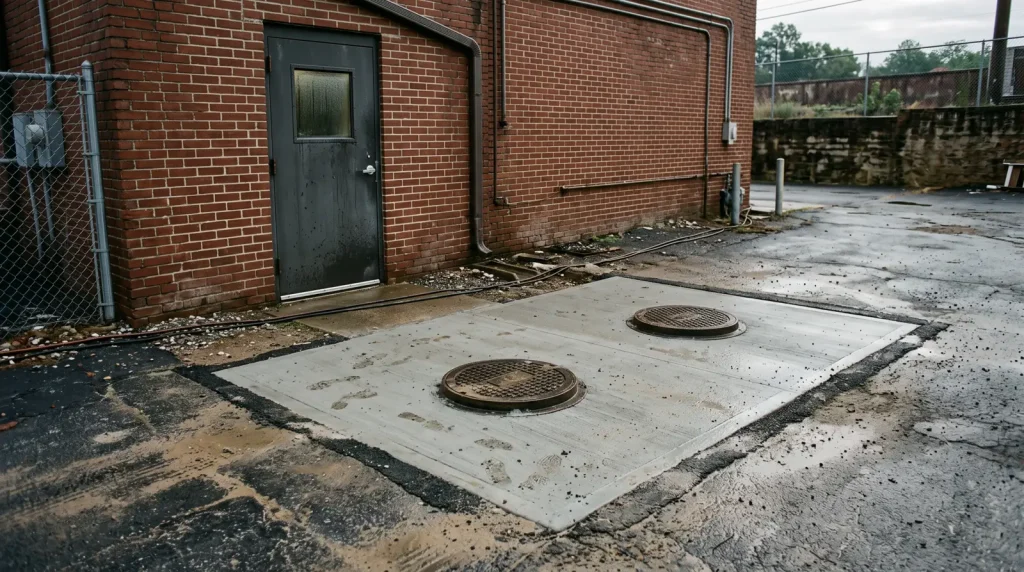
A grease trap is a plumbing tank that slows kitchen wastewater so fats, oils and grease float and solids sink: indoor units are rated 4 to 100 gallons per minute, outdoor interceptors usually 500 to 2,000 gallons.
Key takeaways
- The 2024 International Plumbing Code (IPC) Section 1003.3.1 requires a grease interceptor or automatic grease removal device for pot sinks, pre-rinse sinks, woks, soup kettles and hood wash units (ICC, IPC 2024 chapter 10).
- A hydromechanical trap rated 50 gallons per minute (gpm) must hold at least 100 lb of grease under IPC Table 1003.3.5.1; above 100 gpm the pound rating doubles the flow rating (IPC 2024).
- One 16-fixture-unit kitchen sizes at 500 gallons in Pima County, Ariz., 750 gallons under California’s Table 1014.3.6 and 1,000 gallons in Johnson County, Kan. (City of San Diego worksheet; University of Arizona IPC amendments; Johnson County Wastewater).
- Most cities order a pump-out once grease plus solids fill 25% of the liquid depth; Kirkland, Wash. also sets weekly trap cleaning and quarterly interceptor pumping (City of Kirkland).
- Garland ISD’s 2026 bid priced pumping at $0.21 per gallon, so a 1,000-gallon interceptor costs $210 per visit (Garland ISD bid 199-26).
What is a grease trap and how does it work?
A grease trap holds warm kitchen wastewater long enough for it to cool and separate: fats, oils and grease (FOG) float to a cap, food solids settle to the floor and the middle layer leaves through an outlet tee set below the cap. Austin Water sizes this holding time at 12 minutes, and the City of Phoenix uses 17 minutes when no solids interceptor sits upstream (Austin Water; City of Phoenix).
Separation only works while the water is calm and cool enough. Sioux City’s grease program tells restaurants to keep wash water under 140°F and to scrape and dry-wipe pots and pans into the trash before washing (City of Sioux City, 25% rule sheet). Austin Water notes its sizing rules rely on gravity separation, which emulsifying agents defeat (Austin Water).
| Number | What it governs | Source |
|---|---|---|
| 47% | Share of reported sewer blockages caused by grease in EPA’s 2004 Report to Congress | EPA-833-F-12-003, Sept. 2012 |
| 50 to 450 mg/L | Typical local oil and grease discharge limits; 100 mg/L is the most common | EPA FOG fact sheet |
| 25% | Grease plus solids depth that triggers a pump-out in Tampa, Kirkland, Daytona Beach and Sioux City | City of Tampa FAQ |
| 0.75 | Fill factor applied to sink volume when sizing a hydromechanical trap | Independence, Mo. sizing form, rev. July 27, 2022 |
| 3 gpm per fixture unit | Flow assigned to each drainage fixture unit for interceptor sizing | Austin Water; City of Phoenix |
| 1,000 gallons | Minimum gravity interceptor in Johnson County, Kan. and Gainesville, Fla. | Johnson County Wastewater; GRU |
What is the difference between a grease trap and a grease interceptor?
Plumbing codes such as the IPC call both devices grease interceptors and split them by type. A hydromechanical grease interceptor, the unit most people call a grease trap, sits indoors and is rated in gpm and pounds of grease under PDI G101 or ASME A112.14.3. A gravity grease interceptor is an outdoor tank, 300 to 2,000 gallons in the utility rules below, sized by retention time and tested to IAPMO/ANSI Z1001 (University of Arizona IPC amendments, effective July 1, 2026).
| Feature | Hydromechanical (grease trap) | Gravity interceptor | Source |
|---|---|---|---|
| Location | Indoors, under or beside the sink | Outdoors, in ground, often in the parking lot | Sioux City; Kirkland |
| Rated by | Flow (gpm) and grease capacity (lb) | Liquid volume (gallons) | IPC 2024 Table 1003.3.5.1; CPC Table 1014.3.6 |
| Test standard | PDI G101, ASME A112.14.3; ASME A112.14.4 for automatic units | IAPMO/ANSI Z1001; installed per ASME A112.14.6 | NYC Plumbing Code 2022 §1003.3.4; UA amendments |
| Typical minimum | 25 gpm and 50 lb in Pima County; 75 gpm in Austin | 300 gallons in Pima County; 1,000 gallons in Johnson County | UA amendments; Austin Water; JoCo |
| Cleaning interval | Weekly in Tampa, Kirkland and Sioux City | Quarterly in Kirkland and Daytona Beach; 90 days in Johnson County | Tampa; Daytona Beach |
| Who cleans it | Kitchen staff allowed in Tampa and Sioux City | Licensed or certified hauler | Sioux City; Kirkland |
| Dishwasher | Not allowed in Pima County; Austin says suited to shops without one | Required at 500 gallons in Austin; kept off the interceptor in San Diego | Austin Water; San Diego worksheet |
The split matters at lease signing. A second-generation restaurant space may already have an outdoor interceptor, while a new shell may need a slab cut and excavation for a 1,000-gallon tank where the utility sets that minimum, which is the kind of scope our guide to tenant improvement contractors explains.
When does code require a grease trap?
Two layers of law apply. The plumbing code your state adopted, usually the IPC or the Uniform Plumbing Code (UPC), requires a grease interceptor for grease-producing fixtures. The sewer utility then sets size, type and pumping under its pretreatment program, which rests on the federal ban in 40 CFR 403.5(b)(3) on “solid or viscous pollutants in amounts which will cause obstruction” (EPA FOG fact sheet, 2012).
IPC 2024 Section 1003.3.1 lists pot sinks, pre-rinse sinks, soup kettles, wok stations, floor drains or sinks that kettles drain into, automatic hood wash units and dishwashers without a pre-rinse sink. Section 1003.3.4 exempts individual dwelling units and private living quarters, and FDA Food Code 5-402.12 requires any grease trap to be easy to reach for cleaning (FDA Food Code 2026).
Austin Water, which updated its grease policies in April 2021, grants a variance only to places that serve prepackaged food in unopened containers, drinks only or cut fruit, and it requires an interceptor later if that business contributes to a sewer overflow (Austin Water criteria). How the interceptor fits with the hood, sinks and suppression system is set out in our guide to commercial kitchen requirements.
Which fixtures must stay off the grease trap?
Keep food waste disposers, toilets and condensate lines off the grease trap, and check your utility’s dishwasher rule before anyone plumbs it. IPC 2024 Section 1003.3.2 bars disposers from grease interceptors, and the cities below split on dishwashers and hand sinks, so the utility’s plan reviewer has the final word on every connection.
| Fixture | Rule | Source |
|---|---|---|
| Food waste disposer | May not discharge to a grease interceptor (IPC 1003.3.2); banned in Austin commercial kitchens since January 2008; 3/8-inch screen in Pima County | IPC 2024; Austin Water; UA amendments |
| Commercial dishwasher | Not through a hydromechanical unit in Pima County; do not connect to the gravity interceptor in San Diego; 500-gallon minimum interceptor in Austin | UA amendments; San Diego worksheet; Austin Water |
| Toilets, urinals, condensate, ice machines | Must not connect in Johnson County; NYC lets interceptors take only grease-bearing waste (§1003.3.1) | JoCo; NYC PC 2022 |
| Hand sink | Not required to connect in Austin; must not connect in Johnson County; Pima County requires either a connection or a “handwash sink only” sign | Austin Water; UA amendments |
San Diego counts a hand sink at 1 DFU but a prep sink at 3, so sink placement and indirect drains decide how much load reaches the trap, which is why our guide to commercial kitchen sinks covers floor sinks and air gaps.
How do you size a grease trap?
Size a hydromechanical grease trap by flow: add the gallons the connected sinks hold, take 75% of that and divide by the drain time of one minute indoors or two minutes outdoors, per the fixture-volume method in the Independence, Mo. form, which accepts units rated to ASME A112.14, CSA B481 or PDI G101 (Independence sizing form). Size a gravity interceptor in gallons by your utility’s formula, which ranges from 12 to 30 minutes of retention.
Hydromechanical grease trap sizing, step by step
A hydromechanical grease trap is sized to drain the connected sinks in a set time without letting grease pass. The 6 steps below follow the fixture-volume method in the Independence, Mo. sizing form, then check the result against IPC Table 1003.3.5.1 and the local minimum, using an illustrative 18-inch three-compartment sink.
- Measure each sink compartment in inches: length x width x depth.
- Divide the cubic inches by 231 to get gallons (231 cubic inches = 1 gallon).
- Multiply by 0.75 for the 75% fill factor.
- Divide by the drainage period: 1 minute for an interior unit, 2 minutes for an exterior unit.
- Round up to the next rated size and read the grease capacity from IPC Table 1003.3.5.1.
- Check the local floor: 25 gpm and 50 lb in Pima County, 75 gpm in Austin (Austin Water).
| Step | Input | Arithmetic | Result |
|---|---|---|---|
| Compartment volume | One bay 18 x 18 x 12 in | 18 x 18 x 12 | 3,888 cu in |
| Three-compartment sink | 3 bays | 3,888 x 3 | 11,664 cu in |
| Gallons | 231 cu in per gallon | 11,664 / 231 | 50.49 gal |
| Flow, interior unit | 75% over 1 minute | 50.49 x 0.75 | 37.87 gpm, buy 50 gpm (100 lb) |
| Flow, exterior unit | 75% over 2 minutes | 37.87 / 2 | 18.94 gpm, buy 20 gpm (40 lb) |
| Austin check | 75 gpm floor | 37.87 is below 75 | 75 gpm unit (150 lb) |
The 18-inch bay size is an illustrative input to show the arithmetic, not a design value. The pound ratings come from the IPC table below, which pairs each standard flow rating with a minimum grease retention capacity.
| Flow-through rating (gpm) | 4 | 7 | 10 | 15 | 20 | 25 | 35 | 50 | 75 | 100 |
|---|---|---|---|---|---|---|---|---|---|---|
| Minimum grease retention (lb) | 8 | 14 | 20 | 30 | 40 | 50 | 70 | 100 | 150 | 200 |
Source: ICC, IPC 2024 Table 1003.3.5.1 (selected rows; the table also lists 6, 9, 12, 14 and 18 gpm). Phoenix still publishes the 1994 UPC trap table, which runs from 1 fixture at 20 gpm and 40 lb to 4 fixtures at 50 gpm and 100 lb (City of Phoenix).
Will the trap fill before the next cleaning?
Flow sizing says nothing about how fast grease builds up. Johnson County, Kan. and Independence, Mo. add a grease production check: pounds of grease per meal x meals per day x days between pump-outs (30 to 90 days in Independence), using values from the American Society of Plumbing Engineers’ design handbook (Johnson County Wastewater).
| Kitchen | Grease per meal | Meals per day | Grease per day | Days to fill |
|---|---|---|---|---|
| Cafe, with flatware (medium) | 0.0325 lb | 200 | 6.5 lb | 15.4 days to fill a 100 lb trap |
| Family restaurant, with flatware (high) | 0.0455 lb | 300 | 13.65 lb | 11.0 days to fill a 150 lb trap; 1,228.5 lb in 90 days |
| Barbecue, with flatware (very high) | 0.075 lb | 350 | 26.25 lb | 2,362.5 lb in 90 days; Johnson County requires a 2,500 lb unit |
Grease values are from Table 8-3 as reprinted by Johnson County Wastewater; the barbecue row is the county’s own example and the other meal counts are illustrative. A trap that reaches its rated capacity in 11 days would need weekly service or a larger unit.
How is a gravity grease interceptor sized?
Gravity interceptors are sized from drainage fixture units (DFU), a code weighting of how much each fixture drains. San Diego’s worksheet counts a three-compartment sink, pre-rinse sink, prep sink and mop sink at 3 DFU each, a wok range at 4 and cookline floor drains at 0, so that line, with two floor drains, totals 16 DFU (City of San Diego DFU worksheet). Each utility turns that count into gallons differently.
| Rulebook | Method | Arithmetic for the 16-DFU kitchen | Minimum size | Source |
|---|---|---|---|---|
| Pima County, Ariz. | DFU table; formula F x 30 min x 1.25 | 11 to 16 DFU row; 0.8 x 16 x 30 x 1.25 = 480 | 500 gal | UA amendments, 2026 |
| Phoenix, 12-minute retention | 3 gpm per fixture unit x 12 min | 16 x 3 x 12 | 576 gal | City of Phoenix |
| California Plumbing Code 2019 | Table 1014.3.6 | Over 8, up to 21 DFU | 750 gal | San Diego worksheet |
| Austin, own fixture count | 3 gpm per fixture unit x 12 min | Austin table gives 22 units: 22 x 3 x 12 | 792 gal | Austin Water |
| Phoenix, no solids interceptor | 3 gpm per fixture unit x 17 min | 16 x 3 x 17 | 816 gal | City of Phoenix |
| Johnson County, Kan. | ASPE Table 8-2 | Up to 35 DFU | 1,000 gal | JoCo |
| Gainesville, Fla. (GRU) | Seats x flow factor x 2.5 h x 1.5 | 80 seats x 2.0 x 2.5 x 1.5 = 600 | 1,000 gal minimum | GRU sizing criteria |
Austin’s own table counts sinks draining to a 2-inch floor sink at 4 units, a direct 2-inch mop sink at 2 and two 2-inch floor drains at 2 each, which is why the same kitchen scores 22 there. Pima County and Phoenix publish their own fixture-unit values, so their rows apply each formula to San Diego’s 16-unit count to isolate the formula. The 80 seats and flow factor 2.0 (no deep frying, reusable servingware, no dishwasher) in the Gainesville row are illustrative inputs.
California’s Table 1014.3.6 continues past the kitchen above: 35 DFU for 1,000 gallons, 90 for 1,250, 172 for 1,500, 216 for 2,000 and 2,640 DFU for 15,000 gallons (San Diego worksheet, 2019 CPC). Phoenix publishes its own worked example, shown below, for a kitchen with a dish machine and four floor drains.
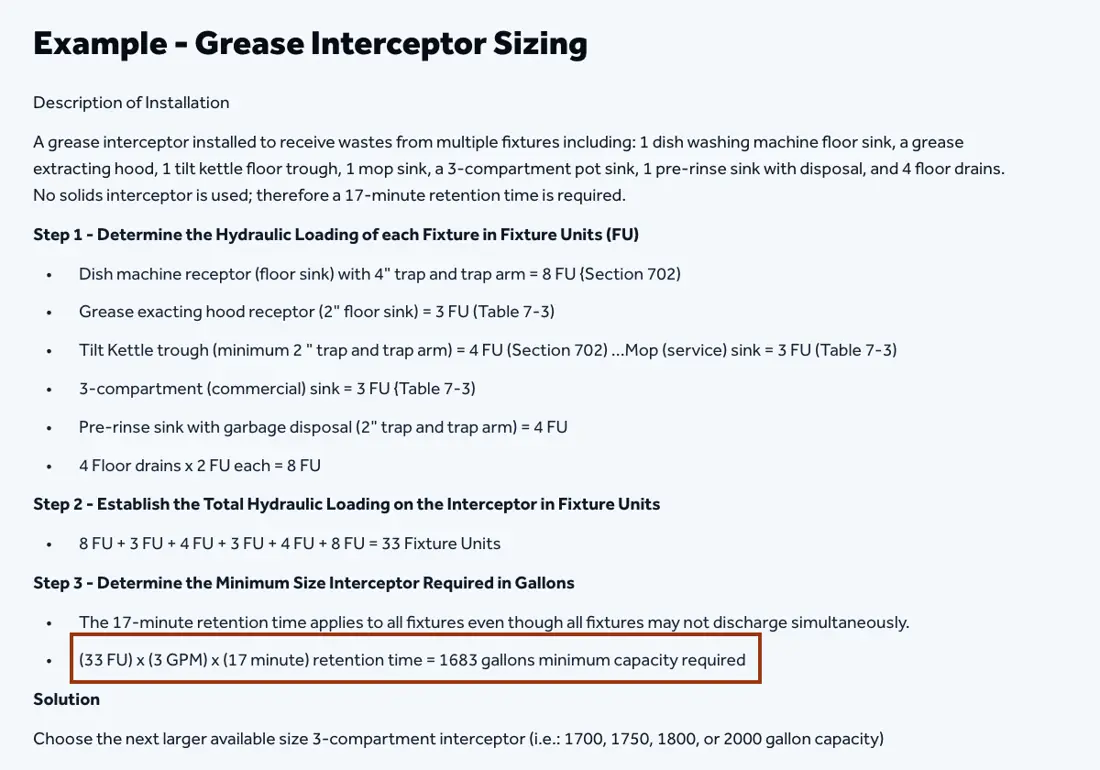
For a shell building with no tenant yet, Johnson County sizes to the inlet pipe: a 4-inch inlet carries up to 216 DFU, which calls for a 2,000-gallon interceptor (Johnson County Wastewater). Austin warns owners not to buy any unit before the utility issues its approval letter (Austin Water). Where the interceptor sits on the site plan is part of the layout work in our guide to commercial kitchen design.
How often does a grease trap need to be pumped?
Pump a grease trap when the floating grease plus the settled solids reach 25% of the liquid depth, or sooner if your city sets a fixed interval. Tampa requires indoor traps to be opened and cleaned at least weekly, Kirkland sets quarterly interceptor pumping, and Johnson County treats 90 days as standard (City of Tampa FAQ; City of Kirkland; Johnson County Wastewater).
| City or utility | Indoor grease trap | Outdoor interceptor | Source |
|---|---|---|---|
| Tampa, Fla. | Opened, inspected and cleaned at least weekly; clean at 25% | Pump at 25%, when solids pass the outlet invert (typically 8 in) or when it stops retaining grease | Tampa Grease Ordinance FAQ |
| Kirkland, Wash. (Ordinance 3778) | Weekly cleaning minimum | Quarterly pumping minimum; over 25% buildup is a violation | City of Kirkland |
| Daytona Beach, Fla. | Not stated | Every 3 months; adjustment only after two pumpings, under 25% | City of Daytona Beach |
| Sioux City, Iowa | Weekly or at 25%, whichever comes first | Certified hauler when 25% is reached | City of Sioux City |
| Johnson County, Kan. | 90-day standard for hydromechanical units | 90-day standard | Johnson County Wastewater |
| Independence, Mo. | Sizing assumes 30 to 90 days between pump-outs | Independence sizing form | |
To test the 25% rule, a hauler or inspector measures the grease cap, the solids layer and the total liquid depth, the three numbers Daytona Beach uses for its check. The layers in the diagram below are:
- Inlet: wastewater enters through an inlet tee into the first compartment.
- Floating grease cap (FOG): 0.5 ft.
- Gray water passing through: 2.5 ft, split by a baffle into a second compartment.
- Settled food solids: 1.0 ft.
- Outlet tee: draws water from below the grease cap; 4.0 ft total depth.
- Result: (0.5 ft + 1.0 ft) / 4.0 ft = 37.5%: over 25%, pump more often (Sioux City worked example).
Austin City Code 15-10-22(23) bans adding enzymes, bacteria or chemicals to a grease trap, because they emulsify grease into a “pancake batter-like” layer that passes into the sewer instead of separating (Austin Water). The same scheduled-service logic applies to hood exhaust systems, covered in our guide to commercial kitchen hood cleaning.
How much does a grease trap cost?
Public records put a small indoor grease trap at $250 to $1,500 installed and a new 750 to 1,500 gallon interceptor at $4,000 to $8,500, per the City of Tampa’s grease ordinance FAQ (City of Tampa). Federal replacement contracts from 2023 to 2026 ran from $6,338 to $958,378, because they include excavation, piping and paving; the award records do not state tank sizes.
| Item | Scope | Price | Date and place | Source |
|---|---|---|---|---|
| Small grease trap, 0 to 100 gal | Installed, average range | $250 to $1,500 | Tampa, Fla., undated FAQ, read Nov. 2026 | City of Tampa |
| New grease interceptor, 750 to 1,500 gal | Installed, average range | $4,000 to $8,500 | Tampa, Fla., undated FAQ, read Nov. 2026 | City of Tampa |
| Hydromechanical unit, 20 lb | Unit only, federal purchase | $608.43 | May 2026 | USAspending, GSA order |
| Hydromechanical unit, 70 lb | Unit only, federal purchase | $496.48 | Feb. 2026 | USAspending, GSA order |
| Hydromechanical unit, 100 lb | Unit only, federal purchase | $538.99 | Sept. 2026 | USAspending, GSA order |
| Hydromechanical unit, 150 lb | Unit only, federal purchase | $1,451.76 | Aug. 2025 | USAspending, GSA order |
| Replace grease interceptor | Installed, size not stated | $6,338 | Eagle Butte, S.D., July 2023 | USAspending, Bureau of Indian Affairs |
| Remove and replace defective interceptor, dining facility | Installed, size not stated | $67,282.41 | North Charleston, S.C., Aug. 2026 | USAspending, DHS |
| Remove and replace grease interceptor | Installed, size not stated | $67,928.40 | Cordova, Alaska, Mar. 2026 | USAspending, U.S. Coast Guard |
| Replace grease interceptor | Installed, size not stated | $80,263.43 | Virginia Beach, Va., Sept. 2025 | USAspending, U.S. Navy |
| Grease interceptor replacement | Installed, size not stated | $147,170 | Cumberland, Md., Aug. 2023 | USAspending, Bureau of Prisons |
| Replace grease interceptor, emergency | Installed, hospital building | $958,378 | Marion, Ind., Aug. 2023 | USAspending, Dept. of Veterans Affairs |
The unit price is the small part. In Tampa’s ranges the installed interceptor costs at least 2.7 times the most expensive small trap ($4,000 vs $1,500), and the federal awards show that removing and replacing a defective tank, as at the $67,282.41 South Carolina dining facility job, runs far past the Tampa averages.
What does grease trap pumping cost?
Garland Independent School District’s 2026 bid priced pumping, cleaning, transport and disposal at $0.21 per gallon and set $175 for 50 and 750 gallon units (Garland ISD bid 199-26). The district solicited 169 suppliers and received 1 response, so treat it as one public price point, not a market average. At that rate a 1,000-gallon interceptor costs $210 per visit.
| Interceptor size | Price per pump-out | Quarterly (4 per year) | Monthly (12 per year) |
|---|---|---|---|
| 750 gal | $175 | $700 | $2,100 |
| 1,000 gal | $210 | $840 | $2,520 |
| 1,500 gal | $315 | $1,260 | $3,780 |
| 2,000 gal | $420 | $1,680 | $5,040 |
Annual totals are our arithmetic from the Garland unit prices. A federal prison in Safford, Ariz. pays $3,360 per quarter for interceptor pumping in 2026 (USAspending, Bureau of Prisons). Equipment choices that add load to the trap, such as dish machines, are compared in our guide to commercial kitchen equipment.
What does a grease trap inspection check?
A grease trap inspection checks that the unit is the approved size, reachable, under the 25% limit and backed by pumping records. Daytona Beach requires the hauler to give the restaurant a disposal manifest and send the city a copy within 7 days, and the restaurant keeps it on site for 1 year (City of Daytona Beach).
- Plan review: the plumbing plans show the interceptor, its size calculation and, in Independence, Mo., an 18-inch sampling port before the city main (Independence sizing form). Johnson County requires the calculation sealed by a Kansas professional engineer (JoCo).
- Rough-in and final plumbing inspection: in New York City, a flow control vented at least 6 inches above the flood rim and direct connection to the sanitary drain (NYC Plumbing Code 2022 §1003.3.4.2 and §1003.3.6).
- Access: lids and manholes reachable without moving equipment; Pima County requires manways of at least 20 inches (UA amendments; Food Code 5-402.12).
- Routine visit: inspector measures grease and solids depth against the 25% rule and reviews the pumping log.
- Enforcement: Tampa bills $61 per hour for a failed re-inspection, and EPA reports New York City adopted a $1,000-per-day fine after finding 73% of restaurants out of compliance (Tampa FAQ; EPA FOG fact sheet).
NYC Plumbing Code 2022 §1003.10 requires access to every interceptor for inspection by both the building department and the sewer agency, so the interceptor is one of the sign-offs a restaurant needs before it opens, alongside the building, fire and health inspections listed in our guide to commercial building permits.
Which grease trap should you plan for?
Plan for a hydromechanical grease trap when four or fewer low-grease fixtures drain to it and no dishwasher or disposer is on the line; plan for a gravity interceptor when the kitchen runs a dishwasher, a fryer-heavy menu or more fixtures. Pima County allows PDI G101 units where 4 or fewer fixtures connect, and Austin calls them suited to sandwich shops, coffee shops and bakeries (UA amendments; Austin Water).
| If | Then | Rule |
|---|---|---|
| No fixture discharges grease (drinks only, prepackaged food) | No interceptor; request the utility’s variance and confirm with the utility | Austin Water variance |
| Pot sink, pre-rinse sink, wok or soup kettle drains to the sewer | Grease interceptor or automatic grease removal device | IPC 2024 §1003.3.1 |
| 4 or fewer fixtures, no dishwasher or disposer, low-grease menu | Hydromechanical grease trap rated by PDI G101 or ASME A112.14.3, sized by fixture gallons x 0.75 per minute of drain time | Pima County via UA amendments; Independence form |
| More than 4 fixtures, or a dishwasher or disposer on the line | Gravity interceptor, outdoor and in-ground, sized in gallons by DFU or retention time, built to IAPMO/ANSI Z1001. Large ASME A112.14.3 units can replace a gravity tank where the utility allows (Austin, Johnson County) | UA amendments; Austin Water |
| Utility sets a gallon floor | Gravity interceptor of at least 1,000 gallons in Johnson County, Kan. and Gainesville, Fla. | JoCo; GRU |
| Kitchen has a dishwasher in Austin | Interceptor of at least 500 gallons, 7 plus 5 minutes retention; San Diego bars dishwashers from the gravity unit | Austin Water; San Diego |
| Shell space, tenant unknown | Size to the inlet pipe: 4-inch inlet, 216 DFU, 2,000 gallons in Johnson County | JoCo |
| Grease plus solids over 25% at pump-out | Pump more often or install a larger unit | Sioux City; Tampa |
| Any unit, any city | Get the utility’s approval letter before buying any unit | Austin Water rule |
Interceptor scope often decides whether a restaurant lease pencils out, so the trap belongs in the first walk-through with the hood and gas service, as our guide to restaurant build-out contractors explains. Tampa prices a new 750 to 1,500 gallon interceptor at $4,000 to $8,500. This page is general information, not legal or engineering advice; the sewer utility’s written approval governs.
What do common grease trap claims get wrong?
Several top-ranking guides state one sizing formula or one cleaning interval as if it applied everywhere. The primary documents show 12, 17 and 30 minute retention rules, pumping intervals from weekly to 90 days and opposite dishwasher rules, so each claim below is checked against the city or code text.
| What several guides say | What the primary source says | Source |
|---|---|---|
| Grease trap and grease interceptor are the same thing | Cities split them: traps are interior units cleaned weekly; interceptors are exterior tanks pumped by a hauler | Sioux City; Kirkland |
| Pump every 90 days | Tampa requires weekly trap cleaning; Daytona Beach starts at 3 months; Independence sizes for 30 to 90 days | Tampa; Daytona Beach; Independence |
| Bigger is always safer | Pima County warns an oversized interceptor can turn corrosive and cause odor problems | UA amendments |
| Enzymes keep a trap clean | Austin bans enzymes and bacteria in the trap under City Code 15-10-22(23) | Austin Water |
| Any dishwasher must go to the interceptor | Austin requires a 500-gallon interceptor; San Diego says do not connect dishwashers to the gravity unit | Austin; San Diego |
Grease interceptors are installed by licensed plumbers; our commercial plumbing contractor guide covers the license classes to check.
How we compiled this
We read 17 primary documents in October and November 2026, including the IPC 2024 and NYC 2022 plumbing code chapters, sizing or pumping rules from 11 U.S. cities, counties and utilities, an EPA fact sheet and a school district bid tabulation, plus 11 federal award records on USAspending.gov. The worked examples use our own arithmetic on those rules with illustrative inputs; we did not test or install any unit.
Frequently asked questions
Do enzymes or bacteria clean a grease trap?
Not legally in some cities. Austin City Code 15-10-22(23) bans adding enzymes, bacteria or chemicals to a grease trap because they emulsify grease so it passes into the sewer instead of floating. Austin allows drain-line products only if they do not delay the time it takes for grease and solids to build up in the trap. Ask your utility before adding any product.
Does a house need a grease trap?
No, under the model plumbing code. IPC 2024 Section 1003.3.4 exempts individual dwelling units and private living quarters, and NYC Plumbing Code 2022 Section 1003.3.3 adds non-culinary schools with home-style stoves. A home-based food business may be treated differently, so ask the sewer utility whether its grease program covers your permit type before you start selling food.
Can a dishwasher drain into a grease trap?
It depends on the city’s written rule. Austin Water requires a kitchen with a dishwasher to install a grease interceptor of at least 500 gallons. Pima County bars dishwashers from hydromechanical units, and San Diego’s worksheet says not to connect dishwashers to the gravity interceptor under the California Plumbing Code. IPC 2024 Section 1003.3.1 lists dishwashers without a pre-rinse sink.
What happens if a restaurant does not pump its grease trap?
The city can fine it, bill re-inspections or refer it for enforcement. Tampa charges $61 per hour when a re-inspection fails, Kirkland treats more than 25% buildup as a violation, and EPA’s 2012 fact sheet reports New York City set a $1,000-per-day fine after finding 73% of restaurants out of compliance with its grease trap rule.
Can restaurant staff clean the grease trap themselves?
Often for indoor traps, rarely for outdoor interceptors. Tampa lets a facility write its own cleaning protocol, and Sioux City lets staff clean interior traps weekly. Kirkland requires authorized contractors for interceptors, and Daytona Beach requires a hauler’s manifest sent to the city within 7 days and kept on site for 1 year.
How big is a typical restaurant grease interceptor?
In the rules we compiled, one restaurant’s gravity interceptor lands between 300 and 2,000 gallons. California’s Table 1014.3.6 gives 750 gallons for up to 21 drainage fixture units and 1,000 gallons for up to 35. Johnson County, Kan. sets a 1,000-gallon minimum and a 2,000-gallon maximum per unit, and Gainesville, Fla. sets a 1,000-gallon minimum.
Sources
- International Code Council, International Plumbing Code 2024, Chapter 10, accessed October 20, 2026.
- NYC Department of Buildings, 2022 NYC Plumbing Code, Chapter 10, accessed November 1, 2026.
- Austin Water, Grease Trap Sizing and Design Criteria, accessed November 1, 2026.
- City of Phoenix Water Services, Grease Trap Sizing Calculations, accessed November 1, 2026.
- City of Independence, Mo., Grease Interceptor Sizing for New and Replacement Interceptors (rev. July 27, 2022), accessed November 1, 2026.
- City of San Diego Public Utilities, DFU Worksheet for Gravity Grease Interceptor Sizing (2019 CPC Table 1014.3.6), accessed November 1, 2026.
- University of Arizona Environmental Health and Safety, 2024 International Plumbing Code Amendments (Pima County grease criteria), effective July 1, 2026, accessed November 1, 2026.
- Johnson County Wastewater, Grease Interceptor Design Requirements, accessed November 1, 2026.
- Gainesville Regional Utilities, Grease Interceptor Sizing, accessed November 1, 2026.
- City of Tampa Wastewater, Grease Ordinance FAQ, accessed November 1, 2026.
- City of Kirkland, Fats, Oils and Grease, accessed November 1, 2026.
- City of Daytona Beach, Commercial Pumping, accessed November 1, 2026.
- City of Sioux City, Understanding Grease Removal and the 25% Rule, accessed November 1, 2026.
- Garland ISD, Bid Tabulation 199-26 Grease Removal Services (2026), accessed November 1, 2026.
- U.S. EPA, Controlling Fats, Oils, and Grease Discharges from Food Service Establishments, EPA-833-F-12-003 (Sept. 2012), accessed November 1, 2026.
- eCFR, 40 CFR 403.5 National pretreatment standards: prohibited discharges, accessed November 1, 2026.
- U.S. FDA, Food Code 2026, accessed October 20, 2026.
- USAspending.gov award records: Bureau of Indian Affairs, Eagle Butte, DHS, North Charleston, U.S. Coast Guard, Cordova, U.S. Navy, Virginia Beach, Bureau of Prisons, Cumberland, Veterans Affairs, Marion, Bureau of Prisons, Safford pumping, GSA orders for 20 lb, 70 lb, 100 lb and 150 lb units; accessed November 1, 2026.