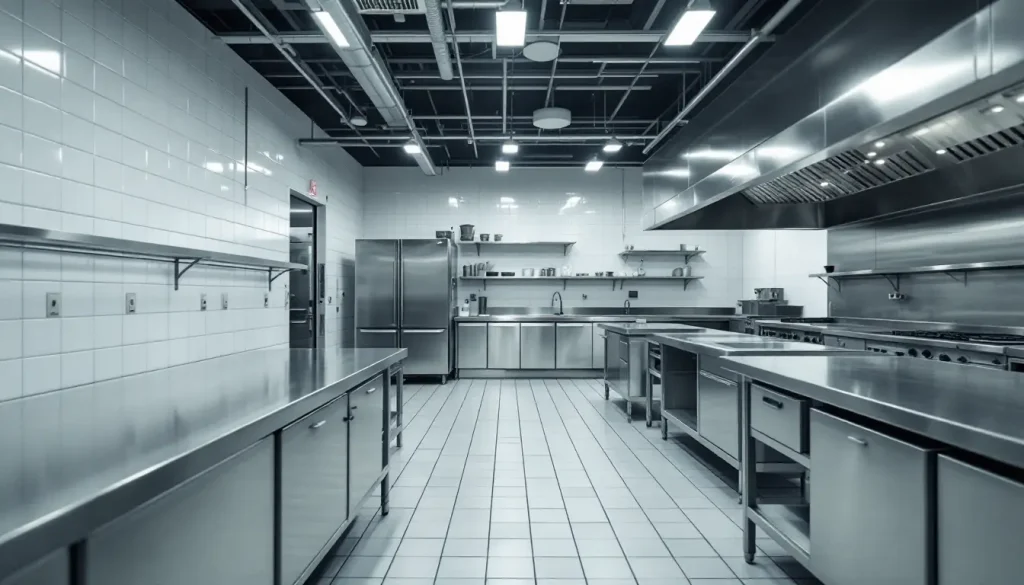
Commercial kitchen lighting requirements come from FDA Food Code section 6-303.11: at least 50 foot-candles (540 lux) where staff work with food or knives, 20 at hand sinks and warewashing, and 10 in walk-ins and dry storage.
Key takeaways
- FDA Food Code 2026 section 6-303.11 sets three minimums: 108 lux (10 foot-candles), 215 lux (20 foot-candles) and 540 lux (50 foot-candles), the same numbers printed in the 2013, 2017 and 2022 editions (FDA Food Code 2026, p. 138 to 139).
- The 10 and 20 foot-candle levels are measured 30 inches (75 cm) above the floor; the 50 foot-candle level is measured at the surface where an employee works with food, knives, slicers, grinders or saws (6-303.11).
- Light bulbs must be shielded, coated or otherwise shatter-resistant wherever exposed food, clean equipment, utensils, linens or unwrapped single-use articles sit below them; heat lamps need a shield that extends past the bulb (6-202.11).
- Luminaires inside a commercial cooking hood must be identified for hood use, keep grease and vapor out of the lamp and wiring compartment, and have no wiring exposed in the hood (NEC 410.10(C), as quoted by EC&M Code Q&A).
- The 2021-cycle energy code space-by-space table allows 1.09 watts per square foot in a food preparation area, against 0.60 in family dining and 0.38 in storage (WAC 51-11C-405054, effective September 7, 2024).
- As of December 31, 2025, only 14 states had at least one agency on the 2022 Food Code, but the lighting values are identical in every edition from 2013 on (FDA adoption report).
| Key number | What it covers | Rule |
|---|---|---|
| 50 fc / 540 lux | Work surface where staff handle food, knives, slicers, grinders, saws | Food Code 6-303.11(C) |
| 20 fc / 215 lux | Hand sinks, warewashing, equipment and utensil storage, toilet rooms, inside reach-ins, self-service | Food Code 6-303.11(B) |
| 10 fc / 108 lux | Walk-in coolers, dry storage, all other rooms during cleaning | Food Code 6-303.11(A) |
| 30 in (75 cm) | Height above the floor where the 10 and 20 fc levels apply | Food Code 6-303.11(A), (B)(3) |
| 1.09 W/ft² | Lighting power allowance, food preparation area | 2021-cycle IECC space-by-space table |
| 1 fc average, 90 min | Egress path lighting on emergency power | IBC 1008.3.5 |
| 90 days | Latest correction date for a Core violation such as low light | Food Code 8-406.11 |
What light levels does the Food Code require in a commercial kitchen?
The Food Code sets three minimum light levels by task, not one level for the whole kitchen. Section 6-303.11 of the FDA Food Code 2026 requires 540 lux (50 foot-candles) at surfaces where employees work with food or with knives, slicers, grinders or saws, 215 lux (20 foot-candles) at sinks, warewashing, equipment storage, toilet rooms and inside reach-ins, and 108 lux (10 foot-candles) in walk-ins, dry storage and any room while it is being cleaned.
A foot-candle is one lumen per square foot; the code rounds the metric values, so 10, 20 and 50 foot-candles appear as 108, 215 and 540 lux. These are minimums, so a plan reviewer will not accept an average that dips below 50 foot-candles at the cutting board even if the room average is higher.
| Kitchen zone | Minimum | Where measured | Food Code paragraph | Source |
|---|---|---|---|---|
| Prep tables, cutting boards, slicer and grinder stations | 50 fc / 540 lux | At the work surface | 6-303.11(C) | Food Code 2026, p. 139 |
| Cook line where staff portion, plate or cut food | 50 fc / 540 lux | At the surface where food is handled | 6-303.11(C) | Food Code 2026, p. 139 |
| Hand sinks | 20 fc / 215 lux | 30 in above floor | 6-303.11(B)(3) | Food Code 2026, p. 139 |
| Dish room and three-compartment sink (warewashing) | 20 fc / 215 lux | 30 in above floor | 6-303.11(B)(3) | Food Code 2026, p. 139 |
| Clean equipment and utensil storage | 20 fc / 215 lux | 30 in above floor | 6-303.11(B)(3) | Food Code 2026, p. 139 |
| Toilet rooms | 20 fc / 215 lux | 30 in above floor | 6-303.11(B)(3) | Food Code 2026, p. 139 |
| Inside reach-in and under-counter refrigerators | 20 fc / 215 lux | Inside the unit | 6-303.11(B)(2) | Food Code 2026, p. 139 |
| Buffets, salad bars, packaged food for sale | 20 fc / 215 lux | At the self-service surface | 6-303.11(B)(1) | Food Code 2026, p. 139 |
| Walk-in coolers and freezers | 10 fc / 108 lux | 30 in above floor, with the unit full of product (CFP) | 6-303.11(A) | CFP 2025 guidance, p. 19 |
| Dry food storage | 10 fc / 108 lux | 30 in above floor | 6-303.11(A) | Food Code 2026, p. 139 |
| Any other room during cleaning (mop room, trash room) | 10 fc / 108 lux | 30 in above floor | 6-303.11(A) | Food Code 2026, p. 139 |
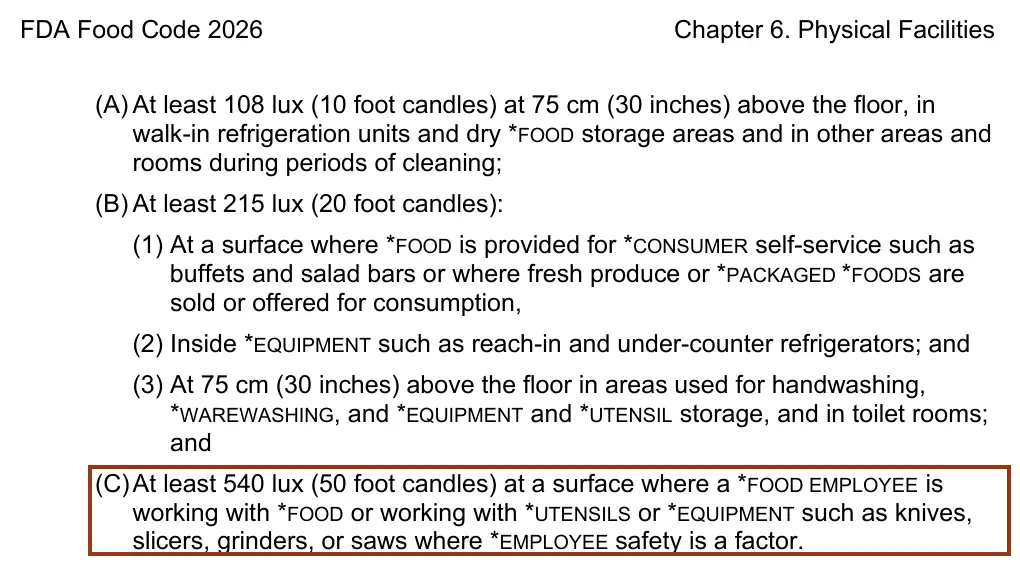
The cook line is not named in 6-303.11. It falls under paragraph (C) wherever a cook cuts, portions or plates food, and the FDA’s Annex 3 explains the purpose: light lets staff read labels, judge the color of food and see soil that needs cleaning (Food Code 2026, Annex 3, p. 466). Where the hood’s own lights are the main light over the line, they have to deliver that level and meet the hood luminaire rules below.
Where does the inspector measure each light level?
Placement matters as much as wattage, because the code fixes the measuring point. The 10 and 20 foot-candle levels are measured 30 inches (75 cm) above the floor, while the 50 foot-candle level is measured at the actual work surface, so a fixture over the prep table, not over the aisle, is what passes 6-303.11(C). Walk-ins must reach 10 foot-candles with the shelves full.
- Mark every food-contact work surface on the equipment plan and put a fixture over each one, not over the aisle; that is the 50 foot-candle point under 6-303.11(C).
- For hand sinks, dish areas, toilet rooms and utensil storage, design to 20 foot-candles on a horizontal plane 30 inches above the floor (6-303.11(B)(3)).
- In walk-ins, place fixtures between shelving runs so stocked shelves do not block the 10 foot-candle level at 30 inches; the CFP Plan Review Guidance 2025 (p. 19) tests the unit full.
- Specify reach-in and under-counter refrigerators with interior lights that deliver 20 foot-candles inside the cabinet (6-303.11(B)(2)); the equipment spec sheet, not the room lighting, has to meet this.
- Show the result on a lighting plan that lists foot-candles for each area; the CFP plan review checklist asks for exactly that (p. 60) and for fixture locations on the floor plan (p. 10).
Our commercial kitchen equipment guide covers refrigerator and prep table selection, and the light level inside a reach-in is one line to add to that spec.
Do commercial kitchen light bulbs have to be shatter-resistant?
Yes, wherever something clean or edible sits below the lamp. Food Code 6-202.11(A) requires bulbs to be shielded, coated or otherwise shatter-resistant in areas with exposed food, clean equipment, utensils and linens, or unwrapped single-service and single-use articles. The only exception, 6-202.11(B), covers rooms that store food in unopened packages that broken glass cannot damage and that can be wiped before opening.
| Location | Lamp rule | Accepted ways to comply | Source |
|---|---|---|---|
| Over prep, cook line, dish room, clean storage | Shielded, coated or shatter-resistant | Lensed fixture, plastic sleeve with end caps, coated or shatterproof lamp | Food Code 6-202.11(A); CFP 2025, p. 46 |
| Walk-in cooler holding open product | Shielded or shatter-resistant | Same as above | CFP 2025, p. 19 |
| Storage of unopened packages only | Shielding not required | Only if glass cannot damage packages and packages can be cleaned before opening | Food Code 6-202.11(B) |
| Infrared or other heat lamps (pass window, carving station) | Shield around bulb | Shield extends beyond the bulb so only the face is exposed | Food Code 6-202.11(C) |
| Inside a Type I cooking hood | Luminaire identified for hood use | Vapor-tight lamp and wiring compartment, corrosion-resistant smooth surface, no exposed wiring | NEC 410.10(C) |
The FDA’s reason is glass in food: Annex 3 states that shielded or shatter-resistant bulbs protect exposed food, clean equipment and linens “should the bulb break” (Food Code 2026, p. 463). The rule was word for word the same in the 2017 Food Code, so a lensed LED fixture that passed in a 2017-edition state passes in a 2026-edition state.
What light fixtures can go inside a commercial kitchen hood?
Only luminaires built and identified for commercial cooking hoods. The National Electrical Code (NEC, NFPA 70) section 410.10(C) permits luminaires in a hood only when the fixture is identified for that use, keeps exhaust vapor, grease and oil out of the lamp and wiring compartment, is corrosion-resistant with a smooth cleanable surface, and is fed by wiring that is not exposed inside the hood.
A standard gasketed vapor-tight fixture from the dining room does not qualify; the EC&M Code Q&A on luminaires in ducts or hoods (October 2014) explains that grease build-up on a hot globe can start a fire. The practical check is that the hood submittal names its luminaires as identified for hood use and that no one swaps them for stock fixtures in the field. Our commercial kitchen hood guide covers Type I and Type II selection and exhaust rates.
How much lighting power does the energy code allow in a kitchen?
The energy code caps installed lighting watts, so the Food Code minimum has to fit inside a power budget. Under the 2021 International Energy Conservation Code (IECC) space-by-space method, a food preparation area is allowed 1.09 watts per square foot, the highest of the restaurant spaces, while family dining gets 0.60 and storage rooms of 50 square feet or more get 0.38, per the table as adopted in Washington WAC 51-11C-405054.
| Space type | Allowance (W/ft²) | Method | Source |
|---|---|---|---|
| Food preparation area | 1.09 | Space-by-space | WAC 51-11C-405054 (2024) |
| Dining, bar/lounge or leisure | 0.86 | Space-by-space | WAC 51-11C-405054 |
| Restroom | 0.63 | Space-by-space | WAC 51-11C-405054 |
| Dining, family | 0.60 | Space-by-space | WAC 51-11C-405054 |
| Laundry/washing area | 0.53 | Space-by-space | WAC 51-11C-405054 |
| Corridor | 0.41 | Space-by-space | WAC 51-11C-405054 |
| Dining, cafeteria or fast food | 0.40 | Space-by-space | WAC 51-11C-405054 |
| Storage room, 50 ft² or more | 0.38 | Space-by-space | WAC 51-11C-405054 |
| Whole building: dining, bar lounge/leisure | 0.80 (0.90 in 2018 IECC) | Building area | SEDAC 2021 IECC lighting summary (2023) |
| Whole building: dining, cafeteria/fast food | 0.76 (0.79 in 2018 IECC) | Building area | SEDAC (2023) |
| Whole building: dining, family | 0.71 | Building area | DOE 2021 IECC LPD table |
The allowance is a building total: IECC section C405.3.2 sets “the total interior lighting power allowance (watts) for an entire building,” so a prep room lit above 1.09 watts per square foot can pass if storage and dining come in under their numbers. IECC section C401.2 also lets a project comply through ASHRAE Standard 90.1, and states amend these tables, so the plan reviewer will hold the design to the table your state adopted.
Worked example: can a 240 ft² prep room reach 50 foot-candles inside its allowance?
The arithmetic below uses the lumen method with two assumed design inputs, a coefficient of utilization of 0.6 and a light loss factor of 0.8; a lighting designer’s photometric run replaces them with values for the actual fixture and room.
| Step | Input or formula | Result |
|---|---|---|
| Room area | 12 ft x 20 ft | 240 ft² |
| Power allowance | 240 ft² x 1.09 W/ft² | 261.6 W |
| Target | Food Code 6-303.11(C), whole room lit to the work-surface level | 50 fc |
| Lumens needed | 50 fc x 240 ft² / (0.6 x 0.8) | 25,000 lm |
| Minimum fixture efficacy | 25,000 lm / 261.6 W | about 96 lm/W |
At about 96 lumens per watt the room meets both codes with no help from other spaces; fixtures below that number need either a borrowed allowance from storage or dining, or task lights aimed only at the 50 foot-candle surfaces. Ask the electrical engineer for the photometric plot at work-surface height, not just the room average.
Which lighting controls does a commercial kitchen need?
A kitchen is not on the 2021 IECC list of spaces that need occupant sensors, so its lights fall under time-switch control instead. Section C405.2.1 requires occupant sensing in 12 space types, including restrooms, storage rooms, locker rooms, break rooms, corridors and enclosed spaces of 300 square feet or less; every area without occupant sensors needs time-switch control under C405.2.2, per the SEDAC 2021 IECC summary.
- Occupant sensors (C405.2.1): storage rooms, restrooms, locker rooms and break rooms. Lights go off within 20 minutes of the space emptying and turn on manually or to no more than 50 percent automatically (C405.2.1.1).
- Safety exception: full automatic-on with no manual control is allowed where manual operation would endanger occupant safety or security (C405.2.1.1 exception).
- Light-reduction control (C405.2.3): a manual control that cuts lighting by at least 50 percent, with an intermediate step between 70 and 30 percent or continuous dimming, unless the space qualifies for an exception.
- Daylight controls (C405.2.4): required above 150 W of general lighting in a primary sidelit zone, but sidelit zones on the first floor of Group A-2 restaurants are exempt.
A sensor that cuts a walk-in’s lights below 10 foot-candles while staff are inside defeats 6-303.11(A), so pair any walk-in sensor with a sensitivity check after the shelving is loaded. Lighting controls are one of the systems tested during building commissioning, which is the stage to catch this.
What emergency lighting does a commercial kitchen need?
If the kitchen sits on a required exit path, such as a back-of-house corridor to a rear exit door, that path needs egress lighting on emergency power. The International Building Code (IBC) requires an average of 1 foot-candle at the floor and at least 0.1 at any point, held for 90 minutes, with a maximum-to-minimum ratio of 40 to 1 (IBC 1008.3.5, as printed in the 2022 NYC Building Code).
Under normal power the same path needs at least 1 foot-candle at the walking surface (IBC 2024 section 1008.2.1). These egress numbers are far below the Food Code levels, so they rarely drive fixture counts; what they drive is which fixtures carry battery packs or ride an emergency circuit. Our emergency lighting requirements guide covers exit signs, testing intervals and the 10-second start rule.
Does your state use an older Food Code edition?
Most states do, but it does not change the lighting numbers. The FDA’s adoption report shows that as of December 31, 2025, 18 agencies in 14 states had adopted the 2022 Food Code and 47 agencies in 37 states were on the 2013, 2017 or 2022 edition. We compared the 6-303.11 and 6-202.11 text in the 2013, 2017, 2022 and 2026 editions and found the same 108, 215 and 540 lux values in each.
| Food Code edition | State agencies using it (Dec 31, 2025) | Lighting values | Source |
|---|---|---|---|
| 2022 | 18 agencies in 14 states (Colorado, Connecticut, Delaware, Georgia, Hawaii, Illinois, Indiana, Mississippi, Nebraska, Ohio, Pennsylvania, Rhode Island, Utah, Virginia) | 10 / 20 / 50 fc, checked | FDA adoption report |
| 2017 | 15 agencies | 10 / 20 / 50 fc, checked | FDA adoption report |
| 2013 | 14 agencies | 10 / 20 / 50 fc, checked | FDA adoption report |
| 2009 | 8 agencies | Not checked by us | FDA adoption report |
| 2005 and 2001 | 2 and 4 agencies | Not checked by us | FDA adoption report |
| No Food Code adopted | 2 state agencies | State rule governs | FDA adoption report |
The FDA page lists 2026 as the current edition, published in 2026, and no state had adopted it by the December 31, 2025 data cut. If your agency is on the 2009 edition or earlier, or has no Food Code, ask the plan reviewer for the adopted lighting section by number and check it against the 50, 20 and 10 foot-candle table above. Counties and cities can add rules on top of the state code.
Which rule applies to your kitchen?
Most kitchen lighting questions reduce to five triggers: the task at the surface, the room type, whether food is exposed below the lamp, whether the fixture is in a hood, and whether the room is on an exit path. The table gives the governing number and code section for each trigger so the electrical, hood and equipment submittals all point to the same requirement.
| If | Then | Rule |
|---|---|---|
| Staff cut, slice, grind or portion food at a surface | Light that surface to at least 50 fc (540 lux) | Food Code 6-303.11(C) |
| The area is a hand sink, dish area, toilet room or utensil storage | At least 20 fc (215 lux) at 30 in above the floor | Food Code 6-303.11(B)(3) |
| The space is a walk-in or dry storage | At least 10 fc (108 lux) at 30 in, tested with shelves full | 6-303.11(A); CFP 2025, p. 19 |
| Exposed food, clean equipment or linens are below the lamp | Shielded, coated or shatter-resistant lamp | Food Code 6-202.11(A) |
| The fixture is inside a cooking hood | Luminaire identified for hood use, no exposed wiring | NEC 410.10(C) |
| Prep room design exceeds 1.09 W/ft² | Offset with lower watts elsewhere or use higher-efficacy fixtures | IECC C405.3.2 |
| Kitchen is on a required exit path | 1 fc average, 0.1 fc minimum on emergency power for 90 minutes | IBC 1008.3.5 |
| Agency is on a pre-2013 Food Code or none | Get the adopted lighting section by number from the plan reviewer | FDA adoption report |
How do plan review and inspection check kitchen lighting?
Lighting is checked twice: on paper at plan review and in the room at the pre-opening inspection. The CFP plan review checklist asks for a lighting plan showing foot-candles for each area under 6-303.11, and the FDA inspection report scores lighting and shielding under item 56, “Adequate ventilation and lighting; designated areas used” (Food Code 2026, Annex 7, Guide 3-B).
- Plan submittal: floor plan with fixture locations (CFP p. 10) and a lighting plan listing foot-candles per area (CFP p. 60).
- Equipment submittal: reach-in interior lighting at 20 foot-candles and hood luminaires identified for hood use.
- Electrical inspection: hood luminaires under NEC 410.10(C), egress lighting circuits under IBC 1008.3 and lighting power and controls under the adopted energy code.
- Pre-opening health inspection: light levels, lamp shielding and heat-lamp shields under 6-303.11 and 6-202.11.
- Correction: both sections are Core items, which the permit holder must correct by the date the regulatory authority sets and no later than 90 calendar days after the inspection (Food Code 8-406.11).
Our commercial kitchen design guide covers the rest of the plan review package, from hand sink placement to finish schedules, and the certificate of occupancy guide explains how health and building sign-offs feed the final permit.
Lighting is one of the items checked at the commercial kitchen inspection, along with the wall finishes around each zone.
How we compiled this
We read sections 6-202.11, 6-303.11 and 8-406.11 and Annexes 3 and 7 in the FDA Food Code 2026 PDF, and compared the lighting text against the 2013, 2017 and 2022 editions. Energy figures come from Washington’s adopted space-by-space table, a 2021 DOE energy code document and an Illinois energy center summary, because the ICC code viewer blocked automated access; the NEC hood rule is quoted from an electrical trade Q&A. All 13 sources were accessed in November 2026; we ran no light measurements, and the worked example uses stated design assumptions.
Frequently asked questions
How many foot-candles does a commercial kitchen need?
FDA Food Code section 6-303.11 requires at least 50 foot-candles (540 lux) at surfaces where staff work with food or knives, 20 foot-candles (215 lux) at hand sinks, warewashing, utensil storage and toilet rooms, and 10 foot-candles (108 lux) in walk-ins and dry storage. The 10 and 20 levels are measured 30 inches above the floor; the 50 level at the work surface (Food Code 2026).
Do commercial kitchen light bulbs have to be shatterproof?
They must be shielded, coated or otherwise shatter-resistant wherever exposed food, clean equipment, utensils, linens or unwrapped single-use articles are below them, under Food Code 6-202.11(A). Rooms storing only unopened packages are exempt if broken glass cannot damage the packages and they can be cleaned before opening. Heat lamps need a shield extending past the bulb.
Can you put a regular light fixture in a kitchen hood?
No. NEC section 410.10(C) allows luminaires in a commercial cooking hood only if they are identified for hood use, keep grease and cooking vapor out of the lamp and wiring compartment, are corrosion-resistant and smooth for cleaning, and are fed by wiring that is not exposed inside the hood. Ask for the hood submittal to name the luminaires.
How bright does a walk-in cooler light need to be?
At least 10 foot-candles (108 lux) measured 30 inches above the floor, under Food Code 6-303.11(A). The Conference for Food Protection’s 2025 plan review guidance adds that the 10 foot-candles must reach throughout the unit when it is full of product, and that walk-in lights must be shielded or shatter-resistant (page 19).
Does my state use different kitchen lighting levels?
Probably not. As of December 31, 2025, 47 agencies in 37 states used the 2013, 2017 or 2022 Food Code, and all three print the same 108, 215 and 540 lux values as the 2026 edition (FDA adoption report). States on the 2009 edition or earlier, and local amendments, should be checked section by section.
How many watts per square foot can a commercial kitchen use for lighting?
Under the 2021-cycle IECC space-by-space method, a food preparation area is allowed 1.09 watts per square foot, the highest restaurant space type, against 0.60 for family dining and 0.38 for storage rooms of 50 square feet or more. The allowance is a building total, so states that adopted ASHRAE 90.1 or amended tables may set different limits.
Sources
- FDA Food Code 2026 (PDF), sections 6-202.11, 6-303.11, 8-406.11, Annex 3 and Annex 7 Guide 3-B, U.S. Food and Drug Administration, accessed 2026-11-21.
- Food Code 2026 landing page, U.S. Food and Drug Administration, accessed 2026-11-21.
- FDA Food Code 2022 (PDF, January 18, 2023 version), accessed 2026-11-21.
- FDA Food Code 2017 (PDF), accessed 2026-11-21.
- FDA Food Code 2013 (PDF), accessed 2026-11-21.
- Adoption of the FDA Food Code by State and Territorial Agencies (content current as of October 29, 2026; data as of December 31, 2025), FDA, accessed 2026-11-21.
- Food Establishment Plan Review Guidance 2025, Conference for Food Protection, pages 10, 19, 45 to 46 and 60, accessed 2026-11-21.
- WAC 51-11C-405054, Table C405.3.2(2) space-by-space method, Washington State Legislature (effective September 7, 2024), accessed 2026-11-21.
- Interior LPD Update, 2021 IECC section C405.3.2 (October 2021), U.S. Department of Energy Building Energy Codes Program, accessed 2026-11-21.
- Top 10 Requirements: 2021 IECC Commercial Lighting (February 22, 2023), Smart Energy Design Assistance Center, University of Illinois, accessed 2026-11-21.
- Code Q&A: Luminaires in Ducts or Hoods, NEC 410.10(C) (October 9, 2014), EC&M, accessed 2026-11-21.
- International Building Code 2024, Chapter 10 Means of Egress, International Code Council, accessed 2026-11-21.
- 2022 NYC Building Code, Chapter 10 Means of Egress, NYC Department of Buildings, accessed 2026-11-21.