A schedule of values is the contractor’s line-by-line split of the contract sum that every monthly pay application bills against: under AIA A201-2017 §9.2 it goes to the architect before the first application for payment.
Key takeaways
- AIA A201-2017 §9.2 requires the contractor to submit a schedule of values before the first Application for Payment on stipulated-sum and GMP contracts, and the architect may object to it (A201 text quoted by CSI).
- On the AIA G703 continuation sheet, percent complete equals column G divided by column C, and balance to finish equals column C minus column G (AIA G703-1992 Instructions).
- The 17-line, $2.4 million tenant build-out example below shows a full schedule of values and its G703 billing that reconcile to the dollar: Application No. 4 shows $1,370,880 completed and stored (57.1 percent), $137,088 retained at 10 percent and $485,244 due (CB&C calculation).
- Moving $180,000 from finishes into early lines of the same schedule overbills the owner by $162,000 at Application No. 2, while mobilization stays at 5.0 percent of the contract, inside the 10 percent cap in FDOT Specification 101-2.2.
- Retainage is capped at 10 percent on federal work (FAR 32.103) and 5 percent of each progress payment for Florida public entities (Fla. Stat. 255.078).
- Federal bank regulators’ lending guidelines say loan disbursements should not exceed actual construction outlays, and cap commercial construction loan-to-value at 80 percent (12 CFR Part 365, Appendix A).
What is a schedule of values in construction?
A schedule of values (SOV) allocates the entire contract sum to portions of the work, each with a dollar value, so progress can be billed and checked line by line. The lines must add up to the contract sum exactly. The contractor prepares it after award, and the architect, owner’s representative or lender’s inspector measures each monthly pay application against it, usually on the AIA G703 continuation sheet (the standard form’s line-by-line page of the monthly pay application, which is summarized on the G702), until final payment.
It is a billing document, not the contractor’s cost budget. Public contractors describe the practice in their SEC filings: Limbach Holdings’ Form 10-K for fiscal 2025 says the company “generally invoices customers on a monthly basis based on a schedule of values that breaks down the contract amount into discrete billing items” (Limbach 10-K, SEC EDGAR).
There is no AIA form for the schedule itself. AIA’s summary of G702-1992 states that “the AIA does not publish a standard schedule of values form” (AIA G702 summary), so contractors type the lines straight onto the G703 continuation sheet. ConsensusDocs does publish one, ConsensusDocs 293, built to pair with its 291 and 292 payment applications. The SOV is agreed in preconstruction, step 5 of the commercial construction process.
| Number | What it means | Source |
|---|---|---|
| Before Application No. 1 | Deadline to submit the SOV on AIA stipulated-sum and GMP contracts | AIA A201-2017 §9.2 |
| 10 days | EJCDC: preliminary SOV due within 10 days of the Effective Date; acceptance conference at least 10 days before the first application | EJCDC C-700-2018 §2.03, §2.05 |
| 9 columns, A to I | Layout of the G703 continuation sheet that carries the SOV each month | AIA G703-1992 Instructions |
| 10% | Maximum retainage on federal construction progress payments | FAR 32.103 |
| 5% | Maximum retainage per progress payment for Florida public entities | Fla. Stat. 255.078(1) |
| 30 of 46 | Jurisdictions with a percentage retainage limit on public work that set it at exactly 5% | CB&C state retainage table |
| 10% | FDOT cap on total mobilization partial payments, as a share of the original contract | FDOT Spec. 101-2.2, FY 2026-27 |
| 10% until 50% complete | Retainage line on HUD’s contractor requisition for insured project mortgages | Form HUD-92448-OHF |
| 80% | Supervisory loan-to-value limit for commercial construction loans | 12 CFR Part 365, App. A |
What does a schedule of values look like? A $2.4M example you can copy
A usable schedule of values has one numbered line per measurable portion of the work, a dollar value per line and a total that equals the contract sum. The example below is a fictional $2,400,000 office tenant build-out with 17 lines; step 2 bills it at Application No. 4, where $1,370,880 is complete and stored and $485,244 is due.
Step 1: the schedule of values
Illustration only: a fictional $2,400,000 stipulated-sum office tenant build-out billed over 7 monthly applications, with lines grouped by CSI MasterFormat division. The values show the arithmetic; they are not a cost benchmark for any market. Overhead and profit sit inside each line, as EJCDC C-700-2018 §2.03.A.3 describes.
| Line | MasterFormat division | Description | Scheduled value (C) | Share of contract |
|---|---|---|---|---|
| 1 | 01 General Requirements | Mobilization | $36,000 | 1.5% |
| 2 | 01 General Requirements | General conditions (supervision, temporary facilities) | $204,000 | 8.5% |
| 3 | 01 General Requirements | Bonds and insurance | $33,600 | 1.4% |
| 4 | 02 Existing Conditions | Selective demolition | $79,200 | 3.3% |
| 5 | 03 Concrete | Concrete slab infill and trenching | $52,800 | 2.2% |
| 6 | 05 Metals | Miscellaneous metals | $38,400 | 1.6% |
| 7 | 06 Wood, Plastics, and Composites | Architectural millwork | $129,600 | 5.4% |
| 8 | 07 Thermal and Moisture Protection | Insulation, firestopping, sealants | $45,600 | 1.9% |
| 9 | 08 Openings | Doors, frames, hardware, interior glazing | $180,000 | 7.5% |
| 10 | 09 Finishes | Metal stud framing and gypsum board | $307,200 | 12.8% |
| 11 | 09 Finishes | Ceilings, flooring, paint | $285,600 | 11.9% |
| 12 | 10 Specialties | Specialties (toilet accessories, signage) | $31,200 | 1.3% |
| 13 | 21 Fire Suppression | Fire suppression modifications | $76,800 | 3.2% |
| 14 | 22 Plumbing | Plumbing | $153,600 | 6.4% |
| 15 | 23 Heating, Ventilating, and Air Conditioning (HVAC) | HVAC | $345,600 | 14.4% |
| 16 | 26 Electrical | Electrical | $321,600 | 13.4% |
| 17 | 27 Communications; 28 Electronic Safety and Security | Communications and fire alarm | $79,200 | 3.3% |
| Total | $2,400,000 | 100.0% |
Step 2: billing it on the G703 at Application No. 4
Each month the contractor updates columns D to F for every line, and the totals roll up to the payment request. At Application No. 4, work completed and stored reaches $1,370,880, or 57.1 percent; 10 percent retainage holds back $137,088, prior certificates total $748,548, and the current payment due is $485,244.
| Line | Description | C Scheduled value ($) | D Previous ($) | E This period ($) | F Stored ($) | G To date ($) | % (G/C) | H Balance ($) | Retainage at 10% ($) |
|---|---|---|---|---|---|---|---|---|---|
| 1 | Mobilization | 36,000 | 36,000 | 0 | 0 | 36,000 | 100.0% | 0 | 3,600 |
| 2 | General conditions (supervision, temporary facilities) | 204,000 | 91,800 | 30,600 | 0 | 122,400 | 60.0% | 81,600 | 12,240 |
| 3 | Bonds and insurance | 33,600 | 33,600 | 0 | 0 | 33,600 | 100.0% | 0 | 3,360 |
| 4 | Selective demolition | 79,200 | 79,200 | 0 | 0 | 79,200 | 100.0% | 0 | 7,920 |
| 5 | Concrete slab infill and trenching | 52,800 | 52,800 | 0 | 0 | 52,800 | 100.0% | 0 | 5,280 |
| 6 | Miscellaneous metals | 38,400 | 28,800 | 9,600 | 0 | 38,400 | 100.0% | 0 | 3,840 |
| 7 | Architectural millwork | 129,600 | 0 | 25,920 | 0 | 25,920 | 20.0% | 103,680 | 2,592 |
| 8 | Insulation, firestopping, sealants | 45,600 | 13,680 | 13,680 | 0 | 27,360 | 60.0% | 18,240 | 2,736 |
| 9 | Doors, frames, hardware, interior glazing | 180,000 | 18,000 | 36,000 | 0 | 54,000 | 30.0% | 126,000 | 5,400 |
| 10 | Metal stud framing and gypsum board | 307,200 | 153,600 | 92,160 | 0 | 245,760 | 80.0% | 61,440 | 24,576 |
| 11 | Ceilings, flooring, paint | 285,600 | 0 | 42,840 | 0 | 42,840 | 15.0% | 242,760 | 4,284 |
| 12 | Specialties (toilet accessories, signage) | 31,200 | 0 | 0 | 0 | 0 | 0.0% | 31,200 | 0 |
| 13 | Fire suppression modifications | 76,800 | 30,720 | 23,040 | 0 | 53,760 | 70.0% | 23,040 | 5,376 |
| 14 | Plumbing | 153,600 | 61,440 | 30,720 | 0 | 92,160 | 60.0% | 61,440 | 9,216 |
| 15 | HVAC | 345,600 | 103,680 | 86,400 | 48,000 | 238,080 | 68.9% | 107,520 | 23,808 |
| 16 | Electrical | 321,600 | 112,560 | 80,400 | 0 | 192,960 | 60.0% | 128,640 | 19,296 |
| 17 | Communications and fire alarm | 79,200 | 15,840 | 19,800 | 0 | 35,640 | 45.0% | 43,560 | 3,564 |
| Total | 2,400,000 | 831,720 | 491,160 | 48,000 | 1,370,880 | 57.1% | 1,029,120 | 137,088 |
The retainage column is shown for checking only. With a flat 10 percent rate, G703 column I stays blank and retainage is taken once on the total; the line figures above sum to the same $137,088.
| Step | Arithmetic | At 10% retainage | At 5% retainage |
|---|---|---|---|
| 1. Original contract sum | Column C total | $2,400,000 | $2,400,000 |
| 2. Total completed and stored to date | Column G total (D + E + F) | $1,370,880 | $1,370,880 |
| 3. Retainage | Rate times line 2 | $137,088 | $68,544 |
| 4. Total earned less retainage | Line 2 minus line 3 | $1,233,792 | $1,302,336 |
| 5. Less previous certificates | Application No. 3 total of $831,720 less its retainage | $748,548 | $790,134 |
| 6. Current payment due | Line 4 minus line 5 | $485,244 | $512,202 |
| 7. Balance to finish, including retainage | Line 1 minus line 4 | $1,166,208 | $1,097,664 |
The check that catches most math errors: column H plus retainage must equal line 7. Here $1,029,120 plus $137,088 equals $1,166,208. When a pay application fails that test, a line’s retainage or a stored-materials amount has usually been dropped between the continuation sheet and the summary.
How are stored materials billed?
Stored materials go in column F, not in the work columns. In the example, $48,000 of HVAC rooftop units delivered but not yet set appear in column F on Application No. 4, lifting the HVAC line to 68.9 percent. When they are installed, the G703 instructions move that value from F into E; payment alone does not reduce column F.
Ask for the supplier invoice and proof of title before paying for stored material. FAR 52.232-5(b)(2) allows federal contracting officers to count material stored away from the site only if the contract authorizes it and the contractor furnishes satisfactory evidence that it has acquired title (FAR 52.232-5).
What retainage rate applies?
The contract sets the rate, within any statutory cap. AIA A101-2017 §5.1.7.1 leaves the retainage percentage blank for the parties, and §5.1.7.1.1 lets them exclude items such as general conditions or insurance (AIA A101 Instructions). Public work is capped by law: 5 percent per payment for Florida public entities, and at most 10 percent on federal contracts.
Rate choice moves real money. In the example, cutting retainage from 10 to 5 percent raises the Application No. 4 payment from $485,244 to $512,202, a $26,958 difference. Across states, 30 of 46 jurisdictions with a percentage limit cap public retainage at exactly 5 percent, per the prompt payment and retainage rules by state. On bonded work, A101 §5.1.7.2 requires the surety’s consent before retainage is reduced, a step covered in our guide to construction surety bonds.
What do the AIA G703 continuation sheet columns mean?
The AIA G703-1992 continuation sheet is where the schedule of values lives month to month. Columns A to C hold the item number, description and scheduled value; D to F hold previous work, this period’s work and stored materials; G totals them; G divided by C gives percent complete; H is the balance to finish; and I is used only for line-by-line retainage.
| Column | What it holds | Rule in the AIA G703 Instructions |
|---|---|---|
| A | Item number | One line per portion of the work, numbered the same every month |
| B | Description of work | Breakdown by sections of the Work or by subcontractors, kept consistent for the whole project |
| C | Scheduled value | Initial total equals the original Contract Sum; the total may be adjusted by change orders |
| D | From previous application | Columns D plus E from the previous application; prior column F values are not entered here |
| E | Work completed this period | Includes stored materials from the last application that are now incorporated |
| F | Materials presently stored | Stored and not yet incorporated; recalculated at the end of every period |
| G | Total completed and stored to date | D + E + F; percent complete is G divided by C |
| H | Balance to finish | C minus G |
| I | Retainage | Used only where variable retainage by line item is permitted; blank on a constant rate |
Change orders normally do not rewrite the original lines. The G703 instructions say they are usually listed separately, on their own G703 or at the end of the basic schedule, with the adjusted contract sum entered on the AIA G702 pay application. Undisputed amounts in a Construction Change Directive should move into a Change Order; disputed amounts follow A201 Section 7.3.
How should a schedule of values be broken down?
Break the schedule of values into portions a reviewer can see and measure on site. The G703 instructions allow lines by sections of the Work or by subcontractors, kept consistent for the whole job. Organizing by CSI MasterFormat division, from Division 01 General Requirements to Division 28 Electronic Safety and Security, mirrors how the project manual and the trade subcontracts are written.
MasterFormat has used 50 divisions since its 2004 edition, up from 16, according to the WBDG SpecsIntact MasterFormat table. Bill Schmalz, FAIA, of Perkins+Will recommends separate rows by floor and system, such as suspended grid and acoustic panels per floor, and asks reviewers to check mobilization and closeout costs and whether deliverables like record documents and O&M manuals appear (AIA Community Hub, 2018).
Overhead and profit do not need their own line. EJCDC C-700-2018 §2.03.A.3 says SOV prices “will include an appropriate amount of overhead and profit applicable to each item of Work”, which is how the 17-line example above is built.
If a lease ties allowance draws to documented costs, the same 17 lines can support each request against a tenant improvement allowance. Builders who price this kind of work are listed under tenant improvement contractors.
When is a schedule of values required, and by which contract?
On AIA contracts the trigger is A201-2017 §9.2: where the contract is a stipulated sum or Guaranteed Maximum Price, the contractor “shall submit a schedule of values to the Architect before the first Application for Payment, allocating the entire Contract Sum to the various portions of the Work.” EJCDC, ConsensusDocs, federal and HUD-insured jobs each set their own timing and reviewer.
Two details in §9.2 change how the review works. The architect does not approve the schedule: it is used “unless objected to by the Architect”, and the 2017 edition adds that later changes must be submitted with supporting data. The required format and backup come from Division 01 of the project manual, MasterFormat section 01 29 73 Schedule of Values, as Kevin O’Beirne, FCSI, explains for CSI.
| Contract family | When the SOV is due | Who reviews it | Retainage default | Source |
|---|---|---|---|---|
| AIA A201-2017 with A101-2017 | Before the first Application for Payment (§9.2) | Architect; used unless the architect objects | Percentage left blank for the parties (A101 §5.1.7.1) | AIA A101 Instructions; A201 §9.2 |
| EJCDC C-700-2018 | Preliminary SOV within 10 days of the Effective Date; conference at least 10 days before the first application | Engineer; “No progress payment will be made” until acceptable schedules are submitted (§2.05.A) | Set in the agreement | EJCDC text quoted by CSI |
| ConsensusDocs | Set in the agreement; form 293 is the SOV | Per the agreement | Set in the agreement | ConsensusDocs 293 |
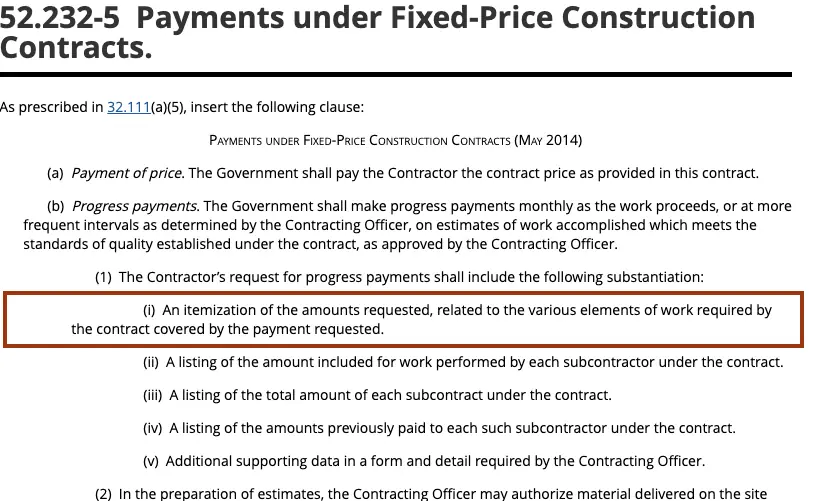
| Federal, FAR 52.232-5 | With every progress payment request: an itemization by element of work, plus each subcontract’s total and amounts paid | Contracting Officer | Only if progress is unsatisfactory, up to 10% (FAR 32.103) | FAR 52.232-5 |
| HUD-insured mortgage, HUD-92448 | Monthly requisition | Borrower’s architect certifies; HUD’s architect or engineer may modify the amount | 10% until at least 50% complete; changes need written approval of borrower, HUD and surety | Form HUD-92448-OHF |
Federal jobs have no AIA form, but the requirement is the same in substance. FAR 52.232-5(b)(1)(i) makes each progress payment request include “an itemization of the amounts requested, related to the various elements of work required by the contract covered by the payment requested” (FAR 52.232-5, acquisition.gov).
What is front-loading, and what does it cost the owner?
Front-loading means assigning inflated values to early lines, such as mobilization, demolition and concrete, and lower values to late trades, so the contractor bills ahead of the work ($180,000 moves in the example below). The contract sum does not change, so a total check misses it. If the contractor stops work, the owner and surety lose the protection the unbilled balance was meant to provide.
Kevin O’Beirne, FCSI, writes that “a contractor may assign inflated values to early-start line items in the schedule of values” and recommends Division 01 limits on amounts payable for bonds and insurance, mobilization and demobilization (CSI, 2022). The table below shifts $180,000 within the same $2,400,000 contract.
| Line | Description | Balanced SOV | Front-loaded SOV | Shift |
|---|---|---|---|---|
| 1 | Mobilization | $36,000 | $120,000 | +84,000 |
| 4 | Selective demolition | $79,200 | $139,200 | +60,000 |
| 5 | Concrete slab infill and trenching | $52,800 | $88,800 | +36,000 |
| 7 | Architectural millwork | $129,600 | $93,600 | -36,000 |
| 9 | Doors, frames, hardware, interior glazing | $180,000 | $156,000 | -24,000 |
| 11 | Ceilings, flooring, paint | $285,600 | $165,600 | -120,000 |
| Contract sum | $2,400,000 | $2,400,000 | 0 |
With the same percent complete on every line, only the values differ; the comparison counts installed work only, so it leaves out the $48,000 of stored HVAC units in Application No. 4. At Application No. 2 the balanced schedule earns $409,440; the front-loaded one bills $571,440, an overbilling of $162,000, or $145,800 after 10 percent retainage. Balance to finish drops from $1,990,560 to $1,828,560, and the millwork, door and finish lines are $180,000 short of their balanced values.
The front-loaded mobilization line is $120,000, or 5.0 percent of the contract: half the 10 percent cap that FDOT 101-2.2 sets for Florida road and bridge contracts, the clearest public benchmark we found. A percentage cap alone would not flag it. Comparing late-trade lines against subcontract values, and the balance to finish against an independent cost to complete, would.
| Application | Balanced SOV, earned | Front-loaded SOV, billed | Billed ahead of earned |
|---|---|---|---|
| No. 1 | $147,720 | $267,720 | $120,000 |
| No. 2 | $409,440 | $571,440 | $162,000 |
| No. 3 | $831,720 | $1,009,320 | $177,600 |
| No. 4 | $1,322,880 | $1,470,480 | $147,600 |
| No. 5 | $1,834,680 | $1,918,680 | $84,000 |
| No. 6 | $2,267,520 | $2,287,920 | $20,400 |
| No. 7 | $2,400,000 | $2,400,000 | $0 |
The gap peaks at $177,600 on Application No. 3 and closes to zero at final payment, because both schedules total $2,400,000. That shape is the signature reviewers look for: billing that runs ahead early and converges late.
How do lenders and owners review a schedule of values?
Lenders and owners test the schedule of values twice: once at the start, against the contract and bid breakdown, and every month, against a site inspection. The federal banking agencies’ real estate lending guidelines say “loan disbursements should not exceed actual development or construction outlays” (12 CFR 365, App. A), so draws are funded on inspected progress, not on the request alone.
- Tie column C to the signed contract. The total must equal the contract sum, with approved change orders listed separately (AIA G703 Instructions).
- Compare each line to the bid and subcontract values. FAR 52.232-5(b)(1)(ii) to (iv) asks for each subcontractor’s amount, each subcontract total and amounts already paid; private reviewers can ask for the same three lists. Line-by-line bid review is covered in how to compare construction bids.
- Check the Division 01 lines. Mobilization at or under 10 percent of the contract (FDOT 101-2.2), bonds and insurance against premium invoices, and general conditions spread across the schedule, about 15 percent a month over 7 months in the example.
- Inspect. On form HUD-92448 the borrower’s architect certifies progress “based on my on-site observations”, and HUD’s architect or engineer may modify the amount before approval.
- Run the in-balance test. Balance to finish (column H) plus undrawn contingency and equity must cover the inspector’s cost to complete; if not, fund only the in-balance amount. Commercial construction loans are also held to an 80 percent loan-to-value limit (12 CFR 365).
- Collect lien waivers for the amount paid. Waiver forms and deadlines differ by state; see mechanics lien laws by state.
- Hold retainage at the contract rate. HUD-92448 retains 10 percent until at least 50 percent of construction is complete, and any change needs written approval of the borrower, HUD and the surety.
The stakes are large. FDIC-insured banks held $453.5 billion of construction and land development loans on June 30, 2026 (FDIC Quarterly Banking Profile, Q2 2026); the quarterly trend is in our construction lending tracker.
Which numbers should trigger a closer look at a schedule of values?
Use thresholds from contract forms and public specifications, not gut feel. A column C total that misses the contract sum, no SOV at Application No. 1, mobilization above 10 percent of the contract, late-trade lines below subcontract values, or a balance to finish smaller than the cost to complete each justify holding certification until the contractor supplies backup.
| If | Then | Basis |
|---|---|---|
| Column C total does not equal the contract sum | Return the SOV: the initial column C total must equal the original Contract Sum | AIA G703 Instructions |
| No SOV on file at Application No. 1 | Hold Application No. 1 until a schedule of values is on file | AIA A201-2017 §9.2 |
| Mobilization above 10% of the contract, or more than 50% of it billed before site work | Request backup: FDOT 101-2.2 caps mobilization at 10% of the original contract | FDOT Spec. 101-2.2 |
| Late-trade lines below subcontract or bid values | Ask for subcontract amounts | FAR 52.232-5(b)(1)(iii) |
| Balance to finish (H) below the inspector’s cost to complete | Fund only the in-balance amount | 12 CFR 365 App. A |
| Public job retainage above the statutory cap, such as 5% in Florida | Reduce retainage to the cap | Fla. Stat. 255.078 |
| Stored material off site with no evidence of title | Leave it out of column F until title is shown | FAR 52.232-5(b)(2) |
| Retainage reduction requested on a bonded job | Get the surety’s written consent first | AIA A101 §5.1.7.2; HUD-92448 |
These 8 checks fit the preconstruction and construction rows of the owner’s commercial project checklist. They are general information drawn from public documents, not legal or financial advice; the executed contract and the governing statute control, so ask your construction attorney which retainage cap and payment deadlines apply to your project.
Our guide to the commercial construction loan shows how draws, inspections and the interest reserve work from the lender’s side.
How we compiled this
We read 16 documents in October 2026, including AIA A201-2017 §9.2 (as quoted by CSI), the AIA G703-1992 and A101-2017 instructions, EJCDC C-700-2018 excerpts, FAR 52.232-5 and 32.103, FDOT’s FY 2026-27 specifications, Fla. Stat. 255.078, 12 CFR Part 365 Appendix A and form HUD-92448-OHF; all are listed under Sources. The $2,400,000 project is fictional and every figure in its tables is computed from the stated inputs. Vendor blogs were used for question phrasing only.
Frequently asked questions
Who prepares the schedule of values?
The general contractor prepares it, usually from its bid breakdown and subcontract values, and submits it to the architect under AIA A201-2017 §9.2 or to the engineer under EJCDC C-700-2018. Subcontractors often prepare their own schedules for their trade, which roll into the general contractor’s lines. Owners and lenders review it; on AIA forms the architect may object to it rather than formally approving it.
Is there an AIA schedule of values form?
No. AIA’s own summary of G702-1992 states that the AIA does not publish a standard schedule of values form. Contractors usually enter the schedule directly on the G703-1992 continuation sheet, whose column C holds each scheduled value. ConsensusDocs does publish one, ConsensusDocs 293, designed for use with its 291 and 292 payment application forms.
How do change orders affect the schedule of values?
AIA’s G703 instructions say approved change orders are usually listed separately, on their own G703 or at the end of the basic schedule, instead of rewriting the original lines. The column C total then rises or falls by the change order amount, and the adjusted contract sum carries to the G702. Undisputed amounts in a Construction Change Directive belong in a change order.
What is the difference between a schedule of values and a project budget?
The schedule of values is the billing breakdown the owner sees and pays against, and its lines must total the contract sum. The contractor’s internal budget tracks cost codes, buyout and margin. In the fictional $2.4 million example the schedule has 17 lines, with overhead and profit inside each line, as EJCDC C-700-2018 §2.03.A.3 describes.
Can the schedule of values be changed after the project starts?
Yes, under the 2017 edition of AIA A201. Section 9.2 says changes must be submitted to the architect with supporting data and, unless the architect objects, become the basis for later applications. A reallocation between lines without a change order should net to zero, because the column C total must keep matching the adjusted contract sum.
How much retainage is withheld from each payment?
The contract sets the rate. AIA A101-2017 §5.1.7.1 leaves the percentage blank. Public work is capped by statute: 5 percent per progress payment for Florida public entities under Fla. Stat. 255.078, and at most 10 percent on federal jobs under FAR 32.103. In the fictional example, moving from 10 to 5 percent retainage raises Application No. 4 by $26,958.
Sources
- Progress Payments, Schedules of Values, Part 1: Fundamentals (quotes AIA A201-2017 §9.2, §9.3.1 and EJCDC C-700-2018), Construction Specifications Institute (Kevin O’Beirne, FCSI). Accessed 2026-10-19.
- What is a Schedule of Values and Why is it Required on Construction Projects?, AIA Contract Documents. Accessed 2026-10-19.
- Instructions: G703-1992, Continuation Sheet, AIA Contract Documents. Accessed 2026-10-19.
- Summary: G702-1992, Application and Certificate for Payment, AIA Contract Documents. Accessed 2026-10-19.
- Instructions: A101-2017, Owner-Contractor Agreement, Stipulated Sum, AIA Contract Documents. Accessed 2026-10-19.
- ConsensusDocs 293 Schedule of Values, ConsensusDocs. Accessed 2026-10-19.
- FAR 52.232-5 Payments under Fixed-Price Construction Contracts, Acquisition.gov (GSA). Accessed 2026-10-19.
- FAR 32.103 Progress payments under construction contracts, Acquisition.gov (GSA). Accessed 2026-10-19.
- Standard Specifications for Road and Bridge Construction, FY 2026-27, Section 101 Mobilization, Florida Department of Transportation. Accessed 2026-10-19.
- Florida Statutes 255.078 Public construction retainage, Florida Legislature. Accessed 2026-10-19.
- 12 CFR Part 365, Appendix A: Interagency Guidelines for Real Estate Lending Policies, eCFR (FDIC). Accessed 2026-10-19.
- Form HUD-92448-OHF Contractor’s Requisition, Project Mortgages, U.S. Department of Housing and Urban Development. Accessed 2026-10-19.
- CSI MasterFormat division table, Whole Building Design Guide (SpecsIntact). Accessed 2026-10-19.
- Reviewing the schedule of values: what architects should look for, AIA Community Hub (Bill Schmalz, FAIA). Accessed 2026-10-19.
- Limbach Holdings Form 10-K, fiscal year 2025, SEC EDGAR. Accessed 2026-10-18.
- Quarterly Banking Profile, Second Quarter 2026, Federal Deposit Insurance Corporation. Accessed 2026-10-04.