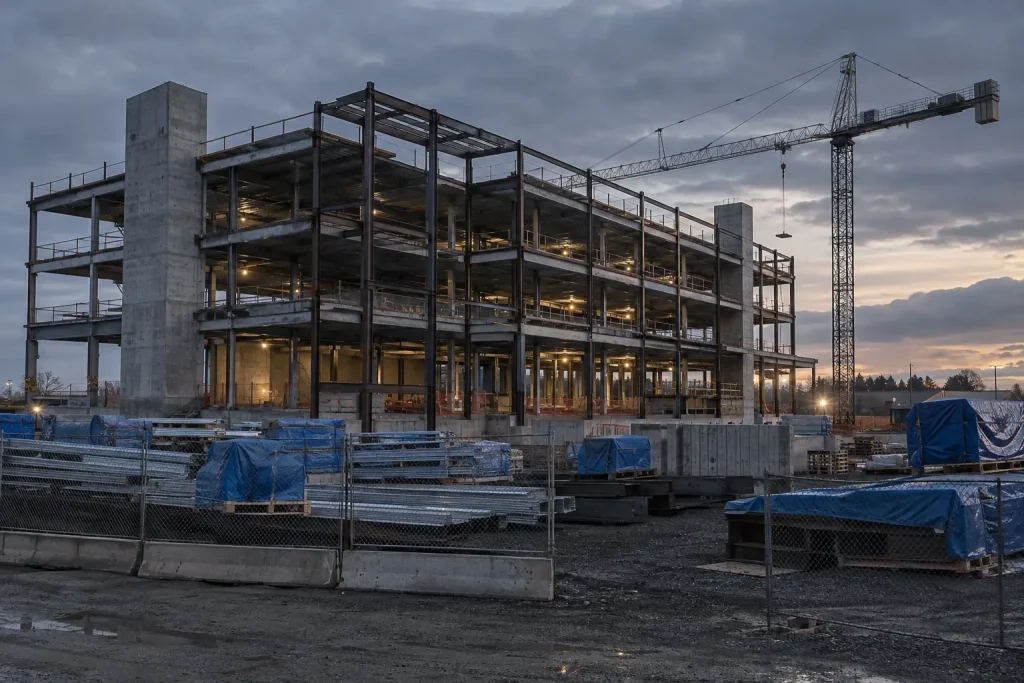
Builder’s risk insurance is temporary property insurance on a building under construction: it pays for direct physical loss to the work, materials and temporary structures, and under AIA contract forms the owner buys it unless the contract says otherwise.
Key takeaways
- On the standard AIA owner-contractor agreement, the owner buys the policy, sized to at least the contract price, unless a box in the insurance exhibit hands the job to the contractor (AIA A101-2017 Exhibit A §A.2.3.1 and §A.3.3.2.1).
- Exhibit A §A.2.3.1.1 says the policy shall not exclude fire, theft, collapse, earthquake, flood or windstorm, yet Utah's FY2026 state policy excludes flood and earthquake and the University of California's 2023 to 2025 master policy did not endorse either.
- Delay in completion (§A.2.4.1) and soft costs (§A.2.4.7) are optional boxes in Exhibit A; Utah's base form pays only $25,000 of delay-driven soft costs.
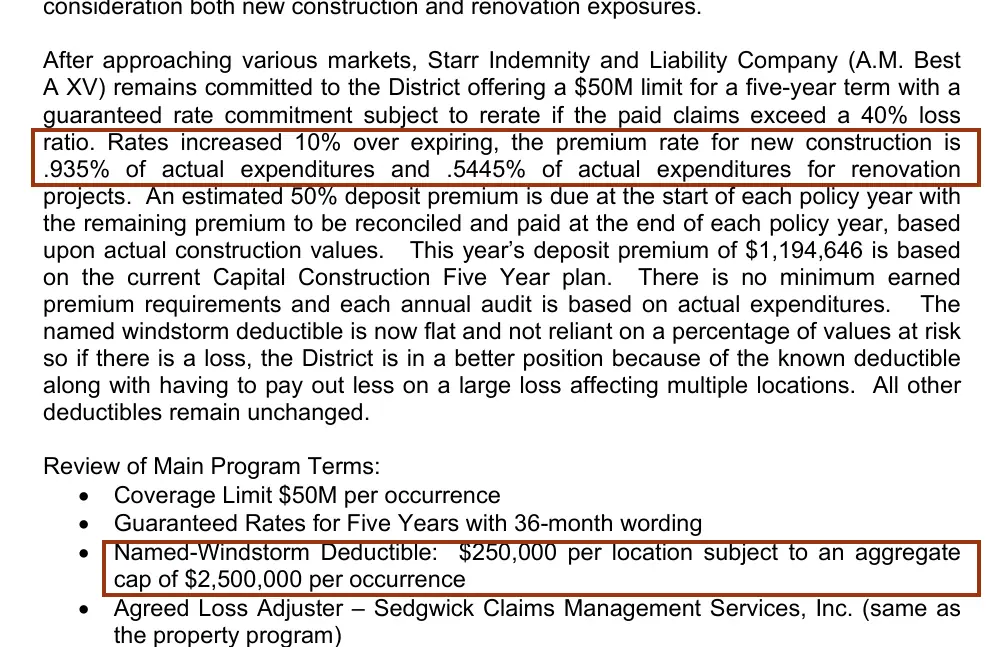
- Miami-Dade County Public Schools pays 0.935% of actual expenditures for new construction and 0.5445% for renovation (2022 to 2027), which works out to $93,500 and $54,450 on a $10,000,000 project and sits below the 1% to 5% range some guides quote without a primary source.
- The same Miami-Dade program uses a flat $250,000 named-windstorm deductible per location, capped at $2,500,000 per occurrence; Fla. Stat. §627.701(2) bars hurricane-only or percentage deductibles unless regulators find them clear.
- Coverage can end before the job does: Utah's form ends 60 days after the building is occupied or put to use, and Exhibit A §A.2.3.2 requires the insurer’s written consent before early occupancy.
What is builder’s risk insurance?
Builder’s risk insurance, also called course of construction insurance, is first-party property cover on the work itself: the structure, materials on site, in transit or in storage, and temporary works. It is not liability insurance or a surety bond. The standard AIA owner-contractor agreement (A101-2017, Exhibit A §A.2.3.1) asks for an “all-risks” completed value form: the limit equals the finished project’s value from day one, and losses are paid at replacement cost.
| Figure | What it is | Source |
|---|---|---|
| 0.935% | Miami-Dade County Public Schools rate for new construction, % of actual expenditures, 2022 to 2027 | Board item E-67, Sept 7, 2022 |
| 0.5445% | Same program, renovation projects | Board item E-67 |
| $250,000 / $2,500,000 | Same program: named-windstorm deductible per location / aggregate cap per occurrence | Board item E-67 |
| $25,000 | Delay soft-cost limit in Utah’s base builder’s risk form, July 2025 to June 2026 | Utah State Risk Management Fund |
| 60 days | Utah form: coverage ends this long after the building is occupied or put to use | Utah policy, condition 15 |
| 1 year | AIA correction period (A201-2017 §12.2.2) that Exhibit A extends property cover into | Calif. Real Property Law Reporter, 2018 |
| $500,000 | Maximum NFIP flood cover for a nonresidential building | 42 U.S.C. §4013(b)(4) |
A performance bond pays the owner if the contractor fails to finish; builder’s risk pays when a fire, storm or theft damages the work. Our construction surety bond statistics cover the bond side, including the $150,000 federal bond threshold.
Who buys builder’s risk insurance: the owner or the contractor?
On an unedited AIA A101-2017 contract, the owner buys builder’s risk: Exhibit A §A.2.3.1 places the duty on the owner unless the §A.3.3.2.1 box shifts it to the contractor. Other contracts set their own rule; the Texas State Office of Risk Management says the Texas requirement “is often placed on the contractor as part of the contract.” Either way, the owner pays the premium, directly or inside the contract price.
- Read the owner-contractor agreement, including the insurance exhibit.
- If it is AIA A101-2017 with Exhibit A (and A201-2017 General Conditions), check the box at §A.3.3.2.1.
- Box not checked: the owner buys (§A.2.3.1): completed value, replacement cost, at least the Contract Sum; the owner carries the deductible (§A.2.3.1.4).
- Box checked: the contractor buys, discloses the deductible, and the owner carries losses within it (§A.3.3.2.1).
- Owner will not buy it: written notice to the contractor before work starts (A201 Article 11). The contractor may buy it, and the cost is added by Change Order. With no notice, the owner carries losses the policy would have paid (Professional Roofing, May 2017).
- Non-AIA contract: the insurance clause decides. Texas SORM: the duty is often placed on the contractor.
| Contract or program | Who buys | Who carries the deductible | Source |
|---|---|---|---|
| AIA A101-2017 Exhibit A, default | Owner (§A.2.3.1) | Owner (§A.2.3.1.4) | AIA A101-2017 Exhibit A (public copy) |
| AIA Exhibit A, §A.3.3.2.1 box checked | Contractor | Owner, for losses within the disclosed deductible | AIA A101-2017 Exhibit A (public copy) |
| Texas state entity contracts | Often the contractor; SORM also runs an owner program | Not stated | Texas SORM |
| University of California projects of $300,000 or more | Owner, through a master program | Contractor, per occurrence | UC FAQ, updated 9/1/2025 |
| Miami-Dade County Public Schools | Owner, portfolio program since October 11, 2006 | Not stated in the board item | Board item E-67 |
Why do owners buy it themselves?
Owners who place their own policy cite cost and control. The UC builder's risk FAQ (updated 9/1/2025) says a contractor-bought policy arrives in the contract cost with “associated fees, profit margin, and potentially independent agent or broker commissions.” Miami-Dade’s school board added that its owner-held program keeps access to FEMA public assistance grants for deductibles.
In a January 11, 2008 purchasing memo, Pasco County’s school district reported that buying a high school’s builder’s risk itself, at $197,028.70, saved $77,552.30 against buying it through the construction manager, about 28% (our arithmetic).
On a construction management at risk job, the insurance exhibit sits in the CM agreement, so the same §A.2.3.1 question applies before the guaranteed maximum price is set. Our construction management at risk guide explains when that price gets fixed.
What does builder’s risk insurance cover?
Builder’s risk covers direct physical loss to the work from any cause the policy does not exclude, plus extensions with their own sublimits. Exhibit A §A.2.3.1.2 requires cover for falsework and temporary structures, building systems during testing and startup, debris removal, and the architect’s and contractor’s fees caused by a loss. Each policy then caps those extensions at different dollar amounts, and that is where the gaps sit.
| Coverage | Utah state policy, FY2026 | UC master program, 2023 to 2025 | Miami-Dade schools, 2022 to 2027 |
|---|---|---|---|
| Main limit | Covered value; loss paid up to 30% above it | $150,000,000 per project; $15,000,000 joisted masonry; $10,000,000 wood frame | $50,000,000 per occurrence |
| Debris removal | 25% of the loss plus up to $25,000 | $15,000,000 | Not stated |
| Transit | Not stated separately | $10,000,000 (inland) | $5,000,000 |
| Temporary offsite storage | Not stated | $10,000,000 per location | Not stated |
| Pollution cleanup | $25,000 per site per 12 months | $500,000 | $1,000,000 |
| Ordinance or law | $50,000 | $25,000,000 (demolition and increased cost) | Not stated |
| Plans and documents | $25,000 | $1,000,000 | Not stated |
| Delay soft costs | $25,000 | Delay in completion not endorsed | Not stated |
| Existing property | Not stated | Not endorsed | $250,000 |
| Deductible | Contract amount or $5,000, whichever is greater | $10,000 to $150,000 by project size and type | $250,000 named windstorm per location |
| Source | Utah SRMF policy | UC coverage summary | MDCPS item E-67 |
Two lines decide most fits. The first is the limit by construction type: UC capped wood frame at $10,000,000 per project, and its FAQ requires carrier approval above $5 million and a stand-alone policy above $10 million. The second is ordinance or law: Utah pays $50,000 per occurrence for code-driven rebuild costs, against $25,000,000 in the UC program.
Is the existing building covered on a renovation?
Not automatically. Exhibit A §A.2.3.3 makes the owner insure the existing structure on a replacement cost basis until the correction period ends, and makes the owner responsible for co-insurance penalties. Policies treat it narrowly: UC’s 2023 to 2025 summary lists damage to existing property as not endorsed, and Miami-Dade’s program caps existing property at $250,000.
For interior work in an occupied building, ask the landlord’s property insurer which policy answers for damage to the base building under §A.2.3.3. Our tenant improvement contractor guide covers how those build-outs are bid.
What does builder’s risk exclude, and what about flood?
Builder’s risk forms usually exclude flood, earthquake, delay and loss of use, deterioration, employee theft, mysterious disappearance and war, and they exclude the faulty work itself while paying resulting damage. Utah’s FY2026 form excludes all of these. That clashes with Exhibit A §A.2.3.1.1, which says the required policy shall not exclude earthquake, flood or windstorm, so the policy may need endorsements to match the contract.
| Exclusion | Utah state policy, FY2026 | UC master program, 2023 to 2025 | What AIA Exhibit A asks |
|---|---|---|---|
| Flood (Utah includes storm surge) | Excluded; handled by the State’s excess property policy | Not endorsed | Shall not be excluded (§A.2.3.1.1) |
| Earthquake and earth movement | Excluded; handled by the State’s excess policy | Not endorsed | Shall not be excluded (§A.2.3.1.1) |
| Faulty design or workmanship | Excluded; resulting covered loss paid | Excluded; resulting damage paid, faulty item not paid | Ensuing loss must be covered (§A.2.3.1.1) |
| Delay and loss of use | Excluded, except $25,000 of soft costs | Not endorsed | Optional box (§A.2.4.1) |
| Terrorism | Not stated | Not endorsed | Not named; Miami-Dade buys it stand-alone ($35M per occurrence) |
| Theft by employees | Excluded | Not stated | Theft shall not be excluded (§A.2.3.1.1) |
| Source | Utah SRMF policy | UC coverage summary | AIA A101-2017 Exhibit A (public copy) |
How does flood cover work under the NFIP?
Where builder’s risk excludes or sublimits flood, the National Flood Insurance Program can insure a nonresidential building up to $500,000 under 42 U.S.C. §4013(b)(4). FEMA's glossary definition leaves out building materials and supplies unless they sit inside an enclosed building on the premises. A $20,000,000 building would need private flood cover above that $500,000.
Are soft costs and delay in start-up covered?
Usually not without an endorsement. Exhibit A lists Loss of Use, Business Interruption and Delay in Completion (§A.2.4.1) and Soft Costs (§A.2.4.7) as optional boxes. Utah’s FY2026 form pays $25,000 of delay-driven soft costs, and UC’s 2023 to 2025 master policy did not endorse delay in completion. A project with a construction loan may need a limit sized to the months of carrying cost.
- Extra construction-loan interest and loan fees (Utah definition; §A.2.4.7)
- Added realty taxes, assessments and permit costs
- Advertising, leasing and lease renegotiation commissions
- Expediting: overtime, extra transport and storage
- Added fees for architects, engineers, attorneys and accountants
- Insurance premiums and guard services over normal expense
The arithmetic shows the gap. Six months of delay on a $10,000,000 interest-only loan at 8% costs $400,000 in interest (8% is an illustrative input, not a quoted rate), against Utah’s $25,000 base limit.
Our commercial construction cost per square foot guide lists builder’s risk among the 9 soft-cost lines to budget beside hard cost.
When does builder’s risk coverage start and end?
Coverage starts when the policy or enrollment attaches, often at the Notice to Proceed, and ends at the first of several triggers. Utah’s FY2026 form ends it at policy expiry, owner acceptance, abandonment, 90 days after completion, or 60 days after the building is occupied or put to use. Exhibit A asks for more: cover until Substantial Completion, then property insurance to the end of the correction period.
| Event | Rule | Source |
|---|---|---|
| Enroll first | Utah: no cover until the project is listed and the full premium is paid. UC: apply at least 10 days before work. | Utah policy; UC FAQ |
| Notice to Proceed | UC: coverage starts on the NTP date. AIA: insureds include all subcontract tiers. | UC FAQ; AIA A101-2017 Exhibit A (public copy) |
| Partial occupancy | AIA §A.2.3.2: insurer’s written consent first. Utah: cover ends 60 days after occupancy or use. | AIA A101-2017 Exhibit A (public copy); Utah policy |
| Completion | AIA: Substantial Completion. Utah: ends 90 days after completion or at owner acceptance. | AIA A101-2017 Exhibit A (public copy); Utah policy |
| Schedule slip | UC: verbal or email notice does not extend coverage; an extension form is required. | UC FAQ |
| Correction period ends | AIA §A.2.3.1.3: insure total value to the end of the correction period, 1 year (A201 §12.2.2). | Calif. Real Property Law Reporter, 2018 |
The 2017 change matters on older templates: A201-2007 §11.3.1 kept owner property insurance in place until final payment or until no one but the owner had an insurable interest, while the 2017 exhibit ties it to Substantial Completion and the correction period.
How much does builder’s risk insurance cost?
We found no state insurance department page that publishes a commercial builder’s risk rate, so the best public cost basis is owner programs that disclose theirs. Miami-Dade County Public Schools pays 0.935% of actual expenditures for new construction and 0.5445% for renovation (2022 to 2027). On a $10,000,000 new build those rates come to $93,500, or $54,450 for a renovation.
| Program | Rate | Basis | Term | Source |
|---|---|---|---|---|
| Miami-Dade schools, new construction | 0.935% | Actual expenditures, audited yearly | Oct 12, 2022 to Oct 11, 2027 | MDCPS item E-67 |
| Miami-Dade schools, renovation | 0.5445% | Actual expenditures | Oct 12, 2022 to Oct 11, 2027 | MDCPS item E-67 |
| Miami-Dade schools, new (prior program) | 0.85% | Actual expenditures | Oct 12, 2020 to Oct 11, 2022 | MDCPS item E-67 |
| Miami-Dade schools, renovation (prior program) | 0.495% | Actual expenditures | Oct 12, 2020 to Oct 11, 2022 | MDCPS item E-67 |
| Pasco County schools, high school, owner-placed vs through the construction manager | Not stated | $197,028.70 owner-placed; $77,552.30 less than the construction manager route (about 28%) | Board memo, January 11, 2008 | Pasco County Schools purchasing memo |
The records show what moves the price. Miami-Dade’s renovation rate is 58% of its new-construction rate (0.5445 / 0.935), its 2022 renewal rose 10% over expiring, and the carrier can rerate if paid claims pass a 40% loss ratio. UC prices by construction type and applies the predominant type’s rate only when it is 80% or more of the value. A contractor-placed policy carries the contractor’s markup, the driver behind Pasco’s 2008 saving.
| Basis | Rate | Premium on a $10,000,000 project | Source |
|---|---|---|---|
| Miami-Dade schools, new construction | 0.935% | $93,500 | MDCPS item E-67 |
| Miami-Dade schools, renovation | 0.5445% | $54,450 | MDCPS item E-67 |
| Guide range, low end | 1% | $100,000 | Embroker, May 2026 (no source given) |
| Guide range, high end | 5% | $500,000 | Embroker, May 2026 (no source given) |
These are public-entity portfolio rates. They are not quotes for a private project, and a single project without portfolio volume could price differently. Ask whether a quote is on estimated or audited values: Miami-Dade pays a 50% deposit and reconciles on actual expenditures each year.
| Claim | Where it appears | What the primary record shows |
|---|---|---|
| “1% to 5% of total project cost” | Embroker, May 2026, no source cited | Miami-Dade schools: 0.495% to 0.935% of actual expenditures, 2020 to 2027 |
| “1 to 4 percent” of construction cost | Wikipedia, citing a 2018 The Balance SB article | Same public records: under 1% |
| “Owner or contractor, it depends” | Most top-ranking guides | AIA Exhibit A default: owner (§A.2.3.1); contractor only if §A.3.3.2.1 is checked |
| “Flood and earthquake are excluded” | Most top-ranking guides | Exhibit A §A.2.3.1.1: shall not be excluded, so endorse the policy to match |
How do named-storm deductibles work on Florida projects?
A named-storm deductible is a term of the policy, not a statutory menu. Florida’s $500, 2%, 5% and 10% hurricane deductible offer in §627.701(3)(a) applies to personal lines residential policies. For other real property, §627.701(2) bars a hurricane-only or percentage deductible unless the Office of Insurance Regulation finds it clear and unambiguous. Miami-Dade’s school program moved to a flat $250,000 per location.
| Deductible basis on a $20,000,000 single-site project | Deductible | Note |
|---|---|---|
| Flat per location (Miami-Dade terms) | $250,000 | MDCPS item E-67, 2022 to 2027 |
| 2% of values at risk | $400,000 | Illustrative percentage, not a quoted term |
| 3% of values at risk | $600,000 | Illustrative percentage, not a quoted term |
| 5% of values at risk | $1,000,000 | Illustrative percentage, not a quoted term |
| One storm, 12 Miami-Dade sites at $250,000 | $3,000,000, capped at $2,500,000 | Aggregate cap per occurrence, MDCPS item E-67 |
The statute’s hurricane clock is also residential-only: under §627.4025(2)(c), a hurricane runs from the first National Hurricane Center warning for any part of Florida until 72 hours after the last watch or warning ends. A commercial builder’s risk policy defines “named storm” in its own wording; Utah’s form counts one occurrence as 72 hours of one atmospheric disturbance.
Timing is the other input: 87.8% of Florida hurricane impacts since 1900 came in August, September or October (NOAA Hurricane Research Division), so any build of 12 months or longer carries the deductible through a full season. Our Florida hurricane risk by county report ranks counties by losses and design wind speeds of about 115 to 180 mph.
In Miami-Dade and Broward, the High-Velocity Hurricane Zone rules add impact and product approval requirements that an underwriter may ask about.
Which builder’s risk setup fits your project?
Match the policy to five facts: the contract form, the delivery schedule, early occupancy plans, the site’s flood and storm exposure, and the construction type. The table maps each to the contract section or policy rule behind it. This page explains public contract and policy terms; it is not insurance or legal advice, and your policy wording and contract control.
| If | Then | Rule or source |
|---|---|---|
| AIA A101-2017 and the §A.3.3.2.1 box is not checked | Owner places the policy before the Work starts and shares it with the contractor | §A.2.3.1; AIA A101-2017 Exhibit A (public copy) |
| Owner does not want to buy it | Give written notice before work starts and budget the Change Order | A201 Article 11; Professional Roofing |
| Renovation or addition | Add existing-structure cover to the end of the correction period; check the existing property sublimit ($250,000 at Miami-Dade) | §A.2.3.3; MDCPS |
| Construction loan or fixed lease-up date | Check the §A.2.4.1 and §A.2.4.7 boxes; size the limit to months of carry ($400,000 for 6 months in the 8% example) | AIA A101-2017 Exhibit A (public copy) |
| Owner will occupy part early | Get the insurer’s written consent; a 60-day occupancy clause may end cover | §A.2.3.2; Utah policy |
| Florida site, build spans August to October | Ask for the named-storm deductible in dollars per location and per occurrence | §627.701(2); MDCPS |
| Mapped flood zone and the policy excludes flood | Price NFIP to $500,000 per building plus excess flood | 42 U.S.C. §4013(b)(4) |
| Wood frame above $5,000,000 | Expect separate underwriting: UC requires approval above $5M and a stand-alone policy above $10M | UC FAQ |
| Schedule slips past the policy end date | Extend in writing before expiry; email does not extend cover under UC rules | UC FAQ |
Ask the broker four things in writing: the deductible in dollars for named storm and all other perils; the flood and earthquake sublimits against §A.2.3.1.1; the occupancy and completion clauses; and the soft-cost limit. Our guide to choosing a commercial contractor covers the certificates to collect, and the commercial construction project checklist puts this step in phase 4.
Builder’s risk covers the work itself; liability claims against the owner run through the contractor’s policy under the additional insured endorsement.
General liability excludes damage to the part of the building being worked on (CG 00 01 exclusion j(5)), which our contractor general liability insurance guide explains clause by clause.
Fire from welding is a common construction loss, so check how the job runs its hot work permit and fire watch before you bind coverage.
Owners usually bind the policy before they issue the notice to proceed that starts contract time.
How we compiled this
In October 2026 we read 11 primary documents: the AIA A101-2017 Exhibit A text, Utah’s and UC’s builder’s risk policy documents, UC’s FAQ, Miami-Dade schools’ 2022 board item, the Texas SORM page, Fla. Stat. §627.701 and §627.4025, 42 U.S.C. §4013, FEMA’s NFIP glossary and NOAA’s hurricane list. The Pasco figure comes from the school district’s own 2008 purchasing memo; a 2024 newspaper report of a later Pasco policy was left out because we could not open the board’s record of it. We excluded unsourced market rates. CB&C is a matching service, not an insurer or broker.
Frequently asked questions
Is builder's risk insurance the same as general liability?
No. Builder’s risk is property cover on the work itself, while general liability pays third-party injury and property damage claims. AIA A201-2017 §11.2 and Exhibit A §A.2.2 require the owner’s “usual general liability insurance” separately, and Exhibit A §A.3.2 lists the contractor’s commercial general liability. A surety bond is a third product that guarantees the contractor’s performance.
Who pays the builder's risk deductible?
Under AIA A101-2017 Exhibit A, the owner carries losses within the deductible both when the owner buys the policy (§A.2.3.1.4) and when the contractor buys it (§A.3.3.2.1). Owner programs can shift it: University of California contract documents make the contractor pay per-occurrence deductibles, which ran from $10,000 to $150,000 in its 2023 to 2025 program.
Does builder's risk insurance cover theft of materials?
Usually for theft of covered property, with limits. AIA Exhibit A §A.2.3.1.1 says theft shall not be excluded, but Utah’s FY2026 form excludes theft by employees and unexplained disappearance. Materials away from the site fall under sublimits: $10,000,000 for transit in UC’s 2023 to 2025 program and $5,000,000 in Miami-Dade schools’ 2022 to 2027 program.
Does builder's risk insurance cover flood?
Often not, or only to a sublimit. Utah’s FY2026 policy excludes flood including storm surge, and UC’s 2023 to 2025 master policy did not endorse flood. AIA Exhibit A §A.2.3.1.1 says the required policy shall not exclude flood, so the policy may need an endorsement. The NFIP insures nonresidential buildings up to $500,000 under 42 U.S.C. §4013(b)(4).
How long does builder's risk coverage last?
For the construction term plus any written extension. Utah’s FY2026 form ends coverage at the first of policy expiry, owner acceptance, 90 days after completion or 60 days after occupancy. AIA Exhibit A expects cover until Substantial Completion and then property insurance to the end of the 1-year correction period. UC says email does not extend coverage.
How is the builder's risk premium calculated?
As a rate on construction value. Miami-Dade schools apply 0.935% for new construction or 0.5445% for renovation to actual expenditures, with a 50% deposit and a yearly audit. UC rates by construction type and project type, using the predominant type when it is 80% or more of the value. Ask whether your premium is on estimated or audited values.
Sources
- AIA Document A101-2017 Exhibit A, Insurance and Bonds (public copy in a Sauk County, Wisconsin bid package), American Institute of Architects / Sauk County, WI. Accessed October 19, 2026.
- Builder’s Risk Policy, July 1, 2025 through June 30, 2026, Utah State Risk Management Fund (Division of Facilities Construction and Management). Accessed October 19, 2026.
- Master Builder’s Risk Program Coverage Summary (term Sept 1, 2023 to Sept 1, 2025), Regents of the University of California. Accessed October 19, 2026.
- Frequently Asked Questions: Builder’s Risk Insurance (updated 9/1/2025), University of California Office of the President. Accessed October 19, 2026.
- Builder’s Risk Program, Texas State Office of Risk Management. Accessed October 19, 2026.
- Board item E-67: Renewal of the Portfolio Builders’ Risk Insurance Program (Board meeting Sept 7, 2022), Miami-Dade County Public Schools. Accessed October 19, 2026.
- Permission to Place Purchase Order, Builder’s Risk Insurance, High School “FFF” (memo, January 11, 2008), District School Board of Pasco County, Department of Purchasing. Accessed October 26, 2026.
- Florida Statutes §627.701 (2025), Florida Senate. Accessed October 19, 2026.
- Florida Statutes §627.4025 (2025), Florida Senate. Accessed October 19, 2026.
- 42 U.S.C. §4013, Nature and limitation of insurance coverage, Legal Information Institute, Cornell Law School. Accessed October 19, 2026.
- Building in the Course of Construction (glossary, updated March 5, 2020), FEMA. Accessed October 19, 2026.
- Continental United States Hurricane Impacts/Landfalls 1851 to 2025, NOAA AOML Hurricane Research Division. Accessed October 19, 2026.
- A tougher stance (May 2017), Professional Roofing (Stephen M. Phillips). Accessed October 19, 2026.
- AIA 2017 insurance provisions (California Real Property Law Reporter, Sept 2018), McCormick Barstow LLP reprint. Accessed October 19, 2026.
- How much does builder’s risk insurance cost (guide quoted in the correction table), Embroker. Accessed October 19, 2026.
- Builder’s risk insurance (quoted in the correction table), Wikipedia. Accessed October 19, 2026.