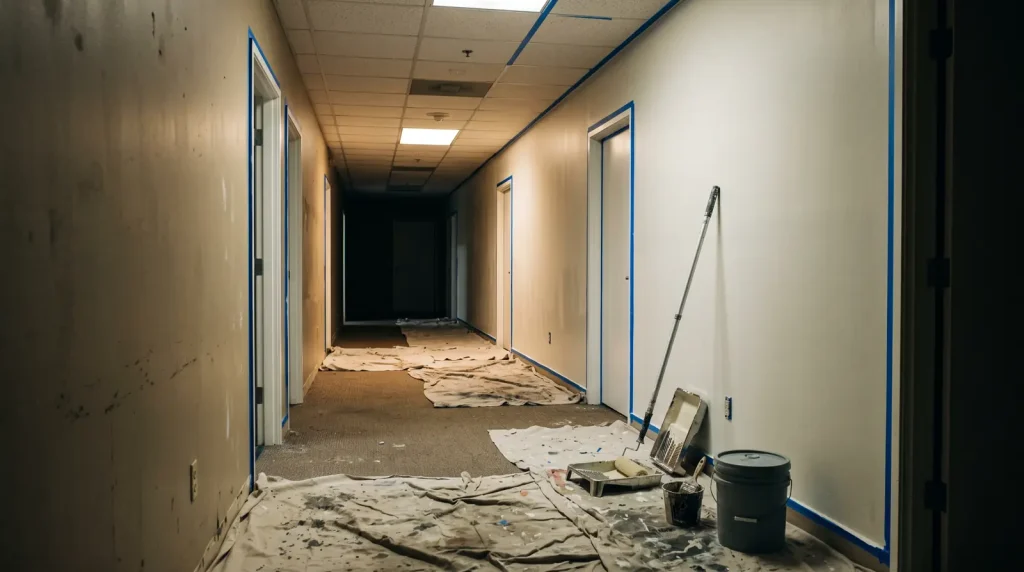
Commercial painting cost $0.50 to $3.80 per square foot of painted surface across 11 bids to Calvert County, Maryland in October 2024 (median $1.11), and $2.13 to $2.45 on 2020 federal awards drawing 15 or more offers.
Key takeaways
- In Calvert County, Maryland’s ITB 2025-023 bid comparison (October 2024), 11 bidders priced interior painting at $0.50 to $3.80 per square foot during office hours, with a median of $1.11.
- The same bidders charged a median 39% more per square foot for after-hours painting, with a range of 20% to 50% across the 10 bidders whose entries were usable.
- Federal painting awards on USAspending.gov that drew 15 and 18 offers came in at $2.13 and $2.45 per square foot in 2020; three single-offer awards from 2022 to 2025 ran $5.89 to $11.45.
- EPA’s lead-safe rule reaches a commercial building only where a pre-1978 space hosts a child under 6 for at least 3 hours a day, 2 days a week, 6 hours a week and 60 hours a year (40 CFR 745.83).
- The federal guide specification UFGS 09 90 00 (August 2026) sets a 1.5 mil minimum dry film per coat and bars painting below 50 °F or within 5 °F of the dew point, two clauses any owner can copy into a bid package.
How much does commercial painting cost per square foot?
Public records put routine commercial painting of walls and ceilings at about $0.43 to $3.80 per square foot of painted surface. Jobs that add scraping, metal siding, window sealing or an epoxy floor, or that drew one bidder, ran $5.89 to $11.70. The lowest prices came from multi-year unit-price contracts, and every figure here is per square foot of surface painted, not per square foot of floor.
What did federal agencies pay per square foot?
We searched federal contract awards through the keyless USAspending.gov API for painting jobs whose award text states the area painted. Ten awards from 2020 to 2025 qualified. Dividing each obligated amount by the stated area gives the price per square foot below; the GSA row is per usable floor square foot, which is why it sits apart from the painted-surface rows.
| Award (place, start date) | Scope stated in the award | Amount | Per sq ft | Offers | Source |
|---|---|---|---|---|---|
| Shaw AFB, SC, Dec 2022 | 353,964 sq ft interior and exterior painting (task order) | $151,406.93 | $0.43 | Task order on a multi-year contract | FA480323F0013 |
| Shaw AFB, SC, Feb 2021 | 8,820 sq ft interior walls and trim, Building 721 | $4,159.68 | $0.47 | Task order, same contract | FA480321F0014 |
| Shaw AFB, SC, Apr 2023 | 11,770 sq ft interior walls plus 1,000 sq ft drywall repair, Building 251 | $6,789.20 | $0.58 | Task order, same contract | FA480323F0023 |
| Mount Rushmore National Memorial, SD, Sep 2020 | 15,000 sq ft interior painting, ceilings and walls, admin building | $31,894.39 | $2.13 | 15 | 140P6320P0059 |
| Horseshoe Bend National Military Park, AL, May 2020 | About 6,515 sq ft exterior painting: visitor center, comfort station and shelter | $15,950.00 | $2.45 | 18 | 140P5220P0071 |
| Beale AFB, CA, Aug 2022 | 20,400 sq ft interior (brush, roller, spray) plus 5,790 sq ft exterior on four buildings | $154,245.59 | $5.89 | 1 | FA468622C0004 |
| Main Treasury, Washington, DC, Sep 2025 | Scraping and painting 30,000 sq ft of basement corridor walls | $323,482.00 | $10.78 | 1 | 2032H325C00033 |
| Little Rock AFB, AR, Jul 2022 | 6,100 sq ft CMU wall plus 7,200 sq ft Galvalume metal, and resealing all exterior windows | $152,250.00 | $11.45 | 1 | W50S6P22C0001 |
| Beale AFB, CA, Sep 2022 | 20,000 sq ft concrete floor: prep, two coats epoxy, one coat polyurethane | $233,946.96 | $11.70 | Competed among eligible firms | FA468622F0057 |
| GSA federal building, Fresno, CA, Nov 2024 | Repaint about 5,000 usable sq ft of common areas, lobby and trim | $51,137.00 | $10.23 per floor sq ft | 1 | 47PK0525C0006 |
Three patterns stand out. Task orders under one Shaw Air Force Base multi-year contract ran $0.43 to $0.58 per square foot. Two National Park Service jobs competed under simplified acquisition procedures drew 15 and 18 offers and landed at $2.13 and $2.45; the Horseshoe Bend award text set an estimated price range starting at $25,000, and the winning price of $15,950 came in 36% below that floor. The single-offer awards also carried heavier scope, such as scraping 30,000 square feet of corridor walls at the Main Treasury.
What do unit-price bids from a county show?
Calvert County, Maryland buys painting through an annual unit-price contract, so its bid comparison shows each bidder’s price per square foot, per door, per linear foot and per hour. The sheet for ITB 2025-023, dated October 2024, lists 11 bidders against an estimated 12,000 square feet a year during office hours and another 12,000 after hours. The 2019 round, ITB 2020-037, had 5 bidders.
| Line item | Unit | Low | Median | High | 2019 median (5 bids) |
|---|---|---|---|---|---|
| Surfaces to be painted, office hours | per sq ft | $0.50 | $1.11 | $3.80 | $0.70 |
| Surfaces to be painted, after hours | per sq ft | $0.60 | $1.815 (10 bids) | $5.70 (10 bids) | $0.75 |
| Doors, office hours | each | $30.00 | $65.00 | $250.00 | $50.00 |
| Door frames, office hours | each | $12.00 | $35.75 | $200.00 | not compared |
| Moldings, window frames, railings | per linear ft | $1.00 | $3.00 | $10.00 | not compared |
| Plaster and drywall repair | per hour | $10.00 | $35.00 | $65.00 | not a 2019 line |
| Exterior painting, staining, power washing, office hours | per hour | $30.00 | $40.00 | $100.00 | $28.00 |
| Exterior work, after hours | per hour | $32.00 | $52.24 | $150.00 | $38.00 |
Source: Calvert County ITB 2025-023 bid comparison and ITB 2020-037 bid comparison, accessed November 1, 2026; medians are CB&C arithmetic. One 2024 bidder entered $80.00 per square foot for after-hours walls, a $960,000 line, so the after-hours median and high use the other 10 bids.
What moves a commercial painting bid up or down?
Five inputs show up as price movers in the public records: how many firms bid, whether work runs after hours, how much surface prep the spec demands, which substrate gets coated, and whether lead rules apply. For scale, painters earned a median $23.75 an hour in May 2025 per the Bureau of Labor Statistics, while the median billed rate for exterior work in the 2024 county bid was $40.
| Price driver | Public evidence | Effect seen | Source |
|---|---|---|---|
| Number of bidders | National Park Service jobs with 15 and 18 offers vs federal awards with 1 offer | $2.13 to $2.45 vs $5.89 to $11.45 per sq ft | USAspending |
| After-hours work | Same 10 county bidders, office vs after hours | Median +39% per sq ft; exterior hourly median $40 to $52.24 (+31%) | Calvert County |
| Surface prep and repair | UFGS 09 90 00 calls for removing coatings where more than 20% of a surface is peeling | Repair priced by the hour: $10 to $65 in the county bid | UFGS 09 90 00 |
| Substrate | Concrete floor epoxy system; CMU plus metal siding | $11.70 and $11.45 per sq ft | USAspending |
| Lead-safe work | Signs, containment and cleaning verification under 40 CFR 745.85 | No public record we found isolates its dollar cost | 40 CFR 745.85 |
| Bid errors | One county bid priced after-hours walls at $80.00 per sq ft | Total bid $1,127,900 vs $63,570 low bid | Calvert County |
Painting labor is a large trade: the BLS Occupational Employment and Wage Statistics survey counted 225,190 construction and maintenance painters in May 2025, with a median of $23.47 an hour for the 148,030 who work for building finishing contractors. Public building work can also carry federal or state prevailing wage rates, which our prevailing wage vs market wage report compares by trade.
Worked example: what does a 20,000 square foot warehouse repaint cost?
A one-story warehouse 100 by 200 feet has 20,000 square feet of floor but, with 24-foot walls, 14,400 square feet of interior wall. Two coats of a latex rated at 350 to 400 square feet per gallon need 72 to 82 gallons. Multiplying the wall area by the public unit prices above gives $7,200 to $54,720 before doors, trim or the roof deck.
| Step | Input | Result | Source |
|---|---|---|---|
| Perimeter | 2 × (100 ft + 200 ft) | 600 ft | CB&C arithmetic |
| Wall area | 600 ft × 24 ft | 14,400 sq ft | CB&C arithmetic |
| Paint for two coats | 28,800 sq ft ÷ 350 to 400 sq ft per gallon | 72.0 to 82.3 gallons | ProMar 200 Zero VOC Flat data sheet (11/2023) |
| Film check | 1,604 × 34% volume solids ÷ 1.5 mils dry | 363.6 sq ft per gallon, before waste | Data sheet; UFGS 09 90 00 |
| Low county unit price | 14,400 sq ft × $0.50 | $7,200 | Calvert County 2024 |
| Median county, office hours | 14,400 sq ft × $1.11 | $15,984 | Calvert County 2024 |
| Median county, after hours | 14,400 sq ft × $1.815 | $26,136 | Calvert County 2024 |
| Competed federal rate | 14,400 sq ft × $2.13 | $30,672 | NPS award 140P6320P0059 |
| High county unit price | 14,400 sq ft × $3.80 | $54,720 | Calvert County 2024 |
The data sheet’s 350 to 400 square feet per gallon assumes 4 mils wet and 1.4 mils dry. A spec that copies the UFGS 1.5 mil minimum lowers the theoretical spread rate to about 364 square feet per gallon, so ask each bidder which film thickness and how many gallons their price assumes. Dock doors, man doors and frames are priced per piece in the county bid, at a median $65 per door. Our warehouse construction guide covers the wall heights and shell types that set this area.
How do interior, exterior and industrial painting differ?
Interior commercial painting is mostly latex on gypsum board, plaster and block; exterior work adds weather limits, wood moisture limits and masonry cleaning; industrial painting covers steel and concrete floors, where an abrasive-blast prep standard and a contractor accreditation matter more than color. UFGS 09 90 00 sets a different rule set for each, and the table below lists them with sources.
| Item | Interior | Exterior | Industrial (steel, concrete floors) | Source |
|---|---|---|---|---|
| Typical substrate | Gypsum board, plaster, CMU | Masonry, stucco, wood, metal siding | Structural steel, tanks, concrete floors | UFGS 09 90 00 |
| Moisture limit before coating | New plaster 8% max (ASTM D4444), aged 30 days | Wood 12% max (ASTM D4444) | Epoxy only if concrete emits 3 lb or less per 1,000 sq ft in 24 h (ASTM F1869), cured 30 days | UFGS 09 90 00 |
| Surface prep standard | Clean, patch, prime | Existing coated surfaces cleaned to SSPC SP 1 (stucco excepted) | SSPC SP 6 commercial blast, or SP 10 near-white for severe exposure | UFGS 09 90 00 |
| Weather window | 50 °F to 95 °F, and 5 °F above dew point | 50 °F to 95 °F, and 5 °F above dew point | 50 °F to 95 °F, and 5 °F above dew point | UFGS 09 90 00 |
| Federal VOC limit | Flat 250 g/L, nonflat 380 g/L | Flat 250 g/L, nonflat 380 g/L | Industrial maintenance 450 g/L, floor coatings 400 g/L | 40 CFR 59 Subpart D |
| Contractor accreditation | AMPP QP 9 | AMPP QP 9 | AMPP QP 1 | UFGS 09 90 00 |
| Public price example | $2.13 per sq ft, 15 offers | $2.45 per sq ft, 18 offers | $11.70 per sq ft, epoxy floor | USAspending |
Food-service floors follow their own health code rules on cove bases and heat, set out in our commercial kitchen flooring guide. For a concrete warehouse or shop floor, ask the bidder for the ASTM F1869 moisture result before an epoxy system is priced, since a slab above 3 pounds per 1,000 square feet in 24 hours fails the UFGS test.
Which standards should a commercial painting spec name?
A spec that names a product standard, a gloss level, a surface prep standard, a minimum film thickness and a contractor accreditation lets every bidder price the same job. The free federal guide specification UFGS 09 90 00 (August 2026), published on the Whole Building Design Guide, uses all five, and a private owner can copy its clauses.
What do MPI gloss levels mean?
The Master Painters Institute (MPI) grades sheen on a 7-step scale measured with a 60 degree gloss meter, and UFGS 09 90 00 reprints it. Writing “MPI Gloss Level 3” instead of “eggshell” pins the sheen to 10 to 25 gloss units at 60 degrees, whatever name a maker gives its product.
| MPI level | Name | Gloss units at 60 degrees | UFGS name, for levels the government has used |
|---|---|---|---|
| G1 | Matte or flat | 0 to 5 | Flat |
| G2 | Velvet | 0 to 10 | Flat |
| G3 | Eggshell | 10 to 25 | Eggshell |
| G4 | Satin | 20 to 35 | Not listed |
| G5 | Semi-gloss | 35 to 70 | Semi-gloss |
| G6 | Gloss | 70 to 85 | Gloss |
| G7 | High gloss | 85 minimum | Not listed |
For steel, the prep standard sets most of the cost. The SSPC standards, now published by the Association for Materials Protection and Performance (AMPP), run from light to heavy as listed below. UFGS 09 90 00 notes that SSPC SP 11 power tool cleaning to bare metal meets the cleanliness of SP 6 where blasting is not possible.
- SSPC SP 1: solvent cleaning to remove oil, grease and dirt before any other prep.
- SSPC SP 2 and SP 3: hand tool and power tool cleaning for localized rust.
- SSPC SP 7: brush-off blast cleaning.
- SSPC SP 6: commercial blast cleaning for extensive deterioration in mild exposure.
- SSPC SP 10: near-white metal blast cleaning for severe exposure; SP 5 white metal is a higher grade still.
- SSPC SP 13: surface preparation of concrete.
Do EPA lead-safe rules apply to commercial painting?
Usually not, but sometimes yes. EPA’s Renovation, Repair and Painting (RRP) rule covers housing and child-occupied facilities built before 1978. A commercial building falls inside only where a pre-1978 space hosts the same child under 6 at least 3 hours a day on 2 days a week, 6 hours a week and 60 hours a year, such as a day care, preschool or kindergarten classroom.
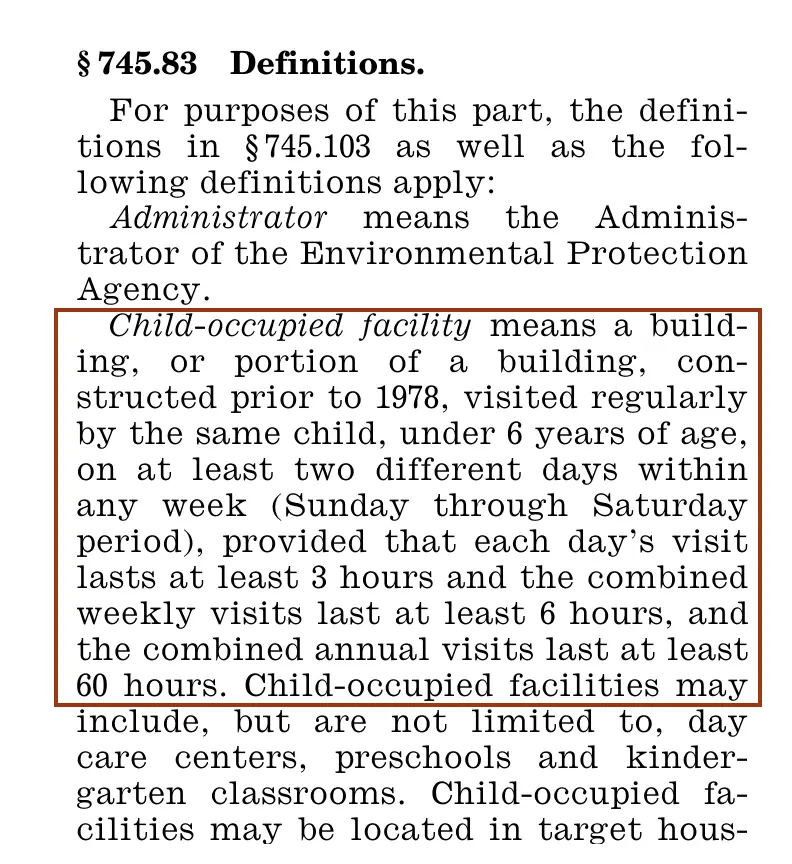
Inside a child-occupied facility, the rule also reaches common areas that children under 6 use routinely, such as restrooms and cafeterias, and the exterior walls next to the facility. That matters for older stock: in the 2018 Commercial Buildings Energy Consumption Survey, 46.3% of U.S. commercial buildings were built before 1980, as our commercial building age report shows. This page is general information, not legal advice; EPA’s RRP program page explains who must be certified.
| Rule | Threshold or requirement | Citation |
|---|---|---|
| Child-occupied facility | Built before 1978; same child under 6; 2 or more days a week; 3 or more hours a day; 6 hours a week; 60 hours a year | 40 CFR 745.83 |
| Minor repair exemption | 6 sq ft or less of painted surface per room inside, 20 sq ft or less outside; no window replacement; same room within 30 days counts as one job | 40 CFR 745.83 |
| Lead-free finding | Components below 1.0 mg/cm² or 0.5% by weight, found by a certified inspector, an EPA-recognized test kit or a lab paint chip test | 40 CFR 745.82(a) |
| Notice | Pamphlet to the owner and parents no more than 60 days before work; certificate of mailing at least 7 days before | 40 CFR 745.84(c) |
| Work area | Warning signs, containment, floor covered 6 ft beyond the work | 40 CFR 745.85(a) |
| Banned practices | Open-flame burning; high-speed sanding, grinding or blasting without a shroud and HEPA vacuum; heat guns at 1,100 °F or more | 40 CFR 745.85(a)(3) |
| Worker exposure, any building | Lead PEL 50 µg/m³ over 8 hours; action level 30 µg/m³ | 29 CFR 1926.62 |
Outside child-occupied space, RRP does not apply, but OSHA’s lead in construction standard, 29 CFR 1926.62, still protects the painting crew when scraping or sanding disturbs lead paint in any building. Ask the bidder whether its price assumes a lead test result, and who orders it, before scraping starts in a building from before 1978.
What VOC limits apply to commercial paint?
Federal rules cap volatile organic compounds (VOCs) in architectural coatings at 250 grams per liter for flat paint and 380 for nonflat under 40 CFR 59 Subpart D. Several regions set lower limits: South Coast AQMD Rule 1113 in Southern California allows 50 grams per liter for both. Name the stricter rule in the spec where the building sits under one.
| Coating category | Federal limit, g/L (40 CFR 59) | South Coast AQMD Rule 1113, g/L |
|---|---|---|
| Flat coatings | 250 | 50 |
| Nonflat coatings | 380 | 50 |
| Primers, sealers and undercoaters | 350 (primers and undercoaters) | 100 |
| Floor coatings | 400 | 50 |
| Industrial maintenance coatings | 450 | 100 |
| Anti-graffiti coatings | 600 | 100 (non-sacrificial) |
Sources: 40 CFR 59 Subpart D, Table 1 and SCAQMD Rule 1113 (amended February 5, 2016), accessed November 1, 2026. Zero-VOC lines can meet the lowest limit: the ProMar 200 Zero VOC Flat data sheet lists less than 50 grams per liter and compliance with South Coast AQMD and Ozone Transport Commission rules.
How do you schedule commercial painting in an occupied building?
Painting an occupied building moves the work to nights or weekends, and the recoat and cure times on the product data sheet set the schedule. A zero-VOC latex rated for a 4 hour recoat at 77 °F lets two coats go on in one night; the Navy option in UFGS 09 90 00 then asks for 48 hours before people return and 72 hours of ventilation.
- Friday 6 pm: tenants leave; the crew covers furniture, masks trim, patches and primes.
- Friday 8 pm to 10 pm: coat 1 goes on at about 1.4 to 1.5 mils dry film.
- Saturday 2 am to 4 am: coat 2 goes on, 4 hours after coat 1 ended, the earliest recoat at 77 °F and 50% relative humidity on the data sheet.
- Saturday 4 am: coat 2 is done; the 48 hour wait and 72 hours of ventilation start (100% outside air, or 6 air changes an hour when outside air is 55 °F to 85 °F at 30% to 60% humidity, otherwise 1.5).
- Monday 4 am: 48 hours have passed since the last coat.
- Monday 8 am: tenants return; ventilation continues to Tuesday 4 am.
The 2024 county bid prices that after-hours window at a median 39% over office hours, so a job split into one night shift per floor costs more per square foot but avoids lost workdays. Our guide to renovating a building that stays occupied covers phasing, after-hours windows and tenant notices. For a suite build-out, painting is often the last trade before move-in, as our tenant improvement contractors guide shows.
How do you compare commercial painting bids?
Compare painting bids on the same measured surfaces and the same spec, priced per unit. The county records show why: lump-sum bids for one job spread 2.04 times from low to high in Everett, Massachusetts in 2026, and one Lawrence school line ranged $4,500 to $22,000 in 2019. A unit-price form exposes where that spread comes from.
- Measure paintable area by surface (walls, ceilings, doors, frames, trim in linear feet), not floor area; GSA’s Fresno award shows how a per floor square foot figure ($10.23) misleads next to per surface figures.
- Issue a unit-price bid form like Calvert County’s: per square foot for walls, per door, per frame, per linear foot of trim, per hour for repairs, with office-hours and after-hours columns.
- Name the product standard and coats: MPI product number or approved equal, MPI gloss level, number of coats and 1.5 mils minimum dry film per coat.
- Name the prep: SSPC SP number for metal, removal where more than 20% of a surface is peeling, and moisture limits (wood 12%, plaster 8%).
- Settle lead first in pre-1978 space: who tests, and whether 40 CFR 745 or only 29 CFR 1926.62 applies.
- Check unit prices line by line for errors before ranking totals; one 2024 county bid’s $80.00 per square foot entry turned a mid-range bid into $1,127,900.
- Ask for AMPP QP 9 (commercial) or QP 1 (industrial steel) accreditation where the job warrants it, plus three similar projects in 3 years, the experience test UFGS uses.
- Hold payment to the punch list: list touch-ups by room and require them closed before final payment.
Our guide to comparing construction bids covers exclusions and allowances in more depth, and our punch list guide shows how to close out touch-ups before final payment. To check licensing, insurance and references, use our steps for choosing a commercial contractor.
What do cost guides get wrong about commercial painting prices?
Several top-ranking cost guides, updated in 2025 and 2026, repeat a range of $2 to $6 per paintable square foot and $50 to $120 an hour, mostly citing each other or one contractor’s price sheet. Public bid and award records give a wider and lower picture for routine work, and a higher one for single-bidder or heavy-prep jobs.
| What several guides say | What public records show | Source |
|---|---|---|
| $2 to $6 per paintable square foot | $0.50 to $3.80 in 11 county unit-price bids (median $1.11); $2.13 to $2.45 on federal awards with 15 to 18 offers; $5.89 to $11.45 on single-offer federal awards | Calvert County 2024; USAspending |
| $50 to $100 or $55 to $120 per hour | $30 to $100 per hour for exterior work in office hours (median $40); painter median wage $23.75 an hour, May 2025 | Calvert County 2024; BLS OEWS |
| A price “per square foot” without saying which square foot | Per floor square foot and per painted square foot differ: GSA paid $10.23 per usable floor square foot in Fresno | USAspending |
Which path fits your commercial painting project?
Four questions set the rules and spec lines for a commercial painting job: building age and child occupancy, substrate, whether people stay in the space, and the local air district. The decision table and flowchart below hold the same logic, with the threshold and rule for each branch, so an owner can mark up a bid package before sending it out.
| If | Then | Rule or source |
|---|---|---|
| Built before 1978 and a child under 6 uses the space 3+ hours a day, 2+ days a week, 60+ hours a year | Hire an EPA-certified firm; pamphlet within 60 days; containment and cleaning verification | 40 CFR 745.83 to 745.85 |
| Built before 1978, no child-occupied space | Test before scraping or sanding; crews work under the 50 µg/m³ lead PEL | 29 CFR 1926.62 |
| Coating structural steel | Name SSPC SP 6, or SP 10 for severe exposure; ask for AMPP QP 1 | UFGS 09 90 00 |
| Epoxy on a concrete floor | Require an ASTM F1869 result of 3 lb per 1,000 sq ft in 24 h or less, and 30 days of cure | UFGS 09 90 00 |
| Space stays occupied | Bid after-hours unit prices (median +39%); plan 4 h recoat and 48 h before reoccupancy | Calvert County 2024; UFGS |
| Site under South Coast AQMD | Flats and nonflats 50 g/L; industrial maintenance 100 g/L | SCAQMD Rule 1113 |
| Only one bid arrives | Compare its price per painted square foot with $0.50 to $3.80 county unit prices before award | Calvert County 2024 |
When painting is part of a wider refit, our office renovation guide covers the code path and budget for the whole job.
Eggshell, semigloss and gloss paint need a Level 5 drywall finish under UFGS 09 29 00, and our drywall types and finish levels guide lists what each GA-214 level includes.
Floor systems priced by mils, removal and moisture tolerance are compared in our epoxy flooring cost breakdown.
How we compiled this
We compiled 23 primary documents, all accessed November 1, 2026: 10 federal award records from the USAspending.gov API, 4 municipal bid tabulations (Calvert County, Maryland twice; Everett and Lawrence, Massachusetts), UFGS 09 90 00, 40 CFR 745, 29 CFR 1926.62, 40 CFR 59, SCAQMD Rule 1113, EPA’s RRP page, one Sherwin-Williams data sheet, BLS wages and EIA building ages. We did not survey painters or price any job; per square foot figures divide award or bid amounts by the area each record states.
Frequently asked questions
How much does commercial painting cost per square foot?
In Calvert County, Maryland’s October 2024 unit-price bid, 11 painters priced interior walls at $0.50 to $3.80 per square foot during office hours, median $1.11. Federal awards with 15 and 18 offers ran $2.13 and $2.45 per square foot in 2020, and single-offer federal jobs with scraping, metal or window work ran $5.89 to $11.45 (Calvert County; USAspending).
Do commercial painters charge by the hour or by the square foot?
Both, depending on the line. Calvert County’s 2024 bid form priced walls per square foot, doors and frames each, trim per linear foot, and repairs and exterior work per hour. Exterior hourly bids ran $30 to $100 during office hours, median $40, while BLS put the median painter wage at $23.75 an hour in May 2025.
Does the EPA lead paint rule apply to commercial buildings?
Only to child-occupied facilities built before 1978: space where the same child under 6 spends at least 3 hours a day on 2 days a week, 6 hours a week and 60 hours a year, such as a day care (40 CFR 745.83). Elsewhere, OSHA’s 29 CFR 1926.62 still limits crew lead exposure to 50 µg/m³ over 8 hours.
How long after painting can employees return to the space?
Plan on about 48 hours if you copy the federal guide spec. ProMar 200 Zero VOC Flat lists a 4 hour recoat at 77 °F and 50% humidity. The Navy option in UFGS 09 90 00 asks owners to wait at least 48 hours before reoccupying freshly painted rooms and to ventilate for 72 hours, so a Friday night repaint is ready Monday morning.
How many gallons of paint does a commercial job need?
Divide the painted area times the number of coats by the data sheet’s coverage. A 100 by 200 foot warehouse with 24 foot walls has 14,400 square feet of wall; two coats at 350 to 400 square feet per gallon need 72 to 82 gallons, before waste. A thicker 1.5 mil dry film spec cuts coverage to about 364 square feet per gallon.
What certifications should a commercial painting contractor have?
UFGS 09 90 00 names two company accreditations from the Association for Materials Protection and Performance: AMPP QP 9 for commercial painting contractors and AMPP QP 1 for industrial steel work. In pre-1978 child-occupied space, the firm also needs EPA RRP certification with a certified renovator on the job. Also check your state’s contractor license and three similar projects in 3 years.
How much does an epoxy floor coating cost for a commercial building?
One public record: Beale Air Force Base paid $233,946.96 in October 2022 to scrape, prep and apply two coats of epoxy plus a polyurethane topcoat on about 20,000 square feet of concrete floor, or $11.70 per square foot. UFGS 09 90 00 bars epoxy on slabs emitting more than 3 pounds of moisture per 1,000 square feet in 24 hours.
Sources
- Calvert County, MD: ITB 2025-023 Interior Painting and Vinyl Wall Covering and Exterior Painting, bid comparison (October 2024), accessed 2026-11-01
- Calvert County, MD: ITB 2020-037 bid comparison (2019), accessed 2026-11-01
- City of Everett, MA: IFB EPS-26-98 Interior Painting Services bid tabulation (May 13, 2026), accessed 2026-11-01
- City of Lawrence, MA: Lawrence Public Schools painting project bid spreadsheet (April 4, 2019), accessed 2026-11-01
- USAspending.gov API: awards FA480323F0013, FA480321F0014, FA480323F0023, 140P6320P0059, 140P5220P0071, FA468622C0004, 2032H325C00033, W50S6P22C0001, FA468622F0057, 47PK0525C0006, accessed 2026-11-01
- UFGS 09 90 00 Paints and Coatings (August 2026), Whole Building Design Guide, accessed 2026-11-01
- 40 CFR 745.83 Definitions, eCFR and 2025 annual edition PDF, govinfo, accessed 2026-11-01
- 40 CFR 745.82, 745.84 and 745.85, eCFR, accessed 2026-11-01
- EPA Lead Renovation, Repair and Painting Program, accessed 2026-11-01
- OSHA 29 CFR 1926.62 Lead, accessed 2026-11-01
- 40 CFR 59 Subpart D, Table 1: VOC content limits for architectural coatings, accessed 2026-11-01
- South Coast AQMD Rule 1113 Architectural Coatings (amended February 5, 2016), accessed 2026-11-01
- Sherwin-Williams ProMar 200 Zero VOC Interior Latex Flat, product data sheet (11/2023), accessed 2026-11-01
- BLS Occupational Employment and Wage Statistics, May 2025, Painters, Construction and Maintenance (47-2141), accessed 2026-11-01
- EIA 2018 CBECS Table B8, year constructed, accessed 2026-11-01